
Your crypto tax software isn't an insurance policy against a Canada Revenue Agency (CRA) audit. Knowing how to choose a blockchain accounting firm is essential because automation lacks the strategic depth to defend a complex DeFi portfolio when a regulator demands clarity.
Many investors feel a lingering anxiety that their messy on-chain history will eventually trigger a costly investigation. You likely understand that generalist accountants often fail to grasp the nuances of staking or liquidity pools, leaving your filings vulnerable to errors.
Selecting the right specialist allows you to shift from a defensive posture to one of total financial command. This guide outlines the specific criteria needed to select a partner who ensures your records are clean and defensible.
We'll examine how to verify a firm's technical proficiency in reconciling multi-chain transactions. You'll also learn why mastery of the adjusted cost base (ACB), which is the average cost of your crypto assets used to calculate gains, is non-negotiable for Canadian compliance.
Key Takeaways
- Identify the importance of forensic reconciliation, which involves the meticulous verification of every on-chain event, to transform volatile data into records that withstand CRA (Canada Revenue Agency) scrutiny.
- Master how to choose a blockchain accounting firm by evaluating their technical capacity to handle complex DeFi (Decentralized Finance) transactions and multi-chain environments.
- Understand the distinction between capital gains, which are profits from selling assets for more than their cost, and business income to ensure your Canadian tax filings remain accurate.
- Explore how specialized corporate structuring and fractional CFO services help you gain total command over your digital asset treasury and growth.
The Critical Difference Between Generalists and Blockchain Accounting Firms
Blockchain accounting is the forensic reconciliation of fragmented on-chain data into GAAP-compliant financial records. GAAP stands for Generally Accepted Accounting Principles, which are the standard rules for financial reporting in Canada. Learning how to choose a blockchain accounting firm starts with recognizing that crypto isn't just another asset class; it requires a shift from traditional ledger entry to data reconstruction.
Relying solely on automated tax software often leads to a "garbage in, garbage out" scenario. These tools frequently misinterpret complex smart contract interactions, which are self-executing agreements with terms written directly into code. Without a human expert to verify the data, you risk submitting records that the CRA will easily dismantle during an audit.
A specialized approach is mandatory for serious digital asset holders. Generalists lack the infrastructure to handle the high stakes of decentralized finance. You need a partner who can bridge the gap between legacy corporate finance and the volatile world of Web3. For those seeking established financial guidance in other jurisdictions, firms like Brown Hamilton Partners offer the professional stability and decades of experience necessary to navigate evolving regulatory landscapes.
Why Generalist CPAs Often Fail Crypto Clients
Traditional accountants rely on centralized bank statements that don't exist in the decentralized world. Most generalists lack a deep understanding of blockchain technology and the sub-ledger tools required to track it. This gap in knowledge often results in messy books that fail to reflect the economic reality of your positions.
They often struggle to distinguish between nuanced events like airdrops, where you receive free tokens, or hard forks, which occur when a blockchain splits into two separate chains. Treating every movement as a simple capital gain can lead to massive overpayments or compliance red flags for CRA filers. In Canada, the classification of these events can significantly impact your tax liability.
The Role of On-Chain Forensics in Modern Accounting
Specialized firms use forensic techniques to trace funds across multiple bridges and protocols. This is vital for verifying your Adjusted Cost Base (ACB), which is the average cost of your holdings used by the CRA to determine taxable gains. If you lose track of your ACB, you're essentially guessing on your tax returns.
A crypto tax accountant doesn't just look at the final balance. They build a chronological narrative for every transaction, ensuring that historical data is reconstructed even if exchange records are missing. This level of detail provides the "defensible" records necessary to satisfy a CRA inquiry with confidence.
This proactive methodology transforms messy on-chain activity into a clean, audit-ready ledger. It gives you the agency to navigate the Canadian tax landscape without the fear of systemic errors or regulatory friction. By choosing a firm with forensic capabilities, you're investing in long-term stability and growth.
Technical Competency: Evaluating a Firm's Blockchain Infrastructure
The strength of your financial records depends entirely on the infrastructure used to build them. When evaluating how to choose a blockchain accounting firm, you must look beyond basic tax reports to ensure the firm can handle high-volume data from various Layer 1 and Layer 2 networks. Retail software often fails to reconcile transactions across these layers, leading to gaps in your cost basis that the CRA will flag as suspicious.
Professional-grade firms utilize specialized sub-ledger tools designed for the complexities of the blockchain ecosystem. These systems allow for an end-to-end audit trail that tracks every single satoshi, the smallest unit of Bitcoin, or wei, the smallest unit of Ethereum, from origin to its current state. This level of granularity is the difference between a "best guess" and a defensible record that withstands a rigorous audit.
Mastering DeFi and NFT Accounting Complexity
Decentralized Finance (DeFi) requires a deep understanding of wrapped tokens, which are assets pegged to the value of another cryptocurrency to allow for cross-chain use. Synthetic assets, which are derivatives that provide exposure to other assets without requiring ownership, add another layer of technical friction. Your accounting partner must have a proprietary methodology to reconcile these interactions without losing data integrity.
NFT accounting introduces its own set of challenges, particularly regarding secondary market royalties and sales. In Canada, it's vital to distinguish between staking rewards, which are tokens earned by securing a network, and interest income earned from lending protocols. A failure to categorize these correctly can lead to significant miscalculations in your taxable income for the 2025 tax year and beyond.
Ensuring Audit-Ready Financial Records
Raw blockchain data is often unintelligible to traditional financial systems. A specialized firm standardizes this data into a format that traditional accounting platforms can ingest, ensuring your clean, defensible books remain consistent. This process ensures that your corporate treasury is managed with the same rigor as a traditional enterprise.
Maintaining these records throughout the fiscal year, rather than waiting until the April 30 deadline, provides total peace of mind. It allows for proactive tax planning and strategic decision-making based on real-time data. If you're ready to move toward total financial command, you can speak with our team to evaluate your current infrastructure needs.
Jurisdictional Expertise: Navigating CRA Crypto Tax Rules
The Canada Revenue Agency (CRA) views cryptocurrency as a commodity, not as legal tender. This classification means every swap, sale, or purchase of goods using digital assets triggers a taxable event. When evaluating how to choose a blockchain accounting firm, you must ensure they possess deep jurisdictional knowledge of these specific Canadian rules.
The CRA applies an "intent test" to determine if your activity results in business income or capital gains. For individuals, 50% of a net capital gain is included in taxable income. However, if the CRA deems you are "carrying on a business" based on the frequency of your trades or your level of expertise, 100% of the profit becomes taxable. Factors such as the length of time you hold an asset and the nature of the tokens you trade weigh heavily in this determination.
Canadian filers must also address the requirements of the T1135 Foreign Income Verification Statement. This form is mandatory if you hold specified foreign property, including crypto held on exchanges outside Canada, with a total cost amount exceeding $100,000 CAD at any time during the year. Ignoring this requirement is a common pitfall that leads to automatic penalties, regardless of whether you actually made a profit.
CRA Audit Preparation and Defense
A specialized firm acts as your advocate during a CRA crypto audit. They don't just hand over raw data; they provide a structured narrative that explains the economic reality of your on-chain movements. This proactive stance shifts the conversation from a defensive posture to a position of total command over your financial history.
Speaking the language of CRA auditors is a specialized skill. These officials follow strict internal manuals regarding "identical properties" and the weighted average cost method. Having a partner who understands these internal frameworks ensures your records are not just accurate, but also defensible under intense scrutiny.
Specific Canadian Tax Forms and Deadlines
Your crypto activity will typically appear on a T1 return for individuals or a T2 return for corporations. The accuracy of these filings depends on the meticulous calculation of your Adjusted Cost Base (ACB). In Canada, the ACB represents the total cost of a property plus any expenses incurred to acquire it, such as transaction fees.
You must use the weighted average cost of all identical properties, like units of the same cryptocurrency, to determine your gains or losses. For personalized assistance in your province, you can connect with a crypto tax accountant in Canada. They provide the regional support needed to meet the specific deadlines for the 2025 tax year.
While self-employed individuals have until June 15, 2026, to file their returns, all tax payments are still due by April 30, 2026. Specialized firms help you manage these timelines to avoid late-payment interest charges. This structured approach provides the liberation and agency required to thrive in a complex regulatory environment.
Strategic Services: Beyond Basic Tax Filing
Mastering your taxes is only the first step toward financial liberation. When researching how to choose a blockchain accounting firm, you must look for a partner that provides strategic oversight far beyond the annual filing deadline. A specialized firm acts as an elite navigator, helping you resolve the friction between digital asset volatility and traditional operational requirements. For growing enterprises that need a solid base for their back-office, Financial Foothold provides outsourced accounting operations and payroll administration to ensure long-term stability.
A sophisticated firm moves away from a defensive posture to an offensive one focused on mastery and growth. They don't just record history; they help you build a roadmap for thriving in a complex world. This includes managing high-stakes environments where traditional financial institutions often lack the necessary infrastructure to support Web3 innovation.
Web3 startups often operate in environments where managing "runway" is a matter of survival. Runway is the amount of time a company can continue to operate before running out of cash. A fractional CFO provides this high-level financial leadership and treasury management without the overhead of a full-time executive.
These experts also facilitate robust on-ramp and off-ramp solutions, which are the processes of converting fiat currency to crypto and vice versa. Establishing compliant crypto-to-fiat payment systems ensures your operational expenses are met with minimal slippage and maximum transparency. This disciplined approach preserves your capital during volatile market cycles.
Corporate Structuring and Entity Management
The way you organize your business significantly impacts your global tax obligations and your relationship with the CRA. Choosing between a Canadian corporation and an offshore entity requires a deep understanding of foreign property reporting and jurisdictional frameworks. Specialized corporate structuring ensures your digital assets are held in a manner that optimizes tax efficiency while maintaining full compliance.
This strategic approach also extends to managing crypto payroll for global teams. Paying contractors in stablecoins or native tokens requires precise record-keeping to satisfy both Canadian standards and international reporting rules. A specialized firm helps you automate this process, ensuring every payment is backed by a clean, defensible audit trail.
Strategic growth requires a foundation of stability and intellectual leadership. By selecting a firm that offers these comprehensive services, you gain total command over your financial future. If you're ready to evolve your corporate strategy, contact our specialists today to discuss your unique treasury and structuring needs.
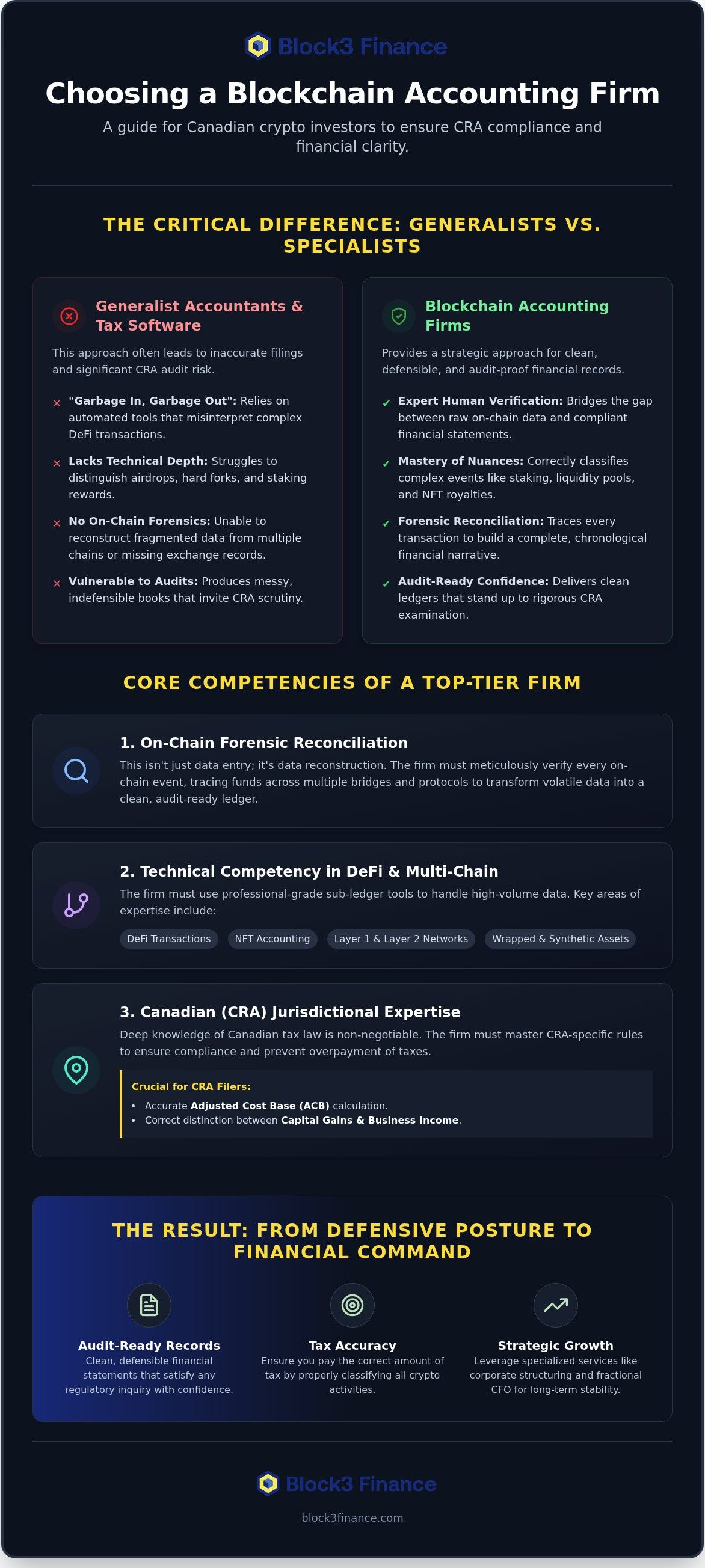
Why Block3 Finance is the Right Partner for Your Blockchain Journey
Understanding how to choose a blockchain accounting firm requires looking for a partner that possesses both technical rigor and a forward-looking energy. Block3 Finance transcends the role of a traditional auditor by acting as a proactive advocate for your financial health. We offer a sophisticated blend of professional authority and empowering mentorship to help you gain total command over your assets.
With 13+ years of blockchain financial expertise, our team understands the nuances of the Canadian landscape. When deciding how to choose a blockchain accounting firm for your Canadian entity, prioritize firms with a proven record of resolving friction between on-chain data and tax reporting. Our white-glove service model ensures you are treated as a strategic partner rather than just a client.
Our Proven Track Record with 980+ Clients
We have served over 980 global clients, ranging from individual high-net-worth traders to complex Decentralized Autonomous Organizations (DAOs). DAOs are organizations represented by rules encoded as a computer program that is transparent and controlled by the organization members. Our company background reflects a deep commitment to intellectual leadership in the Web3 space.
Our primary objective is to turn messy, complex on-chain activity into clean, defensible records that satisfy the CRA. We provide the roadmap you need to thrive in a world where the rules of finance are being rewritten. This dedication to accuracy ensures you maintain total command over a volatile financial landscape.
Get Started with a Specialized Consultation
Taking the first step toward total financial command involves a comprehensive audit of your digital assets. We analyze your historical data to identify any gaps in your compliance strategy before they become liabilities. This proactive approach is the hallmark of a true Visionary Navigator.
Don't leave your CRA compliance to chance or basic retail software that fails to reconcile multi-chain transactions. You can contact our team today to begin your journey toward clean books and strategic growth. We are ready to help you navigate the future of finance with confidence and agency.
Take Command of Your Blockchain Financial Future
Navigating the complexities of digital asset taxation requires a shift from a defensive posture to one of total mastery. Technical infrastructure and deep jurisdictional knowledge are the pillars of defensible records. Knowing how to choose a blockchain accounting firm ensures your on-chain activity is transformed into clean, audit-ready books that withstand CRA scrutiny.
Mastering the Adjusted Cost Base and the intent test is essential for every serious Canadian filer looking to maintain long-term stability. As a firm ranked top provider by Bitcoin.com with over 13 years of specialized expertise, we've helped more than 980 global clients resolve financial friction. We act as your Visionary Navigator, providing the white-glove service needed to manage corporate structuring and strategic growth.
This disciplined approach provides the liberation and agency required to thrive in the evolving Web3 landscape. Secure your digital asset future with a Block3 Finance consultation. You possess the tools to turn volatility into stability; now is the time to lead your enterprise with confidence.
Frequently Asked Questions
What is the difference between a regular accountant and a crypto accountant?
A crypto accountant specializes in the forensic reconciliation of on-chain data into GAAP-compliant records. Unlike generalists who rely on centralized bank statements, these experts use sub-ledger tools to track fragmented data across various networks. They understand the nuances between airdrops, forks, and staking rewards, ensuring your Canadian tax filings reflect economic reality rather than automated guesses.
Does the CRA know about my cryptocurrency transactions?
The CRA actively tracks crypto activity through data sharing agreements and court orders against major exchanges. Money services businesses in Canada must report transactions over $10,000 to FINTRAC. Additionally, the implementation of the Crypto-Asset Reporting Framework (CARF) in 2027 will further increase the agency's visibility into your sales and transfers for the 2026 tax year and beyond.
How do blockchain accounting firms handle DeFi liquidity pool transactions?
Specialized firms use proprietary methodologies to reconcile the unique receipt tokens generated by liquidity pools. They track the cost basis of the assets you provide and the value of the tokens you receive in return. This process ensures that every reward or fee earned is correctly categorized as either capital gains or business income for CRA filers.
Is crypto tax software enough for a business with high transaction volume?
Software alone is rarely sufficient for complex corporate entities or high-volume traders. Most tools struggle with cross-chain bridges and synthetic assets, leading to critical errors in your Adjusted Cost Base (ACB). Learning how to choose a blockchain accounting firm involves finding experts who can manually verify software outputs to produce clean, defensible financial records.
What documents should I prepare before meeting a blockchain accounting firm?
You should gather read-only API keys for all exchanges and a comprehensive list of your public wallet addresses. Providing historical CSV files for defunct platforms and a record of your original intent for large trades is also vital. These details allow your accountant to reconstruct a chronological narrative for every transaction and satisfy potential CRA inquiries.
How much does it cost to hire a specialized blockchain accounting firm?
The cost of hiring a specialized firm depends on the volume of your transactions and the complexity of your DeFi interactions. While prices vary, the investment provides total peace of mind and clean books that can withstand a rigorous audit. You should focus on the value of strategic advice and the resolution of regulatory friction rather than searching for the lowest price.
Can a blockchain accounting firm help me if I haven't filed crypto taxes in years?
Specialized firms excel at forensic reconstruction for clients who have fallen behind on their filings. They can trace historical funds across multiple protocols to establish an accurate cost basis for previous years. This process often involves utilizing the CRA Voluntary Disclosure Program (VDP), which allows taxpayers to correct past omissions and potentially avoid certain penalties.
What is the T1135 and does it apply to my crypto holdings?
The T1135 is the Foreign Income Verification Statement required for specified foreign property with a total cost exceeding $100,000 CAD. This form applies to crypto held on exchanges located outside of Canada at any point during the year. Failing to file this form can result in significant daily penalties, even if your holdings didn't generate any profit during the fiscal year.

Article by
Mahad Mohamed
Mahad Mohamed is an accountant and the CEO of Block3 Finance, with over 26+ years of Canadian and international tax and accounting experience. A crypto accounting specialist since the early days of Bitcoin, he has consulted for over 38 crypto companies and collaborated with legal professionals on regulatory matters. His expertise spans corporate reorganization, cross-border tax structuring (Canada & US), tax disputes, and CRA audits.
Previously, Mahad worked for the Canada Revenue Agency (CRA), Big4 accounting firms, and served as a Rulings Officer for the Federal Tax Authority of the UAE before acquiring Tax Partners in 2014.
Block3 Finance and Tax Partners has 44 full-time accountants and over 9,800+ clients.
Disclaimer
This article provides general information only and is current as of its publication date. It has not been updated and may be out of date. It does not constitute legal advice and should not be relied upon as such. Every tax situation is unique and may differ from the examples discussed in this article. If you have specific questions, you should seek the advice of our accountants for your unique circumstances.
Frequently Asked Questions
What is the difference between a regular accountant and a crypto accountant?
A crypto accountant specializes in the forensic reconciliation of on-chain data into GAAP-compliant records. Unlike generalists who rely on centralized bank statements, these experts use sub-ledger tools to track fragmented data across various networks. They understand the nuances between airdrops, forks, and staking rewards, ensuring your Canadian tax filings reflect economic reality rather than automated guesses.
Does the CRA know about my cryptocurrency transactions?
The CRA actively tracks crypto activity through data sharing agreements and court orders against major exchanges. Money services businesses in Canada must report transactions over $10,000 to FINTRAC. Additionally, the implementation of the Crypto-Asset Reporting Framework (CARF) in 2027 will further increase the agency's visibility into your sales and transfers for the 2026 tax year and beyond.
How do blockchain accounting firms handle DeFi liquidity pool transactions?
Specialized firms use proprietary methodologies to reconcile the unique receipt tokens generated by liquidity pools. They track the cost basis of the assets you provide and the value of the tokens you receive in return. This process ensures that every reward or fee earned is correctly categorized as either capital gains or business income for CRA filers.
Is crypto tax software enough for a business with high transaction volume?
Software alone is rarely sufficient for complex corporate entities or high-volume traders. Most tools struggle with cross-chain bridges and synthetic assets, leading to critical errors in your Adjusted Cost Base (ACB). Learning how to choose a blockchain accounting firm involves finding experts who can manually verify software outputs to produce clean, defensible financial records.
What documents should I prepare before meeting a blockchain accounting firm?
You should gather read-only API keys for all exchanges and a comprehensive list of your public wallet addresses. Providing historical CSV files for defunct platforms and a record of your original intent for large trades is also vital. These details allow your accountant to reconstruct a chronological narrative for every transaction and satisfy potential CRA inquiries.
How much does it cost to hire a specialized blockchain accounting firm?
The cost of hiring a specialized firm depends on the volume of your transactions and the complexity of your DeFi interactions. While prices vary, the investment provides total peace of mind and clean books that can withstand a rigorous audit. You should focus on the value of strategic advice and the resolution of regulatory friction rather than searching for the lowest price.
Can a blockchain accounting firm help me if I haven't filed crypto taxes in years?
Specialized firms excel at forensic reconstruction for clients who have fallen behind on their filings. They can trace historical funds across multiple protocols to establish an accurate cost basis for previous years. This process often involves utilizing the CRA Voluntary Disclosure Program (VDP), which allows taxpayers to correct past omissions and potentially avoid certain penalties.
What is the T1135 and does it apply to my crypto holdings?
The T1135 is the Foreign Income Verification Statement required for specified foreign property with a total cost exceeding $100,000 CAD. This form applies to crypto held on exchanges located outside of Canada at any point during the year. Failing to file this form can result in significant daily penalties, even if your holdings didn't generate any profit during the fiscal year.