
The IRS no longer views digital asset production as a peripheral activity; they now treat it with the same rigorous oversight as traditional financial sectors. This shift demands a transition from defensive record-keeping to a proactive strategy of total command. Our crypto mining tax guide delivers the professional framework necessary to navigate these high-stakes regulatory waters.
You're likely exhausted by the complexity of tracking the fair market value, or the market price in U.S. dollars at the time of receipt, for every reward. It's frustrating to face the uncertainty of the new 1099-DA broker reporting forms while trying to scale your operations. We understand that maintaining dominion and control, which refers to the moment you have the legal right to transfer or sell your rewards, is the primary trigger for taxation.
This article provides a clear roadmap to help you distinguish between hobby and business status while implementing audit-ready methodologies. You'll gain a comprehensive understanding of the mandatory FIFO accounting method and the new $2,000 reporting thresholds for 2026. We'll prepare you to transform volatile data into a defensible financial legacy.
Key Takeaways
- Identify the precise moment of "Dominion and Control", which is your legal power to sell or transfer rewards, to accurately trigger taxable events under IRS rules.
- Prepare for the 2026 filing season by understanding how mandatory FIFO accounting and the new Form 1099-DA change your reporting requirements for digital assets.
- Utilize this crypto mining tax guide to navigate the "Profit Motive" test and determine if your operation qualifies for business-scale deductions on Schedule C.
- Master the methodology for aggregating high-volume on-chain data and assigning accurate Fair Market Value (FMV), or the market price in U.S. dollars, to every individual reward payout.
- Shift to an offensive compliance strategy that utilizes professional reconciliation to transform volatile mining data into audit-ready financial records.
IRS Crypto Mining Tax: Why 2026 is a Landmark Year
2026 marks a decisive era for U.S. miners. The IRS has intensified its focus on the digital asset tax gap, positioning mining compliance at the center of its enforcement strategy. Under U.S. tax law, you must report mining rewards as gross income at the moment you gain dominion.
Dominion is the specific point in time when you have the legal power to sell, transfer, or exchange the asset. This crypto mining tax guide highlights how the regulatory landscape has evolved from suggestion to strict mandate. The introduction of Form 1099-DA provides the IRS with a direct window into your on-chain activities.
To understand why this oversight is increasing, it's helpful to review what crypto mining is and how it generates new units of property. The government now views these digital assets with the same scrutiny as traditional securities.
The 1099-DA Revolution for Miners
Starting in 2026, brokers will report proceeds from digital asset transactions to the IRS. This includes any mining rewards processed through centralized platforms or specific service providers. You're required to calculate the Fair Market Value (FMV), which represents the value of the crypto in U.S. dollars at the moment of receipt.
For payments exceeding $2,000 made after December 31, 2025, these reports will be transmitted directly to the government. You must maintain a rigorous reconciliation process to ensure your internal records align with these third-party filings. Discrepancies between your reported income and broker data are a primary trigger for IRS audits.
New Cost Basis Rules for 2026
The IRS now mandates that brokers track your cost basis with surgical precision. For the 2026 tax year, the First-In, First-Out (FIFO) accounting method is the required standard for calculating gains and losses. This removes the flexibility previously used by some miners to minimize tax liabilities through specific identification.
Self-custody operations face the greatest risk in this new environment. If you transfer mined assets to private wallets, brokers can't track the original cost basis, which often leads to inaccurate reporting. You must cultivate independent, audit-ready records to prove your basis and prevent overpayment.
Learn how Block3 Finance builds defensible financial records that withstand federal scrutiny. Our team specializes in the high-volume reconciliation required for 2026 compliance. We help you move from a defensive posture to total command of your financial landscape.
The Taxable Trigger: When Does Mined Crypto Count as Income?
The IRS doesn't wait for you to sell your assets to claim its share. Income is recognized the moment you "receive" it under the federal tax code. This threshold is defined by the "Dominion and Control" test, which is the definitive standard for taxable receipt in the U.S. jurisdiction.
Dominion and Control means the exact moment you have the legal power to sell, transfer, or exchange the asset. According to IRS Notice 2014-21, cryptocurrency is treated as property. Its receipt through mining is a taxable event that requires reporting the Fair Market Value (FMV) as gross income.
FMV is the market price in U.S. dollars at the time you gain control over the tokens. This value serves two purposes. It establishes your ordinary income for the year and sets your cost basis for future disposals. This crypto mining tax guide highlights that mining is a dual-taxation activity, involving both income tax upon receipt and capital gains tax upon sale.
Dominion and Control in Mining Pools
Determining the exact timestamp of income for pool-based rewards requires careful analysis. If rewards are marked as "pending" in a pool dashboard but the balance is not yet withdrawable, you haven't gained dominion. The tax trigger usually occurs when the pool credits your account and you have the autonomy to move those funds.
This reporting requirement persists even if you leave the rewards in an exchange-hosted wallet. The IRS considers the income realized as soon as it's made available to you. You must maintain precise logs of these timestamps to ensure your FMV calculations are defensible during an audit.
Cloud Mining and LSDs
Cloud mining contracts where you don't own the physical hardware create unique tax challenges. The IRS may view these payments as a return on a service contract rather than direct property production. You should evaluate whether your contract allows for immediate receipt or if rewards accrue over time without your control.
Liquid Staking Derivatives (LSDs) further complicate the "accrual" vs. "receipt" debate. If you receive a new token representing your staked position and rewards, that receipt is likely a taxable event. If these complexities make your reporting feel unmanageable, consult with our specialized team to refine your compliance framework.
Filing Status: Hobbyist vs. Professional Mining Operations
The IRS distinguishes between hobbyist activities and professional trades through a rigorous Profit Motive test. This classification is the most significant factor in determining your final tax bill. Your status dictates whether you can offset your income with the high costs of hardware and power.
Professional miners conduct their operations as a trade or business with a clear intent to generate profit. The IRS evaluates nine specific factors, such as the expertise of the taxpayer and the time spent on the activity. This crypto mining tax guide helps you navigate the transition from a casual miner to a sophisticated business entity.
Hobbyist Reporting on Schedule 1
If your mining is a hobby, you must report rewards as "Other Income" on Form 1040, Schedule 1. You're required to report the Fair Market Value (FMV), or the market price in U.S. dollars, at the moment you gain dominion over the assets. Fidelity's crypto tax guide clarifies that for 2026, the IRS expects high transparency for these individual rewards.
Hobbyists face a harsh reality regarding expenses. Under current U.S. tax laws, you generally cannot deduct electricity, internet, or hardware costs against your hobby income. This makes high-volume hobbyist mining less efficient as your rewards increase. For those scaling their rigs, professional tax filing for individual crypto investors provides the necessary oversight to avoid costly reporting errors.
Professional Mining on Schedule C
Filing as a professional allows you to treat your mining as a legitimate business on Schedule C. This status unlocks the ability to deduct hardware depreciation through Section 179 or bonus depreciation rules. You can also deduct the full cost of electricity, cooling, and any necessary repairs to your infrastructure.
Professional status comes with the obligation to pay self-employment tax at a rate of 15.3% on your net earnings. Despite this, the total tax liability is often lower for business owners because they only pay tax on their profit, not their gross revenue. You must maintain separate business bank accounts and professional-grade bookkeeping to defend this status during an audit.
Strategic entity structuring is often the next step for large-scale mining farms. Moving from a sole proprietorship to an LLC or S-Corp can provide additional layers of liability protection and tax optimization. Clean financial records are the foundation of this professional transition.
Step-by-Step: How to Calculate and Report Mining Income
Reporting mining income is a meticulous process of translating raw blockchain data into a format the IRS accepts. It requires moving beyond simple totals to a transaction-by-transaction analysis. This crypto mining tax guide emphasizes that accuracy at the granular level is the only way to ensure total command over your 2026 compliance obligations.
You must aggregate data from all block explorers, mining pools, and wallet addresses used during the tax year. This involves exporting CSV files or utilizing API connections to capture every reward event. Each individual payout must be assigned an accurate Fair Market Value (FMV), which is the market price in U.S. dollars at the moment you gain dominion, or the legal power to transfer the asset.
Business filers should calculate deductible expenses such as electricity, cooling, and hardware maintenance costs. Section 179 depreciation allows you to deduct the full cost of qualifying hardware in the year of purchase, providing a significant immediate tax shield for growing operations. Finally, ensure the digital asset question on Form 1040 is answered truthfully to avoid the legal risks associated with under-reporting compensation.
Data Reconciliation and FMV
High-frequency mining generates thousands of transactions that can overwhelm traditional accounting software. You should use a reliable pricing aggregator to find the USD value at receipt for every single block reward. This methodology ensures you account for "dust" transactions, which are tiny amounts of crypto that often complicate record-keeping but remain taxable in the eyes of the IRS.
Using daily average prices is a common mistake that leads to inaccurate reporting and potential penalties. The IRS requires the spot price at the exact time of receipt to establish your income and your future cost basis. Precise reconciliation transforms a chaotic list of payouts into a disciplined financial statement.
Creating an Audit-Ready Trail
The IRS requires specific on-chain hashes to support your income claims during an official review. By linking your reported income directly to wallet activity, you create a defensive document trail that proves your compliance. Explore our audit preparation services for crypto firms to ensure your records meet these high standards and withstand rigorous federal scrutiny.
If you're managing high-volume on-chain data, contact our team to transform your raw logs into a defensible tax strategy. We specialize in resolving the friction between complex blockchain data and traditional financial oversight.
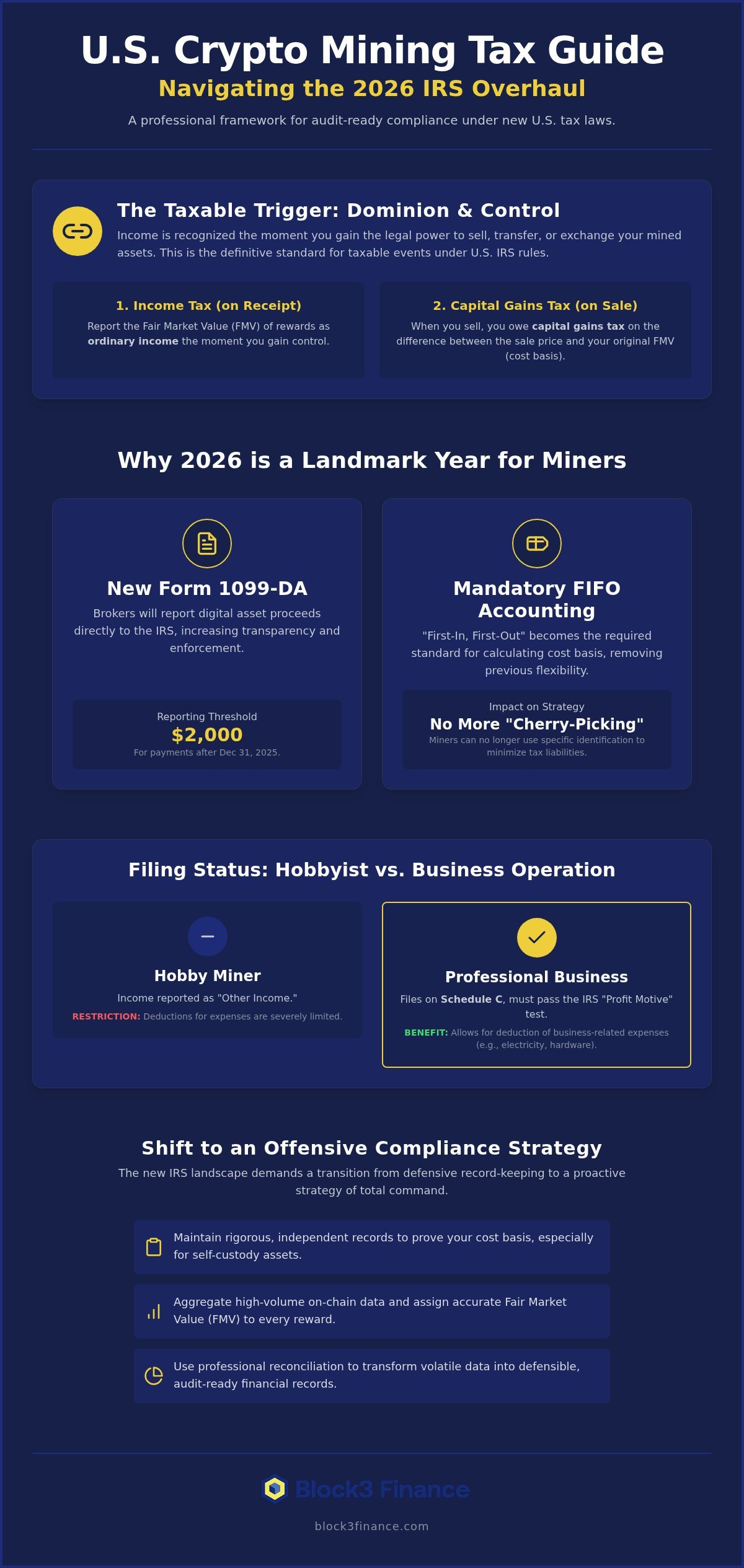
Strategic Compliance with Block3 Finance
Block3 Finance manages the intricate reconciliation of high-volume mining data, converting thousands of on-chain events into defensible financial records. This crypto mining tax guide has established the necessity of precision. Our firm provides the technical infrastructure to achieve it.
Specialized crypto accountants play a vital role in identifying tax deductions that generalist firms often overlook. We analyze your hardware energy consumption, cooling costs, and maintenance fees to maximize your operational efficiency. Our team ensures that your Fair Market Value (FMV), or the market price in U.S. dollars at receipt, is recorded with surgical accuracy to prevent overpayment of IRS liabilities.
Global mining operations face additional friction due to cross-border tax implications and varying jurisdictional requirements. We provide customized reporting solutions that address the unique needs of mining enterprises and high-net-worth investors. Our approach ensures you don't lose dominion and control, which is the legal power to sell or transfer assets, over your tax position while scaling across multiple regions.
Beyond Basic Filing: CFO and Advisory
Strategic entity structuring is essential for reducing the self-employment tax burden on professional mining profits. We help you evaluate whether an LLC or S-Corp provides the most advantageous framework for your specific hash rate. This proactive planning is the difference between merely surviving an audit and thriving through growth.
Our advisory services extend into proactive tax planning for the 2026 and 2027 fiscal years. We help you anticipate regulatory shifts before they impact your bottom line. Access fractional CFO services for scaling Web3 firms to gain an elite financial partner for your mining enterprise.
Secure Your 2026 Tax Position
A "white-glove" approach to crypto tax compliance removes the administrative burden from your daily operations. We handle the complex data aggregation and reporting required by the IRS. This allows you to focus on optimizing your hardware and energy contracts for maximum profitability.
Start your professional tax review now to ensure your records are audit-ready for the upcoming season. Early preparation is the most effective defense against the increased scrutiny of the new 1099-DA landscape. Contact Block3 Finance for professional crypto mining tax guidance to secure your financial future.
Mastering the 2026 Regulatory Landscape
The shift toward mandatory 1099-DA reporting and FIFO accounting signifies a new era of transparency for the IRS. You must move beyond simple tracking to a disciplined strategy centered on the precise timing of dominion and control, which refers to your legal power to transfer mined assets. This crypto mining tax guide has detailed how accurate Fair Market Value (FMV), or the market price in U.S. dollars at receipt, transforms volatile data into defensible financial records.
Success in 2026 requires an offensive posture that anticipates increased federal scrutiny. As a top-ranked firm by Bitcoin.com with over 13 years of specialized blockchain expertise, we've secured audit-ready outcomes for more than 980 global clients. We provide the technical rigor needed to resolve the friction between high-volume on-chain activity and traditional tax oversight.
Take command of your financial future by partnering with a team that understands the evolution of the digital asset space. Secure your 2026 mining tax compliance with Block3 Finance and ensure your operation remains both efficient and fully compliant. You have the power to turn these regulatory challenges into a roadmap for sustained growth.
Frequently Asked Questions
Are crypto mining rewards taxable even if I don't sell them?
Yes, the IRS requires you to report mining rewards as ordinary income at the moment you gain dominion and control. This means you owe tax based on the Fair Market Value (FMV), or the market price in U.S. dollars at receipt. You don't need to sell the assets to trigger this tax liability. This value establishes your cost basis for calculating future capital gains upon disposal.
How do I determine the fair market value of my mined crypto?
You must determine the Fair Market Value (FMV) by identifying the spot price of the asset at the exact timestamp of receipt. Relying on daily averages or monthly closing prices is insufficient for a professional crypto mining tax guide. Instead, utilize a reliable pricing aggregator to capture the specific value in U.S. dollars. This precision ensures your records are defensible and prevents the IRS from overestimating your gross income.
Can I deduct my electricity costs if I mine crypto as a hobby?
No, individual taxpayers mining as a hobby generally cannot deduct electricity or hardware costs under current IRS rules. While you must report 100% of the rewards as income, you're unable to offset that amount with operational expenses. This rule makes hobby mining significantly less tax-efficient than a professional operation. If your costs are high, you should evaluate if your activity meets the Profit Motive test to file as a business.
What is the difference between Schedule 1 and Schedule C for miners?
Schedule 1 is used by hobbyists to report other income without the benefit of deducting expenses. Conversely, Schedule C is for professional mining businesses, allowing for full deductions of electricity, hardware depreciation, and repairs. While Schedule C filers pay a 15.3% self-employment tax on net earnings, they often face a lower total tax burden. This is because business owners only pay tax on their actual profits rather than their gross revenue.
Do I need to pay quarterly estimated taxes on my mining income?
Yes, you likely need to pay quarterly estimated taxes if you expect to owe $1,000 or more to the IRS for the year. Mining income is not subject to traditional withholding, so you must proactively manage these payments to avoid underpayment penalties. These deadlines typically fall in April, June, September, and January. Maintaining clean, monthly books allows you to calculate these payments accurately and protect your liquid capital throughout the fiscal year.
How does the new Form 1099-DA affect my mining tax reporting?
Form 1099-DA requires brokers to report digital asset transactions directly to the IRS, providing the government with a clear view of your on-chain activity. If you use centralized pools or exchanges, the IRS will receive a record of your proceeds. You must reconcile your personal records with these third-party reports to ensure consistency. Discrepancies between your 1040 filing and the 1099-DA data are a primary trigger for federal audits and inquiries.
Is cloud mining taxed differently than hardware mining?
Cloud mining is often taxed as a service contract rather than direct property production. While the income is still taxable upon receipt, the timing of dominion, or the legal power over the assets, may differ depending on your contract. You must analyze the specific terms of your cloud mining agreement to determine when you gain control over the rewards. This distinction is critical for establishing an accurate cost basis for 2026 compliance.
What happens if I fail to report my mining rewards to the IRS?
Failing to report mining rewards can result in significant penalties, interest charges, and an increased risk of a full IRS audit. The IRS specifically asks about digital asset transactions on the first page of Form 1040, making non-disclosure a serious compliance failure. Intentional omission can even lead to criminal charges in extreme cases. Truthful reporting, supported by a professional crypto mining tax guide, is the only way to secure a defensible financial position.

Article by
Mahad Mohamed
Mahad Mohamed is an accountant and the CEO of Block3 Finance, with over 26+ years of Canadian and international tax and accounting experience. A crypto accounting specialist since the early days of Bitcoin, he has consulted for over 38 crypto companies and collaborated with legal professionals on regulatory matters. His expertise spans corporate reorganization, cross-border tax structuring (Canada & US), tax disputes, and CRA audits.
Previously, Mahad worked for the Canada Revenue Agency (CRA), Big4 accounting firms, and served as a Rulings Officer for the Federal Tax Authority of the UAE before acquiring Tax Partners in 2014.
Block3 Finance and Tax Partners has 44 full-time accountants and over 9,800+ clients.
Disclaimer
This article provides general information only and is current as of its publication date. It has not been updated and may be out of date. It does not constitute legal advice and should not be relied upon as such. Every tax situation is unique and may differ from the examples discussed in this article. If you have specific questions, you should seek the advice of our accountants for your unique circumstances.
Frequently Asked Questions
Are crypto mining rewards taxable even if I don't sell them?
Yes, the IRS requires you to report mining rewards as ordinary income at the moment you gain dominion and control. This means you owe tax based on the Fair Market Value (FMV), or the market price in U.S. dollars at receipt. You don't need to sell the assets to trigger this tax liability. This value establishes your cost basis for calculating future capital gains upon disposal.
How do I determine the fair market value of my mined crypto?
You must determine the Fair Market Value (FMV) by identifying the spot price of the asset at the exact timestamp of receipt. Relying on daily averages or monthly closing prices is insufficient for a professional crypto mining tax guide. Instead, utilize a reliable pricing aggregator to capture the specific value in U.S. dollars. This precision ensures your records are defensible and prevents the IRS from overestimating your gross income.
Can I deduct my electricity costs if I mine crypto as a hobby?
No, individual taxpayers mining as a hobby generally cannot deduct electricity or hardware costs under current IRS rules. While you must report 100% of the rewards as income, you're unable to offset that amount with operational expenses. This rule makes hobby mining significantly less tax-efficient than a professional operation. If your costs are high, you should evaluate if your activity meets the Profit Motive test to file as a business.
What is the difference between Schedule 1 and Schedule C for miners?
Schedule 1 is used by hobbyists to report other income without the benefit of deducting expenses. Conversely, Schedule C is for professional mining businesses, allowing for full deductions of electricity, hardware depreciation, and repairs. While Schedule C filers pay a 15.3% self-employment tax on net earnings, they often face a lower total tax burden. This is because business owners only pay tax on their actual profits rather than their gross revenue.
Do I need to pay quarterly estimated taxes on my mining income?
Yes, you likely need to pay quarterly estimated taxes if you expect to owe $1,000 or more to the IRS for the year. Mining income is not subject to traditional withholding, so you must proactively manage these payments to avoid underpayment penalties. These deadlines typically fall in April, June, September, and January. Maintaining clean, monthly books allows you to calculate these payments accurately and protect your liquid capital throughout the fiscal year.
How does the new Form 1099-DA affect my mining tax reporting?
Form 1099-DA requires brokers to report digital asset transactions directly to the IRS, providing the government with a clear view of your on-chain activity. If you use centralized pools or exchanges, the IRS will receive a record of your proceeds. You must reconcile your personal records with these third-party reports to ensure consistency. Discrepancies between your 1040 filing and the 1099-DA data are a primary trigger for federal audits and inquiries.
Is cloud mining taxed differently than hardware mining?
Cloud mining is often taxed as a service contract rather than direct property production. While the income is still taxable upon receipt, the timing of dominion, or the legal power over the assets, may differ depending on your contract. You must analyze the specific terms of your cloud mining agreement to determine when you gain control over the rewards. This distinction is critical for establishing an accurate cost basis for 2026 compliance.
What happens if I fail to report my mining rewards to the IRS?
Failing to report mining rewards can result in significant penalties, interest charges, and an increased risk of a full IRS audit. The IRS specifically asks about digital asset transactions on the first page of Form 1040, making non-disclosure a serious compliance failure. Intentional omission can even lead to criminal charges in extreme cases. Truthful reporting, supported by a professional crypto mining tax guide, is the only way to secure a defensible financial position.