
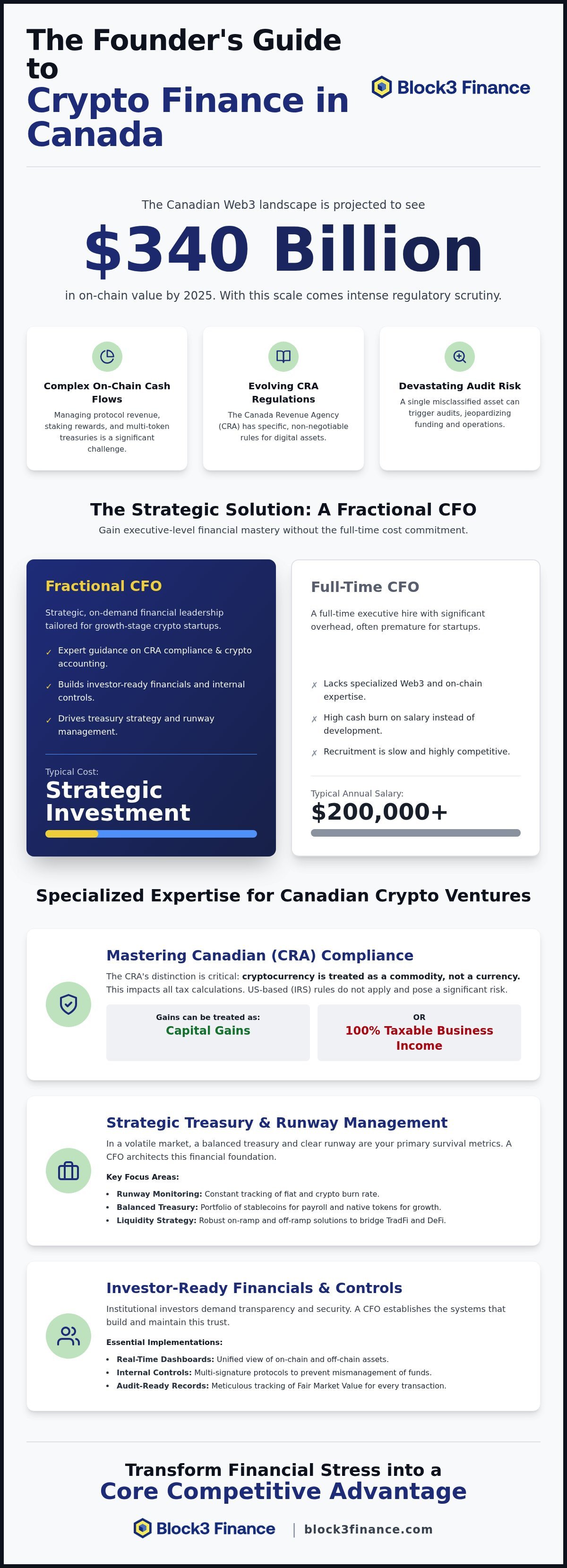
With an estimated $340 billion in on-chain value moving through Canada between 2024 and 2025, the margin for financial error in the Web3 space has vanished. For founders, the challenge isn't just building the next protocol; it's surviving the scrutiny of a refined regulatory landscape. Hiring a fractional cfo for crypto startups is no longer a luxury for the distant future, it's a strategic necessity for those who intend to scale.
You've likely felt the friction of managing complex on-chain cash flows while keeping one eye on the evolving reporting requirements of the Canada Revenue Agency, or CRA. It's exhausting to balance aggressive growth with the constant fear that a single misclassified digital asset could trigger a devastating audit.
This guide reveals how specialized fractional leadership provides the strategic mastery needed to secure venture capital funding and master your runway. You'll discover how to build defensible financial records that satisfy both institutional investors and Canadian tax authorities.
We'll explore tax-efficient corporate structuring, sophisticated on-ramp and off-ramp solutions, and the specific 2026 compliance standards your startup must meet to thrive. By the end, you'll have a roadmap to transform your financial department from a source of stress into a core competitive advantage.
Key Takeaways
- Master strategic treasury management to navigate the unique volatility of the Canadian blockchain landscape with professional confidence.
- Ensure records are audit-ready by tracking fair market value—the open market price of an asset—for all transactions under CRA guidelines.
- Discover why a fractional cfo for crypto startups offers a superior return on investment during the transition from seed to growth stages.
- Understand how Canadian corporate structuring and Controlled Foreign Corporation rules—tax laws for Canadian-owned businesses abroad—impact your global operations.
- Secure operational liquidity through robust on-ramp and off-ramp strategies that bridge the gap between decentralized assets and fiat requirements.
What is a Fractional CFO for Crypto Startups in Canada?
A fractional CFO provides executive-level financial leadership on a contract basis, offering high-growth ventures the strategic depth of a veteran executive without the overhead of a full-time hire. In the volatile digital asset sector, this role is the difference between reactive survival and proactive mastery. Utilizing a fractional cfo for crypto startups allows founders to deploy more capital toward development while securing their financial foundation.
For Canadian entities, this professional ensures every transaction aligns with the Canada Revenue Agency, or CRA, reporting standards. They don't just balance books; they architect the financial systems that support scaling and investor confidence. Investing in a fractional cfo for crypto startups is a strategic move that helps you avoid the $200,000 plus annual salary commitment of a full-time executive.
The Role of a Digital Asset CFO in 2026
Modern financial leadership in the Web3 ecosystem—the decentralized evolution of the internet—requires a dual-layered expertise that traditional accountants often lack. A digital asset CFO oversees complex on-chain and off-chain financial ecosystems, ensuring treasury management accounts for protocol-specific risks and liquidity needs. They actively manage the friction between decentralized protocols and the rigid requirements of traditional banking institutions. Essentially, the crypto CFO serves as the strategic bridge between technical code and regulatory compliance.
Why Canadian Jurisdictional Expertise Matters
The CRA views cryptocurrency as a commodity, which is a marketable good like gold or oil, rather than a currency. This distinction is critical because it dictates whether your gains are treated as capital gains or as 100% taxable business income. A Canadian-focused CFO understands these nuances, along with the specific application of GST/HST—the Goods and Services Tax and Harmonized Sales Tax—to digital services and cross-border transactions.
Relying on generic, US-based services is a significant risk for Canadian firms because the rules governing the IRS in the United States differ fundamentally from those of the CRA. A local expert ensures your filings aren't just complete, but are defensible under Canadian law. They provide the white-glove oversight necessary to protect your corporate structure through several key functions:
- Accurate classification of mining and staking activities as business income.
- Meticulous tracking of the fair market value for every asset at the time of transaction.
- Strict adherence to FINTRAC reporting requirements for firms acting as money services businesses.
Strategic Financial Oversight for Growth-Stage Web3 Firms
Runway management is the primary survival metric for early-stage crypto ventures. A strategic CFO doesn't just watch the bank account; they monitor the burn rate of both fiat and digital assets. In a market where token prices can drop 20% in a single day, having a clear view of your operational longevity is essential. You must know exactly how many months of operations remain under various market conditions.
Strategic CFOs implement robust on-ramp and off-ramp solutions to ensure operational liquidity. This allows firms to move capital between decentralized protocols and traditional banking systems without friction. Investor reporting has also evolved. Institutional investors now require transparent, real-time dashboards of on-chain holdings rather than static quarterly reports. These dashboards should integrate with your accounting software to provide a unified view of your fiat bank accounts and digital wallets.
Internal controls are vital to prevent the mismanagement of private keys and treasury funds. Without strict multi-signature protocols—which require multiple approvals for a single transaction—the risk of internal error or theft increases. A fractional cfo for crypto startups establishes these guardrails early, ensuring the founder isn't a single point of failure for the company's capital.
Treasury Management and Liquidity Strategy
Developing a balanced portfolio of stablecoins and native tokens is necessary to fund ongoing operations. Stablecoins provide the predictability needed for payroll, while native tokens represent the long-term value of the protocol. Implementing crypto-to-fiat payment solutions allows you to pay global contractors in their local currency while keeping your treasury on-chain.
Mitigating volatility risks requires disciplined treasury rebalancing and hedging. As professional bodies focus on modernizing crypto asset taxation, your treasury strategy must remain flexible. You can't afford to be caught in a liquidity crunch during a bear market because your assets were locked in illiquid staking pools. A proactive strategy ensures you have the cash flow to weather market downturns without halting development.
Fundraising Support and Investor Relations
Preparing defensible financial models is the key to withstanding the scrutiny of Tier-1 VCs. These investors look beyond the hype to see if your unit economics and token distribution make sense. A fractional cfo for crypto startups assists with tokenomics design to ensure long-term financial viability and prevents excessive dilution. They ensure your cap table—the record of who owns what percentage of the company—remains healthy for future rounds.
They provide the financial narrative needed for Series A and Series B capital raises. This involves translating complex blockchain metrics into terms that traditional equity investors understand. If you're preparing for your next round, consulting with a strategist can help refine your pitch and ensure your books are audit-ready before the due diligence process begins.
Fractional vs. Full-Time CFO: Evaluating the ROI
Startups typically reach a 'CFO inflection point' after securing their first significant funding round. At this stage, the complexity of on-chain treasury management exceeds the capabilities of a standard bookkeeper. Implementing a fractional cfo for crypto startups allows you to capture approximately 80% of the strategic value of a full-time hire at roughly 20% of the cost.
The true return on investment isn't found only in salary savings. It's built through audit-readiness and the systematic avoidance of costly CRA penalties. Improperly reporting digital assets in Canada can lead to significant interest and late-filing fees. Professional oversight ensures your records are defensible before an auditor ever knocks on your door.
Flexibility is a core advantage of the fractional model. As your startup's transaction volume increases, the engagement scales to match your operational pace. This prevents you from overpaying for leadership during quiet development phases while providing surge capacity during active fundraising or product launches.
Cost-Benefit Analysis for Canadian Startups
Full-time CFOs in Canada often require significant equity stakes and high base salaries that can drain a startup's runway. In contrast, fractional services at Block3 Finance operate on a predictable monthly retainer that scales with your needs. This model eliminates the "hidden" costs of employment, such as benefits, Canada Pension Plan (CPP) contributions, and Employment Insurance (EI) premiums.
Professional oversight significantly reduces year-end accounting fees by delivering clean, reconciled data to your tax preparers. Unlike generalist firms, we account for the specialized software costs necessary to track thousands of blockchain transactions. This proactive approach prevents the expensive "cleanup" work that often plagues Web3 firms during tax season.
When to Make the Transition
Specific operational indicators signal when it's time to move beyond basic accounting. If you're managing multiple entities or navigating complex DAO governance structures, your financial architecture requires expert navigation. A DAO, or Decentralized Autonomous Organization, introduces unique reporting challenges regarding treasury disbursements and member compensation.
You may also require specialized corporate structuring to protect your assets from unnecessary tax exposure. Preparing for a potential acquisition or an institutional investment round also necessitates this level of financial rigor. Tier-1 investors expect to see professional financial models that reflect a deep understanding of both Canadian law and blockchain mechanics.
Navigating CRA Compliance and Canadian Corporate Structuring
The CRA requires meticulous tracking of the fair market value for every crypto transaction. This value represents the price an asset would fetch on the open market at the exact time of the trade. If your startup fails to document these values, you'll be unable to defend your filings during an audit. A fractional cfo for crypto startups implements the systems needed to automate this tracking, ensuring your books remain clean and defensible.
Corporate structuring for crypto businesses must account for Canadian 'Controlled Foreign Corporation' rules. These regulations ensure that income earned by foreign entities controlled by Canadians is still subject to domestic tax. Proper entity setup can significantly reduce the tax burden for founders and investors. By utilizing the Small Business Deduction, Canadian-Controlled Private Corporations (CCPCs) can access a federal tax rate of 9% on the first $500,000 of active business income.
Audit-ready books are the only defense against increasing CRA scrutiny of digital asset firms. The agency has signaled a focus on platform registration and clear risk disclosure for 2026. Without professional oversight, your startup could face significant penalties for improper reporting. It's essential to file your T2 Corporate Income Tax Return within six months of your fiscal year-end to remain in good standing.
Canadian Tax Filing and Reporting Standards
Understanding the difference between capital gains and business income is essential for crypto trading. Capital gains apply when you sell assets for a profit, with a 66.67% inclusion rate for corporations as of 2026. Business income is 100% taxable and applies if you're deemed to be operating a trading business. You must also ensure compliance with T1135 reporting, a form for verifying foreign property, if you hold assets on foreign exchanges exceeding $100,000 CAD. For a deeper look at these requirements, see our guide on Crypto Tax in Canada.
Structuring for Global Web3 Operations
Founders should evaluate registering in Ontario versus British Columbia. Ontario provides access to a dense network of financial professionals, while British Columbia is known for its tech-friendly regulatory posture. Managing tax implications for Canadian founders of offshore DAOs is particularly complex. A DAO is a decentralized organization governed by code rather than a central authority. Even if your DAO is offshore, the CRA may still view its income as taxable in Canada if the mind and management reside here.
A fractional cfo for crypto startups manages cross-border compliance to prevent double taxation, which occurs when two countries tax the same income. This involves navigating tax treaties and ensuring that your global operations don't trigger unexpected liabilities. If you need to optimize your corporate framework for the 2026 tax year, book a consultation with our team today.
Scaling Your Web3 Venture with Block3 Finance CFO Services
Block3 Finance combines 13 plus years of specialized blockchain expertise with the technical rigor of traditional corporate finance. We move beyond the defensive posture of mere regulatory management to provide an offensive strategy focused on sustainable growth. Our CFO services empower founders to master the inherent volatility of the digital asset landscape with absolute command over their capital.
We excel at translating complex, high-volume on-chain data into clean, defensible financial records that satisfy the most stringent Canadian standards. This intellectual depth allows startups to present audit-ready books to the CRA and sophisticated venture capital firms alike. By partnering with a Bitcoin.com top-ranked provider, you signal a commitment to financial excellence that resonates with institutional investors.
Our firm serves as a Visionary Navigator for your executive team. We have successfully guided 980 plus global clients through high-stakes environments, ensuring their financial architecture supports rapid scaling. This elite oversight is the foundation of long-term viability in a decentralized economy.
The Block3 Finance Methodology
Our methodology adopts a proactive and supportive stance that liberates founders from the friction of financial administration. We seamlessly integrate monthly accounting with high-level strategic oversight to ensure daily execution remains aligned with your long-term vision. This holistic approach resolves the disconnect between technical development and financial accountability.
Clients gain access to an elite network of global blockchain financial professionals who understand the nuances of cross-border operations and decentralized protocols. We don't just provide a service; we offer a roadmap for thriving in a world where the rules of finance are being rewritten. This white-glove experience ensures your firm remains a calm force even during periods of extreme market turbulence.
Next Steps for Growth-Stage Founders
Assessing your current financial posture is the first step toward achieving total mastery over your runway. We recommend utilizing our professional check-list to identify gaps in your current reporting or treasury management protocols. This tool provides immediate clarity on whether your startup is prepared for the next phase of institutional scrutiny.
Booking a consultation allows us to discuss a tailored leadership model that fits your specific needs as you scale. Whether you are navigating a Series A raise or optimizing your Canadian corporate structure, a fractional cfo for crypto startups provides the elite strategy required for success. Contact Block3 Finance today to secure your startup's financial future.
Mastering Your Financial Future in the 2026 Web3 Landscape
Success in the Canadian blockchain sector requires more than innovative code; it demands a sophisticated financial architecture that withstands the scrutiny of both Tier-1 investors and the CRA. By prioritizing audit-ready records and optimized liquidity strategies, you protect your firm's runway and long-term reputation.
Block3 Finance serves as your Visionary Navigator, leveraging over 13 years of blockchain financial mastery to resolve the friction between innovation and compliance. As the firm ranked #1 for crypto tax by Bitcoin.com, we provide the CRA-specific expertise needed to thrive under the 2026 regulatory framework.
Integrating a fractional cfo for crypto startups ensures you maintain the strategic oversight of an elite executive while preserving your vital development capital. Your journey from seed to scale deserves a partner who understands the unique nuances of the decentralized world.
Scale your Web3 startup with Block3 Finance CFO Services and gain total command over your financial destiny today. The future of finance is yours to lead.
Frequently Asked Questions
What exactly does a fractional CFO do for a crypto startup?
A fractional CFO provides executive-level financial leadership and strategic oversight on a part-time basis. They manage your startup's runway, which is the amount of time your business can operate before running out of money. These professionals also handle treasury rebalancing and prepare real-time dashboards of on-chain holdings for investor reporting.
How is a fractional CFO different from a crypto tax accountant?
A fractional CFO focuses on forward-looking strategy and operational growth, whereas a crypto tax accountant primarily handles historical compliance and tax filings. While the accountant ensures your records meet CRA standards, the CFO uses that data to drive fundraising support and liquidity management. Both roles are necessary but serve different stages of the financial lifecycle.
When is the right time for a Web3 startup to hire a fractional CFO?
Most ventures reach an inflection point after their first significant funding round or when managing on-chain treasury becomes too complex for a standard bookkeeper. If you are preparing for Series A or managing multiple entities, hiring a fractional cfo for crypto startups is a strategic necessity. This ensures your financial architecture is robust enough for institutional scrutiny.
Does a crypto CFO help with Canadian CRA audit preparation?
Yes, they implement the internal controls and record-keeping systems required to ensure your books are audit-ready at all times. They verify that every transaction tracks the fair market value, which is the open market price of an asset. This proactive approach ensures all on-chain data is defensible if the CRA requests an examination of your records.
Can a fractional CFO assist with crypto-to-fiat on-ramp and off-ramp solutions?
A specialized CFO architects the systems that bridge decentralized assets with traditional banking institutions. They manage liquidity strategy and implement crypto-to-fiat payment solutions to facilitate global payroll and contractor payments. This ensures your startup can move capital efficiently between blockchain protocols and fiat bank accounts without operational friction.
How much do fractional CFO services typically cost for Canadian startups?
Costs for these services vary based on the complexity of your blockchain activity and the level of strategic engagement required. Most engagements are structured as a predictable monthly retainer that scales as your transaction volume increases. This model allows you to access elite financial expertise at a fraction of the cost of a full-time executive hire.
Do I need a CFO if my startup is structured as a DAO?
A Decentralized Autonomous Organization, or DAO, requires professional financial leadership to manage treasury disbursements and complex governance structures. A CFO ensures the DAO's financial activities remain transparent to members while aligning with Canadian corporate tax obligations. They provide the necessary human oversight to translate decentralized code into compliant financial reporting.
What specific Canadian tax forms does a crypto CFO manage?
They oversee the preparation of the T2 Corporate Income Tax Return and the T1135 Foreign Income Verification Statement for assets held on foreign exchanges. The CFO also manages GST/HST filings, which are the Goods and Services Tax and Harmonized Sales Tax. Their oversight ensures that every filing accurately reflects the unique nature of digital asset business income.

Article by
Mahad Mohamed
Mahad Mohamed is an accountant and the CEO of Block3 Finance, with over 26+ years of Canadian and international tax and accounting experience. A crypto accounting specialist since the early days of Bitcoin, he has consulted for over 38 crypto companies and collaborated with legal professionals on regulatory matters. His expertise spans corporate reorganization, cross-border tax structuring (Canada & US), tax disputes, and CRA audits.
Previously, Mahad worked for the Canada Revenue Agency (CRA), Big4 accounting firms, and served as a Rulings Officer for the Federal Tax Authority of the UAE before acquiring Tax Partners in 2014.
Block3 Finance and Tax Partners has 44 full-time accountants and over 9,800+ clients.
Disclaimer
This article provides general information only and is current as of its publication date. It has not been updated and may be out of date. It does not constitute legal advice and should not be relied upon as such. Every tax situation is unique and may differ from the examples discussed in this article. If you have specific questions, you should seek the advice of our accountants for your unique circumstances.
Frequently Asked Questions
What exactly does a fractional CFO do for a crypto startup?
A fractional CFO provides executive-level financial leadership and strategic oversight on a part-time basis. They manage your startup's runway, which is the amount of time your business can operate before running out of money. These professionals also handle treasury rebalancing and prepare real-time dashboards of on-chain holdings for investor reporting.
How is a fractional CFO different from a crypto tax accountant?
A fractional CFO focuses on forward-looking strategy and operational growth, whereas a crypto tax accountant primarily handles historical compliance and tax filings. While the accountant ensures your records meet CRA standards, the CFO uses that data to drive fundraising support and liquidity management. Both roles are necessary but serve different stages of the financial lifecycle.
When is the right time for a Web3 startup to hire a fractional CFO?
Most ventures reach an inflection point after their first significant funding round or when managing on-chain treasury becomes too complex for a standard bookkeeper. If you are preparing for Series A or managing multiple entities, hiring a fractional cfo for crypto startups is a strategic necessity. This ensures your financial architecture is robust enough for institutional scrutiny.
Does a crypto CFO help with Canadian CRA audit preparation?
Yes, they implement the internal controls and record-keeping systems required to ensure your books are audit-ready at all times. They verify that every transaction tracks the fair market value, which is the open market price of an asset. This proactive approach ensures all on-chain data is defensible if the CRA requests an examination of your records.
Can a fractional CFO assist with crypto-to-fiat on-ramp and off-ramp solutions?
A specialized CFO architects the systems that bridge decentralized assets with traditional banking institutions. They manage liquidity strategy and implement crypto-to-fiat payment solutions to facilitate global payroll and contractor payments. This ensures your startup can move capital efficiently between blockchain protocols and fiat bank accounts without operational friction.
How much do fractional CFO services typically cost for Canadian startups?
Costs for these services vary based on the complexity of your blockchain activity and the level of strategic engagement required. Most engagements are structured as a predictable monthly retainer that scales as your transaction volume increases. This model allows you to access elite financial expertise at a fraction of the cost of a full-time executive hire.
Do I need a CFO if my startup is structured as a DAO?
A Decentralized Autonomous Organization, or DAO, requires professional financial leadership to manage treasury disbursements and complex governance structures. A CFO ensures the DAO's financial activities remain transparent to members while aligning with Canadian corporate tax obligations. They provide the necessary human oversight to translate decentralized code into compliant financial reporting.
What specific Canadian tax forms does a crypto CFO manage?
They oversee the preparation of the T2 Corporate Income Tax Return and the T1135 Foreign Income Verification Statement for assets held on foreign exchanges. The CFO also manages GST/HST filings, which are the Goods and Services Tax and Harmonized Sales Tax. Their oversight ensures that every filing accurately reflects the unique nature of digital asset business income.