
Most investors treat NFT tax reporting as a defensive chore to avoid IRS scrutiny. Mastering the nuances of the "collectible" classification is actually a strategic move for long-term portfolio growth. It's time to shift from a reactive posture to one of total command over your digital wealth.
You've likely felt the friction of calculating cost basis, which is the original purchase price of your asset, or worried that incomplete on-chain records could trigger an audit. These complexities make it difficult to determine if your assets are taxed at the standard capital gains rate or the higher 28% rate reserved for collectibles. The IRS treats these digital assets as property, meaning every trade or swap creates a taxable event that requires precise documentation.
This guide provides the roadmap you need to navigate these high-stakes regulations with confidence. We'll detail how to use Form 1099-DA and Form 8949 to report sales and royalties while maintaining a defensible audit trail. You'll gain a clear understanding of the strategies available to minimize your tax liability legally under current IRS rules.
Key Takeaways
- Understand how the IRS classifies NFTs as property, ensuring you recognize every trade or swap as a potential taxable event.
- Identify the specific criteria that trigger the 28% "collectible" tax rate to avoid unexpected liabilities on your digital assets.
- Master the nuances of NFT tax reporting by accurately tracking cost basis and fair market value for every mint and royalty payment.
- Build a defensible audit trail using Form 8949 and Form 1099-DA to provide the transparency required for IRS compliance.
- Learn how professional accounting services reconcile complex on-chain activity into clean, audit-ready financial records.
Understanding NFT Taxation under IRS Guidelines
The Internal Revenue Service (IRS) maintains a clear stance: your digital gallery is not a mere collection of links, but a portfolio of property. For federal tax purposes, the agency classifies these assets as digital assets, a category that subjects them to the same rigorous oversight as traditional real estate or securities. This classification means your NFT tax reporting obligations begin the moment you interact with a smart contract.
Every transaction on the blockchain carries a fiscal consequence. Whether you are buying, selling, or swapping, you are likely triggering a taxable event. For instance, purchasing an NFT using Ethereum (ETH) is viewed as a "disposal" of that ETH. You must recognize a capital gain or loss based on the change in value of the cryptocurrency from the time you acquired it to the moment you spent it on the NFT. Before diving into the tax codes, it is essential to understand what is a non-fungible token (NFT): a unique digital identifier recorded on a blockchain that certifies ownership and authenticity.
Defining Digital Assets for 2026 Filers
For the 2026 filing season, the IRS utilizes "digital asset" as an expansive umbrella term. This terminology encompasses cryptocurrencies, stablecoins, and NFTs alike. When you prepare your Form 1040, you will encounter a mandatory question asking if you received, sold, or exchanged any digital assets. Accuracy is paramount here; a "No" answer when you have active on-chain records can flag your return for an audit. The implementation of Form 1099-DA for the 2025 tax year means the IRS will receive direct reports of your gross proceeds from many marketplaces. Even receiving airdrops, which are tokens or assets sent to your wallet for free, typically counts as ordinary income. You must report the fair market value of these airdrops at the time of receipt, even if you don't sell them immediately.
The IRS View on NFTs as Property
The decision to treat NFTs as property rather than currency has significant implications for your tax liability. This framework allows you to offset your gains with capital losses, but it also demands meticulous record-keeping. You must track your cost basis, which is the original purchase price plus any commissions or transaction fees, for every asset. Unlike traditional currency, the value of an NFT fluctuates, and the IRS requires you to report the USD value at the time of every exchange. Relying on specialized tax filing and reporting services ensures that these calculations remain defensible during an audit.
Your classification as either a casual investor or a professional trader further dictates your reporting requirements. Casual investors generally report gains and losses on Schedule D, while those operating a business as a creator or high-frequency trader may use Schedule C. This distinction is the first step in building a compliant strategy that protects your digital wealth.
The 'Collectible' Trap: Standard vs. Higher Tax Rates
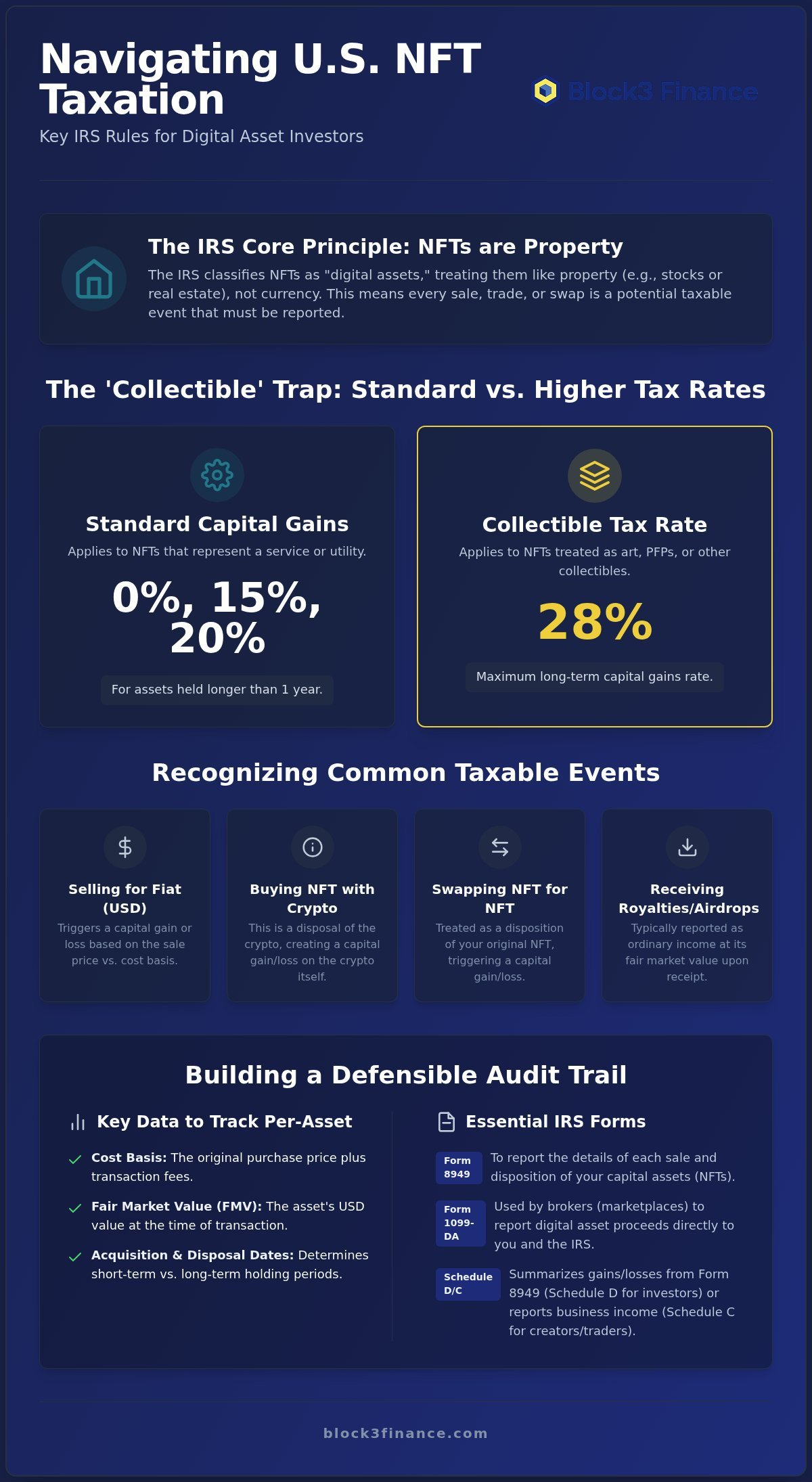
Most investors assume their long-term digital holdings qualify for the standard capital gains tax rates of 0%, 15%, or 20%. While this is true for many assets, the IRS has introduced a significant hurdle for NFT tax reporting by potentially classifying certain tokens as collectibles. Under Section 408(m) of the tax code, assets deemed collectibles face a much higher maximum long-term capital gains rate of 28%.
The agency applies a "look-through" rule to determine the correct rate. This means the tax treatment of the NFT follows the treatment of the underlying asset it represents. If your NFT grants ownership of a digital work of art, it's likely a collectible; if it represents a service or a utility, it might qualify for the lower standard rates. You can find more detail on property classification in the official IRS guidelines regarding digital assets.
When Does the 28% Collectible Rate Apply?
The IRS traditionally defines collectibles as items like art, rugs, antiques, or certain metals. For NFT investors, this definition creates friction when dealing with Profile Picture (PFP) collections. If the IRS views a specific collection primarily as "art," you could be forced to pay the 28% rate upon sale. Collectible status is a tax classification where an asset is deemed a work of art or tangible property under Section 408(m), subjecting it to a higher maximum capital gains rate. Distinguishing between a utility token and a collectible is vital for protecting your margins.
Capital Gains vs. Ordinary Income for NFT Traders
Your holding period is the primary factor in determining your tax rate. Assets held for one year or less are subject to short-term capital gains, which are taxed as ordinary income at rates ranging from 10% to 37%. Only assets held for more than 365 days qualify for long-term rates. High-frequency trading can lead to tax bracket migration, where your trading profits push you into a higher ordinary income bracket. This shift can significantly increase the tax you owe on all your income, not just your NFT sales.
Navigating these thresholds requires a proactive strategy to ensure you aren't overpaying due to a simple classification error. If you're unsure how your specific portfolio is categorized, it's a wise move to consult with a specialized crypto accountant to review your transaction history. Mastery of these rates transforms tax season from a defensive struggle into a controlled part of your investment lifecycle.
Navigating Taxable NFT Events: From Minting to Royalties
Every interaction with a smart contract creates a fiscal footprint that the IRS monitors with increasing precision. When you use Ethereum (ETH) to acquire an asset, you aren't just buying; you're disposing of a digital asset. This triggers a capital gain or loss on the ETH used, calculated by the difference between its value when you acquired it and its value at the moment of the trade.
Swapping one NFT for another is not a tax-free exchange. The IRS views this as two distinct events: the sale of your original asset and the immediate purchase of the new one. You must determine the fair market value in USD at the time of the swap to satisfy NFT tax reporting requirements for both assets involved in the transaction.
Tax Consequences of Minting and Secondary Sales
For creators, the act of minting a new token is generally not a taxable event under current IRS rules. You haven't realized a gain until the asset is transferred to a buyer for value. However, you must track gas fees carefully. These transaction costs can often be added to your cost basis or treated as a business expense to reduce your overall tax liability.
Secondary market participants are taxed at the time they sell NFTs, with the gain calculated as the difference between the sale price and the original cost basis. If you sell an NFT for fiat currency or another cryptocurrency, the profit is recognized as a capital gain. Accurate documentation of the fair market value at every step is the only way to maintain a defensible position.
Reporting NFT Royalties as Business or Passive Income
Royalties present a unique challenge because they represent recurring ordinary income rather than one-time capital gains. If you create NFTs as a hobby, your income is typically reported on Schedule E. In this scenario, your ability to deduct expenses may be limited by specific hobby loss rules that prevent you from claiming a net loss against other income.
Professional studios and high-volume creators must treat this activity as a business. This requires reporting income on Schedule C, which may subject the earnings to a 15.3% self-employment tax in addition to standard income tax. Managing the complex accounting of recurring on-chain revenue streams is where Block3 Finance CFO services provide essential strategic oversight. We help you navigate the transition from a casual creator to a structured business entity, ensuring every royalty payment is documented for full IRS compliance.
Building a Defensible Audit Trail for NFT Transactions
The IRS expects you to maintain a comprehensive ledger detailing the date, value, and nature of every trade. Your cost basis must include the original purchase price plus any commissions or transaction fees paid to the marketplace. Failing to document these costs accurately can lead to overpaying on your capital gains.
Choosing an accounting methodology is a strategic decision for your portfolio. You can use First-In, First-Out (FIFO) or Specific Identification to optimize your tax outcome. Specific Identification allows you to select which specific asset you're selling to minimize realized gains, but it requires flawless records of every wallet interaction.
Determining Cost Basis in Multi-Asset Trades
Swapping one NFT for another requires a two-step valuation process. You must determine the fair market value of the asset you're receiving in USD at the exact moment of the trade. This becomes difficult with illiquid or "unpriced" assets that don't have a clear floor price on major marketplaces.
To build a defensible record, you should save timestamped screenshots from blockchain explorers and record the ETH-to-USD conversion rate at the time of the swap. This also applies to "wrapped" assets. If you wrap a digital asset into a new token, the IRS may view this as a taxable disposal depending on the contract's structure. Precise documentation is your only defense against IRS assumptions.
If your NFTs are lost to hacks or stolen, navigating the strict 2026 rules for casualty loss deductions is exceptionally difficult. The IRS has significantly restricted these deductions for individuals. You must typically prove the loss was due to a federally declared disaster, making most digital asset thefts non-deductible for casual investors.
Essential IRS Forms for NFT Disclosure
For NFT tax reporting, you'll primarily use Form 8949 to list every individual sale and exchange. These individual entries then flow into Schedule D to summarize your total capital gains and losses. Accuracy here is critical because the IRS now uses data analytics to reconcile on-chain activity with reported figures.
Starting with the 2025 tax year (filed in 2026), brokers and marketplaces will issue Form 1099-DA. This form provides the IRS with a direct window into your gross proceeds, making it impossible to hide high-value transactions. You must ensure your internal records align perfectly with what these platforms report to the government.
A disorganized wallet is a significant liability in an audit. If your on-chain history feels like a chaotic puzzle, contact our audit and compliance team to build a defensible record of your digital wealth.
Strategic Compliance with Block3 Finance
Generic tax software often lacks the sophistication to reconcile "off-catalog" NFT mints and complex smart contracts. These automated tools frequently miscalculate the 28% collectible rate or fail to capture the nuances of multi-asset swaps. Block3 Finance specializes in turning chaotic on-chain data into clean, defensible financial records that stand up to IRS scrutiny.
Our team brings over 13 years of blockchain financial expertise to your digital portfolio. We've managed over 980 global clients, providing a level of intellectual leadership that software alone cannot replicate. This proactive approach shifts your narrative from merely managing regulations to achieving total command over your digital wealth.
Why Specialized Crypto Accounting Beats Generic Software
The "Visionary Navigator" approach at Block3 Finance goes beyond basic data entry to address the "grey area" regulations of the 2026 tax year. While an algorithm might default to the highest tax rate, our experts analyze the underlying utility of your assets to argue for the most favorable treatment. We identify missed deduction opportunities, such as specific gas fee allocations, that generic platforms often overlook.
Professional oversight is the most effective way to reduce audit risk in a landscape of increasing IRS transparency. By choosing Block3 Finance Tax Filing and Reporting, you gain a partner dedicated to precision and advocacy. We ensure your NFT tax reporting is not just compliant, but strategically optimized for your specific financial goals.
Securing Your Digital Legacy through Professional Oversight
High-net-worth investors often face complex international compliance requirements that require "white-glove" corporate vocabulary and deep technical rigor. Block3 Finance helps you navigate these high-stakes environments, ensuring your digital assets are integrated into your broader financial strategy. We provide the stability and intellectual depth needed to manage large-scale portfolios across multiple jurisdictions.
Maintaining audit-ready books is essential for future corporate structuring or potential exits from the Web3 space. Our services provide a clear roadmap for thriving in a volatile industry, positioning your digital legacy for long-term sustainability. When you're ready to take total command of your fiscal future, schedule a consultation with Block3 Finance to secure your portfolio.
Mastering Your Digital Fiscal Future
Achieving total command over your digital wealth requires shifting from a defensive posture to one of proactive mastery. You now understand that the distinction between a standard capital asset and a 28% collectible is the difference between a thriving portfolio and an unnecessary tax burden. By maintaining meticulous on-chain records and utilizing the correct IRS forms, you transform the complexity of NFT tax reporting into a strategic advantage.
Block3 Finance stands as a calm force in this volatile industry, bringing 13+ years of blockchain financial expertise to every engagement. Ranked as a top provider by Bitcoin.com, we've delivered clean, defensible audit trails for over 980 global clients. Our team possesses the technical rigor needed to navigate high-stakes environments while ensuring your digital legacy remains secure and audit-ready.
Don't let regulatory friction slow your momentum in the Web3 space. Secure your NFT portfolio with elite crypto tax reporting from Block3 Finance. You have the tools and the roadmap; now it's time to take control of your financial evolution with confidence.
Frequently Asked Questions
Do I have to pay taxes if I trade one NFT for another NFT?
Yes, the IRS treats an NFT-to-NFT swap as a taxable disposal of property rather than a tax-free exchange. You must recognize a capital gain or loss based on the fair market value of the assets in USD at the time of the trade. This requires precise NFT tax reporting to ensure you're calculating the cost basis of the new asset correctly while accounting for the gain on the old one.
How does the IRS determine if an NFT is a "collectible" taxed at 28%?
The IRS utilizes a "look-through" rule to classify digital assets under Section 408(m). If the underlying asset associated with the NFT is a work of art, rug, antique, or specific metal, it's deemed a collectible. This triggers a maximum long-term capital gains rate of 28%. Utility tokens that provide access to services rather than ownership of art may qualify for lower standard capital gains rates.
Can I claim a tax loss if my NFT project goes to zero or is a "rug pull"?
Claiming a loss for a "rug pull" is exceptionally difficult under current IRS rules. Casualty loss deductions are generally restricted to losses resulting from federally declared disasters. For most investors, the asset must be sold or exchanged to realize a capital loss. If the asset remains in your wallet and has no liquidity, you often cannot claim a loss until a formal disposal occurs.
What is the "fair market value" of an NFT if there are no recent sales?
You must establish a reasonable estimation of value using contemporaneous data from the blockchain. This often involves looking at the floor price of the collection or the most recent comparable sales of similar traits. Documenting your methodology with timestamped screenshots is vital. If no market data exists, you may need professional valuation services to create a defensible record for your NFT tax reporting obligations.
Are NFT gas fees tax-deductible under IRS rules?
Gas fees are generally not deductible as a standalone expense for casual investors; instead, they're integrated into your cost basis. When you buy an NFT, the gas fee is added to the purchase price. When you sell, the fee is subtracted from the gross proceeds. This effectively reduces your total capital gain. Professional creators operating as a business may be able to deduct these as business expenses on Schedule C.
How do I report NFT royalties as a digital artist?
Royalties are reported as ordinary income rather than capital gains. If you're a professional creator, you'll report this income on Schedule C, where it's subject to both income tax and a 15.3% self-employment tax. Casual creators or hobbyists typically use Schedule E. It's essential to track these payments in USD value at the exact moment they're received in your wallet to ensure full compliance.
What happens if I forget to check the digital asset box on my Form 1040?
Failing to answer the digital asset question on Form 1040 accurately can be viewed as a willful omission by the IRS. This significantly increases your audit risk and may lead to penalties or interest on unpaid taxes. If you realize you've made an error, you should amend your return immediately. The IRS uses data from Form 1099-DA to reconcile your on-chain activity with your reported answers.
Is minting an NFT considered a taxable event for the creator?
No, the act of minting or creating an NFT is generally not a taxable event for the creator under IRS guidelines. You don't realize a gain until the asset is sold, swapped, or otherwise disposed of for value. While the minting process itself isn't taxed, the gas fees paid during the process should be recorded. These costs can eventually be used to adjust your cost basis when the asset is sold.

Article by
Mahad Mohamed
Mahad Mohamed is an accountant and the CEO of Block3 Finance, with over 26+ years of Canadian and international tax and accounting experience. A crypto accounting specialist since the early days of Bitcoin, he has consulted for over 38 crypto companies and collaborated with legal professionals on regulatory matters. His expertise spans corporate reorganization, cross-border tax structuring (Canada & US), tax disputes, and CRA audits.
Previously, Mahad worked for the Canada Revenue Agency (CRA), Big4 accounting firms, and served as a Rulings Officer for the Federal Tax Authority of the UAE before acquiring Tax Partners in 2014.
Block3 Finance and Tax Partners has 44 full-time accountants and over 9,800+ clients.
Disclaimer
This article provides general information only and is current as of its publication date. It has not been updated and may be out of date. It does not constitute legal advice and should not be relied upon as such. Every tax situation is unique and may differ from the examples discussed in this article. If you have specific questions, you should seek the advice of our accountants for your unique circumstances.
Frequently Asked Questions
When Does the 28% Collectible Rate Apply?
The IRS traditionally defines collectibles as items like art, rugs, antiques, or certain metals. For NFT investors, this definition creates friction when dealing with Profile Picture (PFP) collections. If the IRS views a specific collection primarily as "art," you could be forced to pay the 28% rate upon sale. Collectible status is a tax classification where an asset is deemed a work of art or tangible property under Section 408(m), subjecting it to a higher maximum capital gains rate. Distinguishing between a utility token and a collectible is vital for protecting your margins.
Do I have to pay taxes if I trade one NFT for another NFT?
Yes, the IRS treats an NFT-to-NFT swap as a taxable disposal of property rather than a tax-free exchange. You must recognize a capital gain or loss based on the fair market value of the assets in USD at the time of the trade. This requires precise NFT tax reporting to ensure you're calculating the cost basis of the new asset correctly while accounting for the gain on the old one.
How does the IRS determine if an NFT is a "collectible" taxed at 28%?
The IRS utilizes a "look-through" rule to classify digital assets under Section 408(m). If the underlying asset associated with the NFT is a work of art, rug, antique, or specific metal, it's deemed a collectible. This triggers a maximum long-term capital gains rate of 28%. Utility tokens that provide access to services rather than ownership of art may qualify for lower standard capital gains rates.
Can I claim a tax loss if my NFT project goes to zero or is a "rug pull"?
Claiming a loss for a "rug pull" is exceptionally difficult under current IRS rules. Casualty loss deductions are generally restricted to losses resulting from federally declared disasters. For most investors, the asset must be sold or exchanged to realize a capital loss. If the asset remains in your wallet and has no liquidity, you often cannot claim a loss until a formal disposal occurs.
What is the "fair market value" of an NFT if there are no recent sales?
You must establish a reasonable estimation of value using contemporaneous data from the blockchain. This often involves looking at the floor price of the collection or the most recent comparable sales of similar traits. Documenting your methodology with timestamped screenshots is vital. If no market data exists, you may need professional valuation services to create a defensible record for your NFT tax reporting obligations.
Are NFT gas fees tax-deductible under IRS rules?
Gas fees are generally not deductible as a standalone expense for casual investors; instead, they're integrated into your cost basis. When you buy an NFT, the gas fee is added to the purchase price. When you sell, the fee is subtracted from the gross proceeds. This effectively reduces your total capital gain. Professional creators operating as a business may be able to deduct these as business expenses on Schedule C.
How do I report NFT royalties as a digital artist?
Royalties are reported as ordinary income rather than capital gains. If you're a professional creator, you'll report this income on Schedule C, where it's subject to both income tax and a 15.3% self-employment tax. Casual creators or hobbyists typically use Schedule E. It's essential to track these payments in USD value at the exact moment they're received in your wallet to ensure full compliance.
What happens if I forget to check the digital asset box on my Form 1040?
Failing to answer the digital asset question on Form 1040 accurately can be viewed as a willful omission by the IRS. This significantly increases your audit risk and may lead to penalties or interest on unpaid taxes. If you realize you've made an error, you should amend your return immediately. The IRS uses data from Form 1099-DA to reconcile your on-chain activity with your reported answers.
Is minting an NFT considered a taxable event for the creator?
No, the act of minting or creating an NFT is generally not a taxable event for the creator under IRS guidelines. You don't realize a gain until the asset is sold, swapped, or otherwise disposed of for value. While the minting process itself isn't taxed, the gas fees paid during the process should be recorded. These costs can eventually be used to adjust your cost basis when the asset is sold.