
The IRS now receives direct data on your digital asset sales through the Form 1099-DA mandate; the era of voluntary self-reporting has officially ended. For many founders, crypto accounting for web3 projects feels like attempting to map a hurricane while standing in the eye of it. You've likely felt the friction of reconciling thousands of smart contract interactions across protocols only to worry if your revenue recognition will survive a federal audit.
It's true that the transition to fair value accounting under ASU 2023-08 adds a layer of volatility to your reported net income. However, this shift also provides a unique opportunity to demonstrate institutional-grade maturity and intellectual depth to your stakeholders. This guide will help you master the complexities of Web3 financial reporting under US IRS rules and GAAP standards.
We'll examine the impact of the 2026 cost basis reporting requirements and the strategic advantages of maintaining an audit-ready general ledger. You'll gain a roadmap to transform your back-office from a compliance burden into a source of strategic financial clarity to manage your runway.
Key Takeaways
- Understand how the IRS classifies digital assets as property and why systematic recording of on-chain data is essential for US compliance.
- Learn to map complex wallet interactions and gas fees to specific business accounts to streamline crypto accounting for web3 projects.
- Transition from legacy impairment models to the new fair value measurement standards under ASU 2023-08 to reflect the true market value of your holdings.
- Establish a defensible, audit-ready workflow by linking on-chain transaction hashes directly to off-chain business documentation and internal controls.
- Discover how strategic CFO services provide a growth roadmap by optimizing burn rates and managing runway for high-growth Web3 entities.
What Is Web3 Accounting Under US IRS Rules?
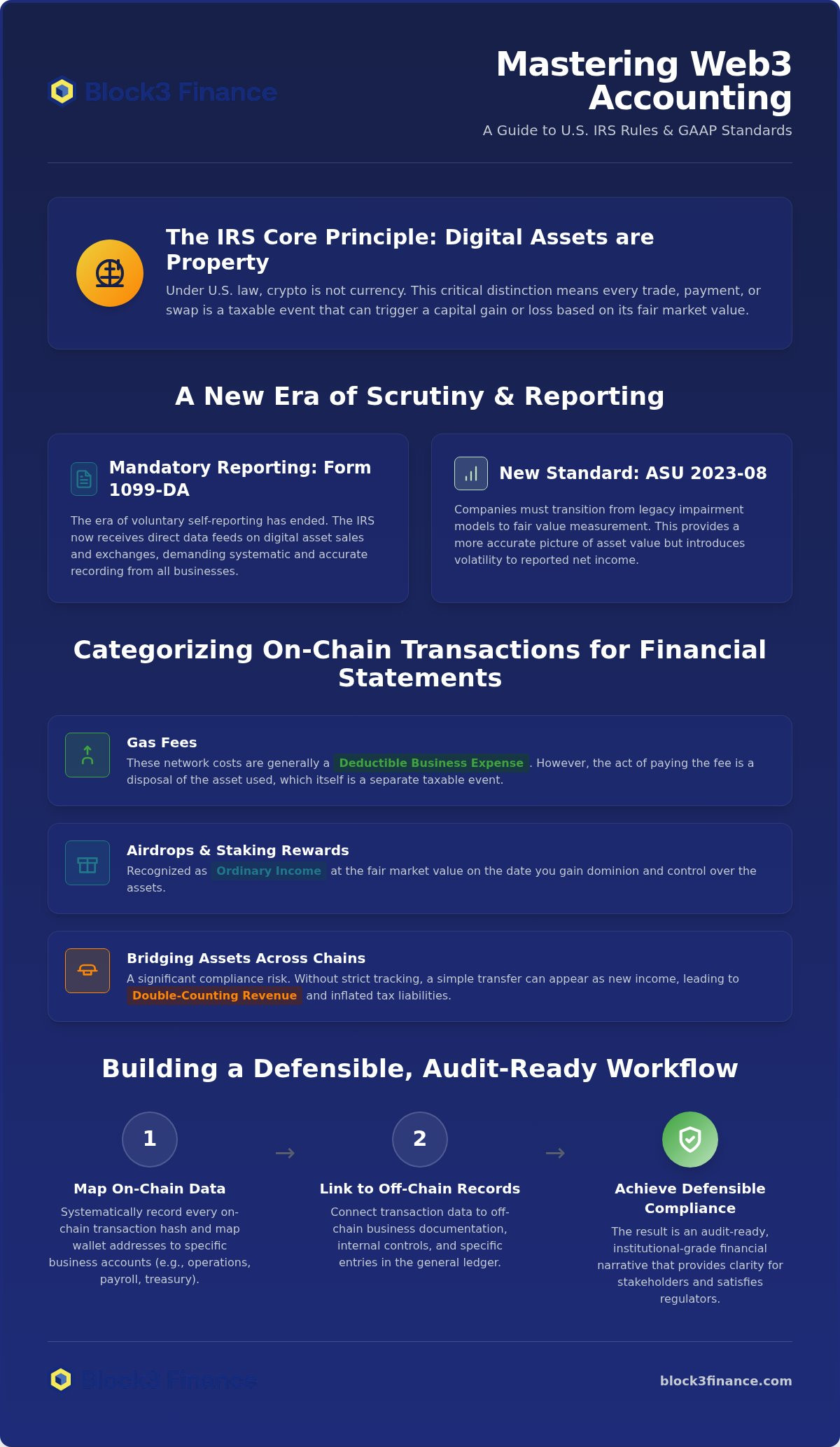
Web3 accounting is the systematic recording of every on-chain and off-chain transaction for a business entity. It transforms raw blockchain data into a structured financial narrative that satisfies both internal stakeholders and external regulators. In the United States, the IRS classifies digital assets as property rather than currency. This distinction is critical; it means every trade, payment, or swap triggers a capital gain or loss based on the fair market value at the time of the transaction. For any enterprise operating in this space, achieving a clean ledger is a high-stakes endeavor that requires a "Visionary Navigator" approach. This mindset shifts the focus from defensive compliance to offensive mastery, ensuring your project remains resilient in a volatile market.
Effective crypto accounting for web3 projects demands more than just occasional data entry. It requires a continuous reconciliation process that bridges the gap between decentralized protocols and legacy financial standards. Without this rigor, projects face significant risks, including inaccurate revenue recognition and the constant threat of IRS audits. By establishing a robust framework early, you position your project as a disciplined, institutional-grade participant in the digital economy.
The Distinction Between Bookkeeping and Tax Compliance
Daily bookkeeping tracks the operational pulse of your organization, providing the data needed to manage burn rates and runway. While tax compliance satisfies your annual IRS obligations, monthly accounting ensures your records remain defensible for future venture capital rounds or M&A activity. Investors demand transparency and verifiable data before committing capital. Maintaining clean, real-time records proves that your project is a stable enterprise rather than a chaotic experiment. Specialized software can automate much of the data ingestion, but it requires expert oversight to ensure every cryptocurrency transaction maps correctly to your specific chart of accounts.
Why Web3 Projects Require Specialized US Accountants
Traditional CPA firms often struggle with the granular nature of smart contract data. They lack the specialized tools needed to parse decentralized governance rewards or the internal controls required for multi-signature wallet oversight. Managing crypto accounting for web3 projects requires a deep understanding of how on-chain protocols interact with legacy financial systems. "Traditional accounting tools were built for fiat; Web3 accounting requires a dual-layered mastery of blockchain and legacy finance." Without this specialized expertise, projects risk missing critical deadlines, such as the new Form 1099-DA reporting mandates, which can lead to severe penalties and reputational damage.
Categorizing Complex On-Chain Transactions for Financial Statements
Mapping wallet addresses to specific business accounts is the foundational step in establishing a defensible general ledger. For enterprises, a single wallet often handles diverse transaction types, ranging from payroll to protocol fees. You must categorize these interactions with surgical precision to ensure your financial statements reflect operational reality rather than a chaotic stream of data.
Under US law, gas fees are generally considered deductible business expenses. These network costs, paid to validators to process transactions, reduce your taxable income when incurred for business purposes. According to the IRS Rules on Virtual Currency, these assets are treated as property; therefore, every fee also involves a realization of the asset used to pay it.
Airdrops and staking rewards present unique challenges for crypto accounting for web3 projects. These are typically recognized as ordinary income at their fair market value on the date you gain "dominion and control" over the assets. When your project bridges assets across chains, you must implement strict tracking to avoid double-counting revenue. Without a clear trail, a simple transfer can appear as new income, leading to inflated tax liabilities.
High-volume protocol interactions often require the use of sub-ledgers. These specialized records allow you to manage thousands of micro-transactions without cluttering your primary general ledger. If you find the volume of on-chain data overwhelming, our team can help you streamline your categorization process.
Revenue Recognition for Token Issuers
Launching a native token requires a sophisticated approach to revenue recognition. You must distinguish between locked and unlocked tokens held in the project treasury. Locked tokens generally aren't recognized as revenue until the specific vesting conditions are met. For a deeper dive into these standards, see our guide on ASU 2023-08 and Crypto Revenue Recognition.
Accounting for DeFi and Liquidity Provision
Recording impermanent loss on financial statements is a nuanced task. This loss represents the value difference between holding assets in a wallet versus providing them to a liquidity pool. While it may not be a realized loss for tax purposes until you withdraw the funds, it must be tracked for accurate financial reporting. Yield farming rewards for US-based projects are taxed as ordinary income, requiring precise documentation of every liquidity pool (LP) token movement to maintain audit readiness.
Navigating Fair Value Measurement Under ASU 2023-08
The Financial Accounting Standards Board (FASB) fundamentally altered the landscape of crypto accounting for web3 projects with the release of Accounting Standards Update (ASU) 2023-08. Historically, US entities were forced to treat digital assets as indefinite-lived intangible assets. This cost-less-impairment model was inherently one-sided; you could record a loss if prices dropped, but you could never recognize a gain if prices recovered. This created a significant disconnect between a project's reported financials and its actual market position.
The new standard mandates fair value measurement for in-scope crypto assets. This means you must measure these assets at their fair market value at each reporting period, with changes in value recognized directly in your net income. This shift provides a more current and realistic view of your financial position, finally aligning GAAP reporting with the economic reality of the digital asset market. For any enterprise, this evolution is a critical step toward achieving institutional-grade transparency.
The Strategic Advantage of Fair Value Accounting
Adopting fair value measurement allows Web3 projects to showcase their true financial strength during market upswings. Instead of a balance sheet burdened by historical costs, your financial statements now reflect the actual liquidity and value of your treasury. While this introduces more volatility to the income statement, it offers a level of transparency that institutional investors and partners now expect. If your team needs assistance transitioning to these new standards, our accounting services provide the technical oversight required for a seamless implementation.
Compliance Requirements for US Entities in 2026
Effective for fiscal years beginning after December 15, 2024, ASU 2023-08 requires specific disclosures that go beyond simple balance sheet entries. US entities must now disclose significant holdings, restricted assets, and a reconciliation of activity during the reporting period. Central to this is the fair value hierarchy, which categorizes assets into three levels:
- Level 1: Quoted prices in active markets for identical assets, such as Bitcoin or Ethereum on major exchanges.
- Level 2: Observable inputs other than quoted prices, including prices for similar assets or data from less active markets.
- Level 3: Unobservable inputs used when little market activity exists, requiring the project to develop its own valuation assumptions.
"ASU 2023-08 represents the most significant evolution in US crypto accounting, demanding precision in market-based valuation." Mastery of these rules ensures your project moves from a defensive posture to a position of strategic clarity. By embracing these standards, you demonstrate a commitment to financial discipline that sets your project apart in a competitive ecosystem.
Building an Audit-Ready Web3 Accounting Workflow
An audit-ready workflow is the bedrock of a sustainable blockchain enterprise. Establishing a clear link between on-chain hashes and off-chain invoices creates a defensible trail that traditional auditors can actually follow. Without this connection, your transactions remain anonymous strings of characters that fail to satisfy regulatory scrutiny or provide the transparency required by institutional partners.
Success in crypto accounting for web3 projects requires a disciplined monthly reconciliation of all exchange accounts and cold storage wallets. You must maintain a comprehensive basis log for every asset held by the project. Basis represents the original cost of an asset for tax purposes, and tracking it accurately is the only way to ensure your capital gains reporting is correct. Preparing for the specific demands of an IRS crypto audit requires this level of proactive documentation to avoid costly penalties and ensure your project remains compliant under US rules.
Documentation and the "Audit Trail"
A simple CSV export from a block explorer is insufficient for a professional audit. These files often lack the necessary business context, such as the specific purpose of a transfer or the identity of the counterparty. You should utilize the memo fields and transaction notes within your accounting software to document the "why" behind every movement of funds. This practice transforms a list of hashes into a meaningful financial record that can survive a rigorous review.
Your year-end audit preparation should include a rigorous checklist to ensure no detail is overlooked. Consider the following steps:
- Verify all wallet balances against your general ledger at the close of each period.
- Maintain signed off-chain contracts for every token grant or advisor agreement.
- Document the fair market value for all staking rewards or airdrops at the exact time you gained control over the assets.
Internal Controls for Digital Asset Treasuries
The concept of segregation of duties is vital for maintaining the integrity of your project's treasury. In a Web3 environment, this means the individual who initiates a transaction should not be the same person who provides the final multi-sig approval. Implementing these hurdles prevents internal fraud and reduces the risk of accidental fund loss during high-stakes operations. While hardware wallets are suitable for early-stage teams, high-growth entities should consider institutional custody solutions for enhanced security and more granular permissioning.
Effective treasury management requires a balance between operational speed and financial safety. If you are unsure if your current setup meets institutional standards, you can request a custom internal control review from our team. We help you navigate these complex environments with the technical rigor of an elite strategist, ensuring your assets remain protected as you scale.
Strategic CFO Services for High-Growth Web3 Entities
While precise bookkeeping provides the foundation, a fractional CFO acts as your strategic architect. They transform the raw data generated by crypto accounting for web3 projects into a comprehensive growth roadmap. This proactive approach ensures you aren't just reacting to regulatory changes but are actively positioning your entity for long-term scalability.
Managing runway and burn rate is particularly complex for crypto-native startups facing market volatility. A CFO optimizes your treasury by balancing liquid assets against long-term holdings, ensuring you maintain enough capital to survive extended market downturns. They also play a vital role in corporate structuring for crypto businesses, helping you select the right legal framework to protect your team and intellectual property under US law.
Efficient on-ramp and off-ramp strategies are essential for daily operations. You need reliable systems to convert digital assets into fiat for vendor payments and traditional business expenses. A CFO oversees these on and off-ramp solutions, minimizing slippage, which is the difference between the expected price of a trade and the actual price executed, and ensuring your operational flow remains uninterrupted.
Scaling with Authority: The Fractional CFO Model
High-growth projects often require elite financial talent long before they can justify the cost of a full-time executive. The fractional model allows you to leverage deep industry expertise for board reporting and investor relations at a fraction of the traditional overhead. Our CFO services provide the intellectual leadership needed to navigate complex funding rounds and maintain institutional-grade financial discipline.
Managing Global Payroll and Operations
Paying international contributors in stablecoins or native tokens introduces significant complexity to your back-office operations. While this method offers speed and efficiency, it also creates specific tax withholding obligations for US projects. You must ensure you're correctly classifying workers and adhering to IRS reporting requirements to avoid significant penalties during an audit.
Navigating these global operational hurdles requires a partner who understands both blockchain mechanics and legacy tax law. We invite you to contact the Block3 Finance team for a strategic consultation. We'll help you build a robust operational framework that supports your global ambitions while maintaining strict compliance with US standards.
Master Your Financial Evolution
The shift toward fair value measurement under ASU 2023-08 and the implementation of Form 1099-DA mark a new chapter for US-based digital asset enterprises. You now have the tools to move beyond a defensive posture. You can instead embrace financial transparency as a strategic advantage. By establishing a robust audit trail and leveraging specialized CFO oversight, you ensure your project remains resilient against regulatory shifts and market volatility.
The complexities of crypto accounting for web3 projects demand a partner with the technical depth to bridge decentralized protocols and legacy standards. As the firm ranked #1 by Bitcoin.com, Block3 Finance brings 13+ years of blockchain financial expertise to your organization. We specialize in ASU 2023-08 compliance, providing the white-glove corporate oversight necessary to turn complex on-chain data into defensible financial records.
Secure your Web3 project’s financial future-Contact our experts today. You have the vision to build the future. Let us provide the roadmap to ensure it rests on a foundation of total financial command.
Frequently Asked Questions
How does the IRS view Web3 project treasuries?
The IRS views Web3 project treasuries as property holdings rather than cash reserves. Every time a treasury disposes of or exchanges a digital asset, it triggers a taxable event based on the fair market value at that specific moment. Maintaining a project treasury requires rigorous tracking of cost basis to ensure accurate capital gains or losses are reported during the annual filing process under current federal tax laws.
Can a Web3 project use traditional accounting software like QuickBooks?
A Web3 project can use QuickBooks, but it cannot function as a standalone solution for on-chain data. You must integrate a specialized crypto sub-ledger to parse blockchain transactions before syncing them with your traditional general ledger. This dual-layered approach ensures that high-volume protocol interactions are properly categorized as business expenses or revenue while maintaining the financial structure required for standard corporate reporting.
What are the biggest crypto accounting mistakes Web3 startups make?
The most frequent mistake is the failure to separate project-related wallet activity from personal or unrelated transactions. Startups also often neglect to document the business purpose of gas fees or fail to record the fair market value of tokens at the exact time of receipt. These oversights create significant friction during audits and can lead to inflated tax liabilities if revenue recognition is handled incorrectly from the start.
How does ASU 2023-08 change how I report my crypto assets?
ASU 2023-08 mandates a shift from the cost-less-impairment model to fair value measurement for certain digital assets. This means you must report your holdings at their current market value at the end of each reporting period. While this adds volatility to your income statement, it allows your balance sheet to reflect the true economic value of your treasury, providing greater transparency for investors and stakeholders.
Do Web3 projects need to issue 1099s to contractors paid in crypto?
Yes, US-based Web3 projects must issue Form 1099-NEC to contractors if they pay them $600 or more in digital assets during a calendar year. The value reported on the form is the fair market value of the cryptocurrency at the time the payment is made. Failing to meet these reporting obligations can result in significant IRS penalties and increased scrutiny of your project’s payroll operations.
What happens if our Web3 project is audited by the IRS?
If the IRS audits your project, they will request a comprehensive list of all wallet addresses and a detailed ledger of every on-chain transaction. You must provide proof of cost basis and documentation for every revenue event, such as airdrops or staking rewards. Having an audit-ready workflow with linked off-chain invoices is the best way to resolve these inquiries quickly and protect your project’s treasury.
Is a DAO considered a corporation or a partnership for US tax purposes?
The IRS typically treats a DAO as a taxable entity, often classifying it as a partnership or a corporation depending on its activities. If a DAO has not formally incorporated, the IRS may categorize it as a general partnership by default. This classification passes tax obligations directly to the individual members. Navigating these classifications requires careful corporate structuring to ensure your DAO isn't exposed to unexpected federal tax liabilities.
How often should a Web3 project reconcile its on-chain transactions?
You should reconcile your on-chain transactions at least once a month to maintain accurate financial clarity. Monthly reconciliation allows you to catch categorization errors early and ensures your burn rate calculations remain current. This disciplined rhythm is essential for high-growth projects that need to manage runway effectively while preparing for the rigorous demands of crypto accounting for web3 projects under US standards.

Article by
Mahad Mohamed
Mahad Mohamed is an accountant and the CEO of Block3 Finance, with over 26+ years of Canadian and international tax and accounting experience. A crypto accounting specialist since the early days of Bitcoin, he has consulted for over 38 crypto companies and collaborated with legal professionals on regulatory matters. His expertise spans corporate reorganization, cross-border tax structuring (Canada & US), tax disputes, and CRA audits.
Previously, Mahad worked for the Canada Revenue Agency (CRA), Big4 accounting firms, and served as a Rulings Officer for the Federal Tax Authority of the UAE before acquiring Tax Partners in 2014.
Block3 Finance and Tax Partners has 44 full-time accountants and over 9,800+ clients.
Disclaimer
This article provides general information only and is current as of its publication date. It has not been updated and may be out of date. It does not constitute legal advice and should not be relied upon as such. Every tax situation is unique and may differ from the examples discussed in this article. If you have specific questions, you should seek the advice of our accountants for your unique circumstances.
Frequently Asked Questions
How does the IRS view Web3 project treasuries?
The IRS views Web3 project treasuries as property holdings rather than cash reserves. Every time a treasury disposes of or exchanges a digital asset, it triggers a taxable event based on the fair market value at that specific moment. Maintaining a project treasury requires rigorous tracking of cost basis to ensure accurate capital gains or losses are reported during the annual filing process under current federal tax laws.
Can a Web3 project use traditional accounting software like QuickBooks?
A Web3 project can use QuickBooks, but it cannot function as a standalone solution for on-chain data. You must integrate a specialized crypto sub-ledger to parse blockchain transactions before syncing them with your traditional general ledger. This dual-layered approach ensures that high-volume protocol interactions are properly categorized as business expenses or revenue while maintaining the financial structure required for standard corporate reporting.
What are the biggest crypto accounting mistakes Web3 startups make?
The most frequent mistake is the failure to separate project-related wallet activity from personal or unrelated transactions. Startups also often neglect to document the business purpose of gas fees or fail to record the fair market value of tokens at the exact time of receipt. These oversights create significant friction during audits and can lead to inflated tax liabilities if revenue recognition is handled incorrectly from the start.
How does ASU 2023-08 change how I report my crypto assets?
ASU 2023-08 mandates a shift from the cost-less-impairment model to fair value measurement for certain digital assets. This means you must report your holdings at their current market value at the end of each reporting period. While this adds volatility to your income statement, it allows your balance sheet to reflect the true economic value of your treasury, providing greater transparency for investors and stakeholders.
Do Web3 projects need to issue 1099s to contractors paid in crypto?
Yes, US-based Web3 projects must issue Form 1099-NEC to contractors if they pay them $600 or more in digital assets during a calendar year. The value reported on the form is the fair market value of the cryptocurrency at the time the payment is made. Failing to meet these reporting obligations can result in significant IRS penalties and increased scrutiny of your project’s payroll operations.
What happens if our Web3 project is audited by the IRS?
If the IRS audits your project, they will request a comprehensive list of all wallet addresses and a detailed ledger of every on-chain transaction. You must provide proof of cost basis and documentation for every revenue event, such as airdrops or staking rewards. Having an audit-ready workflow with linked off-chain invoices is the best way to resolve these inquiries quickly and protect your project’s treasury.
Is a DAO considered a corporation or a partnership for US tax purposes?
The IRS typically treats a DAO as a taxable entity, often classifying it as a partnership or a corporation depending on its activities. If a DAO has not formally incorporated, the IRS may categorize it as a general partnership by default. This classification passes tax obligations directly to the individual members. Navigating these classifications requires careful corporate structuring to ensure your DAO isn't exposed to unexpected federal tax liabilities.
How often should a Web3 project reconcile its on-chain transactions?
You should reconcile your on-chain transactions at least once a month to maintain accurate financial clarity. Monthly reconciliation allows you to catch categorization errors early and ensures your burn rate calculations remain current. This disciplined rhythm is essential for high-growth projects that need to manage runway effectively while preparing for the rigorous demands of crypto accounting for web3 projects under US standards.