
What if your greatest financial risk isn't market volatility, but the invisible friction between your exchange exports and the reality of the blockchain? You've likely felt the mounting pressure of trying to justify a cost basis, which represents the original value of an asset for tax purposes, typically the purchase price plus transaction fees, that doesn't seem to exist across fragmented DeFi protocols. It's an exhausting cycle. Manual adjustments leave even the most disciplined investors feeling exposed. This guide masters the methodology of how to reconcile crypto transactions under IRS rules, turning your raw on-chain data into institutional-grade financial records that stand up to the highest level of federal scrutiny.
We provide a clear roadmap for achieving total command over your digital assets before the April 15, 2026, filing deadline. You'll learn to resolve discrepancies before they trigger an audit and manage the specific requirements for U.S. taxpayers, such as the reporting mandates on Form 1099-DA. By the end of this guide, you'll move from a defensive posture to one of absolute confidence; you will be equipped with a clean set of books and a precise calculation of your tax liability under IRS guidelines.
Key Takeaways
- Learn the systematic approach to how to reconcile crypto transactions by aligning disparate on-chain data with actual wallet balances to ensure your records are audit-ready.
- Differentiate between the specific 2026 reporting mandates for IRS filers in the United States and the capital gains inclusion rules for CRA filers in Canada.
- Master the data aggregation phase by identifying all endpoints, from cold storage to complex DeFi protocols, ensuring no transaction is left unaccounted for.
- Gain the expertise to resolve common accounting friction points such as "Ghost Transactions" and the correct classification of income events like staking or airdrops.
- Discover how to transition from reactive tax filing to proactive financial command by scaling your Web3 infrastructure with professional monthly accounting.
The Fundamentals of Crypto Transaction Reconciliation under IRS Rules
Reconciliation is the disciplined verification process that ensures your internal financial records perfectly mirror your actual blockchain balances. It's the bridge between raw data and institutional-grade clarity. For any digital asset holder, understanding how to reconcile crypto transactions involves more than just syncing an app; it requires a systematic comparison of your accounting ledger against the ground truth of your wallets. This process identifies every discrepancy, from missed network fees to duplicate entries, ensuring your reported figures are both complete and defensible.
The complexity of this task often stems from the friction between "on-chain" and "off-chain" data sources. On-chain data refers to the transparent, immutable history recorded directly on a blockchain ledger, whereas off-chain data consists of the private internal records held by centralized exchanges (CEXs). While automation can assist in bridging these datasets, software often fails to interpret complex events like liquidations or chain splits correctly. Relying solely on automated tools without professional monthly accounting oversight creates significant risks, as unverified errors can compound over time and lead to inaccurate tax reporting.
Why Reconciliation is Mandatory for IRS Compliance
Under U.S. virtual currency law, the IRS treats digital assets as property, which necessitates a precise accounting of every disposal. To remain compliant, taxpayers must utilize a consistent methodology to determine which units are being sold. Many filers opt for First-In, First-Out (FIFO), an accounting principle that assumes the first assets you acquired are the first ones sold or disposed of. Alternatively, you may use Specific Identification if you can provide detailed records for each unit. Accurate reconciliation allows you to justify these choices, providing the necessary evidence to support your Form 8949 filings and establish a clear cost basis for every trade.
Maintaining an audit-ready transaction log is the only way to protect your agency in a high-stakes regulatory environment. The IRS requires you to document the date, time, and fair market value of every transaction in U.S. dollars. Without a reconciled set of books, you may struggle to prove the origin of your funds or the accuracy of your capital gains. By mastering the fundamentals of reconciliation, you transition from a defensive posture to one of absolute command, ensuring your financial infrastructure is built on a foundation of verified truth rather than automated guesswork.
Phase 1: Aggregating Your Digital Asset Data Across Exchanges and Wallets
Data aggregation is the bedrock of a defensible tax return. Before you can address the nuances of how to reconcile crypto transactions, you must first consolidate every digital touchpoint into a single source of truth. This includes your centralized exchange (CEX) accounts, hardware wallets like Ledger or Trezor, and the multitude of DeFi protocols where your assets may be earning yield. In 2026, the complexity of the ecosystem has scaled; you must account for fragmented data across Layer 2 (L2) solutions and sidechains where reporting standards are still maturing. Missing even a single "endpoint" results in a broken cost basis chain, leading to inaccurate tax liabilities that attract unwanted regulatory attention.
The friction in data collection often stems from the variety of formats used by different platforms. While a CEX might provide a streamlined report, a self-custody wallet requires you to pull data directly from a block explorer. If you find the technical requirements of this phase overwhelming, you can reach out to our specialists to ensure your data foundation is secure and complete.
The API vs. CSV Debate for Data Accuracy
Choosing between API synchronization and manual CSV exports is a strategic decision. APIs offer the convenience of real-time updates and are generally faster to implement; for developers building financial platforms that require secure bank data integration, click here to see how Wealthreader's aggregation API facilitates fintech growth. However, they can be blind to certain transaction types, such as specific airdrops or complex liquidity pool interactions. Manual CSV (Comma Separated Values) files are often necessary for "deep" historical data and serve as the ultimate source of truth when an API fails. Following IRS guidelines on reporting digital assets requires a level of granular detail that only a hybrid approach can reliably deliver. When using CSVs, ensure your column headers match your accounting software requirements to prevent import errors that could distort your financial records.
Mapping Internal Transfers to Avoid Double Taxation
Wallet mapping is the process of identifying "Self-Transfers" to ensure they aren't incorrectly flagged as taxable disposals. When you move assets from a CEX to a hardware wallet, many software tools default to treating the withdrawal as a sale and the deposit as new income. Under IRS rules, and similarly for CRA filers, moving assets between wallets you own is a non-taxable event. You must manually match an "Outgoing" transaction from Wallet A to an "Incoming" at Wallet B to preserve your original cost basis. This meticulous matching is a core component of how to reconcile crypto transactions because it eliminates the phantom gains that frequently lead to tax overpayment.
A Step-by-Step Guide to Reconciling Crypto Transactions
Mastering how to reconcile crypto transactions requires a methodical transition from raw data collection to verified financial finality. Once you've aggregated your data, the first step is to identify "Uncategorized" transactions that lack a clear source or destination. These gaps often represent the most significant risk during an audit, as they can lead to an incorrect cost basis. You'll then need to classify income events, such as staking rewards or mining proceeds, which are treated differently than capital gains. This process ensures your monthly accounting remains accurate and reflects the actual movement of your assets across the blockchain.
This phase of how to reconcile crypto transactions also involves resolving "Missing Purchase History." This occurs when you receive an asset in a wallet but the accounting software cannot find the original acquisition transaction, often due to transfers from defunct exchanges or forgotten wallets. After resolving these discrepancies, you must verify your ending balances against real-time blockchain explorers to ensure the ledger matches your actual holdings. Finally, you should lock your books for the fiscal year; this prevents retroactive changes from destabilizing your historical data and ensures that your filings for the April 2026 deadline are based on a permanent record.
Classifying Income Under IRS and CRA Rules
Under IRS rules, the tax authority requires you to report staking and mining rewards as ordinary income at their Fair Market Value (FMV) on the date of receipt. Fair Market Value is defined as the price an asset would sell for on the open market at the exact moment you gain control of it. You can find more detail in the IRS guidance on virtual currency transactions. For CRA filers, the distinction is slightly different. The CRA evaluates whether your activity constitutes business income or a hobby. If the CRA determines you're operating a business, 100% of your profits are taxable, whereas capital gains treatment only taxes 50% of the gain.
Establishing the Adjusted Cost Base (ACB) for Canada
For Canadian taxpayers, the CRA mandates the use of the Adjusted Cost Base (ACB) method. The ACB is the average cost of all identical properties you own, and it must be recalculated every time you acquire new units of a specific cryptocurrency. It's vital to account for the "Superficial Loss" rule, which prevents you from claiming a capital loss if you buy the same asset within 30 days before or after the sale. If you don't account for this rule during reconciliation, you may inadvertently claim disallowed losses, leading to potential penalties during a CRA review. Always verify current CRA thresholds and specific provincial rules to ensure your calculations are precise.
Resolving Common Discrepancies: Missing Cost Basis and Ghost Transactions
Effective reconciliation often feels like forensic accounting. You will inevitably encounter "Ghost Transactions," which are withdrawals from one platform that lack a corresponding deposit at another. These gaps occur when an API fails to capture a transfer or when you've forgotten to link a specific wallet. To maintain a clean ledger, you must manually trace these movements to ensure your accounting software doesn't default to treating them as taxable sales. This is a critical step in how to reconcile crypto transactions because it prevents the inflation of your realized gains. You must also address "Wrapped" tokens, such as WBTC. Under IRS rules, swapping BTC for WBTC is generally treated as a taxable exchange of different properties; a rule that similarly applies to CRA filers who must recognize a gain or loss on the trade.
Handling "Zero-Value" tokens from rug pulls or failed projects requires a disciplined approach. Under IRS rules, you generally can't claim a loss on a token until a disposal event occurs, such as:
- Selling the asset for a negligible amount on a decentralized exchange.
- Sending the tokens to a "burn" address to document abandonment.
- A documented platform failure where the asset is no longer accessible.
For CRA filers, the treatment is similar; you must demonstrate that the asset is truly worthless to realize a capital loss. Additionally, you should integrate gas fees and transaction costs directly into your cost basis. These costs reduce your overall gain or increase your loss, providing a more accurate reflection of your financial performance. If you're managing high volumes of these complex entries, you can consult with our crypto tax accountants to ensure every discrepancy is resolved with precision.
How to Find Missing Purchase Prices
When purchase history is missing, blockchain explorers like Etherscan or Solscan are your most reliable tools. You can use these explorers to find the historical Fair Market Value (FMV) of an asset at the exact time of the transaction. For tokens not listed on major exchanges, you must manually enter a "Fair Value" based on the most reliable data available, such as decentralized exchange prices. Establishing a framework for institutional-grade records ensures that these manual entries are documented and defensible in the event of an audit.
Dealing with Complex DeFi and Liquidity Pools
Reconciling Liquidity Pool (LP) transactions is notoriously difficult due to the "Mint/Burn" versus "Swap" interpretations. Some software treats the deposit of assets into a pool as a taxable swap for an LP token, while others view it as a non-taxable transfer. Under IRS rules, the swap interpretation is often the safer, more conservative stance. You must also account for yield farming rewards that accrue in real-time, which are generally taxed as income upon receipt. Be cautious of "Impermanent Loss," as this is a paper loss that only becomes realized for tax purposes once you withdraw your liquidity and dispose of the assets.
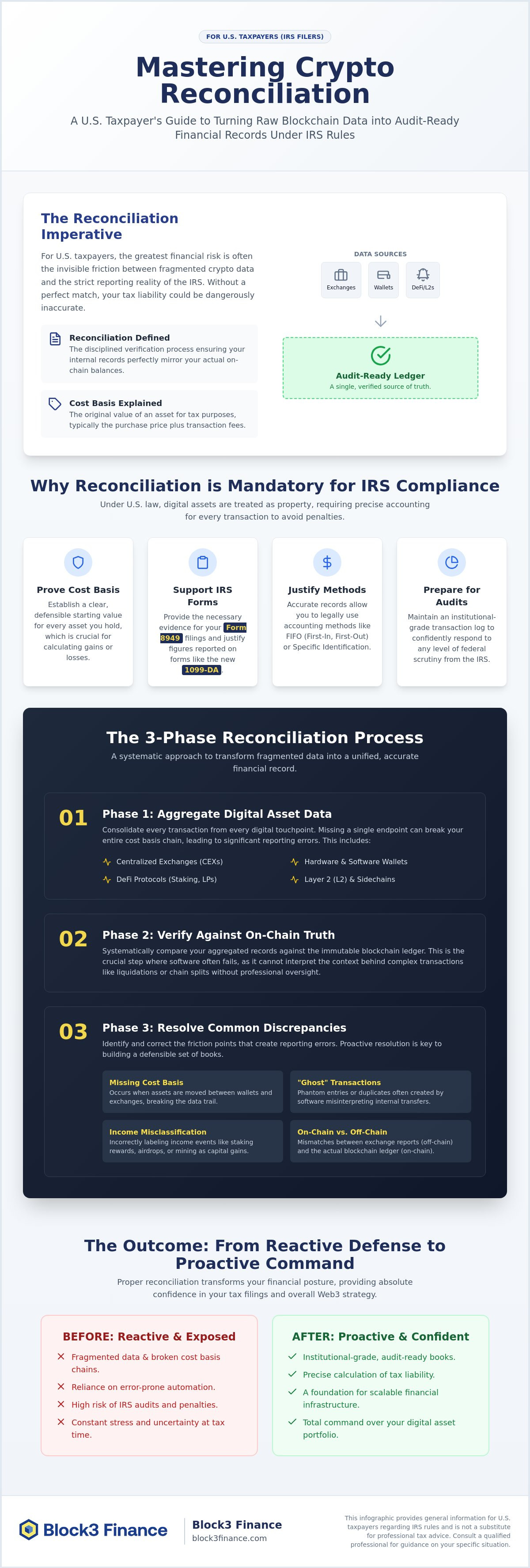
Scaling Your Web3 Financial Infrastructure with Professional Oversight
Navigating the transition from reactive compliance to proactive asset management defines the next phase of your digital journey. While software tools provide the initial calculations, they often lack the intellectual depth required to interpret the complex interplay between DeFi protocols and evolving tax codes. For high-volume traders and institutional-grade Web3 firms, mastering how to reconcile crypto transactions is the foundation of a broader strategy for financial mastery. Relying solely on automation invites risk; professional oversight ensures that your data isn't just processed, but meticulously verified. By implementing Monthly Accounting, you move beyond the frantic energy of tax season and maintain a permanent state of audit-readiness.
Strategic growth requires more than just clean books. It demands the specialized insight found in Fractional CFO Services, which bridge the gap between blockchain activity and corporate treasury management. This shift allows you to move from a defensive posture, focused on avoiding penalties, to an offensive one where your financial data drives your evolution. You gain total command over your landscape, transforming your reconciliation process into a powerful tool for scaling your operations with confidence. This discipline ensures that your financial vision and execution remain inseparable as the industry matures.
When to Move Beyond DIY Reconciliation
Identifying the threshold of complexity is essential for protecting your agency. If your activity exceeds 1,000 transactions annually or involves DAO participation and multi-signature treasury management, the DIY approach becomes a liability. Professionals create a defensible audit trail that software alone cannot replicate, providing the intellectual leadership needed to navigate high-stakes environments. This level of preparation is particularly vital for those facing a CRA Crypto Audit under Canadian rules, where the burden of proof rests entirely on the taxpayer to justify their Adjusted Cost Base. Similarly, under IRS rules, having a verified record of your specific identification choices is the only way to ensure your 2026 filings remain secure against rigorous scrutiny.
The Block3 Finance Approach to Digital Asset Integrity
We provide a white-glove service that resolves the friction between on-chain reality and legacy financial reporting. Our team acts as your visionary navigator, employing specialized Tax Services to ensure global compliance across both U.S. and Canadian jurisdictions. We don't just provide a service; we offer a roadmap for thriving in a volatile industry. Our methodology ensures that every transaction is accounted for, every cost basis is verified, and every tax liability is calculated with absolute precision. Schedule a consultation with Block3 Finance to gain total command over your digital asset legacy and master your crypto finances for the 2026 filing season.
Mastering Your Digital Asset Legacy
The journey from on-chain complexity to institutional-grade clarity requires more than just software; it demands a rigorous methodology for data integrity. You've learned that precise data aggregation and the resolution of discrepancies like "Ghost Transactions" are essential for maintaining a defensible cost basis. By following the specific 2026 mandates for either IRS or CRA filers, you transform your accounting from a seasonal burden into a strategic advantage. This discipline of how to reconcile crypto transactions ensures your financial records reflect the true scale of your success and withstand any level of regulatory scrutiny.
As a top-ranked provider by Bitcoin.com with over 13 years of blockchain financial expertise, Block3 Finance serves more than 980 clients globally, including prominent DAOs and high-growth Web3 startups. We help you navigate the friction of compliance so you can focus on cultivation and innovation. Secure your financial future with specialized Crypto Accounting and Tax Services from Block3 Finance. You have the power to turn volatile data into a clean set of books. Take command of your financial performance and move forward with absolute confidence.
Frequently Asked Questions
How often should I reconcile my crypto transactions?
Monthly reconciliation is the institutional standard for maintaining audit readiness and financial visibility. Waiting until the April 15, 2026, deadline for IRS filers or the April 30, 2026, deadline for most CRA filers creates unnecessary friction and increases the risk of data gaps. Regular reviews allow you to resolve discrepancies in real time, ensuring your books remain a reliable source of truth throughout the fiscal year.
Can I use Excel for crypto reconciliation if I have few transactions?
You can utilize Excel for basic reconciliation if your transaction volume is minimal, but it requires manual entry of historical fair market values for every trade. This manual approach often becomes unsustainable as you scale into DeFi or staking, where the complexity of how to reconcile crypto transactions demands specialized software. For most investors, the risk of manual calculation errors outweighs the perceived cost savings of a spreadsheet.
What is the difference between a transfer and a swap in crypto accounting?
A transfer is a non-taxable movement of assets between wallets you own, whereas a swap is a taxable disposal of one asset to acquire another. Under IRS rules, and similarly for CRA filers, you must match outgoing and incoming transfers to preserve your original cost basis and avoid phantom gains. Swaps require an immediate calculation of capital gains or losses based on the fair market value at the moment of the trade.
How does the IRS treat gas fees for failed transactions?
The IRS generally allows you to treat gas fees for failed transactions as a deductible loss or an investment expense in the year they occur. Because the transaction didn't result in the acquisition of an asset, these fees can't be added to a cost basis. You should maintain clear records of these failed attempts to justify the deduction on your 2025 tax return filed in 2026.
What happens if I cannot find the original purchase price of a token?
If the original purchase price is missing, you must use blockchain explorers to find the historical fair market value at the time of acquisition. If you can't provide a defensible price, the IRS or CRA may assign a zero-dollar cost basis to the asset. This results in you paying tax on the entire proceeds of a future sale, which significantly inflates your tax liability.
Does the CRA require me to report every single micro-transaction?
Yes, the CRA requires you to maintain records for every transaction, regardless of size, to accurately calculate your Adjusted Cost Base. For CRA filers, even micro-transactions for digital goods or services are considered disposals of a commodity. Failing to track these small events can lead to discrepancies in your ending balances and potential penalties during a CRA review of your 2025 or 2026 filings.
Is crypto-to-crypto trading a taxable event in 2026?
Crypto-to-crypto trading remains a taxable event for both IRS and CRA filers in 2026. Each trade is viewed as a sale of one property followed by the purchase of another. You must report the gain or loss on the sold asset using its fair market value in your local currency at the time of the transaction to remain compliant with federal tax laws.
How do I reconcile airdropped tokens that I never asked for?
You must report airdropped tokens as ordinary income based on their fair market value at the moment you gain dominion and control over them. For both IRS and CRA filers, this receipt establishes your initial cost basis for the new asset. Even if you didn't solicit the airdrop, the tax authorities view the receipt of these assets as a taxable increase in wealth that requires precise documentation.

Article by
Mahad Mohamed
Mahad Mohamed is an accountant and the CEO of Block3 Finance, with over 26+ years of Canadian and international tax and accounting experience. A crypto accounting specialist since the early days of Bitcoin, he has consulted for over 38 crypto companies and collaborated with legal professionals on regulatory matters. His expertise spans corporate reorganization, cross-border tax structuring (Canada & US), tax disputes, and CRA audits.
Previously, Mahad worked for the Canada Revenue Agency (CRA), Big4 accounting firms, and served as a Rulings Officer for the Federal Tax Authority of the UAE before acquiring Tax Partners in 2014.
Block3 Finance and Tax Partners has 44 full-time accountants and over 9,800+ clients.
Disclaimer
This article provides general information only and is current as of its publication date. It has not been updated and may be out of date. It does not constitute legal advice and should not be relied upon as such. Every tax situation is unique and may differ from the examples discussed in this article. If you have specific questions, you should seek the advice of our accountants for your unique circumstances.
Frequently Asked Questions
Why Reconciliation is Mandatory for IRS Compliance
Under U.S. virtual currency law, the IRS treats digital assets as property, which necessitates a precise accounting of every disposal. To remain compliant, taxpayers must utilize a consistent methodology to determine which units are being sold. Many filers opt for First-In, First-Out (FIFO), an accounting principle that assumes the first assets you acquired are the first ones sold or disposed of. Alternatively, you may use Specific Identification if you can provide detailed records for each unit. Accurate reconciliation allows you to justify these choices, providing the necessary evidence to support your Form 8949 filings and establish a clear cost basis for every trade. Maintaining an audit-ready transaction log is the only way to protect your agency in a high-stakes regulatory environment. The IRS requires you to document the date, time, and fair market value of every transaction in U.S. dollars. Without a reconciled set of books, you may struggle to prove the origin of your funds or the accuracy of your capital gains. By mastering the fundamentals of reconciliation, you transition from a defensive posture to one of absolute command, ensuring your financial infrastructure is built on a foundation of verified truth rather than automated guesswork. Data aggregation is the bedrock of a defensible tax return. Before you can address the nuances of how to reconcile crypto transactions, you must first consolidate every digital touchpoint into a single source of truth. This includes your centralized exchange (CEX) accounts, hardware wallets like Ledger or Trezor, and the multitude of DeFi protocols where your assets may be earning yield. In 2026, the complexity of the ecosystem has scaled; you must account for fragmented data across Layer 2 (L2) solutions and sidechains where reporting standards are still maturing. Missing even a single "endpoint" results in a broken cost basis chain, leading to inaccurate tax liabilities that attract unwanted regulatory attention. The friction in data collection often stems from the variety of formats used by different platforms. While a CEX might provide a streamlined report, a self-custody wallet requires you to pull data directly from a block explorer. If you find the technical requirements of this phase overwhelming, you can reach out to our specialists to ensure your data foundation is secure and complete.
The API vs. CSV Debate for Data Accuracy
Choosing between API synchronization and manual CSV exports is a strategic decision. APIs offer the convenience of real-time updates and are generally faster to implement. However, they can be blind to certain transaction types, such as specific airdrops or complex liquidity pool interactions. Manual CSV (Comma Separated Values) files are often necessary for "deep" historical data and serve as the ultimate source of truth when an API fails. Following IRS guidelines on reporting digital assets requires a level of granular detail that only a hybrid approach can reliably deliver. When using CSVs, ensure your column headers match your accounting software requirements to prevent import errors that could distort your financial records.
Mapping Internal Transfers to Avoid Double Taxation
Wallet mapping is the process of identifying "Self-Transfers" to ensure they aren't incorrectly flagged as taxable disposals. When you move assets from a CEX to a hardware wallet, many software tools default to treating the withdrawal as a sale and the deposit as new income. Under IRS rules, and similarly for CRA filers, moving assets between wallets you own is a non-taxable event. You must manually match an "Outgoing" transaction from Wallet A to an "Incoming" at Wallet B to preserve your original cost basis. This meticulous matching is a core component of how to reconcile crypto transactions because it eliminates the phantom gains that frequently lead to tax overpayment. Mastering how to reconcile crypto transactions requires a methodical transition from raw data collection to verified financial finality. Once you've aggregated your data, the first step is to identify "Uncategorized" transactions that lack a clear source or destination. These gaps often represent the most significant risk during an audit, as they can lead to an incorrect cost basis. You'll then need to classify income events, such as staking rewards or mining proceeds, which are treated differently than capital gains. This process ensures your monthly accounting remains accurate and reflects the actual movement of your assets across the blockchain. This phase of how to reconcile crypto transactions also involves resolving "Missing Purchase History." This occurs when you receive an asset in a wallet but the accounting software cannot find the original acquisition transaction, often due to transfers from defunct exchanges or forgotten wallets. After resolving these discrepancies, you must verify your ending balances against real-time blockchain explorers to ensure the ledger matches your actual holdings. Finally, you should lock your books for the fiscal year; this prevents retroactive changes from destabilizing your historical data and ensures that your filings for the April 2026 deadline are based on a permanent record.
Classifying Income Under IRS and CRA Rules
Under IRS rules, the tax authority requires you to report staking and mining rewards as ordinary income at their Fair Market Value (FMV) on the date of receipt. Fair Market Value is defined as the price an asset would sell for on the open market at the exact moment you gain control of it. You can find more detail in the IRS guidance on virtual currency transactions. For CRA filers, the distinction is slightly different. The CRA evaluates whether your activity constitutes business income or a hobby. If the CRA determines you're operating a business, 100% of your profits are taxable, whereas capital gains treatment only taxes 50% of the gain.
Establishing the Adjusted Cost Base (ACB) for Canada
For Canadian taxpayers, the CRA mandates the use of the Adjusted Cost Base (ACB) method. The ACB is the average cost of all identical properties you own, and it must be recalculated every time you acquire new units of a specific cryptocurrency. It's vital to account for the "Superficial Loss" rule, which prevents you from claiming a capital loss if you buy the same asset within 30 days before or after the sale. If you don't account for this rule during reconciliation, you may inadvertently claim disallowed losses, leading to potential penalties during a CRA review. Always verify current CRA thresholds and specific provincial rules to ensure your calculations are precise. Effective reconciliation often feels like forensic accounting. You will inevitably encounter "Ghost Transactions," which are withdrawals from one platform that lack a corresponding deposit at another. These gaps occur when an API fails to capture a transfer or when you've forgotten to link a specific wallet. To maintain a clean ledger, you must manually trace these movements to ensure your accounting software doesn't default to treating them as taxable sales. This is a critical step in how to reconcile crypto transactions because it prevents the inflation of your realized gains. You must also address "Wrapped" tokens, such as WBTC. Under IRS rules, swapping BTC for WBTC is generally treated as a taxable exchange of different properties; a rule that similarly applies to CRA filers who must recognize a gain or loss on the trade. Handling "Zero-Value" tokens from rug pulls or failed projects requires a disciplined approach. Under IRS rules, you generally can't claim a loss on a token until a disposal event occurs, such as: For CRA filers, the treatment is similar; you must demonstrate that the asset is truly worthless to realize a capital loss. Additionally, you should integrate gas fees and transaction costs directly into your cost basis. These costs reduce your overall gain or increase your loss, providing a more accurate reflection of your financial performance. If you're managing high volumes of these complex entries, you can consult with our crypto tax accountants to ensure every discrepancy is resolved with precision.
How to Find Missing Purchase Prices
When purchase history is missing, blockchain explorers like Etherscan or Solscan are your most reliable tools. You can use these explorers to find the historical Fair Market Value (FMV) of an asset at the exact time of the transaction. For tokens not listed on major exchanges, you must manually enter a "Fair Value" based on the most reliable data available, such as decentralized exchange prices. Establishing a framework for institutional-grade records ensures that these manual entries are documented and defensible in the event of an audit.
Dealing with Complex DeFi and Liquidity Pools
Reconciling Liquidity Pool (LP) transactions is notoriously difficult due to the "Mint/Burn" versus "Swap" interpretations. Some software treats the deposit of assets into a pool as a taxable swap for an LP token, while others view it as a non-taxable transfer. Under IRS rules, the swap interpretation is often the safer, more conservative stance. You must also account for yield farming rewards that accrue in real-time, which are generally taxed as income upon receipt. Be cautious of "Impermanent Loss," as this is a paper loss that only becomes realized for tax purposes once you withdraw your liquidity and dispose of the assets. Navigating the transition from reactive compliance to proactive asset management defines the next phase of your digital journey. While software tools provide the initial calculations, they often lack the intellectual depth required to interpret the complex interplay between DeFi protocols and evolving tax codes. For high-volume traders and institutional-grade Web3 firms, mastering how to reconcile crypto transactions is the foundation of a broader strategy for financial mastery. Relying solely on automation invites risk; professional oversight ensures that your data isn't just processed, but meticulously verified. By implementing Monthly Accounting, you move beyond the frantic energy of tax season and maintain a permanent state of audit-readiness. Strategic growth requires more than just clean books. It demands the specialized insight found in Fractional CFO Services, which bridge the gap between blockchain activity and corporate treasury management. This shift allows you to move from a defensive posture, focused on avoiding penalties, to an offensive one where your financial data drives your evolution. You gain total command over your landscape, transforming your reconciliation process into a powerful tool for scaling your operations with confidence. This discipline ensures that your financial vision and execution remain inseparable as the industry matures.
When to Move Beyond DIY Reconciliation
Identifying the threshold of complexity is essential for protecting your agency. If your activity exceeds 1,000 transactions annually or involves DAO participation and multi-signature treasury management, the DIY approach becomes a liability. Professionals create a defensible audit trail that software alone cannot replicate, providing the intellectual leadership needed to navigate high-stakes environments. This level of preparation is particularly vital for those facing a CRA Crypto Audit under Canadian rules, where the burden of proof rests entirely on the taxpayer to justify their Adjusted Cost Base. Similarly, under IRS rules, having a verified record of your specific identification choices is the only way to ensure your 2026 filings remain secure against rigorous scrutiny.
The Block3 Finance Approach to Digital Asset Integrity
We provide a white-glove service that resolves the friction between on-chain reality and legacy financial reporting. Our team acts as your visionary navigator, employing specialized Tax Services to ensure global compliance across both U.S. and Canadian jurisdictions. We don't just provide a service; we offer a roadmap for thriving in a volatile industry. Our methodology ensures that every transaction is accounted for, every cost basis is verified, and every tax liability is calculated with absolute precision. Schedule a consultation with Block3 Finance to gain total command over your digital asset legacy and master your crypto finances for the 2026 filing season. The journey from on-chain complexity to institutional-grade clarity requires more than just software; it demands a rigorous methodology for data integrity. You've learned that precise data aggregation and the resolution of discrepancies like "Ghost Transactions" are essential for maintaining a defensible cost basis. By following the specific 2026 mandates for either IRS or CRA filers, you transform your accounting from a seasonal burden into a strategic advantage. This discipline of how to reconcile crypto transactions ensures your financial records reflect the true scale of your success and withstand any level of regulatory scrutiny. As a top-ranked provider by Bitcoin.com with over 13 years of blockchain financial expertise, Block3 Finance serves more than 980 clients globally, including prominent DAOs and high-growth Web3 startups. We help you navigate the friction of compliance so you can focus on cultivation and innovation. Secure your financial future with specialized Crypto Accounting and Tax Services from Block3 Finance. You have the power to turn volatile data into a clean set of books. Take command of your financial performance and move forward with absolute confidence.
How often should I reconcile my crypto transactions?
Monthly reconciliation is the institutional standard for maintaining audit readiness and financial visibility. Waiting until the April 15, 2026, deadline for IRS filers or the April 30, 2026, deadline for most CRA filers creates unnecessary friction and increases the risk of data gaps. Regular reviews allow you to resolve discrepancies in real time, ensuring your books remain a reliable source of truth throughout the fiscal year.
Can I use Excel for crypto reconciliation if I have few transactions?
You can utilize Excel for basic reconciliation if your transaction volume is minimal, but it requires manual entry of historical fair market values for every trade. This manual approach often becomes unsustainable as you scale into DeFi or staking, where the complexity of how to reconcile crypto transactions demands specialized software. For most investors, the risk of manual calculation errors outweighs the perceived cost savings of a spreadsheet.
What is the difference between a transfer and a swap in crypto accounting?
A transfer is a non-taxable movement of assets between wallets you own, whereas a swap is a taxable disposal of one asset to acquire another. Under IRS rules, and similarly for CRA filers, you must match outgoing and incoming transfers to preserve your original cost basis and avoid phantom gains. Swaps require an immediate calculation of capital gains or losses based on the fair market value at the moment of the trade.
How does the IRS treat gas fees for failed transactions?
The IRS generally allows you to treat gas fees for failed transactions as a deductible loss or an investment expense in the year they occur. Because the transaction didn't result in the acquisition of an asset, these fees can't be added to a cost basis. You should maintain clear records of these failed attempts to justify the deduction on your 2025 tax return filed in 2026.
What happens if I cannot find the original purchase price of a token?
If the original purchase price is missing, you must use blockchain explorers to find the historical fair market value at the time of acquisition. If you can't provide a defensible price, the IRS or CRA may assign a zero-dollar cost basis to the asset. This results in you paying tax on the entire proceeds of a future sale, which significantly inflates your tax liability.
Does the CRA require me to report every single micro-transaction?
Yes, the CRA requires you to maintain records for every transaction, regardless of size, to accurately calculate your Adjusted Cost Base. For CRA filers, even micro-transactions for digital goods or services are considered disposals of a commodity. Failing to track these small events can lead to discrepancies in your ending balances and potential penalties during a CRA review of your 2025 or 2026 filings.
Is crypto-to-crypto trading a taxable event in 2026?
Crypto-to-crypto trading remains a taxable event for both IRS and CRA filers in 2026. Each trade is viewed as a sale of one property followed by the purchase of another. You must report the gain or loss on the sold asset using its fair market value in your local currency at the time of the transaction to remain compliant with federal tax laws.
How do I reconcile airdropped tokens that I never asked for?
You must report airdropped tokens as ordinary income based on their fair market value at the moment you gain dominion and control over them. For both IRS and CRA filers, this receipt establishes your initial cost basis for the new asset. Even if you didn't solicit the airdrop, the tax authorities view the receipt of these assets as a taxable increase in wealth that requires precise documentation.