
The era of treating digital asset issuances as a financial "grey area" has officially ended. For founders and CFOs, mastering the accounting for token sales revenue is no longer about creative interpretation; it's about strict adherence to a maturing regulatory framework. You've likely felt the friction of trying to categorize tokens as either intangibles or inventory while the ground shifts beneath you.
We understand the pressure of reconciling high-volume on-chain transactions with traditional financial statements that weren't built for the blockchain. This guide provides the professional framework you need to navigate US GAAP and IRS mandates with absolute certainty. You'll gain the tools to build a defensible revenue recognition policy that stands up to the most rigorous audits.
We will break down the five-step process under ASC 606, the standard for revenue from contracts with customers, and the fair value updates from the Financial Accounting Standards Board (FASB). You'll also find clarity on your 2026 tax liabilities and the new reporting requirements for Form 1099-DA. This is your roadmap to transforming volatile data into audit-ready financial records.
Key Takeaways
- Learn how to apply the five-step ASC 606 framework to classify token issuances as formal contracts with customers under US GAAP.
- Master the accounting for token sales revenue by integrating the latest FASB fair value measurement standards for your 2026 financial reporting.
- Discover how to navigate the complexities of Level 1, 2, and 3 valuation inputs for digital assets that lack immediate exchange liquidity.
- Establish a defensible audit trail by successfully bridging on-chain block explorer data with traditional off-chain accounting systems.
- Prepare for mandatory 2026 IRS reporting requirements, including the critical implementation of Form 1099-DA for digital asset transactions.
The Evolution of US GAAP for Token Sale Revenue
Token sale revenue represents the total proceeds an entity receives when issuing digital assets to third parties. Managing the accounting for token sales revenue starts with defining the nature of the transaction within the United States regulatory framework. This guide focuses strictly on entities operating under US GAAP and IRS rules; it provides the clarity needed to transform complex on-chain events into compliant financial records.
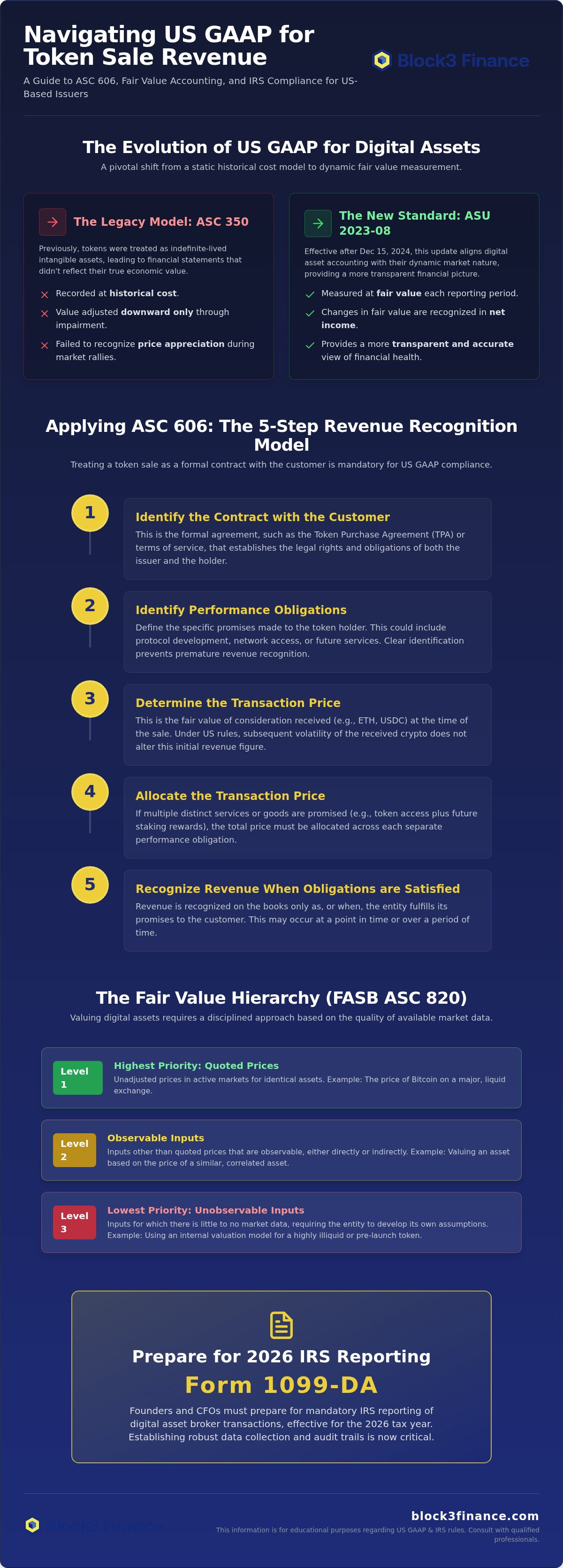
Historically, the Financial Accounting Standards Board (FASB) classified tokens as indefinite-lived intangible assets under ASC 350. This legacy model forced companies to record assets at their historical cost. It only allowed for downward adjustments through impairment losses, which often failed to represent the true economic position of a Web3 project.
The standard has now evolved to reflect the dynamic nature of the digital economy. We help our clients move beyond these static models to embrace a more accurate, fair value approach. This transition is essential for any project aiming for long-term institutional credibility and audit readiness.
The Impact of ASU 2023-08 on Revenue Measurement
The implementation of ASU 2023-08 marks a pivotal shift in how US companies measure their digital holdings. For fiscal years beginning after December 15, 2024, businesses must measure qualifying crypto assets at fair value each reporting period. This requirement aligns with FASB ASC 820, which establishes a framework for measuring fair value based on market participant assumptions.
The previous impairment-only model created significant friction for CFOs. It prevented companies from recognizing price appreciation, leading to financial statements that looked artificially weak during market rallies. Under the new rules, you must recognize changes in fair value within net income for every reporting period.
This change provides a more transparent view of a company's financial health. It also demands more rigorous internal controls to track market prices at specific timestamps. We ensure our clients have the systems in place to capture these fluctuations with precision.
Classifying Tokens: Utility vs. Security for Accounting
Proper classification is the cornerstone of a defensible revenue policy. Utility tokens generally provide the holder with a right to access a specific product or service within a decentralized ecosystem. In contrast, security tokens often represent a financial interest or a claim on future profits, similar to traditional equity.
Classification directly dictates the timing of your revenue recognition. If a token represents a performance obligation under ASC 606, you may need to defer revenue until you deliver the promised service. Security classifications might require different treatment entirely, often involving complex financial instrument accounting.
You should always verify specific legal classifications with your corporate counsel. Our role is to take those legal determinations and build the accounting framework that supports them. This proactive approach prevents costly reclassifications during a year-end audit.
Applying ASC 606 to Digital Asset Token Sales
ASC 606, known as "Revenue from Contracts with Customers," serves as the mandatory framework for US entities. It treats a token sale as a formal contract between the issuer and the holder. You must move beyond viewing these events as simple asset swaps to maintain compliance.
Mastering the accounting for token sales revenue requires a rigorous application of the five-step recognition model. This process ensures that your financial statements reflect the actual delivery of value to your community. We help you navigate these high-stakes requirements with precision and authority.
The 5-Step Process for Token Revenue Recognition
Step 1 is identifying the contract with the customer. This is typically the Token Purchase Agreement (TPA) or the terms of service accepted during the sale. It establishes the legal rights and obligations for both parties.
Step 2 involves identifying performance obligations. These are the specific promises, such as protocol development or network maintenance, that the issuer must fulfill. Clear identification prevents premature revenue recognition that could trigger an audit failure.
Step 3 requires you to determine the transaction price. This is the fair value of the consideration, often other cryptocurrencies, received at the inception of the contract. Under US rules, subsequent changes in the value of the received assets do not impact the initial revenue figure.
Step 4 focuses on allocating the transaction price. If you provide multiple services, such as a token plus future staking rewards, you must assign a portion of the price to each distinct obligation. This ensures your ledger accurately tracks where value is generated.
Step 5 is the final recognition of revenue. This occurs only when you satisfy the performance obligation, whether at a point in time or over a specific duration. Recording revenue too early is a common pitfall that we help our clients avoid.
Identifying Performance Obligations in Web3
Distinguishing between a "Right to Access" and a "Right to Use" is a critical strategic decision. A "Right to Access" suggests an ongoing service where the protocol evolves over time. This typically leads to revenue being recognized over the entire term of the service.
Conversely, a "Right to Use" often applies to functional software delivered at a specific moment. This distinction dictates whether you recognize revenue immediately or defer it over several years. Ongoing development commitments often create "deferred revenue" on your balance sheet.
We define "Deferred Revenue" as money received for goods or services that have not yet been delivered to the customer. Managing these liabilities is essential for maintaining a defensible financial position. If you need to refine your recognition policy, you can consult with our strategic team to ensure your records are audit-ready.
Fair Value Measurement and Valuation Challenges
Measuring the fair value of digital assets is the most scrutinized aspect of accounting for token sales revenue. While ASU 2023-08 mandates fair value, projects often struggle with assets that lack deep market liquidity. We act as a calm force during this process, providing the technical rigor needed to navigate these volatile reporting requirements.
Under FASB ASC 820, you must categorize inputs into three distinct levels. Level 1 inputs are quoted prices in active markets for identical assets, which remains the ideal scenario for valuation. Levels 2 and 3 involve observable and unobservable inputs, respectively, requiring more complex modeling for new or niche tokens.
Most token sales involve non-cash consideration, such as receiving ETH or USDC in exchange for a new project token. Under US GAAP, you measure revenue at the fair value of the consideration received at the exact moment the contract begins. Changes in the value of that ETH after the contract starts won't affect your initial revenue figure.
Valuing Tokens with Limited Liquidity
Active markets provide the most defensible data for your financial records. If your token has low trading volume, you may need to apply a liquidity discount to reflect the true price an independent buyer would pay. This adjustment ensures your balance sheet isn't artificially inflated by "thin" market prices.
To satisfy a future US audit, you must maintain a consistent documentation trail including:
- The specific exchange or price aggregator used as the primary source.
- The timestamp of the transaction relative to the market price.
- A clear rationale for any discounts applied to the market price.
Accounting for Token Lock-ups and Vesting Schedules
Vesting is the process where a person or entity earns the right to their tokens over a set period. For issuers, locked tokens aren't identical to liquid ones and often require a Discount for Lack of Marketability (DLOM). This discount accounts for the inability to sell the asset immediately on the open market.
Vesting schedules can significantly impact the timing of your revenue recognition. As performance obligations are met over time, the issuer recognizes revenue based on the fair value established at the contract's inception. We help you map these schedules to your financial statements to maintain a clear, audit-ready trail.
Building an Audit-Ready Trail for Token Proceeds
Establishing a transparent link between on-chain block explorers and off-chain accounting software is the foundation of institutional trust. When managing the accounting for token sales revenue, you must ensure that every transaction hash corresponds to a verified entry in your general ledger. This operational bridge prevents the data silos that often lead to audit failures.
We maintain that proactive advocacy is the only way to protect your project from regulatory scrutiny. By curating precise blockchain financial records, you move from a defensive posture to one of total command over your fiscal landscape. This discipline allows you to justify every revenue recognition event to US regulators with confidence.
You must also keep contemporaneous records of exchange rates at the exact time of each sale. Relying on daily averages often introduces inaccuracies that complicate your tax liabilities under IRS rules. Capturing spot prices at the moment of the transaction ensures your revenue figures remain defensible and accurate.
Reconciling On-Chain Data with Financial Books
Corporate accounting faces unique challenges due to the pseudo-anonymous nature of wallet addresses. You must explicitly map each wallet to its specific business purpose to satisfy US GAAP requirements for the accounting for token sales revenue. Without this mapping, auditors cannot verify the ownership or the intent of the underlying transactions.
Reconciliation is the rigorous process of ensuring your on-chain activity matches your internal financial records. This step identifies discrepancies caused by gas fees, failed transactions, or timing differences in block confirmations. Resolving these frictions early ensures your monthly reports reflect the true economic reality of the business.
We recommend utilizing specialized tools that export your entire transaction history directly into a general ledger. These systems automate the data flow and reduce the risk of manual entry errors. Standardizing this process is essential for scaling your operations without compromising your financial integrity.
Disclosure Requirements for US Token Issuers
US token issuers must provide detailed disclosures regarding the types of digital assets they hold and any restrictions on their sale. You are also required to explain the specific valuation methods used for each asset class. These notes provide the context necessary for investors and regulators to assess your liquidity and risk profile.
Crypto assets should appear as a separate line item on your balance sheet to distinguish them from traditional cash or intangibles. This presentation highlights your project's digital-first nature while adhering to the latest fair value measurement standards. Clear categorization simplifies the reporting process and enhances transparency for all stakeholders.
Professional crypto audit preparation begins with these comprehensive disclosures. If you want to secure your project's future, you can reach out to our elite strategists to build a custom compliance roadmap today. Our team ensures your records meet the highest standards of professional oversight.
Strategic Financial Oversight with Block3 Finance
Mastering the accounting for token sales revenue requires a partner who understands that innovation and compliance are inseparable. We position our clients to move from a defensive posture to one of total mastery over their financial destiny. Our specialized accounting services reduce the friction of Web3 growth by turning chaotic on-chain data into polished, audit-ready records.
A dedicated crypto CFO acts as the ultimate strategist for your project's longevity and fiscal health. They manage the delicate balance of tokenomics, which represents the economic policies governing a digital asset, and operational runway. We provide the intellectual leadership needed to navigate these high-stakes environments with absolute confidence and professional rigor.
Fractional CFO Services for Token Issuers
Fractional leadership offers elite strategic oversight without the prohibitive costs of a full-time executive. This model allows token issuers to access high-level treasury management and long-term planning tailored to their specific ecosystem needs. We help you cultivate a robust financial foundation that supports sustainable evolution and community trust.
Our team leverages over 13 years of blockchain financial expertise to protect your project’s interests. We've served more than 980 global clients, providing the technical depth needed to handle complex corporate structuring. This deep experience is vital when navigating the complexities of US GAAP audits or specific IRS reporting mandates.
Global Tax Reporting and Compliance Mastery
Maintaining clean, defensible financial records is the only way to ensure audit readiness for your 2026 tax filings. We prioritize accuracy in every ledger entry to simplify the accounting for token sales revenue while resolving the friction between decentralized activity and legacy reporting requirements. Our commitment to IRS standards ensures that your US-based operations remain secure and fully transparent.
You deserve total command over your fiscal landscape in an increasingly regulated market. You can contact Block3 Finance today for a specialized consultation on your token issuance and revenue recognition strategy. We act as your visionary navigator, providing the liberation and agency that only comes from true financial command.
Mastering Your Financial Future in the Token Economy
The transition to fair value reporting and the rigorous application of the ASC 606 framework represent a new era of transparency for US issuers. You now possess the strategic roadmap needed to bridge the gap between complex on-chain activity and traditional financial statements. This mastery is the foundation of institutional trust and long-term sustainability.
Block3 Finance brings 13+ years of blockchain financial expertise to your project, acting as a calm force in a shifting regulatory environment. As a top-ranked provider by Bitcoin.com, we specialize in turning volatile on-chain data into the defensible records required for a successful US audit. We ensure you maintain total command over your accounting for token sales revenue while you focus on ecosystem growth.
Partner with Block3 Finance for elite crypto accounting and CFO services to secure your project's fiscal health and compliance. You don't have to navigate these high-stakes complexities alone. Let's build a transparent and audit-ready future for your organization together.
Frequently Asked Questions
Is token sale revenue taxable immediately upon receipt by the company?
Taxability generally depends on when you recognize the income under IRS rules. Since the IRS treats cryptocurrency as property, revenue is typically taxable when the entity has a fixed right to receive the income and the amount is determinable with reasonable accuracy. If you receive cash or other digital assets during a sale, the fair value of that consideration at the time of receipt is included in your gross income.
How does ASC 606 change the way we report ICO or IDO proceeds?
ASC 606 requires a structured five-step approach to the accounting for token sales revenue. Instead of recording proceeds as an immediate gain, you must identify specific performance obligations, such as protocol development or network maintenance. This often results in proceeds being recorded as deferred revenue on your balance sheet. You then recognize that revenue only as you satisfy your promises to the token holders over time.
Can I recognize revenue if the tokens are still locked in a smart contract?
Revenue recognition depends on the satisfaction of performance obligations rather than the physical transfer of tokens. If tokens are locked but your project has fulfilled its contractual promises, recognition might be appropriate. However, if the lock-up period is tied to ongoing service requirements, the revenue must remain deferred. You should evaluate the specific terms of your Token Purchase Agreement to determine the correct timing under US GAAP.
What is the difference between a utility token and a security for accounting purposes?
Utility tokens provide access to a specific product or service, while security tokens represent a financial interest in an entity. For accounting, utility tokens usually fall under ASC 606 as revenue from contracts with customers. Security tokens may be treated as equity or debt instruments under different FASB standards. This classification determines whether the proceeds are recorded as revenue or as a financing activity on your statement of cash flows.
How do I value a token that has no active market or exchange listing?
You must use Level 2 or Level 3 inputs under the ASC 820 fair value hierarchy for assets without deep liquidity. This involves analyzing observable data from similar assets or using internal valuation models like discounted cash flow analysis. For new issuances, the transaction price itself often serves as the initial fair value. You must document your methodology thoroughly to ensure your financial records remain defensible during a professional US audit.
Does ASU 2023-08 apply to the issuance of tokens or only to holding them?
ASU 2023-08 primarily governs the subsequent measurement of crypto assets held in your treasury. While it requires companies to measure holdings at fair value, the initial accounting for token sales revenue still follows the ASC 606 framework. The update impacts how you report the digital assets received as payment. Any changes in the value of the consideration received must be recognized in your net income for each reporting period.
What happens if the fair value of our tokens drops significantly after the sale?
Under ASU 2023-08, you must recognize that decrease as a loss in your net income for the period. The new fair value model requires dynamic adjustments both up and down, ensuring your financial statements reflect the current market reality. While the initial revenue figure remains fixed based on the price at the contract's inception, the asset's value on your balance sheet will fluctuate. This provides a transparent view of your liquidity.
What forms do I need to file with the IRS for token sale revenue in 2026?
For the 2026 tax year, you must be prepared to use Form 1099-DA for reporting digital asset proceeds to the IRS. Corporations also report token sales as gross income on Form 1120. If your transactions involve covered securities acquired after January 1, 2026, cost basis reporting becomes mandatory. We recommend consulting with a specialized crypto tax accountant to ensure all IRS thresholds and filing deadlines are met with absolute precision.

Article by
Mahad Mohamed
Mahad Mohamed is an accountant and the CEO of Block3 Finance, with over 26+ years of Canadian and international tax and accounting experience. A crypto accounting specialist since the early days of Bitcoin, he has consulted for over 38 crypto companies and collaborated with legal professionals on regulatory matters. His expertise spans corporate reorganization, cross-border tax structuring (Canada & US), tax disputes, and CRA audits.
Previously, Mahad worked for the Canada Revenue Agency (CRA), Big4 accounting firms, and served as a Rulings Officer for the Federal Tax Authority of the UAE before acquiring Tax Partners in 2014.
Block3 Finance and Tax Partners has 44 full-time accountants and over 9,800+ clients.
Disclaimer
This article provides general information only and is current as of its publication date. It has not been updated and may be out of date. It does not constitute legal advice and should not be relied upon as such. Every tax situation is unique and may differ from the examples discussed in this article. If you have specific questions, you should seek the advice of our accountants for your unique circumstances.
Frequently Asked Questions
Is token sale revenue taxable immediately upon receipt by the company?
Taxability generally depends on when you recognize the income under IRS rules. Since the IRS treats cryptocurrency as property, revenue is typically taxable when the entity has a fixed right to receive the income and the amount is determinable with reasonable accuracy. If you receive cash or other digital assets during a sale, the fair value of that consideration at the time of receipt is included in your gross income.
How does ASC 606 change the way we report ICO or IDO proceeds?
ASC 606 requires a structured five-step approach to the accounting for token sales revenue. Instead of recording proceeds as an immediate gain, you must identify specific performance obligations, such as protocol development or network maintenance. This often results in proceeds being recorded as deferred revenue on your balance sheet. You then recognize that revenue only as you satisfy your promises to the token holders over time.
Can I recognize revenue if the tokens are still locked in a smart contract?
Revenue recognition depends on the satisfaction of performance obligations rather than the physical transfer of tokens. If tokens are locked but your project has fulfilled its contractual promises, recognition might be appropriate. However, if the lock-up period is tied to ongoing service requirements, the revenue must remain deferred. You should evaluate the specific terms of your Token Purchase Agreement to determine the correct timing under US GAAP.
What is the difference between a utility token and a security for accounting purposes?
Utility tokens provide access to a specific product or service, while security tokens represent a financial interest in an entity. For accounting, utility tokens usually fall under ASC 606 as revenue from contracts with customers. Security tokens may be treated as equity or debt instruments under different FASB standards. This classification determines whether the proceeds are recorded as revenue or as a financing activity on your statement of cash flows.
How do I value a token that has no active market or exchange listing?
You must use Level 2 or Level 3 inputs under the ASC 820 fair value hierarchy for assets without deep liquidity. This involves analyzing observable data from similar assets or using internal valuation models like discounted cash flow analysis. For new issuances, the transaction price itself often serves as the initial fair value. You must document your methodology thoroughly to ensure your financial records remain defensible during a professional US audit.
Does ASU 2023-08 apply to the issuance of tokens or only to holding them?
ASU 2023-08 primarily governs the subsequent measurement of crypto assets held in your treasury. While it requires companies to measure holdings at fair value, the initial accounting for token sales revenue still follows the ASC 606 framework. The update impacts how you report the digital assets received as payment. Any changes in the value of the consideration received must be recognized in your net income for each reporting period.
What happens if the fair value of our tokens drops significantly after the sale?
Under ASU 2023-08, you must recognize that decrease as a loss in your net income for the period. The new fair value model requires dynamic adjustments both up and down, ensuring your financial statements reflect the current market reality. While the initial revenue figure remains fixed based on the price at the contract's inception, the asset's value on your balance sheet will fluctuate. This provides a transparent view of your liquidity.
What forms do I need to file with the IRS for token sale revenue in 2026?
For the 2026 tax year, you must be prepared to use Form 1099-DA for reporting digital asset proceeds to the IRS. Corporations also report token sales as gross income on Form 1120. If your transactions involve covered securities acquired after January 1, 2026, cost basis reporting becomes mandatory. We recommend consulting with a specialized crypto tax accountant to ensure all IRS thresholds and filing deadlines are met with absolute precision.