
Most investors assume their NFTs are taxed like standard crypto assets, but the IRS look-through rule can instantly trigger a 28% collectible tax rate on your digital art. This distinction creates a high-stakes environment where a simple filing error leads to significant financial friction. Mastering NFT tax reporting requires more than just basic software; it demands a strategic understanding of how the IRS views the underlying asset behind every token.
You've likely felt the weight of reconciling thousands of on-chain transactions while fearing the consequences of an improper filing. It's exhausting to navigate a landscape where regulations shift and the burden of proof rests entirely on your shoulders. We understand that you want to move from a defensive posture to one of total command over your digital portfolio.
This guide provides the clarity you need to handle the 28% collectible rule and file Form 8949 with absolute precision. You'll gain a clear understanding of the look-through rule and learn how to maintain audit-ready records that satisfy IRS scrutiny. We're laying out the definitive roadmap for your 2026 tax obligations so you can focus on growth instead of compliance anxiety.
Key Takeaways
- Understand why the IRS classifies NFTs as property and how every sale, swap, or personal use triggers a taxable event under federal law.
- Learn to apply the "Look-Through Rule" from IRS Notice 2023-27 to determine if your digital assets are subject to the higher 28% collectible tax rate.
- Identify the critical differences in tax liability between NFT investors and creators to ensure you are reporting capital gains or ordinary income correctly.
- Master the process of using Form 8949 for NFT tax reporting to maintain accurate, audit-ready financial records for the 2026 tax year.
- Discover why specialized human accounting is essential for translating complex on-chain activity into defensible filings that standard software often misses.
Understanding IRS Classification: How NFTs are Taxed as Property
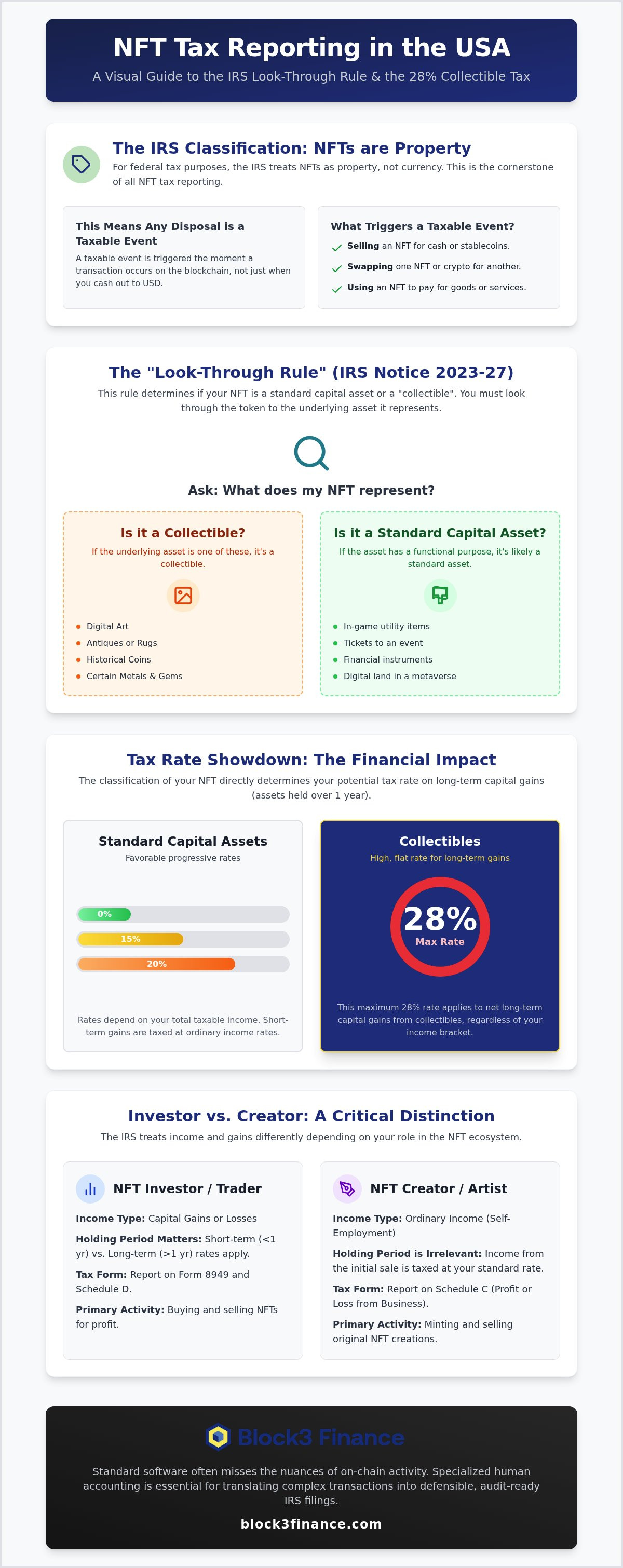
The IRS maintains a clear stance that Non-Fungible Tokens are property for federal tax purposes. They aren't viewed as legal tender or currency. This distinction is the foundation of all NFT tax reporting requirements and dictates how every transaction is treated on your return.
Every disposal of an NFT constitutes a taxable event under IRS rules. This includes selling for cash, swapping for another token, or using the asset for personal purchases. You trigger a tax liability the moment the transaction occurs on the blockchain, not just when you move funds to a bank account.
Many investors mistakenly believe taxes are only due when they "cash out" to USD. In reality, the IRS considers the exchange of one digital asset for another to be a realization of gain or loss. If you use Ethereum (ETH) to purchase a new NFT, you've technically disposed of that ETH and must calculate its value at that exact moment.
This level of oversight aligns with broader global initiatives like the Crypto-Asset Reporting Framework (CARF). These frameworks ensure that digital transactions are transparent and reported accurately across jurisdictions. As an investor, you must adopt a proactive stance to stay ahead of these evolving transparency standards.
Taxable vs. Non-Taxable NFT Events
Understanding which actions require reporting is critical for maintaining a defensible financial record. Most on-chain activity falls under the IRS's watchful eye, requiring careful documentation. You must distinguish between a change in ownership and a simple move of assets.
- Selling an NFT for USD or stablecoins is a taxable disposal.
- Swapping one NFT for a different token is a taxable exchange.
- Receiving an NFT as payment for services is considered ordinary income at its current value.
Conversely, transferring an NFT between two wallets you personally own is generally non-taxable. You aren't changing ownership; you're simply moving property. However, you must still document these movements to prove to the IRS that no disposal occurred during the transfer.
Determining Fair Market Value (FMV)
Fair Market Value (FMV) is the price in USD that the asset would sell for on the open market. This calculation must happen at the precise time of the NFT transaction to ensure total accuracy. Because markets move fast, you can't rely on daily averages or end-of-day prices.
You must capture the specific value in USD of the asset you received or traded away at the minute of the trade. This data forms the basis for your Tax Filing and Reporting, ensuring your cost basis is accurate and defensible. Accurate FMV tracking is the only way to calculate capital gains and losses correctly.
Without this precision, you risk overpaying or triggering an IRS audit. We help our clients navigate these high-stakes calculations by turning volatile on-chain data into disciplined financial records. Mastery of your FMV data is the first step toward gaining command over your tax obligations.
The Look-Through Rule: Are Your NFTs 28% Collectibles?
IRS Notice 2023-27 fundamentally changed how we approach NFT tax reporting. It introduced a mechanism called the "Look-Through Rule" to determine if a digital asset should be taxed as a collectible rather than a standard capital asset. This rule requires you to examine the underlying right or asset associated with the token to determine its tax treatment.
A collectible is an asset specifically defined under Section 408(m) of the Internal Revenue Code. This classification includes traditional items like rugs, antiques, historical coins, and certain precious metals. In the digital context, the most critical category is "art," which the IRS now applies to many NFT collections that feature unique visual elements.
If the underlying asset your NFT represents falls into one of these categories, the token itself inherits that classification. This means your digital art token isn't just a string of code in the eyes of the IRS; it's a high-value collectible subject to unique tax rates. This rule applies even if the asset is entirely intangible and exists only on a blockchain.
How the IRS Applies the Look-Through Test
The IRS doesn't just look at the smart contract. Instead, they perform a look-through analysis for collectibles to see what rights or tangible assets the token grants the holder. This determines if the token's value is derived from a protected or specialized category of property.
Digital art NFTs are almost certain to be classified as collectibles under this current guidance. However, tokens representing real estate or providing specific utility might follow standard capital asset rates, which range from 0% to 20%. The distinction depends entirely on whether the token grants ownership of a Section 408(m) asset.
Determining where your portfolio sits requires a disciplined review of every asset's underlying value. If you're unsure how these rules apply to your specific holdings, you can speak with our team to gain clarity on your reporting obligations. We help you move away from guesswork toward a strategy of total command.
Tax Implications of the 28% Rate
Most cryptocurrency assets are capped at a 20% long-term capital gains rate. Collectible NFTs, however, face a maximum rate of 28% when held for more than one year. This specialized rate is significantly higher than what many investors expect when they enter the market.
This 8% difference isn't negligible. On a high-value sale, that gap can strip away thousands of dollars in net profit that you could have otherwise retained through better structural planning. It's the difference between a successful exit and a significant tax bill that catches you off guard.
Short-term gains remain unaffected by this specific rule. If you hold an NFT for less than a year, the IRS taxes your profit as ordinary income, which can range from 10% to 37% for the 2026 tax year. Understanding your holding period is just as vital as identifying the asset type for accurate filing.
NFT Investor vs. Creator: Determining Your Tax Liability
The IRS doesn't view every participant in the NFT market through the same lens. Your tax profile is defined by your intent and the nature of your blockchain activity. Identifying whether you act as an investor or a creator is the first step in achieving a defensible NFT tax reporting strategy.
Investors focus on the long-term appreciation of digital property. For these individuals, the IRS applies capital gains rules similar to those used for stocks or real estate. Your profit is calculated based on the difference between what you paid and what you received upon disposal.
Creators and minters operate under a different set of expectations. If you produce NFTs for sale, the IRS generally views your activity as a business or a trade. This shift in classification moves your earnings from the capital gains category into ordinary income, which often carries a higher tax burden.
Tax Rules for NFT Investors
Investors trigger a taxable event only when they sell, swap, or use their NFTs. Your tax liability is determined by your capital gain, which is the sale price minus your cost basis. In US tax law, your cost basis includes the original purchase price plus any gas fees paid to acquire the asset.
Holding your assets for the long term provides a strategic advantage. If you hold an NFT for more than 12 months before selling, you qualify for long-term capital gains treatment. This allows you to access lower tax rates compared to short-term holdings, which are taxed at ordinary income levels.
Capital losses also play a vital role in your financial strategy. If you sell an NFT for less than its cost basis, you can use that loss to offset other capital gains. For US filers, if your losses exceed your gains, you can use up to $3,000 of the excess to offset your ordinary income, carrying any remaining balance into future years.
Tax Rules for NFT Creators and Minters
For creators, the moment of the first sale is when the tax clock starts. You must recognize income at the Fair Market Value of the cryptocurrency you received at the exact time of the transaction. This requirement is a core part of the IRS guidance on digital assets, which demands that all income from blockchain activity be reported on federal returns.
Secondary market royalties present an ongoing reporting requirement. Every time your work is resold and you receive a percentage of that sale, that payment is taxed as ordinary income. These payments don't qualify for capital gains treatment because they are considered compensation for your creative work.
Professional creators must also account for self-employment tax. If your NFT activity rises to the level of a business, you'll owe taxes for Social Security and Medicare on your net earnings. On the offensive side, you can deduct legitimate business expenses, such as marketplace fees, minting costs, and marketing expenditures, to reduce your overall taxable income.
The Reporting Process: IRS Forms and Record-Keeping Requirements
Transitioning from classification to filing requires a disciplined approach to data management. Accurate NFT tax reporting depends on your ability to produce a detailed log of every transaction, including the exact date and the Fair Market Value in USD. The IRS expects total transparency, making your record-keeping the foundation of a defensible return.
For investors, the primary reporting vehicle is Form 8949, titled "Sales and Other Dispositions of Capital Assets." You must list each individual trade, showing the date acquired, date sold, proceeds, and cost basis. Cost basis refers to the original value of the asset plus any costs associated with the acquisition.
The totals from Form 8949 then transfer to Schedule D of your Form 1040. This provides the IRS with a clear summary of your net capital gains or losses for the year. It is a methodical process that leaves no room for approximation or missing data points.
Creators face a different reporting path. If you are minting and selling as a business, you report your income on Schedule C, which tracks profit or loss from business activity. Hobbyist creators who don't meet the business threshold might instead use Schedule 1 to report their earnings as "Other Income."
Calculating Cost Basis and Gas Fees
Your cost basis is the total original value of the NFT plus any additional costs incurred to acquire it. Gas fees, which are the network transaction fees paid to process a purchase on the blockchain, are generally added to this basis. This capitalization reduces your future taxable gain when you eventually sell the asset.
When you sell an asset, the gas fees paid for that specific transaction are treated differently. These are typically deducted from the total proceeds of the sale, which directly lowers your reported profit. Correctly categorizing these fees is a common point of failure for automated software, as it requires human oversight to distinguish between acquisition and disposal costs.
We ensure every fee is properly capitalized or deducted to protect your margins and maintain compliance. This level of precision is what separates a standard filing from a professional, strategic tax plan. You gain command over your finances by ensuring every dollar is accounted for under IRS rules.
Essential Records for a Defensible Audit Trail
Building a defensible record requires more than just a list of trades. You must maintain wallet addresses, transaction hashes, and precise timestamps for every single mint, swap, or sale. These digital fingerprints are the only way to verify your activity if the IRS requests an audit.
Don't rely solely on blockchain explorers to store your history. Keep secondary records like marketplace receipts or screenshots to verify the Fair Market Value at the time of the trade. Review our crypto audit preparation checklist for more guidance on securing your records for the 2026 tax year.
Proactive documentation is the only way to ensure you are ready for IRS scrutiny. If you find yourself overwhelmed by the volume of on-chain data, contact our specialized accountants to help translate your activity into a professional filing. We help you move from confusion to total command over your digital portfolio.
Defensible Compliance: Why Specialized NFT Accounting Matters
Standard automated solutions often fail to interpret the nuance of the IRS "look-through" rule. These tools lack the human judgment required to distinguish between a utility token and a collectible art piece. This gap in software logic can lead to improper filings and increased audit risk for the 2026 tax year.
Specialized human accountants bridge the gap between raw blockchain data and defensible financial records. For high-net-worth investors and Web3 firms, professional oversight isn't just a convenience; it's a critical risk management strategy. Block3 Finance applies the technical rigor necessary to navigate this shifting landscape, ensuring every transaction stands up to federal scrutiny.
For corporate entities and DAOs holding digital property, the stakes are significantly higher. We translate complex on-chain activity into institutional-grade reporting that satisfies traditional accounting standards. This level of mastery allows you to move away from reactive compliance toward a position of total command over your digital portfolio.
Beyond Simple Tax Filing
Success in the digital asset space requires more than just reactive NFT tax reporting. Strategic corporate structuring allows you to move from a defensive posture to an offensive one. By organizing your NFT-based business correctly, you can optimize your tax liability and protect your net margins.
Explore our CFO services to implement sophisticated accounting workflows that support scaling your digital asset operations. This level of professional mastery ensures that your financial records are not just compliant but are optimized for long-term growth. Defensible books serve as the bedrock for your future institutional partnerships and financial agency.
We help you navigate the complexities of cost basis tracking and fee capitalization that simple software misses. Our team ensures that every digital asset on your balance sheet is valued correctly and reported accurately. This precision is essential for maintaining a clean audit trail in an increasingly transparent regulatory environment.
Navigating Global Jurisdictions
The global nature of blockchain means your US tax obligations often intersect with international frameworks. If you operate cross-border, your filings must be perfectly aligned with both IRS rules and global transparency initiatives. Failure to reconcile these differences can lead to double taxation or significant reporting gaps.
Read our Definitive Guide to Cryptocurrency Tax Filing to understand how these layers of regulation impact your portfolio. We provide the expertise needed to align your US reporting with the realities of a global Web3 market. This proactive approach ensures you remain compliant without sacrificing your competitive edge.
Securing your financial future requires a partner who understands the technical and legal nuances of the blockchain. You can contact an expert at Block3 Finance to gain total command over your global tax obligations. We help you navigate the chaos of the industry with deep experience and a commitment to best practices.
Gaining Command Over Your Digital Portfolio
Mastering your 2026 tax obligations requires a shift from passive observation to disciplined strategy. You now understand that the IRS views NFTs as property and applies a high-stakes 28% collectible rate through the look-through rule. This specialized knowledge is your first step toward total command over a volatile financial landscape.
Accurate NFT tax reporting isn't just about avoiding penalties; it's about building a defensible record for your digital assets. We've helped over 980 global clients turn complex on-chain data into institutional-grade records. As a top provider ranked by Bitcoin.com with 13+ years of blockchain financial expertise, we provide the technical rigor your portfolio demands.
You don't have to navigate these shifting regulations alone. Secure your NFT tax compliance with Block3 Finance to ensure your filings are precise and audit-ready. You have the agency to thrive in this new economy with the right partner by your side.
Frequently Asked Questions
Do I have to pay taxes if I trade one NFT for another?
Yes, trading one NFT for another is a taxable exchange under IRS rules that must be captured in your NFT tax reporting. You must determine the fair market value (FMV), which is the price in USD that the asset would sell for on the open market, at the moment of the trade. If this value is higher than your original cost basis, you've realized a capital gain, which is the profit from the sale of an asset.
What is the "Look-Through Rule" for NFTs?
The "Look-Through Rule" is a specific IRS analysis that determines if an NFT is a collectible under Section 408(m). The agency examines the underlying asset represented by the token, such as digital art or an antique. If that underlying asset is a collectible, the NFT is taxed at a maximum long-term capital gains rate of 28%. This is significantly higher than the standard 20% rate applied to other digital capital assets held for over a year.
Are NFT gas fees tax-deductible?
Gas fees, which are network transaction fees, aren't directly deductible as business expenses for most investors but do impact your cost basis. Basis is the original value of an asset for tax purposes. When you purchase an NFT, you add the gas fee to the purchase price. When you sell, you subtract the gas fee from the proceeds. This disciplined approach ensures you only pay taxes on your true net profit after all blockchain costs are considered.
How does the IRS know if I have NFTs?
The IRS monitors digital assets through Form 1099-DA, which requires marketplaces and brokers to report gross proceeds from NFT sales. They also employ sophisticated blockchain analytics to map wallet transactions to specific individuals. Every Form 1040 includes a mandatory question asking if you engaged in any digital asset transactions. Misrepresenting this information can lead to severe penalties or a targeted audit of your entire financial history. Our team helps you maintain defensible, accurate records for these inquiries.
Can I claim a tax loss on a worthless NFT?
You can only claim a tax loss on a worthless NFT if you have a realization event, such as a sale for a nominal amount. A realization event is a transaction that fixes a gain or loss for tax purposes. The IRS typically doesn't allow deductions for "unrealized" losses where the asset value has dropped but you still hold the token. You must prove the asset is abandoned or sold to an unrelated party to establish a loss.
What tax forms do I need to file for NFT sales?
Successful NFT tax reporting involves several specific IRS forms. Investors must use Form 8949 to list the details of every sale or exchange, including dates and cost basis. These figures are then summarized on Schedule D of your Form 1040. If your activity is classified as a business, you'll also need Schedule C to report your income and deduct relevant expenses like marketplace fees and marketing costs. This ensures your filing is both complete and compliant.
Is minting an NFT a taxable event for the creator?
Minting an NFT isn't a taxable event, but the subsequent sale or exchange of that token triggers a tax liability. Creators must report the income based on the fair market value of the cryptocurrency received at the time of the transaction. This income is generally treated as ordinary income rather than capital gains. Professional creators may also owe self-employment tax, which is a tax that funds Social Security and Medicare for self-employed individuals who work for themselves.
What is the tax rate for long-term NFT gains?
For most NFTs held for more than one year, the long-term capital gains rates are 0%, 15%, or 20% based on your taxable income. However, the IRS taxes NFTs classified as collectibles at a maximum rate of 28%. Short-term gains for assets held for one year or less are taxed at your ordinary income tax rate. This is the tax rate applied to your regular earnings, like wages, rather than the special rates for investments or long-term holdings.

Article by
Mahad Mohamed
Mahad Mohamed is an accountant and the CEO of Block3 Finance, with over 26+ years of Canadian and international tax and accounting experience. A crypto accounting specialist since the early days of Bitcoin, he has consulted for over 38 crypto companies and collaborated with legal professionals on regulatory matters. His expertise spans corporate reorganization, cross-border tax structuring (Canada & US), tax disputes, and CRA audits.
Previously, Mahad worked for the Canada Revenue Agency (CRA), Big4 accounting firms, and served as a Rulings Officer for the Federal Tax Authority of the UAE before acquiring Tax Partners in 2014.
Block3 Finance and Tax Partners has 44 full-time accountants and over 9,800+ clients.
Disclaimer
This article provides general information only and is current as of its publication date. It has not been updated and may be out of date. It does not constitute legal advice and should not be relied upon as such. Every tax situation is unique and may differ from the examples discussed in this article. If you have specific questions, you should seek the advice of our accountants for your unique circumstances.
Frequently Asked Questions
Do I have to pay taxes if I trade one NFT for another?
Yes, trading one NFT for another is a taxable exchange under IRS rules that must be captured in your NFT tax reporting. You must determine the fair market value (FMV), which is the price in USD that the asset would sell for on the open market, at the moment of the trade. If this value is higher than your original cost basis, you've realized a capital gain, which is the profit from the sale of an asset.
What is the "Look-Through Rule" for NFTs?
The "Look-Through Rule" is a specific IRS analysis that determines if an NFT is a collectible under Section 408(m). The agency examines the underlying asset represented by the token, such as digital art or an antique. If that underlying asset is a collectible, the NFT is taxed at a maximum long-term capital gains rate of 28%. This is significantly higher than the standard 20% rate applied to other digital capital assets held for over a year.
Are NFT gas fees tax-deductible?
Gas fees, which are network transaction fees, aren't directly deductible as business expenses for most investors but do impact your cost basis. Basis is the original value of an asset for tax purposes. When you purchase an NFT, you add the gas fee to the purchase price. When you sell, you subtract the gas fee from the proceeds. This disciplined approach ensures you only pay taxes on your true net profit after all blockchain costs are considered.
How does the IRS know if I have NFTs?
The IRS monitors digital assets through Form 1099-DA, which requires marketplaces and brokers to report gross proceeds from NFT sales. They also employ sophisticated blockchain analytics to map wallet transactions to specific individuals. Every Form 1040 includes a mandatory question asking if you engaged in any digital asset transactions. Misrepresenting this information can lead to severe penalties or a targeted audit of your entire financial history. Our team helps you maintain defensible, accurate records for these inquiries.
Can I claim a tax loss on a worthless NFT?
You can only claim a tax loss on a worthless NFT if you have a realization event, such as a sale for a nominal amount. A realization event is a transaction that fixes a gain or loss for tax purposes. The IRS typically doesn't allow deductions for "unrealized" losses where the asset value has dropped but you still hold the token. You must prove the asset is abandoned or sold to an unrelated party to establish a loss.
What tax forms do I need to file for NFT sales?
Successful NFT tax reporting involves several specific IRS forms. Investors must use Form 8949 to list the details of every sale or exchange, including dates and cost basis. These figures are then summarized on Schedule D of your Form 1040. If your activity is classified as a business, you'll also need Schedule C to report your income and deduct relevant expenses like marketplace fees and marketing costs. This ensures your filing is both complete and compliant.
Is minting an NFT a taxable event for the creator?
Minting an NFT isn't a taxable event, but the subsequent sale or exchange of that token triggers a tax liability. Creators must report the income based on the fair market value of the cryptocurrency received at the time of the transaction. This income is generally treated as ordinary income rather than capital gains. Professional creators may also owe self-employment tax, which is a tax that funds Social Security and Medicare for self-employed individuals who work for themselves.
What is the tax rate for long-term NFT gains?
For most NFTs held for more than one year, the long-term capital gains rates are 0%, 15%, or 20% based on your taxable income. However, the IRS taxes NFTs classified as collectibles at a maximum rate of 28%. Short-term gains for assets held for one year or less are taxed at your ordinary income tax rate. This is the tax rate applied to your regular earnings, like wages, rather than the special rates for investments or long-term holdings.