
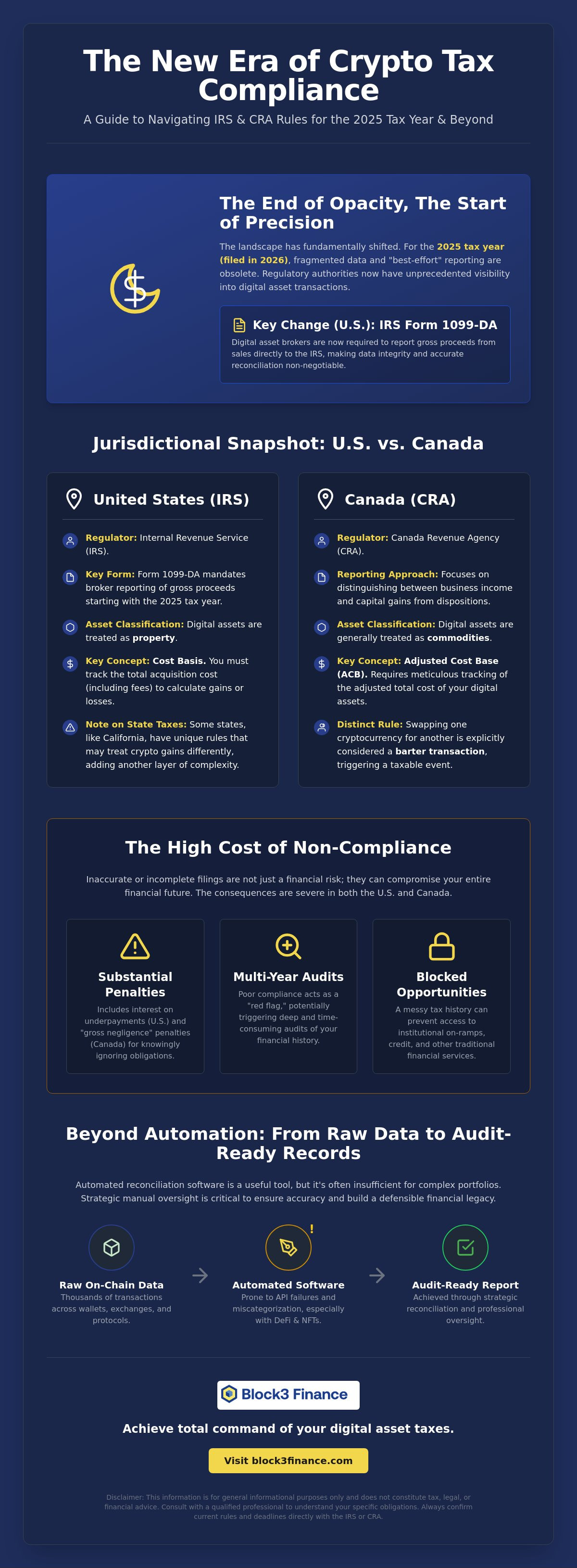
What if the arrival of Form 1099-DA signals the end of digital asset opacity and the beginning of your absolute financial command? For the 2025 tax year filed in 2026, the IRS has fundamentally shifted the landscape by requiring brokers to report gross proceeds, making cryptocurrency tax filing a matter of strategic data integrity rather than mere annual box-checking. Whether you're navigating the rigorous requirements of the IRS in the United States or managing your obligations to the CRA in Canada, the days of fragmented wallet data and "best-effort" reporting are over. It's a high-stakes environment where the digital asset question on your return is no longer a formality but a gateway to total regulatory transparency.
You likely feel the friction of reconciling thousands of on-chain transactions across multiple protocols while worrying about the specific 2025 federal income tax brackets or California's unique treatment of crypto gains as ordinary income. We're here to transform that anxiety into an offensive strategy for growth. This guide provides a sophisticated framework to master these complexities, ensuring you achieve full compliance while minimizing liability through proactive planning. We'll examine the critical distinctions between U.S. federal filings and Canadian requirements, detailing exactly how to build audit-ready records that protect your wealth in an evolving global market.
Key Takeaways
- Learn to navigate the new era of transparency by mastering the specific requirements of IRS Form 1099-DA and the expanded reporting scope for 2026.
- Distinguish between the distinct compliance standards of the U.S. Internal Revenue Service (IRS) and the Canada Revenue Agency (CRA) to ensure jurisdictional accuracy.
- Transform your approach to cryptocurrency tax filing by implementing a strategic framework that converts raw on-chain activity into audit-ready financial statements.
- Uncover the critical limitations of automated reconciliation software and how to manually resolve frequent API failures in complex DeFi and NFT portfolios.
- Categorize digital asset disposals and income streams correctly to minimize tax liability while maintaining a defensible legacy for your Web3 enterprise.
Cryptocurrency Tax Filing in 2026: Navigating the New Compliance Standard
The era of voluntary disclosure has ended. In the United States, the IRS has evolved the digital asset question on Form 1040 from a simple inquiry into a comprehensive data-matching gateway. This shift signifies that the authorities no longer rely on your memory; they rely on their data. For the 2025 tax year filed in 2026, the introduction of Form 1099-DA marks a watershed moment where digital asset brokers must report gross proceeds from sales directly to the government. This makes cryptocurrency tax filing a matter of precision rather than estimation. Mastery is the only path forward for those who wish to protect their wealth while staying ahead of the regulatory curve.
In Canada, the CRA (Canada Revenue Agency) maintains a similarly rigorous stance, treating digital assets as commodities. Canadian taxpayers must distinguish between business income and capital gains, which are profits made from selling an asset for more than its purchase price. The CRA requires the meticulous tracking of the Adjusted Cost Base (ACB), which is the total cost of your digital assets adjusted for transactions like purchases and commissions. Whether you are navigating the complexities of the IRS or the CRA, adopting a "Visionary Navigator" mindset is essential. You must move away from a defensive posture and toward an offensive one focused on building defensible financial records that reflect your total command over your portfolio.
The 2026 Regulatory Landscape
IRS enforcement has reached a new level of sophistication through advanced data-matching capabilities. Under the latest 2026 tax code, a digital asset is defined as any digital representation of value which is recorded on a cryptographically secured distributed ledger or any similar technology as specified by the Secretary. This definition captures everything from stablecoins and NFTs to tokenized real-world assets. The Infrastructure Investment and Jobs Act has fundamentally altered the reporting environment by empowering the government with unprecedented visibility into U.S. Virtual Currency Regulations. The scope of 2026 compliance now extends to every corner of the on-chain ecosystem, leaving no room for fragmented or missing data.
The Cost of Non-Compliance
The risks of inaccurate cryptocurrency tax filing extend far beyond immediate financial penalties. In the United States, the IRS can impose substantial interest on underpayments, while the CRA in Canada can apply penalties for "gross negligence" if they find a taxpayer knowingly ignored their obligations. Beyond these costs, poor compliance creates a "red flag" that can trigger multi-year audits. Perhaps most importantly, inaccurate filings compromise your future. Institutional on-ramps and credit providers increasingly require clean, audit-ready tax histories. If your records are a mess, you risk losing access to the traditional financial systems needed to leverage your digital wealth. We view compliance not as a burden, but as the foundation for your long-term financial legacy.
Decoding Taxable Events: Capital Gains vs. Ordinary Income
Every on-chain movement is a potential decision point for your cryptocurrency tax filing. In the United States, the IRS classifies digital assets as property, meaning that disposals trigger capital gains or losses. This includes selling tokens for fiat, swapping one cryptocurrency for another, or using digital assets to purchase goods. According to the IRS Digital Asset Guidance, these transactions require you to calculate the difference between your cost basis and the fair market value (FMV) at the time of the trade. FMV is the price an asset would command on the open market, while cost basis represents your total acquisition cost, including fees.
The Canada Revenue Agency (CRA) views these transactions through a similar lens but with distinct structural rules. In Canada, swapping one token for another is considered a barter transaction. You must report the gain or loss based on the value of the asset you received in Canadian dollars. Unlike the U.S. system, which allows for various cost-basis methodologies, the CRA mandates the use of the Weighted Average Cost method. This requires you to track the average cost of all identical tokens in your portfolio, rather than picking specific units to sell. Mastering these nuances transforms your tax return from a liability into a defensible record of your financial growth.
Capital Gains Strategies
Success requires a proactive approach to holding periods. In the United States, assets held for more than 365 days qualify for long-term capital gains rates, which are typically lower than ordinary income rates. Canada does not distinguish between short and long-term holdings; instead, 50% of a capital gain is generally included in your taxable income. You can utilize tax-loss harvesting, the strategic selling of assets at a loss to offset gains, to optimize your obligations in both jurisdictions. If you find the complexity of these calculations daunting, consulting a crypto tax accountant can provide the professional oversight needed to navigate volatile markets with confidence.
Income and Rewards
Wealth generated through active participation is taxed differently than market appreciation. In the U.S., the IRS treats staking rewards, mining income, and airdrops as ordinary income based on their FMV at the moment you receive them. Staking rewards are essentially treated as "rent" paid to you for the use of your assets to secure a network. In Canada, the CRA may classify mining or staking as business income if the activity shows a "constituted business" intent, such as high frequency or commercial organization. For casual Canadian investors, these rewards might be treated as capital gains, making it vital to document your specific investment intent from the outset.
Strategic Reconciliation: Why Software Alone is Insufficient
Many investors mistakenly believe that a simple API (Application Programming Interface) sync solves the riddle of cryptocurrency tax filing. This is a dangerous misconception. While software is a powerful tool, it frequently suffers from the "Garbage In, Garbage Out" phenomenon. Automated systems often fail to recognize transfers between your own wallets, incorrectly labeling them as taxable disposals. They struggle with "bridge failures," which occur when assets moved between different blockchains like Ethereum and Solana disappear from the ledger, and they often pull incorrect pricing data from low-liquidity exchanges. These technical blind spots create a fragmented narrative that invites regulatory scrutiny.
In the United States, the IRS holds you strictly responsible for the accuracy of your return, regardless of the software you used. Automated errors don't constitute a valid defense during an audit. In Canada, the CRA expects you to maintain a clear history that justifies your Weighted Average Cost calculations. Relying solely on automation without professional oversight leaves you vulnerable to systemic errors that can trigger unwanted inquiries. We move beyond simple automation by applying a rigorous manual reconciliation process. Our team ensures that every digital asset movement is verified, transforming raw data into a clean, defensible financial record.
The Professional Reconciliation Process
Our methodology begins with comprehensive data aggregation. We don't just pull data from centralized exchanges; we dive into non-custodial wallets and complex smart contract interactions to capture the full scope of your activity. The second step involves identifying "missing links." We manually verify transfers to ensure you aren't paying tax on assets simply moving from a hardware wallet to a hot wallet. Finally, we normalize pricing data. This process ensures that the value of your assets is consistent across all global platforms, resolving the discrepancies that automated tools often ignore. This methodical approach eliminates the friction of missing data and provides a stable foundation for your filing.
Building Audit-Ready Books
Tax authorities in both the U.S. and Canada demand contemporaneous records. These are financial documents created at the exact time a transaction occurs. For a digital asset holder, this means maintaining a ledger that bridges the gap between on-chain hashes and off-chain bank statements. A robust strategy for Blockchain Financial Records: Building an Audit Trail is your primary defense during a regulatory inquiry. We verify that your fiat on-ramps and off-ramps match your bank records, creating a defensible financial history that software alone cannot replicate. This disciplined approach transforms fragmented on-chain activity into a strategic asset, providing the professional weight needed to protect your financial legacy.
Advanced Reporting for DeFi, NFTs, and Web3 Enterprises
Operational complexity reaches its peak when moving beyond individual retail trading into the sophisticated world of Web3 business. For enterprises, cryptocurrency tax filing isn't just about reporting trades; it's about managing treasury assets, decentralized governance, and a global workforce. The challenge lies in the fact that on-chain activity moves faster than traditional accounting frameworks. Whether you're managing a venture-backed startup or a community-led protocol, your compliance strategy must evolve from a defensive chore into a strategic advantage that enables institutional growth. Mastery of these advanced reporting requirements ensures that your enterprise remains a viable, audit-ready participant in the future of finance.
In the United States, the IRS treats digital asset payments to contractors and employees as taxable income, requiring precise reporting of fair market value at the time of transfer. This triggers federal income tax withholding and FICA (Social Security and Medicare) obligations. In Canada, the CRA views token-based compensation as a taxable benefit. You must report the value of these tokens in Canadian dollars as part of the employee's income on their T4 slip. Navigating these jurisdictional hurdles requires more than just a ledger; it requires a proactive Corporate Structuring strategy that optimizes your tax efficiency across borders.
The NFT and Creator Economy
The taxation of non-fungible tokens (NFTs) depends heavily on their underlying utility and your role as either a creator or an investor. In the United States, the IRS may classify certain NFTs as "collectibles," which are subject to a higher maximum long-term capital gains tax rate of 28% compared to the standard 15% or 20% for other capital assets. In Canada, the CRA generally treats NFTs as capital property, where 50% of the gain is included in your taxable income, regardless of whether the asset is considered "art" or a utility token. Creators receiving ongoing on-chain royalties must report these payments as ordinary income in the U.S. or business income in Canada, necessitating meticulous tracking of every secondary market sale.
DAO and Enterprise Treasury
Decentralized Autonomous Organizations (DAOs) present unique challenges because they often lack a traditional legal "center" while managing millions in digital assets. For participants and contributors, understanding DAO Tax Compliance: Frameworks for Decentralized Orgs is critical for avoiding personal liability. Yield farming and flash loans—loans where borrowing and repayment happen within a single blockchain transaction—create dense layers of taxable events that automated tools often misinterpret. While the U.S. and Canada haven't issued specific flash loan statutes, the foundational principle of treating digital assets as property applies. Every interaction with a DeFi protocol must be reconciled against your treasury records to ensure your enterprise maintains a defensible financial legacy.
Global Compliance: Building a Defensible Financial Legacy
Digital assets operate on a borderless infrastructure, yet the tax authorities governing your wealth remain firmly rooted in national jurisdictions. For the sophisticated investor, cryptocurrency tax filing in 2026 requires a perspective that transcends a single country's borders. Managing international obligations is no longer an optional exercise for the elite; it is a fundamental requirement for protecting a global financial legacy. Whether you are a digital nomad moving between hubs or a high-growth firm with a distributed treasury, your compliance strategy must account for the overlapping demands of multiple tax regimes. We view this complexity not as a barrier, but as an opportunity to implement a robust structure that supports long-term wealth preservation.
In the United States, the IRS requires strict adherence to international reporting standards. This includes the FBAR (Report of Foreign Bank and Financial Accounts), which mandates that U.S. persons report financial interest in foreign accounts if the aggregate value exceeds $10,000 at any time during the year. You may also face obligations under FATCA (Foreign Account Tax Compliance Act), a law designed to ensure U.S. taxpayers with foreign financial assets report them to the IRS. In Canada, the CRA (Canada Revenue Agency) requires taxpayers to file Form T1135, the Foreign Income Verification Statement, if they own specified foreign property with a total cost exceeding $100,000 CAD at any point in the year. Because digital assets held on foreign exchanges often fall into these categories, you must verify your specific reporting thresholds directly with the IRS or CRA to avoid severe penalties.
Cross-Border Considerations
Strategic residency plays a pivotal role in your digital asset tax profile. Moving between jurisdictions can trigger "exit taxes" or "deemed dispositions," where a country treats your assets as sold the moment you leave. To avoid double taxation, you must leverage tax treaties that exist between nations like the U.S. and Canada. These agreements help determine which country has the primary right to tax your crypto gains. Implementing a sophisticated Corporate Structuring plan can further shield your assets by utilizing entities that provide both tax efficiency and legal protection. This proactive approach ensures that your wealth remains a tool for growth rather than a target for regulatory friction.
The Block3 Finance Advantage
We provide a "white-glove" experience that goes beyond traditional accounting. Our team acts as your "Visionary Navigator," offering the technical rigor of an auditor combined with the forward-looking energy of a blockchain innovator. We don't just manage your cryptocurrency tax filing; we provide a comprehensive roadmap for institutional growth. By leveraging our CFO services, you gain access to elite financial leadership that transforms volatile on-chain data into stable, defensible records. We resolve the friction of fragmented data and bridge the gap between legacy finance and the decentralized future. Secure your financial future with Block3 Finance’s specialized tax filing services.
Secure Your Legacy Through Strategic Financial Mastery
The 2026 tax season marks a definitive transition from digital asset obscurity to total regulatory transparency. Whether you're adapting to the mandatory IRS Form 1099-DA reporting in the United States or the CRA's strict commodity treatment in Canada, success depends on your ability to transform volatile on-chain activity into defensible financial records. We've explored how professional reconciliation resolves the technical failures of automated software and why advanced reporting for DeFi and Web3 enterprises is the foundation of institutional credibility. Your cryptocurrency tax filing shouldn't be a source of anxiety; it's a strategic opportunity to demonstrate total command over your financial landscape.
As a top-ranked firm by Bitcoin.com with over 13 years of blockchain financial expertise, we've helped more than 980 global clients navigate these high-stakes environments with precision. We bridge the gap between legacy corporate finance and the decentralized future, ensuring your records are audit-ready and your liability is minimized through elite structuring. Partner with the Visionary Navigators at Block3 Finance for your 2026 tax filing. You have the agency to thrive in this evolving market, and we're here to provide the roadmap for your continued growth.
Frequently Asked Questions
Do I have to report crypto to the IRS if I only held it and did not sell?
You must disclose your activity even if you didn't trigger a taxable event. In the United States, the IRS requires every taxpayer to answer the digital asset question on Form 1040, even if they only held assets throughout the year. In Canada, simply holding cryptocurrency isn't a taxable event; however, you must file Form T1135 if the total cost of your foreign property, including assets on non-Canadian exchanges, exceeded $100,000 CAD at any point. Always confirm current disclosure thresholds with the IRS or CRA.
How does the new 1099-DA form change my cryptocurrency tax filing in 2026?
Form 1099-DA marks a transition from voluntary disclosure to mandatory broker reporting for the 2025 tax year filed in 2026. Digital asset brokers now report gross proceeds from your sales directly to the IRS, providing the government with unprecedented visibility into your cryptocurrency tax filing. While Canada doesn't use this specific form, the CRA utilizes international data-sharing frameworks to monitor on-chain activity. This shift makes manual reconciliation and professional oversight essential for ensuring your records match the data the authorities already possess.
Can I use crypto tax software instead of hiring a specialized accountant?
Software is a useful tool for data aggregation, but it lacks the strategic depth required for complex portfolios. Automated platforms frequently fail to recognize transfers between your own wallets or incorrectly price assets during bridge failures. A specialized accountant provides the manual reconciliation and "white-glove" oversight needed to build a defensible audit trail. We transform fragmented software exports into clean financial records that withstand regulatory scrutiny in both the U.S. and Canada, providing a level of mastery that algorithms cannot replicate.
What is the tax treatment for lost or stolen cryptocurrency in 2026?
The ability to claim a deduction for lost or stolen assets is highly restrictive under current laws. For U.S. federal taxes, personal theft losses are generally not deductible unless they're linked to a federally declared disaster. In Canada, the CRA may allow you to report a capital loss if you can provide exhaustive evidence that the assets are truly unrecoverable. Because these rules are subject to strict evidentiary standards, you should consult with a professional to determine if your specific loss qualifies for a deduction under 2026 guidelines.
How are NFT royalties taxed for digital artists and creators?
Royalties generated from secondary market sales are generally taxed as ordinary income for the creator. In the United States, the IRS treats these ongoing payments as income at the moment they're received on-chain. For creators in Canada, the CRA may classify royalty income as business income if the activity is performed in a commercial manner. This requires creators to track the fair market value of every royalty payment in their local currency to ensure accurate reporting and compliance with annual filing requirements.
Is swapping one cryptocurrency for another a taxable event?
Swapping one digital asset for another is a taxable disposal in both the United States and Canada. The IRS treats this as a sale of property, where you must calculate the gain or loss based on the fair market value of the asset received. The CRA views this as a barter transaction, requiring you to report the value of the trade in Canadian dollars. Even if you don't "cash out" to fiat, these trades trigger immediate tax obligations that must be recorded in your 2026 filings.
What records should I keep to ensure my crypto books are audit-ready?
You must maintain contemporaneous records for every on-chain and off-chain transaction. This includes transaction hashes, timestamps, wallet addresses, and exchange statements showing the fair market value at the time of each event. In the U.S., these records prove your cost basis to the IRS, while in Canada, they're essential for justifying your Weighted Average Cost calculations to the CRA. Precise record-keeping is your primary defense against the friction of a regulatory audit and is the foundation of a defensible financial legacy.
How does the IRS treat staking rewards and DeFi yield for tax purposes?
The IRS treats rewards earned from staking or DeFi protocols as ordinary income based on their fair market value when you gain dominion and control over them. This means you owe tax on the rewards at the time they're credited to your wallet, even if you don't sell them. In Canada, the CRA evaluates whether your staking activity constitutes a business or a personal investment. Business-level activity results in income tax, while casual participation might be treated as capital gains, making it vital to document your investment intent clearly.

Article by
Mahad Mohamed
Mahad Mohamed is an accountant and the CEO of Block3 Finance, with over 26+ years of Canadian and international tax and accounting experience. A crypto accounting specialist since the early days of Bitcoin, he has consulted for over 38 crypto companies and collaborated with legal professionals on regulatory matters. His expertise spans corporate reorganization, cross-border tax structuring (Canada & US), tax disputes, and CRA audits.
Previously, Mahad worked for the Canada Revenue Agency (CRA), Big4 accounting firms, and served as a Rulings Officer for the Federal Tax Authority of the UAE before acquiring Tax Partners in 2014.
Block3 Finance and Tax Partners has 44 full-time accountants and over 9,800+ clients.
Disclaimer
This article provides general information only and is current as of its publication date. It has not been updated and may be out of date. It does not constitute legal advice and should not be relied upon as such. Every tax situation is unique and may differ from the examples discussed in this article. If you have specific questions, you should seek the advice of our accountants for your unique circumstances.
Frequently Asked Questions
The 2026 Regulatory Landscape
IRS enforcement has reached a new level of sophistication through advanced data-matching capabilities. Under the latest 2026 tax code, a digital asset is defined as any digital representation of value which is recorded on a cryptographically secured distributed ledger or any similar technology as specified by the Secretary. This definition captures everything from stablecoins and NFTs to tokenized real-world assets. The Infrastructure Investment and Jobs Act has fundamentally altered the reporting environment by empowering the government with unprecedented visibility into U.S. Virtual Currency Regulations. The scope of 2026 compliance now extends to every corner of the on-chain ecosystem, leaving no room for fragmented or missing data.
The Cost of Non-Compliance
The risks of inaccurate cryptocurrency tax filing extend far beyond immediate financial penalties. In the United States, the IRS can impose substantial interest on underpayments, while the CRA in Canada can apply penalties for "gross negligence" if they find a taxpayer knowingly ignored their obligations. Beyond these costs, poor compliance creates a "red flag" that can trigger multi-year audits. Perhaps most importantly, inaccurate filings compromise your future. Institutional on-ramps and credit providers increasingly require clean, audit-ready tax histories. If your records are a mess, you risk losing access to the traditional financial systems needed to leverage your digital wealth. We view compliance not as a burden, but as the foundation for your long-term financial legacy. Every on-chain movement is a potential decision point for your cryptocurrency tax filing. In the United States, the IRS classifies digital assets as property, meaning that disposals trigger capital gains or losses. This includes selling tokens for fiat, swapping one cryptocurrency for another, or using digital assets to purchase goods. According to the IRS Digital Asset Guidance, these transactions require you to calculate the difference between your cost basis and the fair market value (FMV) at the time of the trade. FMV is the price an asset would command on the open market, while cost basis represents your total acquisition cost, including fees. The Canada Revenue Agency (CRA) views these transactions through a similar lens but with distinct structural rules. In Canada, swapping one token for another is considered a barter transaction. You must report the gain or loss based on the value of the asset you received in Canadian dollars. Unlike the U.S. system, which allows for various cost-basis methodologies, the CRA mandates the use of the Weighted Average Cost method. This requires you to track the average cost of all identical tokens in your portfolio, rather than picking specific units to sell. Mastering these nuances transforms your tax return from a liability into a defensible record of your financial growth.
Capital Gains Strategies
Success requires a proactive approach to holding periods. In the United States, assets held for more than 365 days qualify for long-term capital gains rates, which are typically lower than ordinary income rates. Canada does not distinguish between short and long-term holdings; instead, 50% of a capital gain is generally included in your taxable income. You can utilize tax-loss harvesting, the strategic selling of assets at a loss to offset gains, to optimize your obligations in both jurisdictions. If you find the complexity of these calculations daunting, consulting a crypto tax accountant can provide the professional oversight needed to navigate volatile markets with confidence.
Income and Rewards
Wealth generated through active participation is taxed differently than market appreciation. In the U.S., the IRS treats staking rewards, mining income, and airdrops as ordinary income based on their FMV at the moment you receive them. Staking rewards are essentially treated as "rent" paid to you for the use of your assets to secure a network. In Canada, the CRA may classify mining or staking as business income if the activity shows a "constituted business" intent, such as high frequency or commercial organization. For casual Canadian investors, these rewards might be treated as capital gains, making it vital to document your specific investment intent from the outset. Many investors mistakenly believe that a simple API (Application Programming Interface) sync solves the riddle of cryptocurrency tax filing. This is a dangerous misconception. While software is a powerful tool, it frequently suffers from the "Garbage In, Garbage Out" phenomenon. Automated systems often fail to recognize transfers between your own wallets, incorrectly labeling them as taxable disposals. They struggle with "bridge failures," which occur when assets moved between different blockchains like Ethereum and Solana disappear from the ledger, and they often pull incorrect pricing data from low-liquidity exchanges. These technical blind spots create a fragmented narrative that invites regulatory scrutiny. In the United States, the IRS holds you strictly responsible for the accuracy of your return, regardless of the software you used. Automated errors don't constitute a valid defense during an audit. In Canada, the CRA expects you to maintain a clear history that justifies your Weighted Average Cost calculations. Relying solely on automation without professional oversight leaves you vulnerable to systemic errors that can trigger unwanted inquiries. We move beyond simple automation by applying a rigorous manual reconciliation process. Our team ensures that every digital asset movement is verified, transforming raw data into a clean, defensible financial record.
The Professional Reconciliation Process
Our methodology begins with comprehensive data aggregation. We don't just pull data from centralized exchanges; we dive into non-custodial wallets and complex smart contract interactions to capture the full scope of your activity. The second step involves identifying "missing links." We manually verify transfers to ensure you aren't paying tax on assets simply moving from a hardware wallet to a hot wallet. Finally, we normalize pricing data. This process ensures that the value of your assets is consistent across all global platforms, resolving the discrepancies that automated tools often ignore. This methodical approach eliminates the friction of missing data and provides a stable foundation for your filing.
Building Audit-Ready Books
Tax authorities in both the U.S. and Canada demand contemporaneous records. These are financial documents created at the exact time a transaction occurs. For a digital asset holder, this means maintaining a ledger that bridges the gap between on-chain hashes and off-chain bank statements. A robust strategy for Blockchain Financial Records: Building an Audit Trail is your primary defense during a regulatory inquiry. We verify that your fiat on-ramps and off-ramps match your bank records, creating a defensible financial history that software alone cannot replicate. This disciplined approach transforms fragmented on-chain activity into a strategic asset, providing the professional weight needed to protect your financial legacy. Operational complexity reaches its peak when moving beyond individual retail trading into the sophisticated world of Web3 business. For enterprises, cryptocurrency tax filing isn't just about reporting trades; it's about managing treasury assets, decentralized governance, and a global workforce. The challenge lies in the fact that on-chain activity moves faster than traditional accounting frameworks. Whether you're managing a venture-backed startup or a community-led protocol, your compliance strategy must evolve from a defensive chore into a strategic advantage that enables institutional growth. Mastery of these advanced reporting requirements ensures that your enterprise remains a viable, audit-ready participant in the future of finance. In the United States, the IRS treats digital asset payments to contractors and employees as taxable income, requiring precise reporting of fair market value at the time of transfer. This triggers federal income tax withholding and FICA (Social Security and Medicare) obligations. In Canada, the CRA views token-based compensation as a taxable benefit. You must report the value of these tokens in Canadian dollars as part of the employee's income on their T4 slip. Navigating these jurisdictional hurdles requires more than just a ledger; it requires a proactive Corporate Structuring strategy that optimizes your tax efficiency across borders.
The NFT and Creator Economy
The taxation of non-fungible tokens (NFTs) depends heavily on their underlying utility and your role as either a creator or an investor. In the United States, the IRS may classify certain NFTs as "collectibles," which are subject to a higher maximum long-term capital gains tax rate of 28% compared to the standard 15% or 20% for other capital assets. In Canada, the CRA generally treats NFTs as capital property, where 50% of the gain is included in your taxable income, regardless of whether the asset is considered "art" or a utility token. Creators receiving ongoing on-chain royalties must report these payments as ordinary income in the U.S. or business income in Canada, necessitating meticulous tracking of every secondary market sale.
DAO and Enterprise Treasury
Decentralized Autonomous Organizations (DAOs) present unique challenges because they often lack a traditional legal "center" while managing millions in digital assets. For participants and contributors, understanding DAO Tax Compliance: Frameworks for Decentralized Orgs is critical for avoiding personal liability. Yield farming and flash loans—loans where borrowing and repayment happen within a single blockchain transaction—create dense layers of taxable events that automated tools often misinterpret. While the U.S. and Canada haven't issued specific flash loan statutes, the foundational principle of treating digital assets as property applies. Every interaction with a DeFi protocol must be reconciled against your treasury records to ensure your enterprise maintains a defensible financial legacy. Digital assets operate on a borderless infrastructure, yet the tax authorities governing your wealth remain firmly rooted in national jurisdictions. For the sophisticated investor, cryptocurrency tax filing in 2026 requires a perspective that transcends a single country's borders. Managing international obligations is no longer an optional exercise for the elite; it is a fundamental requirement for protecting a global financial legacy. Whether you are a digital nomad moving between hubs or a high-growth firm with a distributed treasury, your compliance strategy must account for the overlapping demands of multiple tax regimes. We view this complexity not as a barrier, but as an opportunity to implement a robust structure that supports long-term wealth preservation. In the United States, the IRS requires strict adherence to international reporting standards. This includes the FBAR (Report of Foreign Bank and Financial Accounts), which mandates that U.S. persons report financial interest in foreign accounts if the aggregate value exceeds $10,000 at any time during the year. You may also face obligations under FATCA (Foreign Account Tax Compliance Act), a law designed to ensure U.S. taxpayers with foreign financial assets report them to the IRS. In Canada, the CRA (Canada Revenue Agency) requires taxpayers to file Form T1135, the Foreign Income Verification Statement, if they own specified foreign property with a total cost exceeding $100,000 CAD at any point in the year. Because digital assets held on foreign exchanges often fall into these categories, you must verify your specific reporting thresholds directly with the IRS or CRA to avoid severe penalties.
Cross-Border Considerations
Strategic residency plays a pivotal role in your digital asset tax profile. Moving between jurisdictions can trigger "exit taxes" or "deemed dispositions," where a country treats your assets as sold the moment you leave. To avoid double taxation, you must leverage tax treaties that exist between nations like the U.S. and Canada. These agreements help determine which country has the primary right to tax your crypto gains. Implementing a sophisticated Corporate Structuring plan can further shield your assets by utilizing entities that provide both tax efficiency and legal protection. This proactive approach ensures that your wealth remains a tool for growth rather than a target for regulatory friction.
The Block3 Finance Advantage
We provide a "white-glove" experience that goes beyond traditional accounting. Our team acts as your "Visionary Navigator," offering the technical rigor of an auditor combined with the forward-looking energy of a blockchain innovator. We don't just manage your cryptocurrency tax filing; we provide a comprehensive roadmap for institutional growth. By leveraging our CFO services, you gain access to elite financial leadership that transforms volatile on-chain data into stable, defensible records. We resolve the friction of fragmented data and bridge the gap between legacy finance and the decentralized future. Secure your financial future with Block3 Finance’s specialized tax filing services. The 2026 tax season marks a definitive transition from digital asset obscurity to total regulatory transparency. Whether you're adapting to the mandatory IRS Form 1099-DA reporting in the United States or the CRA's strict commodity treatment in Canada, success depends on your ability to transform volatile on-chain activity into defensible financial records. We've explored how professional reconciliation resolves the technical failures of automated software and why advanced reporting for DeFi and Web3 enterprises is the foundation of institutional credibility. Your cryptocurrency tax filing shouldn't be a source of anxiety; it's a strategic opportunity to demonstrate total command over your financial landscape. As a top-ranked firm by Bitcoin.com with over 13 years of blockchain financial expertise, we've helped more than 980 global clients navigate these high-stakes environments with precision. We bridge the gap between legacy corporate finance and the decentralized future, ensuring your records are audit-ready and your liability is minimized through elite structuring. Partner with the Visionary Navigators at Block3 Finance for your 2026 tax filing. You have the agency to thrive in this evolving market, and we're here to provide the roadmap for your continued growth.
Do I have to report crypto to the IRS if I only held it and did not sell?
You must disclose your activity even if you didn't trigger a taxable event. In the United States, the IRS requires every taxpayer to answer the digital asset question on Form 1040, even if they only held assets throughout the year. In Canada, simply holding cryptocurrency isn't a taxable event; however, you must file Form T1135 if the total cost of your foreign property, including assets on non-Canadian exchanges, exceeded $100,000 CAD at any point. Always confirm current disclosure thresholds with the IRS or CRA.
How does the new 1099-DA form change my cryptocurrency tax filing in 2026?
Form 1099-DA marks a transition from voluntary disclosure to mandatory broker reporting for the 2025 tax year filed in 2026. Digital asset brokers now report gross proceeds from your sales directly to the IRS, providing the government with unprecedented visibility into your cryptocurrency tax filing. While Canada doesn't use this specific form, the CRA utilizes international data-sharing frameworks to monitor on-chain activity. This shift makes manual reconciliation and professional oversight essential for ensuring your records match the data the authorities already possess.
Can I use crypto tax software instead of hiring a specialized accountant?
Software is a useful tool for data aggregation, but it lacks the strategic depth required for complex portfolios. Automated platforms frequently fail to recognize transfers between your own wallets or incorrectly price assets during bridge failures. A specialized accountant provides the manual reconciliation and "white-glove" oversight needed to build a defensible audit trail. We transform fragmented software exports into clean financial records that withstand regulatory scrutiny in both the U.S. and Canada, providing a level of mastery that algorithms cannot replicate.
What is the tax treatment for lost or stolen cryptocurrency in 2026?
The ability to claim a deduction for lost or stolen assets is highly restrictive under current laws. For U.S. federal taxes, personal theft losses are generally not deductible unless they're linked to a federally declared disaster. In Canada, the CRA may allow you to report a capital loss if you can provide exhaustive evidence that the assets are truly unrecoverable. Because these rules are subject to strict evidentiary standards, you should consult with a professional to determine if your specific loss qualifies for a deduction under 2026 guidelines.
How are NFT royalties taxed for digital artists and creators?
Royalties generated from secondary market sales are generally taxed as ordinary income for the creator. In the United States, the IRS treats these ongoing payments as income at the moment they're received on-chain. For creators in Canada, the CRA may classify royalty income as business income if the activity is performed in a commercial manner. This requires creators to track the fair market value of every royalty payment in their local currency to ensure accurate reporting and compliance with annual filing requirements.
Is swapping one cryptocurrency for another a taxable event?
Swapping one digital asset for another is a taxable disposal in both the United States and Canada. The IRS treats this as a sale of property, where you must calculate the gain or loss based on the fair market value of the asset received. The CRA views this as a barter transaction, requiring you to report the value of the trade in Canadian dollars. Even if you don't "cash out" to fiat, these trades trigger immediate tax obligations that must be recorded in your 2026 filings.
What records should I keep to ensure my crypto books are audit-ready?
You must maintain contemporaneous records for every on-chain and off-chain transaction. This includes transaction hashes, timestamps, wallet addresses, and exchange statements showing the fair market value at the time of each event. In the U.S., these records prove your cost basis to the IRS, while in Canada, they're essential for justifying your Weighted Average Cost calculations to the CRA. Precise record-keeping is your primary defense against the friction of a regulatory audit and is the foundation of a defensible financial legacy.
How does the IRS treat staking rewards and DeFi yield for tax purposes?
The IRS treats rewards earned from staking or DeFi protocols as ordinary income based on their fair market value when you gain dominion and control over them. This means you owe tax on the rewards at the time they're credited to your wallet, even if you don't sell them. In Canada, the CRA evaluates whether your staking activity constitutes a business or a personal investment. Business-level activity results in income tax, while casual participation might be treated as capital gains, making it vital to document your investment intent clearly.