
The IRS now sees every move you make in the global digital asset market. With the 2026 tax year mandating cost basis reporting, which tracks the original purchase price of an asset, on Form 1099-DA, the era of offshore invisibility is over. For firms operating across borders, leveraging crypto tax treaties for businesses isn't just a strategy; it's a survival requirement.
You're likely staring at foreign exchange data while wondering if your FBAR, or Report of Foreign Bank and Financial Accounts, obligations overlap with FATCA requirements. FATCA stands for the Foreign Account Tax Compliance Act, and these rules create a complex web of disclosure for international holdings. It's a high-stakes puzzle where a single misstep leads to heavy penalties.
This guide provides the roadmap you need to achieve total cross-border compliance under IRS rules. We'll break down the 1099-DA mandate, clarify reporting thresholds for foreign assets, and show you how to build a defensible audit trail. You'll gain the clarity needed to resolve friction between international data and US tax obligations.
Key Takeaways
- Master the IRS requirement to disclose worldwide income by identifying all digital assets held in foreign-based accounts.
- Prepare for the 2026 Form 1099-DA mandate, which requires brokers to report the cost basis-the original purchase price-of assets acquired on their platforms.
- Differentiate between FBAR and FATCA reporting thresholds to ensure total transparency for assets held on foreign exchanges or in international custody.
- Utilize crypto tax treaties for businesses to strategically mitigate the risk of double taxation across multiple jurisdictions.
- Shift from a defensive posture to total command by building a defensible audit trail that reconciles complex on-chain activity into IRS-compliant records.
What is International Crypto Tax Reporting for US Filers?
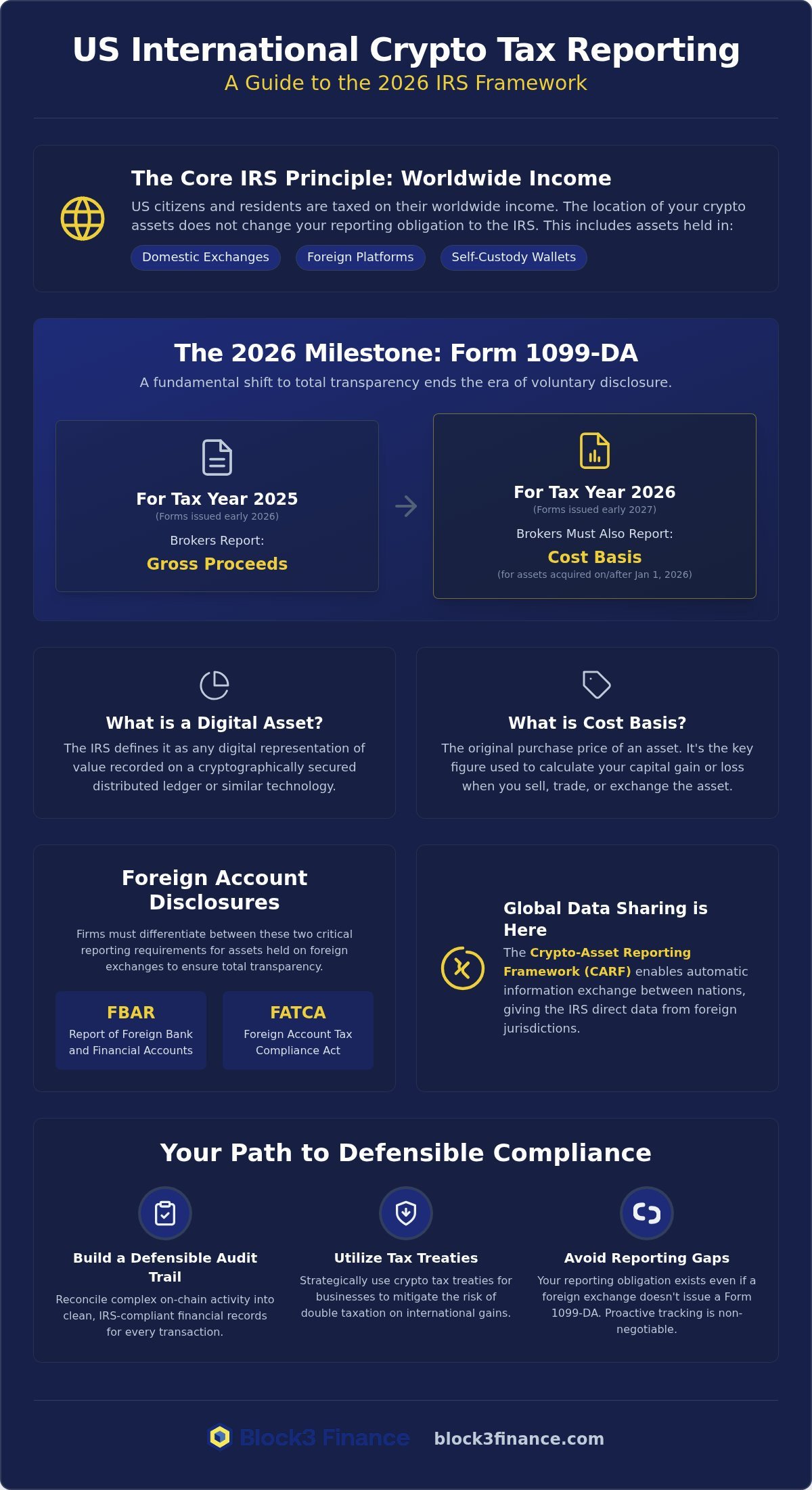
International crypto tax reporting represents the mandatory disclosure of digital assets held within foreign-based accounts or platforms. The IRS maintains a rigorous stance. US citizens and residents are taxed on their worldwide income regardless of where the crypto is held. This obligation persists whether your assets sit on a domestic exchange, a foreign platform, or a private self-custody wallet.
Digital wallets and foreign exchanges often qualify as Foreign Financial Assets under federal guidelines. Managing these cross-border activities requires more than just basic record-keeping. You must cultivate clean blockchain financial records to ensure every transaction remains defensible during an audit. This rigorous documentation supports your use of crypto tax treaties for businesses to avoid paying the same tax twice on international gains.
IRS Jurisdiction and Digital Asset Classification
The IRS classifies cryptocurrency as property for federal income tax purposes. This classification means every trade, sale, or exchange triggers a capital gain or loss. For US taxpayers operating internationally, the worldwide income rule dictates that you must report gains even if the transaction occurred entirely outside US borders. You cannot assume that using a non-US platform exempts you from these federal obligations.
According to the IRS, a digital asset is any digital representation of value which is recorded on a cryptographically secured distributed ledger or any similar technology as specified by the Secretary. Understanding this definition is the first step toward mastering crypto tax treaties for businesses that operate in multiple legal environments. It ensures you don't overlook specific tokens or decentralized finance (DeFi) positions that the IRS considers reportable property.
Why 2026 is a Milestone Year for Compliance
The 2026 tax year marks a definitive shift toward total transparency. Starting January 1, 2026, custodial brokers must track and report the cost basis for assets acquired on their platforms. This information will be included on the Form 1099-DA issued in early 2027. This transition effectively ends the era of voluntary disclosure, replacing it with an automated system that gives the IRS direct visibility into your gross proceeds.
Global cooperation is also accelerating through the Crypto-Asset Reporting Framework (CARF), which facilitates the automatic exchange of information between nations. This increased visibility means the IRS will receive data directly from foreign jurisdictions. It makes omitting offshore holdings a high-risk gamble. Firms must proactively align their internal accounting processes with these new standards to resolve friction before it triggers an audit.
The 2026 IRS Framework: Form 1099-DA and Digital Assets
The introduction of Form 1099-DA changes how the IRS tracks digital wealth. This new form requires custodial brokers to report gross proceeds from sales directly to the agency. For the 2025 tax year, brokers will issue these forms to taxpayers in early 2026. This shift gives the government a direct window into your trading volume and liquidity events.
Starting January 1, 2026, the reporting requirements expand significantly. Brokers must now include the cost basis, which is the original purchase price of an asset, for digital assets acquired on or after that date. These finalized IRS regulations represent a move toward total transparency in the digital asset space. This information will appear on the forms issued in early 2027 for the 2026 tax year.
A critical gap exists when you use foreign exchanges that don't comply with US reporting standards. These international entities often won't issue a Form 1099-DA. However, your legal obligation to report these transactions under IRS rules doesn't disappear. Managing cost basis data is essential for firms utilizing crypto tax treaties for businesses to claim foreign tax credits effectively and avoid double taxation.
Understanding Cost Basis Requirements in 2026
Tracking the original purchase price is now a mandatory broker function for assets acquired in 2026. This change directly impacts how you calculate capital gains and losses for international trades. Gain or loss is the difference between your cost basis and the gross proceeds of a sale. If you move assets from a foreign exchange to a US broker, the basis data might be lost.
The IRS often assumes a cost basis of $0 when data is missing, which can lead to inflated tax bills. You'll need to reconcile your foreign exchange data with domestic 1099-DA records to ensure accuracy. Maintaining a defensible audit trail is the only way to prove your actual acquisition costs for assets held abroad. Successful firms use crypto tax treaties for businesses to navigate the friction between foreign income and US reporting obligations.
Reporting DeFi and Non-Broker Transactions
Decentralized finance (DeFi) protocols typically won't issue standard tax forms. The IRS repealed "DeFi broker" regulations in 2025, which limits 1099-DA requirements primarily to custodial brokers. This means the duty to self-report on-chain activity from non-custodial wallets rests entirely on your shoulders. You must still report these taxable events even if no broker provides a summary of your activity.
Accurate Tax Filing and Reporting becomes your primary defense against IRS scrutiny. You must track every swap, bridge, and yield-earning event across all international wallets. If you're managing complex international transactions and need to ensure your records are audit-ready, reach out to our team for a strategic consultation.
FBAR and FATCA: Reporting Crypto in Foreign Accounts
Disclosure requirements for offshore assets extend well beyond your standard income tax return. You must navigate two distinct frameworks: the Report of Foreign Bank and Financial Accounts (FBAR) and the Foreign Account Tax Compliance Act (FATCA). While these requirements often overlap, they serve different regulatory purposes and have unique filing triggers.
FBAR filings (FinCEN Form 114) are submitted to the Financial Crimes Enforcement Network to combat money laundering. Conversely, FATCA filings (Form 8938) go directly to the IRS to ensure tax compliance on specified foreign financial assets. Utilizing crypto tax treaties for businesses allows you to align these disclosures with your broader global strategy while maintaining total transparency.
The penalties for failing to file are severe and vary based on your intent. Non-willful violations can result in penalties of thousands of dollars per violation. Willful failure to report foreign accounts can lead to fines of $100,000 or 50% of the account balance, whichever is greater. Proactive Audits and Compliance reviews are the best defense against these life-altering financial risks.
FBAR Obligations for Crypto Exchange Users
A foreign crypto exchange is generally considered a reportable financial account if the platform holds your digital assets. Under IRS rules, you must file an FBAR if the aggregate value of all your foreign financial accounts exceeds $10,000 at any time during the calendar year. This threshold is not per account; it is the sum of all international holdings combined.
The deadline for filing FinCEN Form 114 is April 15, which aligns with the standard federal tax deadline. Most filers receive an automatic extension to October 15 if they miss the initial date. You must accurately convert foreign currency and digital asset values to US dollars using the Treasury Reporting Rates of Exchange for the last day of the year.
FATCA Compliance for Digital Asset Investors
Form 8938, or the Statement of Specified Foreign Financial Assets, is a mandatory attachment to your annual tax return if you meet specific asset thresholds. For a single taxpayer living in the United States, the reporting trigger is a total value of specified foreign assets exceeding $50,000 on the last day of the year. These thresholds are generally higher than FBAR limits and vary based on your filing status and residency.
Reportable assets include digital assets held in accounts maintained by foreign financial institutions. You must also disclose tokens or coins issued by a foreign person that are held for investment rather than in an account. Understanding how crypto tax treaties for businesses impact these disclosures ensures you aren't over-reporting or exposing your firm to unnecessary double taxation risks.
Common Pitfalls in Cross-Border Crypto Compliance
Misconceptions regarding physical location often lead to non-compliance. Some users believe that digital assets held in foreign cold storage are exempt from IRS disclosure. This is a significant error. The IRS taxes worldwide income; the physical location of your private keys does not change your reporting obligations.
Anonymity is not a viable tax strategy. Global data exchange frameworks ensure that the IRS receives information from foreign jurisdictions with increasing speed. Attempting to hide assets only increases the risk of severe penalties and audits. You must shift from a defensive posture to one of total command over your financial data.
Navigating Double Taxation and Foreign Tax Credits
Businesses operating across borders face the constant threat of double taxation. This occurs when both the US and a foreign country claim the right to tax the same income. Strategic use of crypto tax treaties for businesses can resolve this conflict. You can often apply Foreign Tax Credits to reduce your US liability by the amount paid to another nation.
Claiming these credits requires filing Form 1116 or 1118. In some cases, you must use Form 8833 to disclose a treaty-based return position to the IRS. Proper Corporate Structuring for Crypto Businesses provides the foundation for these claims. It ensures your Web3 startup or DAO, a decentralized autonomous organization, is positioned to take full advantage of available legal protections.
Reporting Complex On-Chain Activity
International mining and staking rewards create immediate taxable events. Staking involves earning rewards for participating in network security, and you must value these rewards at their fair market value at the moment of receipt. This becomes complex when protocols operate in jurisdictions with different pricing data. You must maintain a precise record of every token earned to avoid under-reporting.
Airdrops, which are free tokens sent to your wallet, are also treated as ordinary income. You must document the value of every airdrop received on foreign platforms to maintain a defensible audit trail. This is especially true for NFT transactions, where cross-border secondary sales often trigger reporting requirements that businesses overlook. Building a clear history of these events is the only way to protect your growth from future scrutiny.
If you're unsure how your international on-chain activity affects your domestic tax bill, contact our specialists today for an expert review of your global strategy.
Strategic Compliance with Block3 Finance
Block3 Finance serves as the elite partner for firms navigating the volatility of international digital asset regulations. We move beyond simple data aggregation to provide a sophisticated blend of professional authority and advocacy. Our mission is to help you gain total command over your cross-border operations while ensuring every transaction meets the highest standards of IRS scrutiny.
Scaling a Web3 firm requires more than just basic filing; it demands high-level strategic oversight. Our fractional CFO services, which provide part-time executive financial leadership, offer the expertise needed to manage complex international structures. By leveraging crypto tax treaties for businesses, we help you cultivate a roadmap for growth that remains resilient against shifting global policies.
Total clarity is our standard. We resolve the friction between chaotic on-chain activity and the rigid requirements of federal reporting. If you're ready to transition from managing regulations to mastering them, schedule a professional consultation with our team today.
Turning Complexity into Defensible Financial Records
Our methodology focuses on creating audit-ready bookkeeping that stands up to the most rigorous examinations. We transform messy, fragmented on-chain data into clean, structured financial statements. This process is essential for businesses that must reconcile domestic 1099-DA forms with data from various international protocols.
With over 13 years of blockchain-specific financial expertise, we've served more than 980 global clients. This deep immersion in the ecosystem allows us to provide a level of oversight that traditional accounting firms cannot match. Explore our Block3 Finance Accounting Services to see how we cultivate stability for your digital portfolio.
Global Solutions for DAOs and Web3 Startups
Decentralized Autonomous Organizations (DAOs) face unique challenges when reconciling worldwide income with US tax obligations. We provide specialized reporting that accounts for the fluid nature of decentralized governance and treasury management. Our team understands how to apply crypto tax treaties for businesses to protect DAO contributors from unnecessary tax exposure.
Managing liquidity across borders requires robust on- and off-ramp solutions. These solutions facilitate the seamless exchange between digital assets and fiat currency, or government-issued money. For a deeper dive into these complexities, consult our DAO Accounting: A Strategic Guide for US-based organizations.
Master Your Global Digital Asset Footprint
The 2026 IRS landscape demands a shift from passive observation to proactive mastery. You must reconcile the automated reporting of Form 1099-DA with the rigorous disclosure requirements of FBAR and FATCA to maintain total transparency. Strategic alignment with crypto tax treaties for businesses allows you to navigate the high-stakes environment of international digital assets without fear of redundant taxation.
Ranked as a top crypto tax firm by Bitcoin.com, Block3 Finance brings specialized reporting for DAOs and high-growth Web3 firms to the forefront of your strategy. We provide the technical rigor of a traditional auditor infused with the mindset of a bold innovator. It's time to claim total command over your cross-border financial records.
Secure your global crypto compliance with Block3 Finance today. You possess the agency to thrive in this complex landscape with a partner that values precision and intellectual depth.
Frequently Asked Questions
Do I have to report crypto held on a foreign exchange like Binance to the IRS?
Yes, you must report all digital assets held on foreign exchanges to the IRS. US taxpayers are required to disclose worldwide income, which includes gains from platforms like Binance or other international entities. Failing to report these holdings can lead to significant penalties, even if the exchange does not provide a 1099-DA.
You should maintain detailed records of every trade to ensure your filings are defensible. This proactive approach protects your growth in a landscape of increasing transparency.
What is the FBAR threshold for cryptocurrency accounts in 2026?
The FBAR reporting threshold for 2026 is an aggregate value exceeding $10,000 at any point during the calendar year. Aggregate value refers to the combined total of all your foreign financial accounts. If the sum of your balances on all foreign crypto exchanges hits $10,001 for even one minute, you must file FinCEN Form 114.
This requirement is separate from your annual income tax return. It is a critical disclosure for maintaining total cross-border compliance.
Will I receive a 1099-DA from a foreign crypto exchange?
You will probably not receive a Form 1099-DA from a foreign exchange. Most international platforms don't follow US reporting regulations and aren't required to issue these forms. However, the IRS still expects you to report all gross proceeds and cost basis information accurately.
You must take a proactive stance by reconciling your own transaction data. This prevents discrepancies that could trigger a federal audit.
How does the IRS track international crypto transactions?
The IRS tracks international transactions through the Crypto-Asset Reporting Framework (CARF), which facilitates the automatic exchange of data between countries. This framework allows the US to receive information about accounts held by US citizens in participating foreign jurisdictions. Additionally, the IRS uses advanced blockchain analytics to link on-chain activity to specific taxpayers.
The era of digital asset anonymity is closing as global transparency becomes the standard. Mastery of your data is now your best defense.
Can I use foreign tax credits for crypto taxes paid in another country?
Yes, you can often claim a Foreign Tax Credit to offset US tax liability on income taxed by another country. This process is governed by specific IRS rules and can be optimized through crypto tax treaties for businesses. These treaties are designed to prevent double taxation, where two countries tax the same income.
You typically file Form 1116 to claim this credit. This strategically reduces your total domestic tax bill while fulfilling global obligations.
What happens if I failed to report foreign crypto in previous years?
Failing to report foreign crypto in previous years can result in substantial fines and interest. You should consult with a professional to explore options like filing an amended return or participating in a voluntary disclosure program. These programs help taxpayers come into compliance before the IRS initiates an investigation.
Taking the offensive now protects your business from more severe penalties later. Proactive correction is always better than a reactive defense during an audit.
Is a hardware wallet considered a foreign account for FBAR purposes?
A hardware wallet is generally not considered a foreign financial account for FBAR purposes because you maintain self-custody of the private keys. However, if your digital assets are held in a custodial account on a foreign exchange, that account is reportable. The distinction lies in who controls the assets.
If a foreign institution holds your tokens, you must include that value in your calculations. Self-custody offers different reporting nuances that require careful navigation.
How do I report staking rewards from a foreign DeFi protocol?
Staking rewards from foreign DeFi protocols must be reported as ordinary income at their fair market value when you receive them. Fair market value is the price of the asset in US dollars at the exact moment it becomes accessible to you. You must track these rewards meticulously, as decentralized platforms rarely provide tax summaries.
Accurate record-keeping ensures you can defend your income calculations. This is vital if the IRS requests an audit of your international on-chain activity.

Article by
Mahad Mohamed
Mahad Mohamed is an accountant and the CEO of Block3 Finance, with over 26+ years of Canadian and international tax and accounting experience. A crypto accounting specialist since the early days of Bitcoin, he has consulted for over 38 crypto companies and collaborated with legal professionals on regulatory matters. His expertise spans corporate reorganization, cross-border tax structuring (Canada & US), tax disputes, and CRA audits.
Previously, Mahad worked for the Canada Revenue Agency (CRA), Big4 accounting firms, and served as a Rulings Officer for the Federal Tax Authority of the UAE before acquiring Tax Partners in 2014.
Block3 Finance and Tax Partners has 44 full-time accountants and over 9,800+ clients.
Disclaimer
This article provides general information only and is current as of its publication date. It has not been updated and may be out of date. It does not constitute legal advice and should not be relied upon as such. Every tax situation is unique and may differ from the examples discussed in this article. If you have specific questions, you should seek the advice of our accountants for your unique circumstances.
Frequently Asked Questions
Do I have to report crypto held on a foreign exchange like Binance to the IRS?
Yes, you must report all digital assets held on foreign exchanges to the IRS. US taxpayers are required to disclose worldwide income, which includes gains from platforms like Binance or other international entities. Failing to report these holdings can lead to significant penalties, even if the exchange does not provide a 1099-DA. You should maintain detailed records of every trade to ensure your filings are defensible. This proactive approach protects your growth in a landscape of increasing transparency.
What is the FBAR threshold for cryptocurrency accounts in 2026?
The FBAR reporting threshold for 2026 is an aggregate value exceeding $10,000 at any point during the calendar year. Aggregate value refers to the combined total of all your foreign financial accounts. If the sum of your balances on all foreign crypto exchanges hits $10,001 for even one minute, you must file FinCEN Form 114. This requirement is separate from your annual income tax return. It is a critical disclosure for maintaining total cross-border compliance.
Will I receive a 1099-DA from a foreign crypto exchange?
You will probably not receive a Form 1099-DA from a foreign exchange. Most international platforms don't follow US reporting regulations and aren't required to issue these forms. However, the IRS still expects you to report all gross proceeds and cost basis information accurately. You must take a proactive stance by reconciling your own transaction data. This prevents discrepancies that could trigger a federal audit.
How does the IRS track international crypto transactions?
The IRS tracks international transactions through the Crypto-Asset Reporting Framework (CARF), which facilitates the automatic exchange of data between countries. This framework allows the US to receive information about accounts held by US citizens in participating foreign jurisdictions. Additionally, the IRS uses advanced blockchain analytics to link on-chain activity to specific taxpayers. The era of digital asset anonymity is closing as global transparency becomes the standard. Mastery of your data is now your best defense.
Can I use foreign tax credits for crypto taxes paid in another country?
Yes, you can often claim a Foreign Tax Credit to offset US tax liability on income taxed by another country. This process is governed by specific IRS rules and can be optimized through crypto tax treaties for businesses. These treaties are designed to prevent double taxation, where two countries tax the same income. You typically file Form 1116 to claim this credit. This strategically reduces your total domestic tax bill while fulfilling global obligations.
What happens if I failed to report foreign crypto in previous years?
Failing to report foreign crypto in previous years can result in substantial fines and interest. You should consult with a professional to explore options like filing an amended return or participating in a voluntary disclosure program. These programs help taxpayers come into compliance before the IRS initiates an investigation. Taking the offensive now protects your business from more severe penalties later. Proactive correction is always better than a reactive defense during an audit.
Is a hardware wallet considered a foreign account for FBAR purposes?
A hardware wallet is generally not considered a foreign financial account for FBAR purposes because you maintain self-custody of the private keys. However, if your digital assets are held in a custodial account on a foreign exchange, that account is reportable. The distinction lies in who controls the assets. If a foreign institution holds your tokens, you must include that value in your calculations. Self-custody offers different reporting nuances that require careful navigation.
How do I report staking rewards from a foreign DeFi protocol?
Staking rewards from foreign DeFi protocols must be reported as ordinary income at their fair market value when you receive them. Fair market value is the price of the asset in US dollars at the exact moment it becomes accessible to you. You must track these rewards meticulously, as decentralized platforms rarely provide tax summaries. Accurate record-keeping ensures you can defend your income calculations. This is vital if the IRS requests an audit of your international on-chain activity.