
The gap between blockchain innovation and IRS compliance is the single greatest risk to your firm’s survival in 2026. You likely feel the constant friction of trying to reconcile complex staking rewards and on-chain liquidations with rigid U.S. federal tax standards. It’s an exhausting balancing act that prevents you from focusing on your core product while the pressure of audit-readiness looms over every move for U.S. enterprises. When you decide to hire fractional cfo expertise, you aren't just filling a seat; you're installing a strategic navigator who brings institutional discipline to decentralized finance.
This guide provides a definitive roadmap to securing elite financial leadership and mastering on-chain treasury management without the prohibitive overhead of a full-time executive hire. You'll discover how to achieve audit-ready financial records that satisfy both investors and regulators under current IRS rules. We'll explore the critical impact of recent federal legislation on your 2026 reporting and outline a clear path for scaling your enterprise from a lean startup to a dominant market player. By the end of this guide, you'll understand how to bridge the divide between decentralized protocols and the institutional rigor required for IRS filers.
Key Takeaways
- Distinguish between traditional accounting and high-level strategic leadership to understand how a fractional CFO manages the unique lifecycle of a Web3 enterprise.
- Identify the critical inflection points, such as preparing for a Series A funding round or a Token Generation Event (TGE), that signal the necessity to hire fractional cfo expertise.
- Utilize a specialized vetting framework to evaluate a candidate’s technical proficiency with sub-ledgers, block explorers, and complex DeFi reconciliation.
- Execute a five-step onboarding plan that begins with a comprehensive financial health check to ensure your on-chain activity is defensible under current IRS rules.
- Master the 2026 regulatory landscape by implementing treasury policies that align with the GENIUS Act and FASB fair value reporting standards for digital assets.
What is a Fractional CFO in the Digital Asset Economy?
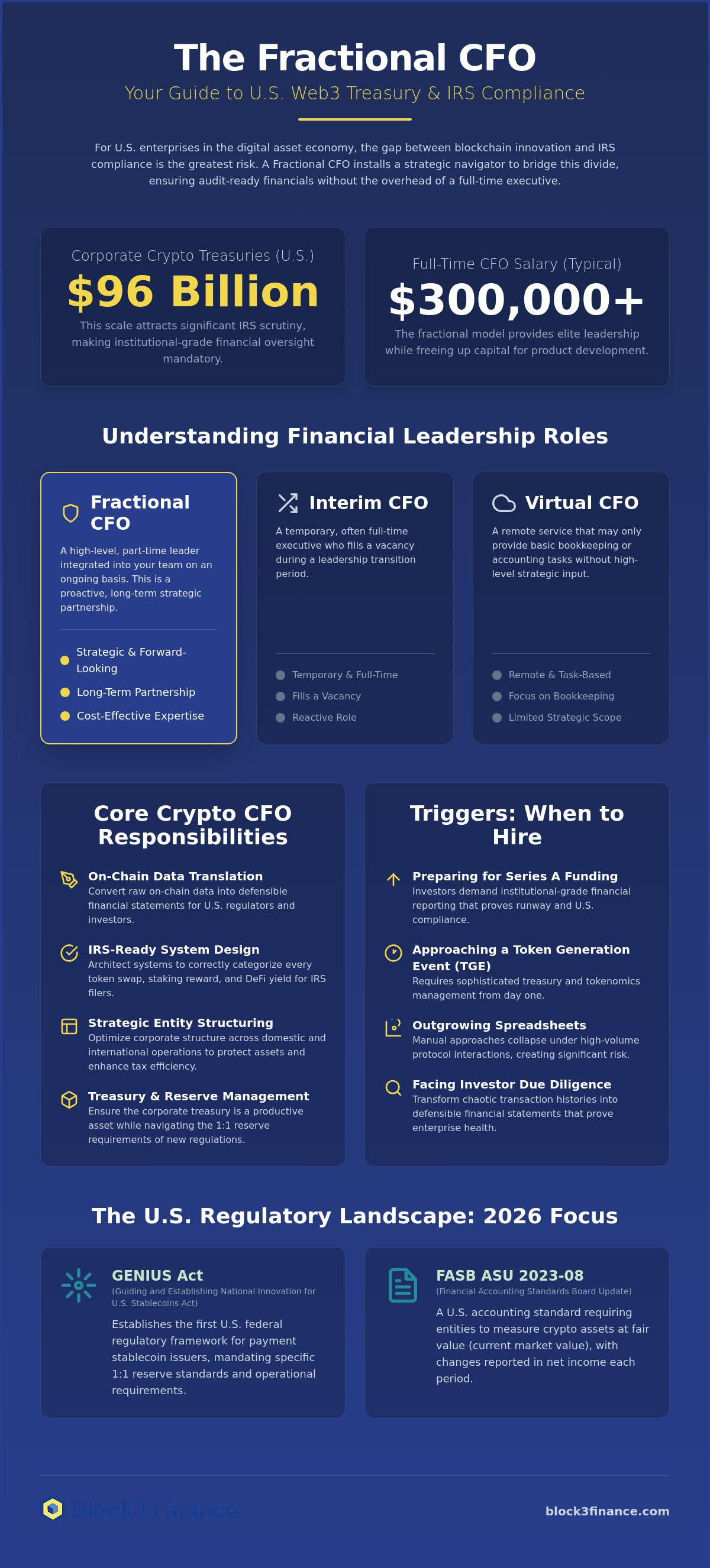
In the maturing digital asset economy of 2026, the traditional boundaries of corporate finance have dissolved. For U.S. enterprises operating under IRS rules, the role of a financial leader has shifted from ledger maintenance to the orchestration of on-chain liquidity and regulatory defense. A fractional CFO serves as this strategic architect. Unlike a traditional accountant who focuses on historical reconciliation, a fractional CFO provides the forward-looking vision necessary to manage high-stakes volatility. This guide focuses exclusively on the U.S. landscape, providing a roadmap for firms navigating federal tax obligations and the requirements of the Guiding and Establishing National Innovation for U.S. Stablecoins Act, known as the GENIUS Act. This legislation establishes the first federal regulatory framework for payment stablecoin issuers, requiring them to maintain specific reserve standards.
The decision to hire fractional cfo expertise marks the transition from a speculative startup to a disciplined enterprise. In 2026, with corporate crypto treasuries valued at approximately $96 billion, institutional-grade financial oversight is no longer optional. The fractional model has emerged as the dominant choice because it provides elite leadership without the $300,000 plus salary requirements of a full-time executive. This allows high-growth firms to deploy capital toward product development while maintaining a "white-glove" financial infrastructure that satisfies both investors and the IRS.
Fractional vs. Interim vs. Virtual CFOs
The term Fractional executive describes a high-level leader who integrates into your team on a part-time, ongoing basis. This differs significantly from an interim CFO, who typically fills a temporary vacancy during a transition, or a virtual CFO, who may only provide basic remote bookkeeping. In the crypto space, the fractional model is a proactive partnership. It implies a long-term commitment to your firm's success, offering the same strategic depth as a full-time hire but at a controlled scale. This evolution reflects a market that demands specialized "Crypto CFOs" who understand the nuances of protocol governance and decentralized liquidity.
The Core Responsibilities of a Crypto-Native CFO
A crypto-native CFO manages the friction between decentralized protocols and centralized reporting standards. Their core mandate involves translating raw on-chain data into defensible financial statements that comply with FASB ASU 2023-08 fair value measurements, which is a U.S. accounting standard requiring assets to be measured at current market value. They don't just record transactions; they design the systems that ensure every token swap, staking reward, and DeFi yield is correctly categorized for IRS filers. Beyond compliance, they oversee corporate entity structuring to protect assets and optimize tax efficiency across domestic and international operations. When you hire fractional cfo services, you gain a partner capable of navigating the 1:1 reserve requirements of the GENIUS Act while ensuring your treasury remains a productive asset.
When Should Your Web3 Firm Hire a Fractional CFO?
Simple bookkeeping becomes a liability once your firm moves beyond the seed stage. For many founders, managing on-chain transactions via spreadsheets is a rite of passage, yet this manual approach quickly collapses under the weight of high-volume protocol interactions. The decision to hire fractional cfo leadership usually coincides with critical inflection points, such as a Series A funding round or a pending Token Generation Event (TGE). Investors in 2026 demand more than just a vision; they require institutional-grade financial reporting that proves your runway is secure and your treasury is compliant with U.S. standards.
Transitioning from founder-led finance to professional oversight is a defensive necessity in the current regulatory climate. With the combined value of corporate crypto treasuries reaching approximately $96 billion in early 2026, the IRS has intensified its focus on digital asset reporting. If your records aren't audit-ready, you risk significant friction during due diligence or tax season. A fractional CFO serves as a visionary navigator, transforming chaotic transaction histories into defensible financial statements that reflect the true health of your enterprise.
Managing Complex Treasury and Tokenomics
Treasury management is the primary challenge for decentralized organizations. It's no longer enough to simply hold assets; you must optimize them. As the market for crypto treasury management tools is projected to grow to $12.34 billion by 2034, firms are increasingly shifting from passive holding to productive asset utilization. Your CFO will implement robust on- and off-ramp solutions to ensure seamless fiat-to-crypto operations. They also provide strategic oversight for staking rewards, airdrops, and yield-bearing assets, ensuring these activities don't create unforeseen tax liabilities for U.S. filers.
Compliance and Regulatory Navigation
The implementation of FASB ASU 2023-08 has fundamentally changed how U.S. entities must measure qualifying crypto assets. Under these rules, you must measure assets at fair value, recognizing changes in net income each reporting period. A fractional CFO ensures your systems are configured to handle these requirements while preparing your firm for the reserve disclosures mandated by the GENIUS Act. For a deeper dive into these requirements, review The Definitive Guide to Cryptocurrency Tax Filing in 2026. If you find your current financial processes are lagging behind these mandates, it may be time to consult with our strategic team to secure your firm's future.
Evaluating Expertise: The Crypto CFO Vetting Framework
A traditional finance background is no longer sufficient for the decentralized era. When you prepare to hire fractional cfo leadership, your vetting process must prioritize a candidate's ability to navigate the specific technical architecture of blockchain protocols. This requires more than a passing familiarity with digital wallets. An elite candidate possesses a non-negotiable technical stack that includes proficiency with block explorers, on-chain sub-ledgers, and the mechanics of decentralized finance (DeFi) protocols. They must demonstrate a proven history of reconciling complex on-chain activity where traditional ERP systems often fail to capture the nuances of gas fees, slippage, and liquidity provision.
Distinguishing between a "crypto enthusiast" and a "blockchain financial expert" is critical for U.S. enterprises. An enthusiast might understand market trends or basic trading, but a financial expert understands how to structure these activities within a Delaware C-Corp or a complex LLC framework under IRS rules. Your CFO must be able to perform deep-dive forensic accounting on your transaction history, ensuring that every movement of capital is defensible and correctly categorized for tax reporting. This level of rigor is what separates a speculative project from a sustainable enterprise that is prepared for institutional scrutiny.
Technical Proficiency vs. Strategic Vision
Technical mastery is the foundation, but strategic vision is what drives growth. Your CFO must understand the underlying mechanics of liquidity pools and smart contracts to forecast how these tools will impact your firm's long-term runway. They serve as the primary translator between your engineering team and your board of directors. By converting protocol complexity into clear, fair-value financial reporting, they enable leadership to make informed decisions about capital allocation. This includes the strategic implementation of crypto-to-fiat payment systems that bridge the gap between your digital operations and your traditional vendors.
The Importance of a Specialized Firm Background
Individual freelancers often struggle to keep pace with the volatile nature of the crypto tax landscape. The rapid evolution of IRS guidance and federal legislation like the GENIUS Act requires a level of constant vigilance that a solo practitioner rarely possesses. Hiring through a specialized firm provides access to a collective intelligence that individual contractors cannot match. At Block3 Finance, our clients benefit from a deep bench of specialists who have managed over 980 global clients. You can review the credentials of our executive team to see the 13 plus years of blockchain financial expertise we bring to every engagement. This institutional depth ensures that your firm's financial strategy is never dependent on a single point of failure.
How to Hire and Onboard a Fractional CFO: A 5-Step Plan
Scaling a Web3 enterprise requires a transition from reactive bookkeeping to proactive financial architecture. This evolution succeeds only when you follow a structured integration process. When you decide to hire fractional cfo expertise, you aren't just adding a consultant; you're installing a strategic engine into your corporate structure. Success depends on clear alignment between your technical operations and your financial goals. Follow this five-step roadmap to ensure your new leadership delivers immediate value for your U.S. based firm.
- Step 1: Perform a Financial Health Check. Before onboarding, you must identify "dark data" in unmapped wallets. Ensure your current on-chain records are accessible and that your transaction history is ready for professional forensic review.
- Step 2: Define the Scope. Determine if your primary need is treasury management, IRS tax compliance, or a fundraising strategy for a 2026 Series A round. A clear mandate prevents scope creep and focuses your CFO on your most critical friction points.
- Step 3: Conduct Technical Edge-Case Interviews. Test candidates on complex scenarios, such as the accounting treatment of assets lost in a bridge hack or the tax implications of a stablecoin de-pegging event. Their answers will reveal if they truly understand the volatility of decentralized finance.
- Step 4: Establish 90-Day KPIs. Set measurable goals, such as achieving a fully reconciled ledger by day 30 and delivering a board-ready treasury risk assessment by day 60.
- Step 5: Integrate the Tech Stack. Connect your CFO with your existing sub-ledgers and accounting software. They must bridge the gap between block explorers and traditional tools like QuickBooks or Xero to ensure a single version of financial truth.
Defining Success in the First Quarter
Clean, defensible monthly financial statements are the non-negotiable baseline for the first 90 days. Your CFO should establish a steady cadence for treasury reporting that highlights liquidity ratios and runway projections. They must also verify that all crypto payroll and contractor payments for U.S. filers comply with federal withholding and reporting requirements. This proactive stance protects the firm from future IRS audits and ensures that your financial infrastructure is as robust as your code. If you are ready to secure your firm's financial future, contact our executive team today to begin your strategic onboarding.
Onboarding into the DAO or Startup Culture
Fractional leaders must adapt to the unique governance models of the blockchain industry. This often involves managing multisig approval processes and maintaining "least privilege" access to corporate wallets to mitigate security risks. A visionary navigator understands that decentralized governance requires a different communication rhythm than traditional corporate silos. For organizations operating under community-led frameworks, our strategic guide for DAO accounting provides deeper insights into how these dynamics influence financial oversight and institutional reporting.
Scaling with Authority: The Block3 Finance CFO Advantage
Block3 Finance operates at the intersection of legacy financial rigor and decentralized innovation. When you decide to hire fractional cfo services through our firm, you gain more than a part-time executive; you secure a visionary navigator dedicated to your firm's long-term legitimacy. Our approach moves beyond the defensive posture of mere compliance, positioning your business for offensive growth and institutional mastery. With over 13 years of blockchain financial expertise and a track record of managing 980 plus global clients, we understand the unique friction points of U.S. based crypto operations under IRS rules.
The true advantage lies in the synergy of our integrated service model. By combining strategic CFO leadership with meticulous monthly bookkeeping and expert tax filing, we eliminate the communication gaps that often lead to financial discrepancies. This holistic oversight ensures that your on-chain activity is always reconciled and ready for institutional due diligence. Our clients, ranging from high-volume traders to complex DAOs, rely on this unified infrastructure to maintain total command over their digital assets in an increasingly regulated environment. We don't just provide a service; we offer a roadmap for thriving in a volatile landscape.
Beyond Traditional Accounting
We specialize in the technical complexities that traditional firms often avoid. Our team provides strategic oversight for on- and off-ramp solutions and payment systems, ensuring that your liquidity remains fluid and your records stay clean. We transform chaotic on-chain data into audit-ready financial statements that satisfy the most rigorous IRS reporting requirements for digital asset holders. For founders ready to transition from a startup mindset to an enterprise-grade financial structure, our CFO services offer the foundation for sustainable scaling and intellectual depth.
Join the Future of Digital Finance
Taking command of your financial landscape requires a partner who understands that vision and execution are inseparable. While our headquarters are located in Ontario, our global reach and specialized focus on U.S. regulatory frameworks allow us to support the world's most complex crypto projects. We provide the intellectual leadership and technical discipline necessary to thrive in the 2026 digital economy. Don't leave your firm's legitimacy to chance. Reach out to us for a strategic consultation and discover how a partnership with Block3 Finance can empower your enterprise to scale with authority.
Mastering the Future of On-Chain Finance
The 2026 financial landscape for digital assets is no longer a wild frontier; it's a regulated ecosystem that rewards precision and foresight. By establishing a robust financial framework today, you ensure your enterprise is prepared for the rigorous fair value reporting standards of ASU 2023-08 and the transparency requirements of the GENIUS Act under IRS rules. You've learned that the decision to hire fractional cfo leadership is the catalyst for transforming chaotic on-chain activity into a strategic asset. Block3 Finance stands as a calm force in this evolving industry, bringing over 13 years of blockchain financial leadership and a proven track record as a top-ranked firm by Bitcoin.com.
We specialize in turning complex DeFi interactions into audit-ready records that satisfy both investors and regulators. It's time to shift from a defensive posture to an offensive strategy focused on growth and legitimacy. Secure Your Strategic Advantage—Book a Consultation with a Block3 Fractional CFO and take command of your firm's financial destiny.
Frequently Asked Questions
What is the typical cost of a fractional CFO for a crypto startup?
Industry rates for specialized digital asset support typically range between $200 and $350 per hour in 2026. Monthly retainers generally scale based on the complexity of your on-chain volume and the level of strategic involvement your project requires. While early-stage startups might find lower entry points, high-growth firms should budget for a partner who understands the nuances of the GENIUS Act (Guiding and Establishing National Innovation for U.S. Stablecoins Act) and fair value reporting under IRS rules.
How many hours a week does a fractional CFO usually work?
A fractional CFO typically dedicates between 5 and 15 hours per week to your enterprise, depending on your current lifecycle and strategic needs. During high-intensity periods, such as a Series B funding round or a major treasury restructuring, this commitment may temporarily increase. The model is designed to provide elite leadership at a fraction of the time and cost of a full-time executive hire.
Can a fractional CFO help with crypto-specific audits like an IRS examination?
Yes, a fractional CFO is essential for navigating IRS examinations and ensuring your records are defensible under U.S. federal law. They act as the primary liaison between your firm and the IRS, providing the forensic data necessary to justify complex on-chain interactions. Having a leader who understands fair value measurements ensures that your reporting remains audit-ready and compliant with current U.S. tax standards.
Does a fractional CFO manage my day-to-day bookkeeping?
A fractional CFO provides strategic oversight rather than performing day-to-day data entry. While they ensure your bookkeeping systems are correctly configured to capture on-chain data, the actual recording of transactions is typically handled by a specialized crypto accountant. The CFO uses the resulting financial statements to drive high-level decisions, manage runway, and optimize your overall treasury strategy for long-term stability.
How does a fractional CFO handle DAO treasury management and multisig wallets?
Managing DAO treasuries requires a deep understanding of multisig security and decentralized governance protocols. Your CFO will establish rigorous internal controls for wallet access, often serving as a non-signing advisor or a key holder within a "least privilege" framework. They ensure that community-led expenditures are correctly categorized for IRS filers while maintaining the transparent reporting standards expected by DAO participants.
What is the difference between a fractional CFO and a crypto tax accountant?
A crypto tax accountant focuses on historical accuracy and compliance, while a fractional CFO provides forward-looking strategy and financial leadership. While both roles are necessary, you hire fractional cfo expertise when you need to manage capital allocation, plan for fundraising, or design a complex treasury policy. The accountant ensures your records are correct; the CFO ensures those records support your firm's growth.
Should I hire a fractional CFO before or after a token launch?
You should ideally hire a fractional CFO at least three to six months before a token launch to establish a defensible financial infrastructure. This lead time allows for the implementation of robust treasury policies and the configuration of on-chain sub-ledgers before transaction volume spikes. Entering a launch without professional oversight often leads to irreversible accounting errors and significant tax liabilities for U.S. based entities.

Article by
Mahad Mohamed
Mahad Mohamed is an accountant and the CEO of Block3 Finance, with over 26+ years of Canadian and international tax and accounting experience. A crypto accounting specialist since the early days of Bitcoin, he has consulted for over 38 crypto companies and collaborated with legal professionals on regulatory matters. His expertise spans corporate reorganization, cross-border tax structuring (Canada & US), tax disputes, and CRA audits.
Previously, Mahad worked for the Canada Revenue Agency (CRA), Big4 accounting firms, and served as a Rulings Officer for the Federal Tax Authority of the UAE before acquiring Tax Partners in 2014.
Block3 Finance and Tax Partners has 44 full-time accountants and over 9,800+ clients.
Disclaimer
This article provides general information only and is current as of its publication date. It has not been updated and may be out of date. It does not constitute legal advice and should not be relied upon as such. Every tax situation is unique and may differ from the examples discussed in this article. If you have specific questions, you should seek the advice of our accountants for your unique circumstances.
Frequently Asked Questions
What is the typical cost of a fractional CFO for a crypto startup?
Industry rates for specialized digital asset support typically range between $200 and $350 per hour in 2026. Monthly retainers generally scale based on the complexity of your on-chain volume and the level of strategic involvement your project requires. While early-stage startups might find lower entry points, high-growth firms should budget for a partner who understands the nuances of the GENIUS Act (Guiding and Establishing National Innovation for U.S. Stablecoins Act) and fair value reporting under IRS rules.
How many hours a week does a fractional CFO usually work?
A fractional CFO typically dedicates between 5 and 15 hours per week to your enterprise, depending on your current lifecycle and strategic needs. During high-intensity periods, such as a Series B funding round or a major treasury restructuring, this commitment may temporarily increase. The model is designed to provide elite leadership at a fraction of the time and cost of a full-time executive hire.
Can a fractional CFO help with crypto-specific audits like an IRS examination?
Yes, a fractional CFO is essential for navigating IRS examinations and ensuring your records are defensible under U.S. federal law. They act as the primary liaison between your firm and the IRS, providing the forensic data necessary to justify complex on-chain interactions. Having a leader who understands fair value measurements ensures that your reporting remains audit-ready and compliant with current U.S. tax standards.
Does a fractional CFO manage my day-to-day bookkeeping?
A fractional CFO provides strategic oversight rather than performing day-to-day data entry. While they ensure your bookkeeping systems are correctly configured to capture on-chain data, the actual recording of transactions is typically handled by a specialized crypto accountant. The CFO uses the resulting financial statements to drive high-level decisions, manage runway, and optimize your overall treasury strategy for long-term stability.
How does a fractional CFO handle DAO treasury management and multisig wallets?
Managing DAO treasuries requires a deep understanding of multisig security and decentralized governance protocols. Your CFO will establish rigorous internal controls for wallet access, often serving as a non-signing advisor or a key holder within a "least privilege" framework. They ensure that community-led expenditures are correctly categorized for IRS filers while maintaining the transparent reporting standards expected by DAO participants.
What is the difference between a fractional CFO and a crypto tax accountant?
A crypto tax accountant focuses on historical accuracy and compliance, while a fractional CFO provides forward-looking strategy and financial leadership. While both roles are necessary, you hire fractional cfo expertise when you need to manage capital allocation, plan for fundraising, or design a complex treasury policy. The accountant ensures your records are correct; the CFO ensures those records support your firm's growth.
Should I hire a fractional CFO before or after a token launch?
You should ideally hire a fractional CFO at least three to six months before a token launch to establish a defensible financial infrastructure. This lead time allows for the implementation of robust treasury policies and the configuration of on-chain sub-ledgers before transaction volume spikes. Entering a launch without professional oversight often leads to irreversible accounting errors and significant tax liabilities for U.S. based entities.