
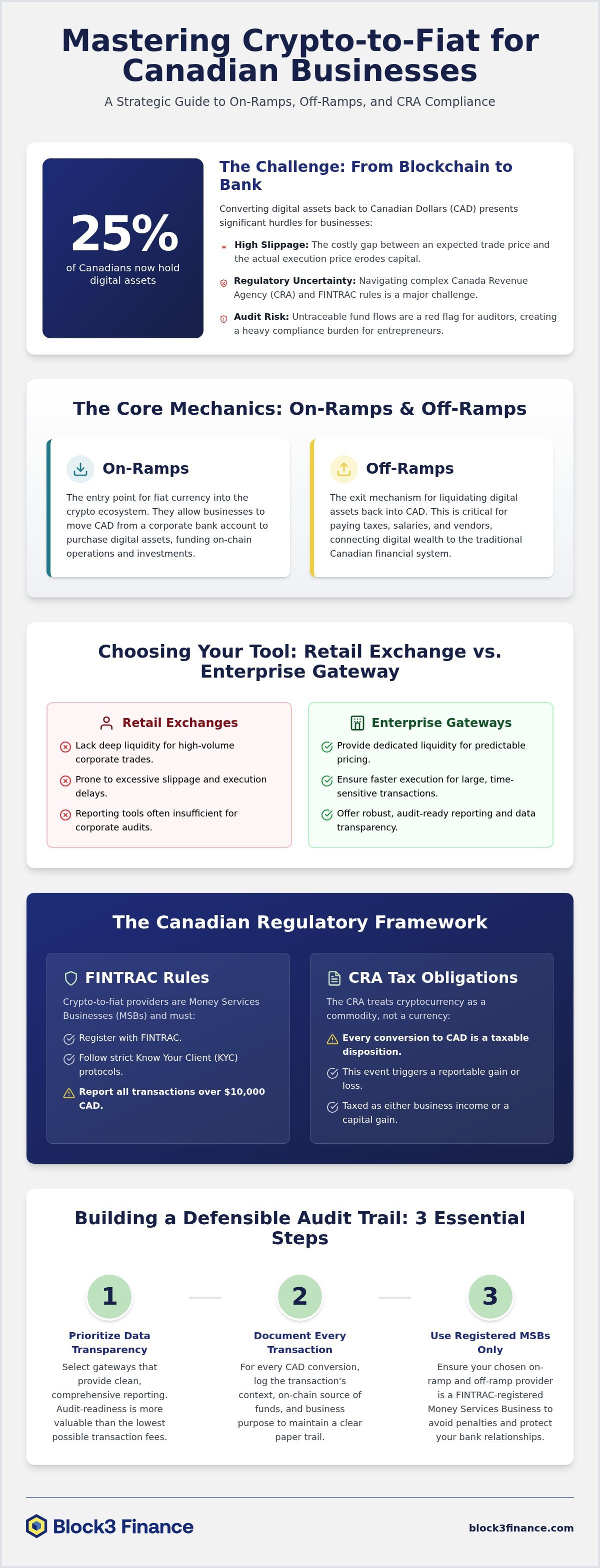
With 25% of Canadians now holding digital assets, the shift from niche experiment to mainstream financial tool is complete. For your company, this means integrating crypto on-ramp solutions for business is no longer optional; it's a strategic necessity.
You likely recognize that while the blockchain offers speed, the transition back to CAD often feels like a minefield of regulatory uncertainty. You may also face high slippage, which is the costly difference between the expected price of a trade and the actual price at execution.
The fear of a CRA audit due to untraceable flows is a heavy burden for any Canadian entrepreneur trying to scale. You can transform this volatility into a disciplined, high-performance financial pipeline.
We'll show you how to master the complexities of converting digital assets into fiat while maintaining the strict, audit-ready records required by the CRA. This guide explores how to minimize tax friction and establish a seamless bookkeeping process for your corporate treasury.
Key Takeaways
- Learn how to select crypto on-ramp solutions for business that prioritize data transparency and clean reporting over the lowest possible transaction fees.
- Understand the regulatory requirements for Canadian firms, including the role of FINTRAC and the necessity of using registered Money Services Businesses.
- Discover the essential steps for building a defensible audit trail by documenting the transaction context and source of funds for every CAD conversion.
- Identify the core differences between simple retail exchanges and enterprise-grade payment gateways to ensure your liquidity events remain efficient.
- Explore how fractional CFO services can help your business integrate blockchain payment systems directly into your traditional Canadian bookkeeping.
Understanding Crypto to Fiat Payment Solutions in Canada
Crypto-to-fiat payment solutions function as the essential conduit between digital asset liquidity and the Canadian banking system. They differ from a standard cryptocurrency exchange by focusing on enterprise-scale operational requirements. These dedicated gateways provide the infrastructure needed to move high volumes of capital without disrupting your primary business flow.
Canadian firms utilize these systems to settle payroll, meet CRA tax obligations, and pay domestic vendors. The primary objective is to create a defensible financial record that ensures every transaction is transparent. This audit-ready posture is the core requirement for any business operating in the blockchain space.
The Mechanics of On-Ramps and Off-Ramps
On-ramps serve as the entry point for fiat currency into the digital ecosystem. They allow you to move CAD from a corporate bank account into blockchain-based assets to fund operations. Using professional crypto on-ramp solutions for business ensures these transfers are documented correctly from the start.
Off-ramps provide the mechanism for liquidating digital assets back into CAD. This process is critical for businesses that need to cover real-world liabilities or realize profits. A robust off-ramp strategy maintains the essential connection between your digital wealth and the legacy financial system.
These systems must interact seamlessly with your existing Canadian business bank accounts to maintain momentum. Without a reliable off-ramp, your digital wealth remains trapped on-chain and disconnected from the legacy financial tools you still need.
Why Businesses are Moving Beyond Traditional Exchanges
Retail exchanges often lack the depth required for high-volume corporate transactions. This leads to excessive slippage and delays that can erode your company's capital. Enterprise solutions provide dedicated liquidity, ensuring faster execution and more predictable pricing for your treasury.
Many firms now utilize stablecoins, which are digital assets designed to maintain a fixed value by being pegged to a fiat currency like the Canadian or US dollar. These assets act as a volatility buffer, allowing you to lock in value on-chain before executing a final conversion to CAD. This strategic layer helps shield your balance sheet from sudden market swings.
By moving beyond retail tools, you gain access to the depth and speed required to execute a modern treasury strategy. This transition allows you to manage digital assets with the same precision as traditional CAD holdings.
Regulatory Compliance and CRA Standards for Canadian Firms
Operating in the Canadian digital economy requires a proactive approach to regulatory oversight. You must ensure that your crypto on-ramp solutions for business align with the rigorous standards set by the Financial Transactions and Reports Analysis Centre of Canada (FINTRAC). Establishing this compliance early positions your firm as a disciplined participant in a high-stakes financial landscape.
FINTRAC and Anti-Money Laundering Protocols
In Canada, any entity facilitating the exchange of virtual currency for fiat money is classified as a Money Services Business (MSB). This designation mandates strict adherence to FINTRAC's requirements for virtual currency businesses. These obligations include comprehensive record-keeping and robust identity verification protocols.
Under Canadian law, MSBs must report all virtual currency transactions exceeding $10,000 CAD to FINTRAC. Failure to use a compliant gateway risks account freezes and significant legal penalties under Bill C-12. This legislation, passed on March 26, 2026, significantly increased the penalty framework for non-compliant firms in Canada.
A non-compliant gateway can lead to your corporate bank account being flagged by traditional Canadian institutions. This effectively cuts off your access to the legacy financial systems you need for daily operations. By choosing professional crypto on-ramp solutions for business that prioritize Canadian AML standards, you protect your company's long-term liquidity.
Tax Implications of Converting Crypto to CAD
Under CRA rules, every conversion from cryptocurrency to CAD is viewed as a taxable disposition. This means the moment you off-ramp, you trigger a tax event that must be reported on your Canadian corporate return. The CRA treats cryptocurrency as a commodity, meaning your gains are realized financial events with specific reporting obligations.
How this is taxed depends on whether the CRA classifies your activity as business income or a capital gain. For most Canadian corporations engaged in active trading, 100% of the profit from crypto activities is included in income. In contrast, investment-focused gains in Canada generally see only 50% of the net capital gain included in taxable income.
You must track the Fair Market Value (FMV) of your assets at the exact time of the trade to ensure accurate reporting. This value represents the highest price, in terms of money, that a property would fetch in an open and unrestricted market. Maintaining this data is essential for defending your records during a Canadian tax review.
For the 2026 tax year in Canada, most individuals must file and pay any balance by April 30, 2027. Under CRA rules, self-employed individuals have until June 15, 2027, to file, but their tax payment is still due by April 30, 2027. Missing these deadlines can result in compounded interest and penalties on any outstanding Canadian tax liability.
For a deeper dive into these nuances, read our guide on Crypto Tax in Canada. If you're concerned about how these rules affect your specific structure, speak with our compliance specialists to secure your financial foundation.
Evaluating Enterprise-Grade Payment Gateways
Selecting the right infrastructure for your corporate treasury is a strategic decision that extends far beyond simple asset conversion. While retail users might prioritize a slick interface, your selection of crypto on-ramp solutions for business should hinge on the gateway's ability to provide granular, exportable data that matches your internal ledger. Precision is the standard. If a provider cannot offer absolute transparency regarding execution times and CAD conversion rates, the resulting reconciliation gaps will create significant friction during year-end reporting.
Clean data is ultimately more valuable than the lowest possible transaction fee. A marginal saving on a swap is quickly erased by the professional fees required to untangle a messy audit trail. You should prioritize providers that offer direct integration with major accounting platforms. This ensures that every move from a digital wallet to a Canadian bank account is captured in real-time, allowing your team to maintain a continuous, audit-ready posture without manual data entry.
You must also verify the provider's underlying banking relationships to ensure reliable CAD support. A gateway's utility is limited if it cannot consistently land funds in a Canadian business account without being flagged or delayed. For more specialized needs, exploring crypto to fiat payment solutions can help you identify partners who have established the necessary trust with domestic financial institutions.
Liquidity Management and Slippage Prevention
Slippage represents the difference between the expected price of a trade and the price at which the trade actually executes. For large corporate off-ramp events, even a 1% slippage can result in the loss of thousands of dollars in capital. High-tier gateways mitigate this by utilizing deep liquidity pools to ensure a predictable conversion rate regardless of market volatility. If you are planning a transaction of significant scale, you should utilize an Over-the-Counter (OTC) desk. These desks provide personalized execution and fixed pricing, shielding your business from the "price impact" often seen on public order books.
Stablecoin Integration for Reduced Volatility
Integrating stablecoins like USDC or USDT into your pipeline can significantly simplify the off-ramp process. These assets allow you to park digital funds in a dollar-pegged environment, effectively locking in value on-chain before you commit to a final CAD liquidation. This strategy provides a necessary buffer, allowing you to wait for optimal banking windows or internal approval cycles without exposing your balance sheet to market swings. It's important to remember that the CRA views the exchange of one stablecoin for CAD as a taxable event. You must track the fair market value of the stablecoin at the moment of conversion to ensure your records remain compliant with Canadian standards.
Building a Defensible Audit Trail for Off-Ramp Activity
The technical execution of crypto on-ramp solutions for business is only half the battle. The true challenge lies in the preservation of transaction context during the liquidation process.
Without a clear link between a digital asset's origin and its final liquidation into CAD, you risk having the CRA reclassify corporate transfers as unexplained income. You must document the source of funds for every conversion, especially for transactions exceeding the $10,000 threshold that triggers mandatory reporting to FINTRAC.
Establishing a disciplined monthly reconciliation cycle is the only way to avoid the frantic year-end scramble that often leads to reporting errors. For more on maintaining these standards, see our guide on CRA Crypto Audit Preparation.
Reconciling High-Volume Crypto-to-Fiat Transfers
Strategic reconciliation involves more than just checking bank balances. You must match every CAD bank deposit to a specific blockchain "exit" event, accounting for the inherent friction of the digital ecosystem.
This includes gas fees, which are the costs paid to process transactions on the network, and gateway commissions. These must be tracked as legitimate business expenses to ensure your net tax position is accurate and compliant with Canadian standards.
Professional crypto accounting provides the specialized framework needed to capture these micro-data points. By treating these fees as distinct entries, you maintain a cleaner cost basis and a more accurate view of your net liquidity.
Documentation Requirements for CRA Readiness
The CRA requires a specific set of data points for every taxable disposition of cryptocurrency. You must archive the date, the exact timestamp of the trade, the asset type, and the fair market value in CAD at that specific moment.
Screenshots of exchange dashboards are notoriously insufficient for an audit. They lack the underlying metadata and cryptographic proof that auditors demand to verify the legitimacy of a high-volume transaction.
You should maintain a permanent digital archive of all conversion contracts and raw API logs from your gateway. Advanced crypto on-ramp solutions for business typically allow for these deep data exports, but the ultimate responsibility for data retention lies with your firm.
Storing these records in a secure, centralized environment ensures that your financial history remains defensible. If you're ready to build a more resilient financial infrastructure, connect with our strategists to secure your audit-ready records.
Strategic Implementation with Block3 Finance CFO Services
Software providers offer tools, but they rarely offer accountability. We position ourselves as the essential bridge between complex payment technology and your broader financial strategy. This ensures that your choice of crypto on-ramp solutions for business serves your long-term goals rather than just your immediate liquidity needs.
Having a specialized accountant manage your gateway implementation prevents the data gaps that lead to CRA scrutiny. We don't just set up a pipeline; we build a fortress around your financial records. This allows you to navigate a volatile landscape with the confidence of an elite strategist who understands both the blockchain and the balance sheet.
Our firm brings over 13 years of blockchain financial expertise to your corporate structure. We've managed over 980 global clients, helping them turn raw on-chain data into defensible books. By partnering with us, you shift from a defensive posture to one of total command over your digital assets.
Tailored On-and-Off-Ramp Solutions
We begin by assessing your specific operational requirements, including transaction volume, frequency, and the jurisdictions of your primary vendors. This deep dive allows us to recommend crypto on-ramp solutions for business that minimize slippage and maximize capital efficiency. Our team specializes in integrating on-and-off-ramp solutions directly into your existing corporate ledger.
This integration significantly reduces the administrative burden on your staff by automating the most tedious aspects of digital asset management. We prioritize providers with established Canadian banking relationships to ensure your CAD transfers are never delayed by legacy system friction. By managing these technical nuances, we provide you with total command over your corporate treasury and liquidity events.
Integrating Payments with Monthly Bookkeeping
Clean records are the result of disciplined monthly reconciliation rather than year-end damage control. Our Fractional CFO services turn complex on-chain data into structured, defensible financial statements. We ensure that every gas fee, commission, and taxable disposition is accounted for according to current CRA standards.
We adopt a Visionary Navigator approach to your compliance, moving beyond a defensive posture to one of proactive mastery. This methodology ensures your business remains resilient in the face of evolving Canadian regulations and increased FINTRAC enforcement. You gain the technical rigor of a traditional auditor combined with the mindset of a bold blockchain innovator.
Your financial future shouldn't be left to chance or unmanaged software. We provide the roadmap and the expertise needed to thrive in the decentralized economy while staying grounded in traditional financial excellence. To begin building your audit-ready infrastructure, contact our team for a comprehensive strategy session.
Command Your Financial Future in the Digital Economy
Establishing a seamless pipeline for your digital assets requires more than just technical integration; it demands a commitment to regulatory excellence. By prioritizing enterprise-grade crypto on-ramp solutions for business, you ensure that your CAD conversions are backed by deep liquidity and precise financial data. This disciplined approach protects your company from the friction of slippage and the high stakes of CRA audits.
True financial liberation comes from having total command over your transaction history. As a top-ranked crypto accounting firm by Bitcoin.com, Block3 Finance brings over 13 years of blockchain financial expertise to your organization. We specialize in turning volatile on-chain activity into clean, defensible financial records that stand up to the most rigorous scrutiny.
You have the opportunity to transform your treasury management from a source of stress into a competitive advantage. Secure your crypto-to-fiat pipeline with Block3 Finance and start building an audit-ready future today. Your journey toward mastery begins with a single strategic partnership.
Frequently Asked Questions
Is it legal for a Canadian business to pay vendors in cryptocurrency?
It's entirely legal for your Canadian company to settle vendor invoices using digital assets. The CRA views these as barter transactions, meaning you must record the fair market value of the cryptocurrency in CAD at the moment of the exchange. This value becomes your cost basis for the goods or services received. You must maintain precise records of these trades to ensure your corporate tax filings remain accurate and defensible.
How does the CRA treat the conversion of stablecoins to CAD?
The CRA treats the conversion of stablecoins like USDC or USDT into CAD as a taxable disposition. Even though stablecoins maintain a peg to the dollar, they are classified as commodities for tax purposes. You must track the cost basis of the stablecoin and report any gain or loss resulting from fluctuations in the CAD exchange rate at the time of the trade. Failing to report these events can lead to penalties.
What are the FINTRAC reporting requirements for crypto-to-fiat transfers?
Money Services Businesses in Canada must report any virtual currency transaction that equals or exceeds $10,000 CAD to FINTRAC. When you utilize crypto on-ramp solutions for business, you must provide comprehensive Know Your Customer data to the provider. These reporting requirements are designed to prevent money laundering and ensure that large capital flows are transparent to federal regulators. Adhering to these standards is essential for your operational standing.
Can I use a personal exchange account for my business off-ramps in Canada?
You should never use a personal exchange account to handle corporate off-ramps. Commingling personal and business assets creates a reconciliation nightmare that often triggers CRA audits. Traditional banks and regulators expect a clear separation of entities to prevent tax evasion or fraud. Using a dedicated corporate account ensures that your business liquidity events are properly documented and that your personal liability remains shielded from corporate financial activity.
How do I calculate the cost basis when liquidating crypto to fiat?
You calculate your cost basis by determining the adjusted cost base of the asset, which includes the original purchase price plus any associated transaction fees. When you liquidate to CAD, your gain or loss is the difference between the fiat received and this total cost. For businesses, 100% of these profits are typically included in income. You must track these figures in real time to ensure your year-end reporting is accurate.
What happens if I cannot provide an audit trail for my fiat deposits?
If you lack a clear audit trail, the CRA may reclassify your fiat deposits as 100% taxable income without allowing for any cost basis deductions. This scenario often results in an inflated tax bill, alongside heavy penalties and interest charges. Without cryptographic proof and gateway logs, you cannot prove the origin of the funds. Maintaining defensible records is the only way to protect your balance sheet from aggressive regulatory reassessments.
Do I need a special bank account to receive fiat from a crypto gateway?
You don't need a specific crypto account, but you must ensure your Canadian financial institution is comfortable receiving funds from a digital asset gateway. Some legacy banks may flag or freeze business accounts that receive frequent transfers from exchanges without prior notice. It's often beneficial to work with a crypto-friendly bank that understands the nature of your operations. This proactive communication prevents unexpected liquidity freezes during critical business cycles.
How can a fractional CFO help with my crypto-to-fiat strategy?
A fractional CFO provides the strategic oversight needed to navigate complex liquidity events and select the most efficient crypto on-ramp solutions for business. They manage your treasury by timing conversions to minimize slippage and ensuring every move is reflected in your bookkeeping. This leadership bridges the gap between blockchain technology and traditional financial discipline. It allows you to focus on growth while they handle the complexities of regulatory compliance.

Article by
Mahad Mohamed
Mahad Mohamed is an accountant and the CEO of Block3 Finance, with over 26+ years of Canadian and international tax and accounting experience. A crypto accounting specialist since the early days of Bitcoin, he has consulted for over 38 crypto companies and collaborated with legal professionals on regulatory matters. His expertise spans corporate reorganization, cross-border tax structuring (Canada & US), tax disputes, and CRA audits.
Previously, Mahad worked for the Canada Revenue Agency (CRA), Big4 accounting firms, and served as a Rulings Officer for the Federal Tax Authority of the UAE before acquiring Tax Partners in 2014.
Block3 Finance and Tax Partners has 44 full-time accountants and over 9,800+ clients.
Disclaimer
This article provides general information only and is current as of its publication date. It has not been updated and may be out of date. It does not constitute legal advice and should not be relied upon as such. Every tax situation is unique and may differ from the examples discussed in this article. If you have specific questions, you should seek the advice of our accountants for your unique circumstances.
Frequently Asked Questions
Is it legal for a Canadian business to pay vendors in cryptocurrency?
It's entirely legal for your Canadian company to settle vendor invoices using digital assets. The CRA views these as barter transactions, meaning you must record the fair market value of the cryptocurrency in CAD at the moment of the exchange. This value becomes your cost basis for the goods or services received. You must maintain precise records of these trades to ensure your corporate tax filings remain accurate and defensible.
How does the CRA treat the conversion of stablecoins to CAD?
The CRA treats the conversion of stablecoins like USDC or USDT into CAD as a taxable disposition. Even though stablecoins maintain a peg to the dollar, they are classified as commodities for tax purposes. You must track the cost basis of the stablecoin and report any gain or loss resulting from fluctuations in the CAD exchange rate at the time of the trade. Failing to report these events can lead to penalties.
What are the FINTRAC reporting requirements for crypto-to-fiat transfers?
Money Services Businesses in Canada must report any virtual currency transaction that equals or exceeds $10,000 CAD to FINTRAC. When you utilize crypto on-ramp solutions for business, you must provide comprehensive Know Your Customer data to the provider. These reporting requirements are designed to prevent money laundering and ensure that large capital flows are transparent to federal regulators. Adhering to these standards is essential for your operational standing.
Can I use a personal exchange account for my business off-ramps in Canada?
You should never use a personal exchange account to handle corporate off-ramps. Commingling personal and business assets creates a reconciliation nightmare that often triggers CRA audits. Traditional banks and regulators expect a clear separation of entities to prevent tax evasion or fraud. Using a dedicated corporate account ensures that your business liquidity events are properly documented and that your personal liability remains shielded from corporate financial activity.
How do I calculate the cost basis when liquidating crypto to fiat?
You calculate your cost basis by determining the adjusted cost base of the asset, which includes the original purchase price plus any associated transaction fees. When you liquidate to CAD, your gain or loss is the difference between the fiat received and this total cost. For businesses, 100% of these profits are typically included in income. You must track these figures in real time to ensure your year-end reporting is accurate.
What happens if I cannot provide an audit trail for my fiat deposits?
If you lack a clear audit trail, the CRA may reclassify your fiat deposits as 100% taxable income without allowing for any cost basis deductions. This scenario often results in an inflated tax bill, alongside heavy penalties and interest charges. Without cryptographic proof and gateway logs, you cannot prove the origin of the funds. Maintaining defensible records is the only way to protect your balance sheet from aggressive regulatory reassessments.
Do I need a special bank account to receive fiat from a crypto gateway?
You don't need a specific crypto account, but you must ensure your Canadian financial institution is comfortable receiving funds from a digital asset gateway. Some legacy banks may flag or freeze business accounts that receive frequent transfers from exchanges without prior notice. It's often beneficial to work with a crypto-friendly bank that understands the nature of your operations. This proactive communication prevents unexpected liquidity freezes during critical business cycles.
How can a fractional CFO help with my crypto-to-fiat strategy?
A fractional CFO provides the strategic oversight needed to navigate complex liquidity events and select the most efficient crypto on-ramp solutions for business. They manage your treasury by timing conversions to minimize slippage and ensuring every move is reflected in your bookkeeping. This leadership bridges the gap between blockchain technology and traditional financial discipline. It allows you to focus on growth while they handle the complexities of regulatory compliance.