
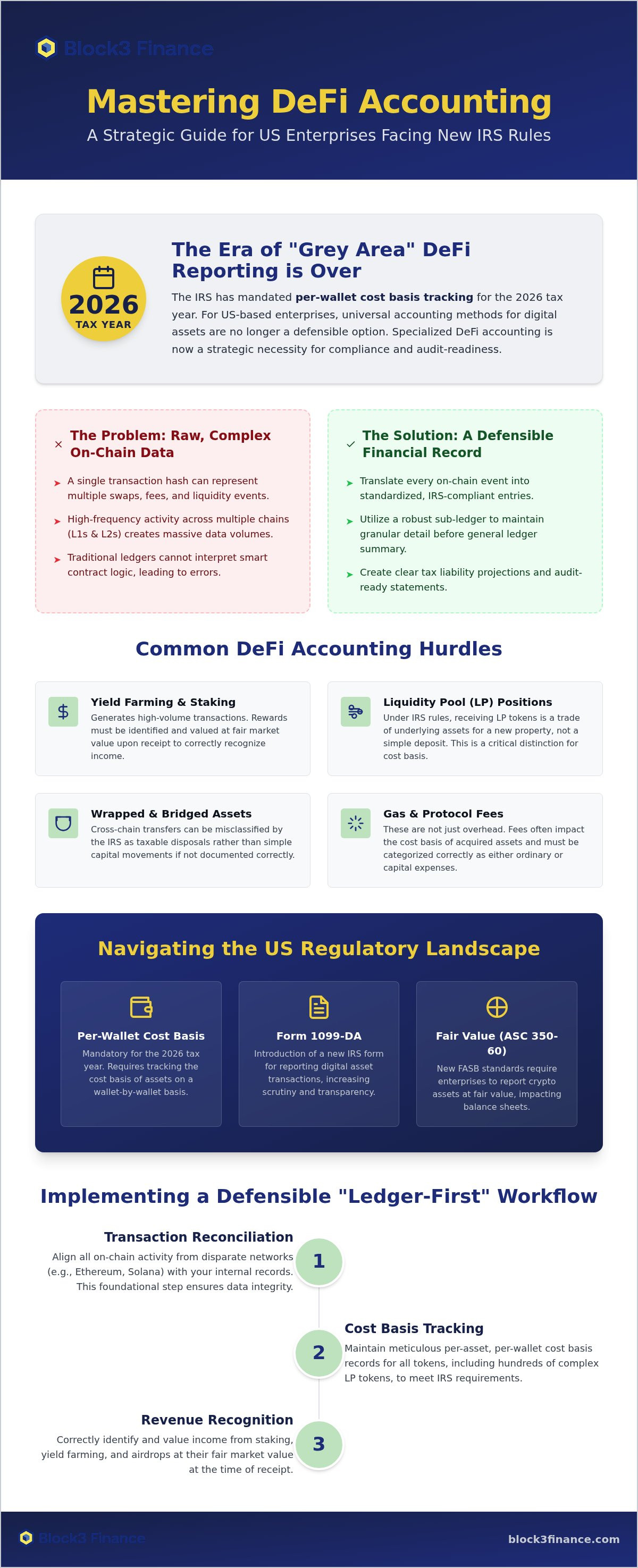
The era of "grey area" DeFi reporting ended the moment the IRS mandated per-wallet cost basis tracking for the 2026 tax year. For US-based enterprises, the days of using universal accounting methods across all digital holdings are over. You've likely felt the friction of reconciling high-volume, multi-chain transactions while fearing the precision of a modern IRS audit. Utilizing specialized DeFi accounting services is no longer a luxury; it's a strategic necessity for any firm seeking to maintain a defensible financial posture.
You understand that decentralized protocols don't naturally speak the language of traditional ledgers, and manual data entry in these environments is a recipe for expensive errors. This guide will show you how to master these complexities by transforming abstract protocol logic into standardized financial records that meet the latest FASB fair value requirements. We'll explore the shift toward ASC 350-60 standards, detail the implementation of Form 1099-DA, and provide a roadmap for optimizing your corporate structure for a transparent, audit-ready future.
Key Takeaways
- Learn to translate complex smart contract interactions into IRS-compliant financial records that stand up to high-level regulatory scrutiny.
- Discover how professional DeFi accounting services resolve the technical hurdles of yield farming, liquidity provision, and impermanent loss.
- Implement a "ledger-first" bookkeeping workflow to eliminate manual data entry errors and maintain audit-ready statements through monthly reconciliations.
- Understand the critical shift toward fair value accounting standards and how they impact your enterprise's digital asset reporting under US tax law.
- Position your firm for growth by transforming volatile on-chain data into clear tax liability projections and a defensible corporate structure.
Understanding DeFi Accounting Services in the US Market
DeFi accounting is the systematic recording and valuation of every interaction your enterprise has with a decentralized protocol. Unlike traditional bookkeeping, which tracks simple bank transfers, what decentralized finance (DeFi) is involves complex, automated logic that executes without intermediaries. These services translate on-chain events into a language the IRS understands.
Traditional bookkeeping often fails because it cannot see the internal mechanics of a smart contract. A single transaction hash might represent multiple swaps, liquidity additions, and fee accruals. Without specialized DeFi accounting services, these events appear as a single, undecipherable lump of data on a standard balance sheet.
High-frequency on-chain activity requires a robust sub-ledger approach. This means maintaining a detailed record of every granular event before summarizing it in your general ledger. It's the difference between a vague estimate and a defensible financial record. With the Total Value Locked (TVL) in DeFi exceeding $130 billion in early 2026, the scale of this data demands professional precision.
Enterprise-grade services go beyond simple tax preparation. While an individual might just want to know their net gain, a US business must ensure its books comply with the Financial Accounting Standards Board (FASB) and IRS mandates. You need a partner that navigates the volatility of the market while anchoring your firm in regulatory stability.
The Core Components of DeFi Financial Management
Effective management requires capturing data across multiple Layer 1 and Layer 2 blockchains. Our DeFi accounting services focus on three primary pillars:
- Transaction Reconciliation: We align your on-chain activity with your internal records across disparate networks like Ethereum and Solana.
- Cost Basis Tracking: We maintain per-wallet cost basis records for hundreds of liquidity pool (LP) tokens, which represent your share of a trading pool.
- Revenue Recognition: We identify staking rewards, which is income earned for securing a network, and yield farming gains at their fair market value upon receipt.
Why US Enterprises Require Specialized DeFi Oversight
Wrapped assets and cross-chain bridging add layers of complexity that often trigger unintended tax events. A wrapped asset is a digital token pegged to the value of another cryptocurrency, allowing it to be used on a different blockchain. If mismanaged, the IRS may view these transfers as taxable disposals rather than simple movements of capital.
Misclassifying protocol fees as capital gains instead of ordinary income can lead to significant penalties. Professional accounting oversight ensures that every gas fee and protocol incentive is categorized correctly. This level of precision is vital for venture-backed startups that must present audit-ready financials to their board and investors under the new ASC 350-60 fair value standards.
Technical Hurdles: From Yield Farming to Impermanent Loss
Yield farming is the primary driver of accounting complexity for modern US enterprises. It involves shifting assets between protocols to capture the best yields, which generates a high volume of transactions. Tracking these movements requires sophisticated DeFi accounting services that can ingest real-time data from block explorers to ensure every movement is recorded.
Valuing non-standard tokens with low liquidity presents a unique challenge. Unlike Bitcoin or Ethereum, many protocol-specific tokens don't have deep markets. This makes it difficult to establish a fair market value at the exact second of receipt, a requirement for accurate IRS reporting in the 2026 tax year.
Gas fees also complicate the picture. These network costs are not just overhead; they often impact the cost basis of the assets you acquire. Failing to account for these small, frequent costs can lead to significant discrepancies in your final tax liability, especially in high-volume environments.
Accounting for Liquidity Pool (LP) Positions
Enterprises must decide between the "enter/exit" and "aggregate" methods of LP accounting. The aggregate method tracks every internal trade within the pool; this provides a more granular view of performance. In contrast, the enter/exit method simplifies the process by focusing on the start and end of the position.
Under IRS rules, you must treat LP tokens as a distinct asset class. This means recognizing that you've traded your underlying assets for a new property. You must also account for impermanent loss, which is the value difference between holding tokens in a pool versus holding them in a wallet. While often an unrealized loss, it significantly impacts your net position and requires professional DeFi accounting services to track accurately.
Staking Rewards and Revenue Recognition
The timing of income recognition for rewards is a major compliance hurdle. The IRS mandates that staking rewards are taxable as ordinary income at their fair market value the moment you have "dominion and control" over them. This often means the moment they're earned, regardless of whether you've manually claimed them to your wallet.
Slashing events, where a validator is penalized for network errors, also impact the corporate balance sheet. These are recognized as realized losses and must be documented to offset your staking income. For a deeper look at these requirements, see our guide on ASU 2023-08 and Crypto Revenue Recognition. If these complexities are creating friction in your operations, you can consult with our strategists to build a defensible reporting framework.
Navigating the IRS Regulatory Landscape for DeFi
The IRS views every liquidity swap and yield harvest as a taxable event. Under US tax law, digital assets are classified as property rather than currency. This means every transaction triggers a capital gain or loss calculation based on the fair market value (FMV) at that specific moment. Professional DeFi accounting services ensure your enterprise stays ahead of enforcement trends by maintaining clean, defensible records.
Relying on the perceived anonymity of decentralized protocols is a high-risk strategy. The IRS uses advanced blockchain analytics to link on-chain activity to real-world identities. You must shift from a defensive posture to an offensive one by mastering your data before an auditor requests it. This proactive approach transforms regulatory compliance from a burden into a competitive advantage.
Many enterprises fall into the "zero-basis" trap when dealing with airdrops or hard forks. An airdrop is a distribution of a digital asset to multiple wallet addresses, often for promotional purposes. A hard fork is a permanent divergence from the previous version of a blockchain, resulting in a new token. The IRS requires you to report these as ordinary income based on their FMV when you receive them, which then becomes your cost basis for future disposals.
IRS Revenue Ruling 2023-14 and Staking
Revenue Ruling 2023-14 clarifies that staking rewards must be included in gross income for the tax year the taxpayer gains "dominion and control" over the assets. Dominion and control is a legal test used by the IRS to determine when you have the power to sell, exchange, or transfer the rewards. You must document the FMV at the exact time of receipt to ensure your DeFi accounting services can accurately project your tax liability. This precision prevents you from overpaying on income that has since lost market value.
Form 1099-DA and the Future of DeFi Reporting
The Infrastructure Investment and Jobs Act expanded the definition of a broker, leading to the creation of Form 1099-DA. Starting in 2026, brokers will file these forms for the 2025 tax year to report digital asset transactions directly to the IRS. While some DeFi-specific broker regulations were repealed in 2025, enterprises must still prepare for a landscape of increased third-party reporting. You can find more detail in The Definitive Guide to Cryptocurrency Tax Filing in 2026. Our firm acts as your navigator, ensuring your internal ledgers match the data reported to the authorities.
Implementing a Defensible DeFi Bookkeeping Workflow
Adopting a "ledger-first" approach is the only way to ensure your financial records survive a rigorous IRS examination. Relying solely on exchange reports is a dangerous shortcut because these documents often lack the granular detail of complex smart contract interactions. You must establish a specialized crypto sub-ledger that serves as your source of truth before any data reaches your general ledger.
Monthly reconciliations are essential to prevent what we call "data rot." This occurs when the context behind a transaction is lost over time, making it impossible to categorize accurately months later. By maintaining a disciplined workflow, you transform chaotic on-chain activity into a structured, audit-ready balance sheet that reflects the true state of your enterprise.
Documenting every interaction is no longer optional under the 2026 per-wallet cost basis tracking mandate. Our DeFi accounting services focus on creating a digital paper trail that links every protocol fee, reward, and swap to its specific economic purpose. This level of detail provides the intellectual depth required to defend your tax positions during a high-stakes audit.
Step 1: Protocol and Wallet Integration
The foundation of your workflow is the aggregation of data from hardware wallets, hot wallets, and decentralized protocols. It's critical to use read-only API access to maintain accounting security while ensuring total visibility into your asset movements. For US enterprises, sub-ledger integration is the automated process of syncing every granular on-chain event into a secondary accounting system that preserves metadata for tax classification.
Step 2: Transaction Categorization and Tagging
Every movement of capital must be tagged as a transfer, swap, trade, or income event to satisfy IRS reporting requirements. You must pay special attention to internal transactions, which are contract-to-contract calls that often remain hidden on standard block explorers. For organizations operating with a decentralized governance model, our guide on DAO Accounting for US-Based Decentralized Organizations provides a strategic framework for managing collective treasuries.
Step 3: Monthly Close and Financial Reporting
Generating a monthly Profit and Loss (P&L) statement and Balance Sheet allows you to visualize your tax liability in real-time. This process involves reconciling your on-chain balances with your off-chain fiat accounts to ensure every "on-ramp" and "off-ramp" event is accounted for. Utilizing professional monthly accounting services ensures that your financial statements remain accurate and compliant throughout the fiscal year. Secure your financial future by scheduling a workflow audit with our team today.
Specialized DeFi Accounting Services from Block3 Finance
Block3 Finance acts as the elite strategist for US enterprises seeking to command their digital asset operations. With over 13 years of blockchain financial expertise, we've served more than 980 clients globally, transforming volatile data into defensible records. While automated tools provide a basic snapshot, our "white-glove" DeFi accounting services offer the human-led strategic depth required for high-stakes environments.
We move beyond mere compliance to help you achieve broader corporate goals like institutional scaling and audit readiness. Our team doesn't just observe the industry; we actively participate in its evolution by setting the standard for digital asset oversight. By choosing a partner with deep immersion in the blockchain ecosystem, you gain a "calm force" that navigates the chaos of the market with technical rigor.
Fractional CFO Services for DeFi Protocols
Web3 firms require sophisticated treasury management and runway planning to survive market cycles. Treasury management is the process of managing a company's holdings with the goal of balancing liquidity and risk. Runway planning is the strategic calculation of how long your company can operate before it needs additional funding.
We provide high-level guidance on Corporate Structuring, ensuring your entity setup is optimized for both IRS rules and future investment. Our experts also lead the way in Audit Preparation, shielding your firm from the risks of "grey area" reporting. We ensure every protocol interaction is documented with the precision required by the latest FASB fair value standards.
Bridging the Gap: On-Ramp and Off-Ramp Solutions
The friction between decentralized protocols and traditional banking systems can stall even the most innovative enterprises. We provide specialized expertise in On-and-Off-Ramp Compliance to ensure the smooth movement of capital between blockchains and US bank accounts. This includes managing complex Crypto-to-Fiat Payment Systems that support your day-to-day corporate operations.
Our DeFi accounting services integrate these financial bridges directly into your core accounting workflow. This creates a seamless flow of data that maintains the integrity of your balance sheet across all jurisdictions. Don't leave your firm's stability to chance in a volatile landscape. Contact our team to secure your DeFi financial future and gain total command over your digital assets.
Command Your Financial Future in the Decentralized Frontier
The transition to per-wallet cost basis tracking and fair value reporting represents a new era for US digital asset operations. You possess the tools to transform complex protocol interactions into a defensible financial narrative that meets the highest regulatory standards. This mastery allows you to shift from a defensive posture to an offensive strategy focused on institutional growth.
Specialized DeFi accounting services offer the intellectual depth required to navigate this volatile landscape with total agency. Block3 Finance brings 13+ years of blockchain financial expertise to your organization, having successfully served over 980 clients globally. Ranked as the #1 provider by Bitcoin.com, we specialize in resolving the friction of multi-chain reporting and IRS compliance.
Your enterprise deserves a partner that acts as a visionary navigator in a chaotic industry. Secure your DeFi compliance with Block3 Finance's expert accounting services to ensure your books remain audit-ready. Take command of your financial destiny and build with confidence on the decentralized frontier.
Frequently Asked Questions
What are DeFi accounting services and why does my business need them?
DeFi accounting services are specialized financial frameworks that translate decentralized protocol interactions into IRS-compliant records. Your business needs them because the high volume and complexity of smart contracts make manual tracking impossible and prone to audit risks. These services provide the technical bridge between on-chain data and the standardized financial language required for enterprise reporting.
How does the IRS treat income from yield farming and liquidity pools?
The IRS treats income from yield farming and liquidity pools as ordinary income, taxable at its fair market value the moment you receive it. When you eventually sell those tokens, any price change from that initial value is treated as a capital gain or loss. This dual-layered tax treatment requires precise tracking of the fair market value at every stage of the transaction lifecycle.
Can standard accounting software like QuickBooks handle DeFi transactions?
Standard software like QuickBooks cannot natively handle DeFi transactions because it lacks the ability to interpret smart contract data or track per-wallet cost basis. You must use a specialized sub-ledger to process on-chain data before syncing the summarized results to your main accounting software. This ensures your general ledger remains clean while your sub-ledger captures the necessary granular detail.
What is impermanent loss and how is it recorded on financial statements?
Impermanent loss is the temporary decline in value that occurs when providing liquidity to a pool compared to simply holding the assets in a wallet. For financial statements, this is typically treated as an unrealized loss while the position remains open. It only becomes a realized loss for tax purposes once you withdraw your assets from the liquidity pool and finalize the trade.
How do I ensure my DeFi activity is audit-ready for the IRS?
To ensure your activity is audit-ready, you must maintain a contemporaneous record of every transaction, including the fair market value and the specific purpose of the trade. Specialized DeFi accounting services provide the digital paper trail necessary to defend your positions under the 2026 per-wallet tracking rules. This proactive documentation prevents the "data rot" that often leads to audit failures.
What is the difference between a crypto bookkeeper and a DeFi CFO?
A crypto bookkeeper focuses on the historical recording of transactions, while a DeFi CFO provides strategic treasury management and runway planning. CFO services help you navigate risk and optimize your corporate structure for long-term growth rather than just tracking past data. This high-level oversight is essential for venture-backed firms that need to manage complex capital stacks.
How does ASU 2023-08 affect how I report DeFi assets on my balance sheet?
ASU 2023-08 requires US companies to measure certain crypto assets at fair value on each reporting date. This means changes in the market value of your holdings are recognized directly in your net income, providing a more accurate view of your financial health. This shift away from the "indefinite-lived intangible" model allows for a more dynamic and transparent balance sheet.
Is staking income taxed when earned or when withdrawn from a protocol?
Staking income is taxed when you have "dominion and control" over the rewards, which often occurs as they accrue or become available in the protocol. You don't need to withdraw the funds to a private wallet for the IRS to consider the rewards as taxable income. Accurate revenue recognition requires logging the value of these rewards at the exact time they are earned.

Article by
Mahad Mohamed
Mahad Mohamed is an accountant and the CEO of Block3 Finance, with over 26+ years of Canadian and international tax and accounting experience. A crypto accounting specialist since the early days of Bitcoin, he has consulted for over 38 crypto companies and collaborated with legal professionals on regulatory matters. His expertise spans corporate reorganization, cross-border tax structuring (Canada & US), tax disputes, and CRA audits.
Previously, Mahad worked for the Canada Revenue Agency (CRA), Big4 accounting firms, and served as a Rulings Officer for the Federal Tax Authority of the UAE before acquiring Tax Partners in 2014.
Block3 Finance and Tax Partners has 44 full-time accountants and over 9,800+ clients.
Disclaimer
This article provides general information only and is current as of its publication date. It has not been updated and may be out of date. It does not constitute legal advice and should not be relied upon as such. Every tax situation is unique and may differ from the examples discussed in this article. If you have specific questions, you should seek the advice of our accountants for your unique circumstances.
Frequently Asked Questions
What are DeFi accounting services and why does my business need them?
DeFi accounting services are specialized financial frameworks that translate decentralized protocol interactions into IRS-compliant records. Your business needs them because the high volume and complexity of smart contracts make manual tracking impossible and prone to audit risks. These services provide the technical bridge between on-chain data and the standardized financial language required for enterprise reporting.
How does the IRS treat income from yield farming and liquidity pools?
The IRS treats income from yield farming and liquidity pools as ordinary income, taxable at its fair market value the moment you receive it. When you eventually sell those tokens, any price change from that initial value is treated as a capital gain or loss. This dual-layered tax treatment requires precise tracking of the fair market value at every stage of the transaction lifecycle.
Can standard accounting software like QuickBooks handle DeFi transactions?
Standard software like QuickBooks cannot natively handle DeFi transactions because it lacks the ability to interpret smart contract data or track per-wallet cost basis. You must use a specialized sub-ledger to process on-chain data before syncing the summarized results to your main accounting software. This ensures your general ledger remains clean while your sub-ledger captures the necessary granular detail.
What is impermanent loss and how is it recorded on financial statements?
Impermanent loss is the temporary decline in value that occurs when providing liquidity to a pool compared to simply holding the assets in a wallet. For financial statements, this is typically treated as an unrealized loss while the position remains open. It only becomes a realized loss for tax purposes once you withdraw your assets from the liquidity pool and finalize the trade.
How do I ensure my DeFi activity is audit-ready for the IRS?
To ensure your activity is audit-ready, you must maintain a contemporaneous record of every transaction, including the fair market value and the specific purpose of the trade. Specialized DeFi accounting services provide the digital paper trail necessary to defend your positions under the 2026 per-wallet tracking rules. This proactive documentation prevents the "data rot" that often leads to audit failures.
What is the difference between a crypto bookkeeper and a DeFi CFO?
A crypto bookkeeper focuses on the historical recording of transactions, while a DeFi CFO provides strategic treasury management and runway planning. CFO services help you navigate risk and optimize your corporate structure for long-term growth rather than just tracking past data. This high-level oversight is essential for venture-backed firms that need to manage complex capital stacks.
How does ASU 2023-08 affect how I report DeFi assets on my balance sheet?
ASU 2023-08 requires US companies to measure certain crypto assets at fair value on each reporting date. This means changes in the market value of your holdings are recognized directly in your net income, providing a more accurate view of your financial health. This shift away from the "indefinite-lived intangible" model allows for a more dynamic and transparent balance sheet.
Is staking income taxed when earned or when withdrawn from a protocol?
Staking income is taxed when you have "dominion and control" over the rewards, which often occurs as they accrue or become available in the protocol. You don't need to withdraw the funds to a private wallet for the IRS to consider the rewards as taxable income. Accurate revenue recognition requires logging the value of these rewards at the exact time they are earned.