
Relying on off-the-shelf software to manage your corporate digital assets in 2026 is no longer a calculated risk; it's a strategic liability. You likely invested in these tools to automate your workflow and simplify reporting. Yet, as the IRS introduces Form 1099-DA, a document used by brokers to report your digital asset proceeds, the crypto tax software limitations for enterprises have become impossible to ignore.
It's frustrating to watch your dashboard time out on high-volume wallets or fail to capture data from obscure decentralized finance (DeFi) protocols. These are financial systems that operate without central intermediaries, and standard software often misses their complex movements. You need records that stand up to an audit, not a collection of "missing data" flags and manual workarounds.
This article reveals why standard platforms fall short and how you can establish a defensible financial framework under current IRS rules. We'll show you how to move from reactive troubleshooting to a proactive stance of total command. You'll discover how to integrate professional oversight with robust technology to ensure your enterprise remains resilient and compliant.
Key Takeaways
- Understand why the high volume and multi-chain complexity of corporate portfolios create a data gap that standard retail software cannot bridge.
- Identify specific crypto tax software limitations for enterprises, such as the frequent misclassification of wrapped tokens as taxable events rather than simple transfers.
- Prepare for the new IRS Form 1099-DA by learning how to reconcile broker-reported data with your own internal on-chain records to prevent audit triggers.
- Shift from high-stress year-end cleanup to a monthly reconciliation workflow to ensure your financial records remain clean and defensible under IRS standards.
- Discover how professional-led financial oversight provides the strategic navigation required to maintain total command over your enterprise compliance.
The Growing Gap Between Crypto Software and Enterprise Needs
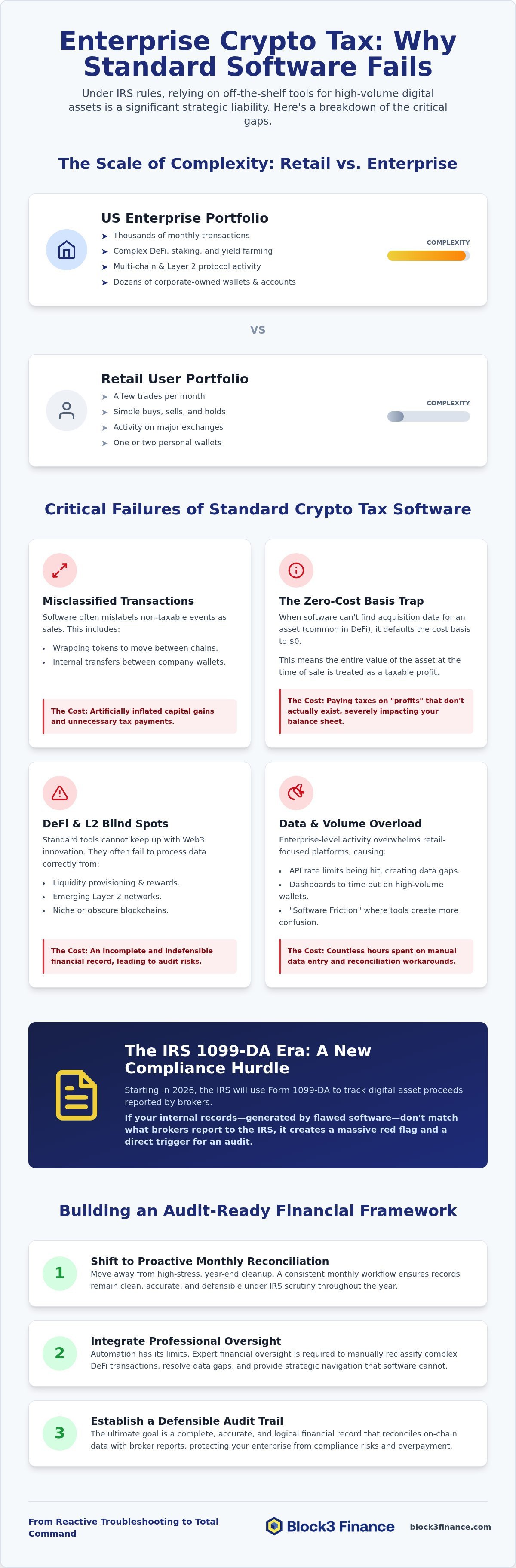
Enterprise crypto tax compliance is the rigorous management of high-volume, multi-chain digital asset transactions under strict IRS rules. While retail users might trade a few times a month, a US enterprise often processes thousands of movements across diverse protocols and layers. Relying on basic tools reveals the crypto tax software limitations for enterprises, as these platforms often collapse under corporate complexity.
This failure leads to "Software Friction," the point where automated systems stop providing clarity and start creating confusion. At this stage, manual reconciliation becomes a mandatory requirement to ensure financial accuracy. For any US firm, a single error in cost basis or transaction classification can lead to massive tax overpayments or unwanted IRS scrutiny.
Retail vs. Enterprise: Why Scale Changes Everything
Scale isn't just about more data; it's about the architectural integrity of that data. Retail platforms frequently hit API rate limits, which are technical restrictions on how much data a software can pull from an exchange or blockchain simultaneously. When your company manages dozens of corporate-owned accounts, tracking inter-wallet transfers becomes a logistical nightmare for basic software.
Without professional oversight, these internal transfers are often mislabeled as taxable sales rather than non-taxable movements. Understanding Virtual currency law in the United States is essential to realize why these errors are so dangerous for your balance sheet. A software tool alone cannot generate the defensible audit trail required for complex corporate structures and high-stakes financial reporting.
The High Cost of Inaccurate Cost Basis
Cost basis is the original value of an asset for tax purposes, which the IRS uses to determine your capital gains or losses. When software encounters "missing data" from a protocol, it often defaults to a zero-dollar cost basis. This systemic error artificially inflates your taxable gains, forcing your enterprise to pay taxes on "profits" that don't actually exist.
Our team at Block3 Finance acts as a calm force, stepping in where automation fails to bridge these critical data gaps. We provide monthly accounting and specialized reconciliation to ensure your records remain clean and defensible. By resolving these crypto tax software limitations for enterprises, we protect your capital and provide the roadmap for continued growth in a volatile landscape.
Technical Limitations: Why Standard Software Fails at Scale
Standard retail tools often collapse when faced with the architectural nuances of decentralized finance (DeFi). For US enterprises, these crypto tax software limitations for enterprises manifest as a failure to recognize liquidity pool positions or complex yield farming rewards. Instead of seeing a strategic movement of capital, the software often sees a series of disconnected, taxable events.
Wrapped tokens present another significant hurdle. These are digital assets pegged to the value of another original asset to allow for use on different blockchains. Basic software often misclassifies the "wrapping" process as a sale, triggering unnecessary capital gains taxes under IRS rules. You shouldn't be penalized for simply moving your assets across chains to optimize your treasury.
Emerging Layer 2 networks and niche blockchains also frequently fall outside the scope of off-the-shelf support. While your Web3 startup might leverage these for speed and lower costs, your tax software may remain blind to the data. This gap creates a strategic liability when you need to reconcile your records for year-end reporting.
DeFi Complexity and the Reclassification Nightmare
Liquidity provisioning involves depositing pairs of assets into a protocol to facilitate trades. Standard software logic often breaks here, failing to track the underlying asset movement correctly. This leads to the risk of "double counting" rewards or losing the original cost basis entirely.
Professional crypto accounting services are essential for manually reclassifying these intricate transactions. We ensure that your DeFi activity is reported accurately to the IRS, preventing costly errors. If you're struggling with messy data, you can speak with our team to begin a clean reconciliation process.
The ASU 2023-08 Compliance Hurdle
Technical failures become even more dangerous when considering ASU 2023-08. This FASB standard requires many US entities to measure certain crypto assets at fair value. Fair value measurement is a method of valuing assets based on their current market price rather than what you originally paid for them.
Most retail software is built for historical cost basis tracking, not the dynamic fair value reporting now required. US enterprises need defensible valuation methodologies that standard platforms simply cannot provide. We help you navigate these requirements, ensuring your financial statements reflect the intellectual depth and technical rigor your stakeholders expect.
The IRS 1099-DA Era: Why Software Alone is a Liability
The introduction of Form 1099-DA represents a tectonic shift in US tax enforcement. This specific IRS form is used by brokers to report digital asset proceeds and, increasingly, cost basis information directly to the government. This new level of transparency creates a "Broker Gap," where exchange-reported data frequently conflicts with your enterprise’s internal on-chain records.
Exchanges only see the activity occurring within their own ecosystems. They lack visibility into the cost basis of assets held in your private cold storage or decentralized protocols. These crypto tax software limitations for enterprises mean that the data sent to the IRS may be fundamentally incomplete, leading to inflated tax liabilities if not manually corrected.
Standard software lacks the "judgment layer" required to reconcile these conflicting data sets for a corporate return. It cannot distinguish between a taxable liquidation and a non-taxable treasury movement between internal accounts. Relying on automated exports without professional intervention invites the IRS to question the integrity of your entire financial framework.
Reconciling Broker Proceeds with On-Chain Reality
Matching 1099-DA reports against private wallet activity is a critical step to prevent over-taxation. Automated software often fails to link a "transfer in" from a private wallet to a subsequent sale on an exchange. When this link is broken, the software defaults to a zero-dollar cost basis, treating the entire sale as pure profit.
This failure results in the IRS receiving transaction-level data that completely ignores your off-exchange acquisition costs. You must maintain audit-ready crypto books that bridge the gap between your private keys and exchange accounts. Only through meticulous reconciliation can you prove the actual path of your capital and protect your bottom line.
Defending Your Position Against IRS Notices
The IRS utilizes automated matching systems to flag discrepancies between 1099-DA filings and your reported capital gains. If the numbers don't align perfectly, the system triggers a notice or a formal inquiry. A standard software-generated report is rarely sufficient to satisfy a revenue agent who requires a detailed explanation of your accounting methodology.
Vague reports from retail-grade tools lack the professional workpapers and defensible narratives required for enterprise-level defense. You need a partner who understands the nuances of blockchain forensics and corporate tax law to advocate on your behalf. Block3 Finance provides the technical rigor and intellectual depth necessary to resolve these matches and secure your enterprise’s financial standing.
Building an Audit-Ready Financial Record
A defensible financial record is not a byproduct of your tools; it is a deliberate architecture. Relying on basic exports ignores the crypto tax software limitations for enterprises that often lead to critical data gaps. You must build a framework that captures timestamped transaction hashes, counterparty identities, and documented fair value for every event.
Sub-ledgering is a detailed accounting record that tracks specific types of transactions, such as individual crypto trades, before they are summarized in your main financial statements. This level of detail is non-negotiable for complex entities. For example, DAO tax compliance requires specialized sub-ledgering to track treasury distributions that most standard software cannot handle.
The Monthly Reconciliation Workflow
Waiting until the 2026 tax season to address software errors is a high-risk strategy for US firms. Monthly reconciliation allows you to identify and correct classification errors before they become systemic liabilities. This proactive pace ensures your books remain audit-ready throughout the entire fiscal year.
Your workflow should include continuous data extraction and immediate classification of all income and expenses. Integrating on- and off-ramp solutions, which are services that move funds between crypto and fiat, directly into this process is essential. It ensures that every conversion is matched to a specific business purpose, closing the gap that often triggers IRS matching notices.
Corporate Structuring and Tax Efficiency
The choice of entity, such as a C-Corp or an LLC, dictates your specific reporting requirements under IRS rules. A well-designed structure simplifies your tax obligations by separating operational wallets from long-term investment holdings. This separation reduces the complexity of your reports and makes it easier for auditors to verify your activity.
Establishing clear boundaries between your accounts prevents the commingling of funds that can lead to significant tax reporting errors. You can use the Block3 Finance checklist to audit your current preparation levels. If you find your internal records are falling behind, contact our team to implement a more robust, professional-led strategy.
Navigating Growth with Block3 Finance’s Enterprise Solutions
Enterprise growth in the digital asset space requires more than just a software subscription. While automation is a tool, it's not a comprehensive strategy for institutional-grade compliance under IRS rules. The "Visionary Navigator" approach at Block3 Finance recognizes that overcoming crypto tax software limitations for enterprises requires a blend of technical accounting rigor and deep blockchain immersion.
We move away from the dry, detached nature of traditional accounting to become a proactive partner in your success. Our team focuses on transforming your complex on-chain data into a strategic advantage that fuels your expansion. By taking command of your financial landscape, you gain the agency to focus on building the future of Web3.
Expertise Beyond the Software License
Your business deserves a crypto tax professional who understands both IRS codes and smart contract logic. Block3 Finance brings over 13 years of specialized blockchain financial expertise to the table, specifically tailored for the US market. This experience is vital for navigating the nuances of decentralized protocols and high-growth startup environments.
Our white-glove service model ensures that every transaction is accounted for and remains defensible during an IRS inquiry. We solve the crypto tax software limitations for enterprises by providing the human judgment layer that algorithms lack. This commitment to best practices creates a stable foundation for your corporate treasury, which refers to the funds and assets your company holds.
Strategic Leadership for Web3 Firms
Fractional crypto CFO services offer a powerful way to scale your financial oversight without the overhead of a full-time executive. We help Web3 firms manage their runway, which is the amount of time a company can operate before running out of money. Our strategists also optimize treasury positions and maintain complex compliance standards for international operations.
Strategic leadership means more than just filing forms; it involves cultivating a roadmap for thriving in a complex global economy. We act as a calm force in a chaotic industry, providing the intellectual leadership your stakeholders demand. Contact Block3 Finance to secure your enterprise compliance and begin your journey toward total financial command.
Master Your Enterprise Financial Future
The landscape of digital asset compliance has shifted from simple tracking to high-stakes strategic management. As the IRS implements Form 1099-DA and FASB mandates fair value reporting, it's clear the gap between basic tools and enterprise needs is widening. You shouldn't leave your corporate treasury to chance or unverified algorithms.
Understanding the crypto tax software limitations for enterprises is the first step toward building a resilient financial framework. By implementing monthly reconciliation and professional sub-ledgering, you transform a potential liability into a clear, defensible asset. This proactive stance ensures your records remain audit-ready while you focus on scaling your operations.
Block3 Finance brings 13+ years of blockchain financial expertise to your organization, specializing in the complexities of DeFi and DAO accounting. As a top provider recognized by Bitcoin.com, we provide the technical rigor required to navigate this volatile environment with confidence. Secure your enterprise with professional crypto tax filing and reporting today. Your mastery over the future of finance starts with a single, decisive step.
Frequently Asked Questions
Why does my crypto tax software show a zero-dollar cost basis for so many transactions?
Your software defaults to a zero-dollar cost basis when it can't identify the original acquisition price of an asset. This happens because the tool lacks visibility into private wallets or decentralized protocols where the asset was first acquired. Without this link, the IRS treats the entire sale as taxable gain. Professional reconciliation is required to connect these data points and prevent artificial tax inflation.
Is Form 1099-DA required for US-based crypto enterprises in 2026?
Yes, Form 1099-DA is a mandatory reporting requirement for the 2025 tax year, which enterprises must file in 2026. Brokers use this form to report gross proceeds from digital asset transactions directly to the IRS. US enterprises should expect to receive these forms from any exchange or custodial service they use. You must reconcile these reports against your internal books to ensure accuracy.
Can I rely on software reports if my company is audited by the IRS?
Relying solely on software exports during an IRS audit is risky because automated reports often lack the necessary workpapers to defend complex positions. Auditors require a clear trail of how cost basis was calculated and how transactions were classified. If your software mislabeled a DeFi movement as a taxable sale, you need professional documentation to prove the error. Software is a starting point, not a substitute.
How does ASU 2023-08 change the way US businesses report crypto on their taxes?
ASU 2023-08 is a standard issued by the Financial Accounting Standards Board (FASB) that requires US entities to measure certain crypto assets at fair value. Fair value is the current market price of an asset. This change demands more frequent and precise valuations, highlighting the crypto tax software limitations for enterprises that are built only for basic gain and loss tracking. It requires a more dynamic reporting framework.
What are the main differences between retail and enterprise crypto tax software?
Retail software is designed for individuals with low transaction volumes and simple exchange trades. Enterprise solutions must handle thousands of monthly movements across dozens of chains and complex protocols. Most retail tools hit API rate limits or fail to recognize corporate structures like multi-signature wallets. Enterprises also require robust sub-ledgering, which is a detailed record of specific transactions, to feed into their primary accounting systems.
How does Block3 Finance handle reconciliation for high-volume DeFi activity?
We utilize a forensic approach to reconcile high-volume DeFi activity by manually classifying complex smart contract interactions. Our team extracts data directly from the blockchain and builds custom sub-ledgers that account for liquidity provisioning and yield farming. This manual oversight resolves the crypto tax software limitations for enterprises that often "double count" rewards. We ensure your records are clean, accurate, and ready for any IRS inquiry.
Should a DAO file taxes in the US if it has US-based contributors?
Yes, a Decentralized Autonomous Organization (DAO) with US-based contributors or business activity generally has US tax obligations. The IRS treats most DAOs as partnerships or corporations depending on their structure and activity. You must report income, distributions, and any payments made to US residents. Because DAOs operate on-chain, specialized accounting is necessary to track treasury movements and fulfill reporting duties under current IRS rules.
What is the risk of using DIY software for a high-growth Web3 startup?
The primary risk of using DIY software for a high-growth Web3 startup is building a foundation of inaccurate financial data. Small errors in cost basis or transaction classification compound as your volume grows, creating a massive reconciliation burden later. This can lead to significant tax overpayments or penalties during an IRS audit. Without professional guidance, you also miss strategic opportunities for tax optimization and treasury management.

Article by
Mahad Mohamed
Mahad Mohamed is an accountant and the CEO of Block3 Finance, with over 26+ years of Canadian and international tax and accounting experience. A crypto accounting specialist since the early days of Bitcoin, he has consulted for over 38 crypto companies and collaborated with legal professionals on regulatory matters. His expertise spans corporate reorganization, cross-border tax structuring (Canada & US), tax disputes, and CRA audits.
Previously, Mahad worked for the Canada Revenue Agency (CRA), Big4 accounting firms, and served as a Rulings Officer for the Federal Tax Authority of the UAE before acquiring Tax Partners in 2014.
Block3 Finance and Tax Partners has 44 full-time accountants and over 9,800+ clients.
Disclaimer
This article provides general information only and is current as of its publication date. It has not been updated and may be out of date. It does not constitute legal advice and should not be relied upon as such. Every tax situation is unique and may differ from the examples discussed in this article. If you have specific questions, you should seek the advice of our accountants for your unique circumstances.
Frequently Asked Questions
Why does my crypto tax software show a zero-dollar cost basis for so many transactions?
Your software defaults to a zero-dollar cost basis when it can't identify the original acquisition price of an asset. This happens because the tool lacks visibility into private wallets or decentralized protocols where the asset was first acquired. Without this link, the IRS treats the entire sale as taxable gain. Professional reconciliation is required to connect these data points and prevent artificial tax inflation.
Is Form 1099-DA required for US-based crypto enterprises in 2026?
Yes, Form 1099-DA is a mandatory reporting requirement for the 2025 tax year, which enterprises must file in 2026. Brokers use this form to report gross proceeds from digital asset transactions directly to the IRS. US enterprises should expect to receive these forms from any exchange or custodial service they use. You must reconcile these reports against your internal books to ensure accuracy.
Can I rely on software reports if my company is audited by the IRS?
Relying solely on software exports during an IRS audit is risky because automated reports often lack the necessary workpapers to defend complex positions. Auditors require a clear trail of how cost basis was calculated and how transactions were classified. If your software mislabeled a DeFi movement as a taxable sale, you need professional documentation to prove the error. Software is a starting point, not a substitute.
How does ASU 2023-08 change the way US businesses report crypto on their taxes?
ASU 2023-08 is a standard issued by the Financial Accounting Standards Board (FASB) that requires US entities to measure certain crypto assets at fair value. Fair value is the current market price of an asset. This change demands more frequent and precise valuations, highlighting the crypto tax software limitations for enterprises that are built only for basic gain and loss tracking. It requires a more dynamic reporting framework.
What are the main differences between retail and enterprise crypto tax software?
Retail software is designed for individuals with low transaction volumes and simple exchange trades. Enterprise solutions must handle thousands of monthly movements across dozens of chains and complex protocols. Most retail tools hit API rate limits or fail to recognize corporate structures like multi-signature wallets. Enterprises also require robust sub-ledgering, which is a detailed record of specific transactions, to feed into their primary accounting systems.
How does Block3 Finance handle reconciliation for high-volume DeFi activity?
We utilize a forensic approach to reconcile high-volume DeFi activity by manually classifying complex smart contract interactions. Our team extracts data directly from the blockchain and builds custom sub-ledgers that account for liquidity provisioning and yield farming. This manual oversight resolves the crypto tax software limitations for enterprises that often "double count" rewards. We ensure your records are clean, accurate, and ready for any IRS inquiry.
Should a DAO file taxes in the US if it has US-based contributors?
Yes, a Decentralized Autonomous Organization (DAO) with US-based contributors or business activity generally has US tax obligations. The IRS treats most DAOs as partnerships or corporations depending on their structure and activity. You must report income, distributions, and any payments made to US residents. Because DAOs operate on-chain, specialized accounting is necessary to track treasury movements and fulfill reporting duties under current IRS rules.
What is the risk of using DIY software for a high-growth Web3 startup?
The primary risk of using DIY software for a high-growth Web3 startup is building a foundation of inaccurate financial data. Small errors in cost basis or transaction classification compound as your volume grows, creating a massive reconciliation burden later. This can lead to significant tax overpayments or penalties during an IRS audit. Without professional guidance, you also miss strategic opportunities for tax optimization and treasury management.