
What if your DAO's decentralized treasury is actually its greatest legal liability under U.S. tax laws? As we move into 2026, the Internal Revenue Service (IRS) is no longer overlooking on-chain activity. Securing professional CFO services for DAOs is now a survival requirement for any protocol operating within the United States.
You likely feel the pressure of reconciling thousands of complex transactions while worrying about being classified as an unstructured partnership. This uncertainty creates a friction that slows down governance and scares away high-value contributors. We help you gain total command over this volatile landscape through specialized fractional CFO strategies.
This guide provides a roadmap for mastering your treasury and ensuring audit-readiness under current IRS rules. We will explore how to stabilize your assets, automate reporting for token holders, and navigate the latest federal mandates. You can move from a defensive posture to an offensive one focused on growth and market leadership.
Key Takeaways
- Specialized CFO services for DAOs provide the sophisticated oversight necessary to bridge the gap between decentralized code and strategic corporate leadership.
- Implement advanced diversification strategies to protect your treasury from market volatility and ensure a sustainable operational runway.
- Navigate complex IRS rules by establishing a defensible entity structure that shields individual token holders from personal tax exposure.
- Operationalize your finance department with integrated crypto-to-fiat solutions designed for reliable contributor payments and transparent reporting.
- Master the transition from volatile on-chain activity to professional, audit-ready financial statements that foster long-term community confidence.
The Strategic Role of a Fractional CFO in DAO Governance
A Decentralized Autonomous Organization (DAO) relies on smart contracts, but code alone cannot manage a multi-million dollar treasury. Specialized CFO services for DAOs provide the high-level financial oversight required to turn volatile on-chain assets into a sustainable business engine. These professionals act as a critical bridge between the core development team and the broader community of token holders.
Strategic leadership ensures that the DAO's financial mission stays perfectly aligned with its technical roadmap. Without this oversight, technical progress often outpaces capital management, leading to sudden liquidity crunches. Fractional CFO services offer a solution by providing elite executive expertise without the prohibitive cost of a full-time hire.
This model allows you to scale your financial department in lockstep with your community's growth. It ensures that your core team stays focused on building code rather than reconciling spreadsheets. You get the benefit of a seasoned strategist who navigates the friction between decentralized ideals and regulatory realities.
Bridging On-Chain Activity and Financial Strategy
CFOs translate complex on-chain data into actionable business insights that community members can actually understand. They ensure every treasury movement is meticulously documented and remains consistent with past governance votes. This level of professional oversight builds essential trust among institutional investors and decentralized participants alike.
By maintaining defensible financial records, CFO services for DAOs prepare the organization for the rigors of IRS reporting. This is particularly vital as the IRS increases its scrutiny of digital asset brokers and cost-basis reporting through Form 1099-DA. You gain a partner who understands both the blockchain ecosystem and the demands of traditional financial frameworks under US law.
Managing Governance-Led Financial Decisions
A CFO helps the community structure proposals for treasury expenditures to ensure long-term sustainability. They provide the sophisticated financial modeling needed to predict how a single governance vote might impact the DAO's multi-year runway. This foresight prevents the organization from making reactive, short-sighted decisions during market downturns.
Clear financial summaries help prevent "governance fatigue" by giving voters the data they need without overwhelming them. When token holders see professional reporting, they're more likely to engage in high-stakes decisions with confidence. They act as the calm force during chaotic voting periods, providing a grounded perspective on budget allocations.
This strategic oversight transforms the treasury from a simple wallet into a powerful tool for ecosystem cultivation. It moves the narrative from mere survival to a position of offensive growth and market leadership. Vision and execution become inseparable parts of your decentralized mission.
Treasury Management Strategies for US-Based DAOs
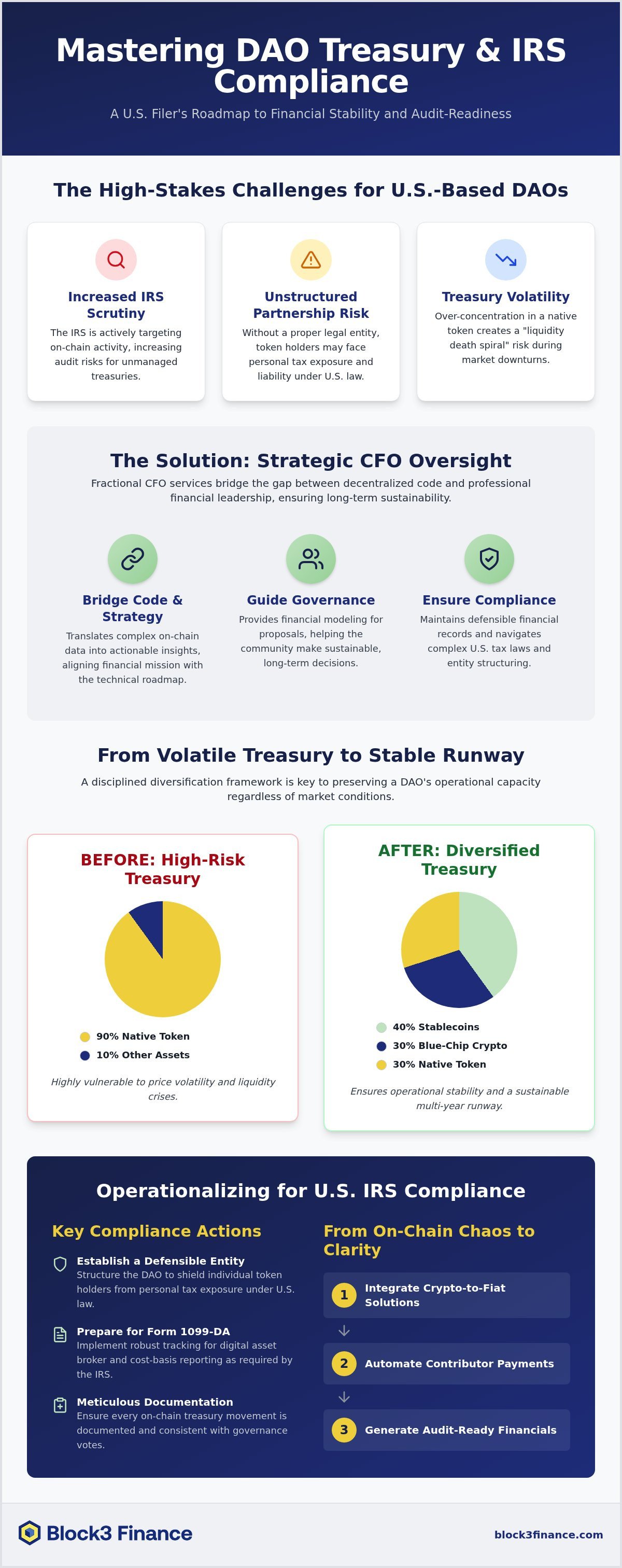
Effective treasury management isn't just about holding assets; it's about active preservation of the DAO's operational runway. Most DAOs suffer from excessive concentration in their native token, which can lead to a liquidity death spiral during market downturns. Professional CFO services for DAOs implement rigorous diversification frameworks to ensure that protocol development never halts due to price volatility.
Strategic allocation between stablecoins and blue-chip assets like Bitcoin or Ethereum provides the bedrock for operational stability. Stablecoins are digital assets designed to maintain a pegged value, usually to the US Dollar, to avoid price swings. We prioritize battle-tested protocols over high-yield, experimental platforms to protect your long-term viability and ensure you can meet your obligations.
The U.S. Department of the Treasury recently released a report on digital asset financial stability risks that highlights the importance of managing these vulnerabilities. We establish clear policies for treasury rebalancing based on predefined financial triggers. This proactive approach prevents emotional decision-making during high-stress market events and shifts the organization to a disciplined strategy.
Diversification and Risk Mitigation
CFOs analyze the risk profile of various decentralized finance (DeFi) protocols before deploying treasury capital into them. DeFi refers to financial services built on blockchain technology that operate without traditional intermediaries. This analysis includes a thorough assessment of smart contract security and the liquidity depth of the target assets to prevent capital loss.
Risk mitigation also involves establishing clear custody solutions that balance security with the need for governance-led movement. We help your community understand the trade-offs between different multi-signature wallet configurations. This ensures that treasury assets are protected from both external hacks and internal mismanagement.
Yield Optimization and Liquidity Planning
Strategic yield management allows your organization to generate passive income on idle reserves without sacrificing safety. Our team balances the desire for high returns with the primary objective of capital preservation. We ensure that liquidity is always available for critical expenses like contributor payroll and ecosystem grants, even in a bear market.
Liquidity planning involves forecasting monthly burn rates, which is the rate at which the DAO spends its capital, and maintaining a ladder of reserves. If you need help designing a custom treasury framework, our strategists can provide the roadmap. We help you navigate the friction between maximizing growth and maintaining a safe margin of error.
Transparency remains the final pillar of this strategy. We provide the community with clear, real-time reporting on treasury health to maintain token holder confidence. This visibility transforms the treasury from a black box into a verifiable asset that proves your decentralized mission is backed by professional financial rigor.
Navigating IRS Compliance and Entity Structuring for DAOs
The IRS is no longer treating decentralized protocols as invisible experiments. With approximately 50 million Americans now owning digital assets according to a Federal Reserve survey, federal authorities have moved from enforcement to creating specific regulatory frameworks. Specialized CFO services for DAOs are the only way to ensure your organization doesn't fall into a trap of unintended tax liabilities.
Selecting the right legal framework is a strategic move that shifts your organization from a defensive posture to one of growth. Without a formal structure, the IRS may default to treating your DAO as an unincorporated partnership. This uncertainty creates a friction that can stall governance and lead to significant personal exposure for your community members.
Understanding US Tax Entity Classifications
Most DAOs begin as unstructured groups, which the IRS often classifies as general partnerships by default. This is a type of pass-through entity where the tax obligations and legal liabilities flow directly to the individual members. To prevent this, we guide organizations through adopting "legal wrappers" like an LLC or an Unincorporated Nonprofit Association (UNA).
These structures provide legal personhood and a clear path for filing annual tax returns under US law. Choosing the wrong structure can lead to massive tax inefficiencies or even disqualify the organization from certain federal exemptions. We evaluate your specific governance model to determine which classification provides the most robust protection for your token holders.
Tax Reporting Requirements for Digital Assets
The 2026 filing season marks a turning point with the mandatory implementation of Form 1099-DA for digital asset transactions. This form requires brokers to report gross proceeds from cryptocurrency sales directly to the IRS. To remain compliant, your organization must maintain an audit trail that reconciles every on-chain event to its precise US dollar value.
Professional CFO services for DAOs ensure that your accounting systems track cost basis on a per-wallet basis rather than using a universal method. Cost basis is the original purchase price of an asset, used to calculate capital gains or losses for tax purposes. This level of detail is critical for protecting the DAO from the increased scrutiny signaled by recent IRS guidance.
Finally, we manage the complexities of foreign entity reporting if your DAO has significant international operations. US members involved in such entities may need to file Form 5471 or Form 8865 to disclose their interests. We provide the strategic leadership required to navigate these high-stakes filing requirements without disrupting your decentralized mission.
Operationalizing DAO Finance: From Payroll to Reporting
Operationalizing a decentralized organization requires a shift from manual wallet transfers to institutional-grade financial systems. We implement crypto-to-fiat payment solutions that allow your DAO to pay traditional vendors who don't yet accept digital assets. This ensures your decentralized mission doesn't stall due to friction with the legacy financial world.
Monthly reporting packages provide the community with a transparent view of financial performance, burn rates, and total runway. Strategic oversight ensures that your payroll systems remain compliant with US labor and tax laws, protecting the organization from costly federal penalties. CFO services for DAOs turn these back-office tasks into a streamlined advantage for your protocol.
Managing Global Contributor Payments
CFOs establish the legal frameworks necessary for paying decentralized contractors across various jurisdictions without triggering IRS red flags. They ensure the DAO collects essential tax documentation, such as Form W-9 for US-based contributors or Form W-8 for international participants. Form W-9 is used to confirm a person's taxpayer identification number, while Form W-8 certifies the foreign status of non-US entities for tax withholding.
We implement automated payment systems to distribute grants and salaries while maintaining a clear and verifiable paper trail. This automation reduces the administrative burden on core contributors and minimizes the risk of human error in treasury movements. It transforms the payment process from a manual chore into a scalable and transparent protocol feature.
Establishing an Audit-Ready Financial Foundation
Achieving audit-readiness requires a complete reconciliation of all sub-ledgers and on-chain wallets to verify every single transaction. Sub-ledgers are detailed records of specific accounts, such as payroll or accounts payable, that feed into the main financial statements. We utilize specialized crypto accounting software to automate data collection and ensure that your financial records are defensible under IRS scrutiny.
Regular reviews keep your books prepared for professional crypto audit preparation, ensuring you're never caught off guard by regulatory inquiries. Our team maintains a steady, logical flow of data to build trust through the accumulation of professional weight. If your organization needs to operationalize its financial systems, our strategists provide the elite leadership needed for long-term stability.
Why Block3 Finance is the Strategic Partner for Your DAO
Block3 Finance bridges the gap between legacy corporate finance and the cutting-edge digital asset space. We provide the stability and intellectual depth that decentralized innovators require to shift from a defensive posture to an offensive one.
Partnering with us allows your core team to focus on building code while we handle the complex financial oversight. We bring a sophisticated blend of professional authority and empowering advocacy to every engagement.
Our team acts as a calm force in a chaotic industry, characterized by deep experience and a commitment to best practices. We understand that CFO services for DAOs require a visionary navigator who can guide a community through high-stakes environments.
Elite Expertise in Blockchain Financial Records
We specialize in transforming chaotic on-chain activity into clean, defensible blockchain financial records. Our methodology ensures that every treasury movement remains consistent with governance votes and legal requirements.
With over 13 years of immersion in the ecosystem, we've developed the technical rigor needed to navigate high-stakes DeFi environments. We provide a roadmap for thriving in a volatile and evolving regulatory landscape under IRS rules.
- Top-ranked crypto accounting firm by Bitcoin.com.
- Trusted by over 980 global clients across various blockchain sectors.
- Proven track record in complex treasury reconciliation and audit-readiness.
Comprehensive Suite of Fractional CFO Services
Our fractional model offers the flexibility to scale our involvement as your organization evolves. From corporate structuring to international tax compliance, we offer a full-scale solution.
This approach ensures that your organization navigates the complexities of the 2026 filing season without facing unexpected federal penalties. We provide the financial modeling needed to predict the impact of governance votes on your long-term runway.
Contact us today to learn how our crypto CFO services can empower your organization. We help you gain total command over your financial destiny.
Secure the Future of Your Decentralized Mission
The shift toward institutional-grade financial oversight is no longer optional for decentralized protocols. By implementing rigorous treasury diversification and a defensible IRS entity structure, you protect your organization from both market volatility and regulatory scrutiny. Professional CFO services for DAOs provide the visionary navigation needed to bridge the gap between on-chain innovation and traditional fiscal responsibility.
Block3 Finance brings 13+ years of blockchain financial expertise to your mission. As a top-ranked crypto accounting firm by Bitcoin.com, we've already helped over 980 global clients master their digital asset operations. We handle the friction of global payroll and audit-readiness so your core team can stay focused on building the next generation of decentralized technology.
Schedule a consultation with our DAO CFO experts today to ensure your treasury is resilient and fully compliant. It's time to build a financial foundation that is as innovative as your code.
Frequently Asked Questions
What exactly are fractional CFO services for DAOs?
Fractional CFO services for DAOs provide high-level financial leadership on a flexible, part-time basis. This model allows decentralized organizations to access elite expertise for treasury management and governance oversight. It is a strategic and cost-effective way to secure professional financial management without the prohibitive expense of a full-time executive hire.
Is a DAO considered a taxable entity by the IRS in the US?
The IRS generally treats these organizations as taxable entities within the United States. If no formal legal structure is chosen, federal authorities often default to a partnership classification. This is a type of pass-through entity where the financial activity flows through to the individual members for tax purposes. This status can create significant personal tax exposure for everyone involved in governance.
How do DAOs report on-chain treasury income to the IRS?
Organizations must document every on-chain transaction by converting the digital asset value to U.S. dollars at the time of receipt. This reporting requires specialized accounting software to maintain a verifiable and transparent audit trail. Proper documentation ensures that all on-chain income is correctly reflected on the annual federal tax return. It also protects the organization from penalties related to underreporting gains.
Can a CFO help with DAO treasury diversification and risk management?
A CFO designs strategic frameworks to protect the organization's runway from extreme market volatility. They manage the transition of volatile assets into stablecoins or blue-chip tokens based on specific risk triggers. This oversight ensures the protocol remains operational regardless of broader market fluctuations. They also evaluate the underlying security of any DeFi protocols used for generating yield on reserves.
What US tax forms are typically required for a decentralized organization?
Typical requirements include Form 1065 for partnerships and the newly introduced Form 1099-DA. Members usually receive a Schedule K-1, which is a document used to report their specific share of income or losses. Global contributors may also need to provide Form W-8 to certify their foreign status for tax purposes. These forms are essential for maintaining compliance with current IRS reporting standards.
How does a fractional CFO handle global contributor payroll in crypto?
They implement automated systems that distribute crypto payments while simultaneously collecting required tax documentation. This includes gathering Form W-9 from U.S. contractors to verify their taxpayer identification numbers. This process ensures the organization meets its federal withholding and reporting obligations. It creates a defensible paper trail that links every contributor payment to a specific expenditure.
Why is a crypto-specialized CFO better than a traditional virtual CFO?
Traditional providers often lack the technical tools needed to reconcile complex decentralized transactions. A crypto-specialized professional understands the unique friction between on-chain activity and IRS mandates. Specialized CFO services for DAOs provide the specific expertise required to navigate the digital asset ecosystem. They offer a sophisticated blend of professional authority and deep immersion in blockchain technology.
How can our DAO achieve audit-ready financial records?
Audit-readiness is achieved through consistent reconciliation between your on-chain wallets and your financial ledgers. A ledger serves as the primary record for all of your organization's financial transactions. This methodical approach ensures that every movement of capital is documented and defensible during a federal review. Maintaining these records in real-time prevents the chaos often associated with retroactive tax preparation.

Article by
Mahad Mohamed
Mahad Mohamed is an accountant and the CEO of Block3 Finance, with over 26+ years of Canadian and international tax and accounting experience. A crypto accounting specialist since the early days of Bitcoin, he has consulted for over 38 crypto companies and collaborated with legal professionals on regulatory matters. His expertise spans corporate reorganization, cross-border tax structuring (Canada & US), tax disputes, and CRA audits.
Previously, Mahad worked for the Canada Revenue Agency (CRA), Big4 accounting firms, and served as a Rulings Officer for the Federal Tax Authority of the UAE before acquiring Tax Partners in 2014.
Block3 Finance and Tax Partners has 44 full-time accountants and over 9,800+ clients.
Disclaimer
This article provides general information only and is current as of its publication date. It has not been updated and may be out of date. It does not constitute legal advice and should not be relied upon as such. Every tax situation is unique and may differ from the examples discussed in this article. If you have specific questions, you should seek the advice of our accountants for your unique circumstances.
Frequently Asked Questions
What exactly are fractional CFO services for DAOs?
Fractional CFO services for DAOs provide high-level financial leadership on a flexible, part-time basis. This model allows decentralized organizations to access elite expertise for treasury management and governance oversight. It is a strategic and cost-effective way to secure professional financial management without the prohibitive expense of a full-time executive hire.
Is a DAO considered a taxable entity by the IRS in the US?
The IRS generally treats these organizations as taxable entities within the United States. If no formal legal structure is chosen, federal authorities often default to a partnership classification. This is a type of pass-through entity where the financial activity flows through to the individual members for tax purposes. This status can create significant personal tax exposure for everyone involved in governance.
How do DAOs report on-chain treasury income to the IRS?
Organizations must document every on-chain transaction by converting the digital asset value to U.S. dollars at the time of receipt. This reporting requires specialized accounting software to maintain a verifiable and transparent audit trail. Proper documentation ensures that all on-chain income is correctly reflected on the annual federal tax return. It also protects the organization from penalties related to underreporting gains.
Can a CFO help with DAO treasury diversification and risk management?
A CFO designs strategic frameworks to protect the organization's runway from extreme market volatility. They manage the transition of volatile assets into stablecoins or blue-chip tokens based on specific risk triggers. This oversight ensures the protocol remains operational regardless of broader market fluctuations. They also evaluate the underlying security of any DeFi protocols used for generating yield on reserves.
What US tax forms are typically required for a decentralized organization?
Typical requirements include Form 1065 for partnerships and the newly introduced Form 1099-DA. Members usually receive a Schedule K-1, which is a document used to report their specific share of income or losses. Global contributors may also need to provide Form W-8 to certify their foreign status for tax purposes. These forms are essential for maintaining compliance with current IRS reporting standards.
How does a fractional CFO handle global contributor payroll in crypto?
They implement automated systems that distribute crypto payments while simultaneously collecting required tax documentation. This includes gathering Form W-9 from U.S. contractors to verify their taxpayer identification numbers. This process ensures the organization meets its federal withholding and reporting obligations. It creates a defensible paper trail that links every contributor payment to a specific expenditure.
Why is a crypto-specialized CFO better than a traditional virtual CFO?
Traditional providers often lack the technical tools needed to reconcile complex decentralized transactions. A crypto-specialized professional understands the unique friction between on-chain activity and IRS mandates. Specialized CFO services for DAOs provide the specific expertise required to navigate the digital asset ecosystem. They offer a sophisticated blend of professional authority and deep immersion in blockchain technology.
How can our DAO achieve audit-ready financial records?
Audit-readiness is achieved through consistent reconciliation between your on-chain wallets and your financial ledgers. A ledger serves as the primary record for all of your organization's financial transactions. This methodical approach ensures that every movement of capital is documented and defensible during a federal review. Maintaining these records in real-time prevents the chaos often associated with retroactive tax preparation.