
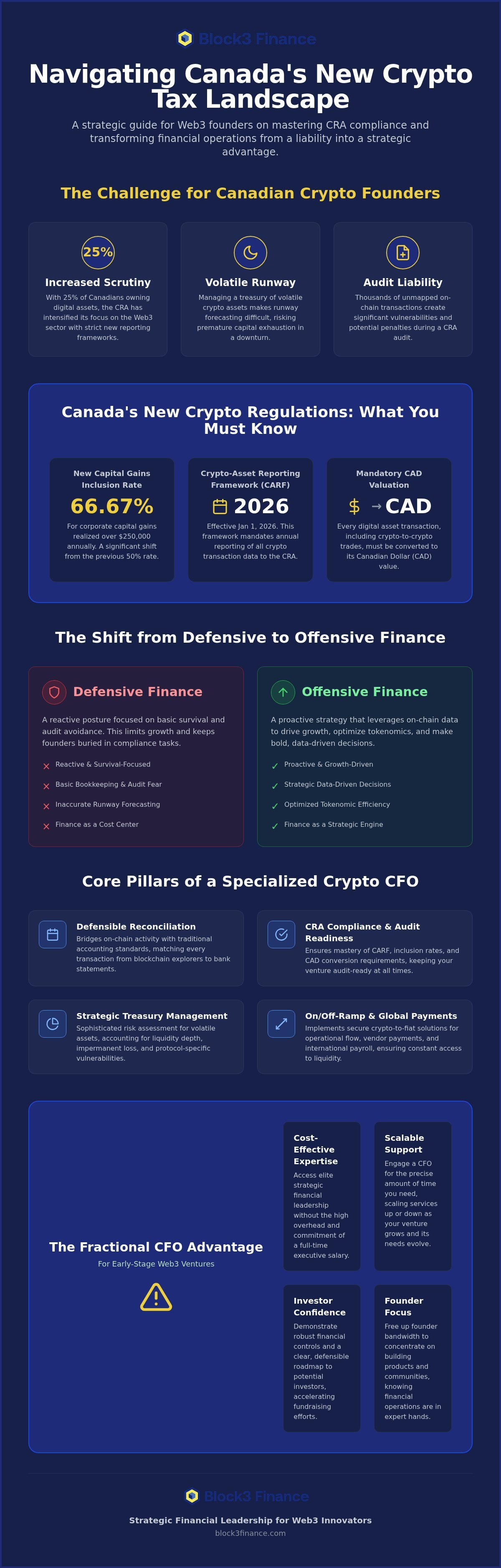
What if your most complex on-chain transactions were actually your greatest strategic advantage rather than your biggest audit liability? With 25% of Canadians now owning digital assets, the CRA has intensified its focus on the Web3 sector through strict new reporting frameworks. Most founders find themselves buried under thousands of unmapped transactions while trying to manage a volatile runway. Specialized CFO services for crypto startups provide the clarity needed to transform this chaos into a defensible financial engine.
You likely started your venture to build the future, not to spend your nights agonizing over capital gains inclusion rates or FINTRAC compliance. It's a common struggle to balance aggressive growth with the technical rigor required for an audit-ready balance sheet. We understand that navigating the shift to a 66.67% inclusion rate for gains over $250,000 requires more than just basic bookkeeping; it demands elite strategic oversight.
This guide explores how a strategic financial partner helps you master these complexities. You'll learn how to implement robust treasury management and prepare for successful fundraising with total confidence. We'll outline the exact roadmap for maintaining command over your digital asset operations throughout 2026.
Key Takeaways
- Understand how to navigate the unique volatility of digital asset treasuries through specialized risk assessment and proactive financial leadership.
- Discover how specialized CFO services for crypto startups establish defensible reconciliation processes that bridge on-chain activity with traditional accounting standards.
- Ensure your venture remains audit-ready by mastering CRA compliance requirements, including the mandatory conversion of all digital asset transactions into Canadian Dollar (CAD) values.
- Learn why fractional CFO models offer a cost-effective way for early-stage Web3 ventures to access elite strategic expertise without the overhead of a full-time executive.
- Gain the tools to transform complex blockchain data into clear financial roadmaps that support successful fundraising and sustainable scaling.
Why Crypto Startups Need Specialized CFO Leadership
Traditional accounting methods often collapse when they're applied to the decentralized world. Most legacy firms lack the specialized infrastructure required to track assets across dozens of liquidity pools, staking contracts, or bridge protocols. Specialized CFO services for crypto startups provide the technical expertise to reconcile these complex data sets into a coherent financial narrative.
Managing a treasury of volatile digital assets isn't merely about tracking daily balances. It requires a sophisticated risk assessment that accounts for liquidity depth, impermanent loss, and protocol-specific vulnerabilities. Without this level of strategic leadership, your financial reporting remains a snapshot of the past rather than a proactive roadmap for future growth.
Strategic leadership ensures your runway is accurately calculated across multiple chains and protocols simultaneously. A crypto-native CFO acts as a vital bridge between decentralized technology and legacy financial institutions. They translate on-chain activity into the precise language required by traditional banks and global regulators, ensuring your venture maintains the stability needed to scale.
The Risk of Inadequate Financial Oversight
Inadequate record-keeping creates massive vulnerabilities during a CRA audit. Canadian startups now face the Crypto-Asset Reporting Framework (CARF), which took effect on January 1, 2026. This framework requires companies to report transaction data annually. Failure to maintain precise records of every trade can lead to significant penalties under these new reporting rules.
Poor oversight also leads to inaccurate runway forecasting. Your runway is the amount of time a company has before it runs out of cash. In the Web3 space, a sudden market downturn can evaporate months of runway in a single afternoon. Expert oversight protects you from premature capital exhaustion by maintaining a clear view of your liquid reserves.
Moving from Defensive to Offensive Finance
Defensive finance is a reactive posture focused on basic survival and audit avoidance. While compliance is mandatory, it shouldn't be the ceiling of your financial strategy. Offensive finance leverages your on-chain data to drive growth and optimize your tokenomic efficiency. It shifts the focus from merely reporting history to actively shaping your company's economic future.
Specialized CFOs empower founders by providing the clarity needed for bold, data-driven decisions. Instead of fearing market shifts, you'll navigate them with a disciplined framework that prioritizes long-term value. This shift in mindset transforms your finance department from a cost center into a strategic engine of innovation. It allows you to focus on building while your financial foundation remains unshakable.
Core Responsibilities of a Digital Asset CFO
A digital asset CFO operates at the intersection of blockchain protocols and corporate governance. They don't just record history; they architect the systems that make growth possible. Utilizing CFO services for crypto startups ensures that every on-chain movement is mirrored by a defensible off-chain record.
Reconciliation is the process of matching transaction data from blockchain explorers with traditional bank statements. This task is notoriously difficult for Canadian firms dealing with high-frequency trades or decentralized finance (DeFi) interactions. A specialized CFO implements automated workflows to bridge this gap, ensuring that every unit of currency is accounted for during tax season.
Moving capital between the digital and physical worlds requires precision. Our team helps you implement secure on-ramp and off-ramp solutions to maintain operational flow. This ensures your business has constant access to liquidity, which is the ease with which your digital assets can be converted into cash for immediate use.
Global operations often involve paying vendors and employees across multiple jurisdictions. Managing crypto-to-fiat payment systems is a core responsibility that prevents payroll delays and minimizes slippage. By designing robust corporate structures, a CFO also optimizes your venture for international tax compliance without sacrificing agility.
Treasury Management and Operations
Security and accessibility must exist in a delicate balance. CFOs oversee the movement of assets between secure cold storage and operational wallets used for daily expenses. This proactive management prevents a single point of failure while keeping the business moving forward. It ensures that your treasury remains both protected and productive.
Strategic Financial Planning and Analysis (FP&A)
FP&A in the Web3 space requires models that can withstand extreme market volatility. A CFO develops these projections to help you understand how token price fluctuations impact your long-term strategy. They provide the foresight needed to adjust spending before market shifts impact your stability.
They also establish Key Performance Indicators (KPIs) to track progress. KPIs are measurable values that demonstrate how effectively a company is achieving its core business objectives. For a crypto startup, these might include active user counts, protocol revenue, or treasury health. If you're ready to refine your financial strategy, you can discuss your goals with our team.
Fractional vs. In-House CFOs for Web3 Growth
The decision to hire a financial executive often marks a turning point for a Web3 venture. Most early-stage founders don't need a full-time, high-salary executive on the permanent payroll. Instead, they require the strategic depth that CFO services for crypto startups provide without the overhead of a traditional C-suite hire. Fractional models deliver elite expertise at a fraction of the cost, allowing you to deploy capital more efficiently toward product development.
Outsourced partnerships offer a level of flexibility that in-house hires simply can't match. You can scale the intensity of support as your startup moves through different growth phases. While an individual hire might possess deep knowledge in one area, they often lack the broad jurisdictional experience required to navigate shifting CRA rules across global operations.
When to Engage a Fractional Crypto CFO
Timing is everything in the blockchain ecosystem. Startups should typically consider engaging a fractional CFO during their Seed or Series A funding rounds. This ensures that your financial foundation is defensible before institutional investors begin their due diligence. It also sets a standard of professional rigor that attracts higher-quality capital.
Engagement becomes critical when you're preparing for your first major institutional audit. If your business model involves complex DeFi interactions or managing a DAO treasury, the technical requirements surpass basic bookkeeping. You need a navigator who understands smart contract logic and its implications for your balance sheet. This expertise ensures your treasury remains a source of strength rather than a point of failure.
The Benefits of a Specialized Firm
A specialized firm brings a "Visionary Navigator" mindset to your leadership team. Because we work across a diverse portfolio of 980+ global clients, we identify emerging trends and regulatory shifts before they become obstacles. This collective intelligence is something a single in-house hire rarely possesses. It allows us to provide proactive advocacy for your venture's growth.
Choosing a firm grants you immediate access to a broader network of crypto accounting specialists. These professionals work in tandem to ensure every transaction is recorded with precision. This collaborative approach also ensures continuity of service, protecting your financial operations from the risks associated with individual staff turnover. Your strategic financial function remains stable even as the industry moves at lightning speed.
Ensuring CRA Compliance and Audit Readiness in Canada
Canadian startups operate under intense scrutiny from the Canada Revenue Agency (CRA). The CRA views digital assets as a commodity rather than a traditional currency. This classification means every transaction carries specific tax implications that require meticulous tracking. Utilizing CFO services for crypto startups ensures your venture meets these rigid standards while you focus on innovation.
A fundamental rule for CRA filers is that all on-chain transactions must be converted to Canadian Dollar (CAD) values at the exact time of the trade. You cannot simply record the token amount and wait until the end of the year to calculate the value. This requirement applies to every swap, payment, or staking reward received throughout the fiscal year.
Audit readiness requires a clear, defensible trail that connects your blockchain activity directly to your general ledger. Without this link, your financial records remain vulnerable to challenges during a regulatory review. We help you build these connections to ensure your records are indisputable from day one.
Navigating CRA Crypto Business Rules
The CRA distinguishes between business income and capital gains based on the nature and frequency of your activity. Capital gains represent the profit you make from the sale of an asset or investment. For 2026, the inclusion rate for net capital gains exceeding $250,000 has increased to 66.67%, making accurate classification more critical than ever.
Maintaining a clear distinction prevents you from overpaying taxes or triggering red flags during a review. If your startup engages in high-frequency trading or liquidity provisioning, the CRA may classify your profits as business income. You should consult our CRA crypto audit guide to understand the specific trail requirements for your business model.
Building an Immutable Audit Trail
Audit readiness starts with a robust technical infrastructure. Our CFOs implement specialized software that syncs your operational wallets directly with professional accounting platforms. This creates a continuous flow of data that eliminates the errors common in manual spreadsheet tracking.
Every transaction requires supporting documentation, including on-chain swaps between two different digital assets. An audit trail is a step-by-step record by which accounting data can be traced back to its original source. Without this proof, the CRA may reject your cost basis claims, leading to higher tax liabilities and potential penalties.
Don't wait for an audit notice to organize your records. You can contact our Canadian compliance team today to secure your financial future.
Scaling Your Web3 Venture with Block3 Finance
Block3 Finance offers a sophisticated blend of high-level professional authority and empowering advocacy. Our CFO services for crypto startups are specifically designed to help you gain total command over a volatile landscape. We move away from the dry nature of traditional accounting by adopting a proactive stance that feels both protective and enabling.
We combine the technical rigor of traditional auditors with the agile mindset of a bold innovator. With 13+ years of blockchain financial expertise, our team has served more than 980 global clients. This deep immersion in the ecosystem allows us to navigate high-stakes environments where legacy firms often struggle. We don't just observe the industry; we are active participants in its evolution.
Customized Corporate Structuring
Growth in the Web3 space often requires expanding beyond your initial borders. We assist in corporate structuring to support your global expansion while maintaining local compliance. Our team ensures your entity is optimized for tax efficiency and regulatory alignment, protecting your capital as you scale.
Seamless operations require reliable bridges between digital and fiat currencies. We help you implement specialized crypto-to-fiat solutions to manage global payroll and vendor obligations without friction. This infrastructure allows your team to focus on building rather than managing technical payment hurdles. It shifts your posture from merely managing regulations to mastering them for growth.
Partnering for the Long Term
Block3 Finance acts as a calm force in the often chaotic crypto industry. We don't just offer a service for filing; we provide a comprehensive roadmap for thriving in a complex world. Our goal is to liberate founders from financial friction, giving you the agency to pursue your vision with total confidence. We function as a grounded, elite strategist who understands that the future of finance requires a new set of rules.
Intellectual leadership and mentorship are core to our partnership model. We believe that vision and execution are inseparable in the digital asset space. You can contact our executive team to discuss your startup's specific trajectory. By aligning with a partner who understands the nuances of the Canadian landscape, you ensure your venture is built on a foundation of stability and intellectual depth.
Master Your Financial Future in Web3
Navigating the intersection of blockchain innovation and Canadian regulatory standards requires more than just traditional bookkeeping. It demands a proactive strategy that transforms volatile on-chain data into a clear roadmap for sustainable growth. By integrating specialized CFO services for crypto startups, you move beyond simple compliance into a position of total command over your venture's economic destiny.
Block3 Finance brings the technical rigor of a traditional auditor to the fast-paced world of digital assets. As a top provider ranked by Bitcoin.com, we've spent over 13 years cultivating expertise while serving more than 980 global clients. We provide the "Visionary Navigator" mindset needed to secure your treasury and satisfy the CRA with audit-ready financial records.
The complexity of the decentralized landscape shouldn't be a barrier to your professional success. You can secure your startup’s financial future with Block3 CFO Services today. We're ready to help you build an unshakable foundation for your next phase of global expansion. Build with confidence while we handle the high-stakes financial navigation.
Frequently Asked Questions
What is the difference between a crypto accountant and a crypto CFO?
A crypto accountant manages the technical accuracy of your historic transactions and tax filings. A CFO, however, focuses on your venture's future by managing runway, treasury risk, and capital allocation. Utilizing CFO services for crypto startups ensures you have both the technical rigor of an auditor and the strategic mindset of an innovator. This dual approach allows you to satisfy the CRA while simultaneously preparing for successful institutional fundraising and global expansion.
How much do fractional CFO services for crypto startups cost?
Fractional CFO services for crypto startups are usually provided through a monthly retainer that scales with your business needs. This approach is far more cost-effective for early-stage ventures than hiring a full-time executive with a six-figure salary. You gain access to elite financial strategy and technical blockchain expertise without the heavy overhead. This model allows you to invest more capital into your core product while maintaining sophisticated financial oversight as you grow.
When should a Canadian crypto startup hire their first CFO?
Most Canadian ventures should engage their first CFO during the Seed or Series A stage. This is when institutional investors begin to demand rigorous financial reporting and clear evidence of runway management. It's also the ideal time to establish defensible records before the CRA's 2026 reporting requirements take full effect. Proactive leadership at this stage prevents the structural financial debt that often plagues rapidly growing Web3 companies as they scale.
Does the CRA treat crypto as a currency or a commodity for startups?
The CRA classifies cryptocurrency as a commodity rather than a currency. For Canadian startups, this means your transactions are taxed as either business income or capital gains. It's important to remember that for 2026, the inclusion rate for capital gains over $250,000 has increased to 66.67%. A CFO ensures your trades are correctly categorized to minimize your tax liability while maintaining full compliance with these evolving rules.
Can a crypto CFO help with fundraising and investor relations?
Yes, a CFO is a vital partner during fundraising because they translate your technical achievements into the financial language investors understand. They prepare sophisticated data rooms, manage due diligence, and provide clear projections that demonstrate your startup's long-term viability. By proving you have total command over your treasury and compliance, a CFO builds the confidence required to secure institutional capital. They ensure your venture is positioned as a mature, low-risk investment for global venture capital firms.
What are the main risks of not having a CFO for a Web3 project?
The most significant risks include running out of cash unexpectedly and facing severe CRA penalties. Without a CFO, you might struggle to manage a volatile treasury or fail to reconcile complex on-chain swaps correctly. In 2026, with increased FINTRAC enforcement and stricter reporting rules, the risk of a failed audit is higher than ever. Professional oversight protects your venture from these systemic threats and ensures your operations remain stable in a chaotic market.
How does a CFO handle on-chain to off-chain reconciliation?
Reconciliation is the process of linking your on-chain activity to your traditional accounting ledger with total precision. A CFO establishes automated workflows to convert every transaction into CAD values at the time of the trade, as required by the CRA. This ensures that your financial records are audit-ready and defensible at all times. It removes the friction of manual tracking and provides a clear view of your company's actual performance across multiple blockchain networks.
Do I need a CFO if I already use crypto accounting software?
While software is a powerful tool for data collection, it can't provide strategic advocacy or navigate complex regulatory shifts. Many platforms fail to interpret DeFi protocols correctly or keep up with specific CRA changes like the 2026 inclusion rate adjustments. A CFO provides the human intelligence needed to turn raw data into a growth roadmap. They ensure your technical tools are used correctly to build a defensible and strategically sound financial future for your startup.

Article by
Mahad Mohamed
Mahad Mohamed is an accountant and the CEO of Block3 Finance, with over 26+ years of Canadian and international tax and accounting experience. A crypto accounting specialist since the early days of Bitcoin, he has consulted for over 38 crypto companies and collaborated with legal professionals on regulatory matters. His expertise spans corporate reorganization, cross-border tax structuring (Canada & US), tax disputes, and CRA audits.
Previously, Mahad worked for the Canada Revenue Agency (CRA), Big4 accounting firms, and served as a Rulings Officer for the Federal Tax Authority of the UAE before acquiring Tax Partners in 2014.
Block3 Finance and Tax Partners has 44 full-time accountants and over 9,800+ clients.
Disclaimer
This article provides general information only and is current as of its publication date. It has not been updated and may be out of date. It does not constitute legal advice and should not be relied upon as such. Every tax situation is unique and may differ from the examples discussed in this article. If you have specific questions, you should seek the advice of our accountants for your unique circumstances.
Frequently Asked Questions
What is the difference between a crypto accountant and a crypto CFO?
A crypto accountant manages the technical accuracy of your historic transactions and tax filings. A CFO, however, focuses on your venture's future by managing runway, treasury risk, and capital allocation. Utilizing CFO services for crypto startups ensures you have both the technical rigor of an auditor and the strategic mindset of an innovator. This dual approach allows you to satisfy the CRA while simultaneously preparing for successful institutional fundraising and global expansion.
How much do fractional CFO services for crypto startups cost?
Fractional CFO services for crypto startups are usually provided through a monthly retainer that scales with your business needs. This approach is far more cost-effective for early-stage ventures than hiring a full-time executive with a six-figure salary. You gain access to elite financial strategy and technical blockchain expertise without the heavy overhead. This model allows you to invest more capital into your core product while maintaining sophisticated financial oversight as you grow.
When should a Canadian crypto startup hire their first CFO?
Most Canadian ventures should engage their first CFO during the Seed or Series A stage. This is when institutional investors begin to demand rigorous financial reporting and clear evidence of runway management. It's also the ideal time to establish defensible records before the CRA's 2026 reporting requirements take full effect. Proactive leadership at this stage prevents the structural financial debt that often plagues rapidly growing Web3 companies as they scale.
Does the CRA treat crypto as a currency or a commodity for startups?
The CRA classifies cryptocurrency as a commodity rather than a currency. For Canadian startups, this means your transactions are taxed as either business income or capital gains. It's important to remember that for 2026, the inclusion rate for capital gains over $250,000 has increased to 66.67%. A CFO ensures your trades are correctly categorized to minimize your tax liability while maintaining full compliance with these evolving rules.
Can a crypto CFO help with fundraising and investor relations?
Yes, a CFO is a vital partner during fundraising because they translate your technical achievements into the financial language investors understand. They prepare sophisticated data rooms, manage due diligence, and provide clear projections that demonstrate your startup's long-term viability. By proving you have total command over your treasury and compliance, a CFO builds the confidence required to secure institutional capital. They ensure your venture is positioned as a mature, low-risk investment for global venture capital firms.
What are the main risks of not having a CFO for a Web3 project?
The most significant risks include running out of cash unexpectedly and facing severe CRA penalties. Without a CFO, you might struggle to manage a volatile treasury or fail to reconcile complex on-chain swaps correctly. In 2026, with increased FINTRAC enforcement and stricter reporting rules, the risk of a failed audit is higher than ever. Professional oversight protects your venture from these systemic threats and ensures your operations remain stable in a chaotic market.
How does a CFO handle on-chain to off-chain reconciliation?
Reconciliation is the process of linking your on-chain activity to your traditional accounting ledger with total precision. A CFO establishes automated workflows to convert every transaction into CAD values at the time of the trade, as required by the CRA. This ensures that your financial records are audit-ready and defensible at all times. It removes the friction of manual tracking and provides a clear view of your company's actual performance across multiple blockchain networks.
Do I need a CFO if I already use crypto accounting software?
While software is a powerful tool for data collection, it can't provide strategic advocacy or navigate complex regulatory shifts. Many platforms fail to interpret DeFi protocols correctly or keep up with specific CRA changes like the 2026 inclusion rate adjustments. A CFO provides the human intelligence needed to turn raw data into a growth roadmap. They ensure your technical tools are used correctly to build a defensible and strategically sound financial future for your startup.