
An IRS error notice isn't a final judgment on your financial integrity; it's a call for strategic correction. Many investors feel a sense of dread when they discover a missed transaction or an error in their cost basis, which is the original value of an asset for tax purposes. However, amending crypto tax return filings is a proactive step toward gaining total command over your digital asset portfolio.
We understand that the complexity of on-chain activity often leads to reporting friction. You've worked hard to build your wealth in a volatile landscape, and the fear of daily compounded interest or unnecessary penalties can feel like a heavy burden.
This guide will empower you to identify common reporting mistakes and rectify them under the latest IRS regulations. You'll discover how to transform messy data into a defensible financial record that stands up to the highest level of scrutiny.
We'll break down the mechanics of Form 1040-X, the specific document used to correct a previously filed U.S. tax return, and explain how the new Form 1099-DA affects your 2026 filings. By the end, you'll have the intellectual depth needed to navigate the amendment process with absolute confidence.
Key Takeaways
- Reframe the amendment process as a proactive strategy for achieving financial mastery and maintaining long-term IRS compliance.
- Identify the specific requirements for Form 1040-X, which is the corrective filing used for individual returns, and the three-year deadline for refund claims.
- Learn to reconcile complex on-chain data with exchange records to build a defensible record that standard software often fails to capture.
- Follow a structured methodology for amending crypto tax return filings to correct reporting errors and mitigate potential penalties.
- Transition from managing regulatory confusion to gaining total command over your digital asset portfolio through professional reporting standards.
Why You May Need to Amend Your Crypto Tax Return
An amended return serves as a strategic corrective filing designed to rectify inaccuracies in a previously submitted tax return. Under IRS regulations, every digital asset transaction constitutes a potential reporting obligation. You must disclose all digital asset income, even if you didn't receive a Form 1099-DA from your broker or exchange.
Proactive disclosure is a hallmark of financial leadership. The IRS generally views voluntary corrections more favorably than errors discovered during an audit. By initiating an amending crypto tax return process, you move from a defensive posture to one of total command over your tax history.
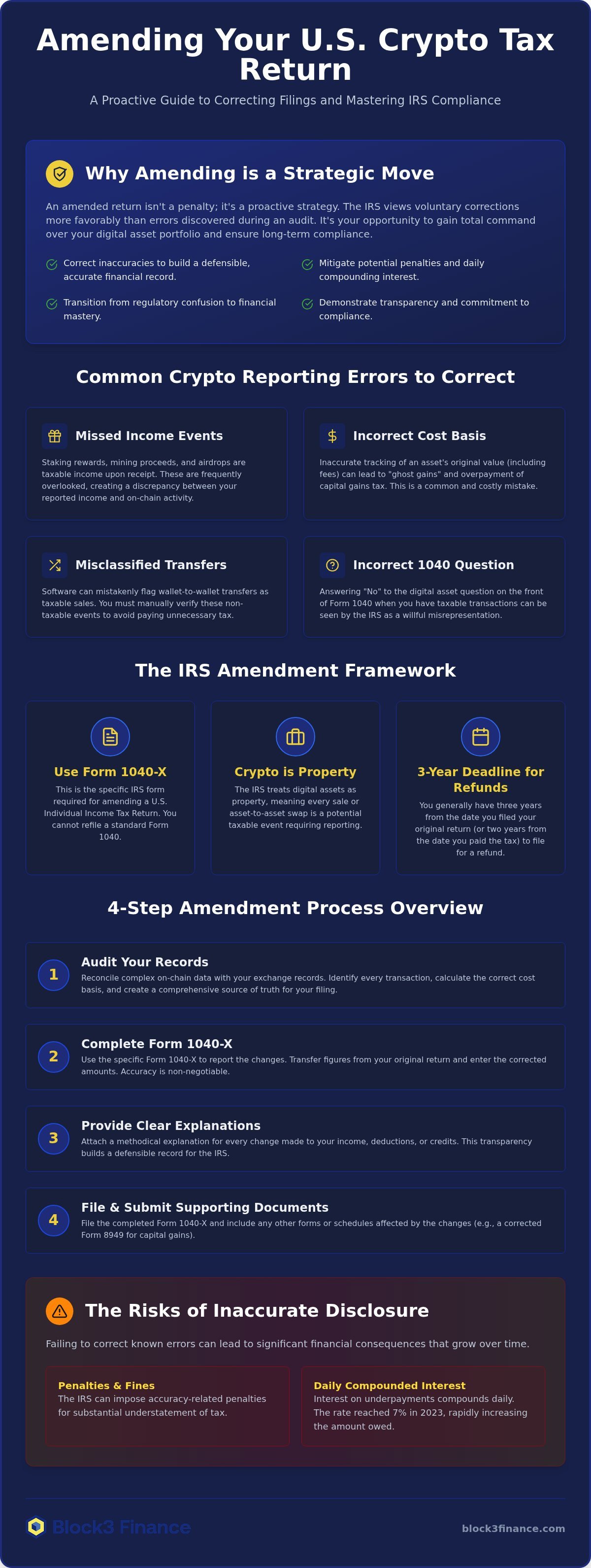
Common triggers for an amendment include discovering missed airdrops or staking rewards. Many investors also find that their initial filings used incorrect cost basis calculations. Cost basis is the original value of an asset for tax purposes, including any fees paid at the time of acquisition.
Identifying Common Digital Asset Omissions
Reconciling on-chain activity reveals gaps that traditional reporting often misses. Staking rewards and mining proceeds are frequently overlooked, yet the IRS classifies these as taxable income at the moment of receipt. Failing to account for these events creates a discrepancy between your reported income and your actual on-chain growth.
Cost basis errors often stem from "ghost" gains. If your records don't track the original purchase price accurately, you may overpay on capital gains tax. Conversely, underreporting can lead to penalties and interest that compound daily, with the IRS interest rate reaching 7% for the third quarter of 2026.
Misclassified transfers also create significant friction. Software often flags a wallet-to-wallet transfer as a taxable sale because it loses the "trail" of the asset. You must manually verify these movements to ensure you aren't paying taxes on non-taxable events.
The Risk of Inaccurate Digital Asset Disclosure
The front of Form 1040 features a critical question regarding digital assets. This question asks whether you received, sold, exchanged, or otherwise disposed of any digital asset. Answering "No" when you have taxable transactions can be interpreted as a willful misrepresentation by the IRS.
Correcting this answer through an amendment demonstrates your commitment to transparency. It protects your reputation and secures your financial future against future inquiries. It's essential to understand the full scope of The Definitive Guide to Cryptocurrency Tax Filing in 2026 to ensure every box is checked correctly.
It's vital to recognize the jurisdictional separation between filing types. While individuals use Form 1040-X, which is the document for amending personal returns, corporate entities must follow different protocols for their amendments. Mastering these distinctions ensures your specific entity remains compliant with federal law.
The IRS Framework for Amending Digital Asset Filings
Navigating the federal tax system requires a precise understanding of how the IRS classifies your holdings. The government treats cryptocurrency as property, which means that every asset-to-asset swap triggers a potential taxable event. You can find detailed definitions of these obligations in the Official IRS guidance on digital assets.
Mastering your tax history involves more than just fixing a single line item. Amending crypto tax return filings often creates a domino effect across multiple years. Because your closing balance in one year dictates your cost basis for the next, a single correction can ripple through your entire financial record.
Understanding Form 1040-X Requirements
The IRS mandates the use of Form 1040-X, the Amended U.S. Individual Income Tax Return, for all personal tax corrections. You cannot simply submit a new Form 1040 and expect the previous version to be overwritten. This specific document acts as a bridge between your original filing and your corrected financial reality.
Accuracy is non-negotiable when completing this form. You must provide a clear, methodical explanation for every change made to your income, deductions, or credits. This transparency builds a defensible record and signals to the IRS that you're taking an active role in your compliance.
If you're unsure how to categorize complex DeFi transactions on this form, you can reach out to our team for a professional review of your data. We transform messy transaction histories into polished financial statements.
Statute of Limitations and Deadlines
Time is a critical factor in recovering overpaid taxes. Under IRS regulations, you generally have three years from the date you filed your original return to claim a refund. Alternatively, you can file within two years of paying the tax, whichever date is later.
However, the window for IRS inquiries can remain open much longer in specific cases. If a "substantial omission" occurs, which is typically defined as underreporting income by more than 25%, the statute of limitations may extend to six years. In cases of suspected fraud, no time limit exists for the IRS to pursue back taxes and penalties.
Staying ahead of these deadlines is essential for protecting your capital. For the 2026 tax year, you should verify all specific filing windows with a crypto tax specialist to ensure your amendment is processed within the legal timeframe. We help you move from a defensive posture to a position of strategic advantage.
Auditing Your Own Records: Records vs. Software
Many investors rely solely on automated platforms to generate their tax reports. While these tools offer a baseline, they often struggle with the granular realities of decentralized finance. You must perform a rigorous reconciliation to verify the accuracy of your filing. Reconciliation is the process of ensuring two sets of records match.
Relying on unverified software outputs is a defensive posture that leaves you vulnerable to IRS scrutiny. When you begin the process of amending crypto tax return filings, you must move beyond automated guesses. You need a methodology that bridges the gap between raw blockchain logs and structured financial statements.
Block3 Finance specializes in this exact transformation. We turn fragmented on-chain activity into clean, defensible accounting records that stand up to the highest professional standards. Our team navigates high-stakes environments where precision is the only path to mastery.
The Pitfalls of Automated Tax Reports
"Missing price" errors are a common friction point in automated systems. When software cannot find a market value for a specific token at the time of a trade, it may default to a zero-dollar cost basis. This error artificially inflates your gains and leads to unnecessary tax overpayments.
Manual review is essential for events like NFT mints and burns, where software frequently misidentifies the nature of the transaction. Creating robust blockchain financial records is the only way to build an effective audit defense. It allows you to prove the intent and outcome of every smart contract interaction.
Reconstructing Historical On-Chain Activity
Defunct exchanges present a significant challenge for those seeking to correct their tax history. If an exchange has closed or lost your transaction data, you must become a forensic investigator of your own wealth. Use block explorers to verify the exact timestamps and values of your historical movements.
You must document the fair value of every asset at the moment of receipt, especially for staking rewards or airdrops. This level of detail is required by IRS guidance on amended returns to ensure your corrected filing is accurate and defensible.
Reconstructing these records is a methodical process that requires intellectual depth and technical rigor. By verifying every entry against the ledger, you eliminate the frantic energy of typical tax preparation. You replace confusion with the steady accumulation of professional weight.
Step-by-Step: How to File an Amended Crypto Return
Executing an amendment is a methodical exercise in financial precision. You aren't just fixing numbers; you're cultivating a pristine record of your digital evolution. When you begin the process of amending crypto tax return filings, start by gathering every original document, including your previously submitted 1040 and all exchange CSV files.
Following a structured sequence ensures that your new filing is both accurate and defensible. This methodology allows you to gain total command over your tax history through the following steps:
- Step 1: Collect all original tax documents, including 1099 forms and the previously filed return.
- Step 2: Re-run your crypto calculations using corrected cost basis data to ensure every transaction is accounted for.
- Step 3: Complete a new Form 8949 and Schedule D to reflect the corrected gains or losses.
- Step 4: Fill out Form 1040-X by referencing the updated figures from your corrected Schedule D.
- Step 5: Write a concise, professional explanation of your changes in Part III of Form 1040-X.
This structured methodology transforms a daunting regulatory requirement into a roadmap for growth. By taking these steps, you demonstrate to the IRS that you possess the technical rigor of a sophisticated investor. You're not merely reacting to rules; you're actively participating in the evolution of your own financial ecosystem.
If you find the technical requirements of these forms overwhelming, you can contact our specialized accountants to manage the submission for you. We ensure your records are clean, defensible, and fully compliant with federal law.
Correcting Form 8949 and Schedule D
Form 8949 is the specific document where you must list the details of every individual cryptocurrency sale. This includes the date you acquired the asset, the date it was sold, and your corrected cost basis. Capital gains are the profits you realize from the sale of property like cryptocurrency. These gains, along with any realized losses, are then summarized on Schedule D to determine your total tax liability for the year.
Writing the Explanation of Changes
Part III of Form 1040-X is your opportunity to provide a disciplined narrative for the IRS. Your explanation should be factual, brief, and entirely professional. Avoid emotional justifications or any language that suggests negligence. A strong entry might state: "Amending to include 1.5 ETH in staking rewards omitted from the original filing." This level of clarity reduces friction and demonstrates your commitment to total compliance.
Securing Compliance with Professional Tax Filing
The transition from a chaotic transaction history to a polished financial record requires more than basic software. Professional accountants act as a calm force in an industry characterized by rapid regulatory shifts and high-stakes volatility. By securing specialized expertise, you ensure that every line item in your filing is both accurate and defensible.
A professional review often reveals opportunities that automated tools overlook. While the process of amending crypto tax return filings is typically viewed as a way to correct underreporting, it's also a tool for recovery. Specialized accountants can identify missed capital losses that offset your gains, potentially reducing your overall tax liability for previous years.
Ensuring your books are audit-ready is the ultimate goal of any corrective filing. This proactive stance prevents the need for future amendments and establishes a foundation of stability. Block3 Finance provides the technical rigor needed to turn complex on-chain activity into clean financial statements that satisfy federal requirements.
The Value of Specialized Crypto Accountants
There is a profound difference between a general CPA and a firm dedicated to the digital asset ecosystem. A generalist may understand legacy tax codes but often lacks the immersion required to reconcile high-volume DeFi protocols or cross-chain movements. We possess the specialized vocabulary and technical tools to resolve the friction inherent in blockchain data.
With expertise spanning over 13 years and 980 global clients, we navigate the specific nuances of IRS reporting with absolute confidence. Our methodology involves a meticulous reconciliation of exchange CSVs and on-chain logs to ensure no detail is lost. You can learn more about finding the right partner in our guide on How to Choose a Crypto Tax Accountant.
Moving from Defensive to Offensive Compliance
True financial mastery involves shifting from a defensive posture to an offensive one. Instead of merely fixing mistakes from the past, you should focus on strategic cultivation of your wealth. Implementing monthly accounting allows you to stay ahead of tax season and make informed decisions in real-time.
This proactive approach grants you total command over your financial destiny. You no longer have to fear the "domino effect" of cost basis errors because your records are verified as they occur. If you're ready to secure your portfolio and gain peace of mind, you should Contact Block3 Finance for a comprehensive compliance review. We help you transform the burden of regulation into a roadmap for growth.
Command Your Digital Financial Future
Achieving total command over your digital history requires more than simple data entry. It demands a rigorous reconciliation of every on-chain event to ensure your records are truly defensible. By amending crypto tax return filings proactively, you replace regulatory friction with a clear roadmap for long-term growth.
Block3 Finance acts as a calm force in this volatile landscape. We bring over 13 years of blockchain financial expertise and have served more than 980 clients globally. As a top provider ranked by Bitcoin.com, we possess the technical rigor to transform complex DeFi and NFT activity into polished accounting records.
Don't let past reporting errors hinder your trajectory toward mastery. Secure your financial records with Block3 Finance today. Your journey toward absolute compliance and financial liberation begins with a single, disciplined step.
Frequently Asked Questions
Can I e-file an amended crypto tax return with the IRS?
Yes, you can e-file Form 1040-X for the current tax year and the two preceding years. This is the preferred method for the IRS in 2026 to ensure faster processing times. Electronic filing reduces the administrative friction that typically accompanies paper submissions. It also allows you to track your status using the "Where's My Amended Return?" tool with greater precision.
What is the penalty for not amending a crypto tax error?
Failing to correct an error leads to daily compounded interest and potential failure-to-pay penalties. For the third quarter of 2026, the IRS interest rate on underpayments is 7%. Proactive disclosure demonstrates financial leadership and can mitigate the risk of more severe accuracy-related penalties. Waiting for an audit notice often results in significantly higher financial friction and compounded costs.
How long does the IRS have to audit a crypto return?
The IRS generally has three years from the date you filed your return to initiate an audit. However, this window extends to six years if you omit more than 25% of your gross income. In cases involving suspected fraud or a failure to file, no statute of limitations exists. Maintaining a defensible financial record is your best defense against these high-stakes inquiries and long-term risks.
Do I need to amend my state tax return if I amend my federal crypto return?
Yes, you typically must amend your state tax return after amending crypto tax return filings at the federal level. Most states use your federal adjusted gross income as the starting point for their own tax calculations. Failing to update your state records can trigger a separate audit once the IRS shares your federal amendment data with state authorities.
What happens if I found a mistake that would give me a refund?
You can secure a refund by filing Form 1040-X within the legal timeframe set by the IRS. You generally have three years from the original filing date or two years from the date you paid the tax to claim your money. This allows you to recover capital that was overpaid due to cost basis errors or missed deductions. It's a strategic move to reclaim your wealth.
Is it better to amend or just report the crypto income in the current year?
You must amend the specific tax year where the error occurred to remain compliant with IRS rules. The IRS doesn't permit "catch-up" reporting of prior-year income on your current return. Attempting to report old gains in the current year creates a distorted financial record and may trigger a red flag. Amending ensures each year remains a clean and accurate reflection of your on-chain activity.
Do I need to send my crypto exchange CSV files to the IRS with my amendment?
You don't need to send raw CSV files to the IRS when you file your amendment. Instead, you must attach a corrected Form 8949 and Schedule D to your Form 1040-X. You should retain your exchange records and block explorer logs in your own files for at least several years. These documents form the foundation of your defensible record if the IRS requests further verification.
How much does it cost to have a professional amend a crypto return?
The cost of professional assistance varies based on the volume of your transactions and the complexity of your on-chain activity. Complex DeFi protocols or defunct exchange data require more technical rigor than simple trades. Investing in expert review ensures your amendment is processed correctly and protects you from the daily interest of future errors. It's a necessary step for those navigating high-stakes digital environments.

Article by
Mahad Mohamed
Mahad Mohamed is an accountant and the CEO of Block3 Finance, with over 26+ years of Canadian and international tax and accounting experience. A crypto accounting specialist since the early days of Bitcoin, he has consulted for over 38 crypto companies and collaborated with legal professionals on regulatory matters. His expertise spans corporate reorganization, cross-border tax structuring (Canada & US), tax disputes, and CRA audits.
Previously, Mahad worked for the Canada Revenue Agency (CRA), Big4 accounting firms, and served as a Rulings Officer for the Federal Tax Authority of the UAE before acquiring Tax Partners in 2014.
Block3 Finance and Tax Partners has 44 full-time accountants and over 9,800+ clients.
Disclaimer
This article provides general information only and is current as of its publication date. It has not been updated and may be out of date. It does not constitute legal advice and should not be relied upon as such. Every tax situation is unique and may differ from the examples discussed in this article. If you have specific questions, you should seek the advice of our accountants for your unique circumstances.
Frequently Asked Questions
Can I e-file an amended crypto tax return with the IRS?
Yes, you can e-file Form 1040-X for the current tax year and the two preceding years. This is the preferred method for the IRS in 2026 to ensure faster processing times. Electronic filing reduces the administrative friction that typically accompanies paper submissions. It also allows you to track your status using the "Where's My Amended Return?" tool with greater precision.
What is the penalty for not amending a crypto tax error?
Failing to correct an error leads to daily compounded interest and potential failure-to-pay penalties. For the third quarter of 2026, the IRS interest rate on underpayments is 7%. Proactive disclosure demonstrates financial leadership and can mitigate the risk of more severe accuracy-related penalties. Waiting for an audit notice often results in significantly higher financial friction and compounded costs.
How long does the IRS have to audit a crypto return?
The IRS generally has three years from the date you filed your return to initiate an audit. However, this window extends to six years if you omit more than 25% of your gross income. In cases involving suspected fraud or a failure to file, no statute of limitations exists. Maintaining a defensible financial record is your best defense against these high-stakes inquiries and long-term risks.
Do I need to amend my state tax return if I amend my federal crypto return?
Yes, you typically must amend your state tax return after amending crypto tax return filings at the federal level. Most states use your federal adjusted gross income as the starting point for their own tax calculations. Failing to update your state records can trigger a separate audit once the IRS shares your federal amendment data with state authorities.
What happens if I found a mistake that would give me a refund?
You can secure a refund by filing Form 1040-X within the legal timeframe set by the IRS. You generally have three years from the original filing date or two years from the date you paid the tax to claim your money. This allows you to recover capital that was overpaid due to cost basis errors or missed deductions. It's a strategic move to reclaim your wealth.
Is it better to amend or just report the crypto income in the current year?
You must amend the specific tax year where the error occurred to remain compliant with IRS rules. The IRS doesn't permit "catch-up" reporting of prior-year income on your current return. Attempting to report old gains in the current year creates a distorted financial record and may trigger a red flag. Amending ensures each year remains a clean and accurate reflection of your on-chain activity.
Do I need to send my crypto exchange CSV files to the IRS with my amendment?
You don't need to send raw CSV files to the IRS when you file your amendment. Instead, you must attach a corrected Form 8949 and Schedule D to your Form 1040-X. You should retain your exchange records and block explorer logs in your own files for at least several years. These documents form the foundation of your defensible record if the IRS requests further verification.
How much does it cost to have a professional amend a crypto return?
The cost of professional assistance varies based on the volume of your transactions and the complexity of your on-chain activity. Complex DeFi protocols or defunct exchange data require more technical rigor than simple trades. Investing in expert review ensures your amendment is processed correctly and protects you from the daily interest of future errors. It's a necessary step for those navigating high-stakes digital environments.