
Could your Canadian crypto enterprise survive a $20,000,000 administrative penalty for a single compliance gap? As of March 2026, FINTRAC has drastically increased fines for very serious violations, making preparation for a CRA crypto audit for businesses a matter of strategic survival. High-stakes environments require a proactive stance that shifts your narrative from merely managing regulations to total mastery.
You likely find yourself caught between the need for rapid innovation and the heavy burden of the new Travel Rule and Stablecoin Act requirements. It's exhausting to manage complex on-chain data while fearing that a single reporting error could sever your vital banking relationships. We understand that the pressure to maintain seamless operations while satisfying the CRA is a constant challenge for modern digital asset firms.
This guide serves as your strategic roadmap to navigating the 2026 AML landscape and building a compliance program that satisfies both FINTRAC and tax authorities. We'll explore how to automate your reporting, secure your on-fiat ramps, and transform your regulatory obligations into a foundation for institutional growth. By the end of this article, you'll have a clear path to becoming audit-ready and operationally resilient.
Key Takeaways
- Understand how FINTRAC oversees the Proceeds of Crime (Money Laundering) and Terrorist Financing Act (PCMLTFA) to ensure your enterprise operates within the legal bounds of Canadian law.
- Develop high-level KYC and KYB protocols that go beyond basic identification to create a defensible, institutional-grade compliance framework for 2026.
- Learn how maintaining robust AML records provides the essential documentation needed to successfully navigate a CRA crypto audit for businesses and prove your cost basis.
- Follow a clear sequence for registering as a Money Services Business (MSB) and appointing a qualified Compliance Officer to lead your regulatory strategy.
- Leverage elite compliance standards to unlock restricted banking relationships and attract significant venture capital investment within the Canadian digital asset market.
Navigating the Canadian Crypto AML Landscape under FINTRAC
The Proceeds of Crime (Money Laundering) and Terrorist Financing Act (PCMLTFA) is the governing act for Canadian AML compliance. This framework empowers the Financial Transactions and Reports Analysis Centre of Canada (FINTRAC) to facilitate the detection and prevention of money laundering. For Canadian enterprises, Anti-Money Laundering (AML) is no longer a passive checklist but a rigorous operational standard designed to safeguard the integrity of the national financial system.
FINTRAC operates as Canada's primary financial intelligence unit, overseeing digital assets to ensure transparency across the blockchain ecosystem. By 2026, the definition of a Virtual Asset Service Provider (VASP) has expanded to include decentralized entities and Web3 startups that previously operated in regulatory gray areas. These organizations now face stricter accountability measures to prevent the illicit flow of funds through non-custodial protocols and emerging stablecoin frameworks.
Identifying as a Money Services Business (MSB)
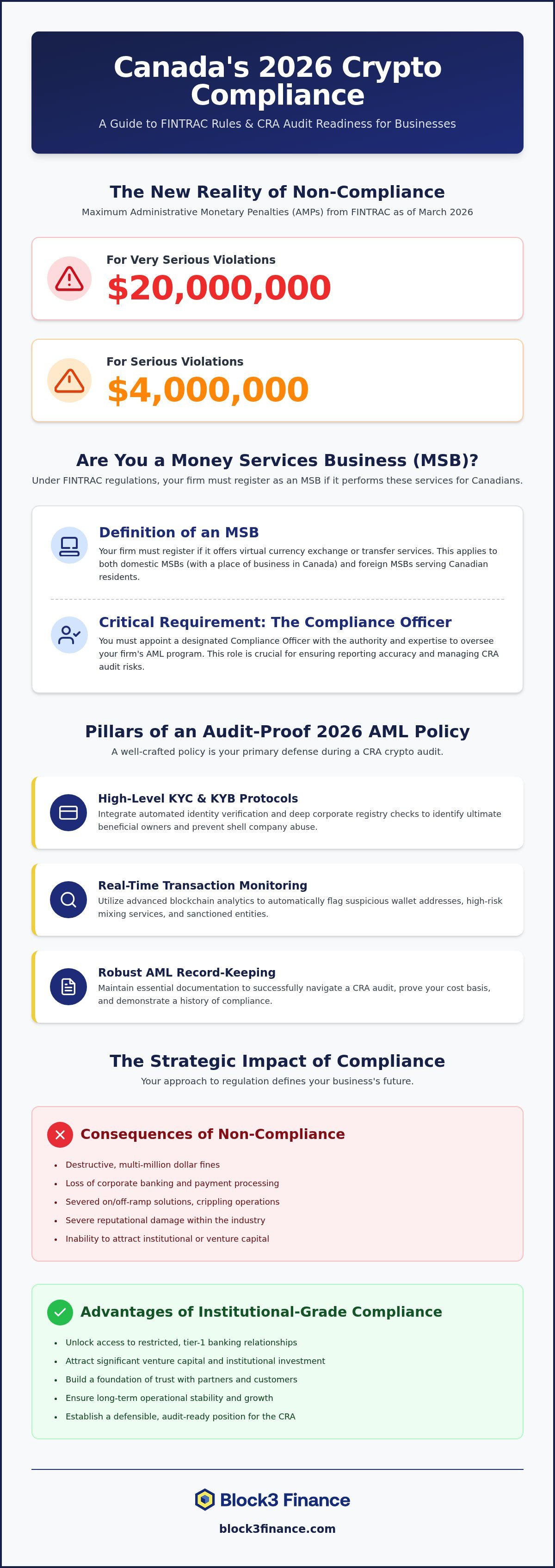
Your firm must register as an MSB if it offers virtual currency exchange or transfer services to Canadian residents. Domestic MSBs are entities with a place of business in Canada, while foreign MSBs provide these services to Canadians without a local physical presence. Both categories must adhere to strict PCMLTFA guidelines to maintain their legal standing and operational rights within the country.
A critical component of this registration is the legal necessity of appointing a designated Compliance Officer. This individual must possess the authority and technical expertise to oversee your firm's AML program and ensure reporting accuracy. Failing to vet this role properly creates significant vulnerabilities during a CRA crypto audit for businesses, as tax authorities often rely on AML records to verify complex on-chain activity.
The Consequences of Non-Compliance in 2026
FINTRAC enforces compliance through Administrative Monetary Penalties (AMPs), which have reached unprecedented levels as of March 2026. For very serious violations, penalties can now reach a maximum of $20,000,000, while even serious violations can cost up to $4,000,000. These financial hits are designed to be punitive, ensuring that negligence doesn't become a simple cost of doing business in the Canadian market.
Beyond direct fines, poor compliance destroys your ability to secure corporate banking and on-ramp solutions. Traditional financial institutions view non-compliant crypto firms as high-risk liabilities and will often terminate relationships to protect their own licenses. Maintaining an audit-ready posture through professional audits and compliance services is the only way to guarantee long-term operational stability and growth.
Essential Components of a 2026 Crypto AML Policy
Mastering the regulatory landscape requires a written AML/CTF policy that reflects your specific blockchain operations. This document isn't a generic template; it's a strategic asset that details how your firm mitigates risks associated with your unique digital asset activities. A well-crafted policy serves as your primary defense during a CRA crypto audit for businesses, proving that your records are defensible and your operations are transparent.
In 2026, Know Your Customer (KYC) and Know Your Business (KYB) protocols must integrate automated identity verification and deep corporate registry checks. These systems verify the ultimate beneficial owners of your corporate clients to prevent shell company abuse and ensure you aren't facilitating sanctioned entities. Real-time transaction monitoring is also vital, utilizing advanced blockchain analytics to flag suspicious wallet addresses or high-risk mixing services as they interact with your platform.
Your staff and executive leadership require specialized AML training that evolves alongside Canadian financial law. This ensures every team member understands their specific reporting duties and can identify emerging threats in the blockchain ecosystem. If you're unsure if your current policy meets these 2026 standards, you can speak with our strategists for a comprehensive review of your framework.
Implementing the 2026 Travel Rule in Canada
The Travel Rule mandates that financial institutions and money services businesses share specific information during virtual currency transfers. When you facilitate transfers, you must securely transmit the originator’s and beneficiary’s names, addresses, and account numbers to the counterparty institution. This requirement ensures a clear trail of ownership for assets moving through the Canadian financial system.
Reporting entities must report the receipt of virtual currency equivalent to $10,000 CAD or more to FINTRAC. This applies to single transactions or multiple transactions conducted within a 24-hour period. These large virtual currency transaction reports must be submitted within five working days to maintain compliance and avoid the increased penalties introduced in early 2026.
Risk-Based Approach (RBA) for Digital Assets
A Risk-Based Approach is the core of modern FINTRAC compliance. This methodology allows you to allocate your resources where the threat of money laundering or terrorist financing is highest. You must conduct a formal Risk Assessment that evaluates your products, delivery channels, and geographic reach to identify potential vulnerabilities.
Customers from high-risk jurisdictions or those with complex corporate structures require Enhanced Due Diligence (EDD). This involves deeper investigation into the source of funds and the purpose of the business relationship. By prioritizing these high-risk areas, you demonstrate the technical rigor required to satisfy both FINTRAC and tax authorities during a CRA crypto audit for businesses.
FINTRAC and the CRA may operate as distinct entities, but their data requirements are inextricably linked. The CRA increasingly views AML records as the definitive source for substantiating complex on-chain activity during a CRA crypto audit for businesses. Your compliance data provides the essential context that transforms anonymous blockchain movements into verifiable financial events.
KYC protocols do more than satisfy anti-money laundering rules; they establish the legal origin of your capital. By proving the source of funds, you create a defensible cost basis that prevents the CRA from misinterpreting initial investments as taxable revenue. Integrating these records with professional crypto accounting ensures your financial reporting remains resilient under the highest levels of scrutiny.
Clean books are the hallmark of a mature enterprise. High-growth Canadian firms must maintain institutional-grade records to facilitate seamless on-ramp operations and secure future funding. A proactive approach to data management positions your brand as a disciplined leader in the digital asset space.
Defensible Records: Beyond Simple Bookkeeping
Raw transaction hashes are the starting point, not the conclusion, of financial reporting. You must cultivate a system that translates these cryptographic strings into clear financial statements that satisfy Canadian regulatory standards. This translation process is vital for defending the economic reality of your business model against aggressive tax reassessments.
Robust AML documentation prevents the CRA from arbitrarily re-characterizing your business income. Without a clear trail, auditors may attempt to reclassify active trading revenue as capital gains, which can lead to unexpected tax liabilities. Matching wallet addresses to verified identities provides a layer of legal protection that confirms your entity's ownership of every digital asset and prevents claims of unreported third-party activity.
Audit-Ready Books for High-Growth Web3 Firms
Strategic preparation for a CRA crypto audit requires more than just reactive responses. You must implement proactive data management strategies that categorize every transaction in real-time while maintaining five years of records as mandated by Canadian law. This level of technical rigor ensures that your books are always ready for a CRA crypto audit for businesses, protecting you from new daily penalties associated with a Notice of Non-Compliance.
Fractional CFO services are essential for navigating the intersection of AML compliance and tax optimization. These experts provide the strategic oversight necessary to align your operational data with your financial goals while managing the complexities of the Crypto-Asset Reporting Framework (CARF). Integrated compliance frameworks significantly reduce the likelihood of CRA reassessments by ensuring total consistency across all government filings.
Step-by-Step Implementation of Crypto AML for Canadian Firms
Establishing a robust compliance framework begins with registering your business as a Money Services Business (MSB) through the official FINTRAC portal. This manual process requires you to disclose your ownership structure, business activities, and the specific virtual currency services you provide to Canadian clients. Precision during this stage is vital; any discrepancies in your initial filing can lead to delays or immediate regulatory inquiries.
You must appoint a qualified Compliance Officer who possesses a deep understanding of the Proceeds of Crime (Money Laundering) and Terrorist Financing Act (PCMLTFA). This individual needs the authority to implement organizational changes and the technical expertise to monitor blockchain-specific risks. Vetting this role is a strategic priority, as the Compliance Officer serves as your primary navigator during any regulatory interaction or CRA crypto audit for businesses.
Selecting and integrating blockchain-native AML and KYC software is the next step in automating your transaction screening. These advanced tools provide real-time risk detection by flagging suspicious wallet addresses and interactions with mixing services. This automation creates a steady flow of defensible data, ensuring that your books remain accurate and transparent for both FINTRAC and tax authorities.
The Biennial Effectiveness Review
Canadian law mandates an independent audit of your AML program every two years to verify that your policies are effectively mitigating risk. This review is a legal requirement that ensures your compliance framework evolves alongside shifting regulatory standards and emerging blockchain threats. During a desk review or an on-site inspection, a FINTRAC examiner will scrutinize your records to confirm that your stated policies match your actual operational practices.
Failing an effectiveness review can result in significant administrative monetary penalties and the loss of your MSB registration. It's essential to prepare for your next compliance audit with a specialist team that understands the technical nuances of the Canadian digital asset landscape. Proactive reviews allow you to identify and resolve friction points before they become liabilities during a formal inspection.
Managing On- and Off-Ramp Compliance
Your fiat-to-crypto gateways must meet stringent Canadian banking standards to maintain institutional-grade operations. Traditional financial partners require proof that your on-ramp solutions align with VASP reporting requirements and provide a clear audit trail. This transparency is necessary to prevent your accounts from being flagged or terminated due to perceived compliance gaps.
Maintaining a clear fiat audit trail alongside your on-chain data is the only way to prove the economic reality of your transactions. This integrated approach ensures that every dollar moving into or out of your ecosystem is fully accounted for and defensible. If you're ready to secure your firm's operational future, contact our team today for a strategic consultation on your AML implementation.
Strategic Advantages of Institutional-Grade Compliance
In 2026, institutional-grade compliance has evolved from a regulatory burden into a premier strategic asset. Venture capital firms and institutional partners now prioritize enterprises that demonstrate a rigorous commitment to FINTRAC standards. This transparency de-risks their portfolios and ensures that your firm remains a viable candidate for high-level funding and partnerships.
Securing long-term banking relationships requires more than just meeting the bare minimum of Canadian law. Financial institutions favor entities that proactively exceed regulatory benchmarks, viewing them as stable partners in a volatile industry. This level of transparency is also a vital component of preparing for a CRA crypto audit for businesses, as it proves your financial records are consistent across all platforms.
Mastering the Canadian framework provides a blueprint for successful international expansion. As 47 countries begin exchanging data under the Crypto-Asset Reporting Framework (CARF) by 2027, your established rigor allows you to enter new jurisdictions with confidence. This offensive posture transforms compliance into a competitive advantage that accelerates your global growth and market entry.
Positioning your firm as a trusted leader in the Web3 ecosystem requires a commitment to radical transparency and technical rigor. By adopting a "compliance-first" culture, you signal to the market that your enterprise is built for longevity. This reputation attracts elite talent and high-value clients who prioritize security and regulatory certainty.
The Block3 Finance Advantage
We leverage 13+ years of blockchain financial expertise to help Canadian entities navigate the complexities of 2026 regulations. Our Visionary Navigator approach shifts the focus from defensive management to offensive growth, turning your compliance framework into a foundation for mastery. You can contact our Ontario-based team to refine your strategy and prepare for the next phase of your evolution.
Future-Proofing Your Digital Asset Enterprise
Staying ahead of evolving FINTRAC and CRA guidelines requires proactive financial leadership and a commitment to best practices. A specialized crypto tax accountant is indispensable in the 2026 environment, providing the technical oversight needed to prevent reassessments and penalties. This level of discipline ensures that your records remain defensible during any CRA crypto audit for businesses.
Integrated compliance reduces friction and fosters a culture of excellence within your Web3 organization. By prioritizing transparency and technical rigor, you position your brand as a trusted leader in the digital economy. Ready to secure your firm’s future? Contact Block3 Finance for a compliance consultation today.
Mastering Your Regulatory Future in the Canadian Digital Economy
Navigating the Canadian regulatory landscape requires a shift from defensive management to offensive mastery. By integrating robust AML protocols with precise financial reporting, you transform compliance into a strategic asset that attracts institutional partners. These systems ensure you remain audit-ready while maintaining the operational freedom to scale.
Your compliance data provides the critical evidence needed to survive a CRA crypto audit for businesses and substantiate your cost basis. Defensible records and biennial effectiveness reviews are the standard for high-growth Web3 firms in 2026. Without this technical rigor, your enterprise remains vulnerable to escalating penalties and severed financial relationships.
Block3 Finance stands as your Visionary Navigator in this volatile space. Ranked #1 by Bitcoin.com, we offer 13+ years of blockchain financial leadership and specialized Canadian tax and AML expertise. Secure your business with institutional-grade crypto compliance by reaching out to our team today. You have the power to turn regulatory complexity into a roadmap for long-term growth.
Frequently Asked Questions
Is my crypto business required to register with FINTRAC in 2026?
Yes, any entity operating as a Money Services Business (MSB) must register with FINTRAC. This requirement applies to firms providing virtual currency exchange, transfer services, or stablecoin issuance to Canadian clients. As of March 2026, the Stablecoin Act mandates that all issuers register as MSBs. Both domestic and foreign entities serving the Canadian market must comply with these PCMLTFA registration guidelines to operate legally.
Can a decentralized organization (DAO) be compliant with Canadian AML laws?
Compliance is possible but requires a structured approach to bridge decentralized protocols with Canadian law. FINTRAC has increased its focus on decentralized entities in 2026, requiring them to identify accountable individuals or legal representatives. A DAO must often establish a centralized compliance framework to handle MSB registration and mandatory reporting. This structure ensures the organization can access fiat on-ramps and avoid the aggressive penalties associated with non-compliance.
How much does it cost to implement a crypto AML program for a startup?
Implementation costs depend on your transaction volume and the complexity of your blockchain architecture. Startups must budget for specialized KYC software, independent biennial effectiveness reviews, and the appointment of a qualified Compliance Officer. While specific pricing varies, the investment is a strategic necessity to avoid the multi-million dollar fines introduced in 2026. Building a robust program early prevents the high costs of reactive remediation during a regulatory inquiry.
What happens if my business fails a FINTRAC audit in Canada?
Failure can trigger Administrative Monetary Penalties (AMPs) that reach up to $20,000,000 for very serious violations as of early 2026. FINTRAC may also publicly name your firm, which often leads to the immediate termination of banking relationships. Furthermore, a failed AML inspection frequently triggers a CRA crypto audit for businesses. Tax authorities view compliance failures as a red flag for unreliable financial records and unreported income.
What is the Travel Rule and how does it apply to my business in 2026?
The Travel Rule requires financial entities to securely transmit originator and beneficiary information during virtual currency transfers. This ensures that a clear trail of ownership exists for assets moving between institutions. In 2026, you must share names, addresses, and account numbers for qualifying transfers to satisfy FINTRAC. This data is vital for proving the economic reality of your transactions and maintaining transparency across the Canadian financial system.
Do I need a dedicated Compliance Officer for a small crypto firm?
Canadian law requires every MSB to appoint a designated Compliance Officer, regardless of the firm's size. While this doesn't always necessitate a full-time hire for smaller startups, the individual must possess the authority to implement policies and report directly to leadership. They act as your primary navigator during a CRA crypto audit for businesses. Their expertise ensures that your AML data remains consistent with your tax filings and general ledger.
How does AML compliance help with my CRA crypto tax filing?
AML compliance generates the granular data needed to substantiate your cost basis and prove the legal origin of your capital. The CRA relies on these verified records to validate the complex on-chain activity reported in your annual filings. When your AML data matches your tax records, you create a defensible position that reduces the risk of reassessments. This technical rigor protects your enterprise from the daily penalties associated with a Notice of Non-Compliance.
Can Block3 Finance help me register as an MSB in Canada?
Block3 Finance provides expert guidance through the manual FINTRAC registration process and the development of comprehensive compliance frameworks. We help you vet your internal policies against 2026 standards and ensure your MSB status is legally sound. Our team focuses on turning these regulatory requirements into a foundation for institutional growth. We align your registration strategy with your broader goals for securing banking relationships and attracting venture capital investment.

Article by
Mahad Mohamed
Mahad Mohamed is an accountant and the CEO of Block3 Finance, with over 26+ years of Canadian and international tax and accounting experience. A crypto accounting specialist since the early days of Bitcoin, he has consulted for over 38 crypto companies and collaborated with legal professionals on regulatory matters. His expertise spans corporate reorganization, cross-border tax structuring (Canada & US), tax disputes, and CRA audits.
Previously, Mahad worked for the Canada Revenue Agency (CRA), Big4 accounting firms, and served as a Rulings Officer for the Federal Tax Authority of the UAE before acquiring Tax Partners in 2014.
Block3 Finance and Tax Partners has 44 full-time accountants and over 9,800+ clients.
Disclaimer
This article provides general information only and is current as of its publication date. It has not been updated and may be out of date. It does not constitute legal advice and should not be relied upon as such. Every tax situation is unique and may differ from the examples discussed in this article. If you have specific questions, you should seek the advice of our accountants for your unique circumstances.
Frequently Asked Questions
Is my crypto business required to register with FINTRAC in 2026?
Yes, any entity operating as a Money Services Business (MSB) must register with FINTRAC. This requirement applies to firms providing virtual currency exchange, transfer services, or stablecoin issuance to Canadian clients. As of March 2026, the Stablecoin Act mandates that all issuers register as MSBs. Both domestic and foreign entities serving the Canadian market must comply with these PCMLTFA registration guidelines to operate legally.
Can a decentralized organization (DAO) be compliant with Canadian AML laws?
Compliance is possible but requires a structured approach to bridge decentralized protocols with Canadian law. FINTRAC has increased its focus on decentralized entities in 2026, requiring them to identify accountable individuals or legal representatives. A DAO must often establish a centralized compliance framework to handle MSB registration and mandatory reporting. This structure ensures the organization can access fiat on-ramps and avoid the aggressive penalties associated with non-compliance.
How much does it cost to implement a crypto AML program for a startup?
Implementation costs depend on your transaction volume and the complexity of your blockchain architecture. Startups must budget for specialized KYC software, independent biennial effectiveness reviews, and the appointment of a qualified Compliance Officer. While specific pricing varies, the investment is a strategic necessity to avoid the multi-million dollar fines introduced in 2026. Building a robust program early prevents the high costs of reactive remediation during a regulatory inquiry.
What happens if my business fails a FINTRAC audit in Canada?
Failure can trigger Administrative Monetary Penalties (AMPs) that reach up to $20,000,000 for very serious violations as of early 2026. FINTRAC may also publicly name your firm, which often leads to the immediate termination of banking relationships. Furthermore, a failed AML inspection frequently triggers a CRA crypto audit for businesses. Tax authorities view compliance failures as a red flag for unreliable financial records and unreported income.
What is the Travel Rule and how does it apply to my business in 2026?
The Travel Rule requires financial entities to securely transmit originator and beneficiary information during virtual currency transfers. This ensures that a clear trail of ownership exists for assets moving between institutions. In 2026, you must share names, addresses, and account numbers for qualifying transfers to satisfy FINTRAC. This data is vital for proving the economic reality of your transactions and maintaining transparency across the Canadian financial system.
Do I need a dedicated Compliance Officer for a small crypto firm?
Canadian law requires every MSB to appoint a designated Compliance Officer, regardless of the firm's size. While this doesn't always necessitate a full-time hire for smaller startups, the individual must possess the authority to implement policies and report directly to leadership. They act as your primary navigator during a CRA crypto audit for businesses. Their expertise ensures that your AML data remains consistent with your tax filings and general ledger.
How does AML compliance help with my CRA crypto tax filing?
AML compliance generates the granular data needed to substantiate your cost basis and prove the legal origin of your capital. The CRA relies on these verified records to validate the complex on-chain activity reported in your annual filings. When your AML data matches your tax records, you create a defensible position that reduces the risk of reassessments. This technical rigor protects your enterprise from the daily penalties associated with a Notice of Non-Compliance.
Can Block3 Finance help me register as an MSB in Canada?
Block3 Finance provides expert guidance through the manual FINTRAC registration process and the development of comprehensive compliance frameworks. We help you vet your internal policies against 2026 standards and ensure your MSB status is legally sound. Our team focuses on turning these regulatory requirements into a foundation for institutional growth. We align your registration strategy with your broader goals for securing banking relationships and attracting venture capital investment.