
Could your internal control over private keys survive a rigorous third-party examination; or is your balance sheet a ticking clock of regulatory risk? Executing a successful US crypto financial statement audit in 2026 requires more than defensive bookkeeping. It demands a proactive mastery of a high-stakes digital landscape.
We understand the friction of reconciling complex on-chain activity with rigid, legacy ERP (Enterprise Resource Planning) systems. The uncertainty surrounding fair value measurement under ASU 2023-08 often leaves even the most diligent teams feeling exposed during high-pressure cycles.
This guide empowers you to transform your financial reporting into a clear, defensible strategic asset. You'll learn to meet the highest FASB (Financial Accounting Standards Board) standards while cultivating the transparent records that institutional investors and regulators now demand.
We'll explore the essential steps for audit readiness; including private key security, 1099-DA compliance, and navigating the latest IRS requirements. By the end, you'll have the roadmap needed to move from compliance anxiety to total financial command.
Key Takeaways
- Transition your reporting to fair value measurement (valuing assets at their current market price) as required by the FASB rule ASU 2023-08 for fiscal years beginning after December 15, 2024.
- Streamline the complexities of a crypto financial statement audit by using specialized sub-ledger software (accounting tools that record detailed transaction data) to bridge the gap between blockchain records and traditional accounting.
- Establish definitive proof of asset ownership to satisfy US GAAP (Generally Accepted Accounting Principles) without exposing sensitive private keys to external risks.
- Position your firm for growth by using audited records to secure institutional-grade corporate structuring and optimized on and off-ramp solutions (services that move funds between crypto and fiat).
- Minimize audit friction by conducting a pre-audit assessment to verify that your internal controls and data integrity meet the highest US standards.
What is a Crypto Financial Statement Audit in the US?
A crypto financial statement audit is an independent examination of an entity's financial records to ensure they align with US Generally Accepted Accounting Principles (GAAP). These are the standardized rules for financial reporting established in the United States to ensure consistency and transparency. Unlike a standard audit, this process requires specialized expertise to reconcile digital asset holdings with traditional accounting frameworks.
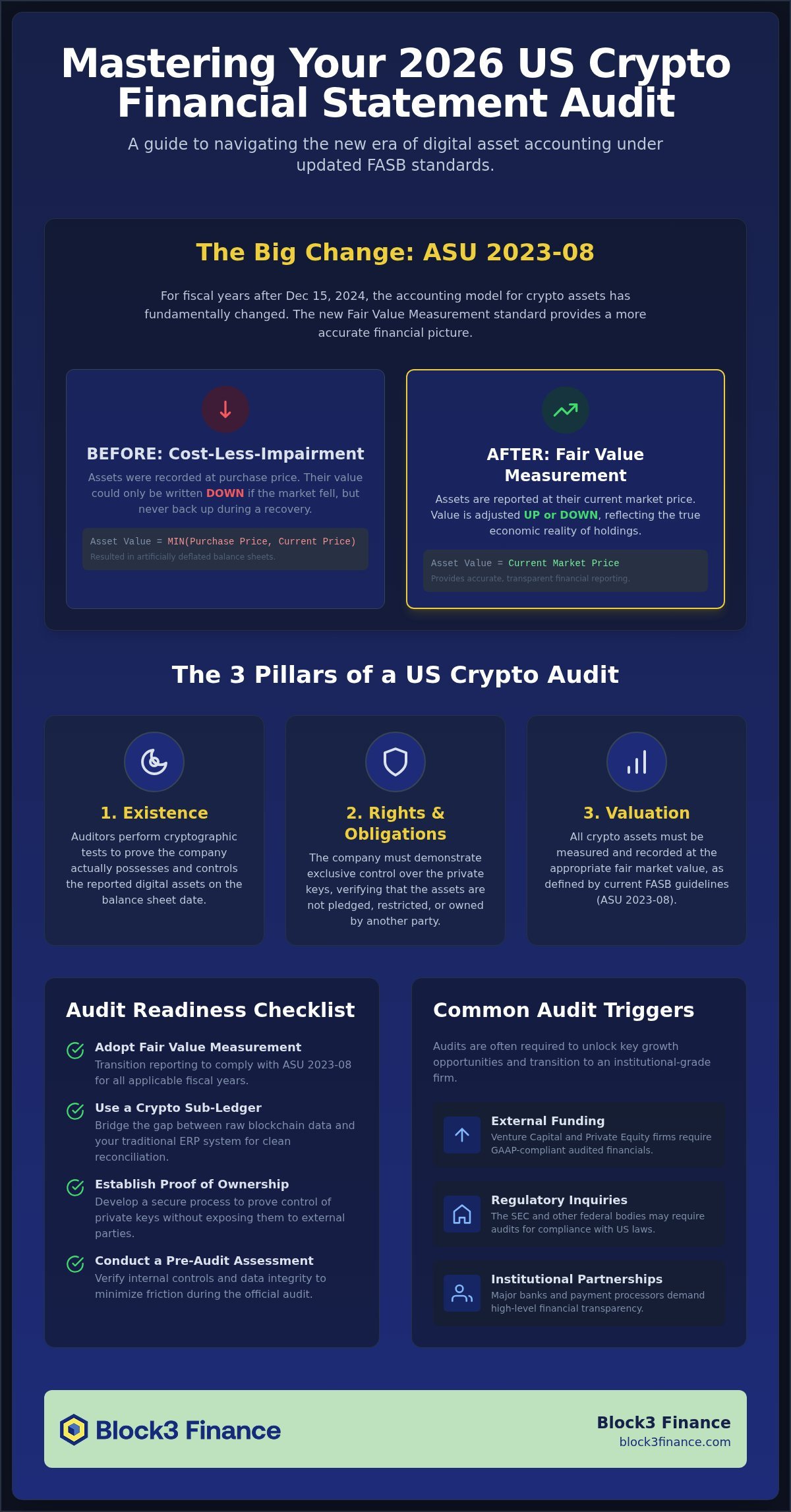
In 2026, the landscape has shifted dramatically due to the implementation of ASU 2023-08. Previously, US firms followed a "cost-less-impairment" model; assets were recorded at purchase price and only adjusted downward if market value fell. The new standard mandates fair value measurement, requiring companies to report the current market price of their crypto assets, which provides a more accurate reflection of financial health.
This level of scrutiny is essential for US-based firms seeking institutional funding or navigating federal regulatory expectations. While a smart contract security audit focuses on identifying vulnerabilities in code, a financial statement audit focuses on the integrity of the balance sheet. It bridges the gap between foundational blockchain technology and the rigorous demands of legacy finance.
Key Components of the Audit Process
A successful audit centers on three primary pillars that verify the legitimacy of your digital holdings. Auditors must establish a clear trail from the blockchain to your financial statements. This process requires a sophisticated understanding of both cryptographic proof and traditional ledger reconciliation.
- Existence: Auditors perform cryptographic tests to prove the company actually holds the reported digital assets at the end of the reporting period.
- Rights and Obligations: You must demonstrate exclusive control over the private keys; verifying that the assets aren't encumbered or owned by another party.
- Valuation: The audit ensures that all assets are recorded at the appropriate fair market value as defined by current FASB (Financial Accounting Standards Board) guidelines.
Audit Triggers for US Crypto Businesses
Most firms don't undergo a complex audit by choice; rather, they do so to unlock specific growth opportunities. These triggers often mark the transition from a startup to a mature institutional player. Mastering these requirements early positions your firm as a leader in the evolving digital economy.
- External Funding: Venture capital firms and private equity investors typically require GAAP-compliant audited financials before closing significant investment rounds.
- Regulatory Inquiries: Federal bodies like the SEC (Securities and Exchange Commission) may require audited statements to ensure compliance with US securities laws.
- Institutional Partnerships: Major banks and payment processors often demand high-level financial transparency before integrating with crypto-native platforms.
The Impact of ASU 2023-08 on US Crypto Audits
ASU 2023-08 represents a seismic shift in how US entities report digital holdings. For fiscal years beginning after December 15, 2024, the FASB (Financial Accounting Standards Board) requires that most crypto assets be measured at fair value. This is the price that would be received to sell an asset in an orderly transaction between market participants. This mandate effectively retires the restrictive "cost-less-impairment" model that previously hindered financial transparency.
Under the old impairment-only system, you could only record losses when market prices dropped, but you couldn't write the value back up during a recovery. This often left balance sheets artificially deflated and failed to reflect the true economic reality of a company's holdings. During a crypto financial statement audit, auditors now focus heavily on the reliability of your valuation data rather than just historical purchase records. You can explore the broader strategic implications of this shift in our guide on ASU 2023-08 and Crypto Revenue Recognition.
Determining Fair Value in Volatile Markets
Navigating fair value requires establishing a "principal market," which is the market with the greatest volume and level of activity for the asset. Auditors expect you to standardize price feeds from multiple reputable exchanges to ensure the data is representative. Following the AICPA crypto audit guidance helps in defining these active markets with the precision required by US GAAP.
You must also distinguish between Level 1 inputs, which are quoted prices in active markets for identical assets, and Level 2 inputs, which rely on observable data from similar assets or inactive markets. Documenting the specific logic behind your price aggregators is vital for surviving a rigorous review. This level of detail proves your valuation isn't arbitrary but is instead based on a disciplined and repeatable methodology.
Revenue Recognition and Fair Value
The specific timing of a token receipt is critical because it establishes the fair value basis for your reported income. High volatility means that a delay of just a few hours can significantly alter your revenue figures on paper. Professional accounting services are essential here to ensure that your sub-ledger (a detailed record of transactions that supports the general ledger) captures these timestamps with cryptographic precision.
Managing the resulting volatility on your balance sheet requires a proactive approach to financial communication. Fair value updates can create swings in net income that investors and stakeholders must understand through transparent reporting. If you're concerned about how these new standards affect your next filing, it's a strategic advantage to consult with an expert strategist to align your books with 2026 requirements.
Core Challenges in Auditing Blockchain Transactions
Auditing a distributed ledger isn't as simple as viewing a block explorer. While the blockchain provides an immutable record, auditors must still verify that the data correctly represents your company's financial position. A successful crypto financial statement audit hinges on your ability to bridge the gap between raw on-chain data and traditional financial reporting.
Reconciling off-chain records, like your internal trade logs, with immutable on-chain data is often where the most friction occurs. Any discrepancy between your internal database and the public ledger can trigger a red flag during the audit. Auditing Decentralized Finance (DeFi), which refers to financial services built on blockchain, presents further hurdles. Activities like staking, where tokens are locked to support a network, or liquidity provision require tracing complex smart contract interactions that often obscure the cost basis of rewards.
Proving Existence and Ownership
Auditors must confirm you actually control the assets listed on your balance sheet. One common method is message signing, where you use your private key to sign a specific string of text provided by the auditor. This proves you have the key without actually moving any funds or risking security.
Alternatively, you might perform a "Satoshi test" by sending a tiny, specific amount of crypto to a designated address. This provides tangible evidence of your ability to move assets. If you use a third-party custodian, auditors will review their SOC 1 or SOC 2 reports. These are independent evaluations that prove the custodian has adequate security and operational controls.
Internal Control Over Financial Reporting (ICFR)
Your Internal Control Over Financial Reporting (ICFR) must be robust enough to prevent unauthorized transactions. This often involves using multi-sig wallets, which are digital wallets that require two or more people to approve a transaction before it can be sent. This creates a clear segregation of duties, ensuring no single individual has total control over company funds.
You must document the entire lifecycle of a transaction from the moment it's initiated to its final settlement on the blockchain. The Impact of ASU 2023-08 means your controls must also capture the exact fair value at the time of each transaction. Maintaining audit-ready books ensures you can provide this evidence immediately, reducing friction and avoiding costly delays during the review process.
How to Prepare for a Successful US Crypto Audit
Preparation isn't just about survival; it's about establishing institutional credibility. Start with a comprehensive pre-audit assessment to identify gaps in your financial records before the official engagement begins.
You must reconcile all wallet activity using specialized sub-ledger software to ensure every transaction is accounted for. Standardizing your valuation process across all digital asset holdings ensures consistency and compliance with US GAAP.
Formalizing your internal control documentation regarding private key management is non-negotiable. You should also engage a crypto tax accountant to ensure your tax provisions accurately reflect current IRS rules and federal requirements.
Reconciliation and Data Management
Bridging the gap between block explorers and your general ledger requires more than a simple CSV export. You need to handle complex transactions like airdrops (free distribution of tokens) and forks (blockchain splits) with absolute precision.
Every on-chain event must have a corresponding business purpose documented. Auditors will look for a clear narrative that explains why a transaction occurred and how it impacts your balance sheet under the new fair value standards.
Selecting the Right Audit Partner
Evaluate an auditor's technical understanding of blockchain and US GAAP simultaneously. A partner who understands the technology but lacks accounting rigor is just as risky as one who understands accounting but fears the blockchain.
Utilizing specialized CFO services during the audit period provides the high-level strategic support needed to manage complex auditor requests. Ask potential partners about their specific experience with US-based crypto entities and their familiarity with the implementation of ASU 2023-08.
If you're ready to secure your financial future and master the complexities of a crypto financial statement audit, book an audit-readiness consultation to ensure your records are defensible.
Strategic Mastery: Beyond the Audit Report
A completed crypto financial statement audit does more than satisfy a regulatory checklist. It serves as the bedrock for institutional-grade corporate structuring. By validating your internal controls and asset valuation; you signal to the market that your entity is built on a foundation of professional rigor.
This transparency becomes a powerful lever when negotiating with financial institutions. Audited financials allow you to secure superior terms for on and off-ramp solutions; which are the services that allow you to exchange digital assets for traditional fiat currency. Banks and processors perceive lower risk in your operations when you present verified books.
Additionally; clean books are the primary catalyst for implementing seamless crypto-to-fiat payment systems. When your on-chain activity is perfectly reconciled with your general ledger; which is the central record of all your company's financial data; you resolve the friction that typically stalls high-volume treasury movements.
Scaling with Authority
Moving from startup-level bookkeeping to enterprise financial oversight requires a mindset shift. A permanent audit trail is not merely a record of the past; it is a strategic asset for future growth. Maintaining high-level transparency helps you navigate:
- Mergers and Acquisitions (M&A): The process of consolidating multiple companies or assets into a single entity.
- Initial Public Offerings (IPO): The method of offering shares of a private corporation to the public in a new stock issuance.
- Institutional Partnerships: High-tier collaborations with traditional banks and venture capital firms that demand rigorous oversight.
Positioning your firm as a leader in digital asset transparency attracts elite partners and high-tier investors. In a landscape where trust is often scarce; a clean audit report differentiates your brand as a grounded and disciplined participant in the global economy. It transforms compliance from a defensive necessity into an offensive advantage.
The Block3 Finance Advantage
At Block3 Finance; we specialize in turning complex on-chain data into clean; defensible records. Our mission is to provide the technical rigor of a traditional auditor combined with the mindset of a bold innovator. We help you move from a defensive posture to one focused on total mastery of your financial environment.
We have served over 980 global clients during our 13+ years of experience. This deep immersion in the blockchain ecosystem allows us to protect your vision while ensuring total compliance with US GAAP and FASB standards. Our team acts as a calm force in a chaotic industry; providing the intellectual leadership you need to thrive.
We help you navigate high-stakes environments with a proactive and supportive stance. Contact our executive team today to begin your journey toward total financial command and audit readiness. Let us help you cultivate a roadmap for growth in the evolving US financial landscape.
Command Your Financial Destiny
The transition to fair value measurement under ASU 2023-08 represents a pivotal evolution for US digital asset reporting. By shifting away from the impairment-only model; you gain the agency to present a transparent and accurate reflection of your firm's economic strength. A successful crypto financial statement audit is the ultimate proof of this maturity; serving as a gateway to institutional partnerships and global scale.
Block3 Finance stands as your visionary navigator in this complex terrain. We are ranked as the top provider by Bitcoin.com and bring 13+ years of specialized blockchain financial expertise to your corner. Our team helps you resolve the friction between on-chain reality and legacy financial standards; ensuring your growth remains protected and defensible.
Don't let regulatory complexity stall your innovation. Secure Your Audit-Ready Books with Block3 Finance and transform your compliance requirements into a strategic advantage. You have the power to master this volatile landscape; and we have the roadmap to help you thrive.
Frequently Asked Questions
What is the difference between a crypto audit and a traditional financial audit?
A crypto audit focuses on verifying digital assets on the blockchain using cryptographic proofs, while a traditional audit relies on bank statements and paper trails. Auditors must confirm existence and ownership of tokens by checking public ledgers. This requires specialized tools to bridge the gap between on-chain data and the general ledger, which is the central record of a company's financial transactions.
Does the IRS require audited financial statements for crypto businesses?
The IRS (Internal Revenue Service) does not strictly require audited financial statements for standard tax filings in the US. However, federal regulations or specific institutional requirements may mandate an audit for other reasons. For example, firms seeking to raise capital or those under SEC (Securities and Exchange Commission) oversight often need audited books to prove compliance.
How long does a crypto financial statement audit typically take in the US?
A typical crypto financial statement audit in the US can take anywhere from four to twelve weeks depending on the complexity of your transactions. Large volumes of DeFi (Decentralized Finance) activity or extensive staking records can extend this timeline significantly. Preparation is the primary factor in speed; having audit-ready books and clear internal controls can reduce the duration by weeks.
What is ASU 2023-08 and how does it affect my audit?
ASU 2023-08 is a FASB (Financial Accounting Standards Board) update that mandates crypto assets be measured at fair value, which is the current market price. This rule is effective for US fiscal years beginning after December 15, 2024. During an audit, this shift requires you to provide verifiable price feeds from active markets to ensure reporting accuracy.
Can an auditor verify assets held in a hardware wallet or cold storage?
Auditors can verify assets in cold storage, which are offline hardware wallets, without you ever sharing your private keys. They typically use message signing; where you sign a specific string of text provided by the auditor to prove control of the address. They might also request a small "Satoshi test" transaction to a designated wallet to provide tangible evidence of control.
What are the most common reasons crypto firms fail their audits?
Most failures occur due to a lack of clear internal controls or poor reconciliation between on-chain activity and internal books. Commingling personal and business assets is another major red flag that undermines financial integrity in the US. Firms also struggle when they cannot provide a documented business purpose for every transaction or maintain a clean sub-ledger, which is a detailed list of transactions.
How much does a crypto financial statement audit cost for a US entity?
The cost of a crypto financial statement audit for a US entity varies based on the volume of transactions and the complexity of the blockchain protocols involved. Factors such as the total number of wallets, the use of DeFi platforms, and the quality of your existing records all influence the final fee. Investing in pre-audit preparation usually reduces the overall cost by streamlining the auditor's workflow and reducing manual data entry.
Is a smart contract audit the same as a financial audit?
A smart contract audit is entirely different from a financial statement audit because it focuses on the security and logic of the code to prevent hacks. In contrast, a financial audit verifies the accuracy of the numbers on your balance sheet and ensures they follow US GAAP (Generally Accepted Accounting Principles). Both are necessary for a mature crypto business but serve completely different operational and compliance purposes.

Article by
Mahad Mohamed
Mahad Mohamed is an accountant and the CEO of Block3 Finance, with over 26+ years of Canadian and international tax and accounting experience. A crypto accounting specialist since the early days of Bitcoin, he has consulted for over 38 crypto companies and collaborated with legal professionals on regulatory matters. His expertise spans corporate reorganization, cross-border tax structuring (Canada & US), tax disputes, and CRA audits.
Previously, Mahad worked for the Canada Revenue Agency (CRA), Big4 accounting firms, and served as a Rulings Officer for the Federal Tax Authority of the UAE before acquiring Tax Partners in 2014.
Block3 Finance and Tax Partners has 44 full-time accountants and over 9,800+ clients.
Disclaimer
This article provides general information only and is current as of its publication date. It has not been updated and may be out of date. It does not constitute legal advice and should not be relied upon as such. Every tax situation is unique and may differ from the examples discussed in this article. If you have specific questions, you should seek the advice of our accountants for your unique circumstances.
Frequently Asked Questions
What is the difference between a crypto audit and a traditional financial audit?
A crypto audit focuses on verifying digital assets on the blockchain using cryptographic proofs, while a traditional audit relies on bank statements and paper trails. Auditors must confirm existence and ownership of tokens by checking public ledgers. This requires specialized tools to bridge the gap between on-chain data and the general ledger, which is the central record of a company's financial transactions.
Does the IRS require audited financial statements for crypto businesses?
The IRS (Internal Revenue Service) does not strictly require audited financial statements for standard tax filings in the US. However, federal regulations or specific institutional requirements may mandate an audit for other reasons. For example, firms seeking to raise capital or those under SEC (Securities and Exchange Commission) oversight often need audited books to prove compliance.
How long does a crypto financial statement audit typically take in the US?
A typical crypto financial statement audit in the US can take anywhere from four to twelve weeks depending on the complexity of your transactions. Large volumes of DeFi (Decentralized Finance) activity or extensive staking records can extend this timeline significantly. Preparation is the primary factor in speed; having audit-ready books and clear internal controls can reduce the duration by weeks.
What is ASU 2023-08 and how does it affect my audit?
ASU 2023-08 is a FASB (Financial Accounting Standards Board) update that mandates crypto assets be measured at fair value, which is the current market price. This rule is effective for US fiscal years beginning after December 15, 2024. During an audit, this shift requires you to provide verifiable price feeds from active markets to ensure reporting accuracy.
Can an auditor verify assets held in a hardware wallet or cold storage?
Auditors can verify assets in cold storage, which are offline hardware wallets, without you ever sharing your private keys. They typically use message signing; where you sign a specific string of text provided by the auditor to prove control of the address. They might also request a small "Satoshi test" transaction to a designated wallet to provide tangible evidence of control.
What are the most common reasons crypto firms fail their audits?
Most failures occur due to a lack of clear internal controls or poor reconciliation between on-chain activity and internal books. Commingling personal and business assets is another major red flag that undermines financial integrity in the US. Firms also struggle when they cannot provide a documented business purpose for every transaction or maintain a clean sub-ledger, which is a detailed list of transactions.
How much does a crypto financial statement audit cost for a US entity?
The cost of a crypto financial statement audit for a US entity varies based on the volume of transactions and the complexity of the blockchain protocols involved. Factors such as the total number of wallets, the use of DeFi platforms, and the quality of your existing records all influence the final fee. Investing in pre-audit preparation usually reduces the overall cost by streamlining the auditor's workflow and reducing manual data entry.
Is a smart contract audit the same as a financial audit?
A smart contract audit is entirely different from a financial statement audit because it focuses on the security and logic of the code to prevent hacks. In contrast, a financial audit verifies the accuracy of the numbers on your balance sheet and ensures they follow US GAAP (Generally Accepted Accounting Principles). Both are necessary for a mature crypto business but serve completely different operational and compliance purposes.