
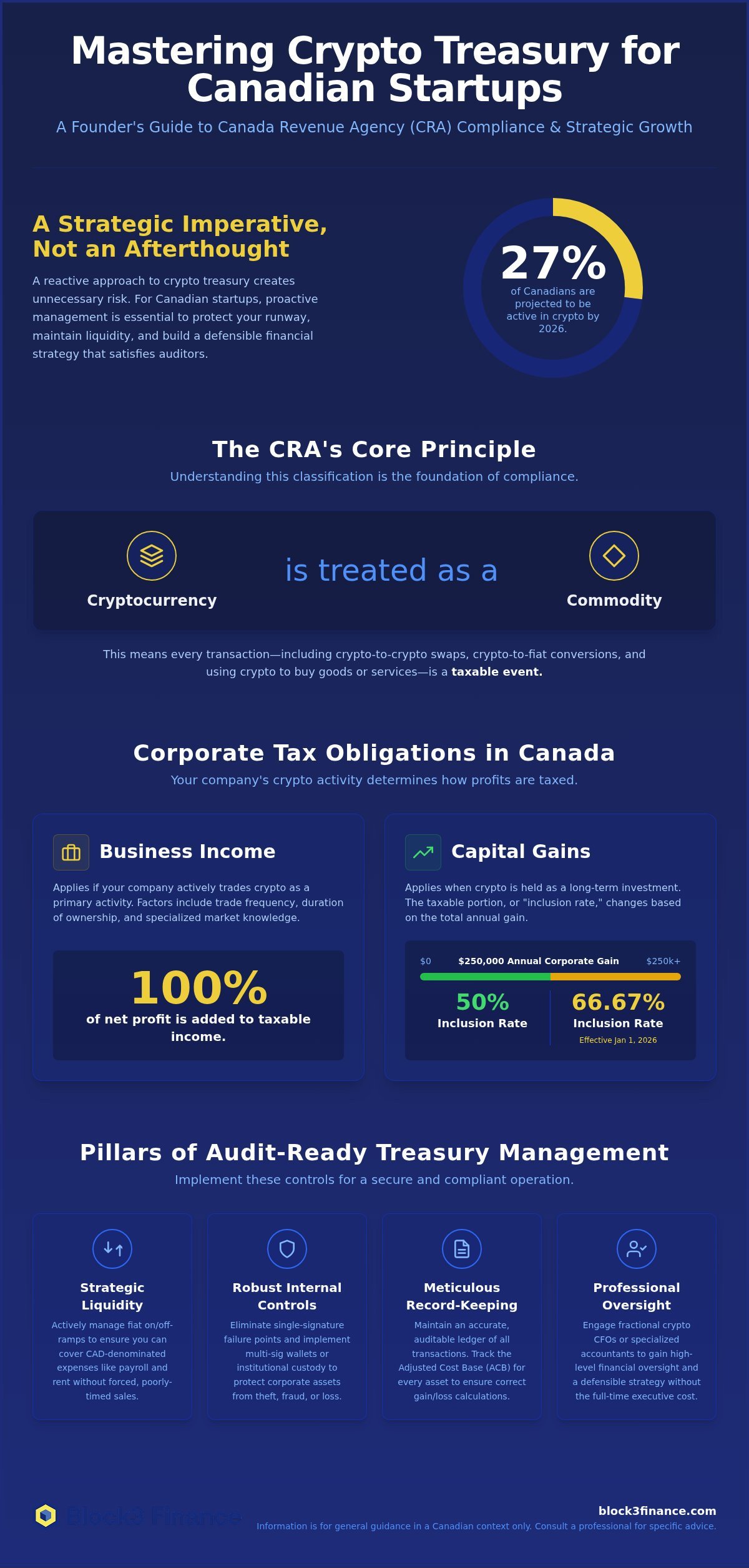
By 2026, nearly 27% of Canadians are active in the digital asset market, yet many startups still treat their crypto holdings as a compliance afterthought. This reactive approach creates unnecessary risk for your runway and your relationship with the Canada Revenue Agency (CRA).
Effective crypto treasury management for startups is now a strategic mandate for any founder building on the blockchain. You understand that digital assets offer unparalleled flexibility, but the difficulty of reconciling on-chain activity for year-end audits remains a constant source of friction.
This guide will empower you to master your liquidity and secure a defensible financial strategy that satisfies Canadian auditors. We'll explore how to manage the 66.67% capital gains inclusion rate, which is the portion of your profit added to taxable income, for corporate holdings over $250,000.
You'll gain a clear roadmap for navigating the evolving FINTRAC enforcement landscape. We'll break down how to optimize your tax positioning and establish reliable fiat on-ramps, which are services that convert crypto to Canadian dollars, to keep your operations running smoothly.
Key Takeaways
- Discover how crypto treasury management for startups provides a strategic framework to balance digital asset growth with strict CRA reporting mandates.
- Learn why the CRA classifies cryptocurrency as a commodity and how to manage the 66.67% capital gains inclusion rate for corporate holdings over $250,000.
- Identify the best practices for navigating fiat on-ramps and off-ramps to maintain consistent liquidity for payroll and essential business expenses.
- Establish audit-ready internal controls that eliminate single-signature failure points and protect your corporate treasury from fraud or loss.
- See how engaging a fractional crypto CFO provides high-level financial oversight and defensible records without the cost of a full-time executive.
Defining Crypto Treasury Management for the Canadian Startup Ecosystem
Crypto treasury management for startups is no longer a niche activity reserved for blockchain developers. It is the sophisticated oversight of your digital assets to ensure your company remains liquid and compliant. While it draws on the foundational principles of treasury management, it requires a specialized lens for the Canadian regulatory environment.
For Canadian firms, this process involves a delicate balance between aggressive growth and meeting strict Canada Revenue Agency (CRA) reporting requirements. It's about moving past simple cold storage. You must treat your treasury as a dynamic financial engine that powers your daily operations, rather than a static savings account.
The Role of Digital Assets in Corporate Finance
Bitcoin, Ether, and stablecoins now function as essential working capital. Stablecoins are digital assets designed to maintain a stable value relative to a currency like the Canadian dollar. Unlike traditional fiat holdings, these assets carry unique volatility and liquidity profiles that require constant monitoring.
Simply "HODLing" is rarely a viable strategy for an active startup. HODLing is the practice of holding assets long-term regardless of market shifts. Your treasury must remain responsive to ensure you can fund development and marketing without waiting for a market cycle to turn. Effective monthly accounting ensures these movements are recorded accurately from the start.
Why Startups Need a Dedicated Treasury Strategy
The primary goal of a treasury strategy is protecting your runway. Runway is the amount of time your business can operate before running out of money. Market volatility can slash your available capital overnight if you don't have a structured plan for converting assets when needed.
Canadian startups must meet fiat-denominated obligations, such as payroll and office leases, in Canadian dollars (CAD). Without a proactive strategy, you risk "accidental" tax liabilities. This happens when you realize gains at the wrong time or fail to account for the CRA's 66.67% inclusion rate on corporate capital gains over $250,000.
Implementing robust crypto treasury management for startups ensures that your team is never blindsided by a sudden market downturn. You gain total command over your financial landscape, ensuring that every on-chain move serves your long-term growth. This level of oversight is essential for maintaining a defensible position during a year-end audit.
CRA Compliance Pillars: Tax and Accounting Foundations for Digital Assets
The Canada Revenue Agency (CRA) maintains a clear stance by treating cryptocurrency as a commodity rather than legal tender. This classification means that every transaction, including crypto-to-crypto swaps, constitutes a taxable event under Canadian law. For effective crypto treasury management for startups, you must maintain meticulous records of your cost basis to calculate accurate obligations.
Startups must distinguish between assets held as inventory and those held as long-term capital property. Inventory is typically valued at the lower of cost or market value at your fiscal year-end. Conversely, capital property remains on your books at its original cost until a disposal occurs, which triggers a capital gain or loss.
Determining Business Income vs. Capital Gains
The CRA examines several factors to decide if your activity constitutes "carrying on a business." These include the frequency of your trades, the length of ownership, and your specialized knowledge of the digital asset markets. If your activity is deemed business income, 100% of the net profit is taxable at your corporate rate.
If the activity qualifies as a capital gain, only 50% of the profit is usually included in your taxable income. However, effective January 1, 2026, the inclusion rate for corporate capital gains exceeding $250,000 annually increases to 66.67%. Adjusted Cost Base (ACB) is the total cost of acquiring an asset, including transaction fees, which serves as the benchmark for calculating your gain or loss upon disposal.
GST/HST Implications for Crypto Transactions
Under the Excise Tax Act, most digital asset transactions are currently classified as "exempt financial services." This means you generally don't charge or collect GST/HST on the sale or exchange of cryptocurrency. This status simplifies some aspects of crypto treasury management for startups, but it doesn't eliminate all reporting duties.
You should verify the specific GST/HST thresholds and rules for your province, particularly if you operate in Ontario or Quebec. Provincial requirements can shift as the regulatory landscape matures in 2026. If you find these requirements complex, speaking with a crypto-literate professional can help you establish a defensible tax position.
- Cost-Basis Tracking: You must record the fair market value in Canadian dollars at the time of every transaction.
- Audit Readiness: The CRA requires you to keep records for at least six years after the end of the tax year they relate to.
- Reporting Frameworks: Be prepared for the Crypto-Asset Reporting Framework (CARF), which will increase transparency for the CRA starting in 2027.
Accurate record-keeping is your best defense against future audits. You must track every on-chain movement across all wallets and exchanges to ensure your ACB remains accurate. This proactive approach transforms messy transaction history into a strategic financial asset that protects your startup's runway.
Strategic Liquidity Management: Navigating Fiat-Crypto Bridges
Maintaining liquidity is the pulse of your business. Without it, your digital wealth remains trapped on-chain while your Canadian dollar obligations continue to mount. Strategic crypto treasury management for startups focuses on minimizing slippage, which is the loss of value during a trade due to market movement or a lack of immediate buyers. You must ensure that your capital is always positioned to support your operational needs without sacrificing your long-term growth potential.
Canadian startups frequently encounter friction when moving capital between exchanges and traditional financial institutions. Most major Canadian banks maintain strict internal policies regarding crypto-related transfers. These policies can lead to frozen accounts or unexpected delays that threaten your ability to meet immediate financial commitments. You must establish redundant pathways to ensure you can always access the capital needed to maintain your runway.
Optimizing On-Ramp and Off-Ramp Solutions
Securing reliable on and off-ramp solutions is a foundational requirement for any Canadian entity. These bridges allow you to move between the blockchain and the Canadian banking system with minimal friction. Utilizing specialized crypto-to-fiat payment systems can automate this process, allowing you to settle vendor invoices directly from your digital holdings without manual intervention.
Compliance is non-negotiable. Your service providers must be registered as a Money Services Business (MSB) with FINTRAC. FINTRAC is the national financial intelligence agency of Canada. This registration ensures the provider adheres to anti-money laundering (AML) and "know your client" (KYC) regulations. These are the standards used to verify the identity of participants and prevent illegal activity. Working with registered providers protects your startup from legal exposure and operational freezes.
Managing Stablecoin Reserves for Payroll
Stablecoins provide a necessary buffer against the volatility of Bitcoin or Ether. For meeting Canadian payroll obligations, fiat-backed stablecoins are the preferred choice. These assets are pegged 1:1 with a traditional currency and are backed by liquid reserves. In contrast, algorithmic stablecoins rely on market incentives to maintain their value. This structure introduces a level of fragility that is unsuitable for a corporate treasury responsible for employee livelihoods.
We recommend maintaining a "fiat buffer" in a traditional Canadian business account. This buffer should cover at least three months of operational expenses. It protects you against exchange rate fluctuations and potential delays in the off-ramping process. By diversifying your reserves between stablecoins and CAD, you ensure your team is paid on time, regardless of market conditions. This proactive approach transforms your liquidity from a source of stress into a tool for strategic agility.
Establishing Audit-Ready Internal Controls for Web3 Operations
Internal controls serve as the essential guardrails for your financial integrity. In a decentralized environment, the absence of a "revert" button makes these systems a prerequisite for survival. Robust crypto treasury management for startups requires a transition from loose, founder-led access to institutional-grade governance that protects every digital asset.
Clean financial records depend on real-time transaction labeling and consistent reconciliation. Audit-readiness is not a task you can defer until the end of the fiscal year. It is a daily operational discipline that ensures your startup can defend its books during a rigorous Canadian audit.
Step 1: Implementing Multi-Signature Governance
Single-signature wallets represent a catastrophic failure point for any corporate treasury. If one founder loses their private key, which is the digital password used to authorize transactions, the startup's entire runway could be permanently locked. We advocate for the use of multi-signature wallets, where a "quorum" is required to move funds.
A quorum is the minimum number of authorized signers needed to approve a transaction. You should distribute keys among founders and trusted independent parties to ensure no single individual has unilateral control. Additionally, utilize Hardware Security Modules (HSMs). HSMs are physical devices designed to store digital keys in a tamper-proof environment, providing a critical layer of physical security.
Step 2: Segregation of Duties and Access Logs
You must separate the role of the individual who initiates a transaction from the person who approves it. This segregation of duties prevents internal collusion and significantly reduces the risk of human error. Maintaining an immutable log of all treasury movements provides a permanent, unchangeable record for your internal oversight and external auditors.
Effective governance requires a structured approach to record-keeping. You can utilize the Block3 Finance checklist to verify that your internal documentation meets the standards expected by Canadian regulatory bodies. This proactive documentation transforms your on-chain activity into a transparent financial narrative.
Step 3: Monthly Reconciliation and Reporting
Consistent monthly bookkeeping is the only reliable way to bridge complex on-chain data with your traditional bank statements. Your monthly reports must accurately account for gas fees, which are the costs paid to the network to process transactions. You must also track failed transactions and airdrops.
Airdrops are the free distribution of new digital assets to your corporate wallet, and they carry specific tax implications in Canada. We also recommend performing periodic "proof of reserve" internal audits. This process involves verifying that your stated digital asset holdings match the actual balances recorded on the blockchain. If you need assistance establishing these institutional standards, reach out to our specialists to secure your operational framework.
Scaling with Authority: The Role of Fractional Crypto CFO Services
Scaling a Web3 venture requires more than just technical innovation. It demands a level of financial sophistication that many early-stage founders lack. While a full-time executive might be out of reach, a fractional crypto CFO provides the high-level oversight necessary to transform your finance department from a cost center into a competitive advantage.
Strategic crypto treasury management for startups evolves as your company grows. Professional leadership helps you navigate the complexities of corporate structuring, ensuring your digital asset holdings are positioned for both tax efficiency and regulatory resilience. This proactive guidance allows founders to focus on building while an expert manages the financial volatility and compliance risks.
Strategic Financial Planning and Runway Modeling
Expert CFOs model "crypto-aware" projections that account for market fluctuations. These models forecast your burn rate with precision, which is the rate at which your company spends its capital before generating positive cash flow. Having these detailed models is vital when you're raising future funding rounds, as investors expect a clear roadmap for capital deployment.
A CFO also acts as a shield between your startup and Canadian auditors. They ensure your internal records align with the expectations of the CRA, reducing the friction of year-end reviews. This relationship management is essential for maintaining your corporate standing and avoiding costly penalties.
Navigating Global Jurisdictions from Canada
Expanding beyond Canadian borders introduces a new layer of complexity regarding international crypto tax compliance. Global startups must carefully structure their entities to avoid double taxation, which occurs when two different countries tax the same income. A strategic navigator helps you choose the right jurisdictions and legal frameworks to protect your global revenue.
Block3 Finance serves as your dedicated partner for maintaining audit-ready crypto books within Canada. We specialize in converting messy on-chain data into the structured records that institutional partners and regulators demand. By integrating crypto treasury management for startups into your core strategy, you secure your runway and build a foundation for long-term authority in the digital asset space.
Master Your Financial Narrative in the Digital Age
Mastering crypto treasury management for startups is about more than avoiding penalties. It is about building a foundation for institutional scale by securing your runway through strategic liquidity and maintaining audit-ready books. We have explored the necessity of multi-sig governance and the nuances of the 66.67% inclusion rate for corporate capital gains in Canada.
Block3 Finance brings 13+ years of blockchain financial expertise to your corner. Ranked as a top provider by Bitcoin.com, our specialized Canadian compliance team ensures your on-chain activity translates into defensible records for the CRA. We turn complex data into a clear financial roadmap that satisfies auditors and investors alike.
Secure your startup’s financial future with Block3 Finance’s CFO services.
You have the tools to turn volatility into a strategic advantage. Your vision deserves a financial partner that understands the rules of the new economy and empowers your growth every step of the way.
Frequently Asked Questions
How does the CRA tax crypto held by a Canadian corporation?
The CRA treats corporate crypto holdings as commodities rather than legal tender. Profits are taxed as either business income or capital gains depending on the nature of your startup's activity. For capital gains exceeding $250,000 annually, the inclusion rate increases to 66.67% in 2026. Business income is 100% taxable at your corporate rate. You must track the fair market value in Canadian dollars for every transaction to ensure accurate reporting.
Can a Canadian startup pay employees in cryptocurrency legally?
Yes, you can legally pay employees in cryptocurrency, but the CRA views this as a barter transaction. A barter transaction occurs when two parties exchange goods or services without using legal tender. You must calculate the fair market value of the digital asset in Canadian dollars at the time of payment. Employers remain responsible for withholding and remitting CPP, EI, and income tax in Canadian dollars to the CRA.
What is the best way to convert large amounts of crypto to CAD for a business?
Utilizing an Over-the-Counter (OTC) desk or a FINTRAC-registered Money Services Business (MSB) is the most efficient method for large conversions. OTC desks provide deep liquidity and help you avoid slippage, which is the loss of value caused by large market orders. These providers ensure you meet anti-money laundering requirements while securing competitive exchange rates. This is a core component of effective crypto treasury management for startups.
Do I need to report crypto holdings if we haven’t sold any assets yet?
You must report holdings even if you haven't sold if the total cost exceeds $100,000 at any point during the year. This is done through Form T1135, the Foreign Income Verification Statement. Additionally, for your year-end financial statements, you must disclose the value of your assets. The specific reporting method depends on whether the assets are classified as inventory or capital property under CRA guidelines.
What internal controls are required for a startup managing digital assets?
Startups should implement multi-signature wallets to eliminate single points of failure. This setup requires multiple authorized individuals to approve a transaction before it executes. You also need a clear segregation of duties, where the person initiating a transaction is not the same person approving it. Maintaining immutable access logs ensures every movement within your treasury is documented and ready for a potential audit by the CRA.
How can a fractional CFO help with our crypto treasury strategy?
A fractional CFO provides elite financial oversight without the cost of a full-time executive. They specialize in crypto-aware runway modeling to help you manage burn rates effectively. By overseeing your crypto treasury management for startups, they ensure your on-chain activity remains compliant with Canadian tax rules. They also lead strategic planning for future funding rounds, providing the financial maturity that institutional investors and Canadian auditors expect.
What happens if a Canadian startup loses access to its treasury keys?
Losing access to private keys results in the permanent loss of the associated digital assets. There is no central authority to reset these passwords or recover the funds. From a tax perspective, you may be able to claim a capital loss, but the CRA requires significant evidence to prove the assets are truly inaccessible. This risk highlights why multi-signature governance and hardware security modules are essential for corporate custody.
Is crypto considered a "specified foreign property" for T1135 reporting in Canada?
Yes, the CRA generally considers cryptocurrency held on foreign exchanges or with non-resident custodians as specified foreign property. If the total cost of all specified foreign property exceeds $100,000 at any time in the year, you must file Form T1135. This requirement applies even if the assets did not generate income. You should consult with a specialist to determine if your specific storage method triggers this filing obligation under Canadian law.

Article by
Mahad Mohamed
Mahad Mohamed is an accountant and the CEO of Block3 Finance, with over 26+ years of Canadian and international tax and accounting experience. A crypto accounting specialist since the early days of Bitcoin, he has consulted for over 38 crypto companies and collaborated with legal professionals on regulatory matters. His expertise spans corporate reorganization, cross-border tax structuring (Canada & US), tax disputes, and CRA audits.
Previously, Mahad worked for the Canada Revenue Agency (CRA), Big4 accounting firms, and served as a Rulings Officer for the Federal Tax Authority of the UAE before acquiring Tax Partners in 2014.
Block3 Finance and Tax Partners has 44 full-time accountants and over 9,800+ clients.
Disclaimer
This article provides general information only and is current as of its publication date. It has not been updated and may be out of date. It does not constitute legal advice and should not be relied upon as such. Every tax situation is unique and may differ from the examples discussed in this article. If you have specific questions, you should seek the advice of our accountants for your unique circumstances.
Frequently Asked Questions
How does the CRA tax crypto held by a Canadian corporation?
The CRA treats corporate crypto holdings as commodities rather than legal tender. Profits are taxed as either business income or capital gains depending on the nature of your startup's activity. For capital gains exceeding $250,000 annually, the inclusion rate increases to 66.67% in 2026. Business income is 100% taxable at your corporate rate. You must track the fair market value in Canadian dollars for every transaction to ensure accurate reporting.
Can a Canadian startup pay employees in cryptocurrency legally?
Yes, you can legally pay employees in cryptocurrency, but the CRA views this as a barter transaction. A barter transaction occurs when two parties exchange goods or services without using legal tender. You must calculate the fair market value of the digital asset in Canadian dollars at the time of payment. Employers remain responsible for withholding and remitting CPP, EI, and income tax in Canadian dollars to the CRA.
What is the best way to convert large amounts of crypto to CAD for a business?
Utilizing an Over-the-Counter (OTC) desk or a FINTRAC-registered Money Services Business (MSB) is the most efficient method for large conversions. OTC desks provide deep liquidity and help you avoid slippage, which is the loss of value caused by large market orders. These providers ensure you meet anti-money laundering requirements while securing competitive exchange rates. This is a core component of effective crypto treasury management for startups.
Do I need to report crypto holdings if we haven’t sold any assets yet?
You must report holdings even if you haven't sold if the total cost exceeds $100,000 at any point during the year. This is done through Form T1135, the Foreign Income Verification Statement. Additionally, for your year-end financial statements, you must disclose the value of your assets. The specific reporting method depends on whether the assets are classified as inventory or capital property under CRA guidelines.
What internal controls are required for a startup managing digital assets?
Startups should implement multi-signature wallets to eliminate single points of failure. This setup requires multiple authorized individuals to approve a transaction before it executes. You also need a clear segregation of duties, where the person initiating a transaction is not the same person approving it. Maintaining immutable access logs ensures every movement within your treasury is documented and ready for a potential audit by the CRA.
How can a fractional CFO help with our crypto treasury strategy?
A fractional CFO provides elite financial oversight without the cost of a full-time executive. They specialize in crypto-aware runway modeling to help you manage burn rates effectively. By overseeing your crypto treasury management for startups, they ensure your on-chain activity remains compliant with Canadian tax rules. They also lead strategic planning for future funding rounds, providing the financial maturity that institutional investors and Canadian auditors expect.
What happens if a Canadian startup loses access to its treasury keys?
Losing access to private keys results in the permanent loss of the associated digital assets. There is no central authority to reset these passwords or recover the funds. From a tax perspective, you may be able to claim a capital loss, but the CRA requires significant evidence to prove the assets are truly inaccessible. This risk highlights why multi-signature governance and hardware security modules are essential for corporate custody.
Is crypto considered a "specified foreign property" for T1135 reporting in Canada?
Yes, the CRA generally considers cryptocurrency held on foreign exchanges or with non-resident custodians as specified foreign property. If the total cost of all specified foreign property exceeds $100,000 at any time in the year, you must file Form T1135. This requirement applies even if the assets did not generate income. You should consult with a specialist to determine if your specific storage method triggers this filing obligation under Canadian law.