
Approximately 25% of global businesses now leverage digital assets for payroll, yet many firms remain paralyzed by the perceived complexity of IRS oversight. You understand that paying contractors in cryptocurrency is no longer a fringe experiment; it's a strategic necessity for securing elite talent and reducing the heavy costs of traditional cross-border transfers. However, the administrative friction of manual Fair Market Value reconciliation and the fear of misclassification under 2026 regulations often overshadow these operational advantages.
We believe compliance shouldn't be a barrier to innovation, but a foundation for institutional growth. This guide provides the technical roadmap you need to master the legal and accounting frameworks required to pay independent contractors under current IRS rules. We'll explore the introduction of Form 1099-DA, the implications of the GENIUS Act for stablecoin payments, and the specific reporting thresholds for Form 1099-NEC. By the end of this article, you'll possess the methodology to transform volatile on-chain activity into a disciplined, audit-ready financial record.
Key Takeaways
- Master the IRS "property" classification to ensure your treasury accurately tracks Fair Market Value at the precise moment of every transaction.
- Discover why stablecoins have become the institutional standard for paying contractors in cryptocurrency to mitigate employer-side capital gains liabilities.
- Align your onboarding process with federal requirements by securing Form W-9 and monitoring the $600 threshold for mandatory 1099-NEC reporting.
- Prepare for the 2026 tax season by understanding the new Form 1099-DA requirements and the impact of the GENIUS Act on stablecoin regulation.
- Implement a defensible audit trail that bridges the gap between raw on-chain data and institutional-grade financial reporting.
The Strategic Shift: Why Modern Enterprises Pay Contractors in Digital Assets
The corporate landscape of 2026 has transitioned from viewing digital assets as a speculative curiosity to recognizing them as a vital treasury tool. For firms scaling global operations, paying contractors in cryptocurrency is no longer just an alternative; it's a strategic lever for growth. Traditional banking systems, burdened by the legacy SWIFT network, create friction that modern enterprises can no longer afford. While a standard international wire might take several business days to clear, blockchain settlement happens in near real-time, providing immediate liquidity to your global workforce. This shift represents a move from a defensive posture of merely managing regulations to an offensive strategy focused on treasury mastery.
The Talent Advantage in a Decentralized Economy
Offering digital payment options allows you to tap into a talent pool spanning over 190 countries without the administrative hurdles of local currency conversions. For Gen Z and Millennial contractors, receiving payments in assets like USDC or BTC provides a sense of financial agency that traditional systems lack. This flexibility is a powerful differentiator when competing for top-tier Web3 developers and creative specialists. By eliminating the typical 3 to 5 day bank settlement delay, you demonstrate a commitment to the contractor's cash flow, fostering deeper loyalty in a competitive market. Contractors who receive digital assets feel a greater sense of ownership over their compensation. They aren't waiting on the whims of intermediary banks or regional holidays; they receive their value the moment the work is verified.
Operational Efficiency and Cost Reduction
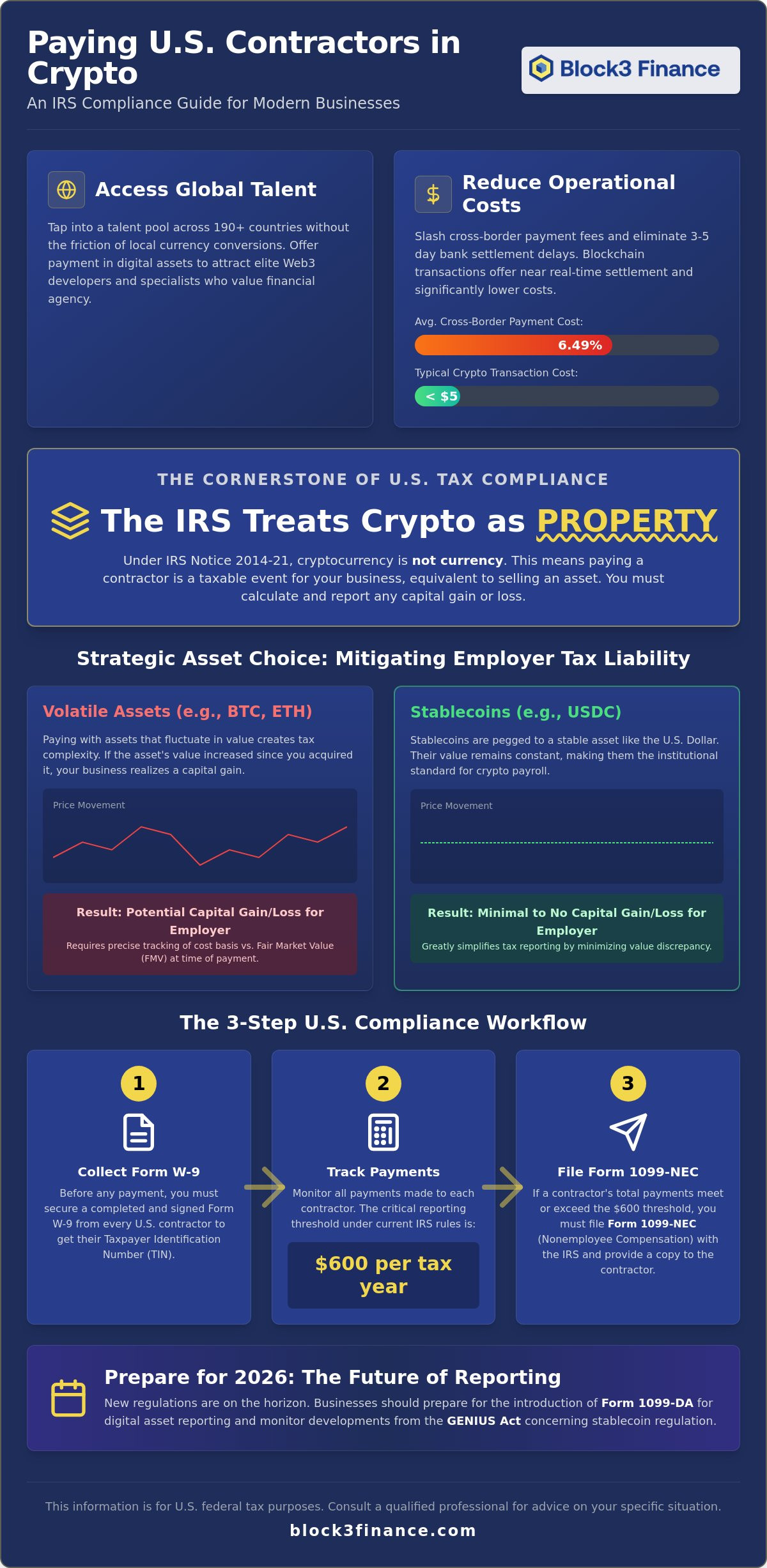
Efficiency isn't just about speed; it's about the bottom line. Research from April 2026 indicates that while traditional cross-border payment costs average 6.49%, crypto transactions typically cost under $5. To understand the foundation of these savings, one must grasp what is cryptocurrency and how it functions as a decentralized, borderless ledger. Beyond transaction fees, the use of programmable money allows for automated, milestone-based payments. This ensures contractors are paid exactly when deliverables are verified on-chain, reducing the administrative burden on your HR team. Integrating these payments into your monthly bookkeeping workflows transforms a potentially chaotic process into a streamlined, defensible audit trail. This proactive approach turns a complex treasury function into a core component of a modern, agile corporate strategy that prioritizes both growth and precision.
IRS Regulatory Framework: How the US Taxes Crypto Payments
The Internal Revenue Service (IRS) maintains a firm stance on the classification of digital assets, which dictates every accounting entry your firm makes. Under IRS Notice 2014-21, cryptocurrency is treated as property rather than currency for federal tax purposes. This distinction is the cornerstone of paying contractors in cryptocurrency because it transforms a simple payroll entry into a taxable disposal of an asset. When you transfer Bitcoin or a stablecoin to a contractor, you aren't just paying for services; you're disposing of a piece of property, which may trigger a capital gain or loss depending on your original cost basis. Maintaining a defensible audit trail requires you to track the exact USD value of the asset at the moment of transfer to satisfy IRS guidelines on crypto reporting.
For the contractor, the payment constitutes ordinary income. For the business, the transaction is more complex. You must account for the difference between the Fair Market Value (FMV) at the time of payment and the price you originally paid for that specific asset. If the asset's value increased while in your treasury, your firm owes capital gains tax. If it decreased, you may realize a capital loss. This dual tax event necessitates a high level of precision in your ledger to avoid discrepancies during a federal audit. If your treasury structure involves high-volume distributions, our team can help you align your processes with federal standards.
Determining Fair Market Value (FMV)
Accuracy in valuation is non-negotiable for US tax compliance. You must select a consistent price oracle or a major exchange's rate to calculate the USD equivalent for every payment. Documenting the "time-of-transfer" value ensures that your records reflect the market reality at the exact second the transaction hit the blockchain. Under IRS rules, Fair Market Value is the price at which the property would change hands between a willing buyer and a willing seller, neither being under any compulsion to buy or to sell and both having reasonable knowledge of relevant facts.
Constructive Receipt and Timing
Timing is everything in crypto accounting. A payment is considered "received" for tax purposes under the doctrine of constructive receipt the moment the transaction is confirmed on the blockchain and becomes available to the contractor. This is particularly critical when dealing with volatile assets like Ethereum, where the value can shift significantly between the initiation of a transfer and its final confirmation. You should consult the IRS website directly for the most current year-specific thresholds and ordinary income rate adjustments to ensure your 2026 filings remain accurate. Using stablecoins can simplify this process by minimizing the gap between the intended payment value and the final received FMV.
Stablecoins vs. Volatile Assets: Strategic Treasury Considerations
Selecting the right digital asset for payroll is a high-stakes decision that dictates the complexity of your back-office operations. For many modern firms, paying contractors in cryptocurrency has become a standard practice for attracting global talent. However, choosing volatile assets like Bitcoin (BTC) or Ethereum (ETH) creates a significant accounting burden for the employer. Every payment made in a fluctuating asset triggers a capital gain or loss for the company based on the difference between the asset's cost basis and its value at the time of transfer. This constant reconciliation can quickly overwhelm a traditional finance team. Consequently, over 90% of digital salary payments in 2026 are settled in stablecoins to mitigate these risks and ensure predictable cash flow.
Stablecoin Selection: Regulatory Trust and Liquidity
USDC and USDT have emerged as the institutional standards for 1099 payments due to their deep liquidity and fiat-pegged stability. USDC, issued by Circle, is often preferred by US-based firms for its transparency and adherence to domestic regulatory frameworks. USDT remains a dominant force in global markets where liquidity is paramount. Utilizing robust on- and off-ramp solutions allows your firm to move between USD and stablecoins with minimal friction. This stability simplifies the reconciliation process for your year-end crypto tax filing, as the Fair Market Value (FMV) remains consistently aligned with the US dollar.
Mitigating Treasury Risk
Managing a digital treasury requires a proactive approach to network costs and market movements. You must account for gas fees; these are the mandatory transaction costs paid to network validators to process your payments on the blockchain. Under IRS rules, these fees are generally deductible as a business expense, but they must be documented accurately. You also need to monitor slippage, which is the difference between the expected price of a trade and the price at which it actually executes. To hedge against sudden market swings, many firms implement crypto to fiat payment solutions that allow for instant conversion at the point of payment. This ensures that the contractor receives the exact value promised while protecting the company's balance sheet from unexpected volatility. Following the latest IRS guidance on digital asset reporting is essential for maintaining a defensible treasury strategy. Finally, leveraging smart contracts can automate these payments with total transparency and security. A smart contract is a self-executing agreement with the terms of the deal directly written into lines of code, ensuring that funds are only released when specific milestones are met.
Compliance Workflow: 1099-NEC Reporting and Documentation
Transitioning from strategic treasury management to administrative execution requires a disciplined approach to documentation. Collecting Form W-9 is the non-negotiable first step for any US-based independent contractor before the first transaction occurs. This form provides the Taxpayer Identification Number (TIN) necessary for your year-end reporting obligations under IRS rules. For the 2026 tax year, if your business pays an independent contractor $600 or more in digital assets, you're required to issue Form 1099-NEC. This threshold applies to the cumulative Fair Market Value (FMV) of all payments made throughout the calendar year, regardless of the specific asset used.
Reporting these payments involves more than just a simple tally. You must report the total USD equivalent of all crypto payments in Box 1 of the 1099-NEC. Because the blockchain typically identifies participants by wallet addresses rather than legal names, your internal records must bridge this gap. Maintaining a robust sub-ledger that maps every wallet address to a verified real-world identity is essential for audit readiness. This record should include the transaction hash, the asset type, the FMV at the time of transfer, and the contractor's legal details. If you're struggling to reconcile on-chain data with your general ledger, our experts can streamline your compliance workflow.
The 1099-NEC Filing Process for Crypto
- Step 1: Calculate the total USD FMV of all crypto transfers made to the contractor during the calendar year using a consistent price oracle.
- Step 2: Verify the contractor’s legal name and TIN via the collected Form W-9.
- Step 3: Issue the 1099-NEC to the contractor by January 31 and file the copy with the IRS by the mandated deadline.
Independent Contractor vs. Employee Classification
The flexibility of paying contractors in cryptocurrency doesn't exempt your firm from the IRS "Right to Control" test. Misclassifying an individual who should be an employee as an independent contractor is a significant risk that can lead to heavy penalties for unpaid payroll taxes and benefits. The IRS examines the behavioral, financial, and relational aspects of the worker's role to determine their status. This scrutiny is particularly intense for decentralized firms, where DAO tax compliance adds a layer of complexity to contractor management. Ensuring your contracts and operational workflows reflect a true contractor relationship is vital for protecting your enterprise from federal enforcement actions.
Mastering the Lifecycle: Institutional-Grade Crypto Accounting
Raw blockchain data is a ledger, but it isn't a financial statement. For institutional-grade reporting, you must bridge the gap between on-chain activity and GAAP or IFRS standards. paying contractors in cryptocurrency at scale requires more than just a wallet; it requires a sophisticated accounting architecture that converts hashes and public keys into defensible financial records. Manual spreadsheets, while common in early-stage firms, inevitably fail under the weight of high-volume transactions. They lack the version control, data integrity, and complex cost-basis tracking required to satisfy federal scrutiny during a corporate audit.
While many firms focus on the digital asset layer, maintaining high-standard foundational books remains critical for industries like construction and real estate, where you can learn more about Okie Accounting Group LLC and their fractional controller services.
Establishing an audit trail that satisfies both internal stakeholders and external regulators is a strategic necessity. This is where Fractional Crypto CFO Services provide the most value. By adopting an offensive posture toward financial oversight, you move beyond mere compliance and into a state of treasury mastery. This approach ensures that your global operations remain agile without sacrificing the precision required by US tax authorities. It transforms the narrative from a defensive struggle against regulation into a proactive strategy for institutional growth.
Building Defensible Financial Records
A robust financial system requires a specialized sub-ledger for every on-chain payroll transaction. This sub-ledger must map the transaction hash to the specific contractor identity and the USD value at the time of receipt. Monthly reconciliation is the only way to identify and resolve discrepancies between wallet balances and your general ledger before they become liabilities. Leveraging Block3 Finance’s expertise allows your firm to navigate high-stakes regulatory environments with the confidence of an elite strategist. We help you cultivate a financial environment where every cent is accounted for and every transaction is defensible under IRS rules.
Future-Proofing Your Payroll Strategy
The regulatory landscape for digital assets is in a state of constant evolution. Preparing for changes like those introduced by the Infrastructure Bill or the new Form 1099-DA is essential for long-term stability. Your payroll strategy must be capable of scaling from 10 contractors to 1,000 without increasing administrative friction or compromising your data integrity. By adopting the "Visionary Navigator" approach, you don't just observe the industry's evolution; you lead it. This proactive stance ensures that your firm remains a calm force in a chaotic market, possessing the technical rigor and intellectual depth to thrive under federal guidelines for years to come.
Commanding Your Global Treasury with Confidence
Mastering the complexities of paying contractors in cryptocurrency requires a fundamental shift from defensive compliance to offensive treasury management. You've learned that tracking Fair Market Value at the precise moment of transfer and ensuring rigorous 1099-NEC reporting are non-negotiable foundations for IRS compliance. By moving away from fragile manual spreadsheets and adopting institutional-grade sub-ledgers, you protect your firm from the severe risks of worker misclassification and audit discrepancies. This level of precision allows your enterprise to focus on growth rather than administrative friction.
Block3 Finance acts as your visionary navigator in this evolving digital landscape. We bring 13+ years of blockchain financial mastery and have empowered 980+ global clients to achieve total command over their digital assets. As a top provider ranked by Bitcoin.com, we specialize in turning opaque on-chain activity into clean, defensible financial records. Secure your global payroll compliance with Block3 Finance’s expert crypto accounting services. The future of global commerce is borderless; with the right frameworks in place, your organization is positioned to lead the evolution of modern finance.
Frequently Asked Questions
Is it legal to pay independent contractors in crypto in the US?
Yes, it is entirely legal to pay independent contractors in digital assets within the United States. The IRS recognizes these transactions under the classification of property rather than legal tender. You must ensure that the contract explicitly states the payment terms and that you maintain rigorous records to satisfy federal reporting requirements. This approach allows your firm to tap into global talent while adhering to the established regulatory framework for property exchanges.
Do I need to issue a 1099-NEC if I pay a contractor in Bitcoin?
You must issue a Form 1099-NEC if the total Fair Market Value of the Bitcoin payments reaches the IRS threshold of $600 or more within a calendar year. This requirement applies to all US-based independent contractors. When paying contractors in cryptocurrency, you report the USD equivalent of the asset at the time of each transfer in Box 1 of the form. Failure to file can result in significant federal penalties for your business.
How do I calculate the tax value of a crypto payment?
The tax value is determined by the Fair Market Value (FMV) of the digital asset at the exact second the transaction is confirmed on the blockchain. You should utilize a consistent price oracle or a major exchange rate to establish this USD equivalent. This precision is vital because the IRS treats every payment as a taxable event. Documentation of the "time-of-transfer" value forms the core of a defensible audit trail for your corporate ledger.
What happens if the price of crypto drops after I pay the contractor?
Any price fluctuations occurring after the contractor receives the asset don't change your initial tax reporting obligation. Your firm's deduction and the contractor's reported income are locked at the FMV at the time of the transfer. However, if you held the asset in your treasury before the payment and its value dropped since you acquired it, you may realize a capital loss. You should consult the IRS directly for current rules regarding capital loss deductions.
Can I pay international contractors in crypto from a US-based company?
You can certainly pay international contractors using digital assets, which often reduces the friction of cross-border settlement. While you generally don't issue a 1099-NEC to non-US residents for work performed outside the US, you must still collect Form W-8BEN to document their foreign status. This documentation protects your firm from backup withholding requirements. Maintaining clear on-chain records ensures you can prove the destination and purpose of these global outflows during a regulatory review.
Do contractors have to pay self-employment tax on crypto earnings?
US-based independent contractors must pay self-employment tax on the Fair Market Value of the cryptocurrency they receive as compensation. The IRS treats these earnings as ordinary income subject to the same self-employment tax rates as fiat payments. Contractors should track the USD value of each payment at the time of receipt to accurately calculate their quarterly estimated tax payments. This ensures they remain compliant with federal tax obligations throughout the fiscal year.
What records should I keep for crypto payroll audits?
You should maintain a comprehensive sub-ledger that maps every on-chain transaction hash to a verified real-world identity. Essential records include the date of transfer, the specific wallet addresses involved, the asset type, and the USD Fair Market Value at the time of the transaction. Additionally, you must keep all Form W-9s or W-8BENs on file. These defensible records are critical for demonstrating compliance during a federal audit or an internal financial review.
Are gas fees for payroll transactions tax-deductible for the business?
Network transaction fees, commonly known as gas fees, are generally deductible as a necessary business expense under IRS rules. You must document these costs separately in your accounting software to ensure they're captured accurately for your year-end tax filing. Because these fees are paid in digital assets, they also represent a disposal of property, which could trigger a minor capital gain or loss. Precise bookkeeping is required to manage these layered tax implications effectively.

Article by
Mahad Mohamed
Mahad Mohamed is an accountant and the CEO of Block3 Finance, with over 26+ years of Canadian and international tax and accounting experience. A crypto accounting specialist since the early days of Bitcoin, he has consulted for over 38 crypto companies and collaborated with legal professionals on regulatory matters. His expertise spans corporate reorganization, cross-border tax structuring (Canada & US), tax disputes, and CRA audits.
Previously, Mahad worked for the Canada Revenue Agency (CRA), Big4 accounting firms, and served as a Rulings Officer for the Federal Tax Authority of the UAE before acquiring Tax Partners in 2014.
Block3 Finance and Tax Partners has 44 full-time accountants and over 9,800+ clients.
Disclaimer
This article provides general information only and is current as of its publication date. It has not been updated and may be out of date. It does not constitute legal advice and should not be relied upon as such. Every tax situation is unique and may differ from the examples discussed in this article. If you have specific questions, you should seek the advice of our accountants for your unique circumstances.
Frequently Asked Questions
Is it legal to pay independent contractors in crypto in the US?
Yes, it is entirely legal to pay independent contractors in digital assets within the United States. The IRS recognizes these transactions under the classification of property rather than legal tender. You must ensure that the contract explicitly states the payment terms and that you maintain rigorous records to satisfy federal reporting requirements. This approach allows your firm to tap into global talent while adhering to the established regulatory framework for property exchanges.
Do I need to issue a 1099-NEC if I pay a contractor in Bitcoin?
You must issue a Form 1099-NEC if the total Fair Market Value of the Bitcoin payments reaches the IRS threshold of $600 or more within a calendar year. This requirement applies to all US-based independent contractors. When paying contractors in cryptocurrency, you report the USD equivalent of the asset at the time of each transfer in Box 1 of the form. Failure to file can result in significant federal penalties for your business.
How do I calculate the tax value of a crypto payment?
The tax value is determined by the Fair Market Value (FMV) of the digital asset at the exact second the transaction is confirmed on the blockchain. You should utilize a consistent price oracle or a major exchange rate to establish this USD equivalent. This precision is vital because the IRS treats every payment as a taxable event. Documentation of the "time-of-transfer" value forms the core of a defensible audit trail for your corporate ledger.
What happens if the price of crypto drops after I pay the contractor?
Any price fluctuations occurring after the contractor receives the asset don't change your initial tax reporting obligation. Your firm's deduction and the contractor's reported income are locked at the FMV at the time of the transfer. However, if you held the asset in your treasury before the payment and its value dropped since you acquired it, you may realize a capital loss. You should consult the IRS directly for current rules regarding capital loss deductions.
Can I pay international contractors in crypto from a US-based company?
You can certainly pay international contractors using digital assets, which often reduces the friction of cross-border settlement. While you generally don't issue a 1099-NEC to non-US residents for work performed outside the US, you must still collect Form W-8BEN to document their foreign status. This documentation protects your firm from backup withholding requirements. Maintaining clear on-chain records ensures you can prove the destination and purpose of these global outflows during a regulatory review.
Do contractors have to pay self-employment tax on crypto earnings?
US-based independent contractors must pay self-employment tax on the Fair Market Value of the cryptocurrency they receive as compensation. The IRS treats these earnings as ordinary income subject to the same self-employment tax rates as fiat payments. Contractors should track the USD value of each payment at the time of receipt to accurately calculate their quarterly estimated tax payments. This ensures they remain compliant with federal tax obligations throughout the fiscal year.
What records should I keep for crypto payroll audits?
You should maintain a comprehensive sub-ledger that maps every on-chain transaction hash to a verified real-world identity. Essential records include the date of transfer, the specific wallet addresses involved, the asset type, and the USD Fair Market Value at the time of the transaction. Additionally, you must keep all Form W-9s or W-8BENs on file. These defensible records are critical for demonstrating compliance during a federal audit or an internal financial review.
Are gas fees for payroll transactions tax-deductible for the business?
Network transaction fees, commonly known as gas fees, are generally deductible as a necessary business expense under IRS rules. You must document these costs separately in your accounting software to ensure they're captured accurately for your year-end tax filing. Because these fees are paid in digital assets, they also represent a disposal of property, which could trigger a minor capital gain or loss. Precise bookkeeping is required to manage these layered tax implications effectively.