
Your Web3 startup doesn't need a $400,000-a-year executive to achieve institutional-grade financial oversight. Many founders feel the constant friction of reconciling thousands of on-chain transactions while facing the looming pressure of IRS Form 1099-DA reporting requirements. It's a common struggle to balance aggressive innovation with the rigid demands of federal compliance. Utilizing specialized startup cfo services for crypto allows you to bridge this gap, transforming chaotic ledger data into a strategic asset rather than a liability.
You're likely looking for a way to secure your runway without the overhead of a full-time hire. This article demonstrates how fractional leadership provides the high-level strategy needed to manage token treasuries and optimize crypto-to-fiat ramps under current IRS rules. You'll discover a roadmap to audit-ready financial statements and gain total command over your burn rate in volatile markets. We'll explore the transition from defensive record-keeping to offensive financial mastery, ensuring your entity remains compliant with evolving FASB standards and SEC expectations.
Key Takeaways
- Learn how fractional leadership bridges the gap between decentralized innovation and the technical rigor required for institutional-grade financial reporting.
- Understand how specialized startup cfo services for crypto provide the strategic oversight needed to manage token treasuries and optimize burn rates without the high overhead of a full-time executive.
- Discover the essential steps for maintaining audit-ready records under IRS rules, including preparation for the specific reporting requirements of Form 1099-DA.
- Identify how tokenomics advisory and treasury management can resolve financial friction and ensure the long-term viability of high-growth Web3 projects.
- Analyze the cost-benefit of rightsourcing your financial leadership to gain access to a broader industry network and elite strategic expertise.
What are Fractional CFO Services for Crypto-Native Entities?
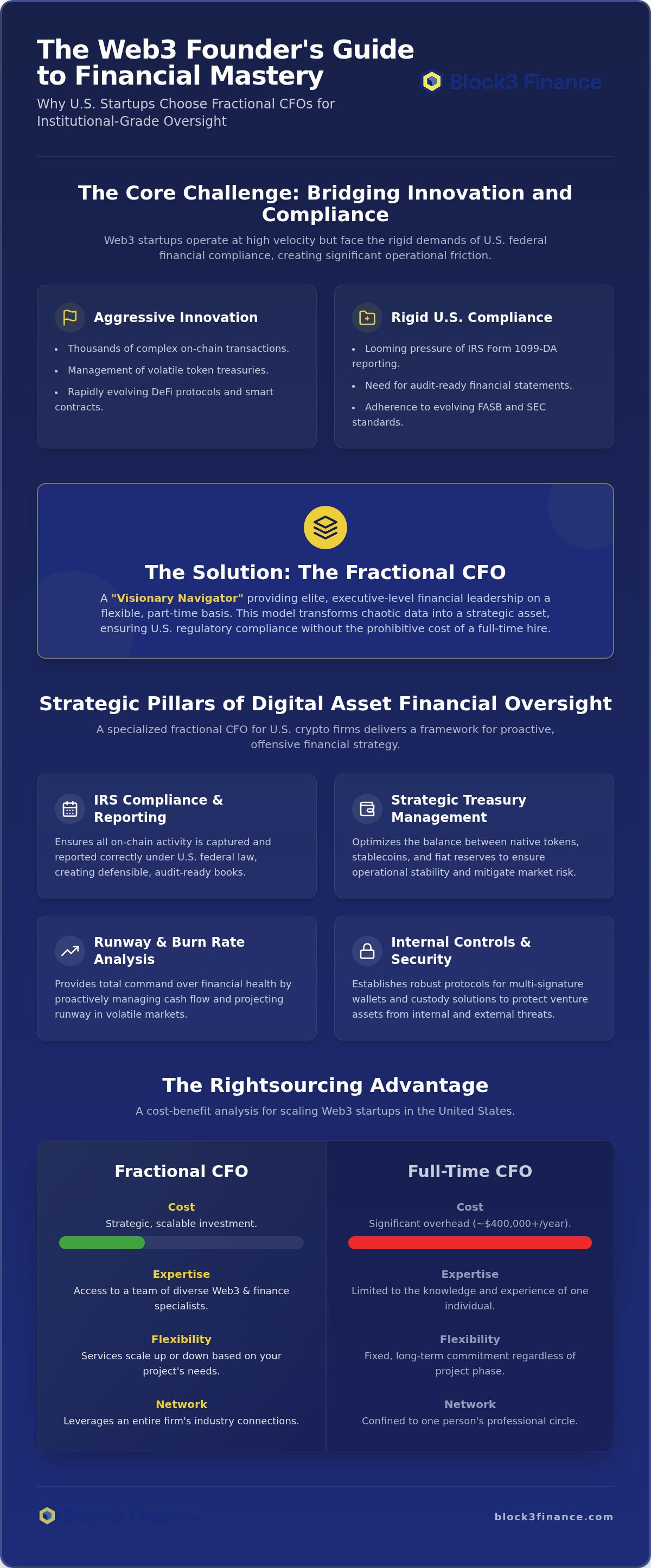
A fractional CFO provides executive-level financial leadership on a flexible, part-time basis. For high-growth Web3 ventures, this model offers a path to institutional-grade oversight without the prohibitive cost of a full-time C-suite hire. This approach, often called "rightsourcing," allows founders to secure elite expertise that scales alongside their project. By engaging startup cfo services for crypto, US entities gain a partner who understands both the technical nuances of blockchain and the rigid requirements of the American financial system. It's about moving away from reactive accounting and toward a proactive, offensive financial strategy.
Traditional accountants often focus on historical data and simple ledger entries. In contrast, a Fractional executive in the digital asset space acts as a "Visionary Navigator." They move beyond simple bookkeeping to provide strategic financial oversight that considers long-term project viability. This transition is essential for firms that need to manage complex on-chain activities while remaining defensible under IRS rules in the United States. These strategists don't just record what happened; they help founders decide what should happen next by analyzing runway, burn rates, and market volatility.
The Evolution of Financial Leadership in Web3
Legacy financial roles often fail in the Web3 environment because they don't account for on-chain liquidity or smart contract risks. Traditional models struggle to value volatile assets or manage the friction of decentralized finance (DeFi) protocols, which are financial systems built on blockchain technology that bypass traditional intermediaries. In 2026, the landscape has shifted from purely defensive compliance to offensive strategic growth. US-based startups now face new challenges, such as the mandatory use of IRS Form 1099-DA for U.S. digital asset brokers and the expanded scope of FASB Subtopic 350-60 for wrapped tokens under U.S. accounting standards. A specialized CFO ensures that these regulatory hurdles become opportunities for building trust with investors and regulators. They translate complex on-chain data into the clear, structured language required by US federal authorities.
Core Responsibilities of a Digital Asset CFO
The scope of a digital asset CFO includes sophisticated treasury management. They oversee the critical balance between stablecoins and native tokens to ensure operational stability and mitigate market risk. They also manage the intricate process of on-chain to off-chain financial reporting, ensuring every transaction is captured for tax purposes under US federal law. This includes maintaining cost basis records on a per-wallet basis as now required by the IRS in the United States. Within the high-stakes environment of Web3, the fractional CFO serves as the essential bridge between disruptive innovation and rigorous regulatory compliance.
Block3 Finance provides these specialized startup cfo services for crypto, helping firms navigate the complexities of US tax law and corporate structuring. Our experts turn fragmented on-chain activity into defensible, audit-ready books that satisfy both internal stakeholders and external regulators.
The Strategic Pillars of Digital Asset Financial Oversight
Mastering financial oversight in the digital asset space requires a shift from passive observation to active management. Founders often struggle with the sheer volume of on-chain data; making it difficult to maintain a clear picture of their financial health. Specialized startup cfo services for crypto provide the structural framework needed to handle these complexities. This includes implementing robust internal controls for multi-sig wallets, which are digital vaults requiring multiple signatures to authorize a transaction, and custody solutions. By establishing clear protocols for asset movement, you protect the venture from both internal errors and external threats.
Treasury management for Decentralized Autonomous Organizations (DAOs), which are member-owned communities without centralized leadership that run on blockchain code, and Web3 startups isn't just about holding assets. It involves strategic allocation and risk mitigation. A fractional CFO helps you navigate the friction between volatile crypto holdings and stable fiat reserves. They provide critical on and off-ramp solutions to ensure that payroll and vendor payments remain seamless, regardless of market conditions. Utilizing these startup cfo services for crypto ensures your venture maintains a "calm force" within the chaotic energy of the market.
Treasury Management and Tokenomics
Project viability depends on a sophisticated understanding of tokenomics, the economic systems governing a cryptocurrency. Your CFO should advise on native token buybacks, staking mechanisms, and liquidity provisioning to support ecosystem health. This strategy must be aligned with your corporate structuring for crypto businesses to ensure tax efficiency and regulatory compliance under US law. It's vital to reference current IRS guidance on digital assets when designing these incentive structures for US filers. Balancing treasury assets requires a disciplined approach that protects your runway while fueling sustainable growth.
On-Chain Reconciliation and Reporting
Translating messy blockchain data into Generally Accepted Accounting Principles (GAAP) compliant financial statements is a core requirement for any US-based entity. GAAP represents the standardized rules and procedures used for financial reporting in the United States. This involves managing gas fee accounting and protocol-level revenue recognition, which can be incredibly complex for DeFi-native projects. Establishing monthly accounting as a foundation allows for real-time visibility into your burn rate and runway. By turning raw transaction data into defensible books, you prepare your venture for future audits and institutional investment. If you're ready to master your financial landscape, reach out to our strategists for a tailored roadmap.
Fractional vs. Full-Time CFO: Rightsourcing for Web3 Scale
Choosing between a dedicated full-time executive and fractional support is a pivotal decision for any scaling venture. In the digital asset space, the total compensation for a seasoned financial officer often exceeds $250,000 annually. For many high-growth firms, this represents a significant drain on runway that could be better allocated to engineering or ecosystem development. Utilizing startup cfo services for crypto allows you to access this same level of elite strategic leadership at a cost that scales with your actual needs. This "rightsourcing" model ensures you aren't overpaying for executive capacity during early stages or market lulls.
The "Expertise Gap" is another critical factor. A single full-time hire, no matter how talented, rarely possesses the exhaustive breadth of knowledge required to master the Web3 landscape. They might excel at traditional GAAP reporting but lack experience in on-chain liquidity management or the nuances of IRS cost-basis tracking for thousands of wallet transactions. A fractional team brings a collective intelligence gathered from serving hundreds of global clients. This shared knowledge base allows them to identify risks and opportunities that a siloed employee might miss. You gain a partner who has already solved the exact challenges you're currently facing.
Flexibility is the ultimate advantage in a volatile industry. Crypto market cycles move with a speed that traditional corporate structures can't match. During a bull market, you may need intensive support for token launches, treasury rebalancing, and rapid team expansion. Conversely, during a bear market, the ability to scale services down preserves vital capital. This agility ensures your financial leadership remains an asset rather than a fixed liability that weighs down your balance sheet when conditions tighten.
The Cost of Inexperience in a High-Stakes Industry
Opting for "cheap" or generalist accounting often leads to catastrophic hidden costs. In the US, missed tax elections or poor digital asset record-keeping can trigger exhaustive IRS audits and heavy penalties. A specialized fractional CFO pays for themselves by implementing tax optimization strategies and extending your runway through disciplined burn rate management. Engaging a fractional service typically costs only a fraction of the total compensation package required for a dedicated full-time financial officer.
The Network Advantage of a Specialized Firm
When you partner with an elite firm, you aren't just hiring a strategist; you're gaining access to a curated ecosystem. This includes established relationships with Web3-friendly banking institutions, specialized legal counsel, and audit partners who understand blockchain technology. You can learn more about the diverse expertise available to your project by reviewing the Block3 Finance Executive Team. Leveraging these existing connections resolves the friction of building a professional network from scratch, allowing you to focus entirely on your core innovation.
Navigating IRS Compliance and Audit Readiness for US Web3 Firms
US-based Web3 firms operate under one of the most scrutinized tax regimes in the world. For these entities, good enough bookkeeping isn't a viable strategy; it's a significant corporate liability. Maintaining a defensible audit trail requires a level of technical blockchain rigor that traditional accounting firms often struggle to provide. By engaging startup cfo services for crypto, you ensure that every on-chain movement is backed by documentation that meets rigorous IRS standards in the United States. This proactive stance shifts your narrative from defending past mistakes to demonstrating total command over your financial landscape.
The role of the CFO has expanded to manage the complexities of ASU 2023-08, which mandates fair value measurement for many digital assets under U.S. accounting standards. This requirement demands real-time valuation and precise record-keeping to ensure financial statements accurately reflect the market value of your treasury. US entities must also navigate the unique tax implications of airdrops, staking rewards, and DeFi participation. Each of these events is typically viewed as a taxable event under IRS rules, requiring immediate valuation at the time of receipt. A specialized strategist ensures these nuances are captured correctly, preventing costly surprises during tax season.
IRS Reporting Requirements for Digital Assets
Precision in reporting is mandatory for maintaining standing with federal authorities in the United States. This includes the accurate preparation of Form 8949 under IRS rules and, for the 2025 tax year filed in 2026, compliance with the new Form 1099-DA requirements for digital asset brokers under IRS rules. Consistent cost-basis tracking is essential; your CFO will help you determine whether FIFO (First-In, First-Out) or HIFO (Highest-In, First-Out) best serves your tax optimization strategy under IRS guidelines. For transactions occurring on or after January 1, 2026, the IRS now requires cost-basis records to be maintained on a per-wallet or per-account basis in the United States. You can explore deeper technicalities in our guide on ASU 2023-08 and Crypto Revenue Recognition.
Preparing for a Crypto Audit in the US
Audit readiness is built through disciplined internal controls and compliant processes for asset custody. This often involves meeting standards like SOC 1 (System and Organization Controls 1), which validates internal controls over financial reporting, and SOC 2 (System and Organization Controls 2), which evaluates security and data privacy standards. When external auditors review your books, a fractional CFO acts as the primary interface, translating complex smart contract interactions into the structured data auditors require. This reduces friction and minimizes the time spent in the hot seat. Effective startup cfo services for crypto provide the mentorship needed to implement these high-level controls before the audit begins. If you are managing a decentralized structure, our resource on DAO Accounting for US-Based Organizations offers specific guidance on maintaining transparency. If you're ready to protect your venture, secure your audit-ready status with our expert team today.
Mastering Your Growth with Block3 Finance’s Fractional CFO Solutions
Block3 Finance operates as the elite navigator for ventures traversing the complex Web3 financial landscape. We don't merely manage your books; we provide a sophisticated blend of high-level professional authority and empowering advocacy. Our "Visionary Navigator" approach is built on three central pillars: authority in technical blockchain rigor, advocacy for your project's growth, and mastery over the volatile regulatory environment. By integrating our CFO Services with proactive tax planning and audit-readiness, we enable founders to shift from a defensive posture to an offensive one focused on expansion. This transition allows you to regain total command over your finances, liberating your team to focus on the innovation that defines your venture.
Founders often find themselves trapped in the friction of reconciling thousands of on-chain transactions while trying to maintain clear visibility into their burn rate. Our startup cfo services for crypto resolve this friction by turning complex data into actionable strategic insights. We act as a protective partner, ensuring your US entity remains defensible under IRS rules while you navigate high-stakes environments. This partnership moves your organization beyond simple compliance, positioning you as a disciplined and sophisticated participant in the evolution of finance. We provide the technical rigor of a traditional auditor infused with the mindset of a bold innovator.
Why Block3 Finance is the Top Choice for Web3 Leaders
Ranked as a top provider by Bitcoin.com, Block3 Finance brings over 13 years of specialized blockchain financial expertise to every engagement. We have served over 980 global clients, acting as a "calm force" in an industry often characterized by chaos and uncertainty. Our deep experience allows us to anticipate regulatory shifts and market trends before they impact your operations. We offer customized solutions that range from early-stage startup runway management to the intricate demands of DAO governance under US law. This steady, logical, and cumulative approach builds trust through a consistent track record of professional excellence.
Take the Next Step Toward Financial Mastery
Achieving financial mastery begins with a clear definition of your project's scope and unique challenges. An initial discovery call allows us to evaluate your current systems and determine the most effective roadmap for your growth. We specialize in managing the transition from legacy accounting methods to crypto-native, audit-ready books that satisfy institutional standards. Our team handles the heavy lifting of financial oversight, ensuring your treasury is optimized and your reporting is flawless. If you're ready to lead your venture with confidence and intellectual depth, partner with Block3 Finance for fractional CFO services today.
Secure Your Financial Future in the Web3 Landscape
Transitioning from defensive compliance to offensive growth requires more than just basic bookkeeping. It demands a strategist who understands the technical nuances of on-chain data. By rightsourcing your leadership, you gain elite expertise that scales with your specific market cycles. This approach allows you to focus on core innovation while we handle the complexities of treasury management and corporate structuring. You gain total command over a volatile landscape through disciplined, proactive oversight.
Utilizing specialized startup cfo services for crypto ensures that your US-based entity remains audit-ready under IRS rules while optimizing your token treasury. Block3 Finance is top-ranked by Bitcoin.com and brings 13+ years of blockchain financial expertise to your venture. Trusted by 980+ global clients, our team provides the intellectual depth needed to resolve friction and cultivate long-term project viability. You don't have to navigate these high-stakes environments alone.
Secure Your Strategic Advantage with Block3 Finance CFO Services. You possess the vision to build the future; we provide the roadmap to ensure you thrive within it.
Frequently Asked Questions
What exactly does a fractional CFO do for a crypto company?
A fractional CFO provides high-level financial strategy and executive leadership on a flexible, part-time basis. They manage runway extension, oversee complex treasury rebalancing between stablecoins and native tokens, and ensure all activities remain defensible under IRS rules. This role acts as a bridge between your technical innovation and the rigorous financial standards required for institutional growth.
How much do fractional CFO services cost for a Web3 startup?
Fees for these services typically depend on the complexity of your on-chain operations and the hours required for strategic oversight. Industry data from mid-2026 indicates that experienced practitioners often charge between $200 and $350 per hour. Many firms prefer monthly retainers to provide startups with predictable executive-level guidance without the $250,000 plus cost of a full-time hire.
Does my crypto business need a CFO if we already have a bookkeeper?
Yes, because bookkeepers focus on recording historical data while a CFO architects your financial future. While a bookkeeper ensures transactions are logged, a CFO provides the "Visionary Navigator" mindset needed for tokenomics advisory and capital allocation. Relying on startup cfo services for crypto ensures your venture has the strategic depth to survive volatile market cycles and aggressive regulatory scrutiny.
Can a fractional CFO help with IRS crypto tax compliance?
A specialized CFO is essential for maintaining audit-ready records that satisfy US federal authorities. They implement systems to track cost basis on a per-wallet basis as required by the IRS for transactions occurring on or after January 1, 2026. This oversight includes preparing your entity for the mandatory use of Form 1099-DA and ensuring all DeFi activities are reported accurately under current US tax laws.
How does a fractional CFO manage DAO treasury and governance?
They establish robust internal controls, such as multi-sig wallet protocols and clear authorization workflows for treasury movements. The CFO advises on native token liquidity and staking rewards to ensure the ecosystem remains healthy and sustainable. Their goal is to maintain financial transparency and stability while ensuring the DAO's operations comply with US corporate and tax frameworks.
What is the difference between an accountant and a fractional CFO in crypto?
Accountants primarily handle tax filings and ensure compliance with existing rules; CFOs focus on growth, fundraising, and strategic asset management. While both are necessary, the CFO provides the high-level analysis of burn rates and market risks that an accountant typically doesn't cover. Engaging startup cfo services for crypto gives you a partner who actively navigates the friction of the blockchain landscape to drive mastery.
How do fractional CFOs handle crypto-to-fiat payment solutions?
They architect compliant on and off-ramp workflows to ensure your project can meet fiat obligations like payroll and vendor fees. This involves selecting liquidity providers that satisfy US regulatory standards and managing the timing of conversions to mitigate slippage. By establishing these secure conduits, the CFO ensures your venture maintains operational stability regardless of market volatility.
When is the right time for a Web3 firm to hire a fractional CFO?
You should consider a fractional CFO when your transaction volume exceeds the capacity of manual tracking or when you're preparing for an institutional funding round. Complexity triggers, such as launching a token or expanding operations into the US, often require immediate executive-level oversight. Hiring early allows you to build a defensible financial foundation before small errors turn into costly audit failures.

Article by
Mahad Mohamed
Mahad Mohamed is an accountant and the CEO of Block3 Finance, with over 26+ years of Canadian and international tax and accounting experience. A crypto accounting specialist since the early days of Bitcoin, he has consulted for over 38 crypto companies and collaborated with legal professionals on regulatory matters. His expertise spans corporate reorganization, cross-border tax structuring (Canada & US), tax disputes, and CRA audits.
Previously, Mahad worked for the Canada Revenue Agency (CRA), Big4 accounting firms, and served as a Rulings Officer for the Federal Tax Authority of the UAE before acquiring Tax Partners in 2014.
Block3 Finance and Tax Partners has 44 full-time accountants and over 9,800+ clients.
Disclaimer
This article provides general information only and is current as of its publication date. It has not been updated and may be out of date. It does not constitute legal advice and should not be relied upon as such. Every tax situation is unique and may differ from the examples discussed in this article. If you have specific questions, you should seek the advice of our accountants for your unique circumstances.
Frequently Asked Questions
What exactly does a fractional CFO do for a crypto company?
A fractional CFO provides high-level financial strategy and executive leadership on a flexible, part-time basis. They manage runway extension, oversee complex treasury rebalancing between stablecoins and native tokens, and ensure all activities remain defensible under IRS rules. This role acts as a bridge between your technical innovation and the rigorous financial standards required for institutional growth.
How much do fractional CFO services cost for a Web3 startup?
Fees for these services typically depend on the complexity of your on-chain operations and the hours required for strategic oversight. Industry data from mid-2026 indicates that experienced practitioners often charge between $200 and $350 per hour. Many firms prefer monthly retainers to provide startups with predictable executive-level guidance without the $250,000 plus cost of a full-time hire.
Does my crypto business need a CFO if we already have a bookkeeper?
Yes, because bookkeepers focus on recording historical data while a CFO architects your financial future. While a bookkeeper ensures transactions are logged, a CFO provides the "Visionary Navigator" mindset needed for tokenomics advisory and capital allocation. Relying on startup cfo services for crypto ensures your venture has the strategic depth to survive volatile market cycles and aggressive regulatory scrutiny.
Can a fractional CFO help with IRS crypto tax compliance?
A specialized CFO is essential for maintaining audit-ready records that satisfy US federal authorities. They implement systems to track cost basis on a per-wallet basis as required by the IRS for transactions occurring on or after January 1, 2026. This oversight includes preparing your entity for the mandatory use of Form 1099-DA and ensuring all DeFi activities are reported accurately under current US tax laws.
How does a fractional CFO manage DAO treasury and governance?
They establish robust internal controls, such as multi-sig wallet protocols and clear authorization workflows for treasury movements. The CFO advises on native token liquidity and staking rewards to ensure the ecosystem remains healthy and sustainable. Their goal is to maintain financial transparency and stability while ensuring the DAO's operations comply with US corporate and tax frameworks.
What is the difference between an accountant and a fractional CFO in crypto?
Accountants primarily handle tax filings and ensure compliance with existing rules; CFOs focus on growth, fundraising, and strategic asset management. While both are necessary, the CFO provides the high-level analysis of burn rates and market risks that an accountant typically doesn't cover. Engaging startup cfo services for crypto gives you a partner who actively navigates the friction of the blockchain landscape to drive mastery.
How do fractional CFOs handle crypto-to-fiat payment solutions?
They architect compliant on and off-ramp workflows to ensure your project can meet fiat obligations like payroll and vendor fees. This involves selecting liquidity providers that satisfy US regulatory standards and managing the timing of conversions to mitigate slippage. By establishing these secure conduits, the CFO ensures your venture maintains operational stability regardless of market volatility.
When is the right time for a Web3 firm to hire a fractional CFO?
You should consider a fractional CFO when your transaction volume exceeds the capacity of manual tracking or when you're preparing for an institutional funding round. Complexity triggers, such as launching a token or expanding operations into the US, often require immediate executive-level oversight. Hiring early allows you to build a defensible financial foundation before small errors turn into costly audit failures.