
A traditional Discounted Cash Flow model is often the first casualty of a volatile crypto market. You've likely felt the frustration of watching a meticulously crafted spreadsheet dissolve as token prices swing 30% in a single afternoon, leaving your runway projections in tatters. It's exhausting to reconcile on-chain treasury movements with off-chain liabilities while the specter of a CRA audit looms over your Adjusted Cost Base (ACB) calculations. Mastering financial modeling for crypto projects isn't just about predicting growth; it's about establishing a command center for your firm's survival.
We understand that Canadian Web3 firms need more than just a ledger. They require a strategic framework that transforms chaotic on-chain data into defensible valuations for sophisticated investors. You'll gain total command over your treasury management and learn to maintain audit-ready records that satisfy CRA standards. This guide moves beyond reactive accounting to provide a clear roadmap for runway management and long-term institutional growth in the digital asset space.
Key Takeaways
- Move beyond static spreadsheets by adopting dynamic simulations that mirror the fluid economic reality of decentralized protocols and on-chain ecosystems.
- Master the complexities of financial modeling for crypto projects by integrating tokenomics, vesting schedules, and protocol-specific revenue streams into your core strategy.
- Secure your firm's standing with the CRA by implementing precise Adjusted Cost Base (ACB) tracking for digital assets treated as commodities under Canadian law.
- Build operational resilience through proactive stress testing, ensuring your treasury can navigate significant market drawdowns while maintaining a clear view of your available runway.
- Leverage fractional CFO expertise to translate complex on-chain data into a defensible valuation and a strategic roadmap that satisfies both investors and regulatory bodies.
What is Financial Modelling for Crypto Projects?
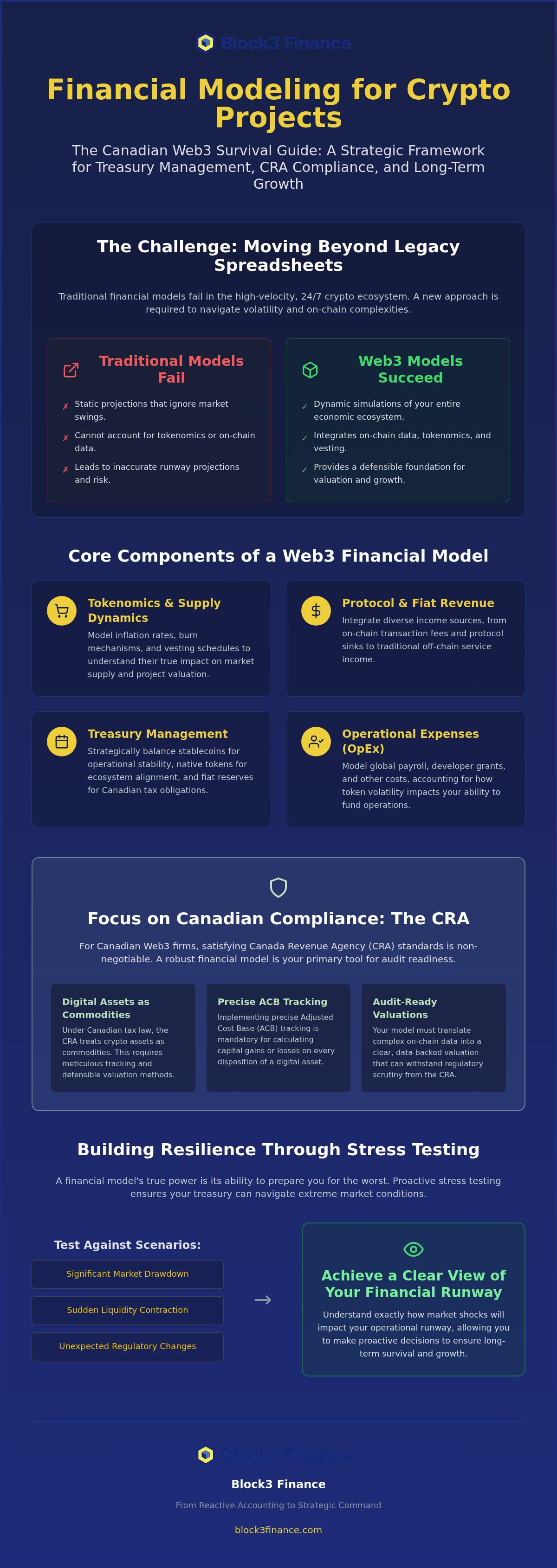
At its core, Financial modeling for Web3 represents a fundamental departure from the static projections of the legacy era. It's a dynamic simulation of a project's entire economic ecosystem, designed to map out how value flows between users, protocols, and treasuries. While traditional finance relies on predictable revenue cycles, financial modeling for crypto projects must account for the high-velocity, 24/7 nature of blockchain networks. It's the difference between a photograph and a live radar feed; one captures a moment, while the other tracks a moving target across a volatile horizon.
Traditional models often fail because they don't recognize the nuances of decentralized protocols. A standard spreadsheet won't account for token inflation, liquidity pool depth, or the impact of governance votes on treasury allocations. Without these variables, a model is just a collection of guesses. We help firms move past "hype-based" projections by building models rooted in verifiable on-chain data. This shift creates a defensible foundation for project viability, ensuring that every dollar of runway is accounted for and every token distribution is strategically sound.
The Evolution of Web3 Financial Planning
The industry has matured far beyond the unregulated frenzy of the ICO era. Today, sustainable growth requires rigorous tokenomics and complex multi-asset treasury management. It's no longer enough to track simple cash flow; firms must now manage a mix of fiat, stablecoins, and volatile native tokens. Block3 Finance acts as a visionary navigator in this space, bridging the gap between legacy corporate finance and the cutting-edge digital asset world through our specialized accounting services. We ensure your financial planning is as innovative as the technology you're building.
Key Stakeholders: Who Needs the Model?
Founders are the primary users, relying on these models to manage runway and time their token vesting schedules with precision. However, the audience is much broader. Investors now demand valuations based on network effects and Metcalfe's Law rather than just speculative fervor. Perhaps most importantly, regulators like the Canada Revenue Agency (CRA) require clear evidence of how you value your assets. For CRA filers, digital assets are treated as commodities, making defensible, data-backed valuations a non-negotiable requirement for audit readiness and long-term stability. A robust model provides the calm force needed to satisfy these diverse interests, ensuring your project remains both competitive and compliant in a high-stakes environment.
Core Components of a Web3 Financial Model
Traditional SaaS models often fail because they overlook the circular economy inherent in decentralized protocols. In financial modeling for crypto projects, your spreadsheet must function as a living map of token velocity and protocol sinks. You aren't just tracking subscriptions; you're simulating an entire monetary policy where supply dynamics and utility are inseparable from your bottom line. A robust model captures the friction between on-chain activity and off-chain operational requirements.
- Tokenomics and Supply Dynamics: You must model inflation rates, deflationary burn mechanisms, and the precise timing of vesting schedules to understand their impact on market depth.
- Revenue Streams: This includes transaction fees, protocol-specific "sinks" that remove tokens from circulation, and traditional service-based fiat income.
- Treasury Management: Balancing stablecoins for stability, native tokens for alignment, and fiat reserves for Canadian tax obligations is a high-stakes exercise in risk management.
- Operational Expenses (OpEx): Modeling global payroll and developer grants requires a clear view of how token volatility affects your ability to attract and retain talent.
Blockchain-Native Performance Metrics
Total Value Locked (TVL) serves as the industry's barometer for protocol health, directly impacting fee revenue for DeFi platforms. However, high TVL is often a vanity metric if it isn't paired with Active Addresses and Token Velocity. High turnover can signal a lack of long-term utility, potentially turning your native token into a speculative asset rather than a utility-driven tool. These metrics must feed directly into your revenue projections to create a realistic growth trajectory.
Modeling the Token Life Cycle
Vesting schedules are the engine of market liquidity. If a massive unlock occurs without a corresponding "Supply Sink," such as a protocol fee buy-back or a staking lock-up, the resulting price impact can decimate your treasury's purchasing power. We model these scenarios to ensure your runway remains intact even during extreme market drawdowns. Managing a Web3 treasury requires a surgical balance; you need enough fiat to cover Canadian payroll while holding native tokens to benefit from network growth.
For CRA filers, every swap between these assets is a taxable event, as the CRA treats digital assets as commodities. Accurate modeling prevents the "liquidity trap" where a project is wealthy on paper but cannot meet its off-chain liabilities or tax debts. If you're struggling to balance these complex variables, you can consult with our team to build a defensible strategic framework that satisfies both investors and regulators.
Modeling for Canadian Regulatory and CRA Compliance
Effective financial modeling for crypto projects serves a dual purpose: it empowers growth while fortifying your project against regulatory friction. In Canada, the Canada Revenue Agency (CRA) provides a specific framework that treats digital assets as commodities rather than legal tender. This classification means every transaction, whether it's a protocol swap or a payment to a vendor, has immediate tax consequences. Your model must transition from a simple projection tool into a robust system of record that accounts for these realities under CRA rules.
The Adjusted Cost Base (ACB) represents the critical metric for any Canadian Web3 firm. It's the average cost of your digital asset holdings, and failing to track it accurately can lead to significant overpayment or, worse, penalties during a CRA crypto audit. A high-fidelity model simulates the tax impact of every treasury movement, ensuring you maintain the liquidity required to cover tax liabilities as they arise. This proactive stance shifts the narrative from managing a burden to mastering your environment.
GST/HST implications also require careful modeling, particularly for projects exporting digital services globally. While many exports are zero-rated, the documentation required to prove the residency of your users can be complex. Your financial framework must capture these nuances to ensure you aren't inadvertently creating a massive off-chain debt that threatens your runway.
Inventory Valuation Methods for CRA Filers
CRA filers generally must use the weighted average cost method for valuing a pool of identical properties, such as Bitcoin or Ethereum. Your model should automatically calculate the "Fair Market Value" in Canadian dollars at the exact moment of each transaction. This level of precision is only possible when you maintain clean blockchain financial records. By integrating these valuation methods directly into your projections, you ensure your financial health reflects the true after-tax reality of your operations.
Tax-Efficient Treasury Structuring
Managing a treasury isn't just about picking winners; it's about tax-efficient liquidation. Converting crypto to fiat to cover Operational Expenses (OpEx) triggers capital gains or business income, depending on your firm's specific circumstances. Similarly, airdrops and staking rewards are often treated as income for Canadian businesses the moment they are received. We recommend founders consult our detailed guide on crypto tax in Canada to understand how these specific treatments impact their long-term runway. A well-structured model allows you to visualize these tax outflows before they become a crisis, providing the calm force needed to navigate a volatile market.
Scenario Analysis and Stress Testing Your Project
In the digital asset space, a "worst-case scenario" often exceeds the imagination of traditional analysts. While legacy firms might stress test for a 10% market correction, financial modeling for crypto projects requires preparing for 90% drawdowns and liquidity crunches that happen in days, not months. You need a model that doesn't just predict the future but survives it. By building "Bull," "Bear," and "Base" cases, you create a strategic playbook for every stage of the market cycle.
A robust framework utilizes Monte Carlo simulations to account for the chaotic nature of decentralized finance. Instead of relying on single-point estimates, these simulations run thousands of iterations to determine the probability of various outcomes, such as protocol exploits or sudden regulatory shifts. This level of rigor transforms your treasury from a passive pool of capital into an active, resilient engine. It allows you to visualize the impact of "Black Swan" events before they occur, ensuring your project remains a calm force in a volatile industry.
Runway Management in Volatile Markets
Longevity is the ultimate metric for success in Web3. You must calculate your "Zero-Revenue Runway" to understand exactly how many months your project can survive if transaction fees or protocol sinks dry up completely. Strategic de-risking is essential; moving a portion of your treasury into fiat or fiat-backed stablecoins ensures you can meet Canadian payroll and tax obligations even during a market rout. Engaging a Fractional Crypto CFO can be the deciding factor in these pivots, providing the elite strategic oversight needed to preserve capital for the next growth cycle.
Sensitivity Analysis for Token Metrics
Your model must also track the delicate correlation between network health and token value. We analyze how fluctuations in staking yields affect user retention and how spikes in gas fees might suppress protocol revenue. For many Canadian firms, the correlation between BTC/ETH prices and their native token is a primary risk factor that must be isolated and managed. Understanding these sensitivities allows you to adjust your parameters proactively rather than reacting to market pressure. If you're ready to build a model that stands up to investor scrutiny and market volatility, contact our team today to begin your strategic assessment.
The Block3 Finance Approach to Strategic Modeling
At Block3 Finance, we believe a spreadsheet should be a living instrument of leadership rather than a static archive of past events. Our approach to financial modeling for crypto projects moves beyond basic projections to create a comprehensive command center for your firm. We integrate our modeling frameworks directly with our professional accounting services, ensuring that every on-chain movement is reflected in a model that drives high-level corporate decision-making. This integration transforms raw data into a defensible record that stands up to the scrutiny of both institutional investors and regulatory bodies.
A sophisticated model serves as the blueprint for your corporate structuring. It informs the optimal timing for capital flows between entities and helps identify when to trigger specific tax strategies. For Canadian Web3 firms, this level of foresight is essential to maintain compliance while scaling. We don't just provide a service; we offer a roadmap for navigating the friction between decentralized innovation and established financial oversight. This disciplined approach ensures that your vision is supported by a foundation of technical rigor and strategic depth.
CFO-Led Financial Leadership
Our team functions as a calm force within the chaotic digital asset landscape, providing the specialized expertise of a fractional CFO to projects at every stage of growth. We use model-driven insights to implement precise on- and off-ramp solutions, ensuring your firm has the fiat liquidity required for Operational Expenses (OpEx) without exposing the treasury to unnecessary market risk. This proactive management is particularly vital for CRA filers who must account for the tax implications of every asset swap. By preparing professional-grade models, we position your project to secure institutional investment by demonstrating a level of financial maturity that is rare in the Web3 space.
Building Your Roadmap to Mastery
Success in the blockchain ecosystem requires a "Visionary Navigator" who understands both the technical nuances of protocols and the practical realities of Canadian tax law. We empower founders to shift from a defensive posture to an offensive one, focusing on mastery and sustainable growth. Your project's financial health is the engine of its longevity; neglecting it is a risk you can't afford to take. Secure your firm's future by adopting a framework that prioritizes clarity, compliance, and strategic agency. We invite you to contact us for a consultation to evaluate your project's financial health and begin building a model that turns your vision into an audit-ready reality.
Command Your Project’s Financial Destiny
Transitioning from a reactive startup to a resilient institution requires more than just a vision; it demands a rigorous strategic framework. You've seen how financial modeling for crypto projects bridges the gap between volatile on-chain innovation and the stable governance required for CRA filers. By implementing precise Adjusted Cost Base tracking and simulating aggressive market drawdowns, you ensure your project remains audit-ready and solvent through any cycle. This disciplined approach transforms your treasury from a point of vulnerability into a source of competitive advantage.
Block3 Finance stands as your visionary navigator, bringing over 13 years of blockchain financial expertise to every engagement. We've served over 980 clients globally and earned our rank as the #1 Crypto Accountant by Bitcoin.com through a commitment to technical excellence and proactive advocacy. Don't leave your runway to chance in an unpredictable market. You can secure your project’s financial future with Block3 Finance CFO Services today. We're ready to help you gain total command over your financial landscape and build a roadmap to lasting mastery in the Canadian Web3 ecosystem.
Frequently Asked Questions
How is cryptocurrency valued for financial modeling in Canada?
Cryptocurrency is valued based on its fair market value in Canadian dollars at the exact time of the transaction. Since the CRA treats digital assets as commodities, your model must track the CAD equivalent of every swap, reward, or payment to ensure accurate Adjusted Cost Base (ACB) calculations. This level of precision is vital for determining whether a disposition results in capital gains or business income for CRA filers.
Does the CRA require specific financial models for crypto startups?
The CRA doesn't mandate a specific software or template, but it does require that your financial records be complete, verifiable, and defensible. In the event of an audit, you must be able to prove how you arrived at your specific valuations and cost bases. Maintaining a robust framework for financial modeling for crypto projects ensures you have a clear paper trail that satisfies the six-year record-keeping requirement under Canadian law.
What is the difference between a traditional financial model and a crypto model?
Traditional models focus on linear revenue and predictable cash flows, whereas crypto models must account for circular token economies and complex supply dynamics. You're modeling variables like token inflation, vesting schedules, and protocol sinks that simply don't exist in legacy finance. These models prioritize liquidity and treasury resilience over simple profit-and-loss statements to manage the inherent volatility of the blockchain space.
How often should a crypto project update its financial model?
You should update your model at least monthly to maintain an accurate view of your runway given the 24/7 nature of digital markets. High-growth projects or those in volatile phases often require weekly adjustments to account for significant token price shifts or changes in protocol usage. Waiting for quarterly reviews often results in reactive decision-making that can jeopardize your project's longevity during a sudden market drawdown.
Can I use standard accounting software for crypto financial modeling?
Standard accounting software like QuickBooks or Xero is excellent for managing off-chain expenses but lacks the capability to track complex on-chain tokenomics directly. You'll need specialized tools or middleware that can bridge the gap between blockchain data and your financial projections. Effective financial modeling for crypto projects typically involves a hybrid approach that integrates on-chain activity with traditional corporate accounting records.
What are the most important KPIs to include in a Web3 financial model?
Your model should prioritize Total Value Locked (TVL), Daily Active Users (DAU), and Token Velocity to measure network health and utility. Additionally, tracking your "Zero-Revenue Runway" and protocol-specific revenue from transaction fees provides a clear picture of operational sustainability. These metrics allow you to move beyond speculative hype and focus on the data-driven reality of your project's growth and stability.
How do I model staking rewards for Canadian tax purposes?
Staking rewards are generally treated as income for Canadian tax purposes and must be valued at their fair market value when you gain control over them. Your model must capture the CAD value at the moment of receipt to establish the cost base for any future dispositions. It's essential to consult the latest CRA guidance or a specialist to ensure your specific treatment aligns with current regulatory interpretations for business income.
Why do I need a crypto-specialized CFO for my financial modeling?
A specialized CFO possesses the technical rigor to reconcile complex on-chain data with the practicalities of Canadian regulatory compliance. They act as a visionary navigator, helping you manage "Black Swan" risks and treasury de-risking strategies that traditional accountants often overlook. This elite oversight ensures your financial strategy is proactive, protective, and fully aligned with the unique demands of the high-stakes Web3 landscape.

Article by
Mahad Mohamed
Mahad Mohamed is an accountant and the CEO of Block3 Finance, with over 26+ years of Canadian and international tax and accounting experience. A crypto accounting specialist since the early days of Bitcoin, he has consulted for over 38 crypto companies and collaborated with legal professionals on regulatory matters. His expertise spans corporate reorganization, cross-border tax structuring (Canada & US), tax disputes, and CRA audits.
Previously, Mahad worked for the Canada Revenue Agency (CRA), Big4 accounting firms, and served as a Rulings Officer for the Federal Tax Authority of the UAE before acquiring Tax Partners in 2014.
Block3 Finance and Tax Partners has 44 full-time accountants and over 9,800+ clients.
Disclaimer
This article provides general information only and is current as of its publication date. It has not been updated and may be out of date. It does not constitute legal advice and should not be relied upon as such. Every tax situation is unique and may differ from the examples discussed in this article. If you have specific questions, you should seek the advice of our accountants for your unique circumstances.
Frequently Asked Questions
Key Stakeholders: Who Needs the Model?
Founders are the primary users, relying on these models to manage runway and time their token vesting schedules with precision. However, the audience is much broader. Investors now demand valuations based on network effects and Metcalfe's Law rather than just speculative fervor. Perhaps most importantly, regulators like the Canada Revenue Agency (CRA) require clear evidence of how you value your assets. For CRA filers, digital assets are treated as commodities, making defensible, data-backed valuations a non-negotiable requirement for audit readiness and long-term stability. A robust model provides the calm force needed to satisfy these diverse interests, ensuring your project remains both competitive and compliant in a high-stakes environment. Traditional SaaS models often fail because they overlook the circular economy inherent in decentralized protocols. In financial modeling for crypto projects, your spreadsheet must function as a living map of token velocity and protocol sinks. You aren't just tracking subscriptions; you're simulating an entire monetary policy where supply dynamics and utility are inseparable from your bottom line. A robust model captures the friction between on-chain activity and off-chain operational requirements.
How is cryptocurrency valued for financial modeling in Canada?
Cryptocurrency is valued based on its fair market value in Canadian dollars at the exact time of the transaction. Since the CRA treats digital assets as commodities, your model must track the CAD equivalent of every swap, reward, or payment to ensure accurate Adjusted Cost Base (ACB) calculations. This level of precision is vital for determining whether a disposition results in capital gains or business income for CRA filers.
Does the CRA require specific financial models for crypto startups?
The CRA doesn't mandate a specific software or template, but it does require that your financial records be complete, verifiable, and defensible. In the event of an audit, you must be able to prove how you arrived at your specific valuations and cost bases. Maintaining a robust framework for financial modeling for crypto projects ensures you have a clear paper trail that satisfies the six-year record-keeping requirement under Canadian law.
What is the difference between a traditional financial model and a crypto model?
Traditional models focus on linear revenue and predictable cash flows, whereas crypto models must account for circular token economies and complex supply dynamics. You're modeling variables like token inflation, vesting schedules, and protocol sinks that simply don't exist in legacy finance. These models prioritize liquidity and treasury resilience over simple profit-and-loss statements to manage the inherent volatility of the blockchain space.
How often should a crypto project update its financial model?
You should update your model at least monthly to maintain an accurate view of your runway given the 24/7 nature of digital markets. High-growth projects or those in volatile phases often require weekly adjustments to account for significant token price shifts or changes in protocol usage. Waiting for quarterly reviews often results in reactive decision-making that can jeopardize your project's longevity during a sudden market drawdown.
Can I use standard accounting software for crypto financial modeling?
Standard accounting software like QuickBooks or Xero is excellent for managing off-chain expenses but lacks the capability to track complex on-chain tokenomics directly. You'll need specialized tools or middleware that can bridge the gap between blockchain data and your financial projections. Effective financial modeling for crypto projects typically involves a hybrid approach that integrates on-chain activity with traditional corporate accounting records.
What are the most important KPIs to include in a Web3 financial model?
Your model should prioritize Total Value Locked (TVL), Daily Active Users (DAU), and Token Velocity to measure network health and utility. Additionally, tracking your "Zero-Revenue Runway" and protocol-specific revenue from transaction fees provides a clear picture of operational sustainability. These metrics allow you to move beyond speculative hype and focus on the data-driven reality of your project's growth and stability.
How do I model staking rewards for Canadian tax purposes?
Staking rewards are generally treated as income for Canadian tax purposes and must be valued at their fair market value when you gain control over them. Your model must capture the CAD value at the moment of receipt to establish the cost base for any future dispositions. It's essential to consult the latest CRA guidance or a specialist to ensure your specific treatment aligns with current regulatory interpretations for business income.
Why do I need a crypto-specialized CFO for my financial modeling?
A specialized CFO possesses the technical rigor to reconcile complex on-chain data with the practicalities of Canadian regulatory compliance. They act as a visionary navigator, helping you manage "Black Swan" risks and treasury de-risking strategies that traditional accountants often overlook. This elite oversight ensures your financial strategy is proactive, protective, and fully aligned with the unique demands of the high-stakes Web3 landscape.