
For a U.S. company, cryptocurrency for corporate treasury means deciding how digital assets are received, held, converted, secured, and accounted for while keeping enough liquidity for obligations priced in U.S. dollars. Bitcoin can diversify reserves, but its price volatility may affect the value of those assets even when the company’s bills remain unchanged. Companies allocating 5%-10% of treasury reserves to Bitcoin or Ether should be prepared for substantial fluctuations in those holdings.
The appeal is clear: some U.S. companies see Bitcoin as a way to diversify reserves, hedge against inflation, or strengthen financial resilience. But a treasury decision involves more than choosing an allocation. Price movements, cash needs, security controls, and U.S. accounting and tax considerations all affect the risk.
This article explains how crypto treasury management works for U.S. businesses, why companies hold Bitcoin, and how reserve allocations can affect financial flexibility. It also explores how accounting can turn price changes into earnings volatility, helping finance leaders assess the impact on the balance sheet and the cash available to run the business.
Key Takeaways
- Balance security, liquidity, and potential yield when shaping a digital-asset treasury strategy.
- Track each cryptocurrency’s exposure and liquidity in one system to spot concentration and cash-flow risks.
- Understand how price changes and accounting treatment can affect reported earnings, even when assets remain unsold.
- Assess Bitcoin’s role in reserves against the company’s operating needs, risk tolerance, and ability to meet fiat obligations.
- Use clear records and consistent reporting to support tax filing, accounting, and audit readiness.
What is crypto treasury management?
Crypto treasury management covers how a company secures, holds, converts, and reports digital assets. A business considering cryptocurrency for corporate treasury should connect its investment choices to its operating cash needs.
Treasury Priorities for Security, Liquidity, and Yield
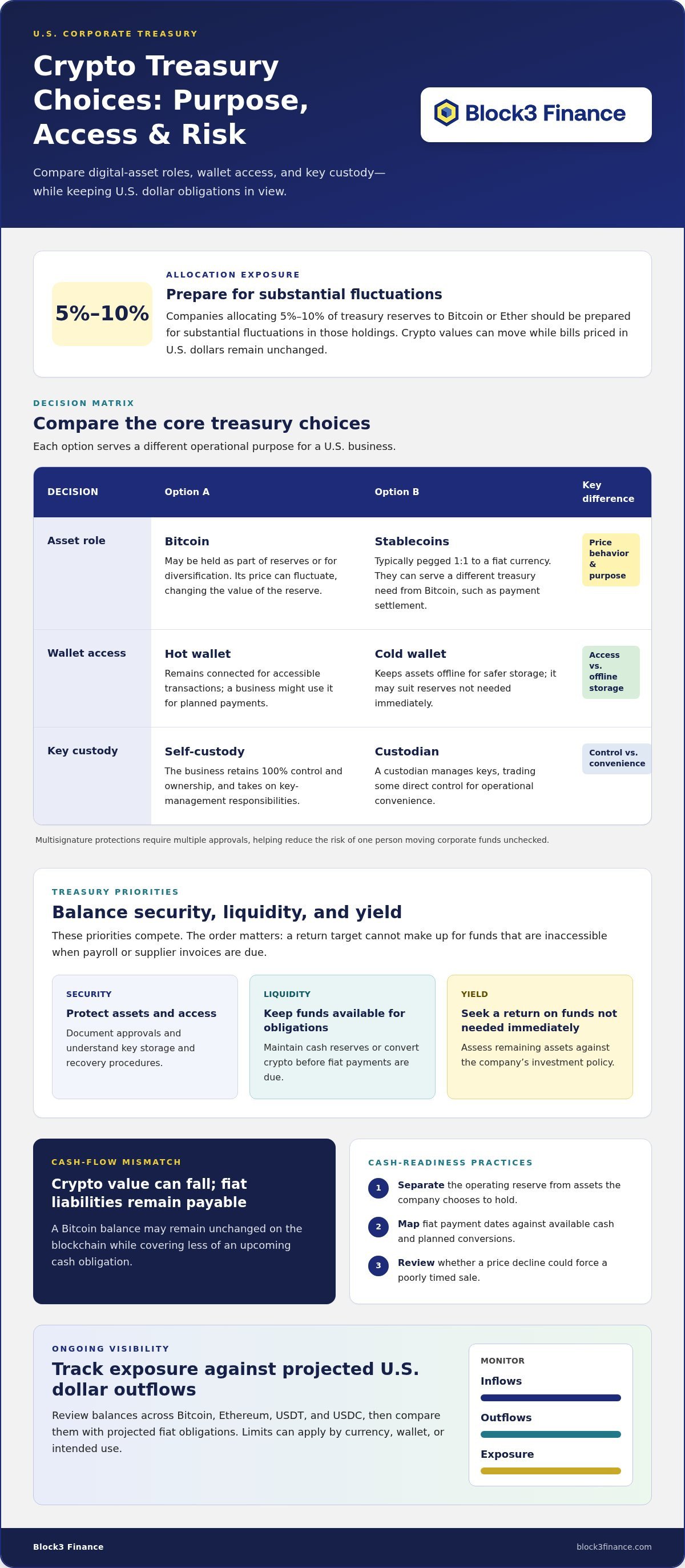
Security, liquidity, and yield are competing priorities in treasury decisions. Security protects assets and access; liquidity keeps funds available for obligations; yield seeks a return on assets not needed immediately. The order matters: a return target cannot make up for funds that are inaccessible when payroll or supplier invoices are due.
For example, a business that receives Bitcoin can separate its operating reserve from assets it chooses to hold. It can protect access through documented approvals, convert funds for expected obligations, and assess whether any remaining assets fit its investment policy. Each decision affects available funds, custody exposure, and accounting records.
Volatility and Allocation Frameworks
An allocation framework sets boundaries around which digital assets a company holds and how much exposure it accepts. This matters because price volatility can change the value of reserves even when near-term bills stay the same. A policy can specify permitted currencies, concentration limits, and conditions for converting assets.
For a company that accepts Bitcoin and stablecoins, the framework can distinguish assets intended for payments from those held as investments. It can also identify a functional currency, the currency used to measure business activity, and limit exposure to currencies outside that core. Clear rules make treasury decisions more consistent across teams.
Liquidity Risks from Falling Crypto Prices
A falling crypto price creates liquidity risk when digital assets lose value but liabilities remain payable in fiat currency. The risk is greatest when a business expects to use those assets for near-term expenses. Its Bitcoin balance may remain unchanged on the blockchain while covering less of an upcoming cash obligation.
Companies can address this mismatch by maintaining cash reserves or converting crypto to cash before obligations are due. For example, a company with supplier invoices priced in fiat can map payment dates against available cash and planned conversions. This review can reveal when a price decline might force a poorly timed sale.
Reserves, Exposure Limits, and Monitoring
Reserve management combines cash planning, exposure limits, and ongoing liquidity monitoring. A treasury team needs to know both what assets it holds and which funds it can access to meet obligations. Limits can apply by currency, wallet, or intended use, while monitoring can highlight shifts in concentration.
A treasury team can review balances across Bitcoin, Ethereum, USDT, and USDC, then compare them with projected fiat outflows. Analytics can flag tightening liquidity or excessive exposure before payment needs become urgent. Real-time reporting of inflows, outflows, and key performance indicators gives finance teams a clearer basis for action.
How do you see the future of Bitcoin treasuries evolving?
Bitcoin, Ethereum, USDT, and USDC may suit corporate holdings when each asset has a defined treasury purpose and risk limit. Bitcoin’s price can fluctuate, while stablecoins are typically pegged 1:1 to a fiat currency, so they serve different needs.
Multi-Crypto Treasury Systems
A multi-crypto treasury system brings asset balances, transaction approvals, and reporting into a single operational view. This matters because managing each blockchain separately can fragment visibility and add reconciliation work.
Enterprise platforms can connect wallet activity with accounting, payments, and other financial systems. For example, a finance team can match a USDC supplier payment to its blockchain transaction and internal record. Task lists can flag pending approvals or held transactions, while automatic sweeps and fund consolidation can reduce manual steps.
As a company adds assets, its platform needs to scale without obscuring balances by currency. Integration also helps teams understand how an exchange, payment workflow, and accounting entry relate. This joined-up view distinguishes digital-asset treasury management from systems designed mainly for bank accounts and conventional payment rails.
Enterprise Wallets and Key Storage
Enterprise wallet design determines how staff access assets and protect the private keys that authorize transactions. This matters because lost keys or uncontrolled access can disrupt treasury operations.
Hot wallets remain connected for accessible transactions, while cold wallets keep assets offline for safer storage. A business might use a hot wallet for planned payments and cold storage for reserves it does not need immediately. Multisignature protections require multiple approvals, reducing the risk of one person moving corporate funds unchecked.
Self-custody gives a business 100% control and ownership of its assets, but also places key management responsibilities on the organization. A custodian can manage keys instead, trading some direct control for operational convenience. Information security teams need to understand the chosen system and its recovery procedures.
Choosing Corporate Crypto Holdings
Choosing corporate holdings means matching each asset to a specific purpose, such as long-term reserves or payment settlement. That distinction matters because Bitcoin and stablecoins have different price and operating characteristics.
Bitcoin may appeal to companies seeking a digital asset investment, but its changing market price can alter reserve value. Stablecoins are typically pegged 1:1 to fiat currency, making them more suited to moving fiat-equivalent value across payment workflows. The peg does not remove the need to assess custody, conversion, and counterparty exposure.
Before adding an asset, a company can document its purpose, permitted uses, custody model, and conversion route. For example, a treasury could designate stablecoins for supplier payments and treat Bitcoin as a separate reserve holding. A defined policy makes decisions easier to review and record.
Institutional Provider Costs
Provider costs include the charges and operational expenses involved in buying, holding, and selling digital assets. Understanding them matters because service and custody arrangements affect the amount ultimately received or retained.
Relevant cost categories can include transaction execution, custody, withdrawals, and blockchain network activity. The exact mix depends on the provider arrangement, asset, transaction, and movement of funds. Compare the full transaction flow, not just the purchase: holding and eventual conversion can also involve costs.
For treasury teams assessing payment integration, map each cost to its related workflow and accounting record. A crypto finance review can help clarify how custody, conversions, and payment operations fit together; discuss your treasury requirements.
Mark-to-market accounting and earnings volatility
Mark-to-market accounting values an asset at its current market price rather than only its original purchase cost. For a company holding Bitcoin, this valuation can cause reported earnings to move even if the company has not sold its holdings.
Mark-to-Market Earnings Effects
Under a mark-to-market approach, a change in Bitcoin’s price can alter the reported value of a company’s holdings at a measurement date. If the price rises, the reported asset value may increase; if it falls, the value may decrease. Whether those changes flow through earnings depends on the accounting framework that applies to the company.
This creates a distinction between cash movement and reported performance. For example, a company may hold the same Bitcoin units while its financial statements show a different value after market prices change. CFOs should map each transaction to its date, quantity, valuation basis, and accounting entry, then reconcile the records with wallet activity. This helps explain changes in earnings without suggesting the company bought or sold Bitcoin.
Bitcoin’s sharp rallies and declines during much of 2021 and 2022, while inflation data moved higher, illustrate how market conditions can change. A treasury policy should therefore define who reviews valuations, how records are reconciled, and how finance teams explain material movements to decision-makers.
Options for Volatility Hedging
Bitcoin options are contracts that can provide the right to buy or sell at an agreed price, offering a potential way to manage price exposure. A more developed Bitcoin options market could give companies additional hedging tools, which may matter when treasury leaders need to reduce uncertainty around a planned holding or transaction.
For example, a company expecting to hold Bitcoin through a future reporting date could assess whether an option fits its risk policy. The hedge has a cost and may not offset every price movement. Finance teams should record the purpose, timing, and outcome of each hedge, then compare its effect with the exposure it was intended to manage.
Debt can heighten investor concern when company reserves fluctuate but repayments remain fixed in fiat currency. A lender or shareholder may view falling asset values differently from management, especially when the Bitcoin position is large relative to operating cash. A treasury team can model how a price decline affects reported assets, borrowing discussions, and funds available for planned payments.
Regulatory and accounting considerations also shape decisions across markets. Companies need to identify the rules and reporting framework that apply in their jurisdiction, then document how each digital-asset transaction is valued and recorded. Consistent accounting policies, approval records, and reconciliations help explain the figures to auditors, lenders, and investors.
Can you explain the concept of Bitcoin treasuries and why companies are adopting this strategy?
A Bitcoin treasury strategy places some corporate capital in Bitcoin as a reserve asset. Companies may seek diversification or an inflation hedge while accepting that Bitcoin’s price can fluctuate.
Inflation Hedging and Diversification
Using Bitcoin as an inflation hedge is a treasury rationale, not a promise that purchasing power will be preserved. Companies may allocate capital to diversify reserves or strengthen financial resilience, but price changes can also increase or decrease the value of those assets.
Governance turns the strategy into practice. Leaders can document the purpose of the holdings, assign approval responsibilities, and define how the allocation fits operating needs. Investors can ask whether the company has a stated reserve policy, how purchases are funded, and how management will explain the position if Bitcoin falls sharply.
Funding choices matter too. MicroStrategy has used convertible debt and equity issuances to raise funds for Bitcoin acquisitions. This approach links treasury strategy to financing decisions, so investors may assess debt obligations, dilution, liquidity, and the company’s underlying business together.
Corporate Crypto Holdings
Corporate Bitcoin holdings range from a defined reserve position to a central strategic focus. These examples help investors assess the scale and financing behind a company’s approach.
At the end of 2024, Tesla held 11,509 BTC, worth about a billion dollars. As of June 9th, 2025, MicroStrategy had accumulated over 582,000 BTC, with holdings valued at more than $62 billion. GameStop announced in March 2025 that it would add cryptocurrency to treasury reserve assets using debt convertible into equity.
Critical Metals Corp announced a convertible note financing agreement on January 21, 2025, that could provide up to $500 million. Its initial financing tranche was $100 million and could be allocated to Bitcoin purchases subject to specific conditions. The structure connects a potential reserve allocation with financing terms that investors should understand.
Some companies also explore lending or yield staking to generate income from crypto holdings. These DeFi strategies introduce protocol and counterparty risks alongside price exposure. A governance review should identify who approves participation, which assets may be committed, and how the company would respond if a protocol or service became unavailable.
Investors can assess whether Bitcoin supports the company’s operating strategy or dominates it. They can also ask how management measures reserve performance, communicates financing decisions, and preserves capital for business obligations. Clear policies and transaction records link each purchase, financing decision, and potential yield strategy to accountable oversight.
Bitcoin allocations in corporate reserves
A Bitcoin allocation changes more than a company’s investment mix. It can affect reserve liquidity, balance-sheet volatility, and the capital available for operating needs. The right allocation therefore depends on its purpose as well as the company’s risk tolerance.
The National Center for Public Policy Research proposed that Amazon evaluate investing 5% of its assets in Bitcoin. Amazon reported total assets of $624 billion and cash, cash equivalents, and marketable securities of $86 billion as of December 30, 2024. Those figures illustrate why an allocation should be assessed against the company’s full financial position, not treated as a standalone percentage.
A 5%-10% allocation of treasury reserves to Bitcoin or Ether can bring substantial fluctuations in the value of those holdings. For a CFO, the practical question is what a price decline would mean for planned payments, working capital, and the ability to fund core operations. A reserve policy can define which assets count toward the allocation and how management responds if their value shifts.
Build the decision around clear limits and review points:
- Purpose: State whether the allocation is intended to diversify reserves, pursue an inflation hedge, or support another strategic objective.
- Capacity: Separate capital available for investment from cash reserved for near-term obligations.
- Exposure: Set a maximum allocation and identify the conditions that trigger review or rebalancing.
- Reporting: Show digital assets, cash, and liabilities together so decision-makers can assess the balance sheet as a whole.
These steps help distinguish a deliberate reserve policy from a position that grows without oversight. They also give boards and investors a consistent way to assess the allocation against liquidity needs, market changes, and the company’s stated strategy. Institutional custody and transaction controls can support that process, but they do not replace sound capital-allocation decisions.
Funding matters as much as the target allocation. If a company uses debt or equity to acquire Bitcoin, it must weigh financing obligations and potential dilution alongside price exposure. The allocation should also fit the company’s governance and ownership structure, since approval authority and reporting responsibilities shape how the policy works.
A corporate structuring review can help align treasury decisions with ownership and governance arrangements. Discuss your corporate treasury structure before a Bitcoin allocation becomes a material balance-sheet decision.
Block3 Finance: Tax Filing and Reporting
Block3 Finance supports companies that need digital-asset activity reflected clearly in their financial records. Its Tax Filing and Reporting, Monthly Accounting, and Audits and Compliance services can help when Bitcoin holdings, conversions, or payment transactions make reconciliations and reporting more involved.
Accurate reporting starts with a clear trail from each wallet transaction to the company’s accounting records. A Crypto Tax Accountant can help organize transaction data and prepare tax reporting based on the company’s activity and applicable jurisdiction. Regular accounting can also help finance teams track holdings and identify gaps before reporting periods close.
If your treasury activity has made accounting or tax reporting more complex, contact Block3 Finance to discuss your needs.
Build a Treasury Policy That Can Evolve
A future Bitcoin position should be governed as an operating decision, not a one-time allocation. Before capital moves, decide who can approve transactions, what conditions trigger a review, and how treasury priorities will change as the business adds payment flows or digital assets. Written thresholds turn a market decision into accountable governance.
Using cryptocurrency for corporate treasury also means aligning finance teams around reliable records. Block3 Finance’s Monthly Accounting, Tax Filing and Reporting, and Audits and Compliance can support the accounting and oversight work that follows treasury activity, especially when wallet records, conversions, and financial statements need to stay connected across reporting periods.
Put your policy under practical scrutiny: clarify decision rights, set review triggers, and map each holding to a business purpose. Contact Block3 Finance to discuss your treasury strategy and the accounting and reporting processes that support it. A disciplined framework gives your team room to make informed decisions as digital finance evolves.
Frequently Asked Questions
How can organizations secure crypto assets?
Organizations can strengthen custody by limiting key access, requiring multiple approvals, and documenting recovery procedures. For cryptocurrency for corporate treasury, consider institutional security that combines multiparty computation (MPC) and hardware security modules (HSMs). Assign key responsibilities to designated staff, separate approval from execution, and maintain an incident response plan covering notification, account freezes, and recovery. These controls help teams prepare for access errors and potential security failures.
What does this trend mean for the broader corporate finance landscape?
It extends treasury work beyond bank accounts and cash forecasts. Finance teams may need to connect wallet records with accounting systems, payment workflows, and internal approvals so digital-asset activity appears in routine reporting. For example, a cross-border stablecoin payment can involve treasury, accounts payable, and accounting. Clear responsibility for each step helps teams reconcile the transaction and explain its business purpose.
What has driven the institutional adoption of Bitcoin in recent years?
Companies have considered Bitcoin to diversify reserves, hedge against inflation, or pursue financial resilience. In the United States, the SEC approved the listing and trading of multiple spot Bitcoin exchange-traded product shares on January 10, 2024, creating another route for market exposure. Institutional interest still depends on each organization’s mandate, risk capacity, custody arrangements, and ability to account for price changes.
What are the benefits and risks of holding cryptocurrency on a corporate balance sheet?
Holding cryptocurrency can diversify assets or support a company’s payment strategy, but it can also expose reserves to price swings and operational risks. An asset may lose value while rent, payroll, or supplier bills remain payable in fiat currency. Before defining the holding’s purpose, management should assess how a downturn could affect cash planning, reported results, and access to funds.
How do companies buy, custody, and secure cryptocurrency treasury assets?
Companies generally arrange purchases through an exchange or another transaction route, then hold assets in a custodial or self-managed wallet. A custodian manages the keys; with self-custody, that responsibility rests with the business. Before purchasing, define who initiates, approves, and records the transaction. Afterward, reconcile exchange confirmations and blockchain activity with internal records to catch discrepancies and maintain a clear audit trail.
What accounting rules apply to corporate cryptocurrency holdings under U.S. GAAP?
Under U.S. GAAP, companies should identify the asset and transaction, then apply the accounting guidance relevant to that classification. Cryptocurrency should not automatically be treated like cash or a conventional investment. Finance teams need consistent records of purchases, sales, transfers, and valuation inputs, along with documentation of the accounting policy used. These records support financial reporting and help explain how digital-asset activity affects the statements.
How are corporate cryptocurrency holdings taxed in the United States?
In the United States, selling or exchanging cryptocurrency can trigger a taxable gain or loss. A gain generally means the company receives more value than its recorded cost for the asset; a loss means it receives less. Either may have tax implications, depending on the transaction and the company’s circumstances. Treasury records should preserve acquisition details, proceeds, transfers, and the business purpose of each transaction.
What internal controls and governance policies should companies adopt for crypto treasury management?
Companies should separate transaction initiation, approval, and recording, and document who is responsible for each. Reconcile blockchain transactions with internal records, retain clear audit trails, and set approval rules for transfers and conversions. A written incident response plan should identify whom to notify, how to freeze affected accounts, and how recovery will proceed. Finance leaders should also monitor relevant compliance obligations and sanctions lists as policies and risks evolve.

Article by
Mahad Mohamed
Mahad Mohamed is an accountant and the CEO of Block3 Finance, with over 26+ years of Canadian and international tax and accounting experience. A crypto accounting specialist since the early days of Bitcoin, he has consulted for over 38 crypto companies and collaborated with legal professionals on regulatory matters. His expertise spans corporate reorganization, cross-border tax structuring (Canada & US), tax disputes, and CRA audits.
Previously, Mahad worked for the Canada Revenue Agency (CRA), Big4 accounting firms, and served as a Rulings Officer for the Federal Tax Authority of the UAE before acquiring Tax Partners in 2014.
Block3 Finance and Tax Partners has 44 full-time accountants and over 9,800+ clients.
Disclaimer
This article provides general information only and is current as of its publication date. It has not been updated and may be out of date. It does not constitute legal advice and should not be relied upon as such. Every tax situation is unique and may differ from the examples discussed in this article. If you have specific questions, you should seek the advice of our accountants for your unique circumstances.
Frequently Asked Questions
How can organizations secure crypto assets?
Organizations can strengthen custody by limiting key access, requiring multiple approvals, and documenting recovery procedures. For cryptocurrency for corporate treasury, consider institutional security that combines multiparty computation (MPC) and hardware security modules (HSMs). Assign key responsibilities to designated staff, separate approval from execution, and maintain an incident response plan covering notification, account freezes, and recovery. These controls help teams prepare for access errors and potential security failures.
What does this trend mean for the broader corporate finance landscape?
It extends treasury work beyond bank accounts and cash forecasts. Finance teams may need to connect wallet records with accounting systems, payment workflows, and internal approvals so digital-asset activity appears in routine reporting. For example, a cross-border stablecoin payment can involve treasury, accounts payable, and accounting. Clear responsibility for each step helps teams reconcile the transaction and explain its business purpose.
What has driven the institutional adoption of Bitcoin in recent years?
Companies have considered Bitcoin to diversify reserves, hedge against inflation, or pursue financial resilience. In the United States, the SEC approved the listing and trading of multiple spot Bitcoin exchange-traded product shares on January 10, 2024, creating another route for market exposure. Institutional interest still depends on each organization’s mandate, risk capacity, custody arrangements, and ability to account for price changes.
What are the benefits and risks of holding cryptocurrency on a corporate balance sheet?
Holding cryptocurrency can diversify assets or support a company’s payment strategy, but it can also expose reserves to price swings and operational risks. An asset may lose value while rent, payroll, or supplier bills remain payable in fiat currency. Before defining the holding’s purpose, management should assess how a downturn could affect cash planning, reported results, and access to funds.
How do companies buy, custody, and secure cryptocurrency treasury assets?
Companies generally arrange purchases through an exchange or another transaction route, then hold assets in a custodial or self-managed wallet. A custodian manages the keys; with self-custody, that responsibility rests with the business. Before purchasing, define who initiates, approves, and records the transaction. Afterward, reconcile exchange confirmations and blockchain activity with internal records to catch discrepancies and maintain a clear audit trail.
What accounting rules apply to corporate cryptocurrency holdings under U.S. GAAP?
Under U.S. GAAP, companies should identify the asset and transaction, then apply the accounting guidance relevant to that classification. Cryptocurrency should not automatically be treated like cash or a conventional investment. Finance teams need consistent records of purchases, sales, transfers, and valuation inputs, along with documentation of the accounting policy used. These records support financial reporting and help explain how digital-asset activity affects the statements.
How are corporate cryptocurrency holdings taxed in the United States?
In the United States, selling or exchanging cryptocurrency can trigger a taxable gain or loss. A gain generally means the company receives more value than its recorded cost for the asset; a loss means it receives less. Either may have tax implications, depending on the transaction and the company’s circumstances. Treasury records should preserve acquisition details, proceeds, transfers, and the business purpose of each transaction.
What internal controls and governance policies should companies adopt for crypto treasury management?
Companies should separate transaction initiation, approval, and recording, and document who is responsible for each. Reconcile blockchain transactions with internal records, retain clear audit trails, and set approval rules for transfers and conversions. A written incident response plan should identify whom to notify, how to freeze affected accounts, and how recovery will proceed. Finance leaders should also monitor relevant compliance obligations and sanctions lists as policies and risks evolve.