
What does a wallet balance tell you about the business activity behind it? On its own, not enough. For U.S. Web3 companies, bookkeeping for web3 companies means connecting wallet and exchange movements to their business purpose, supporting records, and the company’s books.
That connection can be difficult to maintain when transactions span business wallets, exchanges, protocols, and assets such as tokens or stablecoins. A transfer may be visible on-chain but still need context to explain what happened and how it should appear in the records. Without that context and regular reconciliation, month-end reporting can be harder to review.
A disciplined process brings the activity into focus. This guide explains what to capture for Web3 business transactions, how to reconcile activity, and how to build a repeatable monthly close. Block3 Finance provides monthly accounting and bookkeeping for crypto startups, established businesses, DAOs, and Web3 projects, connecting complex on-chain activity with organized financial records.
Key Takeaways
- Build a transaction trail that links each wallet movement to its source, business purpose, and supporting evidence.
- Capture the date, asset, quantity, transaction reference, wallet, and relevant context for each Web3 transaction.
- Compare wallet history with supporting documents and reconciled business records to identify gaps or unexplained differences.
- Use a repeatable U.S. monthly close to gather activity, resolve exceptions, review balances, and prepare reports.
- Specialized bookkeeping for web3 companies can connect fragmented blockchain data to organized, defensible financial records.
Why bookkeeping for Web3 companies needs a clear on-chain record
For a U.S.-based Web3 business, bookkeeping means organizing business activity into consistent financial records that show what happened, why it happened, and how it relates to the company. It connects on-chain movements with invoices, agreements, receipts, and other business context, rather than treating wallet history as a complete set of books.
Blockchain records can make transactions visible, but visibility isn’t the same as understanding. A transaction may show the assets moved, the wallet addresses involved, and the time it was recorded, while leaving its commercial purpose unclear. Activity can also be spread across wallets, protocols, exchanges, and off-chain systems, each holding only part of the story. Learn more about blockchain technology and the distributed records that underpin these transactions.
On-chain evidence shows that a transaction occurred; complete bookkeeping connects that evidence to business purpose and records it in the company’s financial accounts. For bookkeeping for web3 companies, the goal is not simply to collect transaction data, but to make it usable and traceable.
What makes a Web3 business transaction different?
A conventional business payment may be documented through an invoice and a bank statement. A Web3 payment may settle directly between wallets, while its invoice or agreement remains in a separate system. The company needs a clear link between those records.
For example, a company receives a stablecoin payment from a customer. The blockchain can show the transfer into the company’s wallet, but the transaction alone may not identify the customer, the invoice being paid, or the product or service involved. Linking the transfer to those records clarifies its business purpose and helps explain how it belongs in the books.
What bookkeeping should help the business understand
Well-organized records help a company see how on-chain and off-chain activity connects to its operations. They support a coherent view of income, expenses, assets, and fund movements, giving management more context than a list of wallet balances.
To keep that view useful, records should help answer practical questions:
- What business activity does this transaction relate to?
- Which wallet or account sent or received the assets?
- What supporting invoice, agreement, receipt, or internal note explains the transaction?
- How does the activity fit into the company’s financial records and reporting period?
This organization supports management review and financial reporting by making activity easier to trace, explain, and investigate. It also gives the business a clearer foundation for reviewing unusual transactions and resolving gaps in its records.
Bookkeeping records what the business did; it doesn’t automatically determine the tax treatment of each transaction. Tax treatment is a separate assessment, so clear records help preserve the facts needed for that review without treating a bookkeeping entry as a tax conclusion.
Recording Web3 Transactions: Wallet to Books
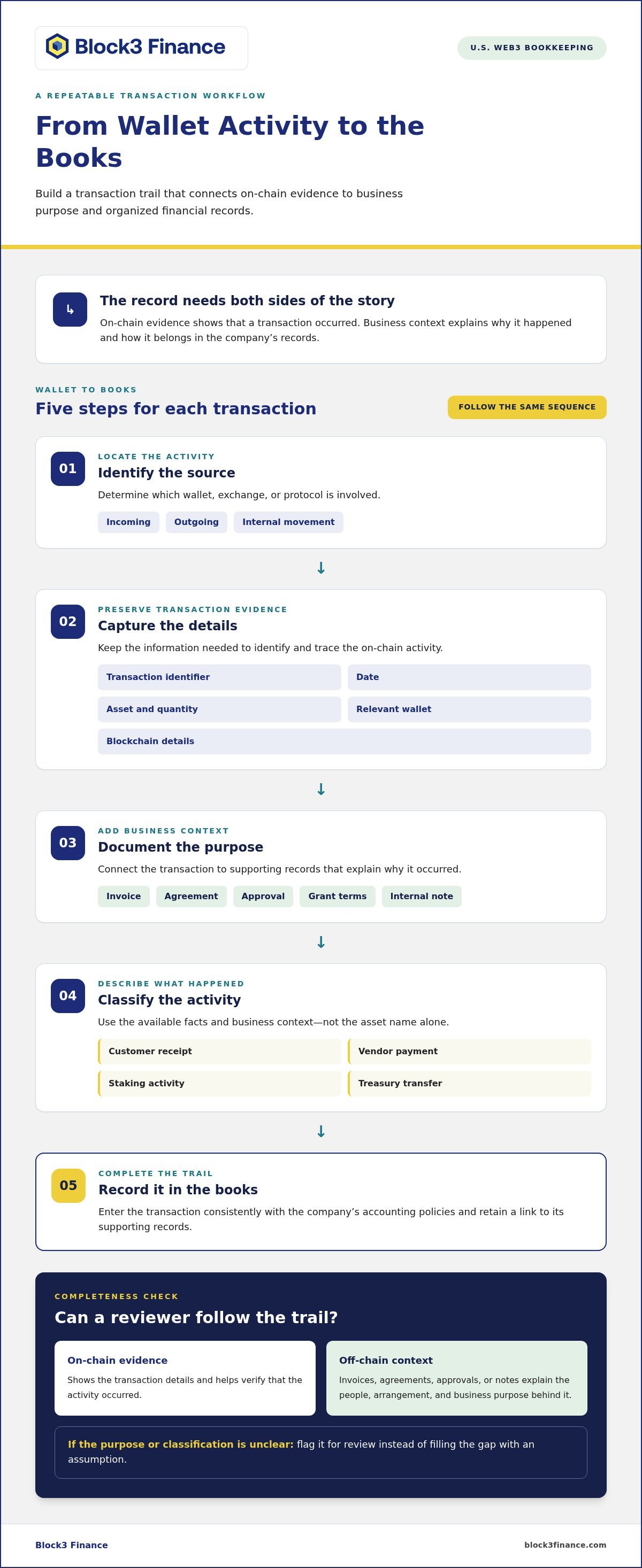
A repeatable workflow turns blockchain activity into records the business can explain. For bookkeeping for web3 companies, follow the same sequence for each transaction, whether it involves a customer, a protocol, or the company’s treasury.
- Identify the source. Determine which wallet, exchange, or protocol activity is involved and whether the transaction is incoming, outgoing, or an internal movement.
- Capture the evidence. Save the transaction identifier, date, asset, quantity, relevant wallet, and blockchain details.
- Document the purpose. Connect the activity to an invoice, agreement, approval, grant terms, or concise internal note.
- Classify the activity. Describe what occurred based on the available facts, such as a customer receipt, vendor payment, staking activity, or treasury transfer.
- Record it in the books. Enter the transaction consistently with the company’s accounting policies, retaining a link to its supporting records.
A complete transaction record combines verifiable on-chain evidence with enough business context to explain why the activity occurred. If the purpose or classification isn’t clear, flag it for review instead of filling the gap with an assumption.
What evidence to capture for on-chain activity
For each on-chain transaction, record the relevant wallet and blockchain, transaction identifier, date, asset, and quantity. Keep related invoices, agreements, approvals, or internal notes with the record when they explain who initiated the activity and its business purpose.
Public blockchain data can support the transaction trail, but it may not identify the people or business arrangement behind a wallet. Off-chain documents and notes provide that context. Organize them so a reviewer can follow the path from transaction evidence to the entry in the books.
How to document different Web3 activity types
The same token can appear in different business contexts, so classify activity based on its facts, not the asset name alone. Examples to document include:
- Customer receipts: Link the payment to the relevant invoice or customer record.
- Vendor payments: Retain the bill, agreement, or approval that explains the outgoing transfer.
- Staking, mining, or airdrops: Note the activity that generated the transaction and retain available supporting details.
- Grants: Keep the grant terms and any records that describe the funds’ purpose.
- Treasury movements: Record the sending and receiving wallets and clarify whether the movement is internal.
- Trading, NFT, or DeFi activity: Preserve the transaction details and relevant trade, asset, or protocol context.
Classification depends on transaction facts and the company’s applicable accounting policies. Bookkeeping records the activity; it doesn’t, by itself, settle tax treatment. For U.S. federal tax context, consult the IRS guidance on virtual currency taxation separately from the company’s bookkeeping decisions.
When blockchain history is fragmented or difficult to interpret, Block3 Finance bookkeeping support can help connect transaction evidence with organized business records.
How to assess Web3 bookkeeping records for completeness and reliability
For a U.S. Web3 business, reliable books should make it possible to trace recorded activity back to source records and understand how exceptions were handled. A transaction count alone doesn’t establish completeness: records may omit activity, include duplicates, or leave movements unexplained.
Compare the evidence at three levels:
| Record layer | What it shows | Review question |
|---|---|---|
| Raw wallet history | Transactions visible for a wallet, including dates, assets, quantities, and transaction references. | Does this represent the relevant wallet activity for the period? |
| Supporting evidence | Invoices, agreements, approvals, or notes that explain the business context. | Is there enough context to support the recorded purpose? |
| Reconciled business record | The activity organized in the accounting records with a clear reference to its evidence. | Can a reviewer follow the entry back to its source and understand any difference? |
The general ledger is the company’s main accounting record, where financial activity is organized into accounts. A subledger can hold additional transaction-level detail, such as wallet activity, and connect that detail to summarized entries in the general ledger. The structure should preserve a clear path between the two, rather than leaving digital asset activity isolated from the company’s broader books.
What reconciliation can reveal
Reconciliation means comparing recorded activity with source records and documenting differences that remain unresolved. Compare wallet movements with available blockchain history, then check whether supporting business documents make sense alongside each recorded purpose.
Investigate unmatched items, possible duplicate entries, and balance differences. Check transaction references, dates, wallet records, and supporting documents; record what you found and how the issue was resolved. If a difference remains open, document it for follow-up rather than silently adjusting the books.
How to keep bookkeeping reviewable
Consistency helps a reviewer understand activity across reporting periods. Use stable transaction descriptions and account mappings, and retain a clear reference from each recorded entry to its source evidence. If a mapping or description changes, document the reason so the change doesn’t obscure how activity was recorded previously.
For bookkeeping for web3 companies, audit-readiness means organized, traceable records that support review. It doesn’t guarantee an audit outcome. A practical review asks whether the evidence supports the entry, whether the business purpose is understandable, and whether unresolved differences are visible with an explanation of their status.
A practical monthly bookkeeping close for a U.S. Web3 company
A dependable close is a repeatable review, not a last-minute search for missing records. For a U.S. Web3 company, separate the ongoing work of collecting activity from the period-end work of reconciling, investigating, and reporting it. This keeps responsibilities clear and gives leaders a more consistent view of business and treasury activity.
A repeatable sequence for the monthly close
Assign responsibility for routine record collection throughout the period, then use the close to review what was gathered. The exact workflow can vary by company, but this sequence provides a practical starting point:
- Gather activity. Collect relevant wallet and exchange records, invoices, agreements, approvals, and other supporting business documents for the period.
- Reconcile records. Compare recorded transactions with available source evidence and identify activity that is missing, duplicated, or unclear.
- Investigate exceptions. Follow up on unmatched items, balance differences, or transactions without enough business context. Keep open questions visible instead of making unsupported assumptions.
- Review balances. Examine the recorded balances and activity for the company’s accounts, including treasury holdings, and document material questions for review.
- Prepare reports. Organize the reviewed records into clear internal financial reporting that helps leaders understand the period’s activity and make informed decisions.
During the period, the people closest to transactions can preserve invoices, approvals, and explanations as activity occurs. At close, the person responsible for review can assess whether records are complete and exceptions have been addressed. This division is useful for decentralized organizations, including DAOs, where contributors may initiate activity while finance reviewers maintain the accounting process.
Consistent monthly accounting connects wallet activity with organized business records and helps leaders interpret treasury movements alongside operating activity. A structured monthly accounting process supports that continuity without requiring every company to follow an identical procedure or deadline.
What to do when records do not tie out
Differences should lead to investigation, not guesswork. Keep an exception log that identifies the item, the evidence reviewed, the context still needed, who will follow up, and whether the issue remains open or has been resolved.
- Separate facts from assumptions. Record what the source evidence shows, then clearly mark any explanation that still needs confirmation.
- Request missing context internally. Ask the relevant contributor or team member for the purpose, approval, or document connected to the activity.
- Document the outcome. Note how the issue was resolved, or why it remains open for further review.
Keep the monthly process proportionate to the company’s activity and responsibilities. Block3 Finance provides Web3 bookkeeping support to help companies manage fragmented records and their monthly close.
How Block3 Finance supports bookkeeping for Web3 companies
Consistent books give a Web3 business a clearer view of its activity and a stronger foundation for financial review. Block3 Finance provides monthly bookkeeping and accounting support that connects blockchain activity with organized, defensible business records, while keeping bookkeeping distinct from tax conclusions or other financial decisions.
Block3 Finance brings 13 + years of blockchain financial expertise and serves 980 + clients worldwide. The firm analyzes blockchain data to help reconcile fragmented transaction histories, bringing activity from wallets and other sources into a more coherent set of records.
That process supports ongoing reporting and audit-readiness by making transactions easier to trace and review. It doesn’t guarantee an audit outcome, and bookkeeping entries alone don’t determine tax treatment; those are distinct considerations that may require separate review.
When specialized bookkeeping support can help
Specialized support can be useful when a company manages activity across multiple wallets, handles complex on-chain transactions, or needs to organize historical records before establishing a consistent monthly process. Block3 Finance’s blockchain data analysis helps connect fragmented transaction histories to the business records that explain them.
Ongoing bookkeeping can help maintain organized reporting over time, rather than allowing unresolved items to accumulate between reviews. For businesses considering reporting treatment, including revenue recognition, the facts and applicable accounting policies matter; bookkeeping helps preserve the activity and supporting context needed for that assessment.
Block3 Finance’s Web3 accounting services support ongoing financial records, while its audit and compliance services relate to financial review and readiness. These connected capabilities serve different purposes: bookkeeping organizes and records activity, while audit work involves a separate review process.
Start a conversation about your Web3 books
A useful first discussion can focus on the company’s structure and activity, where transaction records currently live, and what makes the books difficult to maintain. A high-level picture of the wallets and platforms involved, the kinds of on-chain activity the business handles, and any recordkeeping gaps or historical cleanup needs can help frame the discussion.
Block3 Finance offers a free initial consultation to discuss bookkeeping needs and the records required to support a dependable monthly process. You don’t need to arrive with every transaction already organized; a clear description of the challenge is a practical place to begin.
Book your free initial consultation with Block3 Finance to discuss how monthly bookkeeping can support organized, reviewable records for your Web3 business.
Make your Web3 records part of the operating rhythm
Make financial recordkeeping part of how your company operates, rather than a task left until reporting is due. As your activity changes, assign clear ownership for preserving transaction context and bringing new workflows into the bookkeeping process.
For example, when your team adopts a new wallet or begins using a protocol, decide who will retain relevant business documentation and how the activity will be reviewed. That practice helps records keep pace with the business, rather than leaving future finance reviews to reconstruct decisions from incomplete notes.
Strong bookkeeping for web3 companies gives leadership a more dependable foundation for understanding activity and planning ahead. Begin by identifying the recordkeeping challenge that most limits your team today, whether it’s unclear ownership, fragmented transaction history, or a close that’s difficult to repeat.
Block3 Finance can help shape a bookkeeping approach around your Web3 business. Its Web3 bookkeeping services support more organized records.
Frequently Asked Questions
Can blockchain data alone provide complete bookkeeping records?
Not by itself. Start with an inventory of the company’s relevant wallets, exchange accounts, and networks, rather than relying on one wallet export or explorer view. Update the inventory when the business adds, retires, or changes control of an account. This helps reviewers assess whether the data covers the company’s known on-chain footprint for the period under review.
Are transfers between a company’s own wallets revenue or expenses?
Not simply because tokens moved. If both wallets belong to the company, match the outgoing movement to the corresponding incoming movement so the same transfer isn’t mistaken for two separate business events. If the movement involved a bridge, conversion, or network fee, keep those details distinguishable for review. Apply the company’s accounting policies to the facts, and seek qualified accounting review if the activity’s substance isn’t clear.
What should a Web3 company do with an unidentified wallet transaction?
Keep it visible as a pending review item and assign someone to investigate it. Note the unresolved question, how long it has remained open, and whether it could affect current reporting. Escalate items that remain unresolved through the company’s normal review process. This helps the team prioritize follow-up and prevents an unexplained item from being treated as settled simply because the close is progressing.
Does a Web3 company need a separate ledger for every blockchain?
No. The number of networks alone doesn’t determine the accounting structure. A company can decide whether its reporting needs separate views by network, wallet, or activity type, while maintaining consistent account mappings across them. Cross-chain activity deserves particular attention: movements associated with a bridge can appear on more than one network, so the records should help reviewers distinguish related legs of an activity from separate transactions.
How should a company document a token grant or contributor payment?
Keep a record of the approval and terms that governed the distribution, including any later amendments or conditions. For a grant, note relevant milestones or restrictions; for a contributor payment, retain the agreed payment schedule or other terms that explain how the distribution was authorized. These details help reviewers understand the arrangement over time, especially if the original terms change. Apply the company’s accounting policies to the complete facts.
Can bookkeeping software automatically understand every Web3 transaction?
No. Before relying on a system, define what complete data capture means for the company: which accounts and networks it should cover, what transaction details it should retain, and how it identifies possible duplicates. Review a sample of its output against original records and check whether changes or corrections can be traced. These checks help the team understand the tool’s limits without assuming it can interpret every activity type.
When should a Web3 company consider historical bookkeeping cleanup?
Cleanup may be appropriate when older records make it difficult to explain balances carried into the current reporting period or compare results consistently over time. A practical starting point is to define the periods and accounts in scope, preserve existing records, and document proposed adjustments separately from original entries. This creates a reviewable path for addressing historical gaps without assuming in advance what corrections are needed.

Article by
Mahad Mohamed
Mahad Mohamed is an accountant and the CEO of Block3 Finance, with over 26+ years of Canadian and international tax and accounting experience. A crypto accounting specialist since the early days of Bitcoin, he has consulted for over 38 crypto companies and collaborated with legal professionals on regulatory matters. His expertise spans corporate reorganization, cross-border tax structuring (Canada & US), tax disputes, and CRA audits.
Previously, Mahad worked for the Canada Revenue Agency (CRA), Big4 accounting firms, and served as a Rulings Officer for the Federal Tax Authority of the UAE before acquiring Tax Partners in 2014.
Block3 Finance and Tax Partners has 44 full-time accountants and over 9,800+ clients.
Disclaimer
This article provides general information only and is current as of its publication date. It has not been updated and may be out of date. It does not constitute legal advice and should not be relied upon as such. Every tax situation is unique and may differ from the examples discussed in this article. If you have specific questions, you should seek the advice of our accountants for your unique circumstances.
Frequently Asked Questions
What makes a Web3 business transaction different?
A conventional business payment may be documented through an invoice and a bank statement. A Web3 payment may settle directly between wallets, while its invoice or agreement remains in a separate system. The company needs a clear link between those records. For example, a company receives a stablecoin payment from a customer. The blockchain can show the transfer into the company’s wallet, but the transaction alone may not identify the customer, the invoice being paid, or the product or service involved. Linking the transfer to those records clarifies its business purpose and helps explain how it belongs in the books.
Can blockchain data alone provide complete bookkeeping records?
Not by itself. Start with an inventory of the company’s relevant wallets, exchange accounts, and networks, rather than relying on one wallet export or explorer view. Update the inventory when the business adds, retires, or changes control of an account. This helps reviewers assess whether the data covers the company’s known on-chain footprint for the period under review.
Are transfers between a company’s own wallets revenue or expenses?
Not simply because tokens moved. If both wallets belong to the company, match the outgoing movement to the corresponding incoming movement so the same transfer isn’t mistaken for two separate business events. If the movement involved a bridge, conversion, or network fee, keep those details distinguishable for review. Apply the company’s accounting policies to the facts, and seek qualified accounting review if the activity’s substance isn’t clear.
What should a Web3 company do with an unidentified wallet transaction?
Keep it visible as a pending review item and assign someone to investigate it. Note the unresolved question, how long it has remained open, and whether it could affect current reporting. Escalate items that remain unresolved through the company’s normal review process. This helps the team prioritize follow-up and prevents an unexplained item from being treated as settled simply because the close is progressing.
Does a Web3 company need a separate ledger for every blockchain?
No. The number of networks alone doesn’t determine the accounting structure. A company can decide whether its reporting needs separate views by network, wallet, or activity type, while maintaining consistent account mappings across them. Cross-chain activity deserves particular attention: movements associated with a bridge can appear on more than one network, so the records should help reviewers distinguish related legs of an activity from separate transactions.
How should a company document a token grant or contributor payment?
Keep a record of the approval and terms that governed the distribution, including any later amendments or conditions. For a grant, note relevant milestones or restrictions; for a contributor payment, retain the agreed payment schedule or other terms that explain how the distribution was authorized. These details help reviewers understand the arrangement over time, especially if the original terms change. Apply the company’s accounting policies to the complete facts.
Can bookkeeping software automatically understand every Web3 transaction?
No. Before relying on a system, define what complete data capture means for the company: which accounts and networks it should cover, what transaction details it should retain, and how it identifies possible duplicates. Review a sample of its output against original records and check whether changes or corrections can be traced. These checks help the team understand the tool’s limits without assuming it can interpret every activity type.
When should a Web3 company consider historical bookkeeping cleanup?
Cleanup may be appropriate when older records make it difficult to explain balances carried into the current reporting period or compare results consistently over time. A practical starting point is to define the periods and accounts in scope, preserve existing records, and document proposed adjustments separately from original entries. This creates a reviewable path for addressing historical gaps without assuming in advance what corrections are needed.