
A DeFi reward can create a tax record before you sell or swap it. In the United States, calculating cost basis for DeFi transactions means tracking what you paid for acquired crypto, including relevant acquisition fees, and recording the fair market value of staking or mining rewards when you receive them. Rewards may also be taxable as ordinary income when you gain control of the tokens.
That distinction matters: the value recorded when a reward arrives can become its cost basis later, affecting the gain or loss you report when you dispose of it. But wallet transfers, protocol fees, token swaps, and incomplete transaction histories can make the figures difficult to reconcile.
This guide explains how cost basis works under U.S. tax rules, how to account for fees and DeFi rewards, and what records can support your calculations. It also explains why documenting assumptions matters when transaction data is incomplete or a protocol’s activity does not fit neatly into standard categories.
Key Takeaways
- Understand how an asset’s acquisition value and related fees shape its cost basis and later gain or loss.
- Keep reward receipt records separate from records of later sales or swaps, since each event can affect tax reporting differently.
- Track wallet transfers and transaction details so you can support the continuity of your asset records.
- Document assumptions and unresolved data gaps to create a clearer record for U.S. tax reporting.
What Is Cryptocurrency Cost Basis?
For U.S. tax reporting, cost basis is the value assigned to crypto when you acquire it. It helps determine your proceeds and capital gain or loss when you later dispose of the asset.
Cryptocurrency Cost Basis Definition
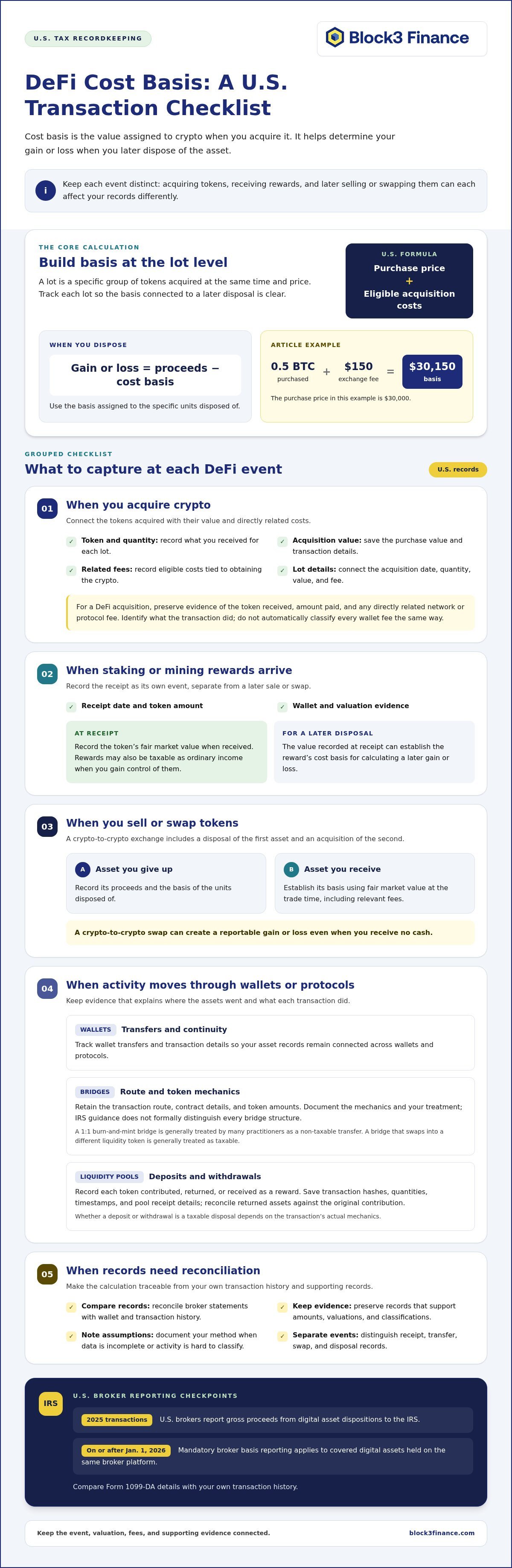
Cost basis generally begins with an asset’s acquisition value and relevant costs, providing a reference point for calculating taxable results. If you sell crypto, subtract its basis from your proceeds to find the gain or loss. A lot is a specific group of tokens acquired at the same time and price. Tracking lots helps show which basis applies to a disposal.
Broker reporting adds another record to reconcile. Beginning with 2025 transactions, U.S. brokers report gross proceeds from digital asset dispositions to the IRS. For covered digital assets acquired on or after January 1, 2026, mandatory broker basis reporting applies when the assets are held on the same broker platform. Compare Form 1099-DA details with your own transaction history.
Keep wallet-level records for each lot. The Internal Revenue Service provides a safe harbor for moving historical pooled digital-asset basis to wallet-level tracking through Rev. Proc. 2024-28. The Internal Revenue Service can charge a 20% accuracy-related penalty on a cryptocurrency tax return, making a clear record of your method and supporting data important.
Basis for Rewards, Gifts, and Inherited Crypto
For staking or mining rewards, record the token’s fair market value when received; that value can establish its basis for a later disposal. Keep the receipt date, token amount, wallet, and valuation evidence together. Airdropped tokens also use fair market value at receipt when they have an established value. If no market exists at that time, the value may be determined when one becomes available.
For gifted or inherited crypto, keep any available records that may help explain how you acquired the asset and the basis used in your calculation. Preserve available transfer details instead of treating the value shown in a wallet as proof of acquisition cost. For each receipt, distinguish the event that brought the tokens under your control from a later sale or swap.
Basis for Crypto Trades and Swaps
Under U.S. tax reporting, exchanging one cryptocurrency for another is treated as disposing of the first asset and acquiring the second. Record the first token’s proceeds and basis, then establish the acquired token’s basis using its fair market value at the trade time, including relevant fees. A crypto-to-crypto swap can create a reportable gain or loss even if you receive no cash.
For bridges and wrapped tokens, retain the transaction route, contract details, and token amounts. A 1:1 burn-and-mint bridge is generally treated by many practitioners as a non-taxable transfer, while a bridge that swaps into a different liquidity token is generally treated as taxable. IRS guidance does not formally distinguish every bridge structure, so document the transaction’s mechanics and your treatment.
Liquidity Pool Deposits and Withdrawals
Liquidity-pool deposits and withdrawals can change the assets you hold, so record each token contributed, returned, or received as a reward. Whether a deposit or withdrawal is a taxable disposal depends on the transaction’s actual mechanics, including whether tokens are exchanged for a different asset or merely represented by a pool receipt token.
For example, save the deposit and withdrawal transaction hashes, token quantities, timestamps, and pool receipt details. Reconcile the returned assets against the original contribution, and track any rewards separately. This evidence helps explain how you calculated basis and proceeds, rather than treating every pool interaction as an ordinary wallet transfer.
Cost basis formula and acquisition fees
For U.S. crypto tax reporting, acquisition costs can affect the basis assigned to each asset lot. Separate purchase costs from disposal costs so your records show how you calculated both basis and proceeds. A consistent method also makes it easier to compare exchange statements with wallet activity.
Cost Basis Formula
The basic formula is cost basis = purchase price + eligible acquisition costs. This total establishes the capital amount used to calculate gain or loss when you dispose of the acquired crypto. For example, buying 0.5 BTC for $30,000 and paying a $150 exchange fee gives that lot a $30,150 basis.
For a disposal, compare net proceeds with the basis assigned to the units sold: gain or loss = proceeds minus cost basis. Keep the calculation at the lot level, because separate purchases of the same token can have different costs. A tracking record should connect each lot to its date, quantity, acquisition value, and related fee. A reliable approach to calculating cost basis for DeFi transactions begins by preserving that connection across wallets and protocols.
Acquisition Costs and Fees
Acquisition costs are expenses directly tied to obtaining crypto, such as a purchase or exchange fee. Including these costs in basis increases the recorded amount compared with the token’s price alone. That distinction matters when you later calculate capital gains: a higher supported basis can reduce the gain reported for the same proceeds.
For a DeFi acquisition, preserve the transaction record showing the token received, the amount paid, and any directly related network or protocol fee. A gas fee for a transaction that acquires an asset may form part of the acquisition record. Identify what the transaction did and retain evidence supporting your classification, rather than assigning every wallet fee the same treatment.
An airdrop or mining reward is not a cash purchase, so do not automatically apply a purchase-fee calculation. Record the receipt event and its valuation separately, then track any later fee tied to acquiring additional units. This distinction keeps the original receipt separate from a subsequent exchange or purchase.
Purchase and Disposal Fees
Purchase fees and sale fees affect different sides of the calculation. A purchase fee directly related to acquiring crypto may be added to basis; a fee directly related to selling crypto can reduce the proceeds used to determine gain or loss. When calculating cost basis for DeFi transactions, keep acquisition charges separate from fees incurred when disposing of tokens.
For example, selling BTC for $42,000 with a $200 sale fee produces $41,800 in proceeds. Compare that net amount with the basis of the specific BTC units disposed of. Don’t add the sale fee to the original purchase basis, because that would mix acquisition and disposal records.
Save exchange statements and on-chain transaction details together, including the fee amount, token, and transaction hash. If fee classification complicates your U.S. crypto tax records, you can discuss your reporting needs.
Cost basis reporting on Form 1099-DA and Form 8949
U.S. broker reports and your own records serve different purposes: gross proceeds may be reported, while DeFi details often require you to reconcile your own records.
U.S. Cost Basis Reporting Rules
Beginning January 1, 2025, U.S. crypto exchanges must track transactions and report information on Form 1099-DA. For 2025 transactions, brokers report gross proceeds from digital asset dispositions to the IRS, but centralized exchanges aren’t required to report cryptocurrency cost basis for the 2025 tax year.
That distinction matters. A Form 1099-DA showing proceeds doesn’t necessarily establish your original basis or the gain or loss on a disposal. Mandatory U.S. broker basis reporting begins for covered digital assets acquired on or after January 1, 2026, and held on the same broker platform. Compare each broker statement with your wallets, exchange records, and DeFi transaction history.
Form 8949 is where U.S. taxpayers report capital asset sales and exchanges, including relevant digital asset transactions. Use your records to report the proceeds and crypto cost basis for each disposition, then reconcile those figures with broker information. If the broker’s basis is missing or incorrect, purchase records can support the correct basis reported on Form 8949.
A practical reconciliation can separate records into three groups:
- Broker sales with reported proceeds and supporting acquisition records.
- Wallet or DeFi disposals that don’t appear on a broker statement.
- Transfers between wallets, documented as transfers rather than omitted activity.
Notice 2024-57 exempts brokers from having to issue Form 1099-DA for staking transactions. Keep reward receipt and disposal records, since the broker form alone may not capture the full income and basis history.
Liquidity Pool and LP Token Basis
For U.S. reporting, an LP token’s basis depends on how the deposit and later transactions are classified and recorded. No single calculation fits every pool structure, so retain the original assets’ basis, amounts deposited, LP tokens received, and transaction details. This evidence supports your chosen treatment when you later redeem, transfer, or dispose of LP tokens.
How is cost basis calculated for DeFi liquidity pool tokens and LP tokens? Record the contributed assets and their existing basis, then document the LP tokens received and any later redemption or disposal. Track each event separately so the calculation reflects the pool’s actual transaction history.
DeFi reporting can become difficult when a protocol shows a single interaction that includes deposits, swaps, rewards, and withdrawals. A software summary may not explain each underlying event. Preserve transaction hashes, timestamps, token quantities, and protocol statements, and document assumptions when the data does not clearly identify an event.
How do DeFi liquidations, impermanent loss, and protocol losses affect tax basis? They can change the assets or value you hold, but do not automatically establish a new basis or deductible loss. Record what the protocol did, which tokens moved, and any proceeds or assets received; use that evidence to determine the transaction’s reporting treatment.
When DeFi activity creates gaps between broker reports and wallet records, organize the original transaction evidence alongside your calculations. This makes each reported gain or loss traceable to a specific event, rather than an unexplained software total.
Staking and mining reward cost basis
For U.S. tax records, treat each staking or mining reward as a separate acquisition lot. Record its fair market value when received; that amount generally establishes its cost basis for a later sale or trade. This creates two distinct moments: receiving a reward and disposing of it. Separating them helps prevent the original receipt from being confused with a later capital gain.
For staking rewards, Revenue Ruling 2023-14 addresses income when a taxpayer gains dominion and control over tokens. In plain terms, dominion and control means the recipient can sell, exchange, or otherwise use the reward. The ruling says staking rewards are generally ordinary income at fair market value when that point is reached. Record when the tokens became accessible, not just when a protocol displayed an estimated reward.
Mining rewards also need a receipt-date value for cost-basis tracking. Keep the block or payout record, token quantity, wallet address, timestamp, and valuation evidence together. If a mining pool combines payouts, preserve its statement and match each credited amount to the corresponding wallet transaction. This detail supports an accurate calculation if you later sell or exchange the mining reward.
- Log the reward token, quantity, receipt time, and wallet.
- Save the fair-market-value evidence used for that receipt.
- Track later transfers, trades, and disposals separately from receipt.
Each reward lot carries its own basis into later trading. If you receive tokens on different dates, do not combine them into one undifferentiated balance. When you sell a reward, compare the proceeds with the basis assigned to the units disposed of. The difference determines the later gain or loss, distinct from any income recognized at receipt.
Restaking can create another recordkeeping event. Preserve the transaction showing whether previously received tokens were locked, transferred, or exchanged for a different asset. Do not treat a restake as a new reward without documenting the basis for that treatment, or erase the original lot. The contract interaction and resulting token balances provide the facts needed to classify the event and maintain basis continuity.
Tax software can import staking and mining activity, but imported labels don’t replace transaction evidence. Reconcile software entries with validator dashboards, mining-pool statements, and wallet histories. One reported staking-reward case assigned fair market values at receipt and established $38,000 of basis across two years. The practical takeaway is clear: value each reward at the proper receipt point, preserve the evidence, and carry that lot-level basis forward.
How is cost basis calculated for cryptocurrency transactions in the United States?
For U.S. tax reporting, cryptocurrency is treated as property, and a gain or loss is generally calculated by subtracting the basis of the units disposed of from their proceeds. The calculation depends on which acquisition lots you identify as sold, so wallet records and a consistent method matter.
Start with each acquisition lot. Record its token, quantity, date, value, fees, and wallet. Then connect each disposal to the lot or lots used. If you sell only part of a holding, your tracking method determines which units supply the basis. A transfer between your own wallets does not change the asset’s acquisition history, but tracking the movement helps preserve that connection.
For U.S. taxpayers, FIFO is the default method described for calculating cryptocurrency gains. FIFO means “first in, first out”: the earliest-acquired units are treated as sold first. Specific Identification lets you select particular units, but requires detailed records identifying them. For 2025 transactions, Notice 2025-7 allows taxpayers to identify specific lots in their own books and records rather than communicating those selections to the broker at the time of sale.
Consider a wallet with two separate lots: one BTC acquired for $70,000 and another acquired for $100,000. If one BTC is sold for $120,000, FIFO uses the $70,000 lot, producing a $50,000 gain before any applicable selling fees. If the $100,000 lot is properly identified instead, the gain is $20,000. The sale price is identical; the selected lot changes the calculation.
From January 1, 2025, U.S. taxpayers use wallet-by-wallet accounting rather than universal accounting. Apply your chosen method to assets held in the relevant wallet, and maintain a lot-level inventory with a carryforward schedule. Cost-basis tracking methods may depend on the applicable tax rules. Rev. Proc. 2024-28 provides a safe harbor for moving historical pooled basis to wallet-level tracking.
- Match each disposal to its wallet and acquisition lot.
- Keep transaction dates, quantities, values, and fee records.
- Reconcile your calculations with exchange statements and broker forms.
- Carry remaining lot quantities and basis into the next tax year.
A crypto-to-crypto trade also requires recording the disposition of the first token and the acquisition value of the second. For assets held less than one year, gains are described as short-term and taxed as ordinary income; holdings beyond one year are long-term for capital-gains purposes. If wallet-level calculations or lot records are difficult to reconcile, discuss your crypto tax reporting.
Block3 Finance: Tax Filing and Reporting
Block3 Finance helps U.S. crypto users turn complex DeFi activity into organized tax records through Tax Filing and Reporting. When wallet histories, reward receipts, LP transactions, and exchange statements don’t align, a Crypto Tax Accountant can help reconcile the records and document the assumptions behind reported figures.
For ongoing activity, Monthly Accounting can support consistent transaction records, while Audits and Compliance can help examine reporting documentation and controls. These services are most relevant when your transaction history spans multiple wallets or protocols, or when you need to prepare and support a U.S. tax filing.
Contact Block3 Finance to discuss your crypto tax reporting needs.
Build a More Defensible Record for What Comes Next
A disciplined approach to calculating cost basis for DeFi transactions gives you more than a figure for your filing. It creates a record you can explain, update, and carry forward as your on-chain activity evolves. The next step is to bring your assumptions, supporting transaction data, and reporting treatment together in a coherent process.
Block3 Finance offers Tax Filing and Reporting, Audits and Compliance, and Monthly Accounting to support that work. If your DeFi history is difficult to reconcile or you want a more structured approach to crypto tax records, contact Block3 Finance to discuss your tax reporting needs.
Clear records support more confident, informed decisions. Start with the documentation you have, identify what needs attention, and strengthen your process from there.
Frequently Asked Questions
Are crypto-to-crypto swaps taxable events under IRS rules?
Yes. Under U.S. tax rules, swapping one cryptocurrency for another is generally treated as disposing of the first asset and acquiring the second. For example, exchanging Token A for Token B can require calculating a gain or loss on Token A, even if no dollars changed hands. Record the first asset’s value and basis at the swap, then track the acquired token’s value as its starting basis.
How are staking rewards, yield farming rewards, and airdrops taxed and valued?
Staking rewards and airdrops are generally ordinary income when you gain control of the tokens, valued at fair market value at that time. Mining rewards use fair market value when received. For yield farming, identify what the protocol credited and when you could access it; a label in a dashboard alone may not show the tax event. Save timestamps, token quantities, wallet records, and valuation evidence for each receipt.
How should gas fees and transaction fees be included in DeFi cost basis?
Classify each fee by the transaction it supports. A fee directly tied to acquiring crypto may be added to that asset’s basis, while a fee directly tied to selling can reduce proceeds. For a swap involving two tokens, retain the transaction details and allocate fees consistently between the disposal and acquisition records. Avoid counting one gas charge twice, and keep failed or reverted transaction records separate from completed trades.
What cost basis accounting methods can U.S. taxpayers use for cryptocurrency, such as FIFO or specific identification?
FIFO is the default method described for U.S. crypto gains: it treats the earliest-acquired units as sold first. Specific Identification lets you identify particular units, supported by detailed records showing the selected lots. For 2025 transactions, Notice 2025-7 allows taxpayers to document selections in their own books and records instead of communicating them to the broker at sale. Apply the method consistently to wallet-level records.
How do U.S. crypto tax reporting rules and Form 8949 apply to DeFi transactions?
U.S. taxpayers report taxable crypto disposals, including relevant DeFi swaps, on Form 8949 using proceeds and the basis of the units disposed of. For 2025 transactions, brokers report gross proceeds on Form 1099-DA, but centralized exchanges aren’t required to report basis for that tax year. DeFi activity may not appear on a broker form, so reconcile wallet and protocol records with reported transactions before filing.

Article by
Mahad Mohamed
Mahad Mohamed is an accountant and the CEO of Block3 Finance, with over 26+ years of Canadian and international tax and accounting experience. A crypto accounting specialist since the early days of Bitcoin, he has consulted for over 38 crypto companies and collaborated with legal professionals on regulatory matters. His expertise spans corporate reorganization, cross-border tax structuring (Canada & US), tax disputes, and CRA audits.
Previously, Mahad worked for the Canada Revenue Agency (CRA), Big4 accounting firms, and served as a Rulings Officer for the Federal Tax Authority of the UAE before acquiring Tax Partners in 2014.
Block3 Finance and Tax Partners has 44 full-time accountants and over 9,800+ clients.
Disclaimer
This article provides general information only and is current as of its publication date. It has not been updated and may be out of date. It does not constitute legal advice and should not be relied upon as such. Every tax situation is unique and may differ from the examples discussed in this article. If you have specific questions, you should seek the advice of our accountants for your unique circumstances.
Frequently Asked Questions
Are crypto-to-crypto swaps taxable events under IRS rules?
Yes. Under U.S. tax rules, swapping one cryptocurrency for another is generally treated as disposing of the first asset and acquiring the second. For example, exchanging Token A for Token B can require calculating a gain or loss on Token A, even if no dollars changed hands. Record the first asset’s value and basis at the swap, then track the acquired token’s value as its starting basis.
How are staking rewards, yield farming rewards, and airdrops taxed and valued?
Staking rewards and airdrops are generally ordinary income when you gain control of the tokens, valued at fair market value at that time. Mining rewards use fair market value when received. For yield farming, identify what the protocol credited and when you could access it; a label in a dashboard alone may not show the tax event. Save timestamps, token quantities, wallet records, and valuation evidence for each receipt.
How should gas fees and transaction fees be included in DeFi cost basis?
Classify each fee by the transaction it supports. A fee directly tied to acquiring crypto may be added to that asset’s basis, while a fee directly tied to selling can reduce proceeds. For a swap involving two tokens, retain the transaction details and allocate fees consistently between the disposal and acquisition records. Avoid counting one gas charge twice, and keep failed or reverted transaction records separate from completed trades.
What cost basis accounting methods can U.S. taxpayers use for cryptocurrency, such as FIFO or specific identification?
FIFO is the default method described for U.S. crypto gains: it treats the earliest-acquired units as sold first. Specific Identification lets you identify particular units, supported by detailed records showing the selected lots. For 2025 transactions, Notice 2025-7 allows taxpayers to document selections in their own books and records instead of communicating them to the broker at sale. Apply the method consistently to wallet-level records.
How do U.S. crypto tax reporting rules and Form 8949 apply to DeFi transactions?
U.S. taxpayers report taxable crypto disposals, including relevant DeFi swaps, on Form 8949 using proceeds and the basis of the units disposed of. For 2025 transactions, brokers report gross proceeds on Form 1099-DA, but centralized exchanges aren’t required to report basis for that tax year. DeFi activity may not appear on a broker form, so reconcile wallet and protocol records with reported transactions before filing.