
With the Social Security wage base limit climbing to $184,500 for 2026 and the 1099-NEC reporting threshold rising to $2,000, the margin for error in digital asset compensation has vanished. You've likely felt the friction of trying to reconcile volatile on-chain payouts with a traditional general ledger while worrying if your withholding calculations will survive a federal audit. It's a high-stakes environment where traditional accounting often fails to capture the nuances of blockchain transactions, leaving your firm exposed to unnecessary risk.
You can achieve total command over your obligations and ensure full crypto payroll compliance by mastering IRS withholding, valuation, and reporting requirements. This guide provides a strategic roadmap for building a defensible audit trail that protects your scale. We will examine how to handle cross-border contractor payments, apply the fair value measurements mandated by ASU 2023-08, and reduce transaction costs for your global team. By the end, you'll have the technical clarity needed to transform your payroll from a regulatory hurdle into a streamlined growth lever for your firm.
Key Takeaways
- Understand how the IRS classifies digital assets as property and how this status dictates your federal withholding obligations for every payroll cycle under US law.
- Master the "Right to Control" test to properly distinguish between W-2 employees and 1099 contractors, preventing costly misclassification penalties for your US-based team.
- Establish a rigorous valuation methodology using specific exchange spot prices to ensure accurate crypto payroll compliance during every taxable on-chain event.
- Align your corporate balance sheet with ASU 2023-08 standards by adopting fair value measurement for all digital asset compensation and reporting.
- Secure your firm's future by drafting a formal Digital Asset Compensation Policy that creates a defensible audit trail for US federal tax authorities.
The US Regulatory Framework for Crypto Payroll
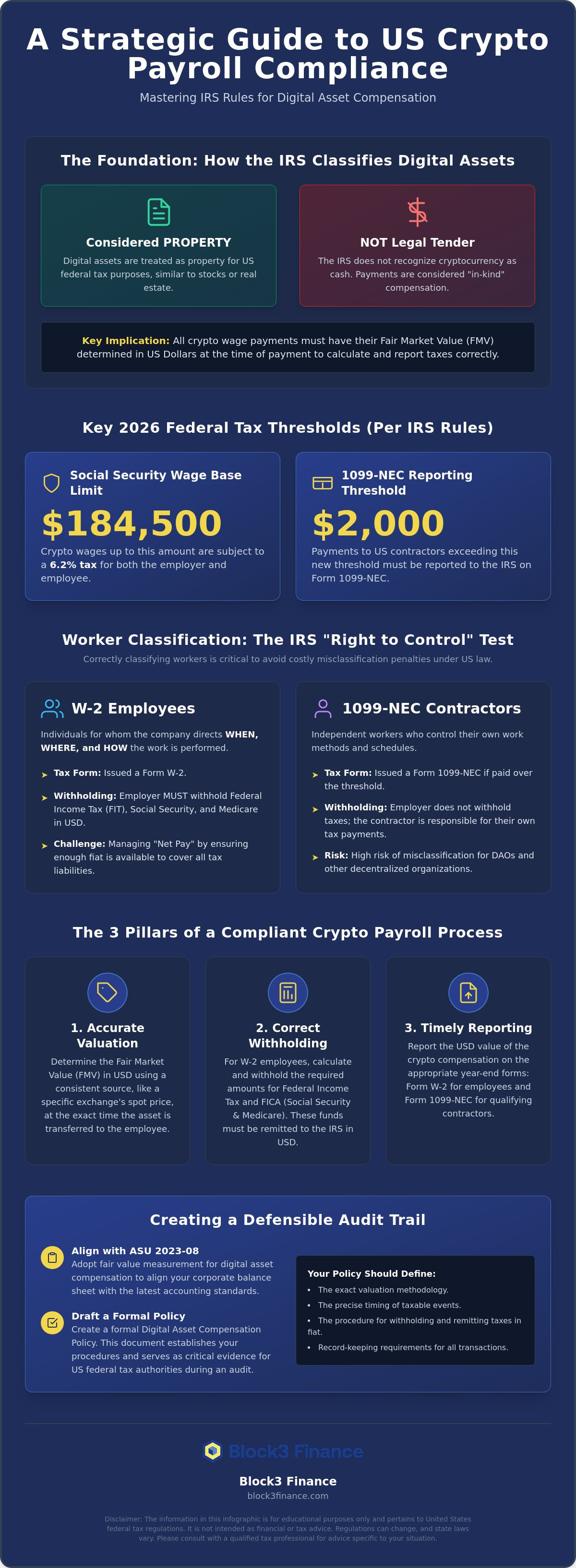
Crypto payroll in the United States isn't a speculative experiment; it's a regulated financial operation. Under federal law, paying wages in digital assets is defined as a "payment in kind," which refers to compensation paid in the form of property rather than cash. The IRS does not recognize cryptocurrency as legal tender. Instead, it treats these assets as property. This fundamental classification within the US Regulatory Framework for Crypto means that every payout is subject to general tax principles. Achieving crypto payroll compliance requires you to move beyond the "send and forget" mindset. You must establish a fiat-denominated salary baseline for every agreement. This ensures that even as token prices fluctuate, the underlying tax obligation remains grounded in US dollars.
Compliance starts with valuation. If you pay an employee in Bitcoin, you aren't just transferring a digital token. You're transferring a specific dollar value that must be reported to federal authorities. This baseline allows you to calculate precise withholding amounts for federal income tax and FICA. Without a fixed USD starting point, your accounting department will face an impossible task during audit season.
IRS Notice 2014-21 and Its 2026 Implications
IRS Notice 2014-21 remains the cornerstone of digital asset taxation under IRS rules. By 2026, federal authorities have refined their focus on these "wages" to ensure full parity with cash compensation. You're required to report the fair market value (FMV) in USD at the exact time the employee receives the asset. This receipt is the taxable event. These payments trigger immediate federal income tax withholding and FICA taxes. For the 2026 tax year, the Social Security wage base limit is $184,500. Every dollar of crypto value up to that threshold is subject to the 6.2% employer and employee tax rate.
Federal vs. State Compliance Considerations
Federal guidelines provide the broad strokes, but state-level regulations add layers of complexity. Some states maintain "legal tender" laws that require you to pay a portion of wages in US dollars to satisfy minimum wage or garnishment requirements. You also can't ignore State Unemployment Insurance (SUI) obligations, which apply to the USD value of crypto wages. Managing a decentralized workforce often requires sophisticated corporate structuring to handle these varying state mandates. Proper crypto payroll compliance means aligning your internal policies with both the IRS and the specific labor departments in every state where your employees reside.
Classifying Workers: W-2 Employees vs. 1099 Contractors
The "Right to Control" test remains the definitive metric for worker classification under IRS rules. For Web3 startups, the line between a dedicated contributor and an independent contractor often blurs due to the fluid nature of decentralized work. However, federal authorities maintain a strict view. If your firm directs when, where, and how a person performs their duties, the IRS likely considers them a W-2 employee. Misclassifying these individuals doesn't just lead to back taxes; it triggers penalties that can jeopardize your firm's solvency. DAOs face the highest risk here, as decentralized structures don't grant immunity from federal labor standards. Achieving crypto payroll compliance requires a proactive audit of every working relationship to ensure your reporting matches the reality of your operations.
According to IRS Notice 2014-21, digital assets are property, and payments made to workers are subject to the same tax principles as cash wages. This means you must issue Form W-2 for employees and Form 1099-NEC for contractors who meet the reporting threshold. If you're unsure about your current worker status, consult with our team to perform a classification audit before your next disbursement.
IRS Withholding Requirements for W-2 Employees
Paying W-2 employees in digital assets creates a "Net Pay" challenge. You must calculate Federal Income Tax (FIT), Social Security, and Medicare based on the USD value at the time of payment. For 2026, the Social Security wage base limit is $184,500, requiring a 6.2% tax from both the employer and employee. Since the IRS doesn't accept Bitcoin for tax payments, you must ensure enough fiat is withheld from the total compensation package to cover these liabilities. Many firms choose to "gross up" payments. This involves increasing the total payout to ensure the employee receives the intended crypto amount after all USD taxes are settled.
Reporting Payments to 1099 Contractors
For payments made after December 31, 2025, the reporting threshold for Form 1099-NEC has increased to $2,000. If you pay a US-based contractor more than this amount in crypto during 2026, you must file this form with the IRS. You're also required to collect a signed Form W-9 before the first disbursement to verify their Taxpayer Identification Number. For a deeper look at managing these specific relationships, see our guide on Paying Contractors in Cryptocurrency: The 2026 US IRS Compliance Guide. Failing to secure these documents early can lead to backup withholding requirements, adding unnecessary friction to your global operations.
Valuation and Timing: Determining Fair Market Value (FMV)
Precise valuation is the bedrock of crypto payroll compliance under IRS rules. The IRS treats the timestamp of an on-chain transaction as the definitive taxable event. This means the fair market value (FMV) of the digital asset must be captured at the exact moment the worker gains dominion and control over the funds. Relying on daily averages or vague software estimates is a defensive posture that fails during a federal audit. You must adopt a consistent methodology, such as utilizing a specific exchange spot price at the time of the transaction, to ensure your records are defensible and accurate.
Volatility remains a significant hurdle for firms paying in assets like Bitcoin. With Bitcoin trading at approximately $62,500 in mid-July 2026, even a few minutes of delay between payroll approval and execution can create a discrepancy in the reported USD value. This gap complicates your withholding calculations and creates friction in your ledger. By establishing a rigid execution protocol, you eliminate the ambiguity that often leads to under-reporting or over-withholding. This discipline positions your firm as a calibrated actor in a fast-moving market.
Cost Basis Tracking for the Employer
Your obligations don't end with the employee's tax liability. When you pay a team member using digital assets held on your balance sheet, you are essentially disposing of property to satisfy a debt. If the asset has appreciated since you acquired it, your firm must recognize a capital gain. Conversely, if the value has dropped, you may realize a loss. Maintaining rigorous monthly bookkeeping is essential to track these shifting cost bases. Without this oversight, you risk miscalculating your corporate tax liability, leading to expensive corrections during year-end filing.
Stablecoins: USDC vs. USDT in US Payroll
Many firms utilize stablecoins to mitigate the friction of valuation. USDC is frequently the preferred choice for US-based compliance due to its transparent reserve reporting and alignment with domestic regulatory expectations. While these assets aim for a 1:1 peg with the US dollar, minor fluctuations still occur. You must account for these fractional deviations to maintain a clean audit trail. Leveraging professional on-and-off-ramp solutions allows you to fund these payroll cycles efficiently while ensuring your fiat-to-crypto transitions are documented and compliant with federal oversight.
Accounting Standards and Audit Readiness (ASU 2023-08)
The transition to fair value measurement under ASU 2023-08 marks a pivotal shift in how US entities report digital asset holdings. Effective for fiscal years beginning after December 15, 2024, this standard mandates that you measure eligible crypto assets at fair value in each reporting period, with changes flowing directly through net income. This replaces the previous, more restrictive impairment-only model. For your payroll operations, this means the digital assets on your balance sheet are now subject to a more dynamic valuation process. When you disburse these assets to employees, the transaction impacts both your corporate balance sheet and your income statement in real time. Accurate crypto payroll compliance now requires you to reconcile the fair value of the asset at the time of purchase with its fair value at the moment of the payroll taxable event.
Building a defensible audit trail is no longer optional. You must link every on-chain transaction hash directly to your internal payroll records and employee files. This granular level of documentation proves to the IRS that your reported USD values aren't arbitrary. Integrating fractional crypto CFO services ensures your firm maintains these rigorous standards while scaling its Web3 operations. If you're struggling to bridge the gap between your block explorer and your general ledger, contact our specialists to implement an audit-ready accounting framework.
Preparing for an IRS Payroll Audit
Common red flags in a federal payroll audit include inconsistent valuation methodologies and missing 1099-NEC forms for contractors. For the 2026 tax year, remember that the 1099-NEC threshold has increased to $2,000 for payments made after December 31, 2025. You must maintain exhaustive records of wallet ownership and transaction authorizations to prove the legitimacy of every payout. For decentralized entities, managing these records requires specialized oversight. Our guide on DAO Accounting: A Strategic Guide for US-Based Decentralized Organizations provides a deeper look at navigating these complexities under IRS rules.
Internal Controls for Digital Asset Payouts
Strong internal controls protect your firm from both regulatory scrutiny and internal fraud. Implementing multi-sig requirements for all payroll wallet disbursements ensures that no single individual has unilateral control over company assets. You should also maintain a strict separation of duties between the personnel processing payroll and those managing the private keys. Modern software integrations now allow you to connect traditional HRIS platforms directly to the blockchain. This synchronization automates the data flow, reducing the manual entry errors that often trigger IRS inquiries during a routine review.
Implementing a Compliant Crypto Payroll Framework
Implementing a compliant framework requires moving from reactive accounting to proactive governance. You must begin by drafting a formal Digital Asset Compensation Policy. This document serves as your legal shield. It defines the specific exchange used for valuation, the exact timing of the "taxable event," and how your firm manages the volatility risk between approval and disbursement. Without this policy, your crypto payroll compliance remains vulnerable to interpretation by federal auditors during a routine review. A well-defined policy ensures that both the employer and the employee understand the USD-denominated baseline of the compensation package.
Choosing between an in-house setup and a specialized provider depends on your internal technical capacity. While software platforms offer efficiency, they often lack the jurisdictional nuance required for complex US tax filings. You must also establish robust payment solutions to fund your payroll cycles. This involves more than just a simple transfer; you need a documented flow of funds that tracks the transition from corporate fiat accounts to on-chain wallets. Finally, educate your team. Employees receiving digital assets must understand that while you handle the federal withholding, they are responsible for tracking the cost basis of the assets they receive for their own personal tax obligations under IRS rules.
Step-by-Step Compliance Checklist
Success in this space is built on repeatable, disciplined processes. Follow these steps to maintain a clean audit trail:
- Re-verify worker classification (W-2 vs. 1099) every six months to account for evolving roles and the "Right to Control" test.
- Implement automated FMV data collection that captures spot prices at the precise block height of the payment transaction.
- Schedule quarterly tax reviews to reconcile on-chain disbursements with your quarterly federal tax returns, such as Form 941.
The Role of Professional Oversight
Automated software is a powerful tool, but it's not a complete audit defense strategy. Software cannot interpret the nuances of worker classification or navigate the specific fair value disclosures required by ASU 2023-08. Specialized crypto accountants provide the critical layer of human intelligence needed to protect your firm's growth. They transform raw blockchain data into the polished, defensible financial records that IRS agents expect to see. Your firm's evolution into a digital-first organization shouldn't be hampered by regulatory uncertainty. By combining robust internal policies with elite financial oversight, you gain total command over your global compensation strategy. Contact Block3 Finance for a payroll compliance audit to ensure your framework is ready for the 2026 tax year and beyond.
Mastering the Future of Digital Compensation
The landscape of digital asset payroll in 2026 demands more than just basic record-keeping. It requires a sophisticated integration of IRS property rules, precise fair market valuation, and the rigorous accounting standards of ASU 2023-08. By establishing a fiat-denominated baseline and maintaining a clean audit trail for every on-chain transaction, you transform a complex regulatory hurdle into a calibrated growth engine for your firm. Achieving total crypto payroll compliance ensures that your organization remains resilient in the face of federal scrutiny while attracting top-tier global talent.
As the top-ranked provider by Bitcoin.com with over 13 years of blockchain financial expertise, Block3 Finance serves as your visionary navigator in this volatile space. We specialize in turning complex on-chain data into defensible, audit-ready records for US-based entities. Don't leave your firm's stability to chance. Secure your crypto payroll compliance with Block3 Finance and gain the intellectual leadership your Web3 enterprise deserves. You have the tools to lead the evolution of finance; we have the expertise to ensure your foundation is unbreakable.
Frequently Asked Questions
Is it legal to pay employees 100% in cryptocurrency in the US?
Yes, it's legal under federal law to pay employees entirely in digital assets, but state-level labor laws often complicate this. Many states require that you pay at least the minimum wage portion in US dollars to satisfy "legal tender" requirements. You must also ensure enough fiat is withheld to cover federal income tax and Social Security obligations under IRS rules.
Do I need to withhold taxes if I pay my contractors in Bitcoin?
You generally don't withhold taxes for independent contractors in the US, but you must report payments on Form 1099-NEC if they exceed $2,000 for the 2026 tax year. If a contractor fails to provide a valid Form W-9, you may be required to perform backup withholding. This ensures your crypto payroll compliance remains intact even when dealing with non-compliant vendors.
How do I calculate the USD value of a crypto payroll payment for the IRS?
You calculate the USD value by determining the fair market value (FMV) of the asset at the exact timestamp the worker receives it. The IRS requires you to use a consistent valuation methodology, such as the spot price from a major exchange. This specific USD value becomes the basis for all federal withholding and reporting requirements.
What happens if the value of the crypto drops after I pay my employee?
A drop in value after the payout doesn't change your initial tax liability. The taxable event is fixed at the moment of receipt. If the asset loses value later, the employee may realize a capital loss when they sell, but your payroll withholding must still reflect the FMV at the time the wages were paid under US federal law.
Which IRS forms are required for reporting crypto payroll?
You must use Form W-2 for employees and Form 1099-NEC for contractors receiving $2,000 or more in 2026. Additionally, employers must file Form 941 quarterly to report federal income tax and FICA taxes withheld from crypto wages. These forms are critical for maintaining a defensible audit trail for any US-based entity.
Can a DAO be held liable for payroll tax if it has no central US office?
Yes, a DAO can be held liable for payroll taxes if it engages US-based workers. The IRS doesn't require a physical office to establish an employer-employee relationship. If the DAO directs the work of a US person, it must comply with federal withholding and reporting mandates to avoid significant penalties regardless of its decentralized structure.
How does ASU 2023-08 change how I account for crypto payroll expenses?
ASU 2023-08 mandates that you measure certain digital assets at fair value rather than using the old impairment-only model. This means changes in the value of the crypto you hold for payroll must be recorded in your net income each reporting period. It provides a more accurate reflection of your firm's financial health on the corporate balance sheet.
Do employees need to pay capital gains tax on their crypto salary?
Employees don't pay capital gains on the initial receipt of their salary; they pay ordinary income tax on the FMV at that time. However, if they hold the crypto and it appreciates, they'll owe capital gains tax when they sell or exchange it. This secondary tax event is independent of the initial payroll transaction under IRS rules.

Article by
Mahad Mohamed
Mahad Mohamed is an accountant and the CEO of Block3 Finance, with over 26+ years of Canadian and international tax and accounting experience. A crypto accounting specialist since the early days of Bitcoin, he has consulted for over 38 crypto companies and collaborated with legal professionals on regulatory matters. His expertise spans corporate reorganization, cross-border tax structuring (Canada & US), tax disputes, and CRA audits.
Previously, Mahad worked for the Canada Revenue Agency (CRA), Big4 accounting firms, and served as a Rulings Officer for the Federal Tax Authority of the UAE before acquiring Tax Partners in 2014.
Block3 Finance and Tax Partners has 44 full-time accountants and over 9,800+ clients.
Disclaimer
This article provides general information only and is current as of its publication date. It has not been updated and may be out of date. It does not constitute legal advice and should not be relied upon as such. Every tax situation is unique and may differ from the examples discussed in this article. If you have specific questions, you should seek the advice of our accountants for your unique circumstances.
Frequently Asked Questions
Is it legal to pay employees 100% in cryptocurrency in the US?
Yes, it's legal under federal law to pay employees entirely in digital assets, but state-level labor laws often complicate this. Many states require that you pay at least the minimum wage portion in US dollars to satisfy "legal tender" requirements. You must also ensure enough fiat is withheld to cover federal income tax and Social Security obligations under IRS rules.
Do I need to withhold taxes if I pay my contractors in Bitcoin?
You generally don't withhold taxes for independent contractors in the US, but you must report payments on Form 1099-NEC if they exceed $2,000 for the 2026 tax year. If a contractor fails to provide a valid Form W-9, you may be required to perform backup withholding. This ensures your crypto payroll compliance remains intact even when dealing with non-compliant vendors.
How do I calculate the USD value of a crypto payroll payment for the IRS?
You calculate the USD value by determining the fair market value (FMV) of the asset at the exact timestamp the worker receives it. The IRS requires you to use a consistent valuation methodology, such as the spot price from a major exchange. This specific USD value becomes the basis for all federal withholding and reporting requirements.
What happens if the value of the crypto drops after I pay my employee?
A drop in value after the payout doesn't change your initial tax liability. The taxable event is fixed at the moment of receipt. If the asset loses value later, the employee may realize a capital loss when they sell, but your payroll withholding must still reflect the FMV at the time the wages were paid under US federal law.
Which IRS forms are required for reporting crypto payroll?
You must use Form W-2 for employees and Form 1099-NEC for contractors receiving $2,000 or more in 2026. Additionally, employers must file Form 941 quarterly to report federal income tax and FICA taxes withheld from crypto wages. These forms are critical for maintaining a defensible audit trail for any US-based entity.
Can a DAO be held liable for payroll tax if it has no central US office?
Yes, a DAO can be held liable for payroll taxes if it engages US-based workers. The IRS doesn't require a physical office to establish an employer-employee relationship. If the DAO directs the work of a US person, it must comply with federal withholding and reporting mandates to avoid significant penalties regardless of its decentralized structure.
How does ASU 2023-08 change how I account for crypto payroll expenses?
ASU 2023-08 mandates that you measure certain digital assets at fair value rather than using the old impairment-only model. This means changes in the value of the crypto you hold for payroll must be recorded in your net income each reporting period. It provides a more accurate reflection of your firm's financial health on the corporate balance sheet.
Do employees need to pay capital gains tax on their crypto salary?
Employees don't pay capital gains on the initial receipt of their salary; they pay ordinary income tax on the FMV at that time. However, if they hold the crypto and it appreciates, they'll owe capital gains tax when they sell or exchange it. This secondary tax event is independent of the initial payroll transaction under IRS rules.