
In 2026, the perceived anonymity of international digital finance has officially met the reality of the Canada Revenue Agency's new reporting era. For Canadian firms, sending Bitcoin to a developer in Europe or USDT to a supplier in Asia is no longer just a transfer; it is a sophisticated barter transaction that demands immediate CAD valuation and precise regulatory alignment. You likely recognize the mounting friction of managing these assets as the CRA implements the Crypto-Asset Reporting Framework (CARF), creating a landscape where every on-chain movement is visible to authorities. Understanding the tax implications of cross-border crypto payments is now the difference between strategic global scaling and a devastating audit cycle.
We believe that regulatory complexity should be a catalyst for mastery rather than a barrier to growth. This guide provides the clarity you need to navigate non-resident withholding requirements, avoid the pitfalls of double taxation through treaty benefits, and ensure your financial records remain defensible under 2026's increased capital gains inclusion rates. We will explore a clear framework for international compliance that transforms your accounting from a defensive necessity into a calibrated tool for global expansion.
Key Takeaways
- Recognize why the CRA classifies digital assets as commodities rather than functional currency, which necessitates treating every international transfer as a complex barter transaction.
- Master the precise calculation of fair market value in Canadian dollars at the moment of settlement to accurately report the tax implications of cross-border crypto payments.
- Identify your obligations under Part XIII tax rules, specifically regarding the statutory withholding requirements and potential treaty benefits for payments made to non-resident entities.
- Build a robust and defensible audit trail by reconciling complex on-chain data with your primary CAD financial records to prepare for 2026 CRA scrutiny.
- Understand how "Mind and Management" principles determine the tax residency of international subsidiaries and protect your firm from unintended Canadian tax liabilities.
The Mechanics of International Crypto Payments under CRA Rules
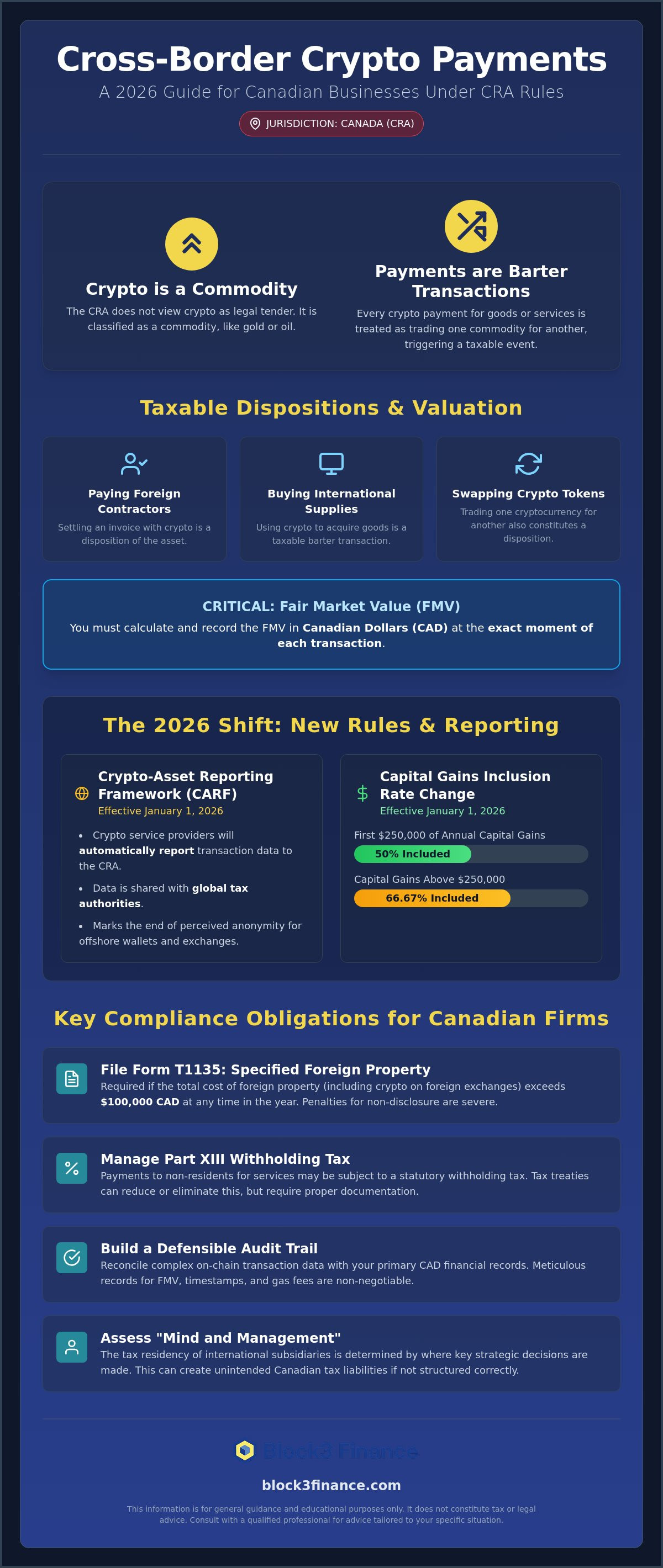
The Canada Revenue Agency (CRA) does not recognize Bitcoin, Ethereum, or stablecoins as legal tender. For Canadian business owners, this is the most critical starting point. Under CRA rules, digital assets are classified as commodities. When your firm settles an international invoice using crypto, you aren't simply moving currency; you are executing a barter transaction. This means you are trading one commodity for a service or a different product. Navigating the tax implications of cross-border crypto payments requires an elite understanding of how these digital commodities are valued and reported within the Canadian tax system.
A taxable event occurs the moment you dispose of the asset. This includes paying a foreign contractor, purchasing equipment from an international supplier, or swapping one token for another on a global exchange. For every transaction, you must establish the fair market value (FMV) in Canadian dollars at the exact time of the transfer. While global cryptocurrency regulations vary by jurisdiction, Canadian businesses remain bound by the specific barter rules established by the CRA. Failure to capture this data in real time creates significant friction during year end reporting.
Your tax liability depends on whether the CRA classifies your activity as business income or capital gains. If your firm is in the business of trading or frequently using crypto for operations, 100% of the profits are taxable as business income. Conversely, if the assets are held as investments, capital gains rules apply. Starting January 1, 2026, for capital gains exceeding $250,000 in a year, the inclusion rate increases to 66.67%, while the first $250,000 remains at the 50% rate. Our crypto tax accountants in Canada help you distinguish between these categories to optimize your tax position.
Crypto as Specified Foreign Property (Form T1135)
Canadian corporations holding specified foreign property with a total cost exceeding $100,000 CAD at any point during the year must file Form T1135. This includes cryptocurrency held on foreign exchanges or in wallets managed outside Canada. The CRA increasingly tracks these assets through data sharing and blockchain analytics. Penalties for non disclosure are severe and accrue daily; we ensure your international digital holdings are correctly disclosed to maintain full compliance.
The Impact of the OECD Crypto-Asset Reporting Framework (CARF)
The era of digital anonymity officially ends on January 1, 2026. With Canada's implementation of the CARF, crypto asset service providers will automatically report transaction data to the CRA, which is then shared with global tax authorities. "Offshore" wallets no longer provide a shield from domestic oversight. Your business must adopt a proactive stance, ensuring that on chain activity matches your CAD financial records before the CRA initiates an inquiry.
Barter Transaction Rules and Fair Market Value (FMV) in 2026
Settling an international debt with digital assets transforms a simple payment into a complex exchange of value. The CRA mandates that businesses treat these as barter transactions. In this framework, the value of the goods or services received must match the fair market value (FMV) of the cryptocurrency surrendered. If the value of the service is not readily apparent, the CRA requires you to use the FMV of the digital asset at the precise moment of the trade. This valuation requirement remains the cornerstone of understanding the tax implications of cross-border crypto payments for any Canadian enterprise operating on a global scale.
Precision in your CAD records is non-negotiable. You must account for the volatility inherent in the digital asset market, as the value of a token often shifts significantly between the time an invoice is issued and the moment the transaction settles on the blockchain. Additionally, network costs, commonly known as gas fees, require careful documentation. These fees generally increase the cost of the goods or services acquired or decrease the proceeds from a disposition. Failing to track these granular costs leads to inaccurate financial reporting and potential friction during a CRA audit. To refine your internal reporting systems, consult with our specialized team for a tailored compliance roadmap.
Valuation Methodologies for International Payments
Canadian businesses must establish a consistent methodology for determining CAD value. The CRA expects you to use a reputable public exchange that provides a verifiable price for the specific asset at the time of the transaction. Consistency is vital; you cannot switch between different exchange rates to find a more favorable tax position. Maintaining a synchronized record of the "point-in-time" value ensures your books remain audit-ready and defensible against regulatory scrutiny.
Taxable Gain or Loss on Payment Settlement
Every cross-border payment triggers a secondary tax calculation. You must compare the FMV of the crypto at the time of payment against its original adjusted cost base (ACB). If the value has increased since you first acquired the asset, you realize a taxable gain. Conversely, if the value has dropped, you may report a capital loss to offset other gains. Managing these moving parts requires professional crypto tax filing for Canadian businesses to ensure every disposition is captured accurately within your corporate tax return. Our strategists help you navigate these calculations to protect your firm’s bottom line while maintaining total transparency with the CRA.
Withholding Taxes and International Treaty Considerations
Mastering the tax implications of cross-border crypto payments requires you to move beyond simple valuation and address the complexities of Part XIII tax. Under CRA rules, when a Canadian business pays a non-resident for specific types of income, such as management fees, royalties, or certain services, a statutory withholding tax of 25% typically applies. This obligation remains active even when the medium of exchange is a digital asset. You must calculate the 25% withholding amount based on the fair market value of the crypto at the time of the transaction, remit that value in Canadian dollars to the CRA, and issue an NR4 slip to the recipient. For 2026 filers, it is vital to confirm the current NR4 filing deadlines directly with the CRA to avoid late-filing penalties.
Tax treaties serve as your primary defense against excessive withholding costs. Canada maintains an extensive network of international agreements, such as the Canada-US tax treaty, which can significantly reduce or even eliminate the 25% statutory rate. These treaties ensure that your global operations remain competitive by preventing the same income from being taxed at full rates in two different jurisdictions. However, claiming treaty benefits is not automatic. You must obtain valid documentation from your foreign vendors, such as a completed Form NR301, to justify the reduced rate during a CRA audit. Our CFO services provide the high-level oversight necessary to manage these treaty applications and protect your firm's cash flow.
Determining the Residency of Your Crypto Vendors
Due diligence is the foundation of a defensible tax strategy. Identifying the residency of a vendor is straightforward with traditional corporations, but it becomes high-stakes when dealing with Decentralized Autonomous Organizations (DAOs) or anonymous developers. If you cannot definitively prove a recipient's tax residency, the CRA may default to the 25% withholding requirement. Furthermore, many crypto-native contracts include "gross-up" clauses. These clauses require your business to pay the vendor the full crypto amount while you absorb the cost of the withholding tax yourself, effectively increasing your operational expenses by 25% or more.
Avoiding Double Taxation on Global Income
Strategic corporate planning allows you to utilize Foreign Tax Credits (FTC) to offset Canadian tax liabilities against taxes already paid abroad. This mechanism is essential for maintaining a lean global footprint. To better understand how to protect your firm, explore our guide on Navigating cross-border crypto tax myths. By integrating these credits with sophisticated corporate structuring, we help you resolve the friction of international expansion while ensuring total compliance with the CRA's evolving digital asset framework.
Best Practices for Maintaining International Crypto Tax Compliance
Operational excellence is the only sustainable defense against regulatory volatility. While the blockchain provides an immutable ledger of activity, the CRA requires a human-readable narrative that justifies every movement of value across borders. For Canadian firms, mastering the tax implications of cross-border crypto payments depends on your ability to bridge the gap between raw on-chain data and traditional CAD financial reporting. You must transform thousands of disparate wallet interactions into a cohesive, defensible audit trail that stands up to the most rigorous scrutiny.
Integrating digital asset activity into your primary bookkeeping system is not a passive task. It requires the active cultivation of a "point-of-transaction" mindset where every gas fee, network cost, and settlement value is captured in real-time. The CRA expects your records to be maintained for at least six years, a significantly longer duration than the three-year standard often seen in other jurisdictions. This long-term accountability means your data must remain accessible and verifiable long after the original wallet or exchange may have evolved or ceased operations. To ensure your financial foundation is secure, schedule a professional compliance review with our team today.
Record-Keeping Checklist for Cross-Border Payments
Maintaining audit-ready bookkeeping for Web3 firms requires a meticulous approach to documentation. For every international transfer, your records must include the unique Transaction ID (hash), the sender and recipient wallet addresses, and a precise timestamp. Crucially, you must pair this data with an invoice that reflects the CAD fair market value at the exact moment of the trade. This level of detail eliminates the friction of retroactive valuation and proves to the CRA that your firm is operating with total transparency.
Software vs. Human Expertise in 2026
Generic tax software often fails to resolve the nuances of complex international corporate flows, particularly when dealing with non-resident withholding or multi-jurisdictional subsidiaries. While automated tools are useful for data ingestion, they lack the sophisticated judgment required for high-volume reconciliation. Engaging an elite crypto tax accountant in Canada provides the strategic oversight necessary to navigate 2026's enhanced reporting standards. We provide the intellectual depth to identify tax-saving opportunities that algorithms simply miss, ensuring your global expansion remains both compliant and profitable.
Preparing for a CRA audit involves more than just exporting a CSV file. Auditors will likely request your original source documents, including exchange statements, private wallet exports, and any relevant international tax treaty forms. By maintaining a clean, synchronized ledger, you position your firm as a disciplined actor in the digital economy rather than a target for enforcement.
Strategic Corporate Structuring for Global Digital Asset Operations
Global expansion requires a structural philosophy that transcends individual transactions. For Canadian enterprises, the tax implications of cross-border crypto payments are deeply influenced by where the entity is incorporated and, more importantly, where its "Mind and Management" resides. The CRA determines corporate residency based on where the central control and management of the business actually occur. If your key strategic decisions are made by directors within Canada, the corporation may be deemed a Canadian resident for tax purposes, regardless of its foreign incorporation. Our team helps you navigate these residency traps to ensure your international subsidiaries remain tax-efficient and compliant.
Choosing the right jurisdiction for your digital asset operations is a high-stakes decision that impacts your global tax footprint. A poorly structured international arm can lead to unintended tax liabilities or the loss of treaty benefits. We provide a roadmap for corporate structuring for Canadian crypto founders that aligns your legal framework with your operational reality. By leveraging our CFO services, you gain the high-level oversight necessary to manage global liquidity while mitigating the risks associated with multi-jurisdictional tax enforcement.
Managing On-Ramp and Off-Ramp Friction
Converting CAD to stablecoins like USDC or USDT to settle international payables is a taxable event. Every conversion triggers a disposition that must be reported to the CRA. We help you implement strategic on- and off-ramp solutions that minimize the friction of these transfers. Beyond tax duties, your firm must remain vigilant regarding Anti-Money Laundering (AML) and Anti-Terrorist Financing (ATF) regulations. Synchronizing your tax reporting with these regulatory obligations ensures your global payment flows remain uninterrupted and fully transparent.
The Visionary Navigator: Partnering with Block3 Finance
Block3 Finance acts as your elite strategist in a volatile financial landscape. We specialize in turning complex on-chain activity into clean, defensible records that satisfy CRA auditors and international tax authorities alike. For scaling Web3 enterprises, the benefits of fractional CFO leadership are clear. You gain access to 13+ years of blockchain financial expertise without the overhead of a full-time executive. Our mission is to provide you with total command over your financial future. To master the broader regulatory environment, we invite you to explore our comprehensive guide to crypto tax in Canada. Together, we will resolve the friction of international expansion and secure your firm's position as a leader in the global digital economy.
Master Your Global Digital Footprint
The landscape of international finance is shifting. For Canadian firms, the ability to resolve the tax implications of cross-border crypto payments is no longer a niche skill; it's a fundamental requirement for global growth. You've learned why the CRA treats every transfer as a commodity exchange and how establishing fair market value in real-time is essential for audit-readiness. By mastering Part XIII withholding rules and leveraging international tax treaties, you transform regulatory friction into a strategic advantage.
Block3 Finance stands as your elite navigator in this complex environment. Top-ranked by Bitcoin.com and specialized in generating CRA-defensible financial records, we bridge the gap between legacy finance and the digital asset space. Our global offices leverage deep Canadian expertise to protect your firm from penalties while optimizing your international tax position. You don't have to navigate 2026's enhanced reporting requirements alone.
Secure your international compliance with Block3 Finance. The future belongs to the disciplined and the proactive. We're ready to help you command this new financial landscape with total confidence.
Frequently Asked Questions
Do I need to pay GST/HST on crypto payments made to international vendors?
GST/HST typically does not apply to payments sent to non-resident vendors who have no business presence in Canada. If the vendor is a registered GST/HST filer, you must calculate the tax based on the fair market value of the digital asset in Canadian dollars at the time of the transaction. Always verify the vendor's registration status to ensure your input tax credit claims remain valid under CRA rules.
How does the CRA treat stablecoin payments for cross-border services?
The CRA treats stablecoins as commodities rather than functional currency for tax purposes. Using USDT or USDC to settle an invoice is a barter transaction that triggers a taxable event. You must establish the CAD value of the stablecoin at the moment of transfer to determine any realized gain or loss on the underlying asset surrendered in the exchange.
What is the penalty for failing to report international crypto transactions in Canada?
Failing to report international transactions can lead to gross negligence penalties equal to 50% of the understated tax. For missing a required T1135 filing, the CRA imposes a penalty of $25 per day, up to a maximum of $2,500 plus interest. Deliberate non-disclosure in the era of CARF reporting carries even higher risks of comprehensive corporate audits.
Can I use a US-based crypto tax software for my Canadian business filings?
Most US-based crypto tax software is incompatible with Canadian requirements because it often defaults to IRS-specific identification methods. The CRA strictly mandates the use of the Adjusted Cost Base (ACB) method for all digital asset dispositions. Using the wrong methodology creates systemic errors in your financial records that won't survive a professional CRA audit.
Are crypto payments to international employees subject to Canadian payroll taxes?
Paying international employees in crypto doesn't exempt your business from Canadian payroll obligations if the individual is a Canadian tax resident. For non-resident employees performing work outside Canada, you must still evaluate Part XIII withholding requirements. These rules ensure that the tax implications of cross-border crypto payments are captured regardless of the medium used for compensation.
How do I claim a foreign tax credit for crypto taxes paid in another country?
You can claim a Foreign Tax Credit (FTC) by filing Form T2036 to prevent the double taxation of global income. This mechanism allows you to deduct taxes paid to a foreign jurisdiction from your Canadian tax liability. You must maintain rigorous documentation, including proof of payment to the foreign tax authority, to justify these credits during a formal review.
Does the CRA track wallet-to-wallet transfers sent outside of Canada?
The CRA possesses sophisticated blockchain analytics tools and participates in the Crypto-Asset Reporting Framework (CARF) to monitor wallet-to-wallet transfers. Starting in 2026, service providers must automatically report transaction data to the CRA. This increased transparency means that transfers to private wallets or foreign exchanges are no longer invisible to Canadian authorities.
What is the T1135 form and do I need it for my business crypto holdings?
Form T1135 is the Foreign Income Verification Statement required for Canadian taxpayers holding specified foreign property. If the total cost of your crypto held on foreign exchanges or in foreign-managed wallets exceeds $100,000 CAD at any point in the year, you must file this form. Failure to disclose these assets leads to significant daily penalties and increased regulatory scrutiny for your enterprise.

Article by
Mahad Mohamed
Mahad Mohamed is an accountant and the CEO of Block3 Finance, with over 26+ years of Canadian and international tax and accounting experience. A crypto accounting specialist since the early days of Bitcoin, he has consulted for over 38 crypto companies and collaborated with legal professionals on regulatory matters. His expertise spans corporate reorganization, cross-border tax structuring (Canada & US), tax disputes, and CRA audits.
Previously, Mahad worked for the Canada Revenue Agency (CRA), Big4 accounting firms, and served as a Rulings Officer for the Federal Tax Authority of the UAE before acquiring Tax Partners in 2014.
Block3 Finance and Tax Partners has 44 full-time accountants and over 9,800+ clients.
Disclaimer
This article provides general information only and is current as of its publication date. It has not been updated and may be out of date. It does not constitute legal advice and should not be relied upon as such. Every tax situation is unique and may differ from the examples discussed in this article. If you have specific questions, you should seek the advice of our accountants for your unique circumstances.
Frequently Asked Questions
Do I need to pay GST/HST on crypto payments made to international vendors?
GST/HST typically does not apply to payments sent to non-resident vendors who have no business presence in Canada. If the vendor is a registered GST/HST filer, you must calculate the tax based on the fair market value of the digital asset in Canadian dollars at the time of the transaction. Always verify the vendor's registration status to ensure your input tax credit claims remain valid under CRA rules.
How does the CRA treat stablecoin payments for cross-border services?
The CRA treats stablecoins as commodities rather than functional currency for tax purposes. Using USDT or USDC to settle an invoice is a barter transaction that triggers a taxable event. You must establish the CAD value of the stablecoin at the moment of transfer to determine any realized gain or loss on the underlying asset surrendered in the exchange.
What is the penalty for failing to report international crypto transactions in Canada?
Failing to report international transactions can lead to gross negligence penalties equal to 50% of the understated tax. For missing a required T1135 filing, the CRA imposes a penalty of $25 per day, up to a maximum of $2,500 plus interest. Deliberate non-disclosure in the era of CARF reporting carries even higher risks of comprehensive corporate audits.
Can I use a US-based crypto tax software for my Canadian business filings?
Most US-based crypto tax software is incompatible with Canadian requirements because it often defaults to IRS-specific identification methods. The CRA strictly mandates the use of the Adjusted Cost Base (ACB) method for all digital asset dispositions. Using the wrong methodology creates systemic errors in your financial records that won't survive a professional CRA audit.
Are crypto payments to international employees subject to Canadian payroll taxes?
Paying international employees in crypto doesn't exempt your business from Canadian payroll obligations if the individual is a Canadian tax resident. For non-resident employees performing work outside Canada, you must still evaluate Part XIII withholding requirements. These rules ensure that the tax implications of cross-border crypto payments are captured regardless of the medium used for compensation.
How do I claim a foreign tax credit for crypto taxes paid in another country?
You can claim a Foreign Tax Credit (FTC) by filing Form T2036 to prevent the double taxation of global income. This mechanism allows you to deduct taxes paid to a foreign jurisdiction from your Canadian tax liability. You must maintain rigorous documentation, including proof of payment to the foreign tax authority, to justify these credits during a formal review.
Does the CRA track wallet-to-wallet transfers sent outside of Canada?
The CRA possesses sophisticated blockchain analytics tools and participates in the Crypto-Asset Reporting Framework (CARF) to monitor wallet-to-wallet transfers. Starting in 2026, service providers must automatically report transaction data to the CRA. This increased transparency means that transfers to private wallets or foreign exchanges are no longer invisible to Canadian authorities.
What is the T1135 form and do I need it for my business crypto holdings?
Form T1135 is the Foreign Income Verification Statement required for Canadian taxpayers holding specified foreign property. If the total cost of your crypto held on foreign exchanges or in foreign-managed wallets exceeds $100,000 CAD at any point in the year, you must file this form. Failure to disclose these assets leads to significant daily penalties and increased regulatory scrutiny for your enterprise.