
A crypto gift can be tax-free when received and still create a tax bill when sold. Under U.S. crypto gift tax rules, recipients generally don’t recognize income simply for receiving a bona fide gift, but selling, exchanging, or otherwise disposing of the crypto may create a reportable gain or loss.
The first priority is to document that the transfer was a gift. Clear records can also establish the asset’s value, the donor’s cost basis, and its acquisition date, all of which may affect how a later sale is taxed.
This article explains what to document when you receive crypto, how U.S. gift-tax reporting may apply to donors, and how basis and holding period affect the tax treatment of gifted crypto when it is disposed of. It also explains why the recipient’s records and the donor’s transfer details matter long after the gift.
Key Takeaways
- Keep a gift letter and transfer records that identify the crypto, amount, transfer date, and donor’s cost basis and acquisition date.
- Use the donor’s basis and the asset’s value when received to assess your basis for a later sale; inherited crypto follows different rules.
- For donors, whether a gift requires reporting depends on the annual exclusion and the recipient. A U.S. donor who exceeds the annual gift tax exclusion must file Form 709.
- Receiving a bona fide crypto gift generally isn’t income, but selling, exchanging, or otherwise disposing of it can create a reportable gain or loss.
- Charitable donations and gifts from foreign persons can have separate documentation or reporting requirements, so identify the type of transfer before assessing its tax treatment.
Can you claim a loss on a crypto gift to a connected party under U.S. rules?
A capital loss is generally the amount by which an asset’s tax basis exceeds the proceeds from a taxable sale. A donor generally can’t claim a loss simply because gifted crypto has fallen in value. A transfer without payment doesn’t establish sale proceeds. For example, giving crypto to a connected person when it is worth less than its acquisition cost doesn’t turn the price decline into a deductible sale loss. U.S. crypto gift tax rules distinguish personal gifts from sales and charitable contributions.
Yes. U.S. tax treatment can differ depending on whether crypto goes to a spouse, charity, or foreign recipient. Charitable donations may require documentation to support a deduction, while certain foreign gifts trigger reporting by the recipient. Gifts between spouses also have distinct gift-tax treatment. The recipient’s later sale is a separate transaction from the original gift.
For a charitable donation, distinguish transferring crypto from claiming a deduction. A donor claiming a U.S. charitable deduction of $250 or more for a virtual currency donation must obtain a contemporaneous written acknowledgment, according to the Internal Revenue Service. Retain the acknowledgment with records identifying the asset, amount transferred, recipient organization, and transfer date. A charitable deduction is not the same as claiming a capital loss on a gift to a connected person.
Foreign gifts have a separate recipient reporting rule. In the United States, a recipient who receives gifts from one foreign person or estate totaling more than $100,000 in a calendar year must file IRS Form 3520, according to the Internal Revenue Service. The threshold concerns gifts from that foreign person or estate during the calendar year, not whether the crypto later produces capital gains. Keep donor details and transfer records to substantiate the source and amount.
For each transfer, preserve records that show what happened:
- Save transaction details showing the asset, amount, date, and wallet addresses.
- Retain a gift letter identifying the recipient and confirming no payment was exchanged.
- Keep the charity’s acknowledgment when claiming a deduction of $250 or more.
- Total gifts from each foreign person or estate for the calendar year when assessing Form 3520 reporting.
Under U.S. crypto gift tax rules, documenting the transfer’s purpose helps distinguish a gift from a sale or donation. U.S. crypto tax reporting also depends on how each transaction fits into the taxpayer’s records; tax filing and reporting accounts for that activity.
Keep the donor’s acquisition records with the gift documentation, then assess any later sale separately. This creates a clearer history of the original transfer and any subsequent capital gain or loss.
How do I prove that the crypto I received was a gift under U.S. rules?
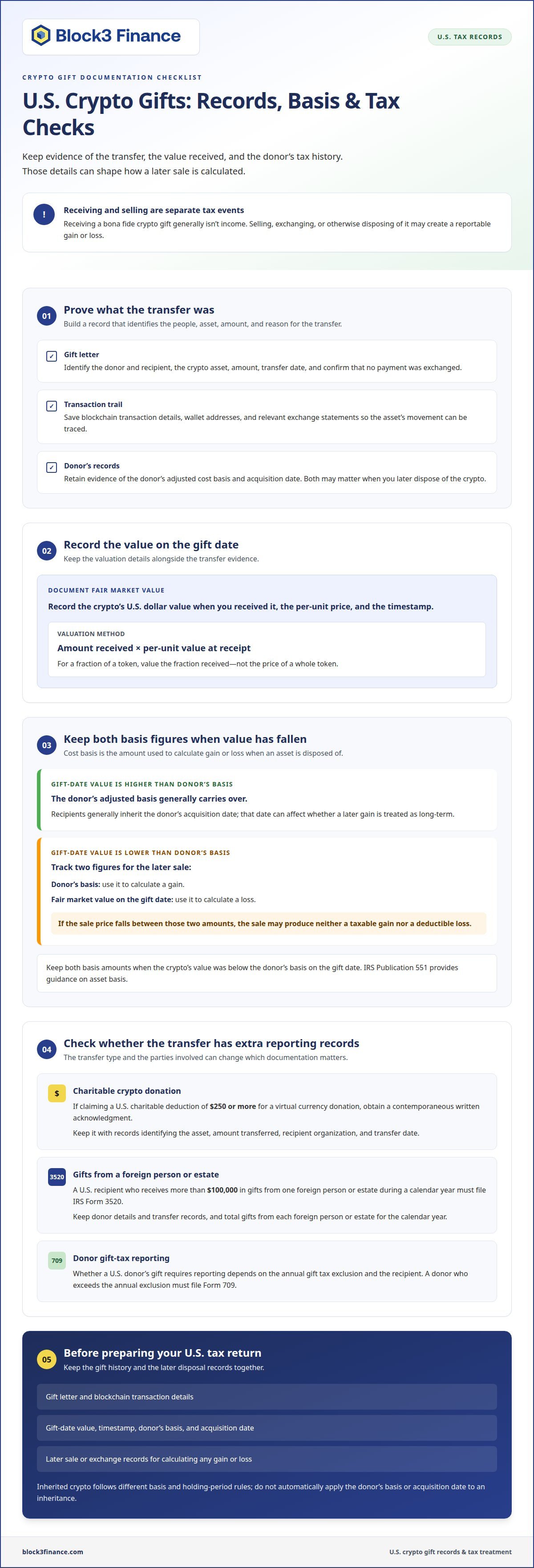
Keep evidence of who transferred the crypto, what you received, and why. A gift letter should identify the asset, amount, transfer date, donor’s cost basis, and acquisition date. Pair it with transaction records, such as wallet addresses and exchange statements, to make the gift’s origin and movement traceable.
To document fair market value, record the crypto’s U.S. dollar value on the date you received it. Multiply the amount transferred by its per-unit value at that time, and retain the pricing record and timestamp. For example, value a fraction of a token based on the amount received, not the price of a whole token.
Cost basis is the amount used to calculate gain or loss when you later dispose of an asset. For gifted crypto, the donor’s adjusted basis generally carries over when the crypto’s fair market value at receipt is higher than the donor’s basis. The acquisition date matters too: recipients generally inherit the donor’s acquisition date, which can affect whether a later gain is treated as long-term.
The double-basis rule applies to gifts whose value has fallen below the donor’s basis. In that situation, use the donor’s basis to calculate a gain and the crypto’s fair market value on the gift date to calculate a loss. If the sale price falls between those amounts, the sale may produce neither a taxable gain nor a deductible loss. Keep both figures rather than recording only one basis.
IRS Publication 551 provides guidance on asset basis. Inherited crypto differs from gifted crypto, so don’t automatically apply the donor’s cost basis or acquisition date to an inheritance. Preserve estate and valuation records that establish the asset’s transfer and relevant value; the inheritance’s basis and holding-period treatment follow a different framework.
Organize records together before preparing a tax return:
- Save the gift letter and blockchain transaction details.
- Record the asset’s value and timestamp when received.
- Retain the donor’s basis and acquisition date, including evidence supporting both.
- Keep later sale records to calculate capital gains, losses, or taxable income accurately.
When donor records are incomplete or basis calculations involve several transfers, a crypto tax accounting discussion can help clarify how to report the transaction.
U.S. gift tax treatment for crypto donors and recipients
For U.S. federal tax purposes, a crypto gift may affect the donor’s gift-tax reporting, while the recipient generally doesn’t recognize income simply for receiving it. The donor, recipient, transfer value, and cumulative gifts determine which records are relevant.
Donor and Recipient Tax Treatment
A donor transfers crypto without receiving payment; the recipient receives the asset as a gift rather than income. According to the Internal Revenue Service, a U.S. crypto gift below $19,000 has no tax implications for the giver. A U.S. donor who exceeds the annual gift tax exclusion must file Form 709 annually, according to the Internal Revenue Service. The recipient’s receipt alone generally doesn’t create income tax, but selling later can have separate consequences. A spouse’s gift also has distinct treatment from gifts to other recipients.
Lifetime Gift and Estate Tax Exemption
The lifetime gift and estate tax exemption is the federal amount that can shelter cumulative taxable gifts and estate transfers. For 2026, it remains important to distinguish that lifetime limit from the annual exclusion; the two serve different roles in assessing a donor’s transfers. The Internal Revenue Service describes the U.S. lifetime gift limit as $13.99 million for 2025, after which the giver may need to pay gift tax. Donors should track prior taxable gifts when assessing how a new bitcoin transfer affects their remaining exemption.
Gifts to Minors and Trusts
A gift of crypto to a minor or trust still requires clear records identifying the intended recipient and the asset’s fair market value at transfer. The recipient’s age or use of a trust makes it especially important to document who receives and controls the crypto, since a wallet address alone may not show that relationship. Record the donor, beneficiary, transfer amount, date, and relevant trust details alongside the transaction record. These facts help assess the gift’s treatment rather than relying only on an account label.
An exchange transfer or direct wallet transfer describes how crypto moves, not whether the transfer is a gift. Whichever method is used, preserve the transaction identifier, sending and receiving addresses, date, amount, and a gift letter. For example, records of a bitcoin transfer between wallets should show that the donor intended a gift, not payment for goods or services. These details can also substantiate the market value used for gift-tax reporting.
Income recognition when gifted cryptocurrency is later disposed of under U.S. rules
Receiving bona fide gifted cryptocurrency generally doesn’t create income for the recipient under U.S. rules. The tax analysis changes if the recipient sells, exchanges, or otherwise disposes of the asset. Keep the gift date separate from the later transaction: the transfer may be a gift, while a sale can produce a reportable gain or loss.
For example, a recipient who sells gifted bitcoin for dollars has disposed of the asset. The sale may create a taxable event even though receiving the bitcoin did not create income. Compare the sale proceeds with the applicable cost basis to calculate the gain or loss. Keep the transaction date, amount received, fees, and basis records together.
Exchanging gifted crypto can also dispose of the asset. If the recipient trades one gifted token for another digital asset, the original asset has been exchanged. Record both sides of the transaction, including the asset that left the wallet and what the recipient received. A change in wallet address alone doesn’t establish a sale; records should show whether ownership changed or an asset was exchanged.
Other actions may also require closer review. Using gifted crypto to pay for goods or services may count as disposing of the asset under the broad rule for otherwise disposing. For instance, spending gifted tokens through a merchant payment differs from holding them in the recipient’s wallet. Preserve the payment confirmation and the asset’s basis information.
Timing matters. If a recipient holds gifted crypto through one tax year and sells it in another, the disposition is generally reported in the year of sale, not the year of receipt. The holding period and applicable basis help determine whether the result is a short-term or long-term capital gain or loss. Don’t assume the gift-date market value replaces the donor’s basis.
Use a consistent record set for each taxable event:
- Identify the gifted asset and its donor-provided basis.
- Save sale or exchange confirmations showing the date and amount.
- Match each outgoing asset to the dollars or property received.
- Record fees relevant to calculating the transaction result.
If a recipient sells part of a gift and keeps the rest, track each disposition separately. A partial sale, for example, doesn’t establish the basis of the remaining crypto. Clear records link each transaction to the correct asset and support accurate income tax reporting.
Selling gifted cryptocurrency and capital gains under U.S. rules
Selling gifted crypto can create a capital gain or loss, even though receiving the gift generally doesn’t create income. A capital gain is the amount by which sale proceeds exceed the asset’s tax basis. Calculate the result using the recipient’s applicable basis, not automatically the asset’s market value when gifted.
Consider the provided bitcoin example: a donor bought one bitcoin for $2,000, including fees, on January 1, 2024. The recipient sold it for $40,000, including fees, on February 1, 2025. Using the donor’s $2,000 cost basis, the example produces a $38,000 long-term capital gain. The donor’s acquisition date matters when determining the holding period.
Holding period affects the capital gains tax rate. The example sale occurred more than a year after the donor’s acquisition, so it is treated as a long-term gain. For U.S. single filers, 2026 long-term capital gains rates are 0% on taxable income up to $49,450, 15% from $49,451 to $545,500, and 20% over $545,501. These rates depend on taxable income and filing circumstances; a $38,000 gain alone doesn’t determine the recipient’s final tax.
Exchanging gifted crypto for another digital asset can also produce a capital gain or loss. For example, trading a gifted token for bitcoin means the recipient disposed of the first asset and received another. Record the transaction date, amount received, fees, and basis of the asset exchanged. Gifting the asset onward is different from selling it, so keep evidence of the transfer’s purpose and whether anything was received in return.
Losses also affect the calculation. U.S. taxpayers may use capital losses to offset capital gains and deduct up to $3,000 from ordinary income. A loss on one gifted asset may therefore change the overall tax calculation, rather than the result for that asset alone. Keep the transaction records for both gains and losses.
- Match each sale or exchange to the correct gifted asset and basis.
- Use the acquisition date to determine the holding period.
- Retain transaction confirmations, fees, and proceeds for tax reporting.
If you’re preparing a return with multiple gifted-asset sales, discuss your crypto capital gains reporting with a tax professional.
How Block3 Finance can help with U.S. crypto taxes
Block3 Finance helps individuals and crypto businesses bring gift records, digital asset activity, and U.S. tax reporting into a clearer accounting picture. A gifted token may involve separate questions about donor reporting, recipient basis, and a later sale. Connecting those details matters when preparing a return or maintaining records across multiple transactions.
Tax Filing and Reporting supports the preparation and reporting of crypto activity. For a recipient, that may involve accounting for a later sale using the relevant basis and transaction records. For a donor, it may involve assessing gift-related reporting alongside other digital asset activity. The appropriate treatment depends on the transaction’s facts, so documentation should support the amounts and dates used in tax calculations.
A Crypto Tax Accountant can help interpret how records fit together. For example, a gift letter may identify the donor’s acquisition date, while wallet and exchange records show when the asset moved or was later disposed of. Reviewing these records together can help identify missing basis details, distinguish transfers from taxable disposals, and organize information for U.S. reporting.
Monthly Accounting can help businesses maintain ongoing records instead of reconstructing activity only at filing time. This is relevant for crypto businesses with recurring wallet transfers, exchange activity, or digital asset payments. Audits and Compliance can also support businesses that need structured financial oversight and compliance support. These services address accounting and reporting needs, not investment or trading decisions.
Consider professional support when gift records are incomplete, a donor’s basis is uncertain, multiple wallets or exchanges are involved, or gifted crypto has been sold or exchanged. A business may also benefit when digital asset activity needs to be reconciled with its regular accounting records. Block3 Finance’s audit and compliance services are relevant to broader oversight needs, while tax work can focus on the reporting questions raised by gifts and later transactions.
Organize the gift documentation, transaction history, and tax records that relate to your question. Contact Block3 Finance to discuss your U.S. crypto tax reporting needs.
Put your crypto gift records to work
Make your records useful beyond a single tax return. Keep gift documents, transaction histories, and basis details organized together so future sales or transfers can be assessed in context. A consistent process can also help distinguish personal transfers from activity connected to a business.
For crypto gift tax rules, the key is to connect each asset’s origin with what happened afterward. If donor records are incomplete, transactions span several wallets, or a gift has since been exchanged or sold, organize the available facts and identify what needs professional review. Clear records provide a practical starting point for that review.
Block3 Finance can help you address U.S. crypto tax reporting and accounting needs with a disciplined view of your digital asset activity. Contact Block3 Finance to discuss your crypto tax needs and decide on a clear next step. With a stronger recordkeeping foundation, you can approach future transactions with greater clarity and control.
Frequently Asked Questions
How can I reduce crypto gift and donation taxes?
Consider donating appreciated crypto directly to an eligible charity instead of selling it first. A direct donation can avoid recognizing the gain that a sale before donating could create. Keep records of the transfer and the asset’s value, and retain the charity’s acknowledgment if claiming a deduction. The tax result depends on the recipient, your basis, how long you held the crypto, and whether you meet the deduction requirements.
What are cryptocurrency gifts?
A cryptocurrency gift is a transfer of digital assets made without payment or an exchange of services. For example, sending bitcoin to a family member without receiving anything in return may be a gift. A transfer to repay a loan or pay for work has a different purpose, even if it moves between personal wallets. Keep a gift letter and transaction details to document the transfer’s intent.
How do I report gifts and donations on taxes?
On a U.S. return, report the taxable results of later crypto sales or exchanges with your other digital asset activity on Form 1040. Donors may need Form 709 when gifts exceed the annual exclusion, while charitable deductions require supporting records. For example, retain the donation receipt, transfer confirmation, and valuation evidence together. The form depends on whether you gave crypto to a person or donated it to a charity.
Is giving crypto as a gift taxable?
Giving crypto may have gift-tax reporting consequences for the donor, but the recipient generally doesn’t recognize income merely for receiving a bona fide gift. Distinguish the transfer from a later sale, exchange, or payment using the asset. For example, giving a token to a relative and later selling it are separate transactions with different tax considerations. Document the donor, recipient, date, and purpose.
How does the IRS classify cryptocurrency gifts for U.S. tax purposes?
The IRS treats virtual currency as property for federal tax purposes, so a gift’s later sale or exchange is analyzed as a property transaction. That distinction matters: receiving a gift isn’t the same as receiving wages, while disposing of the asset can create a reportable gain or loss. Keep records linking the gift transfer to any later transaction, including exchange statements and wallet activity.
What is the annual gift tax exclusion for 2026, and does it apply to crypto gifts?
The 2026 annual exclusion applies to gifts of crypto, with the transfer’s fair market value measured in U.S. dollars when given. Use the IRS-published exclusion amount for 2026 to assess whether a donor’s gift requires reporting. The amount is assessed per recipient, and separate gifts to the same person may need to be considered together. Keep a valuation record and transfer evidence for each gift.
Does gifting cryptocurrency trigger capital gains tax for the giver?
A bona fide U.S. gift is different from selling crypto for cash or exchanging it for another asset. The donor should assess gift-tax reporting separately from capital gains tax, which generally relates to a disposition such as a sale. For example, transferring crypto without payment differs from using it to pay for a purchase. Keep evidence of the transfer’s purpose and any consideration received.
How does a recipient determine the cost basis and holding period of gifted cryptocurrency?
Start with the donor’s transaction records, including the original purchase confirmation, fees, and acquisition date. Match those records to the exact asset and amount transferred, especially if the donor acquired crypto in multiple purchases. A gift letter alone may not establish the basis of each lot. Because the donor’s acquisition date can affect the recipient’s holding period, retain records linking the transferred units to their purchase history.

Article by
Mahad Mohamed
Mahad Mohamed is an accountant and the CEO of Block3 Finance, with over 26+ years of Canadian and international tax and accounting experience. A crypto accounting specialist since the early days of Bitcoin, he has consulted for over 38 crypto companies and collaborated with legal professionals on regulatory matters. His expertise spans corporate reorganization, cross-border tax structuring (Canada & US), tax disputes, and CRA audits.
Previously, Mahad worked for the Canada Revenue Agency (CRA), Big4 accounting firms, and served as a Rulings Officer for the Federal Tax Authority of the UAE before acquiring Tax Partners in 2014.
Block3 Finance and Tax Partners has 44 full-time accountants and over 9,800+ clients.
Disclaimer
This article provides general information only and is current as of its publication date. It has not been updated and may be out of date. It does not constitute legal advice and should not be relied upon as such. Every tax situation is unique and may differ from the examples discussed in this article. If you have specific questions, you should seek the advice of our accountants for your unique circumstances.
Frequently Asked Questions
How can I reduce crypto gift and donation taxes?
Consider donating appreciated crypto directly to an eligible charity instead of selling it first. A direct donation can avoid recognizing the gain that a sale before donating could create. Keep records of the transfer and the asset’s value, and retain the charity’s acknowledgment if claiming a deduction. The tax result depends on the recipient, your basis, how long you held the crypto, and whether you meet the deduction requirements.
What are cryptocurrency gifts?
A cryptocurrency gift is a transfer of digital assets made without payment or an exchange of services. For example, sending bitcoin to a family member without receiving anything in return may be a gift. A transfer to repay a loan or pay for work has a different purpose, even if it moves between personal wallets. Keep a gift letter and transaction details to document the transfer’s intent.
How do I report gifts and donations on taxes?
On a U.S. return, report the taxable results of later crypto sales or exchanges with your other digital asset activity on Form 1040. Donors may need Form 709 when gifts exceed the annual exclusion, while charitable deductions require supporting records. For example, retain the donation receipt, transfer confirmation, and valuation evidence together. The form depends on whether you gave crypto to a person or donated it to a charity.
Is giving crypto as a gift taxable?
Giving crypto may have gift-tax reporting consequences for the donor, but the recipient generally doesn’t recognize income merely for receiving a bona fide gift. Distinguish the transfer from a later sale, exchange, or payment using the asset. For example, giving a token to a relative and later selling it are separate transactions with different tax considerations. Document the donor, recipient, date, and purpose.
How does the IRS classify cryptocurrency gifts for U.S. tax purposes?
The IRS treats virtual currency as property for federal tax purposes, so a gift’s later sale or exchange is analyzed as a property transaction. That distinction matters: receiving a gift isn’t the same as receiving wages, while disposing of the asset can create a reportable gain or loss. Keep records linking the gift transfer to any later transaction, including exchange statements and wallet activity.
What is the annual gift tax exclusion for 2026, and does it apply to crypto gifts?
The 2026 annual exclusion applies to gifts of crypto, with the transfer’s fair market value measured in U.S. dollars when given. Use the IRS-published exclusion amount for 2026 to assess whether a donor’s gift requires reporting. The amount is assessed per recipient, and separate gifts to the same person may need to be considered together. Keep a valuation record and transfer evidence for each gift.
Does gifting cryptocurrency trigger capital gains tax for the giver?
A bona fide U.S. gift is different from selling crypto for cash or exchanging it for another asset. The donor should assess gift-tax reporting separately from capital gains tax, which generally relates to a disposition such as a sale. For example, transferring crypto without payment differs from using it to pay for a purchase. Keep evidence of the transfer’s purpose and any consideration received.
How does a recipient determine the cost basis and holding period of gifted cryptocurrency?
Start with the donor’s transaction records, including the original purchase confirmation, fees, and acquisition date. Match those records to the exact asset and amount transferred, especially if the donor acquired crypto in multiple purchases. A gift letter alone may not establish the basis of each lot. Because the donor’s acquisition date can affect the recipient’s holding period, retain records linking the transferred units to their purchase history.