
For U.S. federal tax purposes, crypto held for more than a year before sale may qualify for long-term capital gains rates of 0%, 15%, or 20%, depending on your taxable income and filing status. For tax year 2025, the 0% rate applies to taxable income up to $48,350 for single filers and $96,700 for married couples filing jointly. Your crypto long-term capital gains tax rate depends on where your total taxable income falls within the applicable thresholds.
It’s natural to focus on the gain from a sale, but the transaction type and how long you held the asset also shape the federal tax result. Selling crypto for another cryptocurrency generally counts as a taxable event, while transferring it between wallets you own generally isn’t a sale.
This guide explains which crypto transactions can trigger tax, how holding periods and taxable income affect long-term rates, and how to estimate federal tax on a gain. It also explains how short-term gains differ and how capital losses may affect your tax picture, giving you a clearer way to assess your crypto activity.
Key Takeaways
- Selling crypto for another digital asset can trigger a taxable gain or loss, even when you never convert it to cash.
- Your holding period matters: assets held for more than a year may qualify for lower federal rates than short-term gains.
- The applicable long-term rate depends on your filing status and total taxable income, not just the size of your crypto gain.
- Accurate records of each transaction’s value and cost basis help clarify gains, losses, and potential tax effects.
- Capital losses may reduce the tax impact of gains, while high earners may also need to account for an additional federal investment tax.
Taxable crypto sales and exchanges
Under U.S. federal rules, buying and holding crypto alone generally isn’t taxable. A sale, exchange, or purchase made with crypto can create a taxable transaction.
Selling crypto for dollars is a disposition, meaning you give up ownership of the asset. Trading one cryptocurrency for another also counts: the first asset is treated as disposed of at its fair market value, meaning its value at the time of the transaction. For example, exchanging Ethereum with a $30,000 cost basis for Bitcoin worth $40,000 creates a $10,000 gain.
Spending crypto can trigger a similar calculation. If you use Bitcoin worth $60,000 after acquiring it at a value of $40,000, the transaction produces a $20,000 gain. By contrast, transferring crypto between wallets you own doesn’t count as a sale. Mining rewards are a separate consideration because crypto received through mining is reportable income.
Giving crypto away instead of selling it doesn’t automatically remove tax filing obligations. U.S. taxpayers who dispose of digital assets by gift may be required to file Form 709; the treatment of a charitable donation can depend on the transaction’s details.
Cost Basis in Crypto Dispositions
Cost basis is the amount used to measure your gain or loss when you dispose of crypto. The basic calculation compares the asset’s basis with the amount received in the transaction. In the Ethereum example, the $30,000 basis and $40,000 value produce a $10,000 gain. Linking each disposal to its basis helps distinguish taxable profit from the transaction’s total value.
Income Thresholds and Capital Gains Rates
Income thresholds are taxable-income cutoffs that help determine which long-term rate applies. According to the Internal Revenue Service, U.S. crypto held for more than a year before sale is subject to annual long-term capital gains rates of 0%, 15% or 20%, depending on income and filing status.
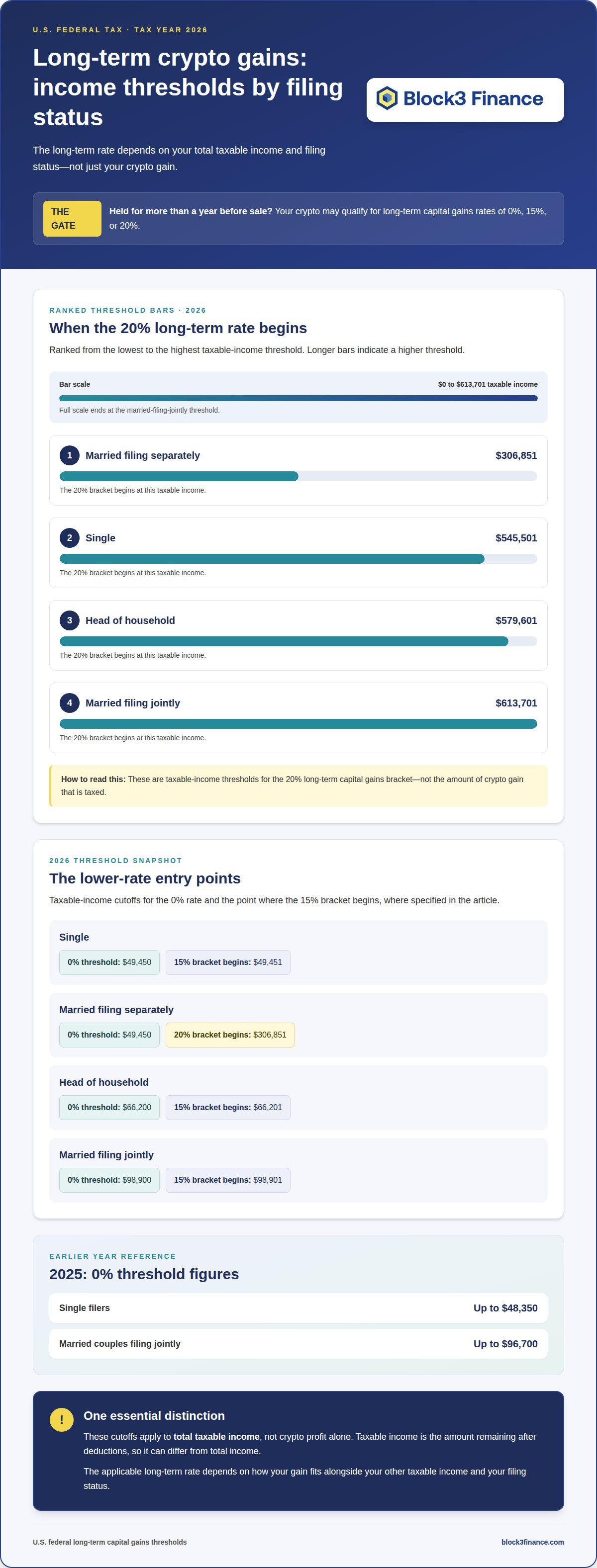
For 2025, the 0% threshold is $48,350 for single filers and $96,700 for married couples filing jointly. In 2026, the 0% threshold is $49,450 for single filers and married people filing separately, $66,200 for head-of-household filers, and $98,900 for joint filers. The 15% bracket begins at $49,451 for single filers, $66,201 for head-of-household filers, and $98,901 for joint filers; the 20% bracket begins at $545,501, $579,601, and $613,701, respectively. Married people filing separately enter the 20% bracket at $306,851.
These thresholds apply to total taxable income, not just crypto profit. A clear transaction ledger supports accurate U.S. crypto tax reporting by connecting each disposal with its proceeds and cost basis.
How much are crypto taxes?
For U.S. federal tax, the amount owed depends on taxable gains and losses, income, and filing details. Reporting is another part of the process. Exchange statements, wallet histories, and tax forms capture different information, so reconciling them helps build a complete transaction record.
Crypto capital gains generally appear on Form 8949 and Schedule D of Form 1040. Form 8949 records individual asset dispositions, while Schedule D summarizes capital gains and losses. Together, these forms connect transaction proceeds and cost basis with the return’s overall result. This reporting does not create a separate crypto tax return.
Losses can also affect the total. In most cases, the Internal Revenue Service allows U.S. taxpayers to use up to $3,000 annually of excess capital losses to reduce taxable income. Capital losses can offset capital gains, including gains from non-crypto assets. For example, a loss on one investment may reduce the taxable effect of a gain elsewhere, depending on the taxpayer’s overall return.
High earners in the United States may owe a 3.8% Net Investment Income Tax on long-term crypto gains, according to the Internal Revenue Service. This additional federal tax is separate from the regular capital gains calculation, and whether it applies depends on income and investment income.
The digital asset question appears on U.S. Forms 1040, 1040-SR, and 1040-NR. A taxpayer’s answer depends on their digital asset activity during the tax year. Selling, exchanging, or otherwise disposing of an asset can require reporting, while holding assets without a transaction is different. Mining or staking rewards may also affect the answer because they can be income.
Broker statements provide another record. U.S. brokers report crypto purchases and sales to taxpayers and the IRS on Form 1099-DA. Cost-basis reporting on that form starts in 2026 for returns filed in 2027. The form can help reconcile transactions, but it doesn’t necessarily capture every wallet or platform activity.
FATCA, the Foreign Account Tax Compliance Act, is a U.S. law concerning the reporting of certain foreign financial accounts and assets. FATCA reporting is separate from calculating crypto capital gains. Using a foreign exchange alone does not determine whether an account is reportable.
Keep account reporting separate from transaction reporting when organizing records. If multiple platforms make reconciliation difficult, discuss your crypto tax reporting needs.
Long-term gains income thresholds by filing status
Your holding period and taxable income determine how U.S. federal rates apply to crypto gains. Taxable income is the amount remaining after deductions, so it can differ from total income. The crypto long term capital gains tax rate depends on how the gain fits alongside your other taxable income and filing status.
According to the Internal Revenue Service, in the United States, cryptocurrency held for more than a year before sale is subject to annual long-term capital gains tax rates of 0%, 15% or 20%, depending on income and filing status. These are federal rates. The thresholds apply to taxable income, not solely to crypto gains.
For U.S. federal tax in 2026, the long-term capital gains thresholds include:
- Single: The 0% rate applies from $0 to $49,450; the 15% bracket begins at $49,451, and the 20% bracket begins at $545,501.
- Married filing jointly: The 0% rate applies from $0 to $98,900; the 15% bracket begins at $98,901, and the 20% bracket begins at $613,701.
- Married filing separately: The 0% rate applies up to $49,450, and the 20% bracket begins at $306,851.
- Head of household: The 0% rate applies up to $66,200; the 15% bracket begins at $66,201, and the 20% bracket begins at $579,601.
These thresholds aren’t limits on the amount of crypto gain that may qualify for a rate. Wages and other income also contribute to taxable income, while deductions affect the amount used to determine your bracket. As a result, taxpayers with the same crypto gain may face different rates because their filing statuses or other income differ.
For example, a single filer whose taxable income falls within the 0% threshold may qualify for that rate on eligible long-term gains. If taxable income reaches the 15% range, the long-term gain may be taxed at that rate within the applicable bracket. The crypto long term capital gains tax calculation therefore depends on the taxpayer’s full taxable-income picture, not just the gain from one transaction.
Short-term gains follow a different federal treatment. In 2026, U.S. federal short-term crypto gains are taxed at ordinary income rates ranging from 10% to 37%. Ordinary income rates are the regular federal income tax rates applied to income such as wages. A gain is short-term when the asset was held for one year or less, and the applicable rate depends on taxable income and filing status.
Mining, staking, airdrops, and hard forks can create income when you receive crypto. That income is distinct from a later capital gain or loss if you sell or exchange the asset. A crypto-to-crypto trade disposes of the asset traded away, while buying crypto with dollars generally creates no capital gain at the time of purchase. Staking rewards and airdrops may count as income when received.
U.S. federal tax treatment of cryptocurrency as property
Under IRS Notice 2014-21, cryptocurrency is treated as property, not currency, for U.S. federal tax purposes. That classification means a taxable disposition can produce a capital gain or loss. A disposition occurs when you sell, exchange, or spend an asset, rather than simply hold it.
The calculation compares the amount received with the asset’s adjusted cost basis. If you bought Bitcoin for $80,000 and sold it for $130,000 more than a year later, the $50,000 difference is generally a long-term capital gain. If the disposition happens after holding the asset for one year or less, the gain is short-term and taxed at ordinary income rates.
For U.S. federal purposes, cryptocurrency held for more than a year may qualify for long-term rates of 0%, 15%, or 20%, based on taxable income and filing status. The rate applies through the capital gains brackets, not as a single rate on every dollar of income. In 2026, a single filer enters the 20% bracket at taxable income of $545,501. The long-term rate schedule is separate from ordinary income brackets.
Property treatment also clarifies how common transactions differ:
- Selling: Compare sale proceeds with the asset’s adjusted basis to calculate a gain or loss.
- Trading: A crypto-to-crypto exchange disposes of the asset traded away; use its fair market value for the calculation.
- Spending: Paying with crypto disposes of property, so appreciation since acquisition may create a taxable gain.
- Holding or transferring: Holding crypto alone isn’t a disposition, and moving it between wallets you own isn’t a sale.
High earners in the United States may owe a 3.8% Net Investment Income Tax on long-term crypto gains, according to the Internal Revenue Service. This additional federal tax can affect the overall liability beyond the regular long-term capital gains rate. For 2026, the top federal long-term rate can reach 23.8% when this tax applies.
State taxes are separate from federal treatment. A state may include crypto gains in taxable income under its own rules, so the federal rate alone doesn’t determine your full tax result. State treatment depends on local tax rules and your filing circumstances.
A hard fork or crypto reward can raise a tax question separate from any later sale. Crypto received through mining or staking may be treated as income; a later sale or exchange can create an additional gain or loss. Keeping these events distinct helps show which amount relates to ordinary income and which reflects a change in the asset’s value.
2025 Long-term capital gains tax rates
For U.S. federal tax purposes, 2025 annual long-term capital gains rates are 0%, 15%, or 20%, depending on taxable income and filing status. The key takeaway: a crypto gain isn’t taxed in isolation. Your other taxable income and filing status help determine which rate applies.
For 2025, a single filer’s taxable income can qualify for the 0% long-term rate up to $48,350. For married couples filing jointly, that threshold is $96,700. These amounts refer to taxable income, not gross income or the amount of a crypto sale. Deductions affect taxable income, so the sale proceeds alone don’t identify the rate.
A single filer’s long-term gains may be taxed at 15% when taxable income falls between the applicable 0% and 20% thresholds. The 20% bracket begins at $533,401. These thresholds show why filing status and total income matter: the same digital asset gain can fall within different brackets for taxpayers with different income or filing arrangements.
Use the thresholds as a framework, not as a direct tax bill. A tax bracket identifies the applicable treatment for long-term gains; it doesn’t mean the full sale value is taxed at that rate. The relevant amount is the gain after accounting for the asset’s cost basis, considered alongside your broader taxable income.
For example, a single taxpayer with taxable income within the 0% threshold may qualify for the 0% rate on eligible long-term gains. A single taxpayer whose taxable income reaches the 15% range may have long-term gains taxed at 15%, while taxable income entering the 20% bracket may bring the 20% rate into play. The exact tax depends on the gain and the taxpayer’s overall return.
Holding period still matters. Long-term brackets apply to qualifying assets held for more than a year before sale; digital assets sold after a year or less are generally treated as short-term gains. This distinction can change the federal rate, even when the sale proceeds and cost basis are otherwise similar.
Some digital assets may have different treatment. Long-term gains on collectibles, which can include some NFTs, may face a U.S. federal rate of up to 28%. Classification therefore matters before applying the standard annual 0%, 15%, or 20% brackets. A reward received as income also differs from a later gain when that asset is sold.
For a 2025 return, separate taxable income, holding period, and asset classification before estimating the federal result. If crypto activity spans multiple wallets or includes digital asset rewards, get help reviewing your crypto tax calculation.
Block3 Finance
Block3 Finance helps individuals and crypto businesses bring transaction records, gains, and tax reporting into a coherent picture. When trades span multiple wallets or exchanges, a Crypto Tax Accountant can help organize the activity and assess how holding periods, cost basis, and filing status affect the return.
Tax Filing and Reporting supports accurate return preparation, while Monthly Accounting helps maintain clear records throughout the year. Audits and Compliance can address reporting controls and documentation as crypto activity becomes more complex.
If you want support making sense of your crypto tax position, contact Block3 Finance to discuss your needs.
Make your next crypto tax decision with clarity
Your tax position depends not only on past transactions but also on how you organize future activity. A consistent recordkeeping process makes it easier to connect wallet movements, exchange activity, and asset dispositions when preparing a return. It also gives you a clearer view of how a planned transaction may affect your reporting before you act.
A disciplined approach to crypto long-term capital gains tax starts with treating tax records as part of your broader financial operations, rather than a task to put off until filing season. Clear documentation supports informed discussions about your reporting position and keeps tax considerations visible as your digital asset activity evolves.
Block3 Finance can help bring structure to that process through crypto tax expertise and financial reporting support. If you’re ready to discuss your circumstances, contact Block3 Finance about your crypto tax needs. A clearer process can help you move forward with greater confidence.
Frequently Asked Questions
When is crypto taxed?
In the United States, tax usually arises when you dispose of crypto or receive it as income. Selling a token, exchanging it for another asset, or spending it can realize a gain or loss. Mining or staking rewards may count as income when received, creating a separate tax consideration from any later sale. Simply holding crypto without a taxable transaction generally doesn’t trigger tax.
What crypto transactions are taxable?
U.S. transactions that may trigger tax include selling crypto for dollars, swapping one token for another, and paying for goods or services with crypto. The asset you give up is treated as disposed of, so its value and basis matter. Mining or staking rewards can create income when received. A transfer between wallets you own differs from a sale, but keeping records helps distinguish transfers from taxable activity.
What is the crypto tax rate?
There isn’t one federal rate for every U.S. crypto transaction. Short-term gains are taxed at ordinary income rates, which range from 10% to 37% for federal tax in 2026. Long-term gains generally use annual 0%, 15%, or 20% rates, based on taxable income and filing status. High earners may also owe the Net Investment Income Tax, so the final amount depends on the return’s broader income picture.
Can you deduct crypto losses?
Yes. U.S. taxpayers can generally use capital losses to offset capital gains, including gains from non-crypto assets. In most cases, the Internal Revenue Service allows up to $3,000 of excess capital losses annually to reduce taxable income. For example, a loss on one digital asset may offset a gain on another. Keep transaction records showing proceeds and basis so the reported loss is supported.
How do crypto tax brackets work?
U.S. federal brackets depend on taxable income and filing status, not simply the amount of a single crypto sale. Short-term gains are added to ordinary income, while qualifying long-term gains use separate capital gains brackets. Deductions affect taxable income before the bracket calculation. Wages and a realized crypto gain both matter when determining your taxable income, even though the gain may receive a different rate.
How are cryptocurrency long-term capital gains taxed in the U.S.?
For U.S. federal tax, a qualifying long-term gain is generally taxed at annual rates of 0%, 15%, or 20%, depending on taxable income and filing status. The gain is based on the amount received when disposing of the asset minus its adjusted basis. For a 2025 return, a single filer enters the 20% bracket at taxable income of $533,401. Some collectibles, including certain NFTs, may have different treatment.
How long must you hold cryptocurrency to qualify for long-term capital gains tax rates?
In the United States, you generally must hold cryptocurrency for more than one year before disposing of it for the gain to qualify as long-term. A sale after one year or less generally produces a short-term gain, taxed at ordinary income rates. The holding period applies to the specific asset disposed of. If you acquired crypto at different times, each lot may have a different holding period.
How does the IRS determine cost basis and proceeds when calculating crypto gains?
The calculation compares the amount received for a digital asset with its adjusted cost basis. For a sale, proceeds are reported in U.S. dollars; for a crypto-to-crypto exchange, the asset traded away is valued at fair market value. If an asset’s basis is lower than its disposal value, the difference is generally a gain. Accurate records link each disposal to its acquisition details.

Article by
Mahad Mohamed
Mahad Mohamed is an accountant and the CEO of Block3 Finance, with over 26+ years of Canadian and international tax and accounting experience. A crypto accounting specialist since the early days of Bitcoin, he has consulted for over 38 crypto companies and collaborated with legal professionals on regulatory matters. His expertise spans corporate reorganization, cross-border tax structuring (Canada & US), tax disputes, and CRA audits.
Previously, Mahad worked for the Canada Revenue Agency (CRA), Big4 accounting firms, and served as a Rulings Officer for the Federal Tax Authority of the UAE before acquiring Tax Partners in 2014.
Block3 Finance and Tax Partners has 44 full-time accountants and over 9,800+ clients.
Disclaimer
This article provides general information only and is current as of its publication date. It has not been updated and may be out of date. It does not constitute legal advice and should not be relied upon as such. Every tax situation is unique and may differ from the examples discussed in this article. If you have specific questions, you should seek the advice of our accountants for your unique circumstances.
Frequently Asked Questions
When is crypto taxed?
In the United States, tax usually arises when you dispose of crypto or receive it as income. Selling a token, exchanging it for another asset, or spending it can realize a gain or loss. Mining or staking rewards may count as income when received, creating a separate tax consideration from any later sale. Simply holding crypto without a taxable transaction generally doesn’t trigger tax.
What crypto transactions are taxable?
U.S. transactions that may trigger tax include selling crypto for dollars, swapping one token for another, and paying for goods or services with crypto. The asset you give up is treated as disposed of, so its value and basis matter. Mining or staking rewards can create income when received. A transfer between wallets you own differs from a sale, but keeping records helps distinguish transfers from taxable activity.
What is the crypto tax rate?
There isn’t one federal rate for every U.S. crypto transaction. Short-term gains are taxed at ordinary income rates, which range from 10% to 37% for federal tax in 2026. Long-term gains generally use annual 0%, 15%, or 20% rates, based on taxable income and filing status. High earners may also owe the Net Investment Income Tax, so the final amount depends on the return’s broader income picture.
Can you deduct crypto losses?
Yes. U.S. taxpayers can generally use capital losses to offset capital gains, including gains from non-crypto assets. In most cases, the Internal Revenue Service allows up to $3,000 of excess capital losses annually to reduce taxable income. For example, a loss on one digital asset may offset a gain on another. Keep transaction records showing proceeds and basis so the reported loss is supported.
How do crypto tax brackets work?
U.S. federal brackets depend on taxable income and filing status, not simply the amount of a single crypto sale. Short-term gains are added to ordinary income, while qualifying long-term gains use separate capital gains brackets. Deductions affect taxable income before the bracket calculation. Wages and a realized crypto gain both matter when determining your taxable income, even though the gain may receive a different rate.
How are cryptocurrency long-term capital gains taxed in the U.S.?
For U.S. federal tax, a qualifying long-term gain is generally taxed at annual rates of 0%, 15%, or 20%, depending on taxable income and filing status. The gain is based on the amount received when disposing of the asset minus its adjusted basis. For a 2025 return, a single filer enters the 20% bracket at taxable income of $533,401. Some collectibles, including certain NFTs, may have different treatment.
How long must you hold cryptocurrency to qualify for long-term capital gains tax rates?
In the United States, you generally must hold cryptocurrency for more than one year before disposing of it for the gain to qualify as long-term. A sale after one year or less generally produces a short-term gain, taxed at ordinary income rates. The holding period applies to the specific asset disposed of. If you acquired crypto at different times, each lot may have a different holding period.
How does the IRS determine cost basis and proceeds when calculating crypto gains?
The calculation compares the amount received for a digital asset with its adjusted cost basis. For a sale, proceeds are reported in U.S. dollars; for a crypto-to-crypto exchange, the asset traded away is valued at fair market value. If an asset’s basis is lower than its disposal value, the difference is generally a gain. Accurate records link each disposal to its acquisition details.