
New chains and protocols test an accounting system at the point where their activity must become reliable financial records. Enterprise crypto accounting solutions should reconcile exchange, custodian, wallet, staking, and DeFi activity, while giving finance teams a controlled way to bring evolving data sources into the same reporting process. Coverage depends on whether each source’s transactions can be captured, classified, and reconciled into accounting-ready records.
That complexity is real: a new integration is useful only when its data moves through accounting workflows without creating blind spots or unexplained adjustments. Finance teams need broad coverage of blockchain activity and a clear way to handle data that changes over time.
This article explains how enterprise crypto accounting works across changing data sources, ERP integrations, high transaction volumes, tax, and audit-ready reporting. Learn what to assess in a solution, how transaction data flows into financial statements, and how specialist accounting support can help strengthen controls and reporting confidence.
Key Takeaways
- Assess whether new chain and protocol activity can be captured, classified, and reconciled into accounting-ready records.
- Plan ERP integrations around consistent transaction mapping, valuation inputs, and review workflows.
- Build audit-ready reporting with traceable source transactions, documented classification logic, and reviewable workpapers.
- Bring exchange, custodian, wallet, staking, and DeFi activity into a controlled process that can handle high transaction volumes.
- Connect tax reporting with financial accounting so digital-asset activity supports clearer filings and financial statements.
ERP integrations
An ERP integration turns blockchain activity into records that fit existing accounting workflows. Implement it in stages: map each data source, migrate transaction history, reconcile control totals, and validate opening balances against wallet and exchange records.
ERP, Banking, and Risk-System Connections
Connect blockchain records to the ERP with consistent account mappings, transaction categories, and approval rules. For example, classify a staking reward before it reaches the general ledger. Banking integrations can match fiat settlements with related digital-asset activity, while risk systems can receive exposure and transaction data. Review how exceptions, reversals, and approval statuses move between systems.
Implementation, Migration, and Balance Validation
Start implementation by documenting the entities, wallets, exchanges, protocols, and accounting periods in scope. Migrate historical activity with transaction identifiers and timestamps intact, then compare imported balances with source records. Resolve unmatched transfers, duplicate entries, and unsupported classifications before posting opening balances. A signed reconciliation record gives finance teams a clear basis for the transition.
Integration coverage takes more than a blockchain connection. A useful workflow identifies activity from each wallet, exchange, and protocol, including staking events and transfers between company-controlled addresses. Map each source’s fields to a consistent record format. Preserve the transaction identifier, asset, quantity, timestamp, and source account so reviewers can trace entries to their origin.
Enterprise blockchain data delivery often uses a warehouse between source systems and finance applications. The warehouse can hold normalized transaction records, while the ERP receives entries prepared for accounting. Define which system owns each field and how corrections flow downstream. For example, a corrected protocol label should update reporting consistently, not create a second ledger entry. An accounting workflow benefits from documented mappings and controlled handoffs.
Secure data sharing requires clear access boundaries. Limit wallet addresses, transaction details, and user permissions to the systems and teams that need them. Set role-based access for finance, treasury, and risk teams, and record changes to mappings or classifications. These controls connect operational data to posted entries without exposing more information than each workflow requires.
Keep accounting treatment visible in the integration design. For U.S. reporting, ASC 350 and ASU 2023-08 are relevant to intangible impairment tracking and compliance differentiation. Map asset classifications and valuation inputs so ERP outputs preserve the distinctions finance teams need. Before expanding to another chain or protocol, test sample transactions, exception handling, and reconciliation results in a controlled implementation environment.
Audit-ready crypto accounting and financial reporting
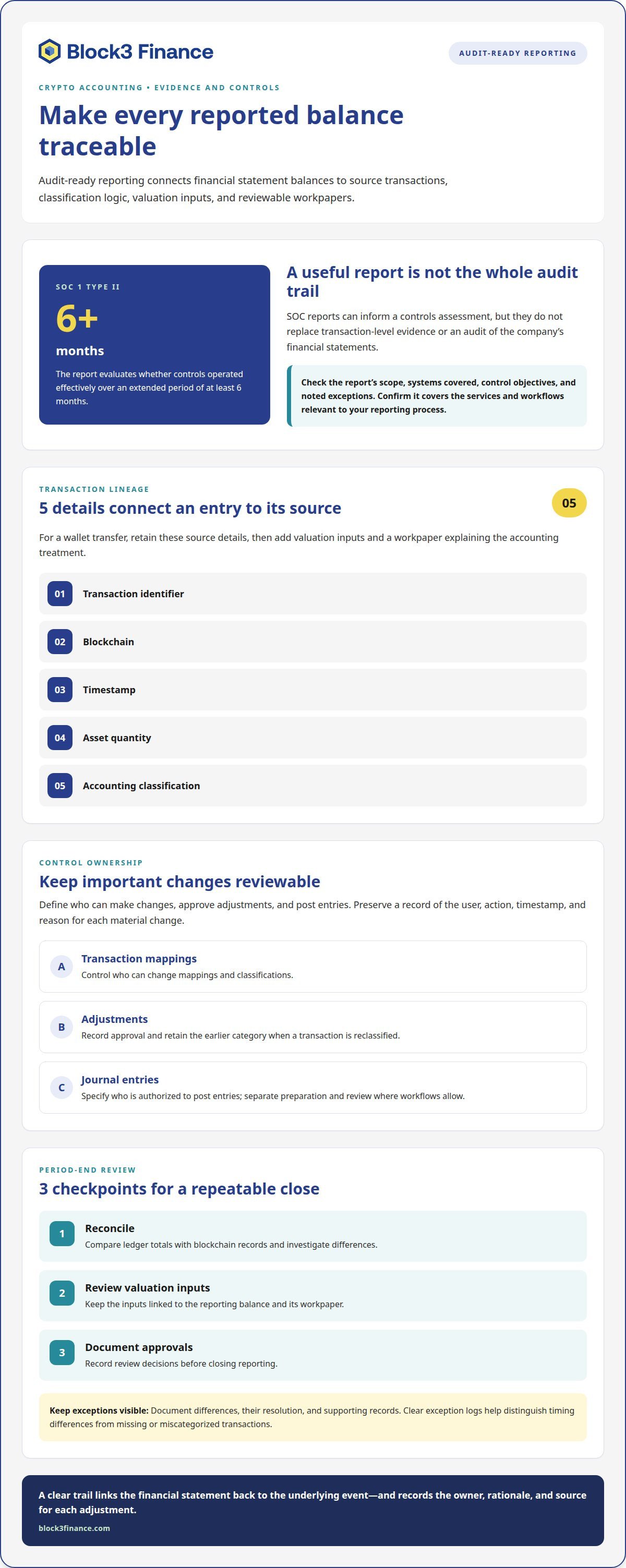
Audit-ready reporting links each financial statement balance to transactions, classification logic, valuation inputs, and reviewable workpapers. A sound process also makes control ownership and unresolved exceptions visible.
Audit Evidence and Transaction Lineage
Transaction lineage lets reviewers trace a ledger entry back to its source. For a wallet transfer, retain the transaction identifier, blockchain, timestamp, asset quantity, and accounting classification. Add valuation inputs and a workpaper explaining the treatment. This evidence helps finance teams reconcile recorded activity with source records and investigate differences without relying on a summary balance alone.
Internal Controls and Audit Trails
Controls should specify who can change transaction mappings, approve adjustments, and post journal entries. Keep an audit trail of the user, action, timestamp, and reason for each material change. For example, when a staking receipt is reclassified, preserve its earlier category and document who approved the update. Separate preparation and review responsibilities where workflows allow.
Workpapers bring the evidence together. Link each reporting balance to its transaction population, calculation method, valuation inputs, and review record. If a custodian report differs from blockchain activity, document the difference, its resolution, and the supporting records. This gives reviewers a path from the financial statement to the underlying event and back.
SOC reports can inform an assessment of controls, but they do not replace transaction-level evidence or an audit of the company’s financial statements. A SOC 1 Type II report evaluates whether controls operated effectively over an extended period of at least 6 months months. For either SOC 1 or SOC 2 reports, examine the stated scope, systems covered, control objectives, and any noted exceptions. Confirm that the report covers the services and workflows relevant to your reporting process.
Build repeatable review checkpoints into period-end workflows. Finance teams can reconcile ledger totals to blockchain records, review valuation inputs, and document approvals before closing reporting. Protocol activity may require different evidence from a custodian statement, so retain source records and classification decisions for each type. Clear exception logs help reviewers distinguish timing differences from missing or miscategorized transactions.
For finance teams strengthening their evidence and control workflows, discuss audit and reporting support as a practical next step. A consistent trail makes reviews easier to reproduce and gives each adjustment a clear owner, rationale, and source.
Regulatory reporting and financial statements
Institutional reporting connects transaction records to tax workpapers, financial statements, and portfolio reporting. For U.S. corporate transactions, maintain records of acquisitions, receipts, transfers, and disposals to support tax calculations and applicable filings.
Tax Information and Compliance Reporting
Tax information reporting starts with complete transaction data, not a year-end ledger balance. Record the asset, quantity, date, source, destination, and purpose of each event. Separate sales, payments, staking receipts, and internal transfers so finance teams can assess the relevant reporting treatment. Keep exchange or custodian statements with the related records.
A NetSuite workflow, for example, can link approved accounting entries to tax workpapers through shared transaction identifiers. Review how data moves between systems, how corrections are recorded, and whether the final reporting package preserves source detail. For U.S. corporate reporting, classify each transaction and calculate its tax effect before preparing applicable returns and information reporting.
Tax, Gain, and Loss Reporting
Gain or loss reporting compares an asset’s recorded basis with its proceeds when it is disposed of. Basis is the amount assigned to an asset for tax calculations. A sale, payment, or exchange may require different analysis from a transfer between company wallets. A clear transaction history helps finance teams distinguish these events and link calculations to ledger entries.
Use a documented workflow to group transactions by type, apply consistent accounting classifications, and reconcile calculated totals to the ledger. Keep the method, source data, and review record together. This connects portfolio activity, financial reporting, and tax workpapers without treating every blockchain movement as a taxable disposal.
Solana staking requires separate records for the original stake, validator activity, and rewards received. Track reward quantities, receipt dates, wallet destinations, and accounting valuation inputs. Keep reward records distinct from unstaking or transfer activity. This structure lets finance teams assess each event separately and include supporting details in reporting workflows.
Fund administration adds another reporting view: net asset value, or NAV, is the value of a fund’s assets minus its liabilities. To prepare NAV reporting, combine portfolio holdings with cash, receivables, liabilities, and the valuation basis for each position. Reconcile wallet and custodian balances to the fund ledger, then document material differences and adjustments. This helps keep investor reporting consistent with underlying financial records.
Strong infrastructure keeps tax and financial reporting connected while preserving their distinct purposes. A tax workpaper may organize gain or loss calculations, while a financial statement presents balances under the company’s accounting policies. Linking each output to transaction records helps reviewers trace portfolio activity to reported figures. A structured crypto tax reporting process can support this connection across U.S. corporate activity.
Which crypto accounting solutions sync large transaction volumes?
In 2026, leading enterprise platforms connect exchange, custodian, wallet, staking, and DeFi activity to accounting-ready records. The right fit depends on source coverage, transaction categorization, reconciliation workflows, and traceable valuation inputs.
Automated Digital-Asset Accounting
Automation should turn incoming digital-asset activity into records finance teams can review and post. A transfer between company wallets, for example, should remain distinct from a sale or payment. Assess whether the system captures each transaction’s source, asset, quantity, timestamp, and destination. Consistent records help organizations process growing activity without treating every blockchain movement alike.
Automation also requires exception handling. If an exchange file lacks a transaction category, the workflow should flag the gap for review rather than silently assigning a classification. Clear status labels help finance teams distinguish imported, categorized, reconciled, and unresolved records.
Wallet Analysis and On-Chain Categorization
Wallet analysis links on-chain activity to an organization’s addresses and identifies movements between them. Categorization then separates transfers, staking rewards, and protocol interactions. For example, match a transfer between two company-controlled wallets as an internal movement, not as two external disposals. Review how the platform records labels and classification changes.
Coverage matters as chain activity evolves. Assess whether newly used blockchain networks and protocols fit the same transaction workflow. Keep missing or ambiguous activity visible as an exception, with the originating wallet and transaction record available for investigation.
Exchange Records and Position Tracking
Exchange integrations should capture both transaction history and position records. Trade fills explain changes in balances; position records show assets held at a point in time. Compare exchange-reported balances with wallet records, and separate deposits, withdrawals, trades, and fees. This helps identify missing transfers or duplicate imports before finalizing accounting entries.
Organizations using multiple exchanges need consistent asset names and transaction categories across feeds. Check whether the platform preserves exchange identifiers and account-level records. A normalized view supports consolidated reporting while keeping source details from each exchange available for review.
Reconciliation, Valuation, and Audit Trails
Enterprise platforms reconcile exchange, custodian, wallet, staking, and DeFi activity into accounting-ready records. Reconciliation compares records from different sources, flags unmatched items, and helps explain balance differences. Transaction-time pricing and historical cost should retain their source inputs and applicable timestamps so reviewers can understand how a recorded value was derived.
Audit trails should record how transactions were categorized, valued, adjusted, and approved. For example, a corrected valuation needs a documented reason and a link to the affected transaction. Pricing models may consider transaction volume, connected data sources, entities, and reporting scope; the price depends on the case and is given after a quote request. These criteria help finance teams assess system fit and expected operating complexity.
Enterprise crypto accounting and tax
Tax and financial accounting need connected records, but they answer different questions. For a digital asset sale, the ledger supports financial reporting while a tax workpaper calculates the transaction’s tax result. Crypto accounting software should preserve links between both outputs and the underlying activity.
Start with a shared transaction record. Capture the asset, quantity, date, source, destination, and business purpose, then apply accounting and tax classifications separately. For example, an internal transfer between company-controlled accounts may change wallet balances without representing a sale. Documented classifications help teams avoid treating every chain movement as a taxable event.
Enterprise systems also need to incorporate activity across native chains and protocols. A new chain may introduce unfamiliar transaction types, while a protocol interaction can combine several events. Establish a process to review new activity, map its fields, and approve its accounting treatment before it enters reporting. This turns changing infrastructure into a governed workflow.
Controls matter because automated records still need oversight. Assign an owner to review unmatched activity, classification exceptions, and valuation inputs. Record the reason for each adjustment alongside the affected transaction. If a protocol event is recategorized after review, for instance, preserve the original classification and document the approved change. These records help finance teams explain reported balances.
Tax calculations depend on the company’s transaction history and the treatment applied to each event. Keep acquisition details, disposition records, and related valuation information together in the tax workpaper. Reconcile workpaper totals with accounting records and investigate differences before preparing reporting outputs. Distinguishing book treatment from tax calculations helps prevent one output from silently overwriting the other.
For organizations using several chains, exchanges, and custodians, define consistent asset names and ownership by entity. Separate company activity from activity belonging to another entity, and retain source records for each account. This helps finance teams review consolidated results while preserving the details needed for tax preparation. It also gives accounting software a stable basis for adding new sources.
The practical takeaway is to treat accounting and tax as linked workflows, not interchangeable reports. Map transactions once, apply each reporting treatment deliberately, and preserve review evidence through final outputs. If your organization needs support aligning crypto records with tax reporting, discuss your accounting and tax requirements.
Block3 Finance: Monthly Accounting
Block3 Finance provides Monthly Accounting for businesses that need digital-asset activity organized into consistent financial records. This support is useful when transaction sources grow, reconciliation becomes difficult to maintain, or finance teams need a dependable period-end process.
Monthly Accounting can bring crypto activity into ongoing bookkeeping workflows, while Tax Filing and Reporting addresses tax outputs. Audits and Compliance supports businesses preparing for review, and a Crypto Tax Accountant can help interpret transaction records for tax reporting. Start with the service that fits your immediate need: ongoing bookkeeping, tax work, or audit preparation.
Share the accounting challenge you’re working through and contact Block3 Finance to discuss the next step.
Build a finance process ready for what comes next
Digital-asset operations will keep changing as businesses add workflows, counterparties, and new ways to move value. The next step is not simply adding another system. Decide who owns data quality, which decisions require review, and how processes adapt when activity changes. A defined operating model helps finance teams scale without treating every new source as an exception.
Use the next planning cycle to identify how digital-asset activity affects finance decisions, then assign clear ownership for each handoff. Enterprise crypto accounting solutions create lasting value when their workflows support those decisions and evolve with the organization. This alignment gives finance leaders room to focus on strategy as operations grow.
Start a conversation about your priorities and possible next steps. Connect with Block3 Finance and move forward with greater clarity and confidence.
Frequently Asked Questions
How do I know my data source will keep up with new chains and protocols?
Use a change-management process to track the chains and protocols the business adopts. Assign an owner to review new activity, record when the source begins capturing it, and include the change in period-close procedures. A protocol interaction is an action involving a blockchain application, such as providing liquidity or claiming a reward. This helps teams identify operational changes before they affect U.S. reporting.
What blockchain data do auditors typically request?
In a U.S. audit, requests depend on the engagement and the company’s activity. Auditors may ask how management determined which wallets and entities belong in the accounting records, or how it selected transactions for review. Be ready to explain the purpose of unusual activity and who approved related accounting decisions. Clear ownership and documented review responsibilities help answer questions about completeness and oversight.
Which platform is best for GAAP/IFRS compliance?
For a U.S. business, assess whether the platform supports the company’s U.S. generally accepted accounting principles (GAAP) policies and reporting needs. There is no universal best choice: asset types, transaction patterns, and company structure affect the fit. Compare how platforms let finance teams apply approved accounting policies and prepare consistent U.S. financial reports. This focuses on U.S. reporting, not IFRS requirements.
Why is this important?
Consistent crypto records help U.S. business leaders make decisions using figures that reflect company activity. If a company approves a new treasury process, for example, finance needs records showing how the change affects cash planning and internal reporting. Clear ownership of accounting decisions also helps management explain its approach to stakeholders. The practical value is better information for deliberate decisions, not just year-end reporting.
What features should enterprise crypto accounting software include?
Enterprise crypto accounting solutions should fit the company’s operating model, not just process transactions. Look for support for multiple legal entities, separate reporting views, role-based access, and configurable close workflows. These capabilities help finance teams keep subsidiary records distinct and assign review responsibilities. Also assess how the system handles policy changes so updates do not compromise continuity in U.S. financial reporting.
How do enterprise crypto accounting platforms compare on supported blockchains, exchanges, and wallets?
Compare platforms against the business’s operating footprint and growth plans. Consider whether the product can accommodate new sources as the organization expands and how teams manage additions internally. Enterprise crypto accounting solutions should support clear ownership of integration decisions across finance and technology teams. A structured evaluation shows whether a platform’s coverage matches current U.S. operations and planned changes.
How do crypto accounting platforms integrate with ERP systems such as NetSuite, SAP, and QuickBooks?
For U.S. businesses, integration design should reflect the company’s chart of accounts, reporting entities, and journal approval process. Finance and technology teams can define which records enter the ERP, who approves them, and how rejected postings are corrected. This operating agreement matters as much as the connector. It helps avoid inconsistent account mapping and keeps financial reporting aligned with the existing close process.
How do businesses account for cryptocurrency under U.S. GAAP and current FASB rules?
U.S. businesses apply relevant accounting guidance to their assets and transactions, then document the policy used in their financial statements. GAAP means generally accepted accounting principles, and FASB is the Financial Accounting Standards Board. The appropriate treatment depends on the facts, including the asset and how the business uses it. Finance teams should maintain a consistent policy and document how it applies to company activity.

Article by
Mahad Mohamed
Mahad Mohamed is an accountant and the CEO of Block3 Finance, with over 26+ years of Canadian and international tax and accounting experience. A crypto accounting specialist since the early days of Bitcoin, he has consulted for over 38 crypto companies and collaborated with legal professionals on regulatory matters. His expertise spans corporate reorganization, cross-border tax structuring (Canada & US), tax disputes, and CRA audits.
Previously, Mahad worked for the Canada Revenue Agency (CRA), Big4 accounting firms, and served as a Rulings Officer for the Federal Tax Authority of the UAE before acquiring Tax Partners in 2014.
Block3 Finance and Tax Partners has 44 full-time accountants and over 9,800+ clients.
Disclaimer
This article provides general information only and is current as of its publication date. It has not been updated and may be out of date. It does not constitute legal advice and should not be relied upon as such. Every tax situation is unique and may differ from the examples discussed in this article. If you have specific questions, you should seek the advice of our accountants for your unique circumstances.
Frequently Asked Questions
How do I know my data source will keep up with new chains and protocols?
Use a change-management process to track the chains and protocols the business adopts. Assign an owner to review new activity, record when the source begins capturing it, and include the change in period-close procedures. A protocol interaction is an action involving a blockchain application, such as providing liquidity or claiming a reward. This helps teams identify operational changes before they affect U.S. reporting.
What blockchain data do auditors typically request?
In a U.S. audit, requests depend on the engagement and the company’s activity. Auditors may ask how management determined which wallets and entities belong in the accounting records, or how it selected transactions for review. Be ready to explain the purpose of unusual activity and who approved related accounting decisions. Clear ownership and documented review responsibilities help answer questions about completeness and oversight.
Which platform is best for GAAP/IFRS compliance?
For a U.S. business, assess whether the platform supports the company’s U.S. generally accepted accounting principles (GAAP) policies and reporting needs. There is no universal best choice: asset types, transaction patterns, and company structure affect the fit. Compare how platforms let finance teams apply approved accounting policies and prepare consistent U.S. financial reports. This focuses on U.S. reporting, not IFRS requirements.
Why is this important?
Consistent crypto records help U.S. business leaders make decisions using figures that reflect company activity. If a company approves a new treasury process, for example, finance needs records showing how the change affects cash planning and internal reporting. Clear ownership of accounting decisions also helps management explain its approach to stakeholders. The practical value is better information for deliberate decisions, not just year-end reporting.
What features should enterprise crypto accounting software include?
Enterprise crypto accounting solutions should fit the company’s operating model, not just process transactions. Look for support for multiple legal entities, separate reporting views, role-based access, and configurable close workflows. These capabilities help finance teams keep subsidiary records distinct and assign review responsibilities. Also assess how the system handles policy changes so updates do not compromise continuity in U.S. financial reporting.
How do enterprise crypto accounting platforms compare on supported blockchains, exchanges, and wallets?
Compare platforms against the business’s operating footprint and growth plans. Consider whether the product can accommodate new sources as the organization expands and how teams manage additions internally. Enterprise crypto accounting solutions should support clear ownership of integration decisions across finance and technology teams. A structured evaluation shows whether a platform’s coverage matches current U.S. operations and planned changes.
How do crypto accounting platforms integrate with ERP systems such as NetSuite, SAP, and QuickBooks?
For U.S. businesses, integration design should reflect the company’s chart of accounts, reporting entities, and journal approval process. Finance and technology teams can define which records enter the ERP, who approves them, and how rejected postings are corrected. This operating agreement matters as much as the connector. It helps avoid inconsistent account mapping and keeps financial reporting aligned with the existing close process.
How do businesses account for cryptocurrency under U.S. GAAP and current FASB rules?
U.S. businesses apply relevant accounting guidance to their assets and transactions, then document the policy used in their financial statements. GAAP means generally accepted accounting principles, and FASB is the Financial Accounting Standards Board. The appropriate treatment depends on the facts, including the asset and how the business uses it. Finance teams should maintain a consistent policy and document how it applies to company activity.