
For a U.S. business, crypto audit red flags include unexplained fund sources, wallet activity that obscures transaction trails, gaps in U.S. compliance records, and weak evidence supporting reported holdings or liabilities. A financial review should connect reported assets with records showing where funds came from, how they moved, and who controls the wallets.
An audit should look beyond a balance sheet or wallet snapshot. Crypto records can span multiple platforms, so gaps in transaction histories, ownership controls, or supporting documents can make it difficult to explain the business’s financial position under U.S. requirements.
This article explains how U.S. businesses can review fund sources, wallet and platform activity, audit partners, and financial reporting for crypto holdings. It also covers evidence that can help resolve discrepancies and when specialized accounting and compliance support can strengthen the review.
Key Takeaways
- Map where crypto moves and identify jurisdictional exposure that could complicate compliance or recordkeeping.
- Trace incoming funds to supporting documentation so unexplained sources can be investigated before an audit.
- Review wallet transfers and platform records for activity that obscures ownership, counterparties, or transaction history.
- Assess whether an audit partner can examine both blockchain evidence and the financial records behind reported holdings.
- Compare reported assets with liabilities, wallet controls, and accounting records to build a more complete picture of crypto holdings.
1. Cross-border and high-risk jurisdiction activity
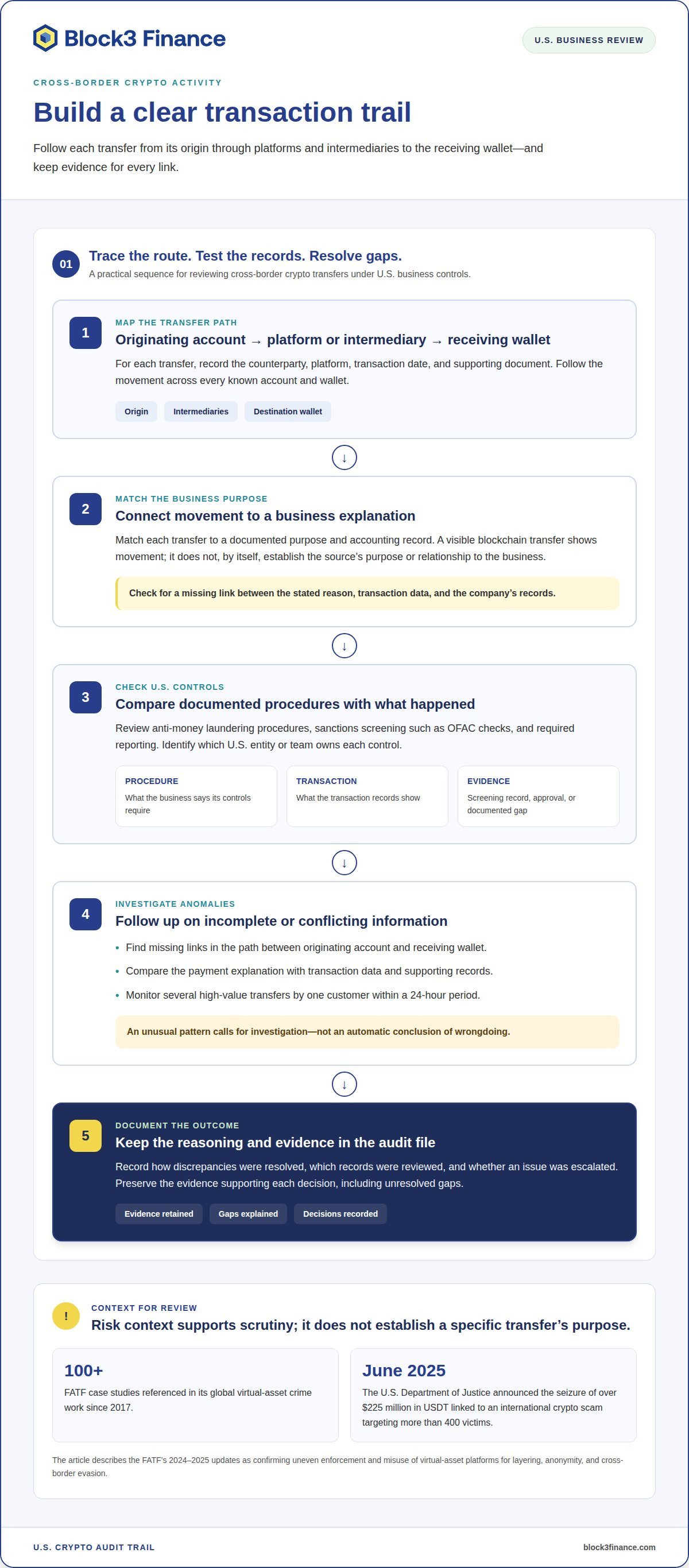
For a U.S. business, cross-border crypto activity can make it harder to establish where assets came from and why they moved. A transfer through a foreign platform or intermediary still needs a clear business explanation in the U.S. company’s records. Map each transfer from the originating account to the receiving wallet, noting the counterparty, platform, transaction date, and supporting document. Follow up on any missing link in that chain.
Assess the U.S. controls relevant to the business’s activity. A crypto compliance review can examine anti-money laundering procedures, sanctions screening such as OFAC checks, and required reporting. Identify which U.S. entity or team owns each control, then compare documented procedures with actual transaction records. For example, if a transfer was screened but the file contains no screening record or approval, document the gap and its effect on the review.
The Financial Action Task Force has investigated virtual-asset crimes against AML legislation globally since 2017, using more than 100 case studies. According to the Financial Action Task Force, its 2024-2025 updates confirm that enforcement remains uneven and virtual-asset platforms are regularly misused for layering, anonymity, and cross-border evasion. For a U.S. business, this context makes the transaction trail important: document how funds entered the business, which intermediaries handled them, and what records support their stated purpose.
In June 2025, the U.S. Department of Justice announced the seizure of over $225 million in USDT linked to an international crypto scam. The scheme targeted more than 400 victims through a fraudulent investment method known as “pig butchering.” For U.S. businesses, this example underlines the importance of reviewing counterparties and payment explanations rather than treating a visible blockchain transfer as evidence of a legitimate source.
Apply a consistent U.S.-focused review to cross-border activity:
- Match each transfer to a documented business purpose and accounting record.
- Identify every platform, intermediary, and counterparty in the transaction path.
- Retain evidence of relevant U.S. sanctions screening and AML controls.
- Escalate incomplete records or explanations that conflict with transaction data.
These indicators call for investigation, not an automatic conclusion of wrongdoing. Keep the evidence and reasoning behind each decision in the audit file, including how the business resolved discrepancies. A crypto audit review can help organize transaction records, U.S. compliance controls, and financial reporting into a coherent assessment. That gives the business a clearer basis for explaining cross-border activity through its records.
Several high-value transfers by one customer within a 24-hr period are an unusual transaction pattern to monitor. At the same time, less than 1% of all cryptocurrency transactions are estimated to relate to illegal activity, while 35% of all cryptocurrency transactions related to illegal activity in 2012. These figures support evaluating each transfer in context rather than treating volume alone as proof of illicit conduct. Record the commercial rationale, corroborating documents, and any unresolved inconsistencies, then explain whether the pattern prompted further review or escalation.
2. Suspicious sources of cryptocurrency funds
For each incoming crypto balance, establish who sent it, why it arrived, and how the business recorded it. Compare the transaction hash with invoices, customer agreements, exchange statements, or internal transfer approvals. A deposit without a matching business explanation needs investigation, even when its wallet address is visible on a public blockchain. Visibility shows movement, not the sender’s purpose or relationship to the business.
A phishing scam illustrates why source tracing matters: criminals stole 400 million Korean won and later exchanged the funds for cryptocurrency. That example does not make every crypto deposit suspicious. It shows how funds can pass from an earlier incident into digital assets, making the business’s own records essential for explaining its receipt and subsequent use.
Start by separating funds by origin. Record whether each asset came from a customer payment, exchange sale, loan, investment, mining activity, or transfer between wallets controlled by the same business. Match each category to supporting documents. For an exchange deposit, retain the account statement and transaction details. For an internal transfer, connect both wallet addresses to the business’s control records.
Look for inconsistencies between the stated source and the transaction trail. A customer payment from an unrelated wallet, a transfer described as a loan without an agreement, or an exchange withdrawal without a matching account record all warrant follow-up. These discrepancies signal a need to investigate, but do not prove misconduct. Document the explanation, evidence reviewed, and any unresolved gap.
- Match each incoming transaction to its stated purpose and business record.
- Compare exchange statements with wallet movements and accounting entries.
- Identify third-party wallets and document their relationship to the sender.
- Separate business receipts from transfers between company-controlled accounts.
Also examine whether the supporting records tell one consistent story. If an invoice names a customer but the wallet history shows a different route, preserve both records and document how the payment was attributed. If an exchange statement shows a withdrawal that accounting records omit, trace the asset into the receiving wallet and correct the reconciliation. A clear chain of evidence helps distinguish incomplete bookkeeping from a source that remains unexplained.
Keep a source-of-funds file linking transaction hashes, dates, wallet ownership evidence, exchange records, contracts, and accounting entries. Organize it by reporting period and asset so reviewers can trace a ledger balance to the underlying transaction. When records are incomplete, note the missing evidence and steps taken to resolve the gap. Don’t replace documentation with assumptions about a wallet address.
When unexplained receipts affect tax records or crypto-to-fiat activity, a conversation about your crypto records can help clarify the accounting questions that need attention. A disciplined review connects the source, transaction, and recorded balance, giving the business a stronger basis for explaining its funds.
3. Wallet and platform behaviour anomalies
Wallet patterns can reveal gaps that ordinary balance checks miss. Review transaction timing, destination changes, repeated transfers, and movement between platforms. A financial security corporation flagged two crypto-account transactions totaling $4.8 million within six minutes. That timing alone doesn’t establish misconduct, but it gives reviewers a concrete pattern to compare with approvals, counterparties, and the business purpose recorded internally.
Look beyond the final wallet address. In a phishing case, criminals relocated funds into a foreign virtual wallet 48 times while attempting to hide their identity. Repeated hops can make the path harder to interpret, so auditors assess whether the business can identify counterparties and explain each transfer. Record the originating wallet, destination, transaction hash, timestamp, and reason for movement.
Wallet chains also matter when assets pass through several addresses before reaching a platform. DeepDotWeb owners concealed the origin of over $15 million in cryptocurrency through a series of Bitcoin wallets. For business reviews, trace movements across addresses and reconcile them against exchange statements and internal records. A change in wallet destination or currency should have a documented business explanation, not simply a matching ending balance.
Unaudited contracts may contain logic that hasn’t received independent review, while upgradeable proxies allow contract behaviour to change after deployment. Admin keys may let specific holders approve upgrades or perform privileged actions, creating control and continuity risks. Review audit evidence, upgrade permissions, key holders, and approval records to understand who can alter the contract or control asset movement.
Use a repeatable wallet review. Compare on-chain activity with platform records and the business’s transaction approvals. Then investigate deviations such as:
- Transfers that lack an identified counterparty or recorded purpose.
- Rapid, repeated movements that don’t match expected business activity.
- Wallet balances that fail to reconcile with platform statements.
- Contract interactions involving unexplained permissions or admin actions.
Crypto auditors assess processes for verifying counterparties and monitoring suspicious transactions. Apply that lens to routine payments and exceptional movements alike. If an account’s activity differs from its documented purpose, preserve the relevant records and identify who authorized the transaction. Compare transaction volume and timing across periods, then document why a pattern changed or remained consistent.
Build the review file around evidence: wallet addresses, transaction hashes, platform statements, contract versions, and approval records. For example, if an admin-key action changes a contract’s behaviour, record the change and compare subsequent transactions with the prior operating pattern. This helps distinguish normal operations from anomalies that need further examination.
4. Choosing a crypto audit partner
A U.S. business should choose an audit partner whose scope matches the question it needs answered. A financial audit, compliance review, proof-of-reserves assessment, and smart contract audit examine different evidence. Ask the partner to define the work, identify the records or code version reviewed, and state what the report will not cover. Clear scope helps prevent a narrow test from being mistaken for broad assurance.
A smart contract audit examines code for flaws that could affect how a contract operates. A proof-of-reserves audit examines evidence supporting reported assets and should explain how it considers liabilities. A Merkle tree, which combines records into a single cryptographic hash, can help summarize account data, but it does not establish complete reserves by itself.
For U.S. businesses, relevant crypto compliance considerations include the Bank Secrecy Act and FinCEN’s Travel Rule, which are AML requirements for cryptocurrency platforms. The AICPA’s 2025 guidance for stablecoin issuers includes expanded disclosure requirements for asset-backed tokens now in effect. Ask the partner to explain how the engagement addresses applicable U.S. requirements and distinguishes compliance testing from a financial statement audit.
The most serious smart contract findings are flaws that could permit unauthorized asset transfers, bypass access controls, or let privileged users change contract behaviour. Request findings by severity, affected code, potential impact, and remediation status. For example, an access-control weakness should identify the permissions affected and whether the correction was retested.
Audit washing occurs when a claim implies broader assurance than the work supports. Watch for reports that omit the tested code version, scope, unresolved findings, or important limitations. A report that says only “audited” without describing the procedures gives readers little basis to assess what was examined.
Before engaging a partner, compare the proposed procedures with the business’s financial, technical, and U.S. compliance risks. Check that the report will identify the reviewed entity, evidence, assumptions, and exceptions. If the proposed scope doesn’t explain how it addresses a material risk, clarify that before work begins.
If an audit leaves issues unresolved, preserve the report and request written details about severity, impact, and remediation status. Assign each corrective action to a responsible team member, retain evidence of the change, and record whether retesting resolved the finding. Don’t describe an issue as fixed until follow-up evidence supports that conclusion.
- Match the engagement scope to the specific assurance your business needs.
- Read the procedures and limitations, not only the audit claim.
- Track unresolved findings through documented remediation and retesting.
5. Financial audits of crypto holdings
A financial audit of crypto holdings tests whether reported assets are supported, controlled, and consistently recorded. Start with the reporting date, then reconcile each ledger balance with wallet records, exchange statements, and transaction history. Even a balance shown on a dashboard needs evidence linking it to the business and its accounting records.
Common proof-of-reserves and financial-audit red flags include an asset snapshot without clear liabilities, unclear wallet ownership, missing transaction history, and unexplained differences between the report and underlying records. Treat a proof-of-reserves statement as one piece of evidence, not a complete view of the business’s financial position. Review what it covers, when its evidence was gathered, and which accounts or entities it includes.
Ownership and control need separate examination. A wallet can hold assets without showing who has authority over them or whether the business can access them. In 2025, holding more than 20% of crypto assets in non-custodial wallets can raise questions about security and ownership controls. Document wallet addresses, control evidence, approval procedures, and any restrictions affecting access.
Trace reported balances back to source records. For each asset, compare the quantity in the general ledger with wallet balances and platform statements. Investigate differences caused by transfers, fees, timing, or incomplete records, and document the explanation. Keep the transaction history supporting any adjustment, since unexplained changes can distort reported assets, gains, or losses.
- Reconcile ledger balances with wallet and exchange evidence at the reporting date.
- Document who controls each wallet and how access is approved.
- Compare the report’s stated scope with the accounts and entities actually reviewed.
- Track every discrepancy through explanation, accounting adjustment, or unresolved finding.
A clear report should explain its scope, evidence, limitations, and findings in language finance teams can use. If it describes assets but omits how liabilities were considered, readers may lack enough context to understand the business’s position. Record that limitation in your review and identify the additional accounting evidence needed to complete the picture.
Keep supporting files together by reporting period, including wallet records, exchange statements, reconciliation schedules, and explanations for adjustments. If a platform balance differs from the ledger, for example, retain the statement and transaction history alongside the correction. This evidence lets reviewers follow the calculation rather than rely on a summary figure alone.
A focused financial review brings wallet control, accounting, and reported balances into one evidence trail. If your business needs help assessing crypto holdings and the records behind them, discuss a crypto audit review.
Block3 Finance: Tax Filing and Reporting
Block3 Finance helps businesses turn crypto records into clearer reporting through Tax Filing and Reporting, Audits and Compliance, Monthly Accounting, and support from a Crypto Tax Accountant. If wallet reconciliations, transaction histories, or reported holdings reveal gaps, organized accounting records can help identify what needs attention and support more consistent financial reporting.
Turn to Block3 Finance when your business needs help connecting crypto activity with tax filings, accounting records, or audit and compliance work. The right starting point depends on the issue: incomplete books may call for ongoing accounting, while reporting questions may need focused tax support.
Contact Block3 Finance to discuss your crypto accounting needs.
Turn review findings into stronger oversight
A useful audit review should inform decisions after the report is filed. Assign an owner to each unresolved issue, record the evidence needed to address it, and establish a regular process for updating accounting records as crypto activity changes. This turns crypto audit red flags into a framework for clearer financial oversight, not a list that sits unused.
Block3 Finance supports businesses with Tax Filing and Reporting, Audits and Compliance, and Monthly Accounting. These services can help connect transaction records with reporting and ongoing bookkeeping when your business needs a more structured approach. The right next step is to focus on the records or audit findings that most affect your reporting.
Contact Block3 Finance to discuss your audit needs. Clear ownership and consistent records can help your business move forward with greater confidence.
Frequently Asked Questions
Crypto Audit: What Should Your Business Expect?
A U.S. business should expect an audit to begin with a defined objective, requested records, and a review period. Prepare a contact who can explain how crypto activity moves from operations into accounting entries. If finance staff use different systems for invoices and wallet records, for example, map how information reaches the ledger. The auditor then tests evidence, discusses exceptions, and shares findings for management review.
What are the most common red flags in a cryptocurrency project audit?
Common crypto audit red flags include token supply records that don’t reconcile with project documentation, unclear approval histories for material transactions, and financial reports that omit key assumptions. If a project records token distributions but can’t connect them to governance approvals or accounting entries, for example, the discrepancy needs an explanation. Check that finance, operations, and governance records agree instead of relying on a single dashboard or summary.
How can I verify whether a crypto audit is legitimate and up to date?
Check that the report identifies the project or entity, the work performed, the records or code version examined, and the report date. Compare that scope with the system currently in use. For example, a protocol upgrade after the reviewed code release can make a technical report less relevant to the deployed version. Also look for documented limitations and whether later changes received additional review.
Which crypto audit firms are reputable, and how can I check their credentials?
Reputation depends on the audit’s purpose, since financial statement work, compliance reviews, and smart contract testing require different expertise. Check whether the report names the responsible firm and professionals, describes their relevant experience, and clearly states the engagement’s scope. For a U.S. financial audit, distinguish an independent financial statement opinion from a technical security assessment. Confirm that the credentials and work described match the assurance your business needs.

Article by
Mahad Mohamed
Mahad Mohamed is an accountant and the CEO of Block3 Finance, with over 26+ years of Canadian and international tax and accounting experience. A crypto accounting specialist since the early days of Bitcoin, he has consulted for over 38 crypto companies and collaborated with legal professionals on regulatory matters. His expertise spans corporate reorganization, cross-border tax structuring (Canada & US), tax disputes, and CRA audits.
Previously, Mahad worked for the Canada Revenue Agency (CRA), Big4 accounting firms, and served as a Rulings Officer for the Federal Tax Authority of the UAE before acquiring Tax Partners in 2014.
Block3 Finance and Tax Partners has 44 full-time accountants and over 9,800+ clients.
Disclaimer
This article provides general information only and is current as of its publication date. It has not been updated and may be out of date. It does not constitute legal advice and should not be relied upon as such. Every tax situation is unique and may differ from the examples discussed in this article. If you have specific questions, you should seek the advice of our accountants for your unique circumstances.
Frequently Asked Questions
Crypto Audit: What Should Your Business Expect?
A U.S. business should expect an audit to begin with a defined objective, requested records, and a review period. Prepare a contact who can explain how crypto activity moves from operations into accounting entries. If finance staff use different systems for invoices and wallet records, for example, map how information reaches the ledger. The auditor then tests evidence, discusses exceptions, and shares findings for management review.
What are the most common red flags in a cryptocurrency project audit?
Common crypto audit red flags include token supply records that don’t reconcile with project documentation, unclear approval histories for material transactions, and financial reports that omit key assumptions. If a project records token distributions but can’t connect them to governance approvals or accounting entries, for example, the discrepancy needs an explanation. Check that finance, operations, and governance records agree instead of relying on a single dashboard or summary.
How can I verify whether a crypto audit is legitimate and up to date?
Check that the report identifies the project or entity, the work performed, the records or code version examined, and the report date. Compare that scope with the system currently in use. For example, a protocol upgrade after the reviewed code release can make a technical report less relevant to the deployed version. Also look for documented limitations and whether later changes received additional review.
Which crypto audit firms are reputable, and how can I check their credentials?
Reputation depends on the audit’s purpose, since financial statement work, compliance reviews, and smart contract testing require different expertise. Check whether the report names the responsible firm and professionals, describes their relevant experience, and clearly states the engagement’s scope. For a U.S. financial audit, distinguish an independent financial statement opinion from a technical security assessment. Confirm that the credentials and work described match the assurance your business needs.