
A ledger can balance and still conceal a broken crypto transaction trail. For U.S. businesses, crypto bookkeeping organizes wallet, exchange, and blockchain activity and reconciles it with the general ledger. Strong crypto bookkeeping best practices also track cost basis, the recorded acquisition cost used to calculate gains or losses, alongside transaction values, fees, and transfers.
That complexity matters: a transfer between your own wallets can look like a sale in an accounting tool until the records are matched, while general-purpose systems may not capture token-level details. You need records that explain what happened and support U.S. accounting and tax reporting.
This guide explains what crypto bookkeeping involves, how often to reconcile records, and how digital-asset subledgers can work with treasury and enterprise systems. It also covers audit and compliance challenges under U.S. rules, helping you identify where your workflow needs stronger controls.
Key Takeaways
- Reconcile wallet and exchange activity with your accounting ledger regularly, and investigate unmatched transfers before they distort your records.
- Keep transaction details that explain what happened, including dates, values, fees, and whether activity was internal or external.
- Use a digital-asset subledger to preserve token-level detail, while sending organized journal entries to your general ledger.
- Prepare audit-ready records by retaining transaction support and using a consistent method to track cost basis.
- The Internal Revenue Service reports that brokers report digital-asset transactions on Form 1099-DA beginning January 1, 2025, and report basis on certain transactions beginning January 1, 2026.
What Defines Crypto Accounting?
In the United States, crypto accounting connects blockchain activity with financial records. Businesses can use a crypto subledger alongside QuickBooks Online or Xero, with software costs varying by provider and business needs. The goal is to translate token activity into entries that support U.S. accounting and reporting.
Blockchain Records and Accounting Ledgers
A blockchain records validated network transactions, while an accounting ledger organizes financial activity by account and reporting period. The distinction matters because an on-chain record shows movement between addresses, not the business purpose or accounting treatment. A journal report translates activity into dated entries, including references, categories, debits, credits, and balances. Those entries can then flow into the general ledger, where finance teams review account totals.
Connecting Crypto Records to Traditional Accounting
Integration connects crypto transaction details to a company’s established accounting system. U.S. businesses may use journal reports to reconcile raw blockchain data with their accounts. For example, an exchange withdrawal to a business bank account should match the ledger’s cash and crypto movements. Matching the transaction reference, amount, and destination helps explain differences between blockchain records and traditional financial accounts, while keeping source details available for review.
Software Dashboards and Audit Workflows
An accounting software dashboard summarizes digital-asset activity and organizes records for review. General accounting software may not track cost basis for each token or interpret on-chain activity on its own, so crypto-specific details may need a separate record. A reviewer can trace a dashboard total to its journal, inspect transaction references, and compare entries with exchange or blockchain records. Bitcoin bookkeeping software can also support audit and compliance workflows compatible with frameworks such as SOX.
Crypto Invoices, Bills, and Clearing Accounts
A clearing account temporarily holds a payment between recording an invoice or bill and confirming settlement. If a U.S. business receives bitcoin for an invoice, it can record the receivable and route the incoming asset through a crypto clearing account. Once matched to the blockchain transaction, staff can clear the temporary balance and record related fees separately. This keeps open invoices distinct from received funds and makes payment status easier to assess.
Deposits from exchanges to a business bank account should match the ledger so cash and crypto can be reconciled. Trace each transaction from its source record to its accounting entry, then confirm that the destination account reflects the same movement. If records differ, investigate timing, fees, duplicate imports, or unmatched transfers before closing the period. This creates a clearer trail for U.S. financial reporting and audit support.
How often should crypto books be reconciled?
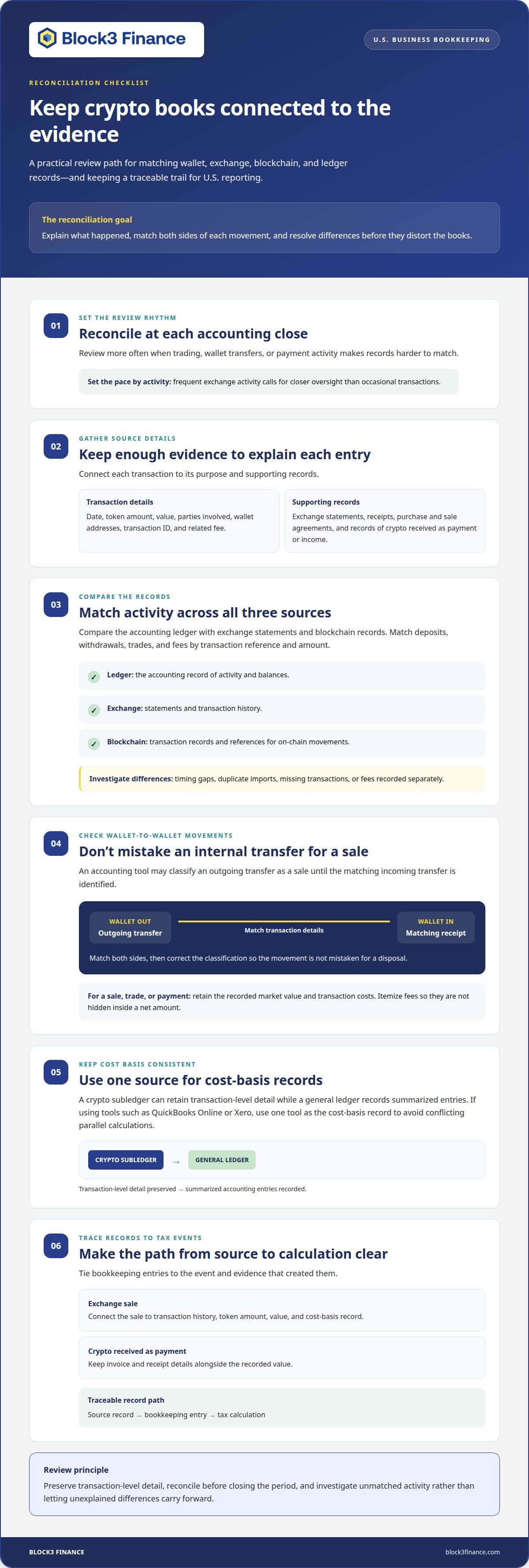
Reconcile crypto books at each accounting close, and review them more often when trading, wallet transfers, or payment activity makes records harder to match. Set the review rhythm according to transaction volume and complexity: a business with frequent exchange activity needs closer oversight than one with occasional transactions.
Keep records that connect each transaction to its purpose and supporting evidence. Useful details include the date, token amount, value, parties involved, wallet addresses, transaction ID, and any related fee. Preserve exchange statements, receipts, purchase and sale agreements, and records of crypto received as payment or income. Together, these details explain how a recorded balance arose and support tax reporting.
For each reconciliation, compare the accounting ledger with exchange statements and blockchain records. Match deposits, withdrawals, trades, and fees by transaction reference and amount. Then investigate differences such as timing gaps, duplicate imports, missing transactions, or separately recorded fees. Businesses using QuickBooks Online or Xero can pair the general ledger with a crypto subledger: the crypto tool retains transaction-level detail, while the accounting system records summarized entries. Use one tool as the cost-basis record to prevent conflicting parallel calculations.
Pay particular attention to transfers between wallets you control. An accounting tool may classify an outgoing transfer as a sale until the matching incoming transfer is identified. Match both sides using their transaction details, then correct the classification so the movement isn’t mistaken for a disposal. For a sale, trade, or payment, retain the recorded market value and transaction costs. Itemize fees so they don’t disappear inside a net amount.
Tax records should connect the bookkeeping entry to the event that created it. For example, tie an exchange sale to its transaction history, token amount, value, and cost-basis record. If you receive tokens as payment, retain the invoice and receipt details alongside the recorded value. This creates a traceable path from source record to ledger entry and tax calculation. If complex wallet activity or tax records are difficult to align, discuss your reconciliation workflow with a specialist.
Integrating digital asset subledgers with TMS and ERP systems
A digital-asset subledger holds transaction-level detail, while a treasury management system (TMS) manages cash and liquidity, and an enterprise resource planning (ERP) system connects financial records across business functions. Linking these systems lets finance teams preserve crypto details while reporting summarized balances through established accounting workflows.
A practical setup gives each system a clear role. The crypto subledger tracks token quantities, wallet movements, transaction references, cost basis, and fees. The ERP receives journal entries for relevant accounts, while the TMS helps compare cash movements and treasury holdings. For example, an exchange withdrawal can appear as a transfer in the subledger and as a matching movement in treasury records, rather than as unexplained cash activity.
Define what data each system sends before connecting them. Map each asset and activity to an appropriate account, then decide how often journal entries move into the ERP. Keep the transaction identifier and source record available alongside each entry. This lets a reviewer trace a summarized balance back to the subledger without copying every blockchain detail into the general ledger.
At acquisition, record the asset’s cost basis and retain the purchase fee in the supporting transaction record. These amounts establish the recorded acquisition cost for later accounting and disposal calculations.
Fair value is the amount an orderly sale would produce in the current market. Because crypto prices can move quickly, use a consistent valuation method and reassess values frequently. FASB fair-value measurement guidance is one compliance consideration for crypto bookkeeping. The subledger should preserve both the original acquisition information and the valuation used for the relevant reporting entry, so changes don’t erase the asset’s transaction history.
Asset categorization matters, too. Distinguish holdings from income received in tokens, and separate assets held for business use from movements between wallets. A payment received for services, for example, should include its invoice reference and receipt details; a wallet transfer should retain its transaction reference. These classifications help TMS and ERP reports reflect what occurred, not merely the token balance.
Protect system connections as carefully as accounting data. Limit access to assigned roles, secure wallet credentials, and review changes to integration permissions. Keep an accessible record of imports and manual adjustments. These controls let teams use digital-asset subledgers to support reporting without losing visibility over wallets, valuation decisions, or financial-system entries.
What is Crypto Bookkeeping?
Crypto bookkeeping turns digital-asset activity into organized records for financial reporting, tax reporting, and audit review. In the United States, every reported balance should connect to transaction evidence and an accounting entry.
Capital Gains and Losses
Capital gains and losses measure the difference between an asset’s cost basis and its value when disposed of. In the United States, selling cryptocurrency for dollars, exchanging one token for another, or using crypto to pay for goods or services can trigger a taxable event. A complete report connects each disposal to its acquisition record, proceeds, fees, and holding period. That detail helps distinguish gains from losses and supports accurate tax calculations.
For example, a sale record should identify the token and quantity, acquisition cost, disposal value, transaction date, and related fees. A trade from Ethereum to USDC also needs both sides recorded, not just the resulting USDC balance. Tie the calculation to the original transaction references so an auditor can follow how the reported gain or loss was determined.
Compliance and Tax Reporting
Compliance and tax reporting rely on transaction records to support financial entries and U.S. tax filings. Retain purchase and sale documents, exchange statements, receipts, and records showing the value of tokens received as payment, staking rewards, or mining income. Assigning a dollar value when tokens are received supports later reporting. These records also explain how a figure moved from a wallet or exchange history into a return or financial statement.
Audit preparation depends on a traceable path, not just a year-end total. Preserve transaction dates, amounts, wallet addresses, and unique transaction identifiers alongside supporting documents. Mark whether activity was internal or external, and record who created and approved journal entries. For a transaction that crosses an exchange and a business wallet, these references help reviewers distinguish a transfer from a sale.
Journal Reports, General Ledgers, and Profit and Loss
A journal report summarizes transactions chronologically for a defined period and provides detail for the general ledger. Entries can identify dates, references, categories, debits, credits, and account balances. Periodic journal entries then move gains, losses, income, and fees from a crypto record into the ledger. This structure supports financial reporting without forcing every blockchain detail into the main accounting record.
Use the general ledger to organize entries by account, then prepare a profit and loss report from recorded income, fees, and realized gains or losses. For example, separate transaction fees from trading proceeds so they remain visible during review. Compare report totals with the underlying journal and source records before finalizing financial statements. Investigate unexplained balances rather than carrying them forward as unsupported adjustments.
For an audit-ready close, assemble journal reports, ledger entries, transaction evidence, and supporting statements. Reconcile report totals to the ledger, confirm that each adjustment has a source record, and retain the approval trail. This gives finance teams a consistent basis for explaining reported results and resolving questions about specific transactions.
Audit, bookkeeping, and compliance challenges
Audit challenges often begin when a reported balance cannot be traced to its source. A wallet total alone doesn’t explain the transaction, its business purpose, or how the books treated it. Build a clear trail from blockchain record to accounting entry and then to the supporting document. This helps reviewers assess gains and losses without relying on a single software classification.
Transaction tracking requires consistent detail. Record the date, token amount, value, sender and recipient addresses, and unique transaction ID. Keep exchange statements, receipts, and purchase or sale agreements with those records. A Bitcoin ledger also needs eight decimal places, or a documented rounding rule, to represent amounts in satoshis. These controls make small balance differences visible rather than burying them in rounded totals.
Internal activity presents a distinct bookkeeping challenge. A transfer between wallets controlled by the same business is not a sale, yet accounting tools may initially classify it as one. Match both sides using transaction references, then label the entry as internal. Journal reports should also distinguish internal from external activity, itemize transaction fees, and record who created and approved each entry.
Cost-basis calculations need another control. Choose one system as the authoritative cost-basis record, and don’t let a second tool recalculate it independently. Apply a consistent method, such as FIFO, to determine which units were disposed of. Human review remains essential because accounting software doesn’t decide how each transaction should be treated. A reviewer must resolve missing data, unusual activity, and conflicting classifications.
U.S. reporting also depends on changing broker information. The Internal Revenue Service reports that brokers report digital-asset transactions on Form 1099-DA beginning January 1, 2025, and report basis on certain transactions beginning January 1, 2026. Compare broker reporting with internal records, since the books must explain the transaction history behind reported figures. Preserve the supporting detail for each reported sale or transfer.
For qualifying crypto assets, US GAAP’s ASC 350-60 applies fair-value accounting for fiscal years beginning after December 15, 2024, with gains and losses recognized in net income. This makes the valuation record and its link to financial statements important audit evidence. Keep the selected valuation method consistent, document reporting entries, and preserve approval history. These steps help finance teams explain how balances and results were assembled.
If your digital-asset audit trail needs a more structured review, discuss your crypto compliance needs.
Block3 Finance: Tax Filing and Reporting
Block3 Finance helps businesses turn digital-asset records into organized tax filings and financial reporting. When wallet activity, exchange statements, and ledger entries are difficult to align, its Monthly Accounting can support ongoing recordkeeping, while Audits and Compliance can help structure audit preparation and review.
For U.S. tax reporting, a Crypto Tax Accountant can help connect transaction records with the calculations behind gains and losses. Tax Filing and Reporting supports the next step by preparing filings from organized documentation rather than disconnected transaction exports. The right support depends on where the bookkeeping process needs attention, whether that means maintaining consistent monthly records, resolving audit-trail gaps, or preparing tax reports.
If you’re ready to discuss your crypto accounting needs, contact Block3 Finance.
Make Your Crypto Finance Process More Resilient
Treat digital-asset accounting as an evolving finance system, not a year-end cleanup task. As transaction patterns change, revisit how your team captures activity, assigns ownership, and turns records into decisions. That discipline gives leaders a clearer foundation for planning and growth.
Strong crypto bookkeeping best practices can help your finance process adapt without sacrificing clarity. Block3 Finance supports that work through Tax Filing and Reporting, Audits and Compliance, and Monthly Accounting, connecting day-to-day records with reporting and review.
Ready to strengthen your approach? Contact Block3 Finance to discuss your crypto bookkeeping needs. A more controlled process can help your team move forward with confidence.
Frequently Asked Questions
What goes wrong most often?
One recurring problem is treating software output as an accounting decision. Tools can import blockchain activity, but human review is needed to determine how transactions should be treated. Another risk is having separate systems independently calculate the same token’s basis, which can produce conflicting figures. Crypto bookkeeping best practices include assigning one authoritative record for those calculations and reviewing exceptions instead of accepting every automated label.
What is blockchain bookkeeping?
Blockchain bookkeeping connects on-chain transaction data with records that explain activity for accounting purposes. For Bitcoin, a transaction hash acts as a unique identifier; entering it into a block explorer can locate the transaction and show its status. A transaction record may also preserve its timestamp and size in bytes. These details let reviewers locate source activity without relying only on a wallet balance.
How should cryptocurrency transactions be categorized in accounting records?
Use categories that let a reviewer distinguish what happened and who handled the entry. For example, journal reports can identify a payment category, relevant account debits and credits, and the person who created and approved a transaction. Marking activity as internal or external also helps explain its role in the books. These crypto bookkeeping best practices make transaction reports easier to assess without vague descriptions.
How do you calculate cryptocurrency cost basis and capital gains?
Cost basis is the recorded acquisition cost assigned to the units sold or exchanged. FIFO means “first in, first out”: the earliest acquired units are treated as disposed of first. Under U.S. IRS rules, for sales subject to the rules from January 1, 2025, specific identification must be made on the taxpayer’s books no later than the date and time of sale. The selected units affect the gain or loss calculation.
What are the U.S. IRS rules for reporting cryptocurrency transactions?
U.S. taxpayers report crypto activity on Form 1040; there isn’t a separate crypto return. Selling, spending, or exchanging cryptocurrency can create a taxable event, so records should support the reported treatment. The Internal Revenue Service’s broker forms provide another reporting record, but they don’t replace the taxpayer’s transaction history. Compare reported broker information with your own records and resolve differences before filing.
How should staking rewards, mining income, airdrops, and crypto payments be recorded?
Keep records that show how tokens entered your control. A mining record, for instance, should identify mining as the source, while an invoice can show that tokens came from a customer payment. For staking rewards or airdrops, preserve relevant platform or wallet evidence and the transaction reference. Clear source labels help prevent different receipt types from being blended into one unexplained balance.
How should crypto-to-crypto trades and transaction fees be accounted for?
For a crypto-to-crypto trade, preserve evidence for both the token surrendered and the token received, including the trade confirmation and related fee record. Keep network charges identifiable instead of embedding them in an unexplained net amount. This separation makes it easier to review exchange activity, analyze transaction costs, and explain why recorded holdings differ from the quantities shown in a trade confirmation.
How do businesses account for cryptocurrency holdings under U.S. accounting rules?
Under U.S. GAAP, qualifying crypto assets fall under ASC 350-60 fair-value accounting for fiscal years beginning after December 15, 2024, with changes recognized in net income. For practical reporting, keep the valuation support tied to each reporting entry, including the asset identified and the method applied. That documentation helps reviewers understand how the reported holdings connect to the business’s financial statements.

Article by
Mahad Mohamed
Mahad Mohamed is an accountant and the CEO of Block3 Finance, with over 26+ years of Canadian and international tax and accounting experience. A crypto accounting specialist since the early days of Bitcoin, he has consulted for over 38 crypto companies and collaborated with legal professionals on regulatory matters. His expertise spans corporate reorganization, cross-border tax structuring (Canada & US), tax disputes, and CRA audits.
Previously, Mahad worked for the Canada Revenue Agency (CRA), Big4 accounting firms, and served as a Rulings Officer for the Federal Tax Authority of the UAE before acquiring Tax Partners in 2014.
Block3 Finance and Tax Partners has 44 full-time accountants and over 9,800+ clients.
Disclaimer
This article provides general information only and is current as of its publication date. It has not been updated and may be out of date. It does not constitute legal advice and should not be relied upon as such. Every tax situation is unique and may differ from the examples discussed in this article. If you have specific questions, you should seek the advice of our accountants for your unique circumstances.
Frequently Asked Questions
What goes wrong most often?
One recurring problem is treating software output as an accounting decision. Tools can import blockchain activity, but human review is needed to determine how transactions should be treated. Another risk is having separate systems independently calculate the same token’s basis, which can produce conflicting figures. Crypto bookkeeping best practices include assigning one authoritative record for those calculations and reviewing exceptions instead of accepting every automated label.
What is blockchain bookkeeping?
Blockchain bookkeeping connects on-chain transaction data with records that explain activity for accounting purposes. For Bitcoin, a transaction hash acts as a unique identifier; entering it into a block explorer can locate the transaction and show its status. A transaction record may also preserve its timestamp and size in bytes. These details let reviewers locate source activity without relying only on a wallet balance.
How should cryptocurrency transactions be categorized in accounting records?
Use categories that let a reviewer distinguish what happened and who handled the entry. For example, journal reports can identify a payment category, relevant account debits and credits, and the person who created and approved a transaction. Marking activity as internal or external also helps explain its role in the books. These crypto bookkeeping best practices make transaction reports easier to assess without vague descriptions.
How do you calculate cryptocurrency cost basis and capital gains?
Cost basis is the recorded acquisition cost assigned to the units sold or exchanged. FIFO means “first in, first out”: the earliest acquired units are treated as disposed of first. Under U.S. IRS rules, for sales subject to the rules from January 1, 2025, specific identification must be made on the taxpayer’s books no later than the date and time of sale. The selected units affect the gain or loss calculation.
What are the U.S. IRS rules for reporting cryptocurrency transactions?
U.S. taxpayers report crypto activity on Form 1040; there isn’t a separate crypto return. Selling, spending, or exchanging cryptocurrency can create a taxable event, so records should support the reported treatment. The Internal Revenue Service’s broker forms provide another reporting record, but they don’t replace the taxpayer’s transaction history. Compare reported broker information with your own records and resolve differences before filing.
How should staking rewards, mining income, airdrops, and crypto payments be recorded?
Keep records that show how tokens entered your control. A mining record, for instance, should identify mining as the source, while an invoice can show that tokens came from a customer payment. For staking rewards or airdrops, preserve relevant platform or wallet evidence and the transaction reference. Clear source labels help prevent different receipt types from being blended into one unexplained balance.
How should crypto-to-crypto trades and transaction fees be accounted for?
For a crypto-to-crypto trade, preserve evidence for both the token surrendered and the token received, including the trade confirmation and related fee record. Keep network charges identifiable instead of embedding them in an unexplained net amount. This separation makes it easier to review exchange activity, analyze transaction costs, and explain why recorded holdings differ from the quantities shown in a trade confirmation.
How do businesses account for cryptocurrency holdings under U.S. accounting rules?
Under U.S. GAAP, qualifying crypto assets fall under ASC 350-60 fair-value accounting for fiscal years beginning after December 15, 2024, with changes recognized in net income. For practical reporting, keep the valuation support tied to each reporting entry, including the asset identified and the method applied. That documentation helps reviewers understand how the reported holdings connect to the business’s financial statements.