
In the United States, a crypto audit examines an organization’s digital asset transactions, holdings, records, and controls. Effective crypto audit preparation starts with understanding how the business uses crypto and which U.S. accounting and regulatory requirements apply.
It’s understandable to focus first on whether every transaction can be accounted for. Multiple wallets, exchanges, and business activities can make that difficult, and U.S. requirements add another layer of complexity. This article explains what a crypto audit involves, how asset classification and recordkeeping affect accounting, and how auditors assess risk and control readiness. It also covers counterparty verification, transaction monitoring, and U.S. reporting obligations to help you build a clearer audit picture.
Key Takeaways
- Bring exchange, wallet, on-chain, and off-chain records together so transaction activity can be reconciled and gaps identified.
- Classify digital assets carefully because classification shapes how they’re valued and reported.
- Tailor audit planning to how the organization uses crypto, its services, and its stage of development.
- Strengthen readiness with clear access, change, and data controls, supported by staff training and reliable records.
- Map compliance responsibilities across jurisdictions, including counterparty checks, transaction monitoring, and reporting requirements.
What is a crypto audit?
A crypto audit examines an organization’s digital asset transactions, holdings, records, and controls. In the United States, audit costs depend on scope, record complexity, wallets, exchanges, and testing needs; pricing is provided after a quote request.
Transaction Records Across Wallets and Exchanges
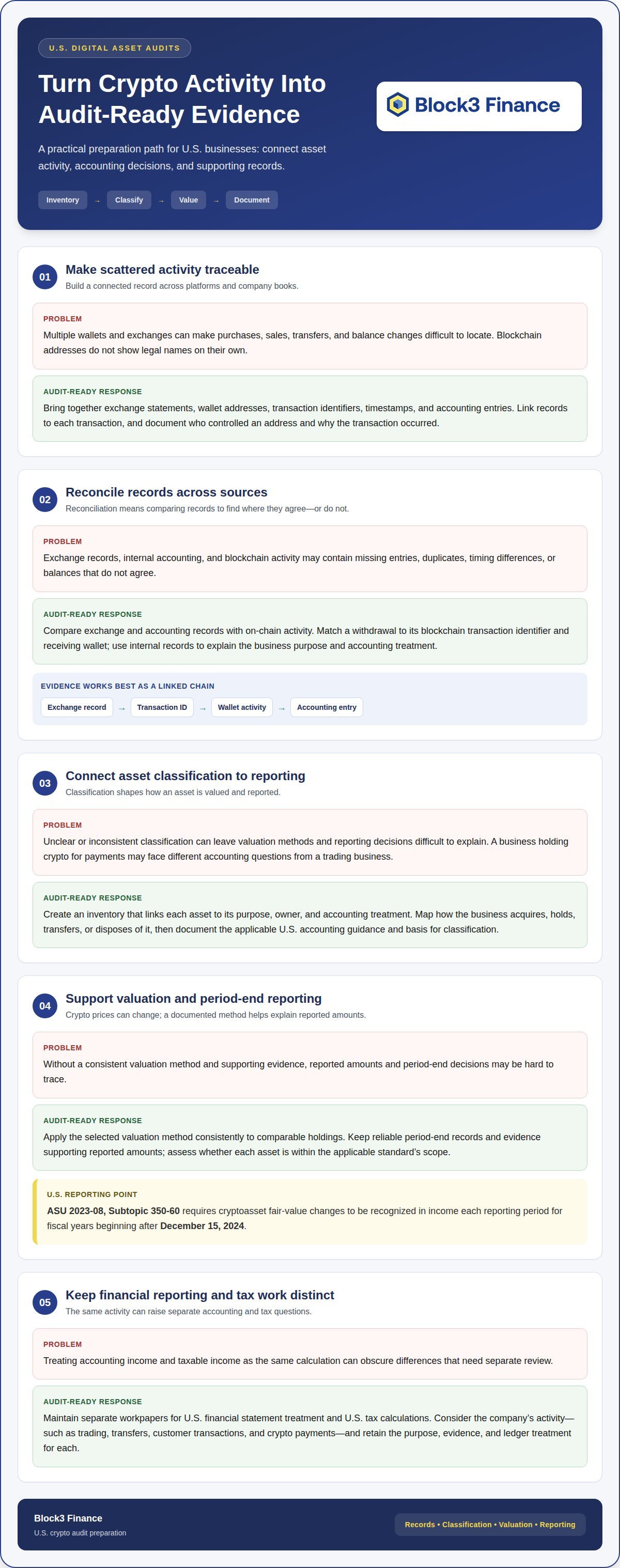
Managing transaction records means bringing activity from every exchange and wallet into a coherent account of the organization’s crypto holdings. This matters because using multiple platforms can make it difficult to find every purchase, sale, transfer, and balance change.
To prepare wallet, exchange, and blockchain evidence, organize exchange statements, wallet addresses, transaction identifiers, timestamps, and related accounting entries. Link each record to the relevant transaction instead of relying on a single balance screenshot. For example, distinguish a transfer between two company-controlled wallets from a sale or payment to another party.
Blockchain transactions use wallet addresses rather than legal names or identification numbers, so records need context linking addresses to organizational activity. An auditor may assess whether customer transactions align with the organization’s crypto holdings. Clear documentation helps explain who controlled an address, why a transaction occurred, and how the business recorded it.
Transaction History Reconciliation
Transaction history reconciliation compares exchange and internal accounting records with activity recorded on the blockchain. It helps identify missing entries, duplicates, timing differences, and balances that do not agree across sources.
For example, an exchange record may show a withdrawal while the company’s ledger records an asset transfer. Matching the withdrawal to the blockchain transaction identifier and the receiving wallet helps establish whether both entries describe the same movement. A defined audit scope can distinguish transaction testing from broader reviews of financial reporting and controls.
Reconciliation also tests completeness: auditors can compare on-chain activity with off-chain records, such as exchange statements and accounting entries. A blockchain record shows that a transaction was recorded on the network, while internal records explain its business purpose and accounting treatment. Neither source necessarily tells the full story on its own.
Because blockchain activity is pseudonymous, transaction verification also depends on evidence linking a wallet address to the organization or its customers. Address records, transaction histories, and related documentation can help establish that connection. Consistent reconciliation gives auditors a clearer view of holdings and supports accountability across exchanges, wallets, and company records.
Using multiple exchanges and wallets can make it difficult for crypto investors to find records of every purchase and sale. This challenge highlights the value of reviewing activity alongside controls, rather than relying on records from one platform alone. A crypto audit can resemble a cash or foreign-exchange audit because it reviews an organization’s cryptocurrency use and controls. These comparisons frame the work around locating activity and understanding how the organization uses and oversees its crypto holdings.
Preparing accounting firms for digital asset audits
For U.S. businesses, accounting teams need a consistent method for classifying, valuing, and reporting digital assets under the financial reporting framework they use. The appropriate audit focus depends on the organization’s role in the crypto ecosystem, its products and services, and its stage of development. A trading business, for example, may face different accounting questions from a company holding crypto for payments.
Begin with an inventory linking each asset to its purpose, owner, and accounting treatment. Then map how the business acquires, holds, transfers, or disposes of each asset. This view helps accounting teams identify where transaction records, valuation methods, or reporting decisions could lead to errors. Strong crypto audit preparation makes these decisions traceable instead of leaving them scattered across spreadsheets and platform exports.
Tax risk assessment should consider the company’s U.S. digital asset activity, not just its period-end balances. Trading, transfers, customer transactions, and crypto payments may raise different tax and accounting questions. For each activity, accounting teams can document its business purpose, supporting evidence, and ledger treatment. This helps distinguish routine activity from transactions that need closer review.
Valuation requires particular care because crypto asset prices can change, while financial reports use defined measurement approaches. Classification influences the approach. For U.S. financial statements, accounting teams should determine the applicable U.S. accounting guidance for each asset type and document the basis for classification. They should apply the selected valuation method consistently to comparable holdings and retain evidence supporting reported amounts.
For U.S. reporting, Accounting Standards Update 2023-08, Subtopic 350-60, requires cryptoasset fair-value changes to be recognized in income each reporting period for fiscal years beginning after December 15, 2024. The standard makes the reporting period’s fair-value movement relevant to income, so accounting teams need a documented valuation process and reliable period-end records. They should assess whether each asset falls within the standard’s scope before applying its measurement requirements. Financial statement treatment should also remain distinct from the company’s U.S. tax calculations, since accounting income and taxable income can require separate workpapers.
A practical review can organize the work around a few connected questions:
- Which digital assets does the organization hold, and how are they classified under its U.S. reporting framework?
- What evidence supports each asset’s valuation and financial statement treatment?
- Do transaction records support the activity included in U.S. tax and financial reporting?
- Are accounting policies applied consistently across reporting periods?
These questions help accounting firms focus testing on an organization’s actual exposures instead of treating every crypto business alike. A U.S. business with several custody models, for example, may need separate control testing for each model. The audit plan should identify relevant risks, the controls intended to address them, and the evidence needed to assess whether those controls operate as designed.
For support aligning digital-asset records with audit requirements, discuss your audit needs.
Audit planning and risk assessment
Audit planning begins by mapping how the organization currently uses crypto and blockchain, then considering planned uses. The audit scope should reflect the company’s role in the ecosystem, its products and services, and its stage of development. A business holding crypto for payments, for example, faces different control questions from one operating a crypto product.
Risk assessment connects those activities to potential financial reporting and control failures. Auditors consider where transactions are initiated, who can authorize them, and how the organization records ownership. Planned blockchain services matter too: new activity can create risks that existing controls weren’t designed to address. Clear planning makes the audit response specific to operations rather than generic.
A crypto audit has no fixed timeline. Its duration depends on the audit’s scope, the number and complexity of activities under review, the readiness of records and controls, and how quickly teams resolve evidence requests or exceptions. For example, unclear wallet ownership may require additional testing and follow-up, extending the work.
Wallet custody is one risk area. Holding more than 20% of a business’s crypto assets in non-custodial wallets can raise questions about security and ownership controls. Auditors may assess how access is granted, how signing authority is managed, and what evidence supports control over those wallets. The percentage is a prompt for scrutiny, not a substitute for understanding the actual custody arrangements.
According to the PCAOB, auditors addressing cryptoasset risks should emphasize risk assessment and tailor their audit responses. The audit team links each identified risk to relevant testing. If the concern is unauthorized transfers, for instance, testing may focus on approval processes and access controls. If reporting relies on a new blockchain product, planning may examine how that product affects transaction recording and oversight.
A risk plan can group the work into practical questions:
- Which current and planned activities use cryptocurrency or blockchain?
- Who approves transactions, manages wallet access, and reviews exceptions?
- Where do the company’s products or services create distinct control risks?
- Which records, controls, or unresolved issues could delay testing?
These questions help prioritize work according to exposure and operational impact. A crypto business with several custody models, for example, may need separate control testing for each model. The resulting audit plan should state the risks, the controls intended to address them, and the evidence needed to assess whether those controls operate as designed.
Audit readiness and trust
Audit readiness depends on controls that make blockchain activity understandable and reviewable. Strong internal processes connect access, transaction approval, data management, and staff responsibilities.
Internal Controls Before an Audit
Internal controls are documented procedures that help protect assets and support reliable records. Auditors need to assess how blockchain technology is accessed, changed, and monitored. Access management should define who can use systems and wallets; change management should document approved system updates. Data management should cover backups and restoration so records remain available when needed.
Controls also address cash-like instruments, including whether access is monitored and restricted. Precise records of issued and unissued items help show what the organization controls. For wallet ownership testing, auditors may request signed messages from wallet addresses. A signing process should identify authorized personnel and preserve evidence of the request and response.
Crypto Audit Preparation Checklist
A checklist is a structured review of records, controls, and responsibilities before testing begins. It matters because missing evidence or unclear ownership can slow an audit. Start by organizing control descriptions, access records, change logs, and data backup procedures. Then identify who can explain each process and where supporting documentation is stored.
Next, review whether staff understand crypto accounting principles and internal control procedures. Training helps employees follow consistent processes when recording transactions or handling exceptions. Include counterparty verification and transaction monitoring in the review, since compliance auditors assess how businesses identify counterparties and monitor suspicious activity.
Readiness also depends on consistent execution. A written access policy has limited value if actual permissions don’t follow it. Internal reviewers can compare assigned access with approved roles, then document exceptions and corrective actions. For example, if someone retains system access after changing roles, the organization should record the issue, the action taken, and who is responsible for resolving it.
Data controls should cover the full record lifecycle. Identify where transaction data is stored, who can change it, and how backups are restored. A restoration test shows whether archived records can be retrieved for audit work. Record the outcome and any gaps to give reviewers evidence beyond a policy document.
Staff training should connect procedures to real work. Employees who handle wallet access need to understand approval and signing steps; accounting staff need to know how internal records support audit testing. Training records and clear escalation routes make responsibilities visible. Proactive preparation also means tracking unresolved control exceptions, assigning ownership, and retaining evidence that each issue was addressed.
These practices establish a sound foundation for audit evidence: defined access, controlled changes, recoverable data, trained staff, and documented monitoring. Together, they help an organization explain how its controls operate instead of relying on informal knowledge when auditors request support.
Regulatory compliance across jurisdictions
For a U.S.-focused audit, map the company’s domestic crypto activities to the compliance processes and records that support them. Identify the business entities involved, the services they perform, and the people responsible for oversight. This creates a clear view of U.S. operations without treating requirements from other countries as part of the same review.
A compliance audit can examine how a U.S. business addresses anti-money laundering controls, sanctions screening such as OFAC checks, and applicable reporting requirements. Auditors may assess how the organization verifies counterparties, monitors crypto transactions, reviews alerts, and documents decisions. For example, a flagged transaction should have a record showing who reviewed it, what information informed the decision, and how the case was resolved.
Organize evidence around the operation each process supports. For counterparty verification, retain records showing what information the business collected and how staff used it. For transaction monitoring, document how alerts are reviewed and escalated. For reporting, connect the relevant business activity to its records and responsible team. This structure helps reviewers assess whether documented procedures match actual practice.
Blockchain operations also raise a governance question: who holds legal or regulatory liability if a data breach or smart-contract error occurs? Organizations using blockchain networks should identify relevant responsibilities and decision-making arrangements. An audit can examine whether assigned roles and incident processes reflect how the organization uses the network, rather than relying on informal assumptions about who responds.
Stablecoin issuers should also consider relevant disclosure expectations. The AICPA’s 2025 guidance for stablecoin issuers includes expanded disclosure requirements for asset-backed tokens, described as now in effect. For a U.S. issuer, audit planning can connect those disclosures to supporting records and controls. The review should document which disclosures apply to the issuer’s activity and how the underlying information is assembled.
A practical U.S. compliance review can bring these workstreams together:
- Map the company’s U.S. operations, services, and responsible teams.
- Document counterparty verification and sanctions-screening processes.
- Trace transaction-monitoring alerts through review and resolution.
- Connect reporting and disclosures to supporting records.
- Assign responsibility for blockchain-related incidents and escalation.
This approach gives audit teams a clear path from business activity to control evidence. It also helps management identify where procedures, records, or ownership need refinement before an audit tests them. Discuss U.S. audit and compliance needs with a team that understands digital-asset operations.
Block3 Finance: Audits and Compliance
Block3 Finance supports digital asset businesses with Audits and Compliance, helping bring accounting records, transaction evidence, and control processes into a clearer audit framework. This support can be useful when wallet activity, reporting practices, or compliance responsibilities need structured review.
Where audit readiness also depends on consistent bookkeeping, Monthly Accounting can help maintain organized financial records. Tax Filing and Reporting and a Crypto Tax Accountant can support related crypto tax work, keeping these needs connected without losing sight of the audit’s scope.
For support with your digital asset audit needs, contact Block3 Finance.
Make audit readiness part of your operating rhythm
Audit readiness works best as an ongoing discipline, not a response to a scheduled review. Treat crypto audit preparation as part of financial governance: assign ownership, keep decisions traceable, and revisit controls as products, counterparties, and jurisdictions change. This approach helps leadership use audit findings to strengthen oversight and make informed operational decisions.
Block3 Finance brings Audits and Compliance together with Tax Filing and Reporting and Monthly Accounting, supporting businesses that need audit work connected to their financial records and reporting processes. If your next step is to clarify audit needs or discuss how these services fit your operations, contact Block3 Finance to discuss your audit.
Build the next phase of your digital asset business on records and controls your team can explain with confidence.
Frequently Asked Questions
What documents and records should a crypto company prepare for an audit?
Prepare records linking digital asset activity to business purpose, authorization, and financial reporting. Useful items include exchange statements, wallet ownership records, transaction identifiers, accounting entries, valuation support, and written accounting policies. Add approvals for significant transactions, access reviews, and records of control exceptions. For example, a customer payment record should link the payment to its invoice and show how the company recorded the asset received.
How should cryptocurrency transactions be reconciled and valued for an audit?
Match transaction records across the accounting ledger, exchange statements, and relevant blockchain activity, then investigate unmatched or duplicated entries. Keep evidence of how assets were valued at the applicable reporting date and apply the method consistently to comparable holdings. For example, a transfer between company wallets should not be treated as a sale just because one wallet shows an outgoing transaction. Document the rationale for its accounting treatment.
Which accounting standards apply to cryptocurrency audits in the United States?
For U.S. financial reporting, the applicable framework depends on the entity and its reporting obligations. Accounting Standards Update 2023-08, Subtopic 350-60, requires cryptoasset fair-value changes to be recognized in income each reporting period for fiscal years beginning after December 15, 2024. This standard addresses qualifying cryptoassets under U.S. GAAP; it doesn’t replace the need to assess asset classification, disclosures, and other applicable accounting guidance.
What IRS rules affect crypto accounting records and audit preparation?
For U.S. federal tax reporting, crypto activity is generally reported with other tax information on Form 1040; there’s no separate crypto return. Selling, trading, spending, staking, airdrops, and mining can create taxable activity, so retain records that support the transaction type, date, proceeds or income, and related accounting treatment. Financial statement accounting and tax reporting serve different purposes, so keep their workpapers distinct and connect any adjustments clearly.
What are common findings and risks in cryptocurrency audits?
Common audit concerns include records that don’t explain a transaction’s business purpose, inconsistent asset classification, unsupported valuations, and unclear wallet access or ownership. Compliance reviews may also identify gaps in counterparty verification, sanctions screening, suspicious activity monitoring, or responsibility for blockchain incidents. For example, a written approval policy may not match actual access permissions. Auditors assess both the documented control and evidence that staff followed it in practice.

Article by
Mahad Mohamed
Mahad Mohamed is an accountant and the CEO of Block3 Finance, with over 26+ years of Canadian and international tax and accounting experience. A crypto accounting specialist since the early days of Bitcoin, he has consulted for over 38 crypto companies and collaborated with legal professionals on regulatory matters. His expertise spans corporate reorganization, cross-border tax structuring (Canada & US), tax disputes, and CRA audits.
Previously, Mahad worked for the Canada Revenue Agency (CRA), Big4 accounting firms, and served as a Rulings Officer for the Federal Tax Authority of the UAE before acquiring Tax Partners in 2014.
Block3 Finance and Tax Partners has 44 full-time accountants and over 9,800+ clients.
Disclaimer
This article provides general information only and is current as of its publication date. It has not been updated and may be out of date. It does not constitute legal advice and should not be relied upon as such. Every tax situation is unique and may differ from the examples discussed in this article. If you have specific questions, you should seek the advice of our accountants for your unique circumstances.
Frequently Asked Questions
What documents and records should a crypto company prepare for an audit?
Prepare records linking digital asset activity to business purpose, authorization, and financial reporting. Useful items include exchange statements, wallet ownership records, transaction identifiers, accounting entries, valuation support, and written accounting policies. Add approvals for significant transactions, access reviews, and records of control exceptions. For example, a customer payment record should link the payment to its invoice and show how the company recorded the asset received.
How should cryptocurrency transactions be reconciled and valued for an audit?
Match transaction records across the accounting ledger, exchange statements, and relevant blockchain activity, then investigate unmatched or duplicated entries. Keep evidence of how assets were valued at the applicable reporting date and apply the method consistently to comparable holdings. For example, a transfer between company wallets should not be treated as a sale just because one wallet shows an outgoing transaction. Document the rationale for its accounting treatment.
Which accounting standards apply to cryptocurrency audits in the United States?
For U.S. financial reporting, the applicable framework depends on the entity and its reporting obligations. Accounting Standards Update 2023-08, Subtopic 350-60, requires cryptoasset fair-value changes to be recognized in income each reporting period for fiscal years beginning after December 15, 2024. This standard addresses qualifying cryptoassets under U.S. GAAP; it doesn’t replace the need to assess asset classification, disclosures, and other applicable accounting guidance.
What IRS rules affect crypto accounting records and audit preparation?
For U.S. federal tax reporting, crypto activity is generally reported with other tax information on Form 1040; there’s no separate crypto return. Selling, trading, spending, staking, airdrops, and mining can create taxable activity, so retain records that support the transaction type, date, proceeds or income, and related accounting treatment. Financial statement accounting and tax reporting serve different purposes, so keep their workpapers distinct and connect any adjustments clearly.
What are common findings and risks in cryptocurrency audits?
Common audit concerns include records that don’t explain a transaction’s business purpose, inconsistent asset classification, unsupported valuations, and unclear wallet access or ownership. Compliance reviews may also identify gaps in counterparty verification, sanctions screening, suspicious activity monitoring, or responsibility for blockchain incidents. For example, a written approval policy may not match actual access permissions. Auditors assess both the documented control and evidence that staff followed it in practice.