
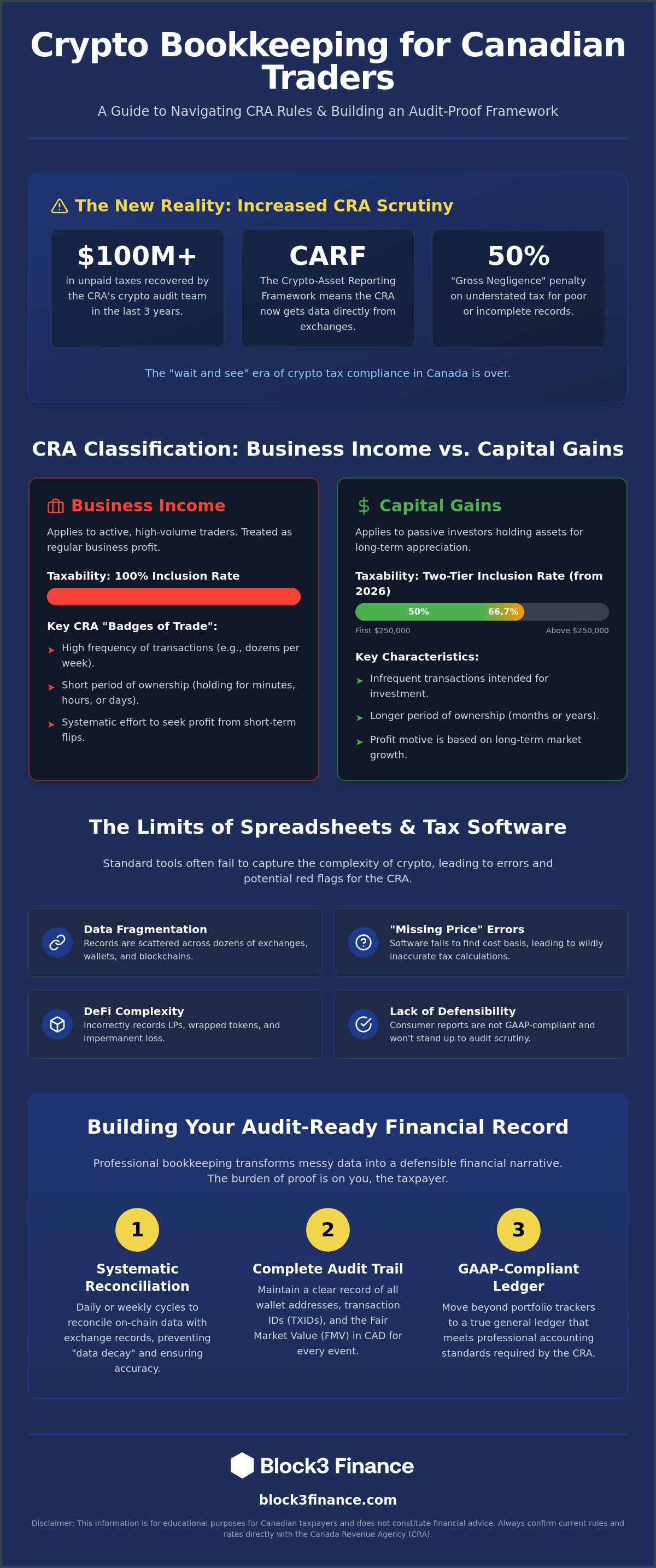
The CRA's specialized team of cryptoasset auditors has recovered more than CAD $100 million in unpaid taxes over the last three years. For active market participants, this figure isn't just a statistic; it's a signal that the era of "wait and see" compliance has ended. You likely feel the weight of data fragmentation across dozens of exchanges and the constant worry that a single classification error could trigger a costly audit. It's a common friction point that prevents many talented traders from scaling their operations with total confidence.
Mastering crypto bookkeeping for traders is the only way to shift from a defensive posture to one of absolute financial command. This guide provides the clarity you need to meet the rigorous defensibility standards required by the CRA while navigating the 2026 two-tier capital gains inclusion rates and new CARF reporting requirements. We'll examine the methodology for classifying business income versus capital gains and provide a roadmap for building an audit-ready financial narrative that supports your long-term evolution in the digital asset space.
Key Takeaways
- Learn how to transition from basic portfolio tracking to systematic, GAAP-compliant records that turn fragmented on-chain data into a defensible financial narrative.
- Identify the specific "badges of trade" the CRA uses to determine if your activity constitutes business income, a critical distinction for high-volume market participants.
- Master the complexities of DeFi bookkeeping by learning how to correctly record wrapped tokens, LP positions, and impermanent loss for CRA filers.
- Implement a robust framework for crypto bookkeeping for traders that utilizes "shadow books" to verify exchange data against direct on-chain reality for maximum defensibility.
- Explore how transitioning from individual trading to a corporate structure can improve tax efficiency and provide a scalable foundation for future growth in Canada.
Beyond Spreadsheets: Why Professional Crypto Bookkeeping is Essential for Canadian Traders
Professional crypto bookkeeping is the systematic reconciliation of on-chain data into GAAP-compliant records. It's the difference between a rough estimate and a bulletproof financial narrative. While many people use basic portfolio trackers to monitor their net worth, these tools don't provide the defensible general ledger required for CRA filers. A true ledger accounts for every movement, fee, and cost-basis adjustment across your entire ecosystem, ensuring your records stand up to professional scrutiny.
The complexity of the foundational concepts of cryptocurrency means that traditional accounting methods often fall short when applied to digital assets. In 2026, the stakes have never been higher for market participants. With the full implementation of the Crypto-Asset Reporting Framework (CARF), the CRA now receives transaction data directly from service providers. High-frequency traders can't afford to wait until year-end to organize their data. You need daily or weekly reconciliation cycles to combat "data decay," a common issue where exchange APIs lose historical cost-basis information or delisted token data over time.
The Limits of Consumer-Grade Crypto Tax Software
Plug-and-play tax tools often fail when they encounter complex DeFi interactions or internal transfers between cold storage and exchanges. These software algorithms frequently produce "missing price" errors that can wildly skew your Canadian tax liability. Professional oversight identifies these anomalies before they become red flags. We ensure that every transaction, from liquidity pool entries to wrapped token swaps, is accurately reflected in your books, preventing the common software glitches that lead to overpaid taxes.
Establishing a Defensible Audit Trail for the CRA
A complete record under CRA guidelines includes wallet addresses, transaction IDs, and the fair market value of assets at the moment of every exchange. In a Canadian tax audit, the burden of proof rests entirely on the taxpayer to disprove the CRA's assessment. Effective crypto bookkeeping for traders acts as a shield against the "gross negligence" penalties that the CRA applies to disorganized or incomplete records. These penalties can reach 50% of the understated tax, making professional record-keeping a vital investment in your financial security and future growth.
CRA Classification: Navigating the 'Business Income' vs. 'Capital Gains' Divide
The CRA does not view all digital asset profits through the same lens. For casual participants, the default assumption is that disposals result in capital gains. However, the agency applies a rigorous set of criteria known as the "badges of trade" to determine if your activity actually constitutes business income. If you are a high-volume trader, you are likely "carrying on a business" in the eyes of the agency. This distinction is vital because business income is 100% taxable. In contrast, capital gains realized on or after January 1, 2026, follow a two-tier inclusion rate for CRA filers: 50% on the first $250,000 and 66.67% on any amount above that threshold.
When your activity shifts from passive investment to active trading, your financial reporting must evolve. Effective crypto bookkeeping for traders requires a transition from tracking simple gains to maintaining a full ledger of business operations. The CRA looks for systematic effort. If you are seeking profit through frequent, short-term flips rather than long-term appreciation, you must prepare for the higher tax obligations and more stringent record-keeping standards associated with business status. You can discuss your trading volume with our team to determine where your activity falls on this spectrum.
Factors That Trigger Business Income Status
The CRA evaluates several key factors to decide if you are running a business. Frequency of transactions is a primary indicator; executing dozens of trades per week suggests a professional operation rather than a personal investment strategy. The period of ownership also matters. Assets held for only minutes or hours signal a trading business. Finally, the agency considers your level of specialized knowledge and the time you dedicate to these activities. If you use professional-grade charting tools or spend hours daily managing your positions, the CRA will likely classify your profits as business income.
Bookkeeping Requirements for Business-Scale Traders
Traders classified as carrying on a business must maintain a complete set of books. This includes a balance sheet and an income statement that reflect the true state of your professional activities. Unlike casual investors, business-scale traders can track and deduct legitimate business expenses to offset their income. These may include:
- Specialized hardware and high-performance computing equipment.
- Subscriptions for trading platforms, data feeds, and research tools.
- A portion of home office costs, provided the space is used primarily for trading.
Maintaining these records manually is often impossible for active market participants. Learn more about our crypto accounting services in Ontario to see how we help traders build a scalable system for long-term growth. By treating your trading as a formal enterprise, you gain the ability to optimize your tax position while remaining fully compliant with Canadian regulations.
Reconciling Complexity: Solving the DeFi and High-Volume Transaction Puzzle
Decentralized finance introduces a layer of architectural complexity that standard accounting software simply cannot resolve. For those engaged in high-frequency algorithmic trading, the sheer volume of "dust" and micro-transactions creates a massive data footprint that requires systematic normalization. Professional crypto bookkeeping for traders moves beyond simple price tracking to account for the nuanced behavior of "wrapped" tokens and liquidity provider (LP) tokens. These assets represent a claim on underlying collateral, but they're often treated as distinct property by the CRA, requiring precise entry and exit valuation to avoid massive discrepancies in your reported income.
Impermanent loss presents another reconciliation hurdle for active market participants. While it feels like a theoretical concept during active farming, it must be recorded as a realized loss for CRA compliance when you withdraw liquidity and receive fewer assets than you originally deposited. Additionally, for those classified as carrying on a business, staking rewards and airdrops are generally treated as business income at their fair market value on the date of receipt. This income must be meticulously tracked to ensure your year-end financial statements reflect the true economic reality of your trading desk.
Liquidity Pool and Yield Farming Reconciliation
Mapping the movement from native assets to LP tokens requires a granular approach to data extraction. Every time you deposit assets into a pool, you are technically swapping those assets for a new token. The CRA views these swaps as immediate taxable dispositions, meaning you must realize any gain or loss at that moment. You must determine the fair market value (FMV) in Canadian dollars at the exact moment of every trade to ensure your cost-basis remains accurate. This level of detail is non-negotiable for high-volume traders who need a defensible record of their yield farming activities.
Cross-Chain and Bridge Transaction Tracking
Bridging assets between ecosystems like Ethereum and Solana adds another layer of friction to your books. You must ensure that internal transfers are clearly identified as non-taxable movements rather than being flagged as sales. Professional bookkeeping allows you to treat gas fees and bridge fees as deductible costs for professional traders, reducing your overall taxable burden. Maintaining this level of clarity is the best way to ensure a CRA Crypto Audit results in a "no-change" letter. We normalize this data across all chains to ensure your financial narrative remains cohesive and transparent.
The Audit-Ready Framework: Building a Defensible Financial Record
A generated report is not the same as a defensible audit trail. While many traders rely on automated software exports, a static PDF often lacks the granular source documentation required to survive a rigorous CRA inquiry. We move beyond surface-level reporting by maintaining "shadow books" that act as an independent verification layer. This process involves cross-referencing exchange-provided data against direct on-chain reality to ensure every transaction is captured with precision. By normalizing data across 400+ exchanges and thousands of token types, we create a unified financial record that reflects your total command over your digital asset ecosystem.
Source Documentation and Data Integrity
Live API access is a fragile foundation for long-term compliance. Exchanges frequently change their data structures, delist assets, or limit historical access, making it essential to archive CSV and JSON exports immediately. We treat block explorers like Etherscan and Solscan as the ultimate truth because they provide an immutable record of your activity. This rigorous approach to data integrity ensures that even if an exchange disappears, your cost-basis remains verifiable for the minimum six-year period required by the CRA. You can't rely on third-party platforms to preserve the evidence you'll need during a high-stakes audit.
The Value of Monthly Bookkeeping for Traders
The traditional "tax season crunch" is a high-risk strategy for active market participants. Professional crypto bookkeeping for traders allows you to resolve errors in real-time and gain actual visibility into your P&L and tax-drag. This proactive cycle identifies "missing price" errors and misclassified transfers before they compound into a multi-year clean-up project that costs significantly more to resolve. Explore our monthly crypto bookkeeping and accounting services to build a system that scales with your trading growth and eliminates the fear of high-cost emergency accounting.
Every high-volume operation eventually encounters "grey areas" where the CRA has not yet issued explicit, granular guidance. We resolve this friction by preparing a detailed Tax Memo for complex positions, such as novel DeFi yield strategies or liquid staking derivatives. This document outlines the specific accounting logic used to classify your activity, providing the agency with a clear, professional explanation of your methodology. It fundamentally shifts the conversation from a defensive posture to a proactive demonstration of professional mastery, ensuring your filings are backed by intellectual depth and technical rigor. If you're ready to secure your financial future, contact our strategists today to begin building your audit-ready framework.
Professional Mastery: Scaling Your Trading with Managed Bookkeeping
Scaling a trading operation requires a decisive shift from technical execution to strategic oversight. Managed crypto bookkeeping for traders liberates you from the friction of manual data entry, allowing you to focus entirely on alpha generation and market analysis. As your capital under management grows, the complexity of your financial reporting must match your operational sophistication. This is where professional mastery begins. It moves beyond simple compliance to treat your trading activity as a premier financial enterprise capable of sustained growth.
High-volume traders often reach a ceiling where disorganized books prevent institutional-grade audits or the acquisition of outside capital. Integrating Fractional CFO services provides the treasury management and risk mitigation strategies necessary to navigate volatile digital asset markets. We help you build a transparent financial infrastructure that signals stability to potential partners and regulators alike. This proactive approach ensures that your firm is not just surviving the 2026 regulatory shift but is actively thriving within it.
Corporate Structuring for Professional Traders
For many CRA filers, transitioning from personal tax reporting to a Canadian Controlled Private Corporation (CCPC) is a pivotal move for long-term wealth preservation. A corporate structure allows for significant tax deferral on trading profits retained within the company, providing more liquid capital for reinvestment into your strategies. It also creates a critical financial partition between your high-risk trading assets and your personal wealth. Strategic entity structuring ensures that your professional evolution is supported by a robust legal framework designed for high-performance finance in Canada.
Securing Your Financial Future in Web3
Navigating the frontier of DeFi requires a partner that bridges the gap between legacy corporate finance and the blockchain ecosystem. As your operations expand across global jurisdictions, maintaining a unified, compliant record becomes your ultimate competitive advantage. We provide the roadmap for this expansion, ensuring your books remain resilient against shifting regulatory tides and new reporting requirements. Building a relationship with a specialized firm allows you to navigate the complexities of the 2026 tax year with absolute certainty.
Your success in the digital asset space depends on the strength of your financial foundation. By institutionalizing your bookkeeping, you gain total command over your P&L and a clear path toward future growth. Contact the experts at Block3 Finance to secure your books for 2026 and ensure your trading firm is built on a foundation of technical rigor and professional mastery.
Master Your Financial Narrative in the 2026 Regulatory Era
The transition toward automated CRA reporting and the full implementation of CARF in 2026 demand a new standard of financial discipline. You've learned that high-volume activity requires more than just basic tax software; it requires a systematic reconciliation of on-chain data that distinguishes between business income and capital gains with absolute precision. By establishing "shadow books" and resolving DeFi complexities in real-time, you protect your capital from the friction of audits and the heavy burden of gross negligence penalties. These systems aren't just about compliance. They're about gaining total command over your trading desk.
Effective crypto bookkeeping for traders is the foundation upon which you can scale a professional firm or transition into a corporate structure for greater tax efficiency. Block3 Finance brings 13+ years of blockchain financial expertise to your corner, delivering the defensible, audit-ready records you need to thrive. As the firm ranked #1 by Bitcoin.com, we provide the technical rigor and visionary navigation required to master this volatile landscape. You have the strategy and the tools to turn regulatory requirements into a long-term competitive advantage.
Secure your trading legacy with professional crypto bookkeeping from Block3 Finance. It's time to trade with absolute confidence and professional mastery.
Frequently Asked Questions
Is crypto bookkeeping different for day traders compared to long-term investors in Canada?
Yes, the bookkeeping requirements differ significantly based on your CRA classification. Day traders are typically considered to be carrying on a business, which requires a full set of double-entry books, including an income statement and balance sheet. Long-term investors generally focus on tracking the cost basis for capital gains, but traders must account for every transaction as business income, which is 100% taxable under Canadian law.
Can the CRA track my crypto trades if I use decentralized exchanges (DEXs)?
The CRA uses sophisticated blockchain analytics to monitor on-chain activity across all public ledgers. While DEXs don't require traditional KYC, your wallet addresses are often linked to centralized exchanges where your identity is verified. The implementation of the Crypto-Asset Reporting Framework in 2026 further enhances the agency's ability to cross-reference on-chain movements with reported income for all Canadian taxpayers.
How often should a high-volume trader reconcile their crypto books?
High-volume market participants should reconcile their records at least weekly to ensure data integrity. Daily reconciliation is even better for those using algorithmic strategies, as it prevents "data decay" and allows you to resolve API errors or missing price data in real-time. Consistent crypto bookkeeping for traders ensures your financial narrative remains defensible and prevents a high-cost emergency clean-up at year-end.
What happens if I have lost or stolen crypto that I can't account for?
You must provide the CRA with documented evidence to support a claim for a business or capital loss. This evidence typically includes transaction IDs of the theft, police reports, or communication regarding exchange insolvencies. If your books don't contain a clear audit trail of the loss, the CRA may disallow the deduction, potentially leaving you with a tax liability for assets you no longer control.
Are crypto bookkeeping fees tax-deductible for Canadian traders?
Professional accounting and bookkeeping fees are generally deductible for CRA filers who are carrying on a trading business. Because these costs are incurred to earn income, you can use them to offset your gross trading profits. You should keep all invoices and records of payment to support these deductions during a potential audit, as they are legitimate business expenses under Canadian tax rules.
Does Block3 Finance support high-frequency algorithmic trading reconciliation?
We specialize in the systematic normalization of high-frequency trading data for professional desks. Our methodology handles the massive transaction volume and "dust" common in automated strategies by extracting raw source data and verifying it against on-chain reality. We ensure that your algorithmic activity is translated into GAAP-compliant financial statements that meet the highest standards of defensibility for the CRA.
How do I handle NFT trading in my professional crypto books?
NFT transactions are treated as taxable dispositions where you must record the fair market value in Canadian dollars at the moment of the trade. Swapping one NFT for another, or for a native token like ETH, triggers a gain or loss that must be reflected in your income statement. Professional books track the unique cost basis of each asset to ensure your inventory valuation remains accurate and compliant.
What is the difference between a portfolio tracker and professional crypto bookkeeping?
A portfolio tracker provides a surface-level estimate of your holdings, but professional crypto bookkeeping for traders creates a verified, double-entry general ledger. Unlike consumer apps, professional bookkeeping includes a balance sheet, income statement, and a comprehensive audit trail that accounts for gas fees, internal transfers, and cost-basis adjustments. This technical rigor is the only way to meet the CRA's strict standards for defensible financial reporting.

Article by
Mahad Mohamed
Mahad Mohamed is an accountant and the CEO of Block3 Finance, with over 26+ years of Canadian and international tax and accounting experience. A crypto accounting specialist since the early days of Bitcoin, he has consulted for over 38 crypto companies and collaborated with legal professionals on regulatory matters. His expertise spans corporate reorganization, cross-border tax structuring (Canada & US), tax disputes, and CRA audits.
Previously, Mahad worked for the Canada Revenue Agency (CRA), Big4 accounting firms, and served as a Rulings Officer for the Federal Tax Authority of the UAE before acquiring Tax Partners in 2014.
Block3 Finance and Tax Partners has 44 full-time accountants and over 9,800+ clients.
Disclaimer
This article provides general information only and is current as of its publication date. It has not been updated and may be out of date. It does not constitute legal advice and should not be relied upon as such. Every tax situation is unique and may differ from the examples discussed in this article. If you have specific questions, you should seek the advice of our accountants for your unique circumstances.
Frequently Asked Questions
Is crypto bookkeeping different for day traders compared to long-term investors in Canada?
Yes, the bookkeeping requirements differ significantly based on your CRA classification. Day traders are typically considered to be carrying on a business, which requires a full set of double-entry books, including an income statement and balance sheet. Long-term investors generally focus on tracking the cost basis for capital gains, but traders must account for every transaction as business income, which is 100% taxable under Canadian law.
Can the CRA track my crypto trades if I use decentralized exchanges (DEXs)?
The CRA uses sophisticated blockchain analytics to monitor on-chain activity across all public ledgers. While DEXs don't require traditional KYC, your wallet addresses are often linked to centralized exchanges where your identity is verified. The implementation of the Crypto-Asset Reporting Framework in 2026 further enhances the agency's ability to cross-reference on-chain movements with reported income for all Canadian taxpayers.
How often should a high-volume trader reconcile their crypto books?
High-volume market participants should reconcile their records at least weekly to ensure data integrity. Daily reconciliation is even better for those using algorithmic strategies, as it prevents "data decay" and allows you to resolve API errors or missing price data in real-time. Consistent crypto bookkeeping for traders ensures your financial narrative remains defensible and prevents a high-cost emergency clean-up at year-end.
What happens if I have lost or stolen crypto that I can't account for?
You must provide the CRA with documented evidence to support a claim for a business or capital loss. This evidence typically includes transaction IDs of the theft, police reports, or communication regarding exchange insolvencies. If your books don't contain a clear audit trail of the loss, the CRA may disallow the deduction, potentially leaving you with a tax liability for assets you no longer control.
Are crypto bookkeeping fees tax-deductible for Canadian traders?
Professional accounting and bookkeeping fees are generally deductible for CRA filers who are carrying on a trading business. Because these costs are incurred to earn income, you can use them to offset your gross trading profits. You should keep all invoices and records of payment to support these deductions during a potential audit, as they are legitimate business expenses under Canadian tax rules.
Does Block3 Finance support high-frequency algorithmic trading reconciliation?
We specialize in the systematic normalization of high-frequency trading data for professional desks. Our methodology handles the massive transaction volume and "dust" common in automated strategies by extracting raw source data and verifying it against on-chain reality. We ensure that your algorithmic activity is translated into GAAP-compliant financial statements that meet the highest standards of defensibility for the CRA.
How do I handle NFT trading in my professional crypto books?
NFT transactions are treated as taxable dispositions where you must record the fair market value in Canadian dollars at the moment of the trade. Swapping one NFT for another, or for a native token like ETH, triggers a gain or loss that must be reflected in your income statement. Professional books track the unique cost basis of each asset to ensure your inventory valuation remains accurate and compliant.
What is the difference between a portfolio tracker and professional crypto bookkeeping?
A portfolio tracker provides a surface-level estimate of your holdings, but professional crypto bookkeeping for traders creates a verified, double-entry general ledger. Unlike consumer apps, professional bookkeeping includes a balance sheet, income statement, and a comprehensive audit trail that accounts for gas fees, internal transfers, and cost-basis adjustments. This technical rigor is the only way to meet the CRA's strict standards for defensible financial reporting.