
This U.S.-focused guide compares crypto accounting standards under IFRS and U.S. GAAP with U.S. tax treatment. For qualifying crypto assets, FASB ASU 2023-08 introduces fair-value measurement, while the IRS applies a separate tax framework.
The distinction matters: a value reported in the financial statements does not automatically determine the tax result. IFRS classification depends partly on why the cryptocurrency is held, while U.S. tax rules treat cryptocurrency as property, not currency.
This article explains which IFRS standards may apply, how measurement and disclosure differ, and what changed under U.S. GAAP. It keeps U.S. tax rules separate so you can see how financial reporting and tax reporting answer different questions.
Key Takeaways
- Under IFRS, the purpose for holding cryptocurrency helps determine whether IAS 2 or IAS 38 applies.
- For qualifying crypto assets, U.S. GAAP’s fair-value approach brings market changes into current-period earnings; asset eligibility and valuation inputs matter.
- Financial statement disclosures can include holdings, restrictions, cost basis, fair value, and changes during the reporting period.
- Accounting treatment and U.S. tax treatment answer different questions, so a financial statement value alone doesn’t establish the tax result.
- The U.S. corporate alternative minimum tax rate is 15 percent, according to the Internal Revenue Service.
Which IFRS Accounting Standards might be used to account for cryptocurrency?
Under IFRS, cryptocurrency holdings covered by the 2019 Agenda Decision generally fall under IAS 38, unless IAS 2 applies to holdings for sale in the ordinary course of business. Under U.S. GAAP, the applicable treatment depends on whether crypto assets meet Subtopic 350-60’s scope criteria.
IFRS and US GAAP Comparisons
This comparison shows how the reporting framework changes the asset’s measurement and presentation. Under IAS 38, an entity may use the cost or revaluation model; IFRS 13 determines fair value when revaluation applies. Under U.S. GAAP before ASU 2023-08, crypto assets were generally indefinite-lived intangible assets under ASC 350, measured at cost less impairment. The newer guidance requires fair value for qualifying assets.
IFRS classification turns on the holding’s purpose. IAS 2 applies to cryptocurrency held for sale in the ordinary course of business; otherwise, IAS 38 generally applies to holdings within the 2019 Agenda Decision. IAS 7 and IAS 32 generally do not treat cryptocurrency as cash, because it is not widely accepted as a medium of exchange or legal tender. IAS 21 describes a non-monetary asset as one that does not give its holder a right to receive fixed or determinable currency units.
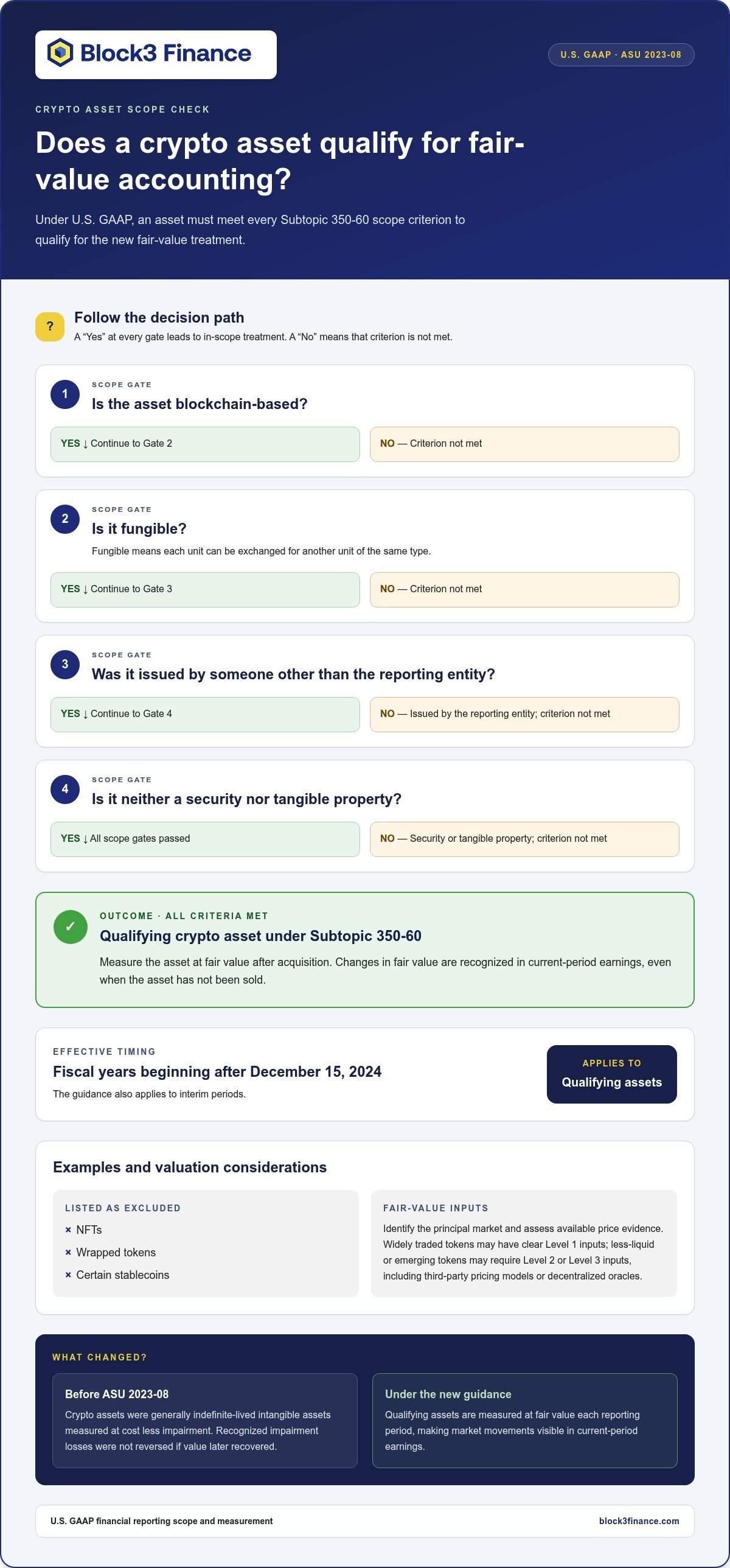
U.S. GAAP’s Subtopic 350-60 applies only to assets meeting its scope criteria, including being blockchain-based and fungible, not issued by the reporting entity, and not a security or tangible property. NFTs, wrapped tokens, and certain stablecoins are excluded. The SEC separately assesses whether a digital asset meets the definition of a security; assets that do are subject to U.S. securities laws and additional disclosure requirements.
Customer Assets Held by Exchanges and Custodians
Customer crypto assets are holdings an exchange or custodian safeguards on customers’ behalf, rather than assets necessarily held for its own account. The accounting analysis matters because customer rights, contractual duties, and control over the assets affect what the entity reports.
An exchange should distinguish its own crypto assets from customer holdings and assess the relevant custody agreements and operating arrangements. The accounting treatment depends on those facts, so customer assets should not automatically be treated as the exchange’s proprietary holdings. This distinction also helps readers understand reported balances and obligations.
For year-end reporting, entities prepare an annual roll-forward reconciling aggregate crypto holdings from opening to closing balances. Under ASU 2023-08, the reconciliation includes additions, dispositions, and gains or losses recognized in net income. A clear record of customer and proprietary positions supports that reporting. A documented digital asset accounting process can help organize those records.
U.S. tax rules are separate from financial reporting. The U.S. corporate alternative minimum tax rate is 15 percent, according to the Internal Revenue Service. The corporate alternative minimum tax, introduced by the Inflation Reduction Act of 2022, is effective for taxable years beginning after December 31, 2022, according to United States Congress.
Fair-value measurement instead of cost-less-impairment
FASB ASU 2023-08 replaces the previous impairment-only approach for qualifying crypto assets. The change makes market movements visible in earnings each reporting period.
Fair Value Measurement Under FASB Guidance
Under Subtopic 350-60, in-scope crypto assets are measured at fair value after acquisition. FASB’s guidance applies to fiscal years beginning after December 15, 2024, including interim periods. For initial measurement, entities continue to apply ASC 350-30. FASB’s amendments require fair-value measurement at each reporting period, giving financial statement users a current view of qualifying digital assets.
Fair Value and Earnings Recognition
Fair-value accounting records changes in qualifying assets’ market value in current-period earnings. A rise can increase reported income, while a fall can reduce it, even without a sale. Before ASU 2023-08, impairment losses on crypto intangible assets weren’t reversed after recognition, even if value recovered during that period. The new approach therefore changes how price movements represent an entity’s financial performance.
FASB also addressed crypto rewards and transaction costs. Some companies apply U.S. GAAP Topic 606 by analogy when accounting for mining or staking rewards they conclude aren’t revenue from customer contracts. Noncash consideration received in a revenue transaction is measured at fair value, unless that value can’t be reasonably estimated. In October 2022, FASB voted 4 to 3 to treat crypto-asset acquisition costs as expenses under GAAP.
Active Markets and Fair Value
FASB’s fair-value approach refers to ASC 820 when identifying an asset’s principal market. Widely traded tokens may have active markets that provide clear prices through Level 1 inputs. Less-liquid or emerging tokens may require Level 2 or Level 3 inputs, including third-party pricing models or decentralized oracles. The entity’s selected inputs affect the valuation, so its method should reflect the available market evidence.
Measurement requires more than copying a quoted price. An entity identifies the principal market, assesses the quality of pricing inputs, and applies its method consistently at each reporting period. For a thinly traded blockchain token, valuation may require careful consideration of the available market evidence.
Crypto Assets Eligible for Fair Value Accounting
FASB ASC 350-60-15-1 sets the scope criteria for assets covered by ASU 2023-08. To qualify, a crypto asset must be blockchain-based and fungible, meaning each unit can be exchanged for another unit of the same type. It must not be issued by the reporting entity, and it must be neither a security nor tangible property. Wrapped tokens, NFTs, and certain stablecoins are excluded. Classification comes before valuation.
When applying these criteria, an entity documents the asset’s characteristics and issuer before selecting a measurement approach. If price inputs or eligibility require careful evaluation, discussing crypto accounting questions can help clarify the reporting analysis.
Financial statement presentation and disclosure requirements
Under U.S. GAAP Subtopic 350-60, companies present qualifying crypto assets separately from other intangible assets and disclose significant holdings, sale restrictions, and reporting-period changes. The disclosures also cover cost basis, fair value, units held, and an annual reconciliation of aggregate holdings.
For each significant crypto asset, companies disclose its cost basis, fair value, and number of units held. The annual roll-forward reconciles opening and closing aggregate balances, including additions, dispositions, and gains or losses recognized in net income.
Presentation matters because a balance-sheet line alone may not explain concentration, restrictions, or movement in digital assets. Subtopic 350-60 requires crypto assets measured at fair value to appear separately from other intangible assets, making the reported amount easier to distinguish.
Interim and Annual Reporting
Under U.S. GAAP Subtopic 350-60, specific disclosures apply in both interim and annual reporting periods. Companies continue to report required information during the year, rather than waiting for year-end. The annual reconciliation provides the opening-to-closing view; interim reporting communicates relevant holdings and changes for that period.
FASB’s disclosure requirements also address concentration. Companies disclose when more than 10% of their crypto holdings are in a single asset or counterparty. This helps financial statement readers identify exposure that an aggregate balance could conceal, such as a portfolio concentrated in one token or with one counterparty.
Restrictions, Events, and Notes
Contractual sale restrictions form part of the Subtopic 350-60 disclosures. A company should identify significant crypto holdings subject to restrictions and explain the restrictions in its reporting. This information helps users distinguish assets that can be sold freely from assets whose sale is contractually limited.
IFRS disclosures follow different requirements. IAS 10 requires disclosure of material non-adjusting events after the reporting period, including significant cryptocurrency fair-value changes. IFRS 18 requires notes that help users understand line items in primary financial statements. These requirements connect a reported balance with relevant events and explanations.
For transactions, the annual U.S. GAAP reconciliation captures additions and dispositions of crypto assets, along with gains or losses recognized in net income. A practical close process tracks each movement, links it to the relevant asset, and reconciles the records with reported opening and closing balances.
Disclosure decisions should distinguish significant holdings from aggregate totals, identify restrictions, and explain movements during each reporting period. For example, a year-end note can pair the unit count and fair value of each significant asset with the annual reconciliation, giving readers a clearer picture of the entity’s digital asset position.
Accounting treatment of acquisition costs
For U.S. GAAP, separate the crypto asset’s initial measurement from the costs of acquiring it. FASB voted 4 to 3 in October 2022 to treat crypto-asset acquisition costs as expenses. The decision affects how an entity records costs associated with obtaining crypto holdings, rather than adding those costs to the asset’s carrying amount. Record the relevant transaction details separately.
For crypto assets within Subtopic 350-60, entities continue to apply ASC 350-30 for initial measurement. That keeps the initial recognition analysis distinct from later fair-value measurement. The first question is whether the asset falls within the guidance; the next is how it should be measured at acquisition. Maintaining that sequence helps prevent valuation changes from being confused with acquisition expenses.
A practical accounting review can break each transaction into three parts:
- Identify the asset. Record the crypto asset acquired and assess the applicable accounting guidance.
- Measure the holding. Apply ASC 350-30 for initial measurement when the asset falls within Subtopic 350-60.
- Record acquisition costs. Expense crypto-asset acquisition costs under the FASB decision, rather than including them in the asset’s recorded amount.
This distinction matters for subsequent reporting. Under the previous U.S. GAAP approach, crypto assets were generally treated as indefinite-lived intangible assets, measured at historical cost less impairment. Keep acquisition costs recorded as expenses separate from the asset balance so that later valuation and impairment records reflect the holding itself.
Consider an entity that acquires a blockchain-based crypto asset and incurs related acquisition costs. It applies the relevant initial-measurement guidance to the asset, then records the acquisition costs as expenses under the FASB decision. If the asset later falls within fair-value guidance, subsequent changes are accounted for separately. This creates a clear audit trail from acquisition through later reporting.
Revenue transactions require a separate analysis. Under U.S. GAAP, noncash consideration received in a revenue transaction is measured at fair value unless that value cannot be reasonably estimated. For example, when a business receives cryptocurrency as consideration, its accounting should distinguish the fair value of that consideration from costs incurred to acquire other crypto holdings.
Mining and staking rewards also require careful classification. Some companies apply Topic 606 by analogy when they conclude those rewards aren’t revenue from contracts with customers. That conclusion affects the accounting analysis; it doesn’t convert acquisition costs into the reward’s valuation. Documenting the transaction type, relevant contract, measurement basis, and expense treatment keeps each entry traceable.
Differences between GAAP and US tax treatment
U.S. GAAP financial reporting and U.S. tax reporting answer different questions. GAAP determines how a business presents crypto assets in its financial statements; IRS rules determine how taxable transactions are treated. The Internal Revenue Service treats cryptocurrency as property rather than currency and taxes it like a capital asset. Separating these purposes is central to applying crypto accounting standards accurately.
That difference matters because a book value change doesn’t, by itself, describe the tax treatment of a transaction. Under U.S. GAAP Subtopic 350-60, qualifying assets are measured at fair value, with changes recognized in current-period earnings. For U.S. tax, selling, trading, or using cryptocurrency for payment requires recognition of a gain or loss based on the change in fair market value.
For example, a business holding a qualifying token may record an increase in market value in GAAP earnings during a reporting period, even if it has not sold the token. A later sale, trade, or payment using that cryptocurrency triggers the IRS treatment described above. Financial statement and tax results can therefore differ in timing and amount, making separate records essential to sound crypto accounting standards.
Keep accounting and tax records distinct. For each transaction, preserve details that connect the financial statement entry with the relevant tax event:
- Identify the asset. Record which token the business acquired, held, transferred, sold, or used for payment.
- Track the accounting treatment. Note whether the asset falls within Subtopic 350-60 and how its reporting-period fair-value changes affect earnings.
- Record transaction details. Document the date and nature of a sale, trade, or payment, along with the fair market value used to determine the gain or loss.
- Reconcile both records. Compare the transaction history with financial statement balances and identify differences in timing or measurement.
Purpose also shapes the accounting analysis. U.S. GAAP may classify crypto holdings within its scope as intangible assets, while the IRS’s property treatment concerns tax reporting. Investors and businesses should not assume that a financial statement classification alone establishes the tax result for a token or transaction.
Losses require the same separation. An impairment loss under an accounting model and a tax loss on a sale or other transaction are not interchangeable. The accounting entry reflects the applicable GAAP measurement; the tax record reflects the transaction and its change in fair market value under the IRS treatment described here.
For a business with frequent token activity, a crypto tax reporting discussion can help align transaction records with accounting entries while keeping the two reporting purposes clear.
Block3 Finance: Tax Filing and Reporting
Block3 Finance helps businesses bring crypto accounting records and U.S. tax reporting into a clearer, more consistent process. Turn to the team when token transactions, fair-value entries, and tax records need to be organized across reporting periods.
Its Tax Filing and Reporting service supports preparation of crypto-related filings, while Monthly Accounting helps maintain records throughout the year. Audits and Compliance can help businesses address reporting controls and documentation, and a Crypto Tax Accountant can assist when transaction records and tax treatment need focused attention.
These services are most relevant when routine bookkeeping no longer captures the full complexity of digital asset activity, or when financial reporting and tax records need to be reconciled. Contact Block3 Finance to discuss your crypto accounting and reporting needs.
Build a Reporting Process You Can Rely On
Digital asset activity continues to evolve, so your reporting process should adapt without losing discipline. Treat each accounting close as an opportunity to strengthen the connection between transaction records, financial statements, and tax reporting. Clear responsibility for those records helps your team explain its decisions and apply consistent methods in future periods.
Start by identifying where your current process creates friction. That could mean reconciling wallet activity, documenting valuation methods, or keeping tax records separate from financial reporting. A focused review can turn these pressure points into a more dependable routine and help your team apply crypto accounting standards with greater clarity.
Block3 Finance can support that work through Tax Filing and Reporting, Audits and Compliance, and Monthly Accounting. Discuss your crypto accounting needs with Block3 Finance and take the next step toward a more controlled reporting process.
Frequently Asked Questions
What Are the Main Amendments of the New Standard?
ASU 2023-08 adds a defined accounting model and related reporting duties for crypto assets that meet its scope. For implementation, companies can build an asset-by-asset eligibility register, assign responsibility for valuation evidence, and map required information to financial statement notes. This helps the accounting team distinguish assets covered by the update from excluded items before closing entries are prepared.
What does this mean in practice?
A finance team needs a repeatable close process that connects token records to accounting decisions. For example, a preparer can document the asset’s characteristics, valuation evidence, and reviewer approval in one workpaper. Keeping that support together makes it easier to explain a reported balance during internal review and trace the decision in a later reporting period.
What has changed under the new rules?
The change gives companies a different way to present qualifying crypto activity to financial statement readers. Finance teams should assess whether their existing close templates capture the information required by the update and whether review controls address crypto-specific valuation judgments. This process change is separate from tax calculations, which continue to follow applicable U.S. tax treatment.
When Does the New Rule Take Effect?
Required application is tied to the start of an entity’s fiscal year, not simply its year-end date. Identify the fiscal calendar, determine the first applicable year, and plan reporting-system and review changes before that year begins. Early adoption is permitted for interim and annual financial statements that have not yet been issued or made available for issuance.
When did the new FASB rules take effect?
FASB issued ASU 2023-08 on December 13, 2023. Required application begins for fiscal years starting after December 15, 2024, including interim periods within those fiscal years. Those are separate milestones: issuance marks when FASB published the update, while the fiscal-year start determines mandatory application. Eligible entities could choose early adoption for qualifying financial statements not yet issued.
What U.S. GAAP accounting standards apply to cryptocurrency and digital assets?
U.S. GAAP application depends on the asset’s characteristics and the entity’s facts. A company should assess whether a holding falls within Subtopic 350-60 before applying that model; assets outside its scope require analysis under other relevant guidance. If a digital asset may meet the definition of a security, the entity also considers the SEC’s classification and related U.S. securities-law disclosure implications.
How does FASB ASU 2023-08 change accounting for crypto assets?
For an entity applying the update, the operational change includes revising close procedures so crypto balances and supporting valuation evidence can be reviewed together. Teams may need to map wallet or custodian records to the general ledger, document price inputs, and assign review responsibility. These controls help trace reported information to the underlying asset records and chosen accounting treatment.
How are crypto assets measured and reported after ASU 2023-08?
For eligible holdings, retain support for the measurement date, selected price evidence, unit count, and asset identity. This lets reviewers trace a reported balance to the underlying records and understand how the valuation was established. Companies should also ensure their note-preparation process captures required asset-level information and reconciles it with the amounts presented in the financial statements.

Article by
Mahad Mohamed
Mahad Mohamed is an accountant and the CEO of Block3 Finance, with over 26+ years of Canadian and international tax and accounting experience. A crypto accounting specialist since the early days of Bitcoin, he has consulted for over 38 crypto companies and collaborated with legal professionals on regulatory matters. His expertise spans corporate reorganization, cross-border tax structuring (Canada & US), tax disputes, and CRA audits.
Previously, Mahad worked for the Canada Revenue Agency (CRA), Big4 accounting firms, and served as a Rulings Officer for the Federal Tax Authority of the UAE before acquiring Tax Partners in 2014.
Block3 Finance and Tax Partners has 44 full-time accountants and over 9,800+ clients.
Disclaimer
This article provides general information only and is current as of its publication date. It has not been updated and may be out of date. It does not constitute legal advice and should not be relied upon as such. Every tax situation is unique and may differ from the examples discussed in this article. If you have specific questions, you should seek the advice of our accountants for your unique circumstances.
Frequently Asked Questions
What Are the Main Amendments of the New Standard?
ASU 2023-08 adds a defined accounting model and related reporting duties for crypto assets that meet its scope. For implementation, companies can build an asset-by-asset eligibility register, assign responsibility for valuation evidence, and map required information to financial statement notes. This helps the accounting team distinguish assets covered by the update from excluded items before closing entries are prepared.
What does this mean in practice?
A finance team needs a repeatable close process that connects token records to accounting decisions. For example, a preparer can document the asset’s characteristics, valuation evidence, and reviewer approval in one workpaper. Keeping that support together makes it easier to explain a reported balance during internal review and trace the decision in a later reporting period.
What has changed under the new rules?
The change gives companies a different way to present qualifying crypto activity to financial statement readers. Finance teams should assess whether their existing close templates capture the information required by the update and whether review controls address crypto-specific valuation judgments. This process change is separate from tax calculations, which continue to follow applicable U.S. tax treatment.
When Does the New Rule Take Effect?
Required application is tied to the start of an entity’s fiscal year, not simply its year-end date. Identify the fiscal calendar, determine the first applicable year, and plan reporting-system and review changes before that year begins. Early adoption is permitted for interim and annual financial statements that have not yet been issued or made available for issuance.
When did the new FASB rules take effect?
FASB issued ASU 2023-08 on December 13, 2023. Required application begins for fiscal years starting after December 15, 2024, including interim periods within those fiscal years. Those are separate milestones: issuance marks when FASB published the update, while the fiscal-year start determines mandatory application. Eligible entities could choose early adoption for qualifying financial statements not yet issued.
What U.S. GAAP accounting standards apply to cryptocurrency and digital assets?
U.S. GAAP application depends on the asset’s characteristics and the entity’s facts. A company should assess whether a holding falls within Subtopic 350-60 before applying that model; assets outside its scope require analysis under other relevant guidance. If a digital asset may meet the definition of a security, the entity also considers the SEC’s classification and related U.S. securities-law disclosure implications.
How does FASB ASU 2023-08 change accounting for crypto assets?
For an entity applying the update, the operational change includes revising close procedures so crypto balances and supporting valuation evidence can be reviewed together. Teams may need to map wallet or custodian records to the general ledger, document price inputs, and assign review responsibility. These controls help trace reported information to the underlying asset records and chosen accounting treatment.
How are crypto assets measured and reported after ASU 2023-08?
For eligible holdings, retain support for the measurement date, selected price evidence, unit count, and asset identity. This lets reviewers trace a reported balance to the underlying records and understand how the valuation was established. Companies should also ensure their note-preparation process captures required asset-level information and reconciles it with the amounts presented in the financial statements.