
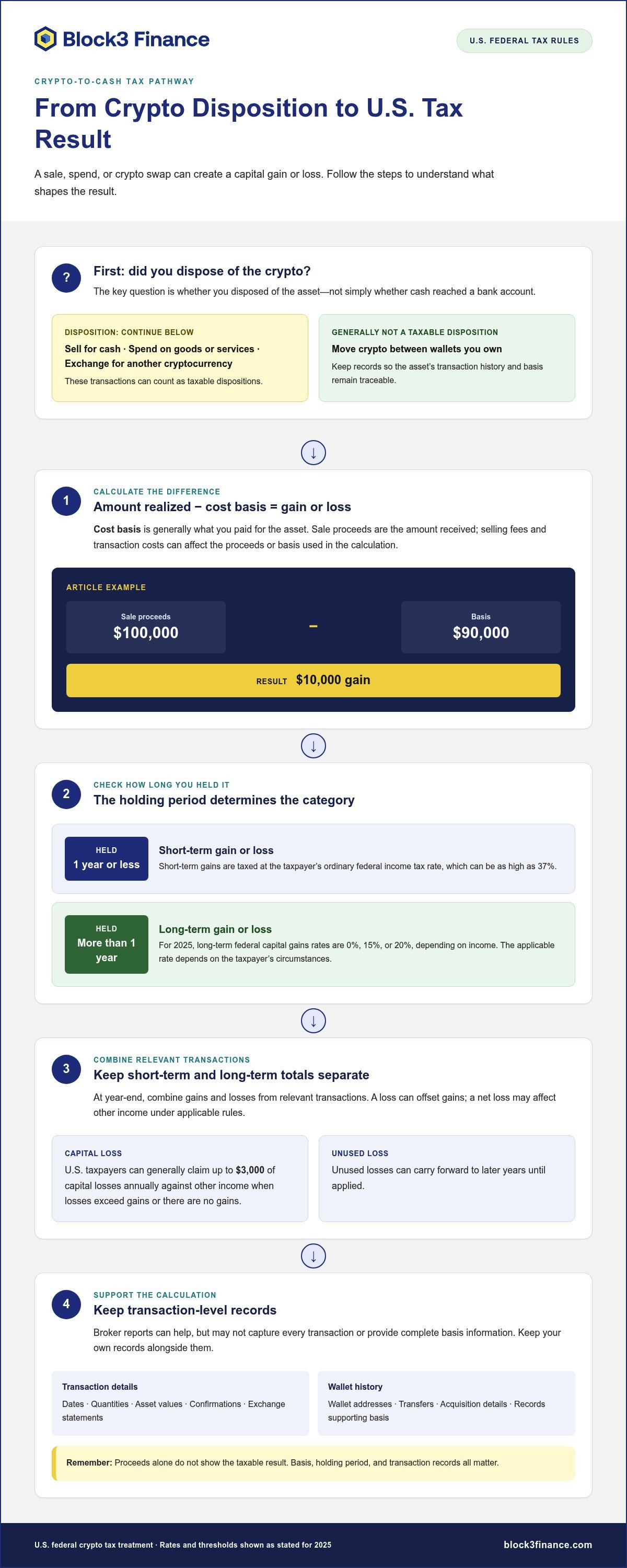
Converting crypto to cash has tax implications: under U.S. federal tax rules, selling cryptocurrency can create a taxable capital gain or loss, based on the difference between the sale proceeds and your cost basis, generally the amount you paid for the asset. Spending crypto or exchanging it for another cryptocurrency can also count as a taxable disposition. Moving crypto between wallets you own generally isn’t taxable.
Taxes don’t apply only when money reaches a bank account. The key question is whether you disposed of the crypto and whether its value changed since you acquired it. A sale at a loss matters too, because losses can affect your overall tax calculation.
This article explains how U.S. rules apply to selling, spending, and trading crypto, which transactions may be tax-free, and how digital asset activity is reported. It also explains why transaction records matter and how holding period, cost basis, and proceeds shape the result, helping you approach tax reporting with greater clarity.
Key Takeaways
- A crypto sale, purchase, or swap can have different tax consequences depending on the asset’s cost basis and value when disposed of.
- Moving crypto between wallets you own is generally different from selling or spending it, but careful records help preserve its transaction history.
- Broker reports can help with tax preparation, but they may not capture every transaction you need to report.
- Separate capital gains from income-related crypto activity so you can identify the records and tax forms that may apply.
- Learn how transaction-level reporting and accounting support can help organize digital asset activity for filing and compliance.
Are there tax-free crypto transactions?
In the United States, a broker’s report doesn’t determine whether you owe federal tax. It provides transaction information, but you remain responsible for reporting your digital asset activity. A bitcoin sale, crypto swap, or mining income may involve different records and tax treatment, so keep your own transaction history alongside broker forms.
Broker reporting is phasing in. For digital asset transactions effected on or after Jan. 1, 2025, U.S. brokers must report gross proceeds. Gross proceeds are the value received from a sale or disposition, before considering your basis or other costs. For certain digital asset transactions effected on or after Jan. 1, 2026, brokers must also report basis, generally the asset’s acquisition cost. These requirements don’t mean every transaction will have complete basis information.
Form 1099-DA is central to this transition. Updated cost-basis reporting for qualifying crypto purchases made from January 1, 2026, is to be distributed in early 2027. Compare any broker statement with your own records: a transfer between accounts, an asset acquired elsewhere, or a transaction the broker didn’t handle may require details beyond the form. A record of dates, quantities, values, and wallet activity supports accurate U.S. crypto tax reporting.
Transition relief also affects the first reporting years. For calendar-year 2025 transactions reported in 2026, the IRS provides brokers penalty relief for Form 1099-DA filing and furnishing failures when they make a good-faith effort to file and furnish forms correctly and on time. The IRS also provides brokers backup withholding relief for transactions occurring in 2025 and 2026. In 2027, relief applies to transactions for customers whose name and taxpayer identification number match IRS records through the TIN-matching program. It also applies to certain preexisting accounts with a non-U.S. address, if the broker hasn’t previously classified the customer as a U.S. person.
Your records should make each transaction traceable. Keep confirmations, exchange statements, wallet addresses, dates, quantities, and the U.S. dollar value when assets were received or disposed of. For mining, record the receipt details used to establish the asset’s value and potential taxable income. The IRS says Part I of its virtual currency FAQs generally applies to transactions completed before January 1, 2025, so note which tax year each transaction belongs to.
Basis records require particular care. Revenue Procedure 2024-28 offers transitional guidance for allocating unused digital asset basis to units held in each wallet or account as of Jan. 1, 2025. That allocation can matter when later sales occur across multiple accounts. Keep the allocation method and supporting wallet records with the relevant tax-year documents, rather than relying solely on a broker’s proceeds report.
Capital gains and losses on crypto-to-cash transactions
For U.S. federal tax purposes, disposing of crypto can create a capital gain or loss. The result depends on your basis, proceeds, and holding period.
Calculating Gains, Losses, and Basis
Basis is generally what you paid for an asset, adjusted by relevant transaction details. Subtract basis from the amount realized to calculate a gain or loss. For example, selling bitcoin with a $90,000 basis for $100,000 produces a $10,000 gain. This calculation matters because proceeds alone don’t show the taxable result.
Selling fees and transaction costs can affect the proceeds or basis used in a calculation, so keep receipts and exchange statements. Separate acquisition costs from costs tied to a sale, and retain records showing how each amount relates to the transaction.
Crypto Losses and Loss Harvesting
Loss harvesting means disposing of an asset at a loss to recognize that loss for tax purposes. Crypto losses are generally exempt from wash-sale rules under current U.S. rules, since cryptocurrency is generally treated as property rather than a security. By contrast, the wash-sale rule for securities can disallow a loss when the same or a substantially identical security is bought within 30 days before or after sale.
The Internal Revenue Service says U.S. taxpayers can generally claim up to $3,000 of capital losses on an annual basis against other income when losses exceed gains or there are no gains. Unused losses can carry forward to later years until applied. Track the acquisition date, sale date, and asset units for each loss; those details support accurate reporting and help distinguish crypto dispositions from security transactions.
The holding period affects how U.S. federal capital gains are classified. Crypto held for one year or less generally produces a short-term gain or loss, while assets held for more than a year generally qualify for long-term treatment. The Internal Revenue Service states that crypto held for more than a year before sale generally qualifies for a lower capital gains tax rate.
Short-term gains are taxed at the taxpayer’s ordinary federal income tax rate, which can be as high as 37%. For 2025, long-term federal capital gains rates are 0%, 15%, or 20%, depending on income. The applicable rate depends on the taxpayer’s circumstances, so a gain’s size alone doesn’t establish the final tax.
At year-end, combine gains and losses from relevant transactions, keeping short-term and long-term amounts separate. A loss can offset gains, while a net loss may affect other income under the applicable rules. Spending crypto on goods or services can also produce a capital gain or loss, because the asset’s value when spent is compared with its basis.
For instance, using cryptocurrency originally bought for $40,000 to purchase a car worth $45,000 produces a $5,000 gain, ignoring transaction costs. Keep the purchase value and original basis together in your records. If multiple wallets or tax lots are involved, organize each asset’s history before calculating the year’s net capital result. For help organizing complex crypto tax calculations, connect with a crypto tax professional.
Forms for reporting digital asset dispositions and income
U.S. federal reporting separates asset dispositions from income received through crypto activity. A disposition means selling, exchanging, or otherwise giving up an asset. The Internal Revenue Service says U.S. taxpayers use Form 8949 to report sales and other dispositions of capital assets, including applicable digital asset dispositions. The form captures transaction details used to calculate gains and losses.
Form 1040 also asks about digital asset activity. That question has appeared beginning with tax year 2020. A sale, exchange, or payment using digital assets may affect how you answer it. Review activity across exchanges and wallets, not only transactions shown on a tax form. A broker statement can help, but it may not cover crypto received directly or activity outside that broker.
Crypto received for services or business activity can create income before any later sale. For example, if you receive $200 of cryptocurrency for services, that amount is income when received. It also generally establishes the asset’s basis. If you later spend it when worth $500, subtract the $200 basis to calculate the later capital gain. Report the income and subsequent disposition as separate tax events.
Mining, staking, airdrops, and hard forks can also create income. The research facts identify Form 1099-MISC for income from these activities, but income remains reportable even if no form arrives. For mining or staking rewards, fair market value when received generally establishes basis for a later disposition. Keep the receipt date, asset amount, and value records together so the income and any later gain remain distinct.
Crypto activity treated as income is generally ordinary income, meaning it’s taxed under income tax rules rather than as a capital gain. The applicable federal marginal rate may range from 10% to 37%. An employee paid in bitcoin reports the value received as income at payment, regardless of later price movement. If the employee later sells or spends that bitcoin, calculate any separate gain or loss from its basis.
Mining as a business can involve another tax layer. A U.S. crypto mining business may owe 15.3% self-employment tax on mining profits after eligible tax deductions. That calculation is distinct from reporting mining receipts as income. Keep records of rewards, related business expenses, and dispositions so each amount enters the correct calculation.
Certain cryptocurrency funds and regulated futures continue to report gains and losses on Form 1099-B. Compare that statement with your own records, then reconcile income and dispositions before filing. A form can support reporting, but it doesn’t replace your responsibility to account for digital asset activity. If you encounter discrepancies across your forms or need professional accounting and tax resolution assistance, CJ Business Solutions, LLC offers comprehensive support to help resolve complex compliance issues.
Tax treatment of selling or spending cryptocurrency
For U.S. taxpayers, converting crypto to cash has tax implications beyond simply receiving dollars. Federal reporting and the final tax calculation are separate considerations.
Reporting Sales, Exchanges, and Conversions
For U.S. federal reporting, answer Yes to the digital assets question when you dispose of digital assets for U.S. dollars or another currency. This identifies activity for the tax return; it doesn’t by itself mean tax is owed. A sale reported at a loss still involves a disposition that belongs in your reporting.
The IRS identifies Notice 2014-21 as guidance on convertible virtual currency. Keep the transaction confirmation and the account statement together, especially when an exchange records the trade before cash is withdrawn. The sale and a later movement of dollars are distinct account events, so their dates and descriptions should not be confused in your records.
The tax implications of converting crypto to cash also depend on whether the transaction is a sale, a payment, or another type of exchange. Record what actually happened rather than treating every entry labelled “withdrawal” as the underlying crypto transaction.
State Income Tax on Crypto Sales
A crypto-to-cash sale may affect state income tax in the United States, but states don’t follow one uniform approach. The applicable state rules and your circumstances determine how the sale is handled on a state return. A federal result alone doesn’t establish the state treatment.
For a practical review, identify the state whose return you file and review its current treatment of digital asset gains. Keep that analysis separate from federal reporting, since a state return may require its own calculation or presentation. Don’t assume that a federal tax result automatically settles the state question.
State tax obligations can also depend on where you are treated as a resident under the applicable rules. If you moved or changed residence during the tax year, organize the relevant dates and records for each period. This helps frame the state review without assuming that one state’s treatment applies everywhere.
For U.S. filers, the key distinction is between identifying an event accurately and determining its tax result. Reporting a digital asset transaction doesn’t mean every sale produces a tax bill, and a state return may involve separate considerations. Keep the transaction description and state information needed to support your filing position.
Understanding the tax implications of converting crypto to cash means considering the federal reporting question alongside applicable state rules. Keep each jurisdiction’s analysis separate, and use the transaction details to support the treatment reported on each return. For broader financial guidance and integrated filing support, wealth management and tax preparation firms like Timothy Roberts & Associates, LLC can help investors navigate these complex requirements.
Wallet transfers and non-taxable events
Under U.S. federal tax rules, moving cryptocurrency between wallets or accounts you own isn’t taxable by itself. The transfer doesn’t create sale proceeds or profit because you still own the same assets. Your original cost basis and acquisition date carry over to the receiving wallet, preserving the asset’s tax history.
The distinction is ownership, not the number of wallets involved. For example, moving bitcoin from your personal wallet to another account you control differs from exchanging it for another token. In the first case, you retain ownership; in the second, you dispose of one asset and receive another. The second transaction can have separate tax consequences.
Keep records connecting the sending wallet to the receiving wallet. A useful transfer record includes:
- The date and amount sent, along with the asset’s name.
- The sending and receiving wallet addresses or account identifiers.
- The transaction hash or exchange confirmation, when available.
- The original acquisition date and basis for the transferred units.
These details help distinguish an internal transfer from a taxable sale when reviewing activity across accounts. Without a complete transfer history, a deposit into an exchange account may look like a new acquisition, even if the asset came from your own wallet. Matching timestamps, amounts, and transaction records helps preserve continuity.
Maintain the same basis and holding-period information after each transfer. If you bought a unit of bitcoin and later moved it between your own wallets, the move doesn’t reset its acquisition date. That date remains relevant when you eventually sell, spend, or exchange the asset and calculate any gain or loss.
Wallet records also help distinguish transfers from income. Crypto received as payment, mining rewards, or from another source may need different reporting from assets moved between your accounts. Note why each deposit occurred, who controlled the source wallet, and whether it reflects a transfer or newly received assets. This context supports accurate tax reporting without treating every incoming transaction as ordinary income.
For year-end records, reconcile wallet histories with exchange statements and retain the original transaction data. A tax professional can use these records to trace basis through transfers and identify transactions that produced proceeds. Organized records are especially useful when assets moved through several accounts before a sale or other disposition.
If wallet activity is difficult to reconcile, discuss your crypto transaction records with a tax professional before preparing your U.S. return.
Block3 Finance: Tax Filing and Reporting
Block3 Finance helps bring U.S. digital asset activity into a clear tax reporting framework. When sales, swaps, mining income, or transfers across wallets make records difficult to reconcile, its Tax Filing and Reporting service can help organize transactions and prepare reporting. A Crypto Tax Accountant can assess how basis, proceeds, and income classification apply across your records.
For ongoing activity, Monthly Accounting supports consistent record organization, while Audits and Compliance can help review reporting processes and documentation. These services are relevant when exchange statements, wallet histories, and income records need to align before filing.
To discuss your crypto tax reporting needs, contact Block3 Finance.
Build a stronger framework for your next transaction
Understanding the tax implications of converting crypto to cash is part of building a disciplined approach to digital assets. A clear process can help you carry reliable records forward as your activity evolves, rather than reconstructing transaction history at filing time. The next step is turning what you’ve learned into a reporting framework that fits your activity and keeps supporting documents connected to each transaction.
Block3 Finance provides Tax Filing and Reporting, Audits and Compliance, and Monthly Accounting for digital asset activity. These services can support you when you need to prepare filings, review reporting processes, or maintain organized records over time. The aim is clarity and control, not added complexity.
Contact Block3 Finance to discuss your crypto tax reporting needs and take a considered next step with your records.
Frequently Asked Questions
How is crypto taxed?
In the United States, the IRS generally treats cryptocurrency as property, so selling, swapping, or spending it can create a capital gain or loss. Crypto received for services, mining, staking, or certain other activities may instead be ordinary income when received. Report applicable digital asset activity on Form 1040; crypto doesn’t require a separate federal return. Classify each event first, then identify the records and tax forms relevant to it.
Can the IRS track crypto activity?
Yes. U.S. brokers report certain digital asset transaction information to the IRS, which can compare reported details with a tax return. For transactions effected on or after Jan. 1, 2025, brokers must report gross proceeds. The IRS may also receive copies of relevant information returns. Broker reporting doesn’t capture every transaction, so taxpayers remain responsible for activity they conduct directly or through accounts that don’t provide complete records.
What is the crypto tax rate?
There isn’t one U.S. federal tax rate for every crypto transaction. Crypto income is generally taxed as ordinary income at the taxpayer’s marginal rate, while a capital gain’s rate depends partly on how long the asset was held. For 2025, short-term gains can be taxed at ordinary federal rates up to 37%; long-term rates are 0%, 15%, or 20%, depending on taxable income.
Is converting cryptocurrency to cash a taxable event in the United States?
Yes. Selling cryptocurrency for U.S. dollars is generally a disposition for U.S. federal tax purposes, even if you keep the dollars in an exchange account instead of withdrawing them to a bank. The sale can produce a gain or loss based on the asset’s basis and sale proceeds. Moving cryptocurrency between accounts you own is different because ownership hasn’t changed.
How is capital gain or loss calculated when selling cryptocurrency for cash?
Subtract the asset’s adjusted basis from the amount realized on the sale to calculate a capital gain or loss. If your proceeds exceed your basis, the difference is a gain; if proceeds are lower, it’s a loss. Identify the specific units sold and retain purchase confirmations, sale statements, and transaction details. These records help support the calculation if exchange data is incomplete.
What are the U.S. federal tax rates for short-term and long-term crypto gains?
For 2025, U.S. short-term crypto gains are taxed at the taxpayer’s ordinary federal income tax rate, which can reach 37%. Long-term gains may be taxed at 0%, 15%, or 20%, depending on taxable income. The holding period determines which category generally applies. These are federal rates; your overall tax calculation can also depend on other income and applicable tax rules.
How does the crypto holding period affect taxes when cashing out?
The holding period generally starts when you acquire the asset and ends when you sell or otherwise dispose of it. Under U.S. federal rules, crypto held for one year or less generally produces a short-term gain or loss; holding it for more than a year generally qualifies the gain for long-term treatment. Track dates for each tax lot, since units of the same cryptocurrency may have different acquisition dates.
How do crypto exchanges report cash sales to the IRS, including Form 1099-DA?
For U.S. digital asset transactions effected on or after Jan. 1, 2025, brokers must report gross proceeds. For certain transactions effected on or after Jan. 1, 2026, they must also report basis. Form 1099-DA is part of this phased-in reporting. Compare the form with your own transaction records: proceeds may be reported even when basis information or activity outside that broker needs separate review.

Article by
Mahad Mohamed
Mahad Mohamed is an accountant and the CEO of Block3 Finance, with over 26+ years of Canadian and international tax and accounting experience. A crypto accounting specialist since the early days of Bitcoin, he has consulted for over 38 crypto companies and collaborated with legal professionals on regulatory matters. His expertise spans corporate reorganization, cross-border tax structuring (Canada & US), tax disputes, and CRA audits.
Previously, Mahad worked for the Canada Revenue Agency (CRA), Big4 accounting firms, and served as a Rulings Officer for the Federal Tax Authority of the UAE before acquiring Tax Partners in 2014.
Block3 Finance and Tax Partners has 44 full-time accountants and over 9,800+ clients.
Disclaimer
This article provides general information only and is current as of its publication date. It has not been updated and may be out of date. It does not constitute legal advice and should not be relied upon as such. Every tax situation is unique and may differ from the examples discussed in this article. If you have specific questions, you should seek the advice of our accountants for your unique circumstances.
Frequently Asked Questions
How is crypto taxed?
In the United States, the IRS generally treats cryptocurrency as property, so selling, swapping, or spending it can create a capital gain or loss. Crypto received for services, mining, staking, or certain other activities may instead be ordinary income when received. Report applicable digital asset activity on Form 1040; crypto doesn’t require a separate federal return. Classify each event first, then identify the records and tax forms relevant to it.
Can the IRS track crypto activity?
Yes. U.S. brokers report certain digital asset transaction information to the IRS, which can compare reported details with a tax return. For transactions effected on or after Jan. 1, 2025, brokers must report gross proceeds. The IRS may also receive copies of relevant information returns. Broker reporting doesn’t capture every transaction, so taxpayers remain responsible for activity they conduct directly or through accounts that don’t provide complete records.
What is the crypto tax rate?
There isn’t one U.S. federal tax rate for every crypto transaction. Crypto income is generally taxed as ordinary income at the taxpayer’s marginal rate, while a capital gain’s rate depends partly on how long the asset was held. For 2025, short-term gains can be taxed at ordinary federal rates up to 37%; long-term rates are 0%, 15%, or 20%, depending on taxable income.
Is converting cryptocurrency to cash a taxable event in the United States?
Yes. Selling cryptocurrency for U.S. dollars is generally a disposition for U.S. federal tax purposes, even if you keep the dollars in an exchange account instead of withdrawing them to a bank. The sale can produce a gain or loss based on the asset’s basis and sale proceeds. Moving cryptocurrency between accounts you own is different because ownership hasn’t changed.
How is capital gain or loss calculated when selling cryptocurrency for cash?
Subtract the asset’s adjusted basis from the amount realized on the sale to calculate a capital gain or loss. If your proceeds exceed your basis, the difference is a gain; if proceeds are lower, it’s a loss. Identify the specific units sold and retain purchase confirmations, sale statements, and transaction details. These records help support the calculation if exchange data is incomplete.
What are the U.S. federal tax rates for short-term and long-term crypto gains?
For 2025, U.S. short-term crypto gains are taxed at the taxpayer’s ordinary federal income tax rate, which can reach 37%. Long-term gains may be taxed at 0%, 15%, or 20%, depending on taxable income. The holding period determines which category generally applies. These are federal rates; your overall tax calculation can also depend on other income and applicable tax rules.
How does the crypto holding period affect taxes when cashing out?
The holding period generally starts when you acquire the asset and ends when you sell or otherwise dispose of it. Under U.S. federal rules, crypto held for one year or less generally produces a short-term gain or loss; holding it for more than a year generally qualifies the gain for long-term treatment. Track dates for each tax lot, since units of the same cryptocurrency may have different acquisition dates.
How do crypto exchanges report cash sales to the IRS, including Form 1099-DA?
For U.S. digital asset transactions effected on or after Jan. 1, 2025, brokers must report gross proceeds. For certain transactions effected on or after Jan. 1, 2026, they must also report basis. Form 1099-DA is part of this phased-in reporting. Compare the form with your own transaction records: proceeds may be reported even when basis information or activity outside that broker needs separate review.