
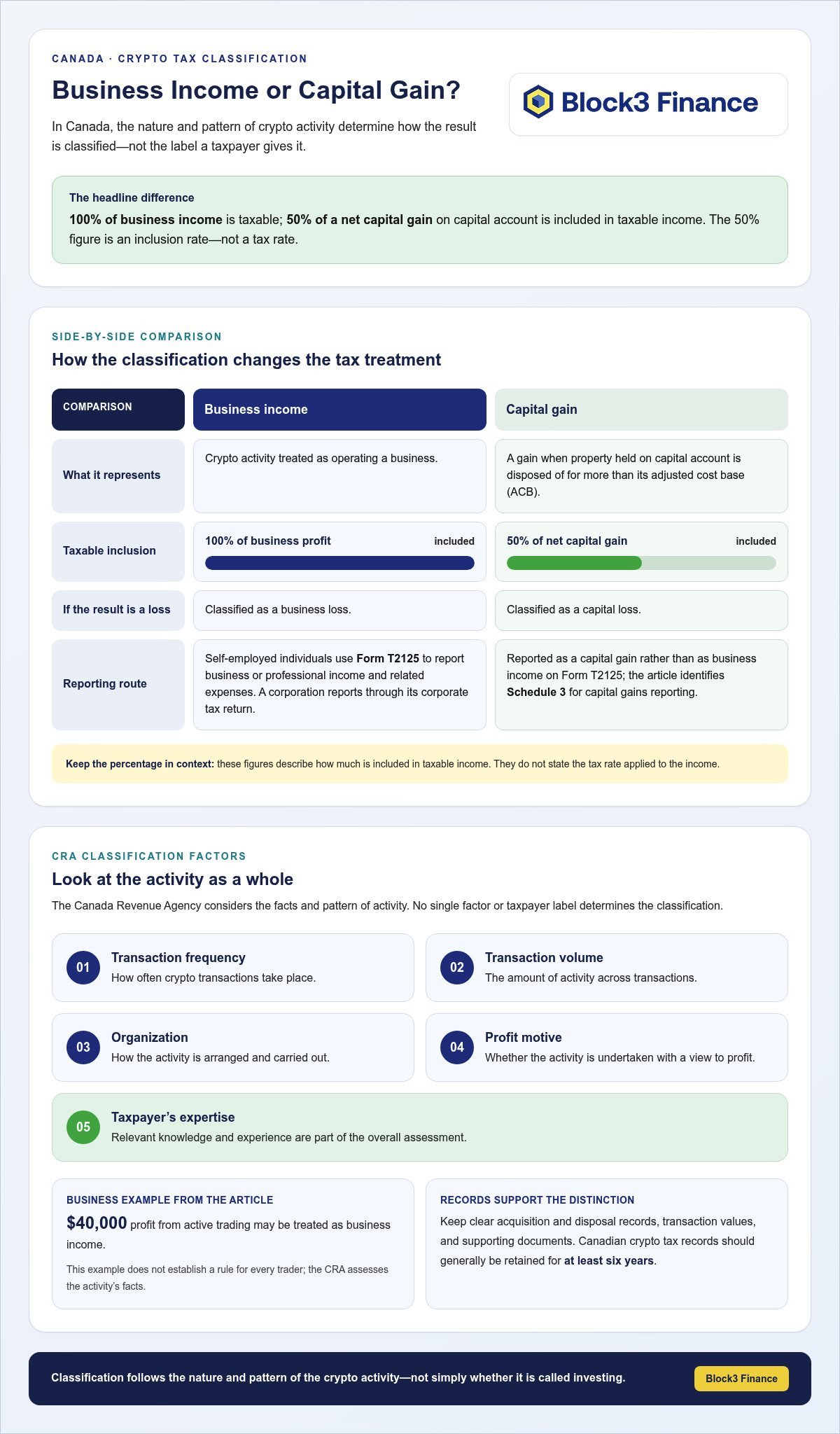
The key distinction in Canada’s crypto tax rules for businesses is whether an activity produces business income or a capital gain: 100% of business income is taxable, while 50% of a net capital gain on capital account is included in taxable income. The Canada Revenue Agency considers factors such as transaction frequency and volume, organization, profit motive, and the taxpayer’s expertise. The label you use matters less than the nature of the activity.
It’s reasonable to expect crypto buying and selling to receive the same tax treatment each time. In practice, the facts and pattern of activity matter: business income or losses are reported differently from capital gains or losses.
This guide explains Canada’s crypto tax rules for businesses, including what may indicate business trading rather than investing and how that distinction affects reporting. It also covers record-keeping, crypto payments and GST/HST, helping you approach compliance with greater clarity.
Key Takeaways
- Classify crypto activity by its nature: business income is fully taxable, while only half of a net capital gain on capital account is included in taxable income.
- Assess trading patterns using factors such as transaction frequency and volume, organization, profit motive, and relevant expertise.
- Keep clear records of crypto acquisitions, disposals, and transaction values; Canadian crypto tax records should usually be retained for at least six years.
- Consider GST/HST alongside income tax when a business accepts crypto, since the transaction’s fair market value can affect the calculation.
- Separate investing from business trading based on the full pattern of activity, not simply the taxpayer’s label for it.
Business income versus capital gains
In Canada, crypto activity can result in business income or a capital gain, and the classification affects how the result is reported and taxed. The nature and pattern of the activity matter more than whether it is simply called investing.
Classifying Crypto Transactions
Business income comes from crypto activity treated as operating a business; a capital gain arises when property held on capital account is disposed of for more than its adjusted cost base. A loss follows the same classification: it is either a business loss or a capital loss. The distinction matters because 100% of business profit is taxable, while half of a net capital gain is included in taxable income.
For example, a Canadian taxpayer’s $40,000 profit from active trading may be treated as business income. That example doesn’t establish a rule for every trader. The CRA assesses the activity’s frequency and volume, organization, profit motive, and the taxpayer’s expertise. A corporation can also have a capital gain when it disposes of crypto held on capital account.
Reporting Business Income on Form T2125
Form T2125 is used by self-employed individuals to report business or professional income and related expenses with their Canadian tax return. Where crypto activity is classified as a business, the form provides a way to calculate the net business result rather than reporting it as a capital gain on Schedule 3.
Keep the calculation consistent with the activity’s classification. For example, a self-employed miner treated as operating a business would organize relevant income and expenses as business records before completing Form T2125. Incorporation changes the reporting context: a corporation reports through its corporate tax return, not an individual’s T2125. The right reporting route matters because business income or loss and capital gains or losses are reported differently.
Tax Treatment of Crypto Transactions
Income tax treatment depends on whether a transaction generates business income or involves a disposal of property held on capital account. Business profits are fully included in taxable income; only half of a net capital gain is included. The latter is often called the capital gains inclusion rate, not a 50% tax rate.
Buying, selling, trading, or using crypto to pay for something can involve a transaction whose value must be determined for reporting. Mining or staking activity can also create tax questions, so record the transaction and its value when it occurs. For a Canadian overview of crypto tax treatment, the relevant distinction remains whether the activity is income-producing or capital in nature.
Incorrect reporting can lead to a gross negligence penalty that increases tax by 50%. Crypto tax evasion or fraud can carry penalties of up to 200% of the taxes evaded and up to 14 years in prison. These risks make accurate classification and records important, especially when active trading resembles a business.
How Does Crypto Tax Work in Canada?
For Canadian businesses, crypto tax reporting depends on reliable transaction records and consistent valuation in Canadian dollars. A clear audit trail connects each acquisition or disposal to the relevant tax calculation.
Crypto Books and Records
Crypto books and records track a business’s digital-asset activity and support its tax reporting. Canadian businesses should generally keep these records for at least six years.
Create a transaction file that connects exchange statements, wallet activity, invoices and accounting entries. For each transaction, record the date, asset, quantity, purpose and Canadian-dollar value. Note whether it involved a purchase, sale, trade, barter, gift, donation, gambling activity or reward. These details help explain how you calculated each reported amount.
Regularly reconcile wallet and exchange histories with the business ledger. If a transaction appears in one source but not another, document the reason before preparing the return. Keep supporting documents with each entry so you can trace the reported amount back to the underlying activity.
Transaction Records and Adjusted Cost Base
Adjusted cost base, or ACB, tracks the cost of crypto held as capital property. It helps calculate the gain or loss when that property is disposed of.
For a Canadian corporation, crypto ACB is tracked at the corporation level, not separately for each individual behind it. Keep the corporation’s acquisition and disposal history together, including purchase costs and related fees. For example, a Bitcoin purchase price of $60K with a $60 purchase fee illustrates why recording fees alongside the asset’s cost matters.
Keep separate transaction histories for distinct entities. A founder’s personal wallet and a corporation’s wallet should not be treated as one pool. Separating them supports accurate calculations and helps prevent personal activity from being confused with company transactions.
Valuing Transactions in Canadian Dollars
Canadian crypto tax reporting requires determining the value of crypto when it is acquired or disposed of in a transaction. Use its value in Canadian dollars at the transaction time when calculating the amount to report.
Use a consistent valuation method and keep evidence for each conversion. For example, record the Canadian-dollar value when the business receives crypto for goods or services, rather than using a later price. A Canadian business registered for GST/HST that accepts crypto calculates GST/HST using its fair market value at the transaction time.
Keep the date, transaction details and conversion basis together. This makes it easier to compare the original entry with exchange or wallet data during year-end accounting.
Provincial and Territorial Tax Differences
Canada’s federal crypto reporting framework is distinct from the provincial or territorial portion of a business’s overall tax calculation. The business’s province or territory can affect its total income tax payable, so its location matters when preparing the complete return.
Keep the same transaction records and valuation evidence for federal and provincial or territorial reporting. Don’t assume a crypto transaction is classified differently simply because the business operates in another province. Consider the classification separately from the calculation of the total tax obligation.
If records span several wallets, exchanges, or accounting systems, discuss your crypto reporting needs as part of organizing the filing process.
Crypto transactions that may count as business activity
In Canada, crypto activity can result in business income or a loss, or a capital gain or loss. Transaction patterns and purpose help distinguish business activity from investing.
Crypto Transaction Types and Taxable Events
Crypto transactions can include purchases, sales, trades, barters, gifts, donations, gambling and rewards. Identify each event because acquisitions and disposals may have different tax consequences.
A business that repeatedly buys and sells assets as an organized trading activity may be carrying on a business. The CRA considers factors such as transaction frequency and volume, organization, profit motive and the taxpayer’s expertise. No single factor determines the classification; the overall pattern and circumstances matter.
Record the purpose of each transaction. For example, note whether crypto was acquired for business operations, held as an investment or received as a reward. A crypto-to-crypto exchange can still involve a disposal, even if no Canadian dollars changed hands. Record both assets and their values at the transaction time.
There is no blanket rule that every crypto transaction is tax-free. Buying crypto with Canadian dollars is an acquisition to record, while a later sale, trade or barter may create a reportable result. A transfer between wallets controlled by the same business is not automatically a sale. Record it so it isn’t mistaken for a disposal.
Transactions With GST/HST Implications
GST/HST may apply to a business’s taxable supplies, and accepting crypto does not change that. A Canadian business registered for GST/HST that accepts crypto should calculate the tax using the crypto’s fair market value at the transaction time.
For example, when a registered business sells goods or services for crypto, it should record the value at the transaction time and account for GST/HST accordingly. Record the crypto received as well. This separates the supply of goods or services from the later tax treatment of holding or disposing of the crypto.
Mining has a specific GST/HST treatment in Canada. Under section 188.2 of the Excise Tax Act, mining activity and mining payments are not treated as supplies, and mining costs do not qualify for input tax credits. This rule concerns GST/HST; it does not by itself settle whether mining proceeds are business income for income tax.
Record staking rewards, mining proceeds and payments for business activity with their purpose and value. Distinguish income received from a later disposal of the asset, since these events can raise separate tax questions. Clear entries help keep income tax analysis separate from GST/HST accounting.
Capital gains inclusion rate
For crypto held on capital account, Canada includes 50% of a net capital gain in taxable income for 2026. This inclusion rate is not the tax rate: it determines how much of the gain enters the income calculation. The resulting tax depends on the taxpayer’s applicable income tax rates.
Classification comes first. A disposal of crypto held as capital property may create a capital gain or capital loss, while crypto activity classified as a business is reported as business income or loss. The 50% inclusion rule applies to the capital result, not automatically to every crypto profit. Keep the classification and calculation distinct when preparing Canadian reporting.
For individuals, a proposed increase to a two-thirds inclusion rate on annual gains above $250,000 did not become law. The proposal was canceled on March 21, 2025. For 2026, the applicable capital-gains inclusion rate remains 50% under the facts covered here. Don’t apply the canceled proposal to a crypto gain merely because its amount exceeds that threshold.
Capital losses also follow the inclusion rule: 50% of a crypto capital loss is recognized for offset purposes. Net capital losses can generally be carried back to the previous three tax years. That treatment differs from a business loss, so the activity’s classification affects how the loss can be used. Keep each disposal and its adjusted cost base supported by transaction records.
The superficial loss rule can restrict a claimed loss when the same or identical property is acquired during a defined period. It applies when that acquisition occurs from 30 days before a loss disposition through 30 days after it, and the replacement property remains owned 30 days after the sale. For example, selling a token at a loss and reacquiring identical property within that window may trigger the rule.
Before claiming a crypto capital loss, compare the sale date with purchases of the same or identical property across the relevant period. Include holdings acquired through other accounts in your review. Both timing and continued ownership conditions matter, so the loss sale alone does not determine whether the rule applies. Keep the dates, quantities and disposal values used in your analysis.
For reporting, Canadian crypto-asset dispositions on capital account are reported on Schedule 3. The return identifies total proceeds on line 15200 and the total gain or loss on line 15301. Reconcile those amounts to the disposal records and adjusted cost base, then distinguish capital reporting from business-income reporting. That separation keeps the inclusion calculation tied to the correct tax treatment.
Distinguishing crypto investing from business trading
In Canada, crypto profits may be business income or capital gains, depending on the circumstances. The CRA assesses transaction frequency and volume, organization, profit motive and the taxpayer’s expertise. The key question is not simply whether tokens were sold at a profit, but how the activity was conducted and what the records show about its purpose and pattern.
Review the factors together rather than treating one trade as decisive. Repeated transactions, significant organization and specialized knowledge can indicate that crypto activity is being carried on as a business. A single disposal does not automatically show the same pattern as organized, frequent trading. The facts behind each position matter.
- Frequency and volume: Compare the number and scale of transactions across the activity, not just one profitable disposal.
- Organization: Look at how the trading is structured, including the business records and systems used to manage it.
- Profit motive: Consider whether the activity is carried out to earn profit, alongside its actual pattern and purpose.
- Expertise: Note relevant knowledge and experience that may shape how the taxpayer conducts crypto trading.
Apply this review to both profitable and loss-making periods. Business classification does not depend only on whether the final result is profitable. For example, frequent, organized token transactions remain part of the overall activity pattern even when a particular disposal produces a loss. Classifying activity consistently helps avoid treating similar transactions differently without a factual reason.
Also distinguish the type of crypto received from the reason for receiving it. Mining or staking rewards, payment for services and tokens acquired for trading can arise from different activities. Record each asset’s purpose, receipt date and value. These details help explain whether a receipt relates to business operations and how a later disposal fits into the broader activity.
A practical review can begin with a transaction history, then group activity by purpose and assess the CRA factors against that evidence. If your business’s crypto activity has grown from occasional transactions into an organized trading operation, discuss your crypto tax classification and reporting needs.
Block3 Finance: Tax Filing and Reporting
Block3 Finance supports Canadian businesses that need to turn crypto activity into clear, consistent tax reporting. Its Tax Filing and Reporting service can help when a business must organize transactions, distinguish business income from capital gains, and prepare the related filings.
For ongoing activity, Monthly Accounting helps maintain financial records throughout the year, while Audits and Compliance supports a structured approach to documentation and reporting. A Crypto Tax Accountant can help assess complex activity, such as frequent trading, mining, or staking, and bring the relevant records into the filing process.
If your business is preparing its Canadian crypto tax reporting, contact Block3 Finance to discuss your needs.
Build a Clearer Path for Your Crypto Operations
Tax treatment is not just a year-end question. As your Canadian business adopts new digital-asset activities, make classification and record review part of regular financial decision-making. This gives you a clearer basis for assessing how each activity fits the business, rather than relying on assumptions after transactions have accumulated.
Applying the Canada crypto tax rules for businesses is an ongoing discipline: keep the accounting process aligned with how the business actually earns, holds, and uses crypto. Block3 Finance can support that work through Tax Filing and Reporting, Audits and Compliance, and Monthly Accounting, connecting transaction records with the reporting process.
Move forward with a tax process built around your business’s crypto activity. Contact Block3 Finance to discuss tax support and take the next step with greater clarity.
Frequently Asked Questions
What cryptocurrency records will the CRA want?
Keep evidence that lets the CRA connect reported amounts to the underlying activity. Useful records include exchange statements, wallet histories, invoices, receipts and accounting entries. For transfers between wallets, retain transaction identifiers and identify the business-controlled wallets involved. Reconcile these sources with the ledger, and document gaps or corrections so the accounting trail explains how each return amount was calculated.
What Falls Under Business Activities?
Crypto activity may constitute business activity when its purpose and conduct show an organized effort to earn profit. Examples include recurring token trading, mining or receiving crypto for business services. Context matters: document why assets were acquired, how they were used and whether transactions formed part of the operation. The source and role of a token receipt can help clarify its treatment.
How does Canada tax cryptocurrency income earned by a business?
Under Canada crypto tax rules for businesses, crypto profit classified as business income is included in taxable income in full. The resulting tax calculation depends on the business’s legal structure and overall taxable income. Keep operational receipts separate from any later gain or loss on the crypto received. For example, tokens earned for services and their subsequent disposal are separate events to record and assess.
When is crypto treated as business income versus a capital gain in Canada?
Classification follows the circumstances of the activity, not the taxpayer’s preferred label. The CRA considers factors such as trading frequency and volume, organization, profit motive and expertise. Record a brief explanation of each asset’s intended role when acquired, supported by transaction history. If that role changes, document when and why so reporting reflects the activity’s actual pattern.
How are crypto payments for goods and services taxed for Canadian businesses?
Under Canada crypto tax rules for businesses, record crypto received for goods or services at its fair market value in Canadian dollars at the transaction time. Include that value as part of the sale. Accepting tokens does not remove GST/HST considerations for a registered business. If the business later disposes of those tokens, assess that event separately using its own date, value and transaction records.
How are crypto-to-crypto trades and token swaps taxed in Canada?
A token swap can count as a disposal even when the business receives another crypto asset instead of cash. Record the outgoing and incoming tokens, transaction date and Canadian-dollar values for both. For example, a swap may require tracking the disposition of the first asset and the acquisition cost of the replacement. The tax result depends on whether the outgoing token was held as capital property or as part of business activity.
Can Canadian businesses deduct crypto mining, staking, and transaction expenses?
Assess each expense in relation to the business activity it supports, and retain invoices or other records showing its purpose. Don’t assume every wallet fee or equipment cost is deductible simply because it relates to crypto. GST/HST has a separate restriction: under section 188.2 of Canada’s Excise Tax Act, mining costs don’t qualify for input tax credits. That rule addresses input tax credits, not every income-tax expense.
How are cryptocurrency inventory and cost basis calculated for Canadian businesses?
Start by identifying whether tokens are held as trading assets in a business or as capital property, since the classification determines the relevant calculation. For capital property, adjusted cost base tracks the cost used to calculate a gain or loss on disposal. A Canadian corporation tracks crypto ACB at the corporate level. Keep acquisition and disposal histories aligned across its wallets and accounts.

Article by
Mahad Mohamed
Mahad Mohamed is an accountant and the CEO of Block3 Finance, with over 26+ years of Canadian and international tax and accounting experience. A crypto accounting specialist since the early days of Bitcoin, he has consulted for over 38 crypto companies and collaborated with legal professionals on regulatory matters. His expertise spans corporate reorganization, cross-border tax structuring (Canada & US), tax disputes, and CRA audits.
Previously, Mahad worked for the Canada Revenue Agency (CRA), Big4 accounting firms, and served as a Rulings Officer for the Federal Tax Authority of the UAE before acquiring Tax Partners in 2014.
Block3 Finance and Tax Partners has 44 full-time accountants and over 9,800+ clients.
Disclaimer
This article provides general information only and is current as of its publication date. It has not been updated and may be out of date. It does not constitute legal advice and should not be relied upon as such. Every tax situation is unique and may differ from the examples discussed in this article. If you have specific questions, you should seek the advice of our accountants for your unique circumstances.
Frequently Asked Questions
What cryptocurrency records will the CRA want?
Keep evidence that lets the CRA connect reported amounts to the underlying activity. Useful records include exchange statements, wallet histories, invoices, receipts and accounting entries. For transfers between wallets, retain transaction identifiers and identify the business-controlled wallets involved. Reconcile these sources with the ledger, and document gaps or corrections so the accounting trail explains how each return amount was calculated.
What Falls Under Business Activities?
Crypto activity may constitute business activity when its purpose and conduct show an organized effort to earn profit. Examples include recurring token trading, mining or receiving crypto for business services. Context matters: document why assets were acquired, how they were used and whether transactions formed part of the operation. The source and role of a token receipt can help clarify its treatment.
How does Canada tax cryptocurrency income earned by a business?
Under Canada crypto tax rules for businesses, crypto profit classified as business income is included in taxable income in full. The resulting tax calculation depends on the business’s legal structure and overall taxable income. Keep operational receipts separate from any later gain or loss on the crypto received. For example, tokens earned for services and their subsequent disposal are separate events to record and assess.
When is crypto treated as business income versus a capital gain in Canada?
Classification follows the circumstances of the activity, not the taxpayer’s preferred label. The CRA considers factors such as trading frequency and volume, organization, profit motive and expertise. Record a brief explanation of each asset’s intended role when acquired, supported by transaction history. If that role changes, document when and why so reporting reflects the activity’s actual pattern.
How are crypto payments for goods and services taxed for Canadian businesses?
Under Canada crypto tax rules for businesses, record crypto received for goods or services at its fair market value in Canadian dollars at the transaction time. Include that value as part of the sale. Accepting tokens does not remove GST/HST considerations for a registered business. If the business later disposes of those tokens, assess that event separately using its own date, value and transaction records.
How are crypto-to-crypto trades and token swaps taxed in Canada?
A token swap can count as a disposal even when the business receives another crypto asset instead of cash. Record the outgoing and incoming tokens, transaction date and Canadian-dollar values for both. For example, a swap may require tracking the disposition of the first asset and the acquisition cost of the replacement. The tax result depends on whether the outgoing token was held as capital property or as part of business activity.
Can Canadian businesses deduct crypto mining, staking, and transaction expenses?
Assess each expense in relation to the business activity it supports, and retain invoices or other records showing its purpose. Don’t assume every wallet fee or equipment cost is deductible simply because it relates to crypto. GST/HST has a separate restriction: under section 188.2 of Canada’s Excise Tax Act, mining costs don’t qualify for input tax credits. That rule addresses input tax credits, not every income-tax expense.
How are cryptocurrency inventory and cost basis calculated for Canadian businesses?
Start by identifying whether tokens are held as trading assets in a business or as capital property, since the classification determines the relevant calculation. For capital property, adjusted cost base tracks the cost used to calculate a gain or loss on disposal. A Canadian corporation tracks crypto ACB at the corporate level. Keep acquisition and disposal histories aligned across its wallets and accounts.