
For U.S. taxpayers, crypto income and realized gains must be reported to the IRS, even when the amount is only $1. The consequences of not reporting crypto gains can include an audit, penalties, and interest on unpaid tax. A missed transaction doesn’t make the reporting obligation disappear.
Crypto activity is easy to overlook: selling an asset, swapping one cryptocurrency for another, or receiving crypto as income may have tax consequences. You may also be concerned that incomplete records or an earlier return have left you exposed.
This article explains which crypto transactions may be taxable under U.S. rules, how underreporting can lead to IRS scrutiny and financial penalties, and how to address an inaccurate return. It also covers Form 1040-X, which the Internal Revenue Service identifies as the form for amending a U.S. individual income tax return. With a clearer view of the rules and records involved, you can take a more deliberate approach to correcting past reporting and managing future filings.
Key Takeaways
- Identify which crypto activity may create taxable income or a reportable gain, including trades, conversions, and spending.
- Learn how transaction records and tax forms help reconcile activity across wallets and exchanges.
- Understand how underreporting can expose a return to IRS review, additional tax, penalties, and interest.
- See how an amended return can help correct an earlier filing and what information to organize before addressing an error.
- Answer the IRS digital asset question accurately by considering the activity you had during the tax year.
How are crypto transactions reported?
Under U.S. rules, report taxable crypto income and realized gains on your federal return. Short-term and long-term gains receive different tax treatment, based on how long you held the asset.
Reporting US Crypto Gains and Income
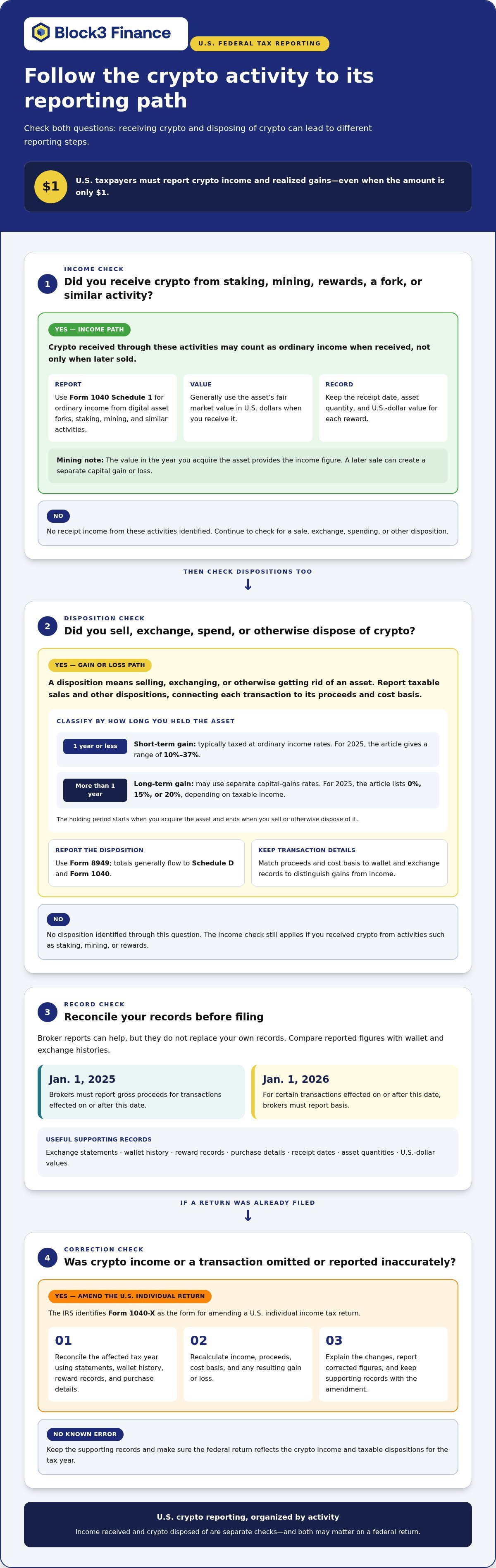
U.S. taxpayers report digital asset sales and other dispositions using Form 8949, with totals generally flowing to Schedule D and Form 1040. A disposition means selling, exchanging, or otherwise getting rid of an asset. Crypto income and realized gains must be reported even when the amount is only $1. Keeping each transaction connected to its proceeds and cost basis helps distinguish taxable gains from income.
Broker reports can help reconcile activity, but they don’t replace your own records. According to the Internal Revenue Service, brokers must report gross proceeds for transactions effected on or after Jan. 1, 2025. For certain transactions effected on or after Jan. 1, 2026, brokers must report basis. Compare those figures with wallet and exchange records before filing.
Reporting Staking, Mining, and Reward Income
Crypto received through staking, mining, or rewards may count as ordinary income when you receive it, rather than only when you later sell it. Ordinary income is reported separately from a capital gain. The amount is generally based on the asset’s fair market value in U.S. dollars at the time you receive it. Fair market value means the price in an ordinary market transaction at that time. For mining, the value in the year you acquire the asset provides the income figure; a later sale can create a separate capital gain or loss.
Taxpayers use Form 1040 Schedule 1 to report ordinary income from digital asset forks, staking, mining, and similar activities. Keep the receipt date, asset quantity, and U.S.-dollar value with each reward entry. Those records help separate the original income from any later change in value.
Amending Returns to Report Omitted Crypto Income
An amended return corrects an already-filed return when crypto income or a transaction was left out or reported inaccurately. The Internal Revenue Service identifies Form 1040-X, Amended US Individual Income Tax Return, as the form used to amend a US tax return. Use it to explain the changes and report corrected figures, rather than altering the original return without an amendment.
Start by reconciling the affected tax year using exchange statements, wallet history, reward records, and purchase details. Recalculate income, proceeds, cost basis, and any resulting gain or loss before preparing an amendment. If the correction changes the tax owed, calculate the updated amount using the corrected return information. Keep the supporting records with the filed amendment.
Short-Term and Long-Term Gain Reporting
For U.S. federal taxes, a short-term gain generally comes from crypto held for one year or less; a long-term gain comes from crypto held longer than one year. The holding period starts when you acquire the asset and ends when you sell or otherwise dispose of it. This distinction matters because short-term gains are typically taxed as ordinary income, while long-term gains use separate capital-gains rates.
For 2025, short-term gains are typically taxed at ordinary income rates ranging from 10% to 37%. Long-term gains may be taxed at 0%, 15%, or 20%, depending on taxable income. Report the disposal and holding period accurately on Form 8949 and Schedule D, so the return reflects the correct capital-gain category.
Audit, penalty, interest, and criminal risks of underreporting
Under U.S. rules, unreported crypto income can lead to an IRS examination, additional tax, penalties, and interest. How far back the IRS can audit unreported cryptocurrency gains depends on the return and the circumstances, so no single period applies to every case.
Audits of Unreported Crypto Gains
An IRS audit reviews a tax return and its supporting records. This matters because crypto activity may need to be reconciled across exchanges and wallets. The IRS may obtain trading information by subpoenaing an exchange or brokerage firm. Compare transaction histories with reported proceeds, income, and cost basis, the asset’s tax value used to calculate gain or loss. Keep records explaining each reported amount.
Understatement and Negligence Penalties
A negligence penalty applies when a taxpayer fails to take reasonable care, while a substantial-understatement penalty concerns a large gap between reported and required tax. According to the Internal Revenue Service, the penalty for negligence or substantial understatement is 20% of the underpayment. A substantial understatement applies when understated tax is 10% or more of the required tax or $5,000, whichever is greater.
The IRS may also assess a late-payment penalty of 0.5% of unpaid tax per month, capped at 25%. Interest on unpaid tax and penalties begins accruing from the income-tax due date, usually April 15. These charges can increase the amount owed while a balance remains unpaid. Losses or a lower-than-expected earning history don’t erase income or transactions that should have been reported; accurate records help establish the correct calculation.
Criminal Liability for Crypto Tax Evasion
Criminal liability concerns deliberate tax fraud, not simply an arithmetic mistake. Intent and conduct matter. These are serious potential consequences, not automatic outcomes for every omitted transaction. When scrutiny escalates toward potential criminal charges, defense attorneys like the Law Offices of Gary Churak highlight how critical it is to establish a clear defense and distinguish an inadvertent recordkeeping mistake from intentional concealment.
The IRS Voluntary Disclosure Practice considers a taxpayer’s voluntary disclosure when deciding whether to initiate criminal prosecution. That doesn’t erase an obligation to correct a return or settle tax owed. If exchange records, wallet activity, and filed amounts don’t reconcile, organize the supporting documents and address the discrepancy before it grows. Discussing crypto tax compliance can help bring the reporting and audit concerns into focus.
Taxable crypto sales, conversions, and spending
Under U.S. federal tax rules, selling, exchanging, or spending crypto can dispose of the asset and create taxable gains or losses. Report applicable transactions to the IRS even if no dollars entered your bank account. A crypto-to-crypto exchange still involves disposing of one asset.
Report transactions in which you sell, exchange, or otherwise dispose of crypto, including:
- Selling bitcoin or another token for U.S. dollars.
- Exchanging one cryptocurrency for another, such as trading bitcoin for ether.
- Using crypto to buy goods or services.
- Receiving crypto as income, such as payment for work or staking rewards.
For each disposal, compare the proceeds with the asset’s cost basis, generally the amount paid to acquire it. The difference is a capital gain or loss. For example, selling bitcoin bought for $1,000 for $1,200 produces a $200 gain to report. If proceeds are lower than the basis, the transaction may instead produce a loss. The amount depends on the specific acquisition and disposal records.
A conversion has two sides: you dispose of the crypto you give up and acquire the replacement asset. If you exchange ether for bitcoin, calculate the gain or loss on the ether using its basis and value at the time of the exchange. The newly acquired bitcoin has its own basis for a later sale or purchase. Treating a swap as a single nontaxable movement can leave the disposal out of your records.
Spending crypto also counts as a disposal. If you use tokens to pay for a computer, calculate the difference between their cost basis and their value when spent. A gain may arise even though you received merchandise rather than cash. Keep the date, quantity, asset, purchase history, and transaction value so the calculation can be traced.
Buying and holding crypto without selling or exchanging it is different from disposing of it. Following changes to the 2021 Form 1040, a taxpayer who only bought cryptocurrency and did not sell could answer “No” to the digital-asset question. That example concerns the question on Form 1040, not every possible reporting duty or income event.
Form 1099 information can help identify activity, but it doesn’t replace transaction-level records. A report may show proceeds without capturing the basis from a different wallet or exchange. Reconcile each taxable event against your own records, then report the relevant sales and exchanges on Form 8949 and Schedule D with Form 1040. This helps distinguish taxable disposals from purchases you still hold.
Correcting past crypto tax returns
If a filed U.S. tax return omitted crypto income or misstated a gain, correct the affected filing rather than carrying the error forward. The correction may change reported income, capital gains, and tax owed. Identify the tax year and transactions involved, then rebuild the figures from original records instead of estimating from memory.
The Internal Revenue Service identifies Form 1040-X, Amended US Individual Income Tax Return, as the form used to amend a U.S. tax return. Prepare the amendment using corrected figures, and explain what changed from the original return. For example, if an exchange sale was omitted, calculate its proceeds and cost basis, then determine its effect on the return.
Before completing Form 1040-X, collect records that support each revised amount:
- Exchange statements showing transaction dates, quantities, and proceeds.
- Wallet histories that help trace transfers between accounts.
- Purchase records supporting the cost basis of each asset sold.
- Income records for staking, mining, or crypto received as payment.
- The original tax return and any relevant broker statements.
Reconcile transfers carefully. Moving crypto between wallets you control is different from selling or exchanging it, so distinguish internal transfers from disposals. A broker statement may show proceeds without the asset’s full purchase history. Match the reported transaction to acquisition records, and document how you calculated the basis and gain. This helps prevent a transaction from being counted twice or omitted again.
U.S. taxpayers can amend a return up to three years after filing the original. Identify the filing date for the specific return before relying on that period. The correction should cover the relevant year and reflect all related changes, not just the transaction that first drew attention. If a revised capital gain changes total income, recalculate the return using the corrected figures.
After preparing the amendment, keep a copy of Form 1040-X with the transaction records and calculation notes. The amended return should make the change traceable: show what the original filing reported, what the corrected figures are, and why they differ. If the omitted activity spans multiple tax years, organize the records by year so each return can be reviewed on its own terms.
Correcting an error does not make incomplete records irrelevant. Keep source documents from each exchange, broker, and wallet with the amended return. A clear record trail helps explain how you recalculated proceeds, cost basis, income, and capital gains tax, and provides a consistent basis for future filings.
IRS digital asset question and perjury risk
For U.S. taxpayers, the digital asset question on Form 1040 is separate from calculating taxable income. Answer it accurately, then report any taxable income or transactions in the relevant parts of the return.
For the 2025 tax year, Form 1040 asks whether you received, sold, sent, exchanged, or otherwise acquired a financial interest in digital assets during the year. The IRS added a virtual-currency question to Form 1040 beginning in tax year 2020. Read the wording for the specific tax year you’re filing, since the question’s wording can change.
The question covers activity, not simply whether you owe tax. For example, someone who bought bitcoin and held it without selling could answer “No” under changes made to the 2021 Form 1040 question. By contrast, selling bitcoin, receiving crypto as payment, or exchanging one token for another can require a “Yes” response, even though the tax treatment depends on what happened.
The IRS defines a digital asset as a digital representation of value recorded on a cryptographically secured distributed ledger or similar technology under the Infrastructure Investment and Jobs Act. The definition can include cryptocurrency and other qualifying digital assets. Review assets you received, sold, sent, exchanged, or otherwise acquired, rather than focusing only on bitcoin held on an exchange.
Answering “No” when the facts call for “Yes” carries perjury risk. Treat the response as a factual statement about your activity, not as a shortcut based on whether a broker sent a form or whether you believe tax is due. If you’re unsure how an event fits, compare the question’s wording with your transaction records for that tax year.
Separate the checkbox decision from the reporting calculation. A “Yes” answer doesn’t automatically mean every digital asset event created taxable income. Buying and holding an asset, for example, differs from selling it, while crypto received as income may need to be reported before a later sale. Record the event type, date, asset, quantity, and fair market value in U.S. dollars when you received the income.
Before filing, review exchange statements alongside wallet activity and income records. A broker statement may not show every transaction across accounts, while an on-chain transfer can require context to determine whether it was a transfer or a disposition. Use that review to answer Form 1040 accurately and report taxable events in the appropriate forms.
If your records leave uncertainty about the digital asset question or related reporting, discuss your crypto tax reporting with a qualified professional.
Block3 Finance: Tax Filing and Reporting
Block3 Finance helps individuals and businesses bring crypto activity into clear, organized tax records through Tax Filing and Reporting, Audits and Compliance, and Monthly Accounting. When transactions span wallets, exchanges, income types, or tax years, a Crypto Tax Accountant can help connect the records with the figures reported on your return.
This support can be useful when preparing a filing, reviewing incomplete records, or responding to questions about crypto tax compliance. A structured review can help identify gaps, organize transaction evidence, and clarify which reporting issues need attention. The aim is practical: make the activity and its tax treatment easier to understand and document.
For support with crypto tax reporting, contact Block3 Finance.
Make your next filing a deliberate one
Crypto reporting isn’t only a year-end task. Recording activity consistently as it happens can make future filings easier to review and help you spot gaps before they carry forward. Treat each wallet, exchange, and income source as part of one financial picture, not as isolated records.
The consequences of not reporting crypto gains can extend beyond a single return, especially when an unresolved omission affects later reporting. If your records raise questions, focus on establishing what happened, documenting the figures, and choosing a clear next step. Block3 Finance offers Tax Filing and Reporting, Audits and Compliance, and Monthly Accounting to support crypto tax records and compliance needs.
Take the next step with a focused review of your crypto tax situation. Contact Block3 Finance to discuss crypto tax support, and move forward with a clearer reporting process.
Frequently Asked Questions
Do you pay taxes on crypto?
You may owe U.S. tax when crypto activity creates taxable income or a gain. Merely owning an asset doesn’t itself mean tax is due. Gifts involve separate rules: for 2025 and 2026, crypto gifts of $19,000 or less per recipient fall within the annual gift exclusion. A gift above that amount may require the donor to file Form 709, even when no gift tax is ultimately payable.
Can the IRS track crypto activity?
The IRS has used blockchain analysis in its efforts to understand cryptocurrency activity. It began collaborating with blockchain analytics companies in 2015. For your own records, keep wallet addresses and transaction hashes together with account statements and notes explaining transfers. A transaction hash identifies a specific blockchain transaction, helping you connect a record to activity without relying solely on a platform’s summary.
How is crypto taxed?
Crypto mining operated as a bona fide U.S. business may involve self-employment tax as well as income tax. The research facts give a 15.3% self-employment tax rate on mining profits after eligible deductions. Whether mining is a business matters: activity, records, and eligible expenses inform the calculation. Keep expense documentation and records of mined assets so reported profit reflects the business activity.
Does the IRS know about my DeFi trading?
No single report captures every DeFi position and protocol interaction. For your records, separate activity by protocol and classify each entry, such as a deposit, withdrawal, or reward, before calculating its tax treatment. Keep transaction hashes and protocol statements where available. This helps you explain how you derived a reported figure instead of relying on a single wallet balance that may hide activity.
How are cryptocurrency gains taxed in the United States?
U.S. capital losses can reduce gains from taxable investments, and in some cases reduce ordinary income. The research facts allow up to $3,000 of capital losses to offset ordinary income. Track losses alongside gains for the same tax year, and retain transaction records supporting each amount. This broader calculation can change the overall tax result, even when one crypto sale produced a gain.
What are the penalties for failing to report crypto gains?
Consequences depend partly on whether an omission reflects carelessness, a substantial understatement, or intentional evasion. If the IRS questions a return, organize records showing how you reached the reported figures, including transaction exports and notes from the original preparation. A clear account of how an error occurred can help explain the circumstances, but it doesn’t replace correcting inaccurate tax information. When substantial penalties or formal disputes arise from unfiled crypto gains, professional resolution firms such as US Tax Advocate Services LLC can assist taxpayers in negotiating relief and navigating IRS problem resolution.
How does the IRS detect unreported cryptocurrency income?
One example of the IRS seeking exchange data is its December 2016 summons to Coinbase for records concerning more than 500,000 customers who had traded crypto in prior years. The initial scope covered users with a single deposit or withdrawal transaction larger than $20,000. This history shows why exchange activity and tax records should be kept consistent, including for older tax years.
What interest and late-payment penalties apply to unreported crypto taxes?
For U.S. federal taxes, the late-payment penalty is 0.5% of unpaid tax per month, capped at 25%; interest also accrues on unpaid tax and penalties. The amount depends on the unpaid balance and how long it remains outstanding. If a corrected return increases tax due, calculate the balance using the revised figures and address the amount owed rather than treating the amendment as the payment itself.

Article by
Mahad Mohamed
Mahad Mohamed is an accountant and the CEO of Block3 Finance, with over 26+ years of Canadian and international tax and accounting experience. A crypto accounting specialist since the early days of Bitcoin, he has consulted for over 38 crypto companies and collaborated with legal professionals on regulatory matters. His expertise spans corporate reorganization, cross-border tax structuring (Canada & US), tax disputes, and CRA audits.
Previously, Mahad worked for the Canada Revenue Agency (CRA), Big4 accounting firms, and served as a Rulings Officer for the Federal Tax Authority of the UAE before acquiring Tax Partners in 2014.
Block3 Finance and Tax Partners has 44 full-time accountants and over 9,800+ clients.
Disclaimer
This article provides general information only and is current as of its publication date. It has not been updated and may be out of date. It does not constitute legal advice and should not be relied upon as such. Every tax situation is unique and may differ from the examples discussed in this article. If you have specific questions, you should seek the advice of our accountants for your unique circumstances.
Frequently Asked Questions
Do you pay taxes on crypto?
You may owe U.S. tax when crypto activity creates taxable income or a gain. Merely owning an asset doesn’t itself mean tax is due. Gifts involve separate rules: for 2025 and 2026, crypto gifts of $19,000 or less per recipient fall within the annual gift exclusion. A gift above that amount may require the donor to file Form 709, even when no gift tax is ultimately payable.
Can the IRS track crypto activity?
The IRS has used blockchain analysis in its efforts to understand cryptocurrency activity. It began collaborating with blockchain analytics companies in 2015. For your own records, keep wallet addresses and transaction hashes together with account statements and notes explaining transfers. A transaction hash identifies a specific blockchain transaction, helping you connect a record to activity without relying solely on a platform’s summary.
How is crypto taxed?
Crypto mining operated as a bona fide U.S. business may involve self-employment tax as well as income tax. The research facts give a 15.3% self-employment tax rate on mining profits after eligible deductions. Whether mining is a business matters: activity, records, and eligible expenses inform the calculation. Keep expense documentation and records of mined assets so reported profit reflects the business activity.
Does the IRS know about my DeFi trading?
No single report captures every DeFi position and protocol interaction. For your records, separate activity by protocol and classify each entry, such as a deposit, withdrawal, or reward, before calculating its tax treatment. Keep transaction hashes and protocol statements where available. This helps you explain how you derived a reported figure instead of relying on a single wallet balance that may hide activity.
How are cryptocurrency gains taxed in the United States?
U.S. capital losses can reduce gains from taxable investments, and in some cases reduce ordinary income. The research facts allow up to $3,000 of capital losses to offset ordinary income. Track losses alongside gains for the same tax year, and retain transaction records supporting each amount. This broader calculation can change the overall tax result, even when one crypto sale produced a gain.
What are the penalties for failing to report crypto gains?
Consequences depend partly on whether an omission reflects carelessness, a substantial understatement, or intentional evasion. If the IRS questions a return, organize records showing how you reached the reported figures, including transaction exports and notes from the original preparation. A clear account of how an error occurred can help explain the circumstances, but it doesn’t replace correcting inaccurate tax information.
How does the IRS detect unreported cryptocurrency income?
One example of the IRS seeking exchange data is its December 2016 summons to Coinbase for records concerning more than 500,000 customers who had traded crypto in prior years. The initial scope covered users with a single deposit or withdrawal transaction larger than $20,000. This history shows why exchange activity and tax records should be kept consistent, including for older tax years.
What interest and late-payment penalties apply to unreported crypto taxes?
For U.S. federal taxes, the late-payment penalty is 0.5% of unpaid tax per month, capped at 25%; interest also accrues on unpaid tax and penalties. The amount depends on the unpaid balance and how long it remains outstanding. If a corrected return increases tax due, calculate the balance using the revised figures and address the amount owed rather than treating the amendment as the payment itself.