
A single misstep in classifying a token warrant as equity instead of a liability can trigger a catastrophic chain reaction during a year-end audit. You likely understand that traditional GAAP rules were not built for the unique volatility of digital assets. The pressure to maintain compliance while scaling your Web3 firm often feels like a defensive battle against shifting IRS expectations.
Mastering the technical nuances of accounting for token warrants is the only way to transform these complex instruments from a source of friction into a strategic advantage. This guide provides the roadmap you need to navigate US GAAP and IRS frameworks with total command. We position you to move beyond mere regulatory management toward a posture of financial mastery.
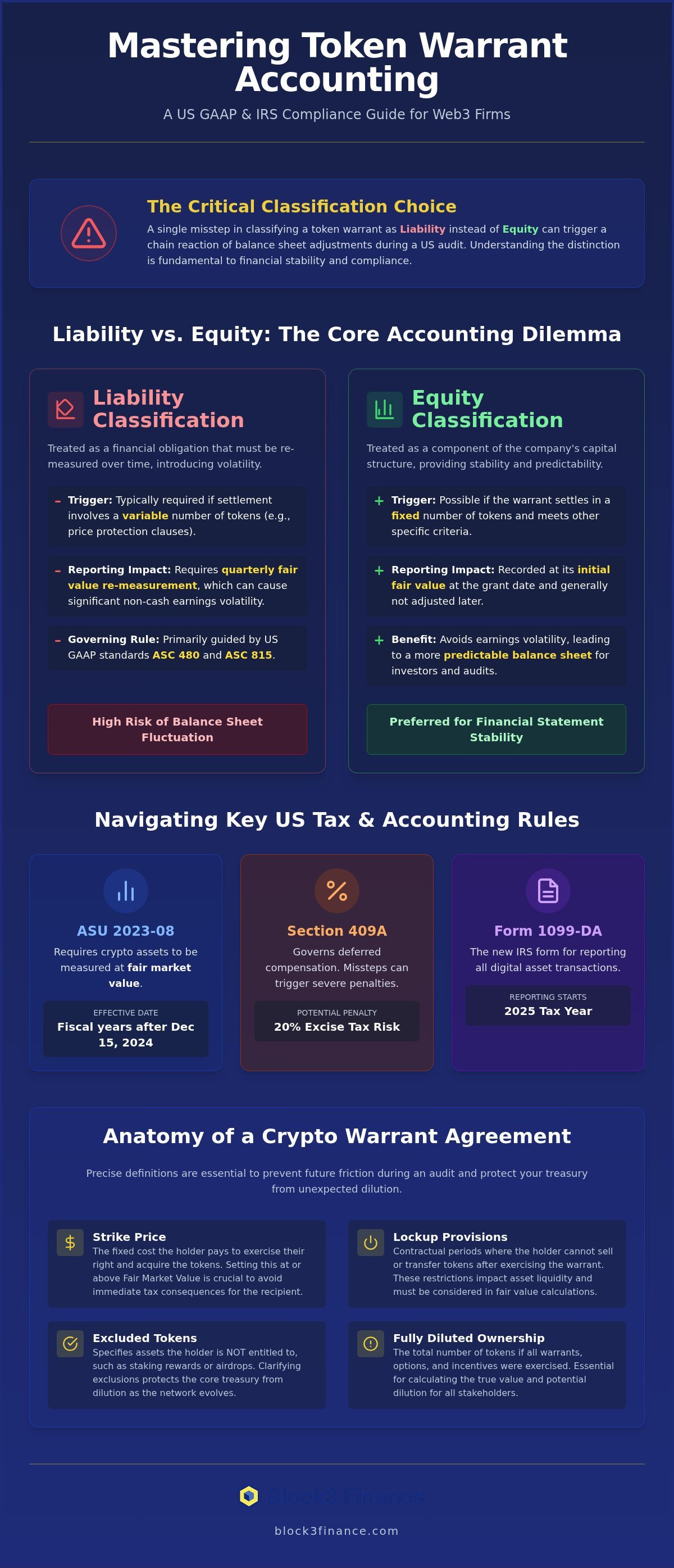
We will examine the critical distinctions between liability and equity classification, the impact of Section 409A (the IRS code governing deferred compensation) on service provider grants, and the latest fair value measurement requirements mandated by ASU 2023-08. This accounting standard requires crypto assets to be measured at their market value for fiscal years starting after December 15, 2024. You will also learn how to prepare for Form 1099-DA, which is the new IRS form for reporting digital asset transactions starting in the 2025 tax year.
Key Takeaways
- Determine whether your instruments qualify as equity or liabilities to prevent significant balance sheet adjustments during a US audit.
- Navigate the transition to fair value measurement required by ASU 2023-08 to ensure your accounting for token warrants reflects current market realities.
- Mitigate the risk of 20% excise taxes by aligning your token issuance with Section 409A requirements for deferred compensation.
- Leverage strategic CFO oversight to resolve the friction between complex on-chain activity and defensible financial reporting.
What Are Token Warrants under IRS Frameworks?
A token warrant is a legal right to acquire digital assets at a future date at a predetermined price. It functions as a specialized Warrant (finance) instrument designed specifically for the blockchain ecosystem. We often see these structured as "side letters" to a SAFE, which stands for a Simple Agreement for Future Equity. This methodology allows you to offer investors a path to token ownership alongside traditional corporate shares.
Precision in accounting for token warrants starts with identifying the exact moment the right is established. The IRS mandates that digital assets are treated as property under Notice 2014-21. This means the timing of the grant and the exercise creates specific tax triggers that you must track with discipline. Every stage of the warrant lifecycle requires defensible records to ensure audit readiness.
It is important to distinguish these instruments from a SAFT, or a Simple Agreement for Future Tokens. While a SAFT represents a direct investment into the future delivery of tokens, a warrant provides an optional right that the holder may or may not exercise. This distinction changes how you recognize the transaction on your balance sheet and how you handle future tax reporting obligations.
Token Warrants vs. Standard Equity Warrants
The primary difference between these instruments lies in the underlying asset. Standard warrants grant rights to corporate stock, while token warrants grant rights to digital assets. Most crypto agreements utilize a "call warrant," which is the right to buy tokens at a specific price. A "put warrant" is the opposite, giving the holder the right to sell tokens back to the issuer at a fixed price.
The "strike price" is the fixed cost the holder must pay to exercise their right. In a digital asset launch, setting this price correctly is vital for accurate financial reporting and future IRS cost basis calculations. If the strike price is set below the fair market value, it can trigger immediate tax consequences for the recipient.
Key Components of a Crypto Warrant Agreement
Precise definitions prevent future friction during an audit. Your agreement must specify "Excluded Tokens," which are assets like staking rewards or airdrops that the holder is not entitled to receive. Clarifying these exclusions early protects the core treasury from unexpected dilution as the network evolves.
"Lockup" provisions are also a standard component of these agreements. These are contractual periods where the holder cannot sell or transfer their tokens after exercising the warrant. These restrictions impact the liquidity of the asset and must be considered when determining the fair value of the warrant for your financial statements.
You must also define "Fully Diluted Ownership" within the contract. This term refers to the total number of tokens that would exist if all possible warrants, options, and incentives were exercised. Understanding this percentage is essential for both the issuer and the investor to calculate the true value of the digital asset holdings.
Liability vs. Equity: The Core Accounting Classification
The distinction between liability and equity is a foundational decision in accounting for token warrants. This classification determines whether the instrument remains a stable component of your capital structure or becomes a volatile figure that fluctuates on your financial statements. Making the wrong choice can lead to unexpected adjustments that complicate your annual audit process.
Under US GAAP, specifically ASC 480 and ASC 815, settlement in a variable number of tokens typically mandates liability classification. If your agreement includes price protection clauses that adjust the token count based on future valuation, the warrant is viewed as a financial obligation. This often happens because the issuer is essentially guaranteeing a specific value rather than a specific ownership stake.
Most Web3 firms prefer equity classification because it creates a more predictable balance sheet. Equity-classified warrants are recorded at their initial fair value and generally don't require subsequent adjustments. If your warrants are classified as liabilities, you must perform quarterly revaluations, which can introduce significant non-cash earnings volatility to your reports.
Criteria for Liability Classification (ASC 480)
ASC 480 focuses on obligations to repurchase the company's own instruments. In the digital asset space, if a warrant allows the holder to compel the issuer to buy back the tokens for cash, it is classified as a liability. This "obligation to repurchase" is a common trap for founders who use standard templates without professional oversight.
The "indexation" test also determines the final classification. This test asks if the warrant is indexed solely to the company’s own stock performance. Because many crypto warrants are indexed to a volatile token price rather than corporate equity, they often fail this test and must be recorded as liabilities on the balance sheet.
The implementation of ASU 2023-08 reinforces the necessity for rigorous fair value measurement in these scenarios. While this standard targets the assets themselves, it highlights the importance of using defensible valuation methodologies for all related financial instruments. If you are navigating these classification hurdles, you might find it helpful to speak with a specialized strategist.
The Benefits of Equity Classification
Equity classification allows you to avoid quarterly "mark-to-market" adjustments. Mark-to-market is the process of revaluing a liability to reflect its current market price at the end of each reporting period. By bypassing this requirement, you maintain a cleaner set of books that are easier for investors to interpret.
To achieve equity status, the agreement must satisfy the "fixed-for-fixed" settlement criteria. Fixed-for-fixed means the number of tokens and the strike price remain constant regardless of market shifts or future funding rounds. This structural rigidity is the price you pay for the accounting simplicity of equity classification.
- Ensure the number of tokens to be issued is fixed and unchanging.
- Verify the strike price is set in USD or a specific token amount without adjustment.
- Confirm the agreement lacks any mandatory redemption or buy-back clauses.
- Consult with a professional to ensure the instrument is indexed solely to company equity.
Fair Value Measurement and ASU 2023-08 Impact
ASU 2023-08 fundamentally shifts how US entities handle digital asset reporting. This standard mandates that crypto assets be measured at fair value, which is defined as the price you'd receive to sell an asset in an orderly transaction between market participants. For firms managing complex instruments, this requirement adds a layer of technical rigor to accounting for token warrants.
Valuing warrants for tokens that haven't yet launched presents a unique systemic challenge. Because there's no active market, you must rely on Level 3 inputs within the valuation hierarchy. These represent unobservable data points that require significant management judgment and defensible internal models to satisfy audit requirements.
Valuation Methodologies for Pre-Launch Tokens
While the Black-Scholes model is a standard tool in traditional finance, its reliance on historical volatility often fails to capture the extreme shifts in the crypto space. We typically recommend the Probability-Weighted Expected Return Method (PWERM) for Web3 startups. This approach estimates the value of a warrant based on the probability of various future outcomes, such as a successful token launch or a corporate acquisition.
You must also account for liquidity constraints through a Discount for Lack of Marketability (DLOM). This discount reflects the reduced value of an asset that can't be sold immediately due to contractual lockup provisions. Applying a DLOM correctly ensures your financial statements reflect the economic reality of restricted digital assets and prevents overstating your balance sheet.
Reporting Requirements for US Entities
US entities must provide comprehensive disclosures for significant warrant holdings to maintain audit readiness. You're required to document the specific unobservable inputs used in your Level 3 valuations, such as volatility assumptions and probability weightings. This transparency builds trust with stakeholders and ensures your records remain defensible under IRS scrutiny.
For a deeper dive into these standards, explore our guide on ASU 2023-08 and Crypto Revenue Recognition. Mastery of these reporting requirements is essential for maintaining total command over your firm's financial health. We help you navigate these complexities by providing CFO-level strategic oversight tailored to the digital asset landscape.
Refining your approach to accounting for token warrants requires a proactive stance that treats compliance as a growth driver. By establishing robust valuation frameworks now, you protect your firm from the friction of future regulatory shifts. Our team focuses on transforming these high-stakes requirements into a roadmap for long-term stability and institutional growth.
Tax Reporting and Section 409A Compliance Risks
Section 409A of the Internal Revenue Code governs what the IRS calls "deferred compensation." If you issue token warrants to employees or contractors with a strike price below the current fair market value, the IRS views this as income you've promised for the future. This "in-the-money" status triggers an immediate 20% excise tax on the recipient in addition to standard income taxes and interest penalties.
To mitigate these risks, you must establish a "Safe Harbor" valuation. This is a formal appraisal the IRS presumes is correct unless they can prove the methodology was grossly unreasonable. Achieving this status for accounting for token warrants requires a professional valuation that follows specific IRS guidelines to ensure your compensation packages don't become a liability for your team.
The stakes are high because the IRS digital asset reporting focus is intensifying. Starting in the 2025 tax year, brokers must report these transactions on Form 1099-DA. This means every grant and exercise event will be visible to the IRS, making manual or "best guess" valuations a major audit risk for your firm.
Warrants for Service Providers vs. Investors
The IRS treats warrants issued to contractors and employees differently than those issued to venture capital investors. For an investor, a warrant is typically a capital asset, and the eventual profit is treated as a capital gain. However, for service providers, the value of the warrant is usually taxed as ordinary income at the time of exercise or vesting.
This distinction significantly changes your withholding obligations and your firm's tax reporting requirements. You should never use warrants as a primary payroll or incentive tool without a crypto tax advisor. Misclassifying these payments can lead to substantial back-tax liabilities and penalties during a corporate audit.
The Role of 83(b) Elections in Token Vesting
An 83(b) election is a specific filing that tells the IRS you want to be taxed on the fair market value of your tokens at the time of the grant rather than when they vest. This is a powerful strategy for early-stage warrant holders who believe the token value will grow significantly. You must file this election with the IRS within exactly 30 days of the grant date, or you lose the opportunity forever.
There is a calculated risk to this approach. You're choosing to pay taxes upfront on an asset that might never launch or could eventually lose all its value. If the project succeeds, however, the election can transform future appreciation into long-term capital gains, which are taxed at a much lower rate than ordinary income.
We help Web3 leaders navigate these high-stakes decisions by providing the strategic oversight needed to protect both the firm and its contributors. By establishing defensible valuations and clear reporting timelines, you gain total command over your compliance landscape. Contact our team to secure your 409A compliance strategy and ensure your firm is ready for the next era of IRS enforcement.
Strategic Crypto CFO Services for Warrant Management
Automated accounting software often fails when faced with the subjective judgment required for accounting for token warrants. While these tools excel at tracking simple on-chain transfers, they lack the intellectual depth to interpret complex classification logic under ASC 480 or ASC 815. Relying solely on automation invites systemic risk during a year-end audit.
High-growth firms require a more sophisticated approach to financial oversight. Engaging fractional crypto CFO services provides the specialized expertise needed to transform volatile digital assets into defensible financial records. We act as your strategic partner, shifting your posture from a defensive struggle with regulations to an offensive focus on mastery and growth.
Clean, institutional-grade records are the lifeblood of successful fundraising and corporate exits. Professional investors look for rigorous documentation that bridges the gap between legacy corporate finance and the blockchain ecosystem. We ensure your warrant tracking is audit-ready from day one, positioning your firm as a grounded leader in a chaotic industry.
Building an Audit-Ready Warrant Ledger
Reconciling on-chain events with specific warrant exercise rights is a methodical process. This requires a seamless integration of monthly bookkeeping with real-time warrant tracking to ensure every transaction is captured accurately. We cultivate a centralized ledger that documents the strike price, vesting milestones, and fair value measurements for every instrument in your portfolio.
Our team manages the "Visionary Navigator" role for our clients by providing a roadmap for thriving in a complex world. We don't just record data; we provide the technical rigor and strategic planning necessary to navigate high-stakes environments. This proactive stance ensures that your financial statements remain stable even as the underlying digital asset markets fluctuate.
Corporate Structuring for Token Issuance
Strategic corporate structuring is essential to minimize tax drag and protect your firm's treasury. Your legal entity must be perfectly aligned with your token distribution strategy to prevent unnecessary friction with the IRS. We help you evaluate the most efficient frameworks for holding and distributing warrants to employees, contractors, and investors.
Mastering the complexities of accounting for token warrants requires a blend of traditional auditing discipline and bold innovation. By establishing a robust corporate structure now, you gain total command over your firm's financial evolution. Take the first step toward institutional-grade compliance and schedule a consultation with Block3 Finance today.
Command Your Digital Asset Compliance
Achieving total command over your firm’s financial landscape requires more than just managing regulations; it demands a proactive mastery of high-stakes environments. By resolving the friction between on-chain activity and US GAAP standards, you position your entity for institutional growth and successful fundraising. Precision in accounting for token warrants is the cornerstone of this evolution, ensuring your balance sheet remains a stable asset rather than a source of audit anxiety.
We help you navigate the complexities of ASU 2023-08 and Section 409A with the technical rigor of a traditional auditor and the mindset of a bold innovator. As a top-ranked crypto tax firm by Bitcoin.com, Block3 Finance provides specialized IRS compliance expertise that has secured audit-ready financial records for over 980 global clients. Our strategic oversight offers the roadmap you need to thrive in a volatile market while maintaining total accountability.
Don't let complex classifications hinder your firm's momentum. Secure your Web3 future with expert crypto CFO services from Block3 Finance. You possess the vision to build the future of finance, and we provide the discipline to ensure that vision is built on a defensible foundation.
Frequently Asked Questions
Is a token warrant considered equity or a liability under US GAAP?
A token warrant is classified as a liability if it requires settlement in a variable number of digital assets or includes price protection clauses. Equity classification under US GAAP requires a "fixed-for-fixed" structure, meaning the strike price and token count remain unchanged. Most crypto warrants are recorded as liabilities because they fail the indexation test, which requires the instrument to be linked solely to the company’s own stock.
What is the tax impact of exercising a token warrant for a US filer?
For US filers, the tax impact depends on whether you are an investor or a service provider. Service providers generally recognize ordinary income at the time of exercise based on the difference between the fair market value and the strike price. Investors typically treat the warrant as a capital asset; the exercise price is added to their cost basis, and future sales are taxed as capital gains under IRS rules.
How does Section 409A affect crypto warrants issued to employees?
Section 409A regulates deferred compensation, which includes token based incentives for US employees. If you issue warrants with a strike price below the current fair market value, the IRS imposes a 20% excise tax plus interest penalties on the recipient. You must use a defensible valuation to ensure the strike price is at or above market value. This prevents catastrophic tax consequences for your team and maintains audit readiness.
Do I need a formal valuation to issue token warrants in the US?
Yes, you need a formal valuation to establish a "Safe Harbor" under IRS rules. This appraisal protects the company from IRS challenges regarding the strike price of warrants issued to service providers. Without a professional valuation, the IRS may determine the warrants were issued "in-the-money," triggering immediate taxation. Formal reports ensure your accounting for token warrants remains defensible and compliant with current US tax law.
Can I file an 83(b) election for a token warrant?
You can file an 83(b) election for the tokens received upon the exercise of a warrant if those tokens are subject to a vesting schedule. This election tells the IRS to tax you on the value of the assets today rather than when they vest. You must file this election with the IRS within 30 days of receiving the tokens to lock in the current valuation for future capital gains treatment.
How does ASU 2023-08 change how I report warrants on my balance sheet?
ASU 2023-08 mandates that certain digital assets be measured at fair value on each reporting date. While the standard focuses on the assets, it increases the rigor required for accounting for token warrants classified as liabilities. You must now use market based data or Level 3 unobservable inputs to revalue these liabilities quarterly. This ensures your financial statements reflect the current economic reality of your digital asset obligations.
What happens if the tokens underlying my warrant never launch?
If the tokens never launch, the warrant typically becomes worthless. For tax purposes, US investors may be able to claim a capital loss once the asset is officially deemed worthless under IRS guidelines. For the issuing company, the liability is generally removed from the balance sheet. This results in a non-cash gain as the obligation to deliver the digital assets is extinguished and the financial records are reconciled.

Article by
Mahad Mohamed
Mahad Mohamed is an accountant and the CEO of Block3 Finance, with over 26+ years of Canadian and international tax and accounting experience. A crypto accounting specialist since the early days of Bitcoin, he has consulted for over 38 crypto companies and collaborated with legal professionals on regulatory matters. His expertise spans corporate reorganization, cross-border tax structuring (Canada & US), tax disputes, and CRA audits.
Previously, Mahad worked for the Canada Revenue Agency (CRA), Big4 accounting firms, and served as a Rulings Officer for the Federal Tax Authority of the UAE before acquiring Tax Partners in 2014.
Block3 Finance and Tax Partners has 44 full-time accountants and over 9,800+ clients.
Disclaimer
This article provides general information only and is current as of its publication date. It has not been updated and may be out of date. It does not constitute legal advice and should not be relied upon as such. Every tax situation is unique and may differ from the examples discussed in this article. If you have specific questions, you should seek the advice of our accountants for your unique circumstances.
Frequently Asked Questions
Is a token warrant considered equity or a liability under US GAAP?
A token warrant is classified as a liability if it requires settlement in a variable number of digital assets or includes price protection clauses. Equity classification under US GAAP requires a "fixed-for-fixed" structure, meaning the strike price and token count remain unchanged. Most crypto warrants are recorded as liabilities because they fail the indexation test, which requires the instrument to be linked solely to the company’s own stock.
What is the tax impact of exercising a token warrant for a US filer?
For US filers, the tax impact depends on whether you are an investor or a service provider. Service providers generally recognize ordinary income at the time of exercise based on the difference between the fair market value and the strike price. Investors typically treat the warrant as a capital asset; the exercise price is added to their cost basis, and future sales are taxed as capital gains under IRS rules.
How does Section 409A affect crypto warrants issued to employees?
Section 409A regulates deferred compensation, which includes token based incentives for US employees. If you issue warrants with a strike price below the current fair market value, the IRS imposes a 20% excise tax plus interest penalties on the recipient. You must use a defensible valuation to ensure the strike price is at or above market value. This prevents catastrophic tax consequences for your team and maintains audit readiness.
Do I need a formal valuation to issue token warrants in the US?
Yes, you need a formal valuation to establish a "Safe Harbor" under IRS rules. This appraisal protects the company from IRS challenges regarding the strike price of warrants issued to service providers. Without a professional valuation, the IRS may determine the warrants were issued "in-the-money," triggering immediate taxation. Formal reports ensure your accounting for token warrants remains defensible and compliant with current US tax law.
Can I file an 83(b) election for a token warrant?
You can file an 83(b) election for the tokens received upon the exercise of a warrant if those tokens are subject to a vesting schedule. This election tells the IRS to tax you on the value of the assets today rather than when they vest. You must file this election with the IRS within 30 days of receiving the tokens to lock in the current valuation for future capital gains treatment.
How does ASU 2023-08 change how I report warrants on my balance sheet?
ASU 2023-08 mandates that certain digital assets be measured at fair value on each reporting date. While the standard focuses on the assets, it increases the rigor required for accounting for token warrants classified as liabilities. You must now use market based data or Level 3 unobservable inputs to revalue these liabilities quarterly. This ensures your financial statements reflect the current economic reality of your digital asset obligations.
What happens if the tokens underlying my warrant never launch?
If the tokens never launch, the warrant typically becomes worthless. For tax purposes, US investors may be able to claim a capital loss once the asset is officially deemed worthless under IRS guidelines. For the issuing company, the liability is generally removed from the balance sheet. This results in a non-cash gain as the obligation to deliver the digital assets is extinguished and the financial records are reconciled.