
A clean ledger isn’t enough if wallet activity, exchange records, and supporting documents don’t tell the same story. For U.S. companies, Web3 financial audit preparation matters because it helps a business explain what happened to its digital assets, support reported balances, and show how key financial controls work.
It’s reasonable to expect an audit to examine the numbers closely. For U.S. Web3 businesses, the challenge is making those numbers traceable across wallets, blockchains, exchanges, and internal records, where transaction data alone may not explain a payment’s business purpose.
This article focuses on audit readiness for U.S. companies, explaining how preparation reduces avoidable friction and what professional preparation involves. You’ll learn how reconciliation and data quality support reliable reporting, which records help establish a clear audit trail, and how controls around custody, approvals, and payments can make financial activity easier to evidence. It also covers how to organize documentation and coordinate with auditors, so your team can approach the process with a clearer view of its records, risks, and responsibilities.
Key Takeaways for U.S. Companies
- For U.S. companies’ financial reporting, reconcile wallet, blockchain, exchange, and accounting records so discrepancies and unexplained transactions can be addressed before audit work begins.
- Prepare supporting evidence for digital-asset balances and transaction purposes, not just raw blockchain data.
- Improve data quality by standardizing records and applying consistent classifications and valuation methods.
- Document controls over custody, approvals, treasury activity, and payments so auditors can follow a clear audit trail.
- Organize financial statements, wallet records, and transaction documentation to distinguish audit-ready bookkeeping from an independent external audit.
1. Reconciling transactions across wallets, blockchains, and exchanges for U.S. companies
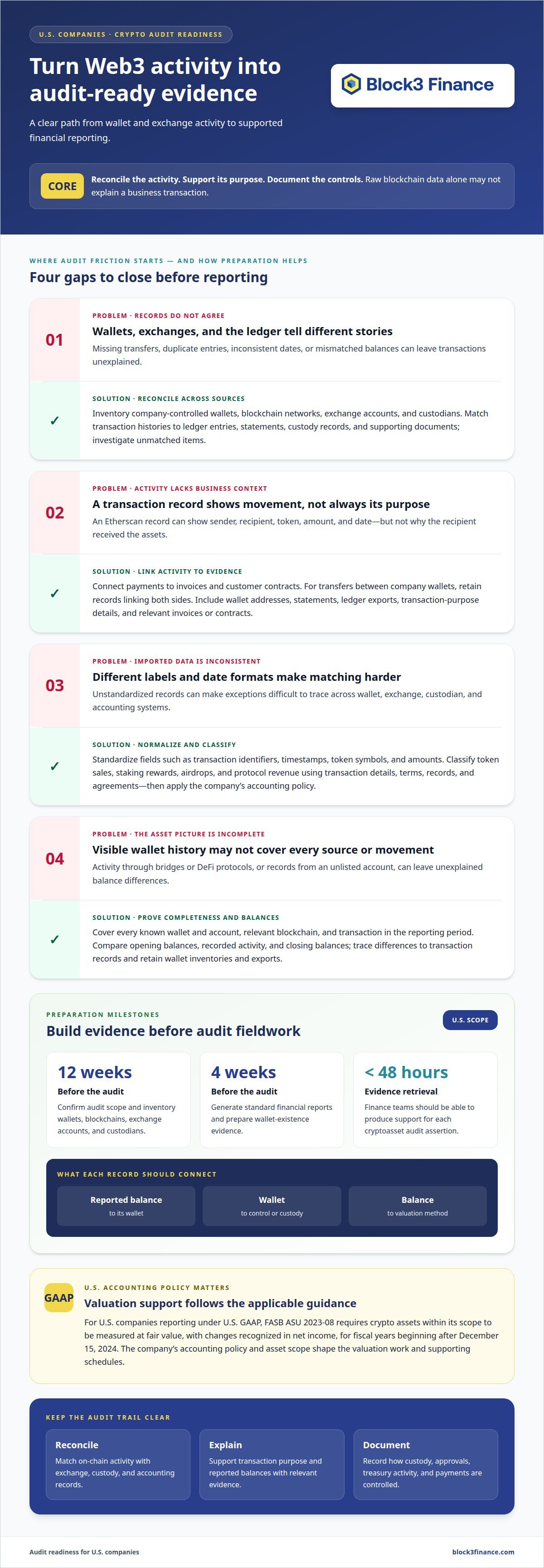
For U.S. companies, reconciliation connects on-chain activity to the accounting records used for financial reporting. A professional starts by inventorying company-controlled wallets, blockchain networks, exchange accounts, and custodians. They then compare transaction histories with ledger entries, exchange statements, custody records, and supporting documents. This can reveal missing transfers, duplicate entries, inconsistent dates, or balances that do not agree across systems.
For an audit, the professional matches transactions across wallets, blockchains, exchanges, and accounting records, then investigates unmatched items. The company should provide wallet addresses, exchange and custodian statements, ledger exports, transaction-purpose details, and relevant invoices or contracts. Together, these records help show whether a movement was a payment, internal transfer, token sale, or another business event.
Blockchain data shows activity, but not always its business purpose. An Etherscan transaction record, for example, shows the sender, recipient, token, amount, and transaction date. It does not explain why the recipient received the assets. A sales invoice and customer contract can provide that context, while records linking both sides are needed for a transfer between company wallets.
Integrations can bring blockchain and financial-platform records into a consistent workflow. A professional connects available wallet, exchange, and custodian data with the accounting system, then maps imported activity to the organization’s ledger categories. Because exchange exports may use different labels or date formats, fields are standardized before matching. Consistent transaction identifiers, timestamps, token symbols, and amounts make exceptions easier to trace.
Token activity also needs classification according to the underlying event. For token sales, staking rewards, airdrops, and protocol revenue, the professional reviews transaction details alongside sale terms, protocol records, distribution information, and related agreements. They record the event date, quantity, counterparty or protocol, and documented purpose, then apply the company’s accounting policy. This evidence supports consistent reporting without treating every token receipt as the same kind of income.
Completeness requires more than downloading a wallet’s visible history. Reconciliation should cover every known wallet and account, relevant blockchain, and transaction in the reporting period, including movements through bridges or DeFi protocols. The professional compares opening balances, recorded activity, and closing balances, then traces unexplained differences to transaction records. A wallet inventory and retained exports help show which sources were included.
These records create a clearer audit trail and support compliance work for U.S. companies. If wallet activity, exchange data, or ledger entries don’t align, the professional documents the difference and its resolution before final reporting. This is where audit preparation support can help organize reconciliations and supporting evidence around the company’s digital-asset activity.
2. Crypto audit readiness and why it matters
Audit readiness turns financial records into evidence auditors can examine efficiently. For a US company, that means supporting the existence, completeness, ownership, and valuation of reported crypto assets. These assertions connect ledger balances to wallet evidence, custody arrangements, transaction records, and accounting policies. If a balance lacks support, auditors may need additional procedures before assessing it. Web3 financial audit preparation helps organize evidence before fieldwork begins.
US companies reporting under US GAAP need to apply the accounting guidance relevant to their crypto assets. FASB ASU 2023-08 requires crypto assets within its scope to be measured at fair value, with changes recognized in net income, for fiscal years beginning after 15 December 2024. The company’s accounting policy and asset scope therefore shape its valuation work and supporting schedules.
A professional prepares a US Web3 company by confirming audit scope and inventorying wallets, blockchains, exchange accounts, and custodians 12 weeks before the audit. The work then moves through reconciliations, accounting-policy review, valuation support, and control documentation. At 4 weeks before the audit, the professional generates standard financial reports and prepares wallet-existence evidence. For Web3 financial audit preparation, each stage should have a clear owner and supporting records.
Audit assertions need timely evidence. Web3 finance teams should be able to produce support for each cryptoasset audit assertion in under 48 hours. Records should connect a specific balance to its wallet, the entity’s control or custody arrangement, and the relevant valuation method. A clear index helps the audit team retrieve evidence without reconstructing transaction history each time.
Preparation also affects the effort required to complete a US crypto audit. Poor records or unresolved differences can prompt more detailed testing, follow-up questions, and remediation. If a company waits until three weeks before close to address audit problems, fixes may cost 10 times as much as prevention. Preparation costs depend on transaction complexity, record quality, control gaps, and engagement scope, rather than one standard fee.
Strong audit readiness supports transparency beyond the audit itself. A documented accounting policy explains how the company handles valuation and changes in asset value; organized schedules show how reported figures connect to supporting records. A professional can structure this work around US GAAP and the audit scope. For help aligning evidence and preparation with an upcoming audit, discuss your audit preparation needs.
3. Digital-asset reconciliation and data quality for U.S. companies
For U.S. companies, reliable audit evidence depends on consistent records, not simply a long transaction export. A professional reviews source data for missing fields, duplicate entries, inconsistent token symbols, and mismatched dates, then standardizes those details before comparing ledger balances with wallet activity. For example, the same token recorded under different symbols across systems can appear to be separate assets and obscure the actual balance.
Valuation requires a documented method and an appropriate price source. CoinGecko or CoinMarketCap can provide token pricing information for year-end crypto balance assessments. A professional records the selected price, valuation date, token, and method, then connects the calculation to financial statements. Thin trading can complicate the analysis: a $50M token position with $200K in daily volume should not be valued solely at its last-trade price.
Price records need context. A professional considers whether the selected market data reflects the asset and measurement date, and whether trading activity supports the valuation approach. If a token appears across several markets, the workpaper should identify the source used and explain how the reported amount was derived. This creates a reviewable path from source data to the balance reported in the accounts.
Custody records should show which wallets hold company digital assets and how access is governed. Wallet schedules can identify addresses, balances, custodians, and each account’s purpose. They should also describe public and private key management policies without placing secret credentials in audit files. Treasury records connect custody arrangements to approvals, transfers, and the people responsible for operating each wallet.
Custodian reports need to match the period under audit. For example, a SOC 1 report covering January through June 2026 doesn’t cover a September 2026 year-end balance. The professional identifies that coverage gap and assesses what other evidence supports the balance and relevant custody controls. The report’s period, covered services, and relationship to the company’s accounts all matter.
Data quality for U.S. companies also depends on preserving source records in a usable form. The professional retains dated exports, valuation workpapers, wallet schedules, and explanations for manual adjustments. If an exchange export changes a token label or omits a transaction description, the adjustment should link back to the original record. This structure lets a reviewer follow the digital assets from source evidence through calculation to the financial statements.
These procedures help show that reported assets have traceable support and reveal where custody or pricing evidence needs further attention. Consistent records give finance teams a stronger basis for explaining balances and resolving audit questions.
4. Internal controls and segregation of duties for U.S. companies
For U.S. companies, internal controls define who can initiate, approve, execute, and record financial activity. In a crypto treasury, one employee might request a transfer, another approve it, and a separate person record it. This division limits unilateral control and creates evidence for an external auditor. A risk assessment helps identify where custody, treasury operations, or payments need stronger controls.
For significant transactions, multi-signature wallets can require approval from more than one authorized participant. The company should document each transaction’s purpose, participants, and approval workflow. For example, a treasury transfer record can link the request, wallet approval, transaction hash, and accounting entry. This documentation shows how the organization authorized and recorded the movement.
Segregation of duties should reflect actual access and responsibilities. Someone who can change wallet permissions and approve transfers presents different risks from someone who only prepares a reconciliation. The control design should identify roles, define approval points, and record how exceptions are handled. Where staffing limits require combined duties, a separate review can provide evidence of oversight.
Evidence of wallet existence should connect each company-controlled address to its reported balance and custody arrangement. The control record can identify the wallet, responsible custodian or internal owner, access procedure, and evidence used to demonstrate existence. Private keys should never appear in audit documentation. Instead, records should describe key-management policies and preserve appropriate evidence without exposing credentials.
Auditors assess whether relevant controls are designed effectively and implemented. They may test an instance of a relevant control, such as approval for a wallet transfer, to assess its design and implementation. A documented example should show the trigger, required approval, completion, and retained evidence. Missing approvals or unclear ownership can prevent auditors from relying on internal controls.
When auditors cannot rely on controls because of poor design or inadequate testing, they perform more detailed substantive testing. That additional work takes longer and increases audit cost. Clear documentation establishes an audit path from risk assessment to control activity, evidence, and review. A control register can name each risk, its response, the responsible role, and the records retained.
Review control design whenever wallet permissions, treasury roles, or payment workflows change. For example, adding a custodian should prompt updates to access records and approval procedures. A consistent record of control changes helps an independent external auditor understand which process operated during the period and assess whether the evidence matches the company’s actual practices.
5. Audit-ready records versus independent external audits
For U.S. companies, audit-ready records support financial reporting; an independent external audit examines that reporting and provides an independent conclusion. Organized ledgers and wallet schedules help auditors trace balances, but do not replace the auditor’s work. For example, a company can prepare evidence for a token balance while the auditor independently evaluates that evidence and performs procedures.
A professional gathers records connecting financial activity to its business purpose and reported treatment. These may include the general ledger, financial statements, wallet and exchange records, custody documentation, transaction exports, valuation workpapers, contracts, invoices, and control documentation. Supporting evidence is organized by account and reporting period, so a reviewer can trace each material balance to its source records.
Receipts need more than an on-chain transaction hash. For a customer payment, supporting documentation should include a sales invoice and contract showing the customer, nature of the service, and payment details. The professional links these documents to the transaction record and ledger entry. This helps explain why the company received the assets and how the receipt appears in financial reporting.
Audit-ready schedules also explain how amounts were calculated. A digital-asset valuation workpaper, for example, can identify the asset, quantity, measurement date, pricing source, and calculation used for the ledger balance. Wallet schedules connect those figures to addresses and custody records. If a balance includes several wallets, the supporting schedule should show how their amounts reconcile to the reported total.
Clear records preserve an audit trail across operations. A reviewer should be able to trace an entry from the ledger to its supporting contract, invoice, wallet transaction, or valuation calculation, then back to the financial statements. The professional documents adjustments and unresolved differences rather than concealing them in a summary. This detail helps distinguish original source data from later accounting entries.
Preparation does not determine the independent auditor’s conclusion. The auditor plans and performs the external audit, evaluates evidence, and decides whether the financial statements meet the applicable reporting framework. The company and its accounting professional prepare records and respond to requests; the auditor remains responsible for independent procedures. Keeping these roles distinct protects the integrity of the audit process.
Before fieldwork, the professional can organize records by financial statement account, evidence type, and reporting period. A consistent index can link each ledger balance to detailed schedules, wallet records, valuation support, and transaction documents. This structure also makes follow-up requests easier to answer without confusing preparation work with the auditor’s independent responsibilities.
For support organizing audit documentation and financial records, contact the team to discuss your audit preparation.
Block3 Finance: Audits and Compliance for U.S. Companies
Block3 Finance helps U.S. Web3 companies organize financial records, reconcile digital-asset activity, and strengthen documentation for audit and compliance work. Turn to the team when wallet records, accounting schedules, or control evidence need to be structured for review, or when your finance team needs support preparing for an upcoming audit.
Preparation can also connect with Tax Filing and Reporting or Monthly Accounting when reporting records need ongoing alignment. Clear schedules and consistent documentation give your team a practical foundation for responding to audit requests and understanding the support for reported balances.
Contact Block3 Finance to discuss your audit preparation needs.
Make audit readiness part of your U.S. company’s operating rhythm
For U.S. companies, audit readiness is strongest when it develops alongside the business, not only when an external review approaches. As products, protocols, and treasury arrangements evolve, financial processes need to keep pace. Treating Web3 financial audit preparation as an ongoing discipline helps teams preserve continuity as activity changes and makes financial information more useful for internal decisions.
The next step is to align preparation with your organization’s reporting needs, accounting framework, and audit scope. A focused discussion can clarify where professional support fits, which records need attention first, and how to build a practical path toward stronger financial oversight. This helps your team make deliberate progress instead of facing a last-minute scramble.
Contact Block3 Finance to discuss audit preparation. With a clear plan and the right support, your team can move forward with greater command of its financial information.
Frequently Asked Questions
Why is this important?
Audit preparation helps decision-makers rely on financial information that reflects the company’s digital-asset activity. For example, a board reviewing runway needs records that distinguish operating expenses from token movements or treasury transfers. Preparation also gives investors and lenders a clearer basis for evaluating reported figures. The benefit is not simply completing an audit; it is building financial processes that support informed decisions as the project develops.
How does a professional document wallet ownership, private-key controls, and on-chain transactions for an audit?
A professional connects wallet addresses to evidence of the company’s relationship to each wallet, then records balances and relevant transaction history. Documentation can describe who controls access, how key-management responsibilities are assigned, and what approval process governs transfers. Private keys should remain confidential and never appear in audit files. For a transfer, the audit trail can link the transaction hash to an approval, business purpose, and corresponding accounting entry.
What internal controls do auditors expect for crypto custody, treasury, and smart contracts?
Auditors examine whether controls address risks in the company’s actual operations. For custody and treasury, this can include assigned access roles, multi-signature approval for significant transfers, documented transaction approvals, and review of completed activity. For smart-contract-related financial activity, records should explain who approves deployments or material changes and how resulting transactions enter the books. Relevant controls depend on how the company uses and governs its contracts.
What tax records does a professional gather from a US Web3 company for an audit?
For a US company, a professional typically organizes records linking crypto activity to the company’s tax and financial reporting. Examples include exchange statements, wallet transaction histories, ledger records, token-sale contracts, customer invoices, and documentation for staking rewards, airdrops, or protocol revenue. Records should identify transaction dates, asset amounts, business purpose, and valuation support. The company’s entity structure and activities determine which supporting schedules are relevant.
What are the most common financial audit findings and risks for Web3 companies?
Common issues include balances without clear ownership evidence, transactions lacking a documented business purpose, inconsistent token classifications, and valuations that cannot be traced to a stated method. Control gaps can also arise when one person initiates and approves treasury activity without a documented review. For example, an unexplained transfer between wallets may look like missing funds until records establish the company’s control of both addresses and the transfer’s purpose.
How much does a financial audit cost for a Web3 startup, and what affects the price?
There is no single audit price for every Web3 startup; the fee depends on the engagement and is provided after a quote request. Factors include the audit scope, complexity of on-chain activity, quality of accounting records, number and nature of custody arrangements, and the state of internal controls. A startup with organized evidence may require different audit work from one with unresolved reconciliations or incomplete supporting documentation.
What accounting standards apply to digital assets under US GAAP and IFRS?
Under US GAAP, FASB ASU 2023-08 requires crypto assets within its scope to be measured at fair value, with changes recognized in net income, for fiscal years beginning after 15 December 2024. Under IFRS, entities using the IAS 38 cost model apply IAS 36 impairment, and impairment reversals are limited.

Article by
Mahad Mohamed
Mahad Mohamed is an accountant and the CEO of Block3 Finance, with over 26+ years of Canadian and international tax and accounting experience. A crypto accounting specialist since the early days of Bitcoin, he has consulted for over 38 crypto companies and collaborated with legal professionals on regulatory matters. His expertise spans corporate reorganization, cross-border tax structuring (Canada & US), tax disputes, and CRA audits.
Previously, Mahad worked for the Canada Revenue Agency (CRA), Big4 accounting firms, and served as a Rulings Officer for the Federal Tax Authority of the UAE before acquiring Tax Partners in 2014.
Block3 Finance and Tax Partners has 44 full-time accountants and over 9,800+ clients.
Disclaimer
This article provides general information only and is current as of its publication date. It has not been updated and may be out of date. It does not constitute legal advice and should not be relied upon as such. Every tax situation is unique and may differ from the examples discussed in this article. If you have specific questions, you should seek the advice of our accountants for your unique circumstances.
Frequently Asked Questions
Why is this important?
Audit preparation helps decision-makers rely on financial information that reflects the company’s digital-asset activity. For example, a board reviewing runway needs records that distinguish operating expenses from token movements or treasury transfers. Preparation also gives investors and lenders a clearer basis for evaluating reported figures. The benefit is not simply completing an audit; it is building financial processes that support informed decisions as the project develops.
How does a professional document wallet ownership, private-key controls, and on-chain transactions for an audit?
A professional connects wallet addresses to evidence of the company’s relationship to each wallet, then records balances and relevant transaction history. Documentation can describe who controls access, how key-management responsibilities are assigned, and what approval process governs transfers. Private keys should remain confidential and never appear in audit files. For a transfer, the audit trail can link the transaction hash to an approval, business purpose, and corresponding accounting entry.
What internal controls do auditors expect for crypto custody, treasury, and smart contracts?
Auditors examine whether controls address risks in the company’s actual operations. For custody and treasury, this can include assigned access roles, multi-signature approval for significant transfers, documented transaction approvals, and review of completed activity. For smart-contract-related financial activity, records should explain who approves deployments or material changes and how resulting transactions enter the books. Relevant controls depend on how the company uses and governs its contracts.
What tax records does a professional gather from a US Web3 company for an audit?
For a US company, a professional typically organizes records linking crypto activity to the company’s tax and financial reporting. Examples include exchange statements, wallet transaction histories, ledger records, token-sale contracts, customer invoices, and documentation for staking rewards, airdrops, or protocol revenue. Records should identify transaction dates, asset amounts, business purpose, and valuation support. The company’s entity structure and activities determine which supporting schedules are relevant.
What are the most common financial audit findings and risks for Web3 companies?
Common issues include balances without clear ownership evidence, transactions lacking a documented business purpose, inconsistent token classifications, and valuations that cannot be traced to a stated method. Control gaps can also arise when one person initiates and approves treasury activity without a documented review. For example, an unexplained transfer between wallets may look like missing funds until records establish the company’s control of both addresses and the transfer’s purpose.
How much does a financial audit cost for a Web3 startup, and what affects the price?
There is no single audit price for every Web3 startup; the fee depends on the engagement and is provided after a quote request. Factors include the audit scope, complexity of on-chain activity, quality of accounting records, number and nature of custody arrangements, and the state of internal controls. A startup with organized evidence may require different audit work from one with unresolved reconciliations or incomplete supporting documentation.
What accounting standards apply to digital assets under US GAAP and IFRS?
Under US GAAP, FASB ASU 2023-08 requires crypto assets within its scope to be measured at fair value, with changes recognized in net income, for fiscal years beginning after 15 December 2024. Under IFRS, entities using the IAS 38 cost model apply IAS 36 impairment, and impairment reversals are limited.