
Cryptocurrency Financial Audit Services for Accountants in the United States. A cryptocurrency financial audit is only as reliable as the evidence supporting the reported balances. Preparation involves reconciling on-chain activity with accounting records, assessing wallet control, identifying related-party transactions, and testing how digital assets are classified, valued, and disclosed in financial statements.
The complexity is real: wallet addresses do not identify people on their own, and records may be spread across blockchains, exchanges, custodians, and internal systems. A disciplined process connects these records, examines controls around private keys, and assesses whether the evidence supports reported holdings.
This guide explains how accountants prepare for crypto audits and what clients should provide, including transaction histories, wallet and custody information, contracts, and accounting records. It also covers reconciliation, asset classification, related-party identification, audit procedures, and assurance services, showing how a professional engagement turns fragmented crypto activity into supportable financial reporting.
Key Takeaways
- Understand how professionals corroborate wallet balances and transaction activity using independent blockchain evidence.
- See how reconciling on-chain and off-chain records can reveal gaps, unusual activity, and potential related-party transactions.
- Learn why the applicable accounting framework affects crypto-asset classification, measurement, and financial statement disclosures.
- Explore how auditors tailor procedures to assess reported balances, ownership, valuation, and internal controls.
- Identify the records and assurance considerations that help support a clear, evidence-based audit process.
How do professionals prepare for crypto audits, and what should clients provide?
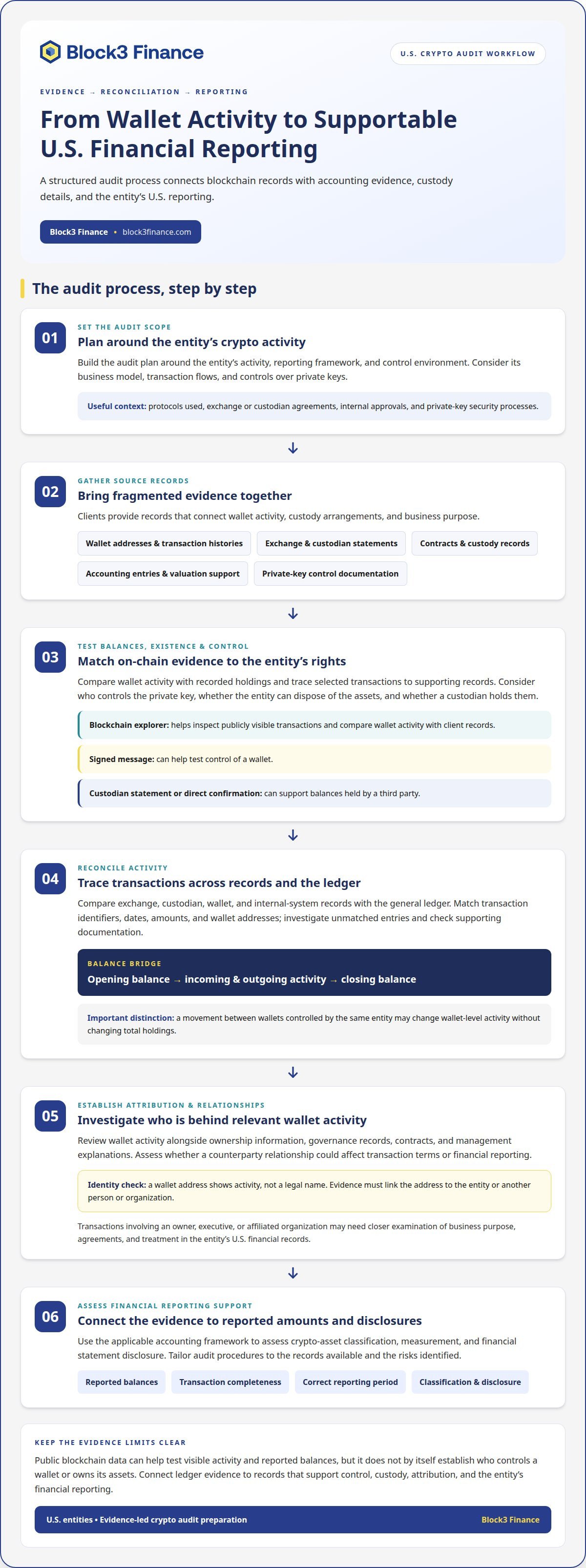
Professionals build an audit plan around the entity’s crypto activity, reporting framework, and control environment. In the U.S., preparation connects blockchain evidence with accounting records and the business risks associated with each transaction.
Independent Transaction and Balance Verification
Auditors compare wallet activity with the entity’s recorded holdings, then trace selected transactions to supporting records. For each wallet, they consider who controls its private key, whether the entity can dispose of the assets, and whether a custodian holds them. This links the blockchain balance to the entity’s rights, rather than treating an address as proof of ownership.
To support this work, clients provide wallet addresses, transaction exports, exchange and custodian statements, and records explaining transfers between accounts. Auditors compare opening balances, incoming and outgoing transactions, and closing balances. A transfer between two wallets owned by the same entity may change wallet-level activity without changing total holdings.
Crypto-Asset Existence Testing
A blockchain explorer lets an auditor inspect publicly visible transactions associated with a wallet address. The auditor can compare the address and transaction history with client records, then test whether reported balances align with on-chain activity at the reporting date. Explorer data can help test existence and completeness, but does not, by itself, establish who controls a wallet or owns its assets.
Auditors therefore connect explorer evidence to other records. A signed message from a wallet can help test control, while custodian statements or direct confirmations can support balances held by a third party. Evidence needs to fit the asset and custody arrangement being examined.
Auditability Benefits and Evidence
Blockchain technology creates a time-ordered record that can help auditors trace transactions and compare disclosed activity with public ledger data. That can strengthen evidence and support accuracy testing. Yet blockchain addresses are pseudonymous: they identify activity through wallet addresses, not legal names or identification numbers. Attribution requires evidence linking an address to the entity or another party.
Auditors assess how the entity uses blockchain technology, including its business model, transaction flows, and controls. For Web3 businesses, relevant records may include protocols used, exchange or custodian agreements, internal approvals, and processes for protecting private keys. Those details help identify risks such as concealed counterparties or incomplete reporting.
Useful preparation materials include:
- Wallet addresses, transaction histories, and exchange or custodian statements.
- Contracts and records that explain wallet ownership, custody, and business purpose.
- Accounting entries, valuation support, and documentation of key security controls.
Auditors tailor procedures to those records and assessed risks. The financial audit process brings blockchain evidence and financial reporting records into one structured examination.
Transaction recording, reconciliation and related-party identification
For U.S. entities, auditors connect blockchain activity with accounting records to test whether reported holdings and transactions are complete. They also investigate counterparties and timing, especially when wallet identities are not immediately clear.
Recording and Reconciling Transactions
Auditors compare transaction records from exchanges, custodians, wallets, and internal systems. They reconcile the records with the general ledger, investigate unmatched entries, and distinguish transfers between the entity’s own wallets from external payments. For example, an outgoing transfer from one controlled wallet and an incoming transfer to another may be a single movement, not a disposal and acquisition.
For U.S. reporting, records may be spread across blockchain data, exchange statements, custody reports, contracts, and separate accounting systems. Auditors compare these sources with ledger entries, examine unmatched activity, and determine whether recorded transactions have supporting documentation. This helps assess whether activity has been recorded completely and in the correct reporting period.
Identifying Related Parties
Related-party analysis considers whether a counterparty has a relationship with the entity that could affect a transaction’s terms or financial reporting. Auditors review wallet activity alongside ownership information, governance records, contracts, and management explanations. A wallet address alone does not reveal a legal name, so evidence must connect the address to a person or organization.
Auditors also investigate possible illegal acts and the parties connected to them, including the risk of concealed identities. For example, a transfer involving a wallet controlled by an owner, executive, or affiliated organization may need closer examination. The auditor considers its business purpose, supporting agreements, and treatment in the entity’s U.S. financial records.
Transaction Verification and Risk Mitigation
Verification compares transaction details across independent records. Auditors may match blockchain transaction identifiers, dates, amounts, and wallet addresses against exchange statements and supporting contracts. They also consider whether the entity, rather than a third party, can direct activity from a wallet. Private-key control matters, but the custody arrangement and other transaction evidence also inform the assessment.
For each material exception, auditors trace the entry to its source and document the explanation. Missing records, unexplained transfers, or inconsistent counterparties can indicate misstatement risks. Clear approval records and documented wallet responsibilities help auditors assess whether controls support accurate U.S. financial reporting.
Transaction Analysis and Cut-Off Risk
Auditors examine wallet logs around the U.S. financial reporting cut-off date, when timing can affect reported holdings. They investigate transactions just before and after that date, comparing blockchain timestamps with accounting entries and supporting records. This can identify transactions recorded in the wrong period or movements that need further explanation.
A client could borrow crypto shortly before cut-off to make reported holdings appear higher. Auditors analyze transfers, agreements, and subsequent activity for signs of this risk. They also assess whether an apparent period-end balance reflects an ongoing holding or a temporary movement.
Useful records for this analysis include:
- Wallet and exchange transaction exports, plus custodian statements.
- Contracts identifying counterparties and the purpose of transfers.
- General ledger entries, approvals, and explanations for unmatched activity.
For help organizing transaction evidence and audit procedures, discuss your audit requirements with a qualified professional.
Crypto-asset classification and financial statement presentation
For U.S. entities, the applicable accounting framework determines how crypto assets appear in the financial statements. Auditors examine classification, measurement, presentation, and disclosures together.
A cryptocurrency audit differs from a blockchain proof-of-reserves attestation: proof-of-reserves procedures focus on specified assets and evidence of control, while a financial statement audit evaluates the statements as a whole against the applicable reporting framework.
In the United States, U.S. GAAP cryptoasset guidance appears in Accounting Standards Update 2023-08, Subtopic 350-60. It applies to fiscal years beginning after December 15, 2024, and requires covered crypto assets to be measured at fair value, with value changes recognized in net income each reporting period.
There is no single fixed U.S. price for a cryptocurrency audit. The fee depends on the engagement’s scope, transaction and wallet complexity, record quality, custody arrangements, valuation work, and assurance requested; the price is provided after a quote request.
Under U.S. GAAP, auditors first assess whether an asset falls within Subtopic 350-60. They then examine whether valuation and related disclosures follow the applicable accounting treatment. The assessment should connect the asset’s characteristics with the ledger entry and the financial statement line where it appears.
Measurement changes the audit focus. Because U.S. guidance calls for fair-value measurement each reporting period, auditors examine pricing sources and valuation support, and assess how recorded changes flow into net income. They also consider whether disclosures clearly explain material holdings and relevant risks to financial statement users.
Impairment requires framework-specific analysis. For crypto assets covered by U.S. GAAP Subtopic 350-60, the stated measurement basis is fair value, and changes enter net income each reporting period. Auditors therefore assess period-end values and their supporting evidence rather than assuming an impairment-only model. Classification must follow the governing framework, not a label chosen for convenience.
For a digital asset service or custody platform, an attestation can examine a defined subject, such as specified balances or controls. A financial statement audit has broader scope: it considers reported assets, liabilities, transactions, presentation, and disclosures. Neither a public blockchain balance nor a reserve report alone demonstrates that every financial statement assertion is supported.
- Reconcile the crypto asset balance to the general ledger and valuation records.
- Document the U.S. GAAP classification and measurement basis applied.
- Connect material holdings and valuation changes to financial statement disclosures.
Financial audit purpose and assertion-based procedures
For a U.S. entity, a financial auditor examines whether its statements comply in all material respects with the applicable reporting framework. The auditor assesses cryptocurrency-related risks and designs procedures to obtain evidence supporting reported balances, transactions, and disclosures.
How professionals plan cryptocurrency audit procedures
Planning starts with the U.S. entity’s business model, accounting records, blockchain activity, and custody arrangements. Auditors identify risks involving valuation, ownership, transaction completeness, and private-key controls. They also determine which specialized skills, knowledge, and software the engagement requires, including expertise in cryptography, distributed ledger technology, and valuation.
The assessed risks shape the audit plan. For example, a complex wallet structure may require more persuasive evidence than an internally generated report alone. The auditor selects procedures that address the U.S. entity’s financial reporting risks and the reliability of its records.
Steps professionals follow in a cryptocurrency financial audit
For a U.S. engagement, professionals first understand the entity and its reporting framework, then identify material crypto balances and related risks. They test relevant controls, obtain evidence for financial statement assertions, evaluate exceptions, and assess presentation and disclosure. For a reported wallet balance, procedures may address existence, rights, completeness, and valuation.
The auditor then evaluates whether the evidence supports the U.S. financial statements and forms an opinion on them as a whole. Each step links crypto activity to the entity’s reporting framework.
Assertions give each procedure a defined purpose. Existence asks whether a reported asset is real; rights and obligations address whether the entity holds or controls it. Completeness tests whether relevant transactions and balances are included, while accuracy and valuation examine recorded amounts. Presentation and disclosure procedures assess how information appears in U.S. financial statements.
For example, when testing a U.S. entity’s stablecoin balance, an auditor may inspect transaction evidence, evaluate accounting records, and assess presentation. A control test examines approval workflows, while substantive testing examines selected balances or transactions. The auditor chooses procedures based on the identified risk and evidence required, not merely the asset’s label.
A stablecoin attestation or agreed-upon procedures engagement has a narrower objective than a financial statement audit. An attestation addresses a defined subject, such as reserve information or controls, while agreed-upon procedures report findings from specified tests. Neither alone expresses an audit opinion on the complete U.S. financial statements.
For a U.S. stablecoin engagement, the practitioner defines the subject, criteria, reporting date, and evidence needed. A reserve-focused examination may not address other assets, liabilities, transaction recording, or disclosures. Readers should distinguish a report on a limited subject from an opinion covering the entity’s financial statements.
- Plan: Understand U.S. operations, reporting, controls, and crypto risks.
- Test: Obtain evidence tailored to each financial statement assertion.
- Conclude: Evaluate exceptions and report the audit opinion or agreed findings.
Assurance services for cryptocurrency activities
Assurance gives stakeholders an independent assessment of defined information, controls, or financial reporting. For cryptocurrency activities, the work must match its purpose: a financial statement audit, a review of controls, and an examination of selected reserve information address different questions.
A blockchain audit examines an entity’s controls over blockchain technology and related transactions. The auditor considers how information systems record activity, who manages or generates private keys, and whether security and compliance controls support reliable financial reporting. A transaction visible on a ledger does not, by itself, prove that an entity owns or controls the associated asset.
For wallet-control testing, an auditor may request a signed message from the wallet address. This can demonstrate access to the private key, while other evidence establishes the entity’s rights and the reported balance. Auditors also assess whether access remains available during and after the audit period, since losing private keys can prevent access to assets.
Custody arrangements shape the evidence plan. Auditors examine relevant contracts and may obtain external confirmations directly from exchanges or custodians. Confirmations received directly from third parties may provide more reliable ownership evidence than information generated internally by the entity. The auditor still considers the response’s relevance and reliability before relying on it.
Valuation brings a different set of challenges. Auditors assess whether pricing sources suit the asset and measurement approach. For complex, illiquid cryptocurrency classified as Level 3, an auditor may use an expert to assess fair value. The engagement team evaluates the expert’s work alongside the entity’s assumptions and supporting records.
Software can help organize wallet activity, compare transaction data, and identify unusual patterns. It does not replace professional judgment. Auditors assess the accuracy and completeness of extracted information, understand system controls, and determine whether blockchain data supports the specific assertion being tested. A sound procedure connects software output to reliable underlying evidence.
Assurance also depends on engagement scope and professional conduct. The IAASB develops auditing and assurance standards and guidance for financial auditors. The IESBA Code identifies integrity, objectivity, professional competence, due care, confidentiality, and professional behaviour as fundamental principles in paragraph 111.1 A1.
Reports communicate results within the engagement’s scope. Where applicable, cryptocurrency activity may receive attention through an emphasis of matter paragraph for material holdings or activities, or through key audit matters. Auditors also assess whether the entity can manage tax obligations arising from digital asset trading.
- Match the requested assurance to the question stakeholders need answered.
- Connect wallet access, custody evidence, valuation, and controls to financial reporting.
- Review findings within the stated scope, rather than treating limited assurance as a full financial statement opinion.
To discuss assurance needs for cryptocurrency activity, contact a professional about your audit requirements.
Block3 Finance: Audits and Compliance
Block3 Finance supports crypto businesses that need structured audit and compliance work grounded in clear financial records. Its Audits and Compliance service can help address crypto transaction evidence, wallet controls, valuation support, and financial statement reporting.
Turn to the team when crypto activity spans wallets, exchanges, custodians, or accounting systems and requires a coherent audit process. Tax Filing and Reporting, Monthly Accounting, and Crypto Tax Accountant services can also support related reporting and recordkeeping needs.
Share your audit objectives and the records available for review to begin a focused discussion. Contact Block3 Finance to discuss your cryptocurrency audit needs.
Make audit readiness part of the next decision
Treat audit readiness as an operating discipline, not a deadline-driven exercise. A well-planned cryptocurrency financial audit can inform how leadership assigns responsibility, strengthens financial processes, and evaluates new digital asset activities. The next step is to turn audit observations into practical decisions across finance and operations.
Block3 Finance offers Audits and Compliance, Tax Filing and Reporting, and Monthly Accounting. These services address audit work, reporting needs, and ongoing accounting for businesses managing crypto activity. Their relevance depends on the work your organization needs and how its records are maintained.
Contact Block3 Finance about crypto audits to discuss your requirements and the records supporting your reporting process.
Clear priorities and consistent ownership can help your team move forward with greater confidence.
Frequently Asked Questions
What is a cryptocurrency financial audit?
A cryptocurrency financial audit is an independent examination of financial statements that include digital asset activity. It evaluates whether the statements comply in all material respects with the applicable reporting framework. For example, an auditor may examine how a business records crypto-related revenue, holdings, and expenses, then assess whether the evidence supports those entries. The engagement’s scope determines which statements, periods, and controls are examined.
How are cryptocurrency holdings valued and reported under U.S. GAAP?
For crypto assets covered by U.S. GAAP Accounting Standards Update 2023-08, Subtopic 350-60, entities use fair-value measurement and recognize changes in value in net income each reporting period. The guidance applies to fiscal years beginning after December 15, 2024. For example, an entity’s closing balance and reported value changes should align with its accounting records and disclosures. The auditor evaluates the applicable classification and supporting valuation evidence.
What records and evidence are needed for a crypto financial audit?
Useful audit evidence typically includes general ledger entries, wallet and exchange transaction exports, custodian statements, contracts, valuation support, and records of relevant controls. A business that uses a custodian, for example, may need agreements explaining custody terms and statements supporting reported balances. The auditor may also need system reports and documentation showing how blockchain activity enters the accounting records. Evidence should relate to the reporting period and financial statement items under examination.
How do auditors verify cryptocurrency balances and wallet ownership?
Auditors compare reported balances with blockchain activity and other records, then assess whether the entity has rights to the assets. A signed message from a wallet address may help demonstrate access to its private key, but it does not alone establish legal ownership. Evidence from a custodian or exchange can support balances held by a third party. Auditors evaluate each source in context, including whether it is independent, relevant, and consistent with the entity’s records.
What risks and fraud concerns do auditors assess for cryptocurrency businesses?
Auditors consider risks such as missing transactions, inaccurate valuations, unauthorized wallet access, concealed counterparties, and incomplete disclosures. For example, a transfer near the reporting cut-off may require examination of its purpose, timing, and accounting treatment. Pseudonymous wallet addresses can complicate counterparty identification, so auditors may compare transaction data with contracts and governance records. They also assess whether controls protect private keys and whether the business can produce reliable financial reporting information.
Which U.S. regulations and tax rules affect cryptocurrency financial audits?
U.S. accounting treatment depends on the applicable financial reporting framework, including U.S. GAAP guidance for covered crypto assets. Tax reporting is a separate consideration: auditors assess whether an entity can manage obligations arising from digital asset trading, while the audit opinion addresses financial statements. The relevant tax treatment depends on the activity and the taxpayer’s circumstances. Businesses should distinguish accounting presentation from tax filings, since the processes serve different reporting purposes.

Article by
Mahad Mohamed
Mahad Mohamed is an accountant and the CEO of Block3 Finance, with over 26+ years of Canadian and international tax and accounting experience. A crypto accounting specialist since the early days of Bitcoin, he has consulted for over 38 crypto companies and collaborated with legal professionals on regulatory matters. His expertise spans corporate reorganization, cross-border tax structuring (Canada & US), tax disputes, and CRA audits.
Previously, Mahad worked for the Canada Revenue Agency (CRA), Big4 accounting firms, and served as a Rulings Officer for the Federal Tax Authority of the UAE before acquiring Tax Partners in 2014.
Block3 Finance and Tax Partners has 44 full-time accountants and over 9,800+ clients.
Disclaimer
This article provides general information only and is current as of its publication date. It has not been updated and may be out of date. It does not constitute legal advice and should not be relied upon as such. Every tax situation is unique and may differ from the examples discussed in this article. If you have specific questions, you should seek the advice of our accountants for your unique circumstances.
Frequently Asked Questions
What is a cryptocurrency financial audit?
A cryptocurrency financial audit is an independent examination of financial statements that include digital asset activity. It evaluates whether the statements comply in all material respects with the applicable reporting framework. For example, an auditor may examine how a business records crypto-related revenue, holdings, and expenses, then assess whether the evidence supports those entries. The engagement’s scope determines which statements, periods, and controls are examined.
How are cryptocurrency holdings valued and reported under U.S. GAAP?
For crypto assets covered by U.S. GAAP Accounting Standards Update 2023-08, Subtopic 350-60, entities use fair-value measurement and recognize changes in value in net income each reporting period. The guidance applies to fiscal years beginning after December 15, 2024. For example, an entity’s closing balance and reported value changes should align with its accounting records and disclosures. The auditor evaluates the applicable classification and supporting valuation evidence.
What records and evidence are needed for a crypto financial audit?
Useful audit evidence typically includes general ledger entries, wallet and exchange transaction exports, custodian statements, contracts, valuation support, and records of relevant controls. A business that uses a custodian, for example, may need agreements explaining custody terms and statements supporting reported balances. The auditor may also need system reports and documentation showing how blockchain activity enters the accounting records. Evidence should relate to the reporting period and financial statement items under examination.
How do auditors verify cryptocurrency balances and wallet ownership?
Auditors compare reported balances with blockchain activity and other records, then assess whether the entity has rights to the assets. A signed message from a wallet address may help demonstrate access to its private key, but it does not alone establish legal ownership. Evidence from a custodian or exchange can support balances held by a third party. Auditors evaluate each source in context, including whether it is independent, relevant, and consistent with the entity’s records.
What risks and fraud concerns do auditors assess for cryptocurrency businesses?
Auditors consider risks such as missing transactions, inaccurate valuations, unauthorized wallet access, concealed counterparties, and incomplete disclosures. For example, a transfer near the reporting cut-off may require examination of its purpose, timing, and accounting treatment. Pseudonymous wallet addresses can complicate counterparty identification, so auditors may compare transaction data with contracts and governance records. They also assess whether controls protect private keys and whether the business can produce reliable financial reporting information.
Which U.S. regulations and tax rules affect cryptocurrency financial audits?
U.S. accounting treatment depends on the applicable financial reporting framework, including U.S. GAAP guidance for covered crypto assets. Tax reporting is a separate consideration: auditors assess whether an entity can manage obligations arising from digital asset trading, while the audit opinion addresses financial statements. The relevant tax treatment depends on the activity and the taxpayer’s circumstances. Businesses should distinguish accounting presentation from tax filings, since the processes serve different reporting purposes.