
Crypto tax penalties for non-compliance in the United States can include penalties for filing late, paying late, or understating tax, as well as interest and, in serious cases, criminal consequences. An accuracy-related penalty is a civil charge for certain errors that understate tax. According to the Internal Revenue Service, the failure-to-file penalty is 5% per month, up to 25%, and the failure-to-pay penalty is 0.5% per month, up to 25%.
It’s easy to overlook a crypto transaction when activity spans multiple wallets, exchanges, or transaction types. But an omitted or inaccurate tax report can have consequences beyond the original tax bill. Deliberate tax evasion, known as willful tax evasion, can lead to criminal exposure. This article explains U.S. penalties and interest, accuracy-related penalties, and when non-compliance may prompt an investigation or prosecution.
You’ll also learn what can affect the seriousness of a case and why accurate records matter when addressing a reporting problem. Understanding the risks can help you assess what may follow and make informed decisions about next steps.
Key Takeaways
- Understand how U.S. crypto tax non-compliance can lead to civil penalties, interest, investigation, or criminal prosecution.
- Learn how negligence, substantial understatements, and fraud can affect the penalties applied to an inaccurate return.
- See why filing late and paying late are separate issues, each with its own potential consequences under IRS rules.
- Recognize how transaction records and reporting accuracy can matter when addressing omitted crypto income.
- Explore how crypto tax filing, reporting, audits, and compliance support can help bring complex records into order.
What penalties apply to crypto non-compliance?
In the United States, crypto tax penalties for non-compliance can include civil assessments, interest, and criminal consequences. The outcome depends on the conduct and whether the issue involves an inaccurate return, unpaid tax, or deliberate evasion.
Civil and Criminal Consequences
Civil penalties address unpaid tax or inaccurate returns, while criminal charges address deliberate violations. This distinction matters because intent can affect the consequences of non-compliance.
For criminal tax evasion, the maximum fine differs by taxpayer type:
- Individuals convicted of cryptocurrency tax evasion may face criminal penalties of up to $250,000.
- The stated maximum fine for corporations is $500,000.
- The available facts do not establish a separate penalty amount for exchanges; their role and conduct matter.
Filing, Payment, and Return Corrections
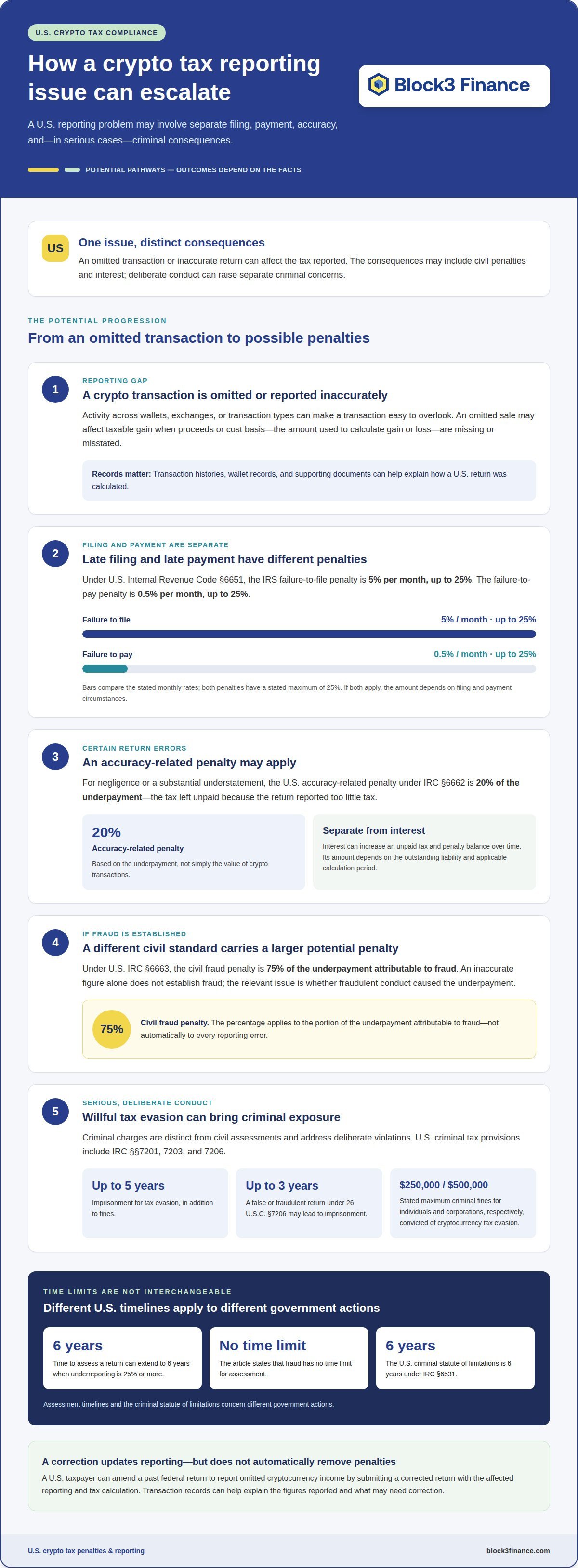
Federal filing and payment failures are separate. According to the Internal Revenue Service, the failure-to-file penalty is 5% per month, up to 25%, and the failure-to-pay penalty is 0.5% per month, up to 25%, under the Internal Revenue Code (IRC), §6651.
U.S. taxpayers can amend a past federal return to report omitted cryptocurrency income by submitting a corrected return with the affected reporting and tax calculation. This updates the reporting record, but does not automatically eliminate penalties.
Willful conduct can raise the stakes beyond civil debt. U.S. criminal tax provisions include IRC §§7201, 7203, and 7206, covering evasion, failure to file, and false returns. Tax evasion can carry imprisonment of up to 5 years, in addition to fines. A false or fraudulent return under 26 U.S.C. § 7206 may lead to up to 3 years in prison.
The time available to assess a tax return can depend on the circumstances. It extends to 6 years when underreporting is 25% or more, and fraud has no time limit. The U.S. criminal statute of limitations is 6 years under IRC §6531. These timelines concern different government actions.
Federal filing and payment penalties can apply when a taxpayer fails to file or pay tax due on digital asset activity. Accurate transaction records help establish what was reported and what may need correction. U.S. crypto tax reporting addresses organizing that reporting.
What is the accuracy-related penalty?
For U.S. taxpayers, an accuracy-related penalty may apply when a return understates tax because of negligence or a substantial understatement. This penalty is separate from unpaid tax and interest, so correcting the taxable amount alone may not resolve the full balance.
According to the Internal Revenue Service, the accuracy-related penalty under IRC §6662 is 20% of the underpayment for negligence or substantial understatement. An underpayment is the tax amount left unpaid because the return reported too little tax. The penalty is calculated against that underpayment, not simply against the value of crypto transactions.
For example, an omitted sale may result in a taxable gain if the reported figures exclude proceeds or misstate cost basis, the amount used to calculate gain or loss. Transaction histories, wallet records, and supporting documents can help explain how the return was calculated and whether an error arose from incomplete information or inaccurate reporting.
Interest can increase the unpaid tax and penalty balance over time. The amount depends on the outstanding liability and the applicable calculation period. An accuracy-related penalty and interest are distinct: one penalizes certain reporting errors, while the other accrues on unpaid tax obligations.
Civil fraud carries a different standard of conduct and a larger potential penalty. Under IRC §6663, the U.S. civil fraud penalty is 75% of the underpayment attributable to fraud. The key issue is the connection between fraudulent conduct and the underpayment; an inaccurate figure alone does not establish that connection.
The proof question therefore centers on the facts behind the return. Records showing omitted transactions, inflated basis, or inconsistent calculations may matter when assessing whether an underpayment resulted from fraud. Frank Richard Ahlgren III’s case involved inflated cost basis on his 2017 return and unreported Bitcoin proceeds over the next two years. Those details illustrate why transaction records and reported figures are examined together.
A market-reported example says an investor who underreports $100,000 in cryptocurrency gains could face up to $75,000 in additional penalties and interest. That example is not a universal calculation: the applicable penalty depends on the underpayment and whether the conduct meets the relevant standard. Criminal prosecution is distinct from these civil assessments and involves separate charges.
Penalties and interest for unreported crypto taxes
An unreported crypto transaction may affect tax owed and could lead to filing or payment consequences. The Internal Revenue Service applies federal rules when individuals fail to meet required filing or payment obligations.
According to the Internal Revenue Service, in the United States, the failure-to-file penalty is 5% per month, up to 25%, under IRC §6651. According to the Internal Revenue Service, in the United States, the failure-to-pay penalty is 0.5% per month, up to 25%, under IRC §6651.
These penalties address different failures: filing a return late and paying tax late. If both apply, the amount depends on the taxpayer’s filing and payment circumstances. An omitted cryptocurrency sale may affect the tax reported, while an unpaid balance can also lead to a payment penalty.
Interest is separate from a penalty. It accrues on unpaid tax and can increase the balance due while the debt remains outstanding. The calculation depends on the unpaid amount and relevant period. For example, a taxpayer who corrects a return but leaves tax unpaid may still owe interest.
What are the state tax penalties for unreported cryptocurrency income in the United States? State penalties and interest follow the relevant state’s tax rules, so federal IRC §6651 rates do not establish a state assessment. The amount depends on the state and the taxpayer’s circumstances.
Exchange statements and blockchain transaction histories can help reconstruct trading activity. For example, a transfer between wallets may need to be distinguished from a sale or exchange when calculating taxable income. Incomplete records can make it harder to determine whether a transaction created a reportable gain or loss.
Start a correction by identifying the affected tax return and gathering records for its transactions. Then recalculate the taxable result and address both the corrected tax and any unpaid balance. Keep the exchange records and transaction calculations that support the corrected figures.
Federal enforcement can involve more than the original amount owed. The IRS may assess penalties and interest, while willful conduct can raise separate criminal concerns. Prompt, accurate reporting can clarify the record, but does not automatically eliminate a tax balance or penalty.
Accuracy-related penalties for crypto underreporting
For U.S. federal returns, negligence or a substantial understatement of cryptocurrency tax can lead to an accuracy-related penalty. The penalty applies to the underpayment, meaning tax left unpaid because the return reported too little. A missing Bitcoin sale, incorrect cost basis, or omitted mining income can change the reported amount and the resulting tax calculation.
According to the Internal Revenue Service, the U.S. accuracy-related penalty under IRC §6662 is 20% of the underpayment. It applies to negligence or substantial understatement of cryptocurrency tax. This civil penalty is separate from the underlying federal tax and any interest. Its calculation focuses on the underpayment, not the total value of digital assets held.
Consider a return that reports Bitcoin proceeds but uses an incorrect cost basis, the amount used to calculate gain or loss. If the error reduces taxable capital gain, it may leave tax underpaid. Mining records also matter: incomplete documentation can make it harder to support reported income or asset values.
The circumstances behind an error matter. A calculation mistake and a deliberate effort to hide transactions are not automatically the same conduct. Records of wallet movements, exchange statements, mining activity, and calculation methods can help explain how a return was prepared. Those records do not, by themselves, determine whether the IRS applies a penalty.
If you’re reviewing a possible underreporting issue, organize each transaction by date, asset, proceeds, and recorded basis. Compare those details with the federal return to identify figures that may need correction. For example, distinguishing a wallet transfer from a sale can help avoid treating different transactions alike in the calculation.
An accuracy-related penalty is civil, while criminal prosecution involves separate legal provisions and issues of intent. The 20% penalty under IRC §6662 concerns negligence or substantial understatement, not every crypto reporting error. A careful review of transaction data can clarify whether the return’s treatment of Bitcoin, other assets, or mining activity affected the amount of tax reported.
In a separate case, Ahlgren failed to report an additional $650,000 in Bitcoin proceeds over the next two years, illustrating how omitted proceeds can increase an underpayment.
What are the IRS accuracy-related and fraud penalties for crypto tax noncompliance?
For U.S. federal returns, the IRS distinguishes inaccurate reporting from civil tax fraud. This distinction matters because negligence and fraud carry different consequences. A missing cryptocurrency transaction may create an underpayment, but the circumstances behind the omission also matter.
The accuracy-related penalty under IRC §6662 is 20% of the underpayment for negligence or substantial understatement. The Internal Revenue Service identifies this rate for U.S. cryptocurrency tax. An underpayment is the tax left unpaid because the return understated the amount due. The penalty is separate from the unpaid tax and interest.
Negligence concerns a failure to take reasonable care in preparing an accurate return. For example, a taxpayer might report an exchange sale but omit another recorded transaction. A substantial understatement is a separate basis for the accuracy-related penalty. Either basis can lead to the 20% assessment when it applies.
Civil fraud carries a higher potential charge. Under IRC §6663, the U.S. civil fraud penalty is 75% of the underpayment attributable to fraud. The phrase “attributable to fraud” is central: the penalty applies to the portion of unpaid tax connected to fraudulent conduct, rather than automatically to every reporting error.
Finding a mismatch in records is not the same as proving fraud. An omitted wallet transaction or incorrect cost basis can reveal an error, but the fraud penalty concerns whether the underpayment resulted from fraud. An inaccurate return alone does not establish fraudulent intent. The facts surrounding the transaction and reporting must support a fraud determination.
Organize records to clarify how each reported figure was calculated. Useful evidence may include exchange histories, wallet records, transaction dates, and the basis used to calculate gains. Comparing those records with the filed return can reveal whether an amount was omitted, miscalculated, or reported inconsistently.
For example, if a return includes proceeds but uses an unsupported basis, the reported gain may be understated. That fact may prompt review, but it does not by itself establish fraud. The applicable civil penalty depends on the error’s cause and the underpayment. Criminal prosecution is separate from the civil penalties under IRC §§6662 and 6663.
Block3 Finance: Audits and Compliance
Block3 Finance helps individuals and businesses address crypto tax reporting and compliance needs. If you’re concerned about crypto tax penalties for non-compliance, accurate records and clear reporting can help establish what happened across your crypto activity. Support may be relevant when transaction histories are fragmented, previous returns need attention, or regular accounting processes must account for digital assets.
Tax Filing and Reporting can help organize digital asset activity for tax returns. A Crypto Tax Accountant can use transaction records to determine how activity is reflected in tax calculations. This can be useful when trading, transfers, and other transactions span multiple wallets or exchanges, or when records from different sources need to be reconciled.
Audits and Compliance supports a structured review of financial records and reporting processes. For a business, this can clarify how crypto activity appears in its accounting and supporting documentation. The service focuses on accounting and compliance, not legal representation in a tax investigation or prosecution.
For ongoing activity, Monthly Accounting can maintain financial records as transactions occur, rather than leaving reconciliation until tax preparation. Regular bookkeeping can help identify missing information and make transaction flows easier to understand. The records needed depend on the individual’s or business’s crypto activity and accounting requirements.
Start by identifying the issue that needs attention: a prior return, incomplete transaction records, or recurring accounting for digital assets. That distinction can help determine whether tax filing and reporting, accounting, or compliance support best fits the work. Addressing crypto tax penalties for non-compliance begins with understanding the reporting issue and organizing the relevant information.
For individuals, the work may involve bringing exchange statements and transaction details into a coherent tax record. For businesses, it may mean reviewing how crypto activity is captured in their accounting records. Block3 Finance can support these tax and accounting needs without presenting that work as legal advice or a promise about the outcome of an IRS matter.
To discuss your crypto tax or compliance needs, contact Block3 Finance.
Frequently Asked Questions
What happens if I don't report crypto on taxes?
In the United States, leaving taxable crypto activity off a return can result in unpaid tax, penalties, interest, and possible investigation. The consequences depend on what was omitted, the resulting underpayment, and whether the conduct appears negligent or deliberate. For example, a return that leaves out a taxable sale may need correction even if the proceeds remain in another wallet.
Can I get penalties abated?
Some U.S. taxpayers may qualify for penalty relief through reasonable cause or first-time abatement. Reasonable cause can support relief when documented facts show a good-faith effort to meet tax obligations. First-time abatement may be available to qualifying taxpayers with a clean compliance history for the prior 3 years. Form 843 is used to request U.S. tax penalty abatement; eligibility and the penalty involved matter.
Can the IRS track my cryptocurrency transactions?
Yes. The IRS has issued John Doe summonses to cryptocurrency exchanges since 2021 to obtain taxpayer transaction records. The IRS Criminal Investigation Division also had 390 crypto-related investigations between 2018 and 2023. Exchange records and blockchain activity can help identify discrepancies between reported tax information and transaction history. Keeping personal records organized helps taxpayers explain activity that may look incomplete or inconsistent.
How much is failure-to-file penalty?
For U.S. federal taxes, the failure-to-file penalty is 5% per month, up to 25%, under IRC §6651, according to the Internal Revenue Service. It concerns filing a required return late, rather than paying the balance late. A taxpayer who files but has not paid may face a separate failure-to-pay penalty. Filing and payment status therefore affect which penalty applies.
Is there criminal exposure for crypto?
Yes. Willful cryptocurrency tax evasion can lead to criminal prosecution under U.S. law. The stated maximum prison sentence for cryptocurrency tax evasion is up to 5 years, in addition to fines. Criminal exposure is distinct from civil penalties for inaccurate reporting. The facts surrounding intent, filings, and transactions shape whether a case involves a criminal allegation rather than only a tax assessment.
What Constitutes Tax Evasion in Relation to Crypto?
Crypto tax evasion involves deliberate efforts to evade tax, such as concealing taxable activity or submitting a false return. A reporting error alone does not establish intentional evasion. For instance, an omitted transaction could result from incomplete records, while knowingly hiding proceeds presents a different concern. U.S. criminal tax provisions include IRC §§7201, 7203, and 7206, covering evasion, failure to file, and false returns.
What are the IRS penalties for failing to report cryptocurrency income or gains?
U.S. consequences can include the unpaid tax, interest, and civil penalties. A conviction for cryptocurrency tax evasion can carry serious criminal consequences. A corporation’s stated maximum fine is $500,000. The applicable outcome depends on the conduct and whether authorities pursue civil or criminal enforcement.
What penalties apply to underpayment of taxes on cryptocurrency transactions?
For U.S. federal tax, an underpayment can trigger interest and a civil penalty. The accuracy-related penalty is 20% of the underpayment for negligence or substantial understatement under IRC §6662. If tax remains unpaid after the due date, the failure-to-pay penalty may also apply. These amounts address different aspects of the balance, so the cause and timing of the underpayment matter.

Article by
Mahad Mohamed
Mahad Mohamed is an accountant and the CEO of Block3 Finance, with over 26+ years of Canadian and international tax and accounting experience. A crypto accounting specialist since the early days of Bitcoin, he has consulted for over 38 crypto companies and collaborated with legal professionals on regulatory matters. His expertise spans corporate reorganization, cross-border tax structuring (Canada & US), tax disputes, and CRA audits.
Previously, Mahad worked for the Canada Revenue Agency (CRA), Big4 accounting firms, and served as a Rulings Officer for the Federal Tax Authority of the UAE before acquiring Tax Partners in 2014.
Block3 Finance and Tax Partners has 44 full-time accountants and over 9,800+ clients.
Disclaimer
This article provides general information only and is current as of its publication date. It has not been updated and may be out of date. It does not constitute legal advice and should not be relied upon as such. Every tax situation is unique and may differ from the examples discussed in this article. If you have specific questions, you should seek the advice of our accountants for your unique circumstances.
Frequently Asked Questions
What happens if I don't report crypto on taxes?
In the United States, leaving taxable crypto activity off a return can result in unpaid tax, penalties, interest, and possible investigation. The consequences depend on what was omitted, the resulting underpayment, and whether the conduct appears negligent or deliberate. For example, a return that leaves out a taxable sale may need correction even if the proceeds remain in another wallet.
Can I get penalties abated?
Some U.S. taxpayers may qualify for penalty relief through reasonable cause or first-time abatement. Reasonable cause can support relief when documented facts show a good-faith effort to meet tax obligations. First-time abatement may be available to qualifying taxpayers with a clean compliance history for the prior 3 years. Form 843 is used to request U.S. tax penalty abatement; eligibility and the penalty involved matter.
Can the IRS track my cryptocurrency transactions?
Yes. The IRS has issued John Doe summonses to cryptocurrency exchanges since 2021 to obtain taxpayer transaction records. The IRS Criminal Investigation Division also had 390 crypto-related investigations between 2018 and 2023. Exchange records and blockchain activity can help identify discrepancies between reported tax information and transaction history. Keeping personal records organized helps taxpayers explain activity that may look incomplete or inconsistent.
How much is failure-to-file penalty?
For U.S. federal taxes, the failure-to-file penalty is 5% per month, up to 25%, under IRC §6651, according to the Internal Revenue Service. It concerns filing a required return late, rather than paying the balance late. A taxpayer who files but has not paid may face a separate failure-to-pay penalty. Filing and payment status therefore affect which penalty applies.
Is there criminal exposure for crypto?
Yes. Willful cryptocurrency tax evasion can lead to criminal prosecution under U.S. law. The stated maximum prison sentence for cryptocurrency tax evasion is up to 5 years, in addition to fines. Criminal exposure is distinct from civil penalties for inaccurate reporting. The facts surrounding intent, filings, and transactions shape whether a case involves a criminal allegation rather than only a tax assessment.
What Constitutes Tax Evasion in Relation to Crypto?
Crypto tax evasion involves deliberate efforts to evade tax, such as concealing taxable activity or submitting a false return. A reporting error alone does not establish intentional evasion. For instance, an omitted transaction could result from incomplete records, while knowingly hiding proceeds presents a different concern. U.S. criminal tax provisions include IRC §§7201, 7203, and 7206, covering evasion, failure to file, and false returns.
What are the IRS penalties for failing to report cryptocurrency income or gains?
U.S. consequences can include the unpaid tax, interest, and civil penalties. A conviction for cryptocurrency tax evasion can carry serious criminal consequences. A corporation’s stated maximum fine is $500,000. The applicable outcome depends on the conduct and whether authorities pursue civil or criminal enforcement.
What penalties apply to underpayment of taxes on cryptocurrency transactions?
For U.S. federal tax, an underpayment can trigger interest and a civil penalty. The accuracy-related penalty is 20% of the underpayment for negligence or substantial understatement under IRC §6662. If tax remains unpaid after the due date, the failure-to-pay penalty may also apply. These amounts address different aspects of the balance, so the cause and timing of the underpayment matter.