
Can a crypto loss reduce your U.S. tax bill? Generally, yes: a loss may be deductible when you sell or otherwise dispose of a digital asset for less than its cost. A crypto tax consultation can help U.S. investors and businesses understand how that rule applies to their transactions and records.
It’s easy to assume that only cashing out to dollars matters. But under U.S. tax rules, swapping or spending crypto, earning it, and participating in decentralized finance (DeFi), financial services built on blockchain networks, or buying and selling non-fungible tokens (NFTs), unique digital assets recorded on a blockchain, can also affect what you report.
This U.S.-focused article explains how crypto sales, exchanges, losses, DeFi, NFTs, and business activity may affect a tax return, and when professional help can be useful. You’ll get an overview of the records and tax questions involved, so you can approach filing with greater confidence.
Key Takeaways
- Understand how Form 8949 fits into U.S. crypto tax reporting, including when an exchange doesn’t send a tax form.
- See why complete records across wallets, platforms, and blockchains matter when calculating gains, losses, and income.
- Learn which crypto activities, from payments and rewards to DeFi and NFTs, may affect your U.S. tax return.
- Recognize when complex activity or business transactions may call for professional tax preparation and ongoing accounting support.
- Explore how specialized reporting, compliance, and accounting services can help bring greater clarity to crypto tax obligations.
What is Form 8949 and how does it relate to crypto?
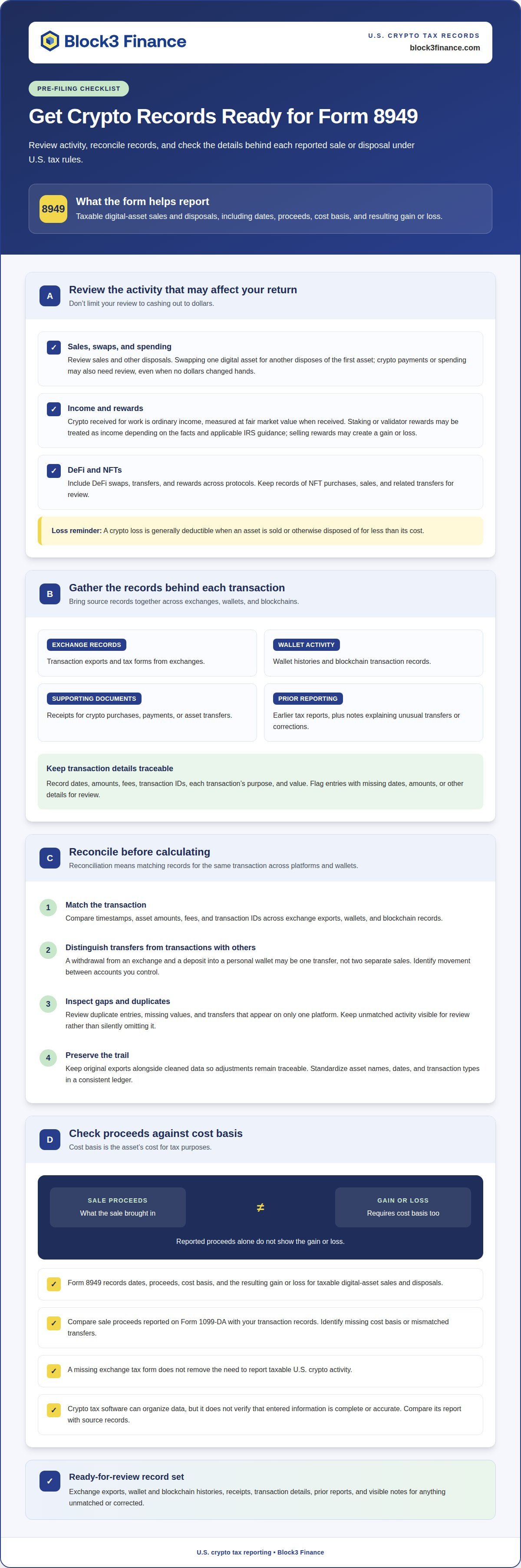
In the United States, Form 8949 lists taxable digital-asset sales and disposals, including dates, proceeds, cost basis, and resulting gain or loss. These details support figures reported on a tax return and help explain how each transaction was calculated.
Digital Asset Activity Without Exchange Forms
A missing exchange tax form doesn’t remove the need to report taxable U.S. crypto activity. Gather records for sales, crypto payments, and transfers between platforms. Review these sources together:
- Exchange transaction exports and tax forms
- Wallet histories and blockchain transaction records
- Receipts for crypto payments or asset transfers
Flag entries with missing dates, amounts, or transaction details for review before preparing the return.
Crypto Gains, Losses, Income, and Expenses
Separate sales and disposals from income, expenses, gifts, and holdings when organizing records. A crypto loss is generally deductible when an asset is sold or otherwise disposed of for less than its cost. In the United States, crypto received for work is ordinary income, meaning income treated like earnings from work, measured at fair market value, its market value when received. Keep records showing each transaction’s purpose and value.
Form 1099-DA and Cost Basis Reporting
According to the Internal Revenue Service, crypto exchanges report sale proceeds to the IRS on Form 1099-DA. Proceeds alone don’t show the gain or loss. Form 8949 also records cost basis, the asset’s cost for tax purposes. Compare reported proceeds with transaction records and identify missing basis or mismatched transfers. Since 2025, crypto tax basis should be tracked according to IRS requirements, according to the Internal Revenue Service.
DeFi, Staking, and NFT Tax Reporting
DeFi activity can involve swaps, asset transfers, and rewards across protocols, so preserve transaction-level records from each wallet and platform. In the United States, the tax treatment of staking or validator rewards when received depends on the facts and applicable IRS guidance; rewards may be treated as income. A gain or loss may arise when those rewards are sold. Record NFT purchases, sales, and related transfers for review.
Crypto tax software can organize data, but it doesn’t verify that the information entered is complete or accurate. Compare its report with source records before using the results on a return.
How Does the IRS Treat Crypto Transactions?
The IRS treats cryptocurrency as property, so U.S. crypto activity must be reviewed as asset transactions, not simply cash movements. State tax rules can differ; bring exchange exports, wallet histories, transaction receipts, and prior tax reports to a consultation.
Tax Calculations and Transaction Reconciliation
Reconciliation means matching records for the same transaction across exchanges, wallets, and blockchains. Start with each platform’s transaction export, then compare timestamps, asset amounts, fees, and transaction IDs. A withdrawal from one exchange and a deposit into a personal wallet may represent one transfer, not two separate sales. Resolve unmatched entries before calculating proceeds, cost basis, and any resulting gain or loss.
Property Treatment of Crypto Transactions
Because the IRS treats cryptocurrency as property, a transaction may need review even if no dollars changed hands. For example, exchanging one digital asset for another involves disposing of the first asset and acquiring the next. The calculation depends on the transaction’s proceeds and the disposed asset’s cost basis. Separating purchases, transfers, sales, and receipts helps tax reports reflect what occurred.
Data quality shapes the result. Import exchange CSV files and wallet records into a consistent transaction ledger, then standardize asset names, dates, and transaction types. Review duplicate entries, missing values, and transfers that appear on only one platform. Blockchain transaction IDs can help match an outgoing transfer to its corresponding incoming record. Keep the original exports alongside cleaned data so adjustments remain traceable.
For histories spread across several platforms, build a timeline for each asset and wallet. Match deposits, withdrawals, swaps, and fees by transaction ID, amount, and date. Then distinguish movement between accounts you control from a transaction with another party. That distinction can change how an entry is classified. Keep unmatched activity visible for review rather than silently omitting it from calculations.
Useful records include exchange transaction exports, wallet addresses, blockchain transaction histories, receipts for crypto purchases or payments, and earlier tax reports. Add notes explaining unusual transfers or corrections. These materials let a preparer trace how calculations were assembled and investigate gaps between platform summaries and wallet activity.
A conversation about your crypto tax records can help clarify which transactions need further reconciliation before filing.
Searching for a Crypto Tax Accountant?
For U.S. taxpayers, selling crypto or swapping one digital asset for another involves disposing of property. Under IRS guidance, mining, staking, and validator rewards may be treated as income when received, depending on the facts and applicable rules. The income classification may vary, and a gain or loss may arise when rewards are later sold. Crypto tax software organizes data, while a CPA can help prepare a return and a tax attorney can address legal tax matters.
Tax Help for Trading, Mining, and Staking
Trading records should distinguish purchases, sales, swaps, fees, and transfers so each entry reflects the underlying activity. For mining and staking, organize reward records by receipt date, asset, and value, then track later sales separately. Under IRS guidance, mining, staking, and validator rewards may be treated as income when received, depending on the facts and applicable rules. The income classification may vary, and a gain or loss may arise when those rewards are sold.
Crypto payments also need clear classification. In the United States, crypto received for work is ordinary income measured at its fair market value when received. Keep the payment record and date, then track what happens if you later sell or spend that asset. The original receipt and a later disposal are separate events for tax review.
NFT and DeFi Tax Issues
NFT and DeFi histories can include marketplace purchases, sales, protocol swaps, liquidity activity, and token rewards. Organize records by wallet and platform, retaining transaction IDs and dates so activity can be traced. For each event, identify what asset left the wallet, what came in, and whether you received income. Those details help classify entries instead of treating every protocol movement alike.
For a DeFi position, preserve records when assets enter or leave a protocol, and note whether each transaction represents a swap, reward, or transfer. For an NFT, keep marketplace records showing the purchase or sale and related asset movements. Tax treatment depends on the transaction’s substance and records, so label each event accurately before including it in tax calculations.
Comparing Software, CPAs, and Tax Attorneys
Crypto tax software can import transaction data and generate reports, but it doesn’t verify that the information entered is complete or accurate. A CPA can apply tax-reporting knowledge to organize records and prepare returns. A tax attorney focuses on legal tax questions and representation. The right support depends on whether your main need is data organization, return preparation, or legal advice.
Software output still needs review. Compare its transaction list with exchange exports and wallet histories, then investigate duplicate entries, missing transfers, or unexplained proceeds. A professional can assess how those issues affect the tax return. For a situation involving a legal dispute or tax controversy, legal advice may be more relevant than software calculations alone.
Tax Treatment of Sales, Swaps, and Airdrops
In the United States, a crypto sale for dollars is generally reported as a capital gain or loss, based on proceeds and cost basis. Swapping one digital asset for another disposes of the asset exchanged and acquires a different one. Record both sides of the swap, including dates and values, so the disposal can be calculated rather than overlooked.
Airdrops require transaction-specific review. Preserve the date received, asset, wallet, and circumstances of receipt, then record any later sale separately. Don’t assume that receiving an asset and disposing of it are the same tax event. Reviewing those records alongside trading, mining, staking, NFT, and DeFi activity helps ensure the tax return reflects the full situation.
Capital gains and losses on sales and exchanges
For U.S. taxpayers, selling cryptocurrency for dollars generally creates a capital gain or loss. The calculation compares sale proceeds with the asset’s cost basis, meaning its cost for tax purposes. Sales for dollars are reported on Form 8949 and Schedule D. A loss is generally deductible when a digital asset is sold or otherwise disposed of for less than its cost.
A swap also involves a disposal. If you exchange one digital asset for another, record the asset given up, the asset received, the transaction date, and the proceeds used in the calculation. The new asset then has its own cost basis for a later transaction. Keep the exchange’s transaction record with your tax reports so each side of the swap can be traced.
Multiple wallets and exchanges can make transaction histories harder to reconcile. An asset might leave one exchange, pass through a self-custody wallet, and later arrive at another platform. Match outgoing and incoming records using transaction IDs, dates, amounts, and asset types. This helps distinguish transfers between accounts you control from sales or swaps that need separate tax treatment.
Blockchain activity adds another layer. One transaction may include several token movements, while platform exports may label entries differently. Accountants can reconcile records by wallet and blockchain, then connect each taxable disposal to its proceeds and basis. Preserve source exports and notes about unusual movements, such as bridge transfers, to support figures included in the filing.
Foreign platform accounts need separate attention. For U.S. taxpayers, accounts holding fiat alongside cryptocurrency may create FBAR and Form 8938 obligations. FBAR means Report of Foreign Bank and Financial Accounts, a report for certain foreign financial accounts. Form 8938, called Statement of Specified Foreign Financial Assets, is an IRS form for reporting certain foreign financial assets. These are separate from calculating crypto gains and losses.
Before filing, compare exchange summaries with wallet histories and transaction-level entries. Look for duplicate sales, missing acquisition records, and proceeds that don’t match the underlying transaction. Tax services can help organize that reconciliation and prepare records for reporting. The goal is a traceable calculation for each sale or exchange, not simply a total copied from an exchange summary.
Crypto tax considerations for DeFi users, NFT participants, and businesses
For U.S. taxpayers, DeFi positions, NFT activity, and business transactions can create records that ordinary exchange summaries don’t capture. The practical priority is to classify each event accurately, preserve its transaction trail, and include relevant activity during tax preparation. Individuals and businesses should organize activity by wallet, platform, and purpose.
A DeFi protocol can involve deposits, withdrawals, token swaps, and reward receipts. Build a transaction sequence showing what entered or left each wallet and which protocol handled the activity. Separate transfers between wallets you control from transactions that change asset ownership. Keep blockchain records and protocol statements together, since a tax software export may not explain the purpose of every entry.
NFT records need more than a marketplace sale total. For each purchase, sale, or transfer, retain the token identifier, transaction date, payment asset, wallet address, and marketplace record. If you receive an NFT for work or business activity, preserve the agreement or invoice describing the transaction. These details help distinguish personal collecting, trading, and business activity during return preparation.
Businesses should connect crypto activity to their books. For a customer payment, retain the invoice, receipt date, asset received, and accounting entry. For a treasury sale, connect the exchange confirmation to the asset’s original acquisition record. Record fees and operating expenses separately, with supporting documents that explain their business purpose. This creates a clearer audit trail than combining customer receipts, trading activity, and protocol movements into one balance.
Reconcile wallet histories against exchange exports and business ledgers before finalizing reports. For example, match a DeFi withdrawal to the receiving wallet, then determine whether the entry is a transfer, reward, or disposal. Review NFT marketplace records alongside payment histories. Tax software can help organize transactions, but staff still need to assess missing entries, misclassified activity, and inconsistent dates.
U.S. taxpayers who fail to report crypto trades or income can face back taxes, interest, and possible penalties. Preparation should therefore include individuals’ wallets, business accounts, DeFi protocols, and NFT platforms, not just a central exchange account. Clear records let a tax professional handle complex activity with a traceable basis for each entry. Discuss your DeFi, NFT, or business crypto tax records to plan the next step.
Block3 Finance
Block3 Finance can be a next step when U.S. crypto activity spans trading platforms, self-custody wallets, DeFi protocols, or business records. Consider support when transaction histories don’t reconcile, cost basis is unclear, or crypto income must be incorporated into a return. Bringing exchange exports, wallet records, prior tax reports, and relevant business books gives the review a practical starting point.
The work can address both a current filing and the records behind it. Tax Filing and Reporting helps organize digital-asset activity for tax reporting. A Crypto Tax Accountant can assess how transactions fit the return, including sales, exchanges, rewards, and business receipts. Audits and Compliance can help review supporting records and reporting processes when documentation or prior filings need closer attention.
- Tax Filing and Reporting: Bring transaction histories and income records for organizing the activity relevant to a U.S. return.
- Crypto Tax Accountant: Use specialized accounting support when trading, DeFi, staking, or NFT activity creates classification or calculation questions.
- Audits and Compliance: Review documentation and reporting processes when records need structured scrutiny.
- Monthly Accounting: Maintain ongoing accounting records for recurring crypto transactions and business activity, rather than reconstructing everything at filing time.
For a business accepting crypto, the accounting picture may include customer receipts, operating expenses, treasury transactions, and wallet transfers. Monthly Accounting can help maintain records across recurring activity, while tax reporting draws on those organized books. For an individual investor, the immediate need may instead be reconciling platform exports with wallet history and distinguishing transfers from disposals.
Before engaging support, bring the records you already have and identify the questions that remain unresolved. Examples include unexplained transaction entries, a missing cost basis, inconsistent exchange summaries, or crypto income recorded outside the accounting system. That context helps focus the work on gaps that affect reporting and compliance.
If you’d like to discuss your crypto tax situation, contact Block3 Finance.
Build a Clearer Path for Your Crypto Tax Reporting
Use your next step to create a process that supports both the current U.S. tax return and future digital-asset activity. A crypto tax consultation can help turn unresolved reporting questions into a practical plan for organizing records, preparing filings, and maintaining consistent accounting as your activity changes.
Block3 Finance offers Tax Filing and Reporting, Audits and Compliance, and Monthly Accounting. These services can support different needs, from preparing crypto tax records for filing to reviewing documentation or maintaining ongoing business books. The right starting point depends on the records you have and the issues you need to address.
You don’t need to wait until every transaction question is resolved to take a constructive next step. Identify the areas that need attention, such as incomplete wallet histories, unclear classifications, or recurring crypto activity in business accounts. A focused discussion can help establish what to address first and how to move forward with greater clarity.
Discuss your crypto tax needs with Block3 Finance and take the next step toward a more organized reporting process.
Frequently Asked Questions
Can I deduct my crypto losses on my tax return?
Yes, a U.S. crypto loss may be deductible when you sell or otherwise dispose of an asset for less than its cost. A price drop alone is different: if you still hold the asset, you haven’t disposed of it. For example, compare the asset’s documented cost with its proceeds when sold. Keep purchase and sale records together so the reported loss has transaction details behind it.
How do I know if my crypto tax report is accurate?
Check whether the report accounts for every exchange, wallet, and blockchain you used during the tax year. Crypto tax software can organize imported data, but it doesn’t establish that the information is complete or accurate. Compare the report with original platform exports, wallet histories, and transaction receipts. Look especially for duplicate entries, missing transfers, and assets with no recorded acquisition history.
What Are Cryptocurrency Tax Services?
Cryptocurrency tax services help organize digital-asset records and prepare tax reporting. Depending on the service, work may include reviewing transactions, calculating gains or losses, and reporting crypto income. Block3 Finance offers Tax Filing and Reporting, Audits and Compliance, Monthly Accounting, and Crypto Tax Accountant services. For example, a business with recurring crypto receipts may need organized accounting records alongside tax preparation.
What happens if I don’t report my crypto trades or income?
In the United States, failing to report crypto trades or income can result in back taxes, interest, and possible penalties. The reporting issue may arise even when an exchange doesn’t provide a tax form. For example, a transfer between your wallets can leave gaps in an exchange-only report. Preserve original records and address missing transactions promptly, since incomplete reporting can make later corrections more difficult.
What does a crypto tax consultation cover?
A crypto tax consultation can clarify how your U.S. digital-asset activity affects reporting and which records need attention. Topics may include sales, swaps, rewards, business payments, or transactions spread across platforms. Bring available exchange exports, wallet histories, prior returns, and business records. A focused review can identify unresolved classifications or incomplete transaction histories and help define next steps for preparation.
How do I find a qualified crypto tax professional or CPA?
Look for a professional whose work covers digital-asset records and the U.S. tax questions relevant to your activity. For example, a trader with exchange and self-custody wallet histories may need help reconciling both, while a business may need reporting aligned with its accounting records. Confirm that the professional’s scope matches your need, such as return preparation, accounting, or compliance support.
What are the U.S. federal tax rules for cryptocurrency transactions?
For U.S. federal tax purposes, cryptocurrency is treated as property. Sales and exchanges can create reportable gains or losses, while crypto received for work is treated as ordinary income at its fair market value when received. Crypto activity is reported on Form 1040, not on a separate crypto return. The specific reporting depends on the transaction type and the records supporting it.
How do I calculate crypto cost basis and capital gains across exchanges and wallets?
Cost basis is the asset’s cost for tax purposes. For each disposal, compare its proceeds with the basis of the asset disposed of; that difference is the gain or loss. Across platforms, trace acquisitions through transfers using transaction IDs, dates, amounts, and wallet records. For example, match an exchange withdrawal to its arrival in your wallet so the transfer doesn’t appear as a new purchase.

Article by
Mahad Mohamed
Mahad Mohamed is an accountant and the CEO of Block3 Finance, with over 26+ years of Canadian and international tax and accounting experience. A crypto accounting specialist since the early days of Bitcoin, he has consulted for over 38 crypto companies and collaborated with legal professionals on regulatory matters. His expertise spans corporate reorganization, cross-border tax structuring (Canada & US), tax disputes, and CRA audits.
Previously, Mahad worked for the Canada Revenue Agency (CRA), Big4 accounting firms, and served as a Rulings Officer for the Federal Tax Authority of the UAE before acquiring Tax Partners in 2014.
Block3 Finance and Tax Partners has 44 full-time accountants and over 9,800+ clients.
Disclaimer
This article provides general information only and is current as of its publication date. It has not been updated and may be out of date. It does not constitute legal advice and should not be relied upon as such. Every tax situation is unique and may differ from the examples discussed in this article. If you have specific questions, you should seek the advice of our accountants for your unique circumstances.
Frequently Asked Questions
Can I deduct my crypto losses on my tax return?
Yes, a U.S. crypto loss may be deductible when you sell or otherwise dispose of an asset for less than its cost. A price drop alone is different: if you still hold the asset, you haven’t disposed of it. For example, compare the asset’s documented cost with its proceeds when sold. Keep purchase and sale records together so the reported loss has transaction details behind it.
How do I know if my crypto tax report is accurate?
Check whether the report accounts for every exchange, wallet, and blockchain you used during the tax year. Crypto tax software can organize imported data, but it doesn’t establish that the information is complete or accurate. Compare the report with original platform exports, wallet histories, and transaction receipts. Look especially for duplicate entries, missing transfers, and assets with no recorded acquisition history.
What Are Cryptocurrency Tax Services?
Cryptocurrency tax services help organize digital-asset records and prepare tax reporting. Depending on the service, work may include reviewing transactions, calculating gains or losses, and reporting crypto income. Block3 Finance offers Tax Filing and Reporting, Audits and Compliance, Monthly Accounting, and Crypto Tax Accountant services. For example, a business with recurring crypto receipts may need organized accounting records alongside tax preparation.
What happens if I don’t report my crypto trades or income?
In the United States, failing to report crypto trades or income can result in back taxes, interest, and possible penalties. The reporting issue may arise even when an exchange doesn’t provide a tax form. For example, a transfer between your wallets can leave gaps in an exchange-only report. Preserve original records and address missing transactions promptly, since incomplete reporting can make later corrections more difficult.
What does a crypto tax consultation cover?
A crypto tax consultation can clarify how your U.S. digital-asset activity affects reporting and which records need attention. Topics may include sales, swaps, rewards, business payments, or transactions spread across platforms. Bring available exchange exports, wallet histories, prior returns, and business records. A focused review can identify unresolved classifications or incomplete transaction histories and help define next steps for preparation.
How do I find a qualified crypto tax professional or CPA?
Look for a professional whose work covers digital-asset records and the U.S. tax questions relevant to your activity. For example, a trader with exchange and self-custody wallet histories may need help reconciling both, while a business may need reporting aligned with its accounting records. Confirm that the professional’s scope matches your need, such as return preparation, accounting, or compliance support.
What are the U.S. federal tax rules for cryptocurrency transactions?
For U.S. federal tax purposes, cryptocurrency is treated as property. Sales and exchanges can create reportable gains or losses, while crypto received for work is treated as ordinary income at its fair market value when received. Crypto activity is reported on Form 1040, not on a separate crypto return. The specific reporting depends on the transaction type and the records supporting it.
How do I calculate crypto cost basis and capital gains across exchanges and wallets?
Cost basis is the asset’s cost for tax purposes. For each disposal, compare its proceeds with the basis of the asset disposed of; that difference is the gain or loss. Across platforms, trace acquisitions through transfers using transaction IDs, dates, amounts, and wallet records. For example, match an exchange withdrawal to its arrival in your wallet so the transfer doesn’t appear as a new purchase.