
Under U.S. tax rules, crypto liquidity pool treatment can depend on what happens when you enter or exit a pool, not just on yield. Pool rewards are generally treated as ordinary income (income taxed as regular income, rather than as capital gains) at their fair market value (the price an asset would sell for in an open market) when received. A later sale may create a capital gain or loss, calculated from that value.
Tax may apply when rewards arrive, but deposits and withdrawals raise a separate question. The IRS treats virtual currency as property for federal tax purposes, but hasn’t determined whether contributing crypto to a liquidity pool or redeeming pool tokens is a taxable exchange.
This guide explains how U.S. tax treatment may apply to pool yield, liquidity mining rewards, deposits, and gains or losses when you contribute or exit. It covers why entry and exit can be less straightforward than reward income, how to consider token values and cost basis, and which records can support reporting.
Key Takeaways
- Liquidity pool rewards are generally treated as ordinary income at their fair market value when received; selling them later may create a separate gain or loss.
- U.S. tax treatment of pool contributions and withdrawals remains less clear, so the transaction’s structure and what you receive can matter.
- Keep records of pool entries, exits, rewards, and their values at the time of each transaction to support tax reporting.
- Gas fees directly tied to acquiring or disposing of crypto may affect cost basis or proceeds, while general investing transfer fees may not provide a tax benefit.
- Tax filing, reporting, and accounting support can help bring complex DeFi activity into a more coherent tax record.
U.S. Capital Gains and Losses When Contributing to or Exiting a Pool
Under U.S. federal tax principles, crypto is property, so disposing of a token can produce a capital gain or loss. The IRS has not determined whether contributing crypto to a liquidity pool or redeeming pool tokens is a taxable exchange.
Capital Gains on Pool Contributions and Exits
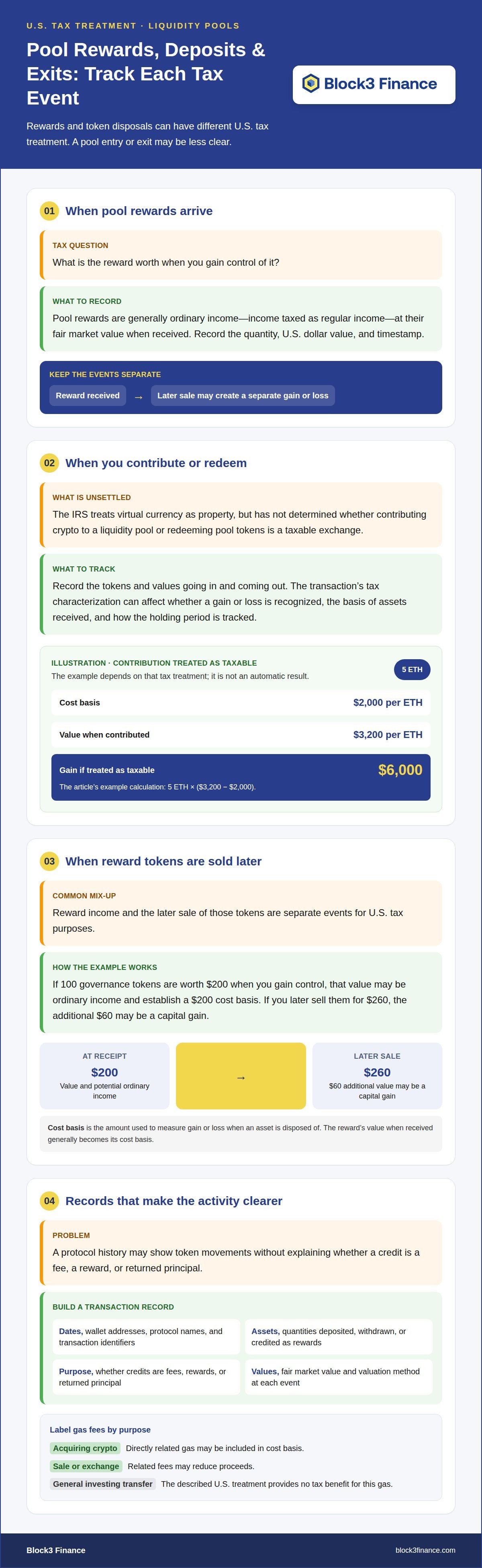
A capital gain or loss is the difference between an asset’s cost basis and its value in a taxable disposal. That distinction matters when depositing tokens because a contribution could be treated as an exchange, although the U.S. treatment is unsettled. For example, depositing 5 ETH with a $2,000-per-ETH cost basis when ETH is worth $3,200 produces a $6,000 gain if treated as taxable. A later exit can also create a gain or loss if the assets received differ in value from the position surrendered.
No-Gain-No-Loss Treatment and Tax Deferral
No-gain-no-loss treatment defers recognition of a gain or loss until a later taxable disposal. U.S. rules don’t establish an automatic deferral for liquidity pool deposits; the IRS has not determined whether depositing crypto or redeeming pool tokens is a taxable exchange. Section 1058 provides an exception for certain securities loans, but no equivalent provision applies to crypto liquidity pool transactions. Section 1258 addresses attempts to convert income into capital gain, so it may matter when a transaction’s structure turns yield into a claimed capital return.
Cost Basis and Holding Period Effects
Cost basis is the amount used to measure gain or loss when an asset is disposed of. If a pool contribution is treated as a taxable exchange, the contributed tokens’ value and basis can determine the resulting gain or loss; the assets received may have a new basis tied to their value at that exchange. At exit, the value of withdrawn assets can inform their basis if treated as newly acquired. The transaction’s tax characterization also affects how the holding period is tracked. Clear records support U.S. crypto tax reporting.
Tax Treatment Across Pool Activities
Liquidity pools, staking, and lending involve different transactions, so their tax treatment can differ. A pool deposit may involve an exchange, while a U.S. crypto loan generally isn’t taxable when made; interest received upon repayment is taxable income. Staking or liquidity rewards may be income when received, and a later sale may create a separate gain or loss. Using a foreign or decentralized protocol doesn’t settle its U.S. tax classification. Record each transaction, token value, and reward to support reporting and reconstruct activity.
How Is Liquidity Pool Yield Taxed Under U.S. Rules?
In the United States, liquidity pool yield is generally ordinary income at its fair market value when received. Trading fees credited to a pool position may count as yield, while gas paid for transactions has separate reporting considerations.
Trading fees credited to a liquidity provider are generally treated as ordinary income when received, based on their fair market value at that time. Selling those tokens later may create a separate capital gain or loss. The IRS has not ruled specifically on liquidity pool rewards, so keep records that distinguish fee income from later token disposals.
Tracking Pool Transactions and Records
A transaction record shows what happened, when it happened, and which assets were involved. This matters because a protocol’s transaction history may show token movements without clearly stating their tax purpose.
- Save transaction dates, wallet addresses, protocol names, and transaction identifiers.
- Record tokens deposited, withdrawn, or credited as rewards, including their quantities.
- Keep pool statements or on-chain records that explain whether a credit represents fees, rewards, or returned principal.
- Separate gas paid for acquiring or disposing of crypto from gas paid for general investing transfers.
These details help connect each entry, exit, and reward to its tax treatment. A crypto tax accounting discussion can help organize complex protocol records.
Recording Fair Market Value
Fair market value is an asset’s U.S. dollar value at the time of a transaction. Record it when yield arrives and for each pool entry or withdrawal, so income and later gains or losses are based on consistent values.
For example, if a protocol credits reward tokens, record their quantity and market value when you gain control of them. That value generally becomes their cost basis, used to calculate gain or loss on a later disposal. Keep the valuation method and timestamp with the transaction record.
Gas fees directly related to acquiring crypto may be included in its cost basis; fees tied to a sale or exchange may reduce the proceeds. By contrast, gas for blockchain transfers made as part of general investing currently provides no tax benefit under the U.S. treatment described. Label each fee by purpose instead of combining all protocol costs.
U.S. Tax Treatment of Liquidity Mining and Reward Income
In the United States, liquidity mining rewards may create taxable income when you gain control of them. A later sale can produce a separate capital gain or loss.
Taxable Sales and Reward Income
Reward income and a later token sale are separate events for U.S. tax purposes. If 100 governance tokens are worth $200 when you gain control, that value may represent ordinary income and establish a $200 cost basis. If you later sell them for $260, the additional $60 may be a capital gain. The timing and fair market value at each event matter.
Yield as Ordinary Income
Many tax professionals treat liquidity pool reward tokens as ordinary income by analogy to IRS Rev. Rul. 2023-14, which addresses staking rewards. The IRS hasn’t ruled specifically on liquidity pool rewards, so this analogy is not a pool-specific IRS determination. For an individual investor, ordinary income is generally reported on Schedule 1. The classification matters because income is recognized separately from any gain on a later sale.
Income Tax on Rewards
For U.S. tax purposes, a reward’s fair market value when received generally determines the income amount and its initial cost basis. If a taxpayer receives reward tokens worth $200 and later sells them for $260, the potential $60 gain is distinct from the initial income. Selling within three months may make that later gain short-term under the example’s treatment.
The same recordkeeping principles apply when liquidity mining pays multiple token types or credits rewards over time. Record each reward when you gain control of it instead of combining deposits, fee credits, and mining distributions into one figure. A protocol dashboard can help identify transactions, while wallet and transaction records help support their amount and timing.
- Record the token, quantity, date received, and fair market value.
- Track later sales separately, using the received value as the starting cost basis.
- Keep records that distinguish reward income from pool principal and trading-fee credits.
For a review of reward classifications and reporting records, contact Block3 Finance about your crypto tax situation.
Do Liquidity Pools Report Transactions to the IRS?
On-chain liquidity pool activity doesn’t by itself establish whether a report goes to the IRS. Broker reporting rules and your U.S. tax reporting are separate questions: an exception to reporting for some transactions doesn’t automatically remove your obligation to report taxable activity.
The IRS issued Notice 2024-57 on June 28, 2024, providing temporary exceptions to broker information reporting for certain digital asset transactions, including qualifying liquidity provider transactions. The exception concerns broker reporting, not whether a pool contribution or withdrawal creates a taxable gain or loss for a participant. The transaction’s tax treatment still depends on what assets moved and how the activity is characterized.
A protocol may record deposits, withdrawals, and fee credits on-chain, but that record isn’t necessarily a tax form sent to the IRS. A decentralized smart contract can execute a transaction without a centralized pool operator collecting every participant’s tax details. Conversely, a platform’s reporting activity doesn’t determine the tax result of transactions in an individual wallet.
For U.S. tax purposes, a withdrawal may return different quantities or types of assets from those contributed. If tokens are treated as disposed of or acquired, their values at exit can affect capital gains, losses, and the cost basis of assets received. Connect the pool contract, wallet, tokens, quantities, and transaction date in your records.
- Separate pool deposits from lending activity and reward credits in your transaction records.
- Match each withdrawal to the relevant contract interaction and assets received.
- Identify any token swap at exit, since exchanging one asset for another may create a taxable disposal.
- Reconcile protocol records with wallet activity before preparing a U.S. return.
When a taxable digital asset sale or exchange occurs, U.S. taxpayers generally report it on Form 8949 and summarize it on Schedule D. A pool or protocol’s silence doesn’t decide whether a transaction belongs on those forms. The key distinction is between an information return filed by a broker and the taxpayer’s reporting of their own taxable activity.
Keep the transaction hash with the related wallet record and tax calculation. This link helps explain whether an entry represents a contribution, withdrawal, reward, or exchange, especially when the protocol interface groups multiple contract actions together.
U.S. Tax Treatment of Liquidity Pool Deposits
For U.S. federal tax purposes, virtual currency is property, and general property transaction principles apply, according to the Internal Revenue Service. The tax treatment of liquidity pool deposits remains unsettled: the IRS hasn’t determined whether depositing crypto or redeeming pool tokens is a taxable exchange.
A deposit can be viewed as transferring tokens in exchange for a new position, such as a pool interest or liquidity provider (LP) tokens. If treated as a taxable exchange, the contributed assets could produce a gain or loss based on their cost basis and value at that time. If no taxable realization occurs, immediate recognition may not follow. The transaction’s structure and the rights attached to the position are central to the analysis.
Some explanations describe pool deposits as automatically taxable exchanges. That overstates the current U.S. position: the IRS hasn’t determined that every deposit is taxable or automatically deferred. A consistent crypto liquidity pool tax treatment analysis should document the transaction details and reasoning, then apply that approach when accounting for later events.
Consider a deposit in which the pool provider receives LP tokens with a $32,000 cost basis in the example. That figure illustrates one possible accounting treatment, not a universal IRS rule. The analysis must account for the assets contributed, what the contract delivers, and whether the transaction changes ownership or creates a distinct exchange.
- Record each token’s quantity, cost basis, and value at deposit.
- Save the contract interaction and wallet records showing the LP tokens or other position received.
- At withdrawal, document the assets returned and compare them with the original contribution.
- Keep reward credits separate from deposited principal, including staking-related distributions.
These records help establish whether a later withdrawal is a return of assets, a different exchange, or a transaction that produces a gain or loss. A change in token quantities alone doesn’t settle the tax result; the contract terms and economic rights matter. U.S. reporting should reflect the treatment applied at entry and exit, rather than treating each event in isolation.
For support aligning deposit analysis with tax reporting, discuss your liquidity pool tax reporting.
Block3 Finance
Block3 Finance can help bring liquidity pool activity into a clearer U.S. tax and accounting picture. Pool deposits, withdrawals, reward credits, and token sales may each require different records and treatment, while the IRS has not determined whether pool deposits or LP-token redemptions are taxable exchanges. That uncertainty makes consistent documentation central to reporting.
Its Tax Filing and Reporting offering is relevant when pool activity must be reflected in a U.S. return. The work can address how entries, exits, rewards, and later disposals are presented, with the transaction history considered alongside the tax treatment applied. This is useful when wallet data shows movements but does not clearly identify whether they represent principal, income, or an exchange.
Monthly Accounting can help maintain financial records as activity occurs across protocols and wallets. Separating deposits from reward income and later sales gives each transaction a clearer place in the books. That ongoing accounting context can also help preserve links between transaction records, token values, and the position held in a pool.
For more complex activity, Audits and Compliance can support a closer review of records and reporting consistency. This may be relevant when a position includes multiple tokens, a withdrawal differs from the original deposit, or transaction histories need to be reconciled across wallets. The focus is on making the accounting and reporting record coherent, not assuming every protocol interaction has the same tax result.
A Crypto Tax Accountant can help assess how U.S. tax principles apply to a specific pool transaction. The relevant details may include what assets entered the contract, what position or tokens came back, whether rewards were received, and how each event was valued and recorded. Clear analysis can distinguish an unresolved classification question from an ordinary income or disposal event.
Block3 Finance’s services may be useful when liquidity pool activity has become difficult to reconcile, when preparing tax filings, or when records need a more consistent accounting structure. The next step is to bring the pool transactions into a focused discussion of their reporting and accounting treatment.
Contact Block3 Finance to discuss your liquidity pool records and U.S. tax reporting.
Make Your Next Pool Decision With Greater Clarity
Your next liquidity pool decision can benefit from the same discipline as your tax records. Before adding or withdrawing assets, consider how the transaction fits into your broader digital asset activity and how you’ll preserve its history. A consistent approach to crypto liquidity pool tax treatment can connect each position, transaction, and reporting decision, rather than leaving gaps to reconstruct later.
U.S. treatment of some pool interactions remains unsettled, so clear records and careful analysis matter. The goal isn’t to predict every protocol outcome. It’s to make informed decisions, maintain a defensible record of what happened, and prepare for tax reporting with the relevant transaction details in view.
When you’re ready to discuss how your pool activity fits into your tax picture, contact Block3 Finance about your crypto taxes. A considered next step can help you move forward with greater confidence and control.
Frequently Asked Questions
Why aren’t liquidity pools tax-free like stock lending?
U.S. tax law provides an exception for certain securities loans, but no equivalent provision applies to crypto liquidity pool transactions. A pool deposit may involve transferring tokens for a different position, rather than making a qualifying securities loan. Stock-lending treatment therefore can’t automatically be applied to digital assets. The IRS has not determined whether contributing crypto to a pool is a taxable exchange.
What should U.S. taxpayers consider when reporting DeFi transactions?
For U.S. tax purposes, the answer depends on the transaction’s structure, including the assets or rights the participant receives. A U.S. characterization shouldn’t be assumed to apply to every DeFi transaction. Identify the specific action, assets, and rights involved before deciding how to report it.
Can you deduct impermanent loss?
Impermanent loss isn’t automatically deductible just because a pool position’s value changed while deposited. For U.S. tax purposes, the result generally depends on whether a transaction realizes a gain or loss, such as through a withdrawal or disposal. Compare the assets received and their tax basis with the relevant transaction values, then determine whether the event produces a reportable capital loss.
How are LP rewards taxed?
In the United States, LP rewards are generally treated as ordinary income at their fair market value when received. That amount generally becomes the rewards’ cost basis for a later sale. For example, if reward tokens are worth $200 when received and later sold for $260, the later $60 increase may be a separate capital gain. Keep reward credits distinct from pool principal and token sales.
Is using DeFi taxable?
Using DeFi isn’t a single tax event under U.S. federal tax principles. A token sale or swap can create a capital gain or loss, and rewards may be income when received. A liquidity pool deposit has a less settled classification because the IRS hasn’t determined whether it is a taxable exchange. Identify the specific action, assets, and rights involved before deciding how to report it.
How does the IRS treat depositing cryptocurrency into a liquidity pool for tax purposes?
The IRS hasn’t determined whether depositing cryptocurrency into a liquidity pool is a taxable exchange. The Internal Revenue Service treats virtual currency as property for federal tax purposes, so general property transaction principles apply. The key question is what the deposit transfers and what the pool contract provides in return. Preserve the transaction details and apply a consistent position when accounting for the deposit and later exit.
Is providing crypto to a liquidity pool a taxable sale or exchange in the United States?
There is no settled, pool-specific IRS determination that every U.S. liquidity contribution is a taxable sale or exchange. Treatment depends on the transaction’s legal and economic substance, including whether tokens are exchanged for LP tokens or another distinct position. Don’t assume either automatic taxation or automatic tax deferral. Record the assets contributed, the position received, and the contract interaction for the tax analysis.
How are liquidity pool deposits and withdrawals valued in USD for tax reporting?
For U.S. reporting, record the fair market value of assets involved at the time of each deposit, withdrawal, or reward. Keep the transaction timestamp, token quantities, wallet, and protocol record together so the U.S. dollar values can be tied to the right event. At withdrawal, document each asset received separately. If the transaction involves a swap, distinguish its value from any separate reward or fee credit.

Article by
Mahad Mohamed
Mahad Mohamed is an accountant and the CEO of Block3 Finance, with over 26+ years of Canadian and international tax and accounting experience. A crypto accounting specialist since the early days of Bitcoin, he has consulted for over 38 crypto companies and collaborated with legal professionals on regulatory matters. His expertise spans corporate reorganization, cross-border tax structuring (Canada & US), tax disputes, and CRA audits.
Previously, Mahad worked for the Canada Revenue Agency (CRA), Big4 accounting firms, and served as a Rulings Officer for the Federal Tax Authority of the UAE before acquiring Tax Partners in 2014.
Block3 Finance and Tax Partners has 44 full-time accountants and over 9,800+ clients.
Disclaimer
This article provides general information only and is current as of its publication date. It has not been updated and may be out of date. It does not constitute legal advice and should not be relied upon as such. Every tax situation is unique and may differ from the examples discussed in this article. If you have specific questions, you should seek the advice of our accountants for your unique circumstances.
Frequently Asked Questions
Why aren’t liquidity pools tax-free like stock lending?
U.S. tax law provides an exception for certain securities loans, but no equivalent provision applies to crypto liquidity pool transactions. A pool deposit may involve transferring tokens for a different position, rather than making a qualifying securities loan. Stock-lending treatment therefore can’t automatically be applied to digital assets. The IRS has not determined whether contributing crypto to a pool is a taxable exchange.
What should U.S. taxpayers consider when reporting DeFi transactions?
For U.S. tax purposes, the answer depends on the transaction’s structure, including the assets or rights the participant receives. A U.S. characterization shouldn’t be assumed to apply to every DeFi transaction. Identify the specific action, assets, and rights involved before deciding how to report it.
Can you deduct impermanent loss?
Impermanent loss isn’t automatically deductible just because a pool position’s value changed while deposited. For U.S. tax purposes, the result generally depends on whether a transaction realizes a gain or loss, such as through a withdrawal or disposal. Compare the assets received and their tax basis with the relevant transaction values, then determine whether the event produces a reportable capital loss.
How are LP rewards taxed?
In the United States, LP rewards are generally treated as ordinary income at their fair market value when received. That amount generally becomes the rewards’ cost basis for a later sale. For example, if reward tokens are worth $200 when received and later sold for $260, the later $60 increase may be a separate capital gain. Keep reward credits distinct from pool principal and token sales.
Is using DeFi taxable?
Using DeFi isn’t a single tax event under U.S. federal tax principles. A token sale or swap can create a capital gain or loss, and rewards may be income when received. A liquidity pool deposit has a less settled classification because the IRS hasn’t determined whether it is a taxable exchange. Identify the specific action, assets, and rights involved before deciding how to report it.
How does the IRS treat depositing cryptocurrency into a liquidity pool for tax purposes?
The IRS hasn’t determined whether depositing cryptocurrency into a liquidity pool is a taxable exchange. The Internal Revenue Service treats virtual currency as property for federal tax purposes, so general property transaction principles apply. The key question is what the deposit transfers and what the pool contract provides in return. Preserve the transaction details and apply a consistent position when accounting for the deposit and later exit.
Is providing crypto to a liquidity pool a taxable sale or exchange in the United States?
There is no settled, pool-specific IRS determination that every U.S. liquidity contribution is a taxable sale or exchange. Treatment depends on the transaction’s legal and economic substance, including whether tokens are exchanged for LP tokens or another distinct position. Don’t assume either automatic taxation or automatic tax deferral. Record the assets contributed, the position received, and the contract interaction for the tax analysis.
How are liquidity pool deposits and withdrawals valued in USD for tax reporting?
For U.S. reporting, record the fair market value of assets involved at the time of each deposit, withdrawal, or reward. Keep the transaction timestamp, token quantities, wallet, and protocol record together so the U.S. dollar values can be tied to the right event. At withdrawal, document each asset received separately. If the transaction involves a swap, distinguish its value from any separate reward or fee credit.