
A crypto-to-crypto swap can create a U.S. tax bill even when no dollars change hands. For U.S. citizens and resident aliens, crypto tax for expats follows the worldwide-income rule: living abroad does not remove the obligation to report taxable crypto income and gains to the IRS.
It is easy to assume that tax relief for working abroad also covers investment gains. But the Foreign Earned Income Exclusion generally applies to qualifying earned income, not crypto capital gains. A Foreign Tax Credit may help when another country taxes the same income.
This guide explains how the IRS treats crypto sales, swaps, spending, and rewards, and how to report gains and losses. It also covers when the Foreign Earned Income Exclusion or Foreign Tax Credit may matter, and why an exchange’s location does not change your U.S. reporting obligations. Understanding how transaction types differ can help you identify what may be taxable and which records support an accurate return.
Key Takeaways
- Distinguish crypto gains from income earned through work abroad, since different tax relief rules may apply.
- Recognize when swaps, sales, or spending crypto can create a taxable gain or loss, even without converting it to cash.
- Understand how the Foreign Tax Credit may interact with income already excluded under the Foreign Earned Income Exclusion.
- Learn how Form 8949 and Schedule D fit into reporting crypto disposals and capital results on a U.S. return.
- See how organized transaction records can support accurate reporting across exchanges and wallets.
Can I use the FEIE to exclude crypto gains?
Generally, no. The Foreign Earned Income Exclusion (FEIE) applies to qualifying income from work abroad, not investment capital gains. A capital gain is the profit realized when you dispose of an asset for more than its adjusted basis, or tax cost after applicable adjustments. Selling crypto at a profit is therefore a separate tax matter for U.S. taxpayers, even if they qualify for the FEIE on work income.
Holding time affects how the IRS classifies an investment gain. For U.S. federal tax purposes, crypto held as an investment for one year or less is short-term, according to the Internal Revenue Service. Crypto held for more than one year is generally treated as long-term. Short-term gains are taxed at ordinary income rates; long-term gains may receive different capital gains rates depending on income and filing circumstances.
For example, buying bitcoin for $18,000 and later selling it for $30,000 produces a $12,000 gain, assuming no fees or other adjustments. That gain is not converted into earned income because the taxpayer lives or works abroad. The FEIE does not exclude it. A crypto tax return should distinguish such investment proceeds from compensation, even when both appear in the same accounts.
Some non-fungible tokens (NFTs), unique digital tokens that can represent ownership of a digital item or other asset, may receive different treatment. If an NFT is treated as a collectible, its long-term gain can face a maximum U.S. federal tax rate of 28%. The classification depends on the NFT’s associated right or asset, not merely its digital format. That distinction matters because two NFTs sold after similar holding periods may not receive identical tax treatment.
Losses can reduce taxable capital gains. If total capital losses exceed capital gains, U.S. taxpayers can deduct up to $3,000 of excess capital losses against ordinary income per year, according to the Internal Revenue Service. Unused losses may carry forward to future U.S. tax filings, where they can offset later gains or eligible income. Keep transaction records that establish each asset’s basis, sale proceeds, and holding period.
Broker statements can help, but they may not establish the full calculation. According to the Internal Revenue Service, U.S. brokers began furnishing Form 1099-DA statements in 2026 for reportable digital-asset sales made in 2025, generally without mandatory basis information. Match reported proceeds with acquisition records before determining the gain or loss. Clear U.S. crypto tax reporting separates sales, basis, and holding periods so the resulting figures reflect each transaction.
Can the Foreign Tax Credit help?
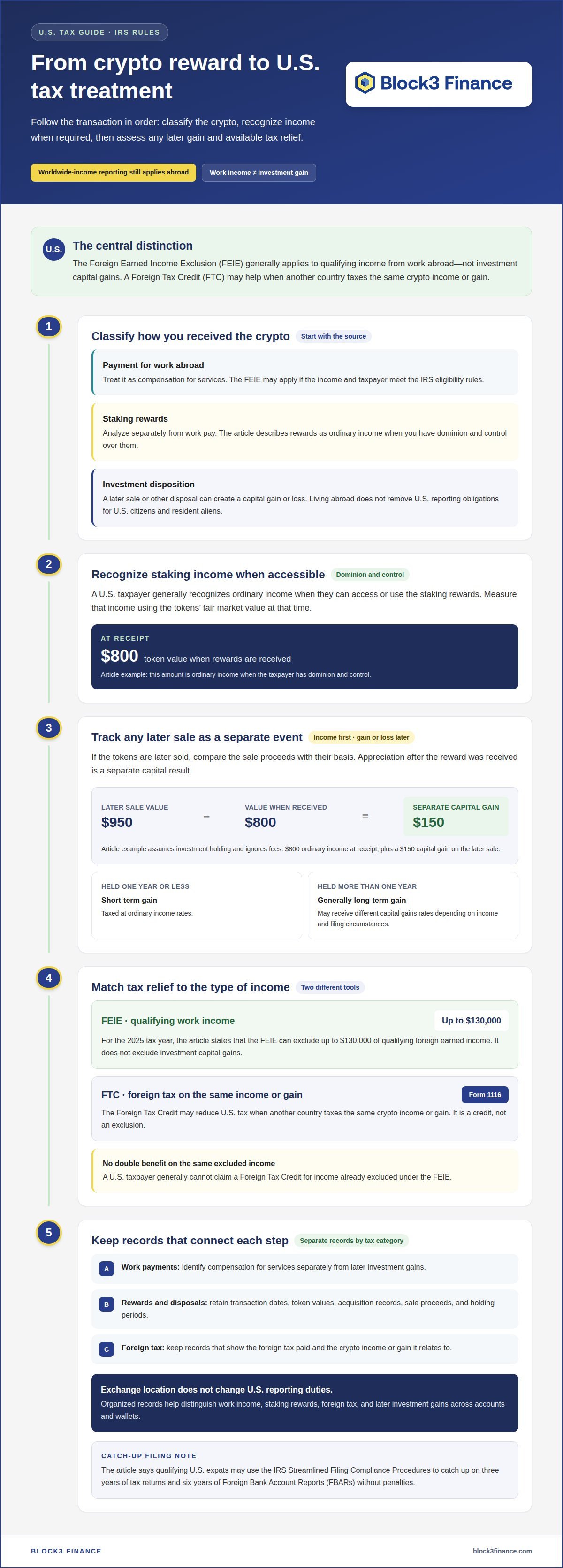
The Foreign Earned Income Exclusion (FEIE) applies to qualifying income from work abroad, not investment capital gains. The Foreign Tax Credit (FTC) may help offset U.S. tax when another country taxes the same crypto income or gain. These provisions apply to different income, so claiming one does not automatically eliminate U.S. tax on every crypto transaction. For U.S. taxpayers, the key distinction is whether crypto came from work, staking, or an investment disposition.
For the 2025 tax year, the Foreign Earned Income Exclusion can exclude up to $130,000 of qualifying crypto pay for work abroad, according to the Internal Revenue Service. The exclusion concerns compensation for services, such as crypto paid to a freelancer for work performed abroad. Eligibility depends on meeting the IRS rules for qualifying foreign earned income. Receiving payment in tokens does not change the need to identify the work income separately from any later investment gain.
Staking rewards require their own analysis. A U.S. taxpayer generally recognizes ordinary income when they have dominion and control over the rewards, that is, when they can access or use them, measured by fair market value at that time. If tokens worth $800 when received are later sold for $950, the taxpayer has $800 of ordinary income and a separate $150 capital gain, assuming investment holding and ignoring fees. The FEIE may apply to qualifying work income, but it does not turn later appreciation into earned income.
The FTC addresses foreign taxation rather than the source of crypto income. A U.S. expat may use Form 1116 to claim a credit against U.S. tax on crypto gains also taxed by the country of residence. The credit can reduce overlapping taxation, but it is not the same as excluding income. A U.S. taxpayer generally cannot claim a Foreign Tax Credit on income already excluded under the FEIE, so the same income cannot receive both benefits.
Eligibility and documentation matter. Keep separate records for work payments, staking rewards, foreign tax paid, and later sales to distinguish income from capital gains. An exchange’s location does not change U.S. reporting requirements. Retain transaction dates, token values, and foreign tax records so you can classify each item and identify which foreign tax relates to it.
Unreported crypto income or foreign accounts can lead to tax, interest, and penalties, depending on the facts and reporting failures. Qualifying U.S. expats may use the IRS Streamlined Filing Compliance Procedures to catch up on three years of tax returns and six years of Foreign Bank Account Reports (FBARs) without penalties.
If foreign tax and crypto transactions span several accounts, discuss your U.S. crypto tax position with a specialist to bring the reporting into focus.
How Is Crypto Taxed for Expats Specifically?
U.S. federal rules apply familiar tax concepts to digital assets, but the result depends on what you do with each asset. For U.S. citizens and resident aliens, living abroad does not remove worldwide-income reporting duties.
Cryptocurrency as Property for Tax Purposes
For U.S. federal tax purposes, the IRS treats cryptocurrency as property, not currency, under its 2014 Notice. That classification means a taxable event can produce a gain or loss when you dispose of crypto, rather than treating every token movement like a foreign-currency payment. Your records need to identify what you acquired, its basis, and what you received when disposing of it.
Buying bitcoin with traditional currency is not itself a taxable event if it is your only virtual-currency activity. A transfer between your own wallets or exchange accounts is not a disposal either. Moving an asset you still own differs from selling, spending, or exchanging it, which can change its tax treatment.
Tax Treatment of Crypto Activities
Crypto activities can fall into different tax categories. Payment for services is generally ordinary income measured at fair market value when received. Staking rewards are also generally ordinary income when you obtain control of the tokens. If you later dispose of them, a separate gain or loss may arise from the change in value since receipt.
Other events require their own classification. An airdrop following a hard fork may be ordinary gross income under Revenue Ruling 2019-24. Selling, exchanging, or spending an asset held as an investment can create a capital gain or loss. Mining may produce business revenue based on the coin’s value, with related acquisition expenses taken into account. Classifying each transaction correctly prevents income and later investment results from being combined.
Overseas Gains and Nonresident Aliens
U.S. citizens and resident aliens generally owe U.S. federal tax on worldwide income, including taxable crypto gains earned or held overseas. An exchange’s location does not change their U.S. reporting requirements, and taxable transactions must be reported regardless of amount. Distinguish activity on foreign platforms from transfers between accounts you own.
Nonresident aliens living outside the United States are not covered by the worldwide-income rule described for citizens and resident aliens. Their U.S. tax treatment depends on the type of income and its connection to the United States, so residence and transaction details matter. For either status, separate records for income, disposals, and wallet transfers help show how each digital asset was treated.
Reporting gains and losses on Form 8949 and Schedule D
U.S. taxpayers generally report each crypto disposal on Form 8949, then report capital gains and losses on Schedule D. A Foreign Tax Credit can reduce U.S. tax on crypto gains also taxed abroad, while tax treaties address overlapping claims under their specific terms. Neither changes the need to report taxable transactions on a U.S. tax return.
Form 8949 records the details behind each disposal. For a crypto sale, trade, or payment, the calculation compares the amount realized with the asset’s adjusted basis. Amount realized is what you received; adjusted basis is generally the asset’s tax cost after adjustments. The difference is your gain or loss. For example, a bitcoin purchase for $4,000 exchanged for ether worth $6,500 creates a $2,500 gain, ignoring fees.
For each disposal, record the asset, acquisition and disposal dates, proceeds, basis, and resulting gain or loss. These details help establish whether a transaction is short-term or long-term. Transfers between wallets you own are not disposals, but selling, exchanging, or spending crypto can be a taxable event. Keep records from every exchange and wallet so you can reconcile transactions with amounts reported.
Schedule D summarizes capital results from Form 8949 and carries them into the capital-gains calculation on the federal tax return. Net gains and losses affect the total reported, rather than each trade being treated as unrelated to the year’s other capital activity. If losses exceed gains, U.S. taxpayers can deduct up to $3,000 of excess capital losses against ordinary income per year, according to the Internal Revenue Service. Remaining losses can carry forward to later U.S. filings.
Living abroad does not exempt U.S. citizens or resident aliens from reporting taxable crypto transactions. The Foreign Earned Income Exclusion on Form 2555 applies to qualifying earned income, not crypto capital gains. A gain from selling investment crypto remains a capital result, even when the taxpayer’s employment income qualifies for exclusion.
For foreign taxes paid on crypto income or gains, eligible U.S. taxpayers report a Foreign Tax Credit on Form 1116. The credit can offset U.S. tax on income also taxed by the country of residence, subject to applicable limits. Income already excluded under the FEIE generally cannot also support a Foreign Tax Credit. A treaty can coordinate taxing rights or relief, but its effect depends on the countries and treaty provisions involved.
Accurate filing depends on matching exchange statements, wallet histories, basis records, and foreign tax documents. Form 8949 supports the transaction-level calculation; Schedule D carries the combined capital result into the return. Keeping those records organized helps distinguish income tax items from capital gains and losses.
Crypto-to-crypto trades and conversions to fiat currency
Under U.S. federal tax rules, exchanging one crypto asset for another can count as a disposal, even when no dollars reach your bank account. Converting crypto to fiat currency, such as U.S. dollars, also disposes of the asset. The key calculation is the amount realized minus adjusted basis, not whether you withdrew the funds or left them on an exchange. This distinction is central to crypto tax for expats: the taxable event is the disposal, not the cash withdrawal.
Consider a bitcoin-for-ether trade. Bitcoin is the asset disposed of, and the ether received establishes the trade’s value. Compare that value with bitcoin’s adjusted basis to calculate a capital gain or loss. A rise in bitcoin’s value can therefore create a taxable gain through a trade, even when the proceeds remain in digital assets.
A fiat conversion follows the same basic logic. If you sell bitcoin for dollars, the proceeds are the amount realized; subtract bitcoin’s adjusted basis to find the gain or loss. Selling for less than your basis can produce a capital loss. Fees or other adjustments may affect the final calculation, so keep transaction details rather than relying only on a platform summary.
For each trading event, preserve enough information to reconstruct what happened:
- The asset surrendered and the asset or currency received.
- The transaction date and the value used to calculate proceeds.
- The surrendered asset’s basis and acquisition records.
- Exchange statements, wallet records, and any transaction fees.
These records are especially important when trading spans multiple exchanges or wallets. The exchange’s country does not change a U.S. taxpayer’s reporting requirements. A transfer between accounts you own is not itself a disposal, while exchanging bitcoin for another token is.
Report taxable disposals on Form 8949, including crypto-to-crypto trades, sales for fiat currency, and crypto used to pay for goods or services. The form captures transaction-level proceeds, basis, and gain or loss; Schedule D summarizes the capital results. Categorizing a trade as a mere transfer can omit a taxable event, while treating every wallet movement as a sale can overstate disposals.
Crypto tax for expats also depends on documenting what left your control and what you received in exchange. A national currency conversion and a token swap both require transaction records, while transfers between accounts you own are not disposals. Get help reconciling crypto trades and fiat conversions when exchange histories and wallet activity do not align.
Block3 Finance
Block3 Finance helps U.S. crypto holders bring transaction records and tax reporting into alignment. When sales, token swaps, staking income, or overseas tax payments make a return difficult to reconcile, its Tax Filing and Reporting and Audits and Compliance services support clear, consistent reporting. Monthly Accounting can help maintain an organized record of crypto activity throughout the year.
Turn to a Crypto Tax Accountant when you need help distinguishing taxable income from capital gains, reconciling activity across wallets and exchanges, or preparing your U.S. filing. Contact Block3 Finance to discuss your crypto tax reporting needs.
Build a Clearer Path for the Next Tax Year
A more deliberate approach to crypto tax for expats starts before filing season. Treat transaction records as part of your ongoing financial process: preserve exchange activity, wallet movements, and the context for each disposal as they occur. Consistent recordkeeping can make it easier to understand your tax position and prepare for future decisions.
Cross-border crypto activity can change as your work, residence, or investment activity shifts. Revisiting your reporting process when circumstances change helps keep your records aligned with your activity. The goal is clarity: a reliable view of your transactions and the information needed to explain them.
If you’re ready to bring greater structure to your U.S. crypto tax process, start a conversation with Block3 Finance. A focused next step can help you move forward with confidence.
Frequently Asked Questions
How Does the IRS Tax Cryptocurrency?
The IRS treats cryptocurrency as property for U.S. federal tax purposes, so the tax result depends on the activity. A sale or exchange can create a capital gain or loss, while payment for services, mining, staking rewards, or some airdrops may create ordinary income. Crypto activity is reported on Form 1040, not on a separate crypto return. The digital-asset question on that form asks about relevant activity during the tax year.
Do I need to file FBAR for crypto on a foreign exchange?
A foreign account holding only virtual currency is not currently reportable on the FBAR under the stated FinCEN position. An exchange account may also hold other financial assets, which can change the reporting analysis. FBAR filing generally concerns foreign financial accounts whose aggregate value exceeds the applicable threshold. Separate from FBAR, Form 8938 is attached to a U.S. tax return and has its own reporting tests for specified foreign financial assets.
Is crypto taxed if I live in a country with no income tax?
Yes. A U.S. citizen or resident alien generally remains subject to U.S. tax on worldwide taxable income and gains while living abroad. If your country of residence does not tax the same crypto income, there may be no foreign tax to claim as a credit against U.S. tax. Keep your U.S. reporting analysis separate from local rules: living in a country with no income tax does not end U.S. filing obligations.
What if you Receive Cryptocurrency as a Gift from someone?
Receiving crypto as a gift from a foreign person can trigger a separate U.S. information-reporting requirement. A U.S. taxpayer who receives cryptocurrency worth more than $100,000 as a gift from a foreign person generally must report it on Form 3520. The gift’s value and the donor’s status matter, so preserve transfer records and information identifying the donor. A later sale or exchange of the gifted tokens is a separate tax event.
What records should you keep?
Keep records linking each token’s acquisition to its later use or disposal. Useful details include dates, quantities, fair market values, transaction IDs, wallet addresses, exchange statements, fees, and the basis assigned to acquired assets. Preserve records of income events too, such as staking distributions or crypto received for work. For overseas activity, retain foreign tax assessments and payment evidence so reported income and any credit claim can be reconciled.
Are Staking Rewards Taxable?
Staking rewards are generally taxable as ordinary income when you obtain dominion and control over the tokens, measured using their fair market value then. For example, if rewards are worth $800 when received and later sold for $950, the receipt creates $800 of ordinary income, while the later sale creates a separate $150 capital gain, assuming investment holding and ignoring fees. U.S. taxpayers generally report staking-reward income on Schedule 1.
How does the U.S. tax cryptocurrency for citizens and green-card holders living abroad?
U.S. citizens and resident aliens, including many green-card holders, generally report worldwide taxable income to the United States while living abroad. Crypto income or gains from foreign exchanges can therefore remain relevant to a U.S. return. An exchange’s foreign location does not change U.S. transaction reporting. Keep account histories and transaction records together so overseas activity can be reported in the correct U.S. tax categories.
How are crypto sales, swaps, spending, mining, staking, and airdrops taxed by the IRS?
Sales, swaps, and spending crypto held as an investment can create capital gains or losses. Mining may produce business revenue based on the coin’s value, with related acquisition expenses considered. Staking rewards generally create ordinary income when controlled. An airdrop of new cryptocurrency following a hard fork is treated as ordinary gross income under Revenue Ruling 2019-24. The transaction’s purpose and the asset’s value at the relevant time determine its reporting treatment.

Article by
Mahad Mohamed
Mahad Mohamed is an accountant and the CEO of Block3 Finance, with over 26+ years of Canadian and international tax and accounting experience. A crypto accounting specialist since the early days of Bitcoin, he has consulted for over 38 crypto companies and collaborated with legal professionals on regulatory matters. His expertise spans corporate reorganization, cross-border tax structuring (Canada & US), tax disputes, and CRA audits.
Previously, Mahad worked for the Canada Revenue Agency (CRA), Big4 accounting firms, and served as a Rulings Officer for the Federal Tax Authority of the UAE before acquiring Tax Partners in 2014.
Block3 Finance and Tax Partners has 44 full-time accountants and over 9,800+ clients.
Disclaimer
This article provides general information only and is current as of its publication date. It has not been updated and may be out of date. It does not constitute legal advice and should not be relied upon as such. Every tax situation is unique and may differ from the examples discussed in this article. If you have specific questions, you should seek the advice of our accountants for your unique circumstances.
Frequently Asked Questions
How Does the IRS Tax Cryptocurrency?
The IRS treats cryptocurrency as property for U.S. federal tax purposes, so the tax result depends on the activity. A sale or exchange can create a capital gain or loss, while payment for services, mining, staking rewards, or some airdrops may create ordinary income. Crypto activity is reported on Form 1040, not on a separate crypto return. The digital-asset question on that form asks about relevant activity during the tax year.
Do I need to file FBAR for crypto on a foreign exchange?
A foreign account holding only virtual currency is not currently reportable on the FBAR under the stated FinCEN position. An exchange account may also hold other financial assets, which can change the reporting analysis. FBAR filing generally concerns foreign financial accounts whose aggregate value exceeds the applicable threshold. Separate from FBAR, Form 8938 is attached to a U.S. tax return and has its own reporting tests for specified foreign financial assets.
Is crypto taxed if I live in a country with no income tax?
Yes. A U.S. citizen or resident alien generally remains subject to U.S. tax on worldwide taxable income and gains while living abroad. If your country of residence does not tax the same crypto income, there may be no foreign tax to claim as a credit against U.S. tax. Keep your U.S. reporting analysis separate from local rules: living in a country with no income tax does not end U.S. filing obligations.
What if you Receive Cryptocurrency as a Gift from someone?
Receiving crypto as a gift from a foreign person can trigger a separate U.S. information-reporting requirement. A U.S. taxpayer who receives cryptocurrency worth more than $100,000 as a gift from a foreign person generally must report it on Form 3520. The gift’s value and the donor’s status matter, so preserve transfer records and information identifying the donor. A later sale or exchange of the gifted tokens is a separate tax event.
What records should you keep?
Keep records linking each token’s acquisition to its later use or disposal. Useful details include dates, quantities, fair market values, transaction IDs, wallet addresses, exchange statements, fees, and the basis assigned to acquired assets. Preserve records of income events too, such as staking distributions or crypto received for work. For overseas activity, retain foreign tax assessments and payment evidence so reported income and any credit claim can be reconciled.
Are Staking Rewards Taxable?
Staking rewards are generally taxable as ordinary income when you obtain dominion and control over the tokens, measured using their fair market value then. For example, if rewards are worth $800 when received and later sold for $950, the receipt creates $800 of ordinary income, while the later sale creates a separate $150 capital gain, assuming investment holding and ignoring fees. U.S. taxpayers generally report staking-reward income on Schedule 1.
How does the U.S. tax cryptocurrency for citizens and green-card holders living abroad?
U.S. citizens and resident aliens, including many green-card holders, generally report worldwide taxable income to the United States while living abroad. Crypto income or gains from foreign exchanges can therefore remain relevant to a U.S. return. An exchange’s foreign location does not change U.S. transaction reporting. Keep account histories and transaction records together so overseas activity can be reported in the correct U.S. tax categories.
How are crypto sales, swaps, spending, mining, staking, and airdrops taxed by the IRS?
Sales, swaps, and spending crypto held as an investment can create capital gains or losses. Mining may produce business revenue based on the coin’s value, with related acquisition expenses considered. Staking rewards generally create ordinary income when controlled. An airdrop of new cryptocurrency following a hard fork is treated as ordinary gross income under Revenue Ruling 2019-24. The transaction’s purpose and the asset’s value at the relevant time determine its reporting treatment.