
Holding period can change the tax treatment of a crypto gain. In the United States, gains on cryptocurrency held for over one year are taxed at preferential rates of 0%, 15%, or 20%, depending on taxable income, according to the Internal Revenue Service; gains on assets held for less than one year are taxed as ordinary income at rates from 10% to 37%. A sound reading of cryptocurrency tax laws by country starts with the jurisdiction, so this guide focuses on U.S. rules.
That distinction matters, but it is only part of the picture. The taxable event, how you received the crypto, and whether it came from services or business activity can also affect your tax obligations. This article explains how U.S. holding periods work, which crypto transactions may trigger tax, what reporting and recordkeeping involve, and how service income and business activity fit in, giving you a clearer framework for managing crypto tax decisions.
Key Takeaways
- Identify whether a crypto transaction is a taxable sale, exchange, or other disposition before calculating its tax impact.
- Use the asset’s holding period to distinguish short-term gains from long-term gains and understand which federal rates may apply.
- Separate tax reporting from broker reporting: Form 1099-DA can provide transaction information, but accurate records remain essential.
- Account for cryptocurrency received for services, mining, or staking as income when applicable, using its value at the relevant time.
- Review business activity separately from personal investing, since the nature of the activity affects how crypto transactions are treated.
What counts as a taxable crypto event under U.S. tax rules?
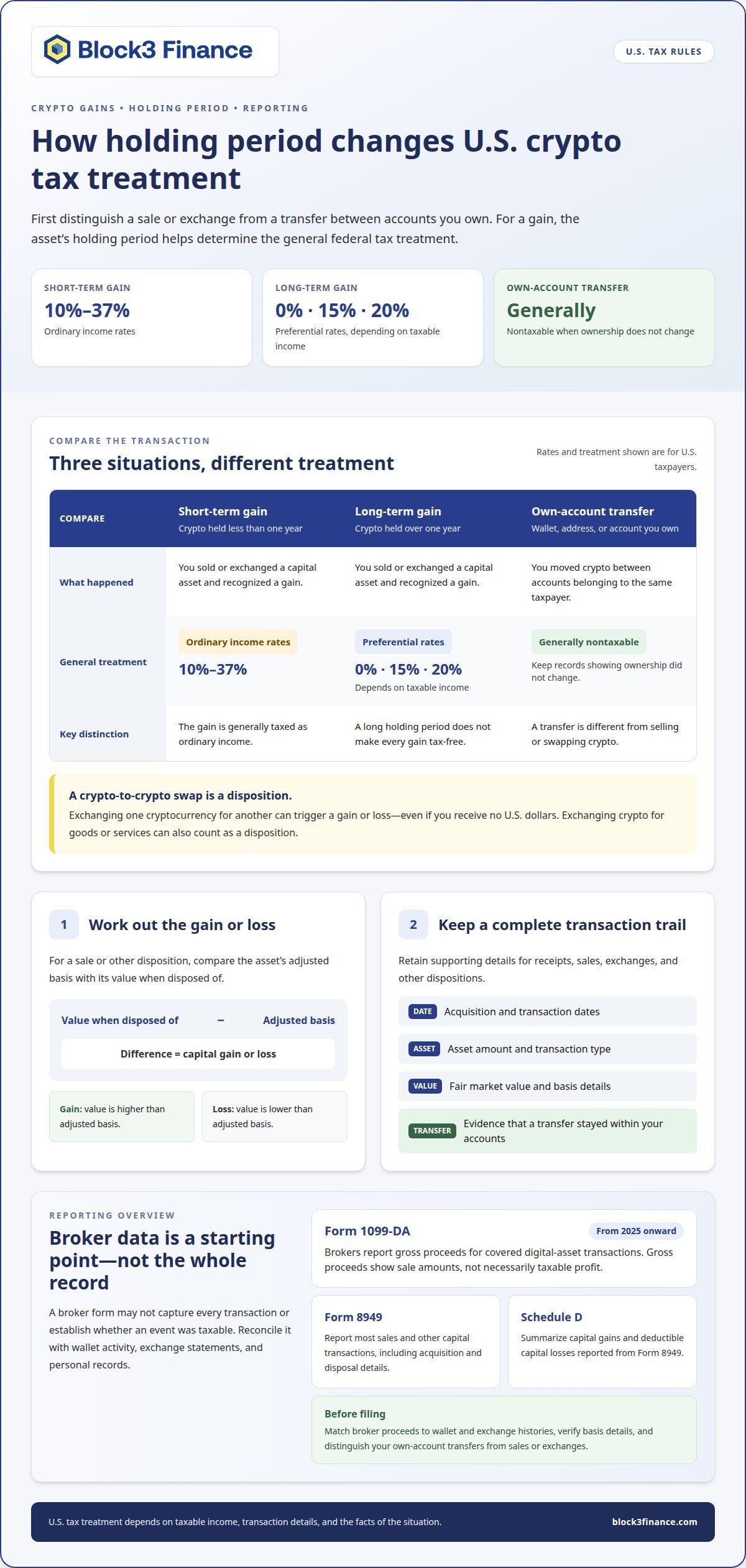
A U.S. taxpayer generally recognizes a capital gain or loss when selling cryptocurrency held as a capital asset. A gain is the difference between the asset’s adjusted basis and its value when disposed of; a loss occurs when the value is lower. Exchanging virtual currency for another cryptocurrency, goods, or services can also count as a disposition.
Holding period affects the tax rate. Gains on cryptocurrency held for over one year are taxed at preferential rates of 0%, 15%, or 20%, depending on taxable income, according to the Internal Revenue Service. Gains on assets held for less than one year are taxed as ordinary income at rates from 10% to 37%. These rates apply to U.S. taxpayers.
A transfer between wallets, addresses, or accounts belonging to the same taxpayer is generally nontaxable under IRS guidance. Keep records showing that ownership did not change. By contrast, swapping one cryptocurrency for another disposes of the first asset, even if you receive no U.S. dollars.
For U.S. residents, nonresidents, and expatriates, tax treatment depends on U.S. tax status and the facts of each transaction. Living abroad alone does not determine how a person’s U.S. crypto activity is treated.
Under U.S. rules, a holding period can qualify a gain for preferential rates, but it does not make every long-term gain tax-free. The applicable rate depends on taxable income and whether the asset was held for over one year.
| U.S. tax situation | Holding period | General treatment |
|---|---|---|
| Short-term gain | Less than one year | Ordinary income rates of 10% to 37% |
| Long-term gain | Over one year | Preferential rates of 0%, 15%, or 20%, depending on taxable income |
| Transfer between your own accounts | Not a disposal | Generally nontaxable |
Choose the row that matches the transaction, then determine the asset’s holding period and applicable U.S. tax treatment. Selling or exchanging crypto is different from moving it between accounts you own.
For official U.S. cryptocurrency tax guidance, consult the Internal Revenue Service’s digital-asset tax materials. Accurate transaction records also support U.S. crypto tax reporting by connecting each disposal to its acquisition date and basis.
Article 5 of El Salvador's Bitcoin Law provides that Bitcoin exchanges are not subject to capital gains tax. In Singapore, cryptocurrency trading income may be taxable when the trading is conducted as a business.
U.S. crypto tax reporting and Form 1099-DA
U.S. taxpayers report taxable digital-asset transactions on their federal returns, even when a broker does not send a tax form. From 2025 onward, brokers must report gross proceeds for covered digital-asset transactions, according to the Internal Revenue Service. Gross proceeds show sale amounts, not necessarily taxable profit. Taxpayers still need records of acquisition costs and other basis details. The phrase cryptocurrency tax laws by country covers different systems, but this section addresses U.S. reporting.
Form 1099-DA provides broker transaction information for U.S. reporting. Treat it as a starting point, then reconcile it against wallet activity, exchange statements, and personal transaction records. A form may not capture every transaction or establish whether an event was taxable. For U.S. taxpayers, cryptocurrency tax laws by country should not distract from the reporting rules that apply to their federal return.
- Form 8949: Report most sales and other capital transactions, including acquisition and disposal details.
- Schedule D: Summarize capital gains and deductible capital losses reported from Form 8949.
- Supporting records: Retain dates, asset amounts, transaction types, and fair market values for receipts, sales, exchanges, and dispositions.
Reconcile records before filing. Match broker proceeds against wallet and exchange histories, then identify transfers between accounts you own so they are not mistaken for sales. Keep evidence supporting each asset’s basis and transaction value. A structured crypto accounting process can organize this information for U.S. tax reporting and help connect transaction records with financial books.
Failing to report taxable cryptocurrency transactions can lead to additional tax assessments, penalties, and interest. Consequences depend on the filing error and circumstances; no single penalty applies to every omission. A missing broker form does not, by itself, remove a taxpayer’s obligation to report taxable activity on a U.S. return.
Accurate reporting requires more than copying figures from a broker form. Form 1099-DA information, Form 8949 entries, Schedule D totals, and wallet records should present a consistent transaction history. Review whether each reported disposal has supporting acquisition details, and whether transfers between your own accounts are distinguished from sales or exchanges.
Income from services paid in cryptocurrency under U.S. tax rules
Under U.S. tax rules, virtual currency received for services is ordinary income. Ordinary income is compensation, not a capital gain from selling an asset. This rule applies whether services are performed as an employee or otherwise. The income amount is the cryptocurrency’s fair market value in U.S. dollars when received.
For example, a contractor paid in bitcoin generally records its U.S. dollar value on the date received. A later sale or exchange of those coins is a separate transaction. Measure any gain or loss against the value recorded when the contractor received them.
Employee wages paid in cryptocurrency have additional payroll treatment. The fair market value is generally included in federal income tax withholding, Social Security and Medicare taxes under FICA, and federal unemployment tax under FUTA. Employers report virtual-currency wages on Form W-2.
For each service payment, keep records connecting the work, receipt, and valuation:
- Record the service performed and the date cryptocurrency was received.
- Document the amount and fair market value in U.S. dollars at receipt.
- Keep the payment record with invoices, payroll information, or other supporting documents.
Mining and staking require careful classification. Record whether bitcoin or another token came from mining, a staking reward, or payment for a service. A service payment falls under the ordinary-income rule above; do not automatically treat every reward as employee wages. The activity and arrangement matter when determining how to report the receipt.
Keep mining and staking records separate from later sales. Track receipt dates, token amounts, and U.S. dollar values so each entry has a clear basis for tax reporting. If you later sell or exchange those assets, calculate that disposition separately from the income recognized at receipt. This distinction keeps income reporting separate from capital gains reporting.
For U.S. taxpayers, the practical sequence is straightforward: identify why the cryptocurrency was received, value it when received, then record any later disposal as a separate event. This distinguishes service income from mining or staking activity without treating every crypto receipt as the same kind of income.
Business and corporate crypto taxation in the United States
For a U.S. business, classify each crypto transaction by its purpose and role in operations. A customer payment, employee compensation, treasury holding, and asset sale are different events. The token’s name alone does not determine its tax treatment. Record the business purpose, transaction date, asset amount, and U.S. dollar value for each entry.
The Internal Revenue Service says its virtual-currency FAQs generally apply to taxpayers holding crypto as a capital asset, except where otherwise noted. A business cannot automatically treat every token as a capital asset. The business activity and transaction purpose matter. For example, payment received for services is ordinary income, while a later disposal may create a separate gain or loss.
Separate business receipts from later transactions. If a company receives crypto for work, record the receipt and its fair market value in U.S. dollars when received. If the company later sells or exchanges those units, track that disposal separately. This preserves the distinction between recognizing income and recording the result of a later transaction.
- Customer receipts: Document the invoice, payment date, token quantity, and dollar value.
- Employee compensation: Keep payroll records with the relevant payment and valuation details.
- Treasury holdings: Track acquisitions, transfers, and any later sale or exchange as distinct events.
- Trading activity: Preserve transaction histories that connect each disposal to the relevant asset records.
These steps support consistent books, but they do not make a transaction tax-exempt. In the ledger, distinguish a transfer between company-owned wallets from a payment to another party. Likewise, do not record an exchange of one token for another as a simple wallet movement.
Entity structure also matters to the company’s reporting framework. A corporation and a pass-through business can have different filing considerations, so connect the entity’s legal structure with its accounting records. Corporate structuring considerations are relevant when organizing ownership, operations, and financial reporting for digital-asset activity.
A disciplined review follows each transaction from source to tax record: identify the business purpose, determine whether the entry is income or a disposition, preserve valuation evidence, and reconcile it to the books. This helps U.S. businesses distinguish operating receipts from trading activity without assuming every crypto transaction receives identical treatment.
Are crypto-to-crypto trades taxable under U.S. tax rules?
Generally, a U.S. taxpayer who exchanges virtual currency held as a capital asset for another virtual currency recognizes a capital gain or loss. Trading one token for another is a disposition, even when no dollars reach the taxpayer’s bank account. The calculation compares the disposed asset’s adjusted basis with the fair market value of what the taxpayer receives.
For example, exchanging one cryptocurrency for another requires records for both sides of the trade. The value received helps establish the proceeds from disposing of the first asset. Its basis determines whether the exchange produced a gain or loss. The acquired asset then has its own basis for a later sale or exchange.
Do not confuse a trade with a transfer between wallets you own. Under IRS guidance, moving virtual currency between wallets, addresses, or accounts belonging to the same taxpayer is nontaxable. Record the movement clearly so it is not mistaken for a disposal. A transfer to another person or a platform trade is different and needs its own transaction record.
For each exchange, keep information that supports the return:
- The date and time of the trade, plus the units of each asset involved.
- The fair market value in U.S. dollars when the exchange occurred.
- The disposed units’ acquisition dates and adjusted basis.
- Transaction records linking the exchange to relevant wallets or platforms.
Unit selection can affect the calculated result. If a U.S. taxpayer can specifically identify the virtual currency units disposed of and substantiate their basis, they may choose which units count as sold. Without specific identification, first-in, first-out ordering applies. The holding period for received cryptocurrency begins the day after receipt, so acquisition and disposal dates matter.
Reconcile platform histories with wallet records before preparing Form 8949. Match each disposal to its basis and dollar value, then carry the reported capital transactions into the return’s applicable summary. This process helps prevent an exchange from disappearing simply because it stayed within crypto markets.
The key distinction is whether ownership continues. A move between accounts belonging to the same taxpayer is a transfer; a swap that disposes of one asset for another is generally a taxable event for U.S. taxpayers holding virtual currency as a capital asset. Keep these categories separate in your transaction ledger.
Block3 Finance
Block3 Finance helps U.S. crypto users bring transaction records, accounting, and tax reporting into a coherent process. When holding periods, exchanges, service income, and business activity overlap, organized records make each event easier to classify and trace. The aim is practical clarity: connect digital-asset activity with the financial records used to prepare and support tax filings.
A crypto tax accountant can help when exchange statements, wallet activity, and income records need to be reconciled for a return. Tax Filing and Reporting can address the preparation and reporting side, while Audits and Compliance support documentation and review. The right work depends on the records and activities involved, such as token disposals, service payments, or business transactions.
For companies, the challenge often extends beyond tax season. Monthly Accounting keeps digital-asset activity connected to regular financial records, rather than leaving transactions to be reconstructed only at filing time. Ongoing records can help distinguish customer receipts, operating payments, treasury movements, and later sales or exchanges.
Block3 Finance’s work can bring together several related needs:
- Tax Filing and Reporting: Organize transaction information for tax preparation and reporting.
- Monthly Accounting: Maintain accounting records that include crypto-related activity.
- Audits and Compliance: Support documentation and review of financial records.
- Crypto tax accounting: Help classify transactions and connect them to reporting records.
This support is especially relevant when a U.S. taxpayer has activity across multiple wallets or platforms, receives crypto for services, or runs a business that uses digital assets. Clear records show how each transaction fits into the broader financial picture and provide a more structured basis for tax preparation and compliance.
Block3 Finance can help align transaction records with accounting and tax reporting needs, whether the activity involves personal holdings or business operations. That makes the next step a focused review of the records and the reporting questions they raise, rather than treating every crypto transaction as interchangeable.
Contact Block3 Finance to discuss support for your crypto tax and accounting needs.
Frequently Asked Questions
Does the holding period matter?
Yes. Under U.S. rules, the holding period affects whether a gain is short-term or long-term and which federal tax rates may apply. Keep purchase or receipt dates for each group of units, especially when acquiring the same token at different times. For inherited or gifted assets, additional basis and holding-period rules may affect the calculation, so keep transfer details with your transaction records.
How are cryptocurrency transactions taxed in the United States?
U.S. tax treatment depends on the transaction and how the cryptocurrency was received. Selling, exchanging, or spending virtual currency held as a capital asset can produce a capital gain or loss. Receiving crypto for services is generally ordinary income. A transfer between accounts owned by the same taxpayer differs from disposing of an asset, so label wallet movements clearly in your transaction records.
How do countries classify cryptocurrency for tax purposes?
This article addresses U.S. rules only. For U.S. taxpayers, a key distinction is often whether crypto is held as a capital asset or received as income. A purchase for investment and a payment for work can therefore have different tax treatment. Identify the reason for each receipt and transaction, then keep records supporting how the activity is reported on the federal return.
What are the capital gains tax rates on crypto in major countries?
This answer covers U.S. federal rates. Long-term cryptocurrency gains on assets held for over one year are taxed at 0%, 15%, or 20%, depending on taxable income. Short-term gains on assets held for less than one year are taxed as ordinary income at rates from 10% to 37%. High earners may also owe a 3.8% Net Investment Income Tax on cryptocurrency gains.
How are crypto mining, staking, and airdrops taxed by country?
For U.S. taxpayers, document mining, staking, and airdrop activity by receipt date, token amount, and fair market value. New cryptocurrency received through an airdrop following a hard fork is taxable income in the year received. Keep records showing how tokens were earned and when control became available. Track later sales or exchanges separately from the original receipt.
What crypto tax reporting and filing requirements apply by country?
For U.S. filers, crypto activity is reported on Form 1040, not on a separate crypto return. Most sales and other capital transactions are reported on Form 8949, with totals summarized on Schedule D. Keep transaction records that support the figures entered, including activity not shown on broker forms. For covered digital-asset transactions, U.S. brokers report gross proceeds from 2025 onward.
How do countries tax crypto income earned by businesses and traders?
For U.S. businesses and traders, tax treatment depends on the nature and purpose of each activity. A business should distinguish customer payments, compensation, asset disposals, and transfers in its books. Crypto received for services is generally ordinary income, while a later sale or exchange is recorded separately. Connecting transaction records with invoices and accounting entries helps support the business’s federal reporting.
Which countries have crypto tax exemptions or tax-free holding periods?
Germany and Switzerland exempt qualifying crypto held for more than one year from capital gains tax. Portugal may exclude qualifying gains after 365 days, Czechia may exempt qualifying disposals after a three-year holding period, and Malta does not tax individuals’ crypto held as a long-term investment.

Article by
Mahad Mohamed
Mahad Mohamed is an accountant and the CEO of Block3 Finance, with over 26+ years of Canadian and international tax and accounting experience. A crypto accounting specialist since the early days of Bitcoin, he has consulted for over 38 crypto companies and collaborated with legal professionals on regulatory matters. His expertise spans corporate reorganization, cross-border tax structuring (Canada & US), tax disputes, and CRA audits.
Previously, Mahad worked for the Canada Revenue Agency (CRA), Big4 accounting firms, and served as a Rulings Officer for the Federal Tax Authority of the UAE before acquiring Tax Partners in 2014.
Block3 Finance and Tax Partners has 44 full-time accountants and over 9,800+ clients.
Disclaimer
This article provides general information only and is current as of its publication date. It has not been updated and may be out of date. It does not constitute legal advice and should not be relied upon as such. Every tax situation is unique and may differ from the examples discussed in this article. If you have specific questions, you should seek the advice of our accountants for your unique circumstances.
Frequently Asked Questions
Does the holding period matter?
Yes. Under U.S. rules, the holding period affects whether a gain is short-term or long-term and which federal tax rates may apply. Keep purchase or receipt dates for each group of units, especially when acquiring the same token at different times. For inherited or gifted assets, additional basis and holding-period rules may affect the calculation, so keep transfer details with your transaction records.
How are cryptocurrency transactions taxed in the United States?
U.S. tax treatment depends on the transaction and how the cryptocurrency was received. Selling, exchanging, or spending virtual currency held as a capital asset can produce a capital gain or loss. Receiving crypto for services is generally ordinary income. A transfer between accounts owned by the same taxpayer differs from disposing of an asset, so label wallet movements clearly in your transaction records.
How do countries classify cryptocurrency for tax purposes?
This article addresses U.S. rules only. For U.S. taxpayers, a key distinction is often whether crypto is held as a capital asset or received as income. A purchase for investment and a payment for work can therefore have different tax treatment. Identify the reason for each receipt and transaction, then keep records supporting how the activity is reported on the federal return.
What are the capital gains tax rates on crypto in major countries?
This answer covers U.S. federal rates. Long-term cryptocurrency gains on assets held for over one year are taxed at 0%, 15%, or 20%, depending on taxable income. Short-term gains on assets held for less than one year are taxed as ordinary income at rates from 10% to 37%. High earners may also owe a 3.8% Net Investment Income Tax on cryptocurrency gains.
How are crypto mining, staking, and airdrops taxed by country?
For U.S. taxpayers, document mining, staking, and airdrop activity by receipt date, token amount, and fair market value. New cryptocurrency received through an airdrop following a hard fork is taxable income in the year received. Keep records showing how tokens were earned and when control became available. Track later sales or exchanges separately from the original receipt.
What crypto tax reporting and filing requirements apply by country?
For U.S. filers, crypto activity is reported on Form 1040, not on a separate crypto return. Most sales and other capital transactions are reported on Form 8949, with totals summarized on Schedule D. Keep transaction records that support the figures entered, including activity not shown on broker forms. For covered digital-asset transactions, U.S. brokers report gross proceeds from 2025 onward.
How do countries tax crypto income earned by businesses and traders?
For U.S. businesses and traders, tax treatment depends on the nature and purpose of each activity. A business should distinguish customer payments, compensation, asset disposals, and transfers in its books. Crypto received for services is generally ordinary income, while a later sale or exchange is recorded separately. Connecting transaction records with invoices and accounting entries helps support the business’s federal reporting.
Which countries have crypto tax exemptions or tax-free holding periods?
Germany and Switzerland exempt qualifying crypto held for more than one year from capital gains tax. Portugal may exclude qualifying gains after 365 days, Czechia may exempt qualifying disposals after a three-year holding period, and Malta does not tax individuals’ crypto held as a long-term investment.