
For U.S. businesses, a defensible DeFi fair value depends on the evidence behind the figure, not just the latest token price. DeFi accounting challenges are easier to manage when valuation inputs are classified by observability and the method is documented for each position.
A publicly traded token may seem straightforward to value, but liquidity, protocol mechanics, and incomplete records can complicate the process, especially when positions involve pooled assets or changing rewards. This article explains how U.S. businesses can measure digital asset fair value and address transaction records, liquidity pools, financial instruments, governance tokens, and airdrops. It also explains why documenting valuation inputs and accounting treatment matters as DeFi positions change.
Key Takeaways
- Build a valuation approach around observable evidence, and document how you assess positions when market inputs are less visible.
- Reconstruct transaction histories across protocols and chains so income recognition and cost basis decisions have a reliable record.
- Account for liquidity pool deposits, fees, rebalancing, and changing market conditions as distinct parts of a position’s value.
- Assess DeFi lending, bridge activity, governance tokens, and airdrops according to their terms and the rights or rewards involved.
- Use consistent monthly accounting to bring complex on-chain activity into a clearer financial reporting process.
What methodologies should be used for fair value measurement of digital assets?
The main DeFi accounting challenges are valuation evidence, incomplete records, and identifying what each position represents. For U.S. reporting, classify valuation inputs by observability and document how each digital asset and its collateral are measured.
Fair Value of Digital Assets and Collateral
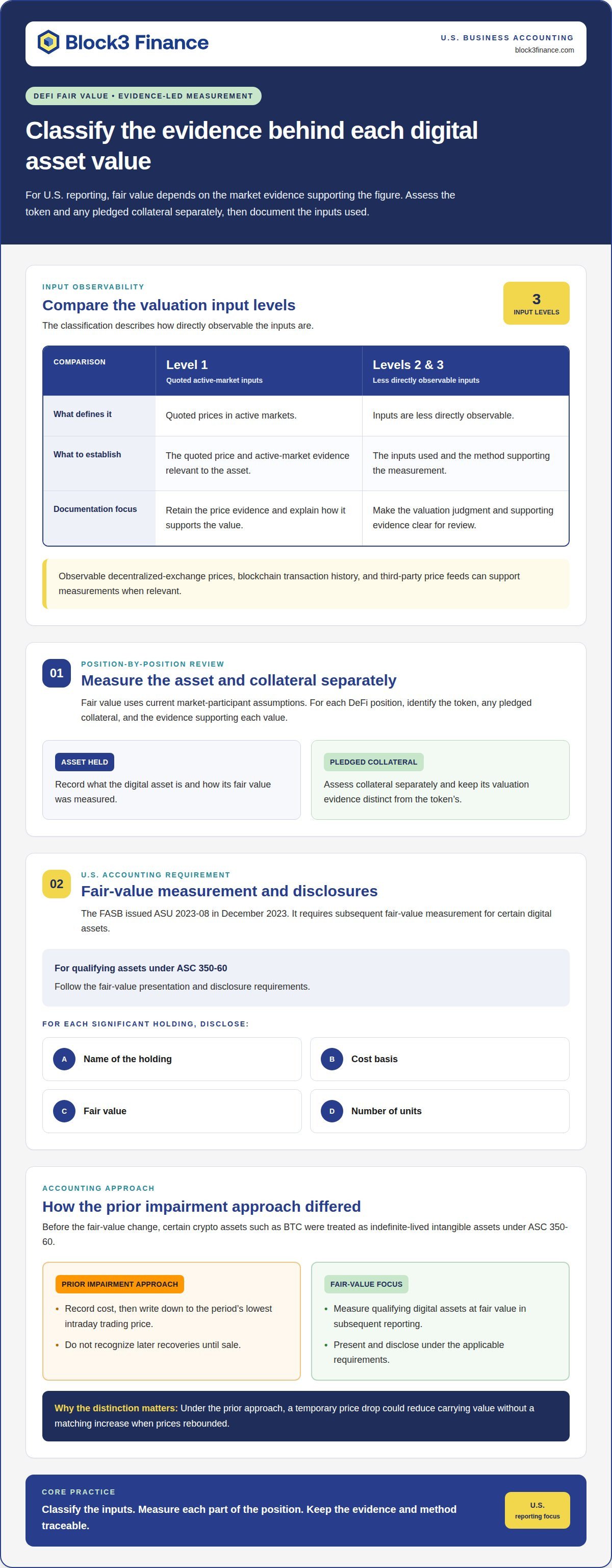
Fair value is the measurement of an asset or liability using current market-participant assumptions. For a DeFi position, assess the token and any pledged collateral separately, then identify the evidence supporting each value. Level 1 inputs use quoted prices in active markets; Levels 2 and 3 reflect less directly observable inputs. This classification helps explain valuation judgments in financial reporting.
The FASB issued ASU 2023-08 in December 2023, requiring subsequent fair-value measurement for certain digital assets. Qualifying assets under ASC 350-60 follow its fair-value presentation and disclosure requirements. For each significant holding, disclosures include its name, cost basis, fair value, and number of units. Observable decentralized-exchange prices, blockchain transaction history, and third-party price feeds can support measurements when relevant.
Before the fair-value change, certain crypto assets such as BTC were treated as indefinite-lived intangible assets under ASC 350-60. Under the prior impairment approach, an entity recorded cost and wrote the asset down to the period’s lowest intraday trading price. Later recoveries weren’t recognized until sale. That asymmetry made impairment timing important: a temporary price drop could lower carrying value without a corresponding increase when prices rebounded.
Wrapped and Synthetic Asset Conversions
A wrapped asset represents another token on a different blockchain, while a synthetic asset tracks an underlying asset’s value through protocol terms. A conversion can change the rights, risks, or asset held, so record the tokens surrendered and received, the transaction evidence, and the valuation inputs at conversion. For example, moving BTC into a wrapped token requires documenting both sides, rather than treating the new ticker as self-explanatory.
Industry terms can obscure the accounting substance. “Collateral” describes assets pledged to support an obligation; “rewards” may refer to tokens earned through protocol activity. “Platforms” may use smart contracts to execute transactions, but code execution alone doesn’t establish how a position should be reported. A structured digital asset accounting process can connect wallet records, pricing evidence, and asset classifications for review.
Incomplete transaction data and cost basis reconstruction
For U.S. businesses and taxpayers, DeFi records can be scattered across wallets, blockchains, and protocol interfaces. Cost basis is the recorded value used to measure gain or loss when an asset is later disposed of. Reconstructing it means linking each acquisition to later transfers, swaps, and disposals. A useful record includes the wallet address, transaction hash, date, token quantity, and value. For example, one wallet may show an Ethereum swap while another records the later transfer.
Start reconciliation with on-chain histories, wallet exports, and protocol records. Separate transfers between wallets under common control from exchanges with another party. Record the assets sent and received, then match each event to its supporting transaction data. For cross-chain activity, connect the source-chain event to the related bridge or destination-chain transaction. If records show an outgoing transfer without a matching receipt, investigate the path before treating it as a disposal or loss.
For U.S. tax purposes, swapping one digital asset for another can create a realization event. IRS Notice 2014-21 describes exchanges of virtual currency for other property as transactions that may produce gain or loss. Record both assets, their values at the transaction, and the supporting evidence. For personal investments, gas fees typically adjust cost basis rather than being directly deductible. Business or professional DeFi gas fees may be deductible as business expenses. IRS Form 8949 is relevant to reporting U.S. transactions.
For U.S. financial reporting, businesses need a consistent policy for classifying DeFi income. ASC 606 may be relevant when assessing revenue from contracts with customers, while lending returns require analysis of their terms and economic substance. Record when income is earned and measurable under the applicable policy. Treat liquidity pool rewards, staking rewards, and lending returns as distinct sources, documenting the protocol terms and event that generated each amount. For organizations seeking specialized business accounting, tax planning, or fractional CFO support to establish these frameworks, tnconsultants.net offers comprehensive advisory services.
Smart-contract algorithms can execute activity without generating complete accounting records. A governance proposal may change reward calculations or contract logic, so retain the relevant proposal and transaction history. Reconcile contract events with token movements and investigate missing prices, unmatched transfers, or unexpected balances. This review helps distinguish earned income from a change in liquidity or exposure and provides a traceable basis for each entry in U.S. reporting.
Liquidity pool deposits, fees, rebalancing, and impermanent loss
For U.S. businesses, pool accounting should distinguish token movements, earned fees, and changes in position value. DeFi accounting challenges arise when these events happen together.
Pool Deposits, Rebalancing, and Impermanent Loss
A liquidity pool deposit adds assets to shared reserves in exchange for a claim on the pool. Automated market makers adjust token balances as trades occur, so a withdrawal may return different quantities from the deposit. Impermanent loss describes the difference between a pool position’s value and the value of holding the deposited assets separately. For U.S. financial reporting, track quantities and values at deposit and withdrawal.
Valuation evidence should reflect both market conditions and the pool’s available liquidity. A quoted price may not represent an executable value when trading depth is limited or volatility is high. Consider whether trading on a small number of exchanges makes the price representative of the broader market. These DeFi accounting challenges are easier to review when the reporting-date analysis records its key inputs.
- Record the pool position and underlying token quantities.
- Separate fees and rewards from contributed principal.
- Document liquidity and price evidence used for reporting.
For example, if one exchange accounts for most trading activity in a pool token, its quoted price may not reflect wider market conditions. U.S. businesses should retain the rationale and evidence for their chosen valuation inputs.
Pool Fees, Staking, and Gain Realization
Pool fees compensate providers for facilitating swaps, while staking commits tokens under protocol terms. Automated market-maker fees may range from a few basis points to several percentage points. Record fees and staking rewards separately from principal. When assets are withdrawn or exchanged, compare the transaction value with the recorded basis to assess whether the event realizes a gain or loss.
Stablecoin pools can face liquidity mismatches if holders cannot readily convert a token during market stress. A stablecoin run occurred in June 2021, illustrating why reported balances and exit liquidity may differ. If users withdraw one asset rapidly, the remaining pool can become concentrated in another. That change can affect valuation and access to funds.
A large withdrawal may exceed a pool’s available liquidity and affect the price received. Document the pool share, asset quantities, accrued fees, and withdrawal terms. Reconcile blockchain activity with protocol records before closing the U.S. reporting period.
Classification and recognition of DeFi financial instruments
Classify each DeFi position according to its contractual rights, economic substance, and transaction evidence. In the United States, accounting treatment depends on what the asset or obligation represents.
Cross-Chain Bridge Transaction Classification
A bridge transaction moves tokens between blockchains, often by locking one token and issuing a corresponding token elsewhere. Its accounting depends on the rights received, not just matching token symbols. For example, record the source-chain transfer, destination-chain receipt, fees, and any outstanding claim separately. This helps distinguish a wallet transfer from an exchange or a change in the asset held.
US Accounting Standards for DeFi Transactions
U.S. businesses apply relevant U.S. GAAP, including FASB guidance for qualifying digital assets, rather than one standard covering every DeFi activity. ASU 2023-08, issued in December 2023, requires subsequent fair-value measurement for certain digital assets. Other positions require analysis of their terms and substance. The applicable treatment may differ for crypto holdings, lending arrangements, and obligations created through smart contracts.
Accounting for Cryptocurrency Held in DeFi Protocols
Businesses account for cryptocurrency held through a protocol by identifying the assets, rights, restrictions, and risks they retain. Start with the transaction record, then determine whether the business still controls the original token or holds a different claim. A protocol deposit, for example, may produce a receipt token or another contractual right. Record the position according to its substance, and document related collateral, rewards, and valuation inputs.
Recording DeFi Lending and Borrowing
Under GAAP, account for DeFi lending and borrowing by analyzing smart-contract terms, assets transferred, repayment rights, and risks. For a loan, track principal, collateral, and interest income as the contract generates cash flows. For borrowing, record the obligation and assets received, then assess repayment terms and collateral exposure. Review recoverability as credit quality and market conditions change, and recognize impairment when necessary.
DAO classification also affects financial reporting. In Samuels v. Lido DAO, decided November 18, 2024, a federal court applying California law suggested in dicta that a DAO could be treated as a partnership. Sarcuni v. bZx DAO, 664 F. Supp. 3d 1100 (2023), also raised that possibility. These cases make governance, member activity, and organizational structure highly relevant to financial reporting and asset classification at firms like Block3 Finance. The U.S. check-the-box regulations provide a default classification under which most unwrapped DAOs would likely receive partnership treatment (Treas. Reg. § 301.7701-3(b)(1)(i), (2)(i)).
Governance token and airdrop distributions
Governance tokens give holders voting rights on proposals in decentralized organizations. A token may let its holder vote on protocol changes, treasury use, or reward terms. Record the tokens received, distribution date, and any conditions on their use. For example, a proposal can change how a protocol allocates rewards, affecting the rights represented by tokens already held.
An airdrop distributes tokens to eligible wallet addresses, often through smart contracts. Eligibility may depend on prior activity, such as using a lending protocol or voting on proposals. Accounting should distinguish tokens that have merely been announced from tokens the organization can access or control. Retain the distribution transaction and the terms that establish when the recipient can claim or transfer the assets.
At recognition, document the number of tokens received and their supportable value on the relevant date. Review trading activity, market access, transfer restrictions, and claim conditions. A token with limited liquidity may require different valuation evidence from one that trades actively. Separating governance rights from economic rights also helps explain whether a token primarily supports voting, provides rewards, or has another contractual feature.
A DeFi lending platform distributed rewards worth $90 million after an update introduced an error in October 2021. The event shows why contract changes and reward calculations need review alongside wallet balances. A control process can compare the announced distribution, contract logic, and actual token transfers. If those records differ, investigate the variance before recording the amount as earned income or a confirmed asset.
For U.S. tax reporting, IRS Revenue Ruling 2023-14 addresses interest-like rewards from DeFi protocols as ordinary income. That treatment concerns those rewards, not every governance token or airdrop. Keep reward distributions distinct from tokens received for voting or other activity. The classification depends on the transaction’s facts and terms, so record the protocol, distribution reason, receipt date, and valuation evidence.
Price changes after receipt can create accounting movements or later disposal outcomes, depending on the applicable reporting framework. Keep separate records for initial recognition, subsequent valuation, and any token sale or exchange. For each airdrop, retain the smart-contract event, wallet address, token quantity, and claim restrictions. This evidence helps explain reported income, asset balances, and losses if governance tokens decline in value.
Block3 Finance: Monthly Accounting
Block3 Finance’s Monthly Accounting is a practical next step when DeFi activity has outgrown ad hoc spreadsheets. Recurring accounting helps bring wallet movements, protocol positions, and exchange activity into an organized reporting process. This is useful for businesses managing token swaps, lending, liquidity pools, or governance rewards, where activity across multiple platforms can make balances difficult to interpret. Consistent records also give management a clearer view of assets, obligations, and period-to-period changes.
Organize transaction records around the business’s reporting needs. This includes distinguishing transfers from exchanges, recording income and expenses, and supporting digital asset balances. For example, a pool deposit, a reward distribution, and a later withdrawal are distinct events that should not be collapsed into one unexplained balance. Clear classifications connect blockchain activity with financial statements and make review more structured.
Tax Filing and Reporting can help when business transactions, rewards, or disposals need to be reflected in tax filings. Tax treatment depends on the activity and applicable jurisdiction, so accounting records should retain transaction dates, asset quantities, and supporting values. Professional digital asset tax reporting support can assist when records span wallets, protocols, and exchanges. This is particularly useful when reconstructed activity must align with the business’s accounting records.
Audits and Compliance can support organizations that need their digital-asset records examined against reporting requirements and internal controls. A review may focus on how balances are supported, how transactions are classified, and whether accounting policies are applied consistently. For a DAO or Web3 business, documented procedures can also help explain how governance-related activity enters the books. These services address accounting and compliance needs, not investment decisions or legal disputes.
Monthly accounting is most useful when DeFi transactions recur and financial records need ongoing attention, rather than a one-time year-end reconstruction. It can provide a steady structure for tracking changes in holdings, recording protocol activity, and preparing information for reporting and review. The next step is to discuss how your organization’s DeFi activity fits its accounting and reporting needs. Contact Block3 Finance to discuss your requirements.
Frequently Asked Questions
What’s the issue?
DeFi activity creates accounting questions because transactions can change an asset’s form, location, or rights without a conventional intermediary. A single protocol interaction may combine a token transfer, collateral lockup, reward, and new claim. For example, a wallet balance alone may not show whether assets remain available, have been lent, or support a protocol position. The challenge is to build complete records and apply consistent classifications.
How should liquidity pool deposits and withdrawals be accounted for?
Record a deposit as an asset transfer into a pool and identify any pool-share token or other claim received. On withdrawal, record the assets returned and compare them with the position’s carrying amount. For example, a pool may return different token quantities from those originally deposited. Keep accrued fees separate from principal and document the transaction terms so the ledger distinguishes a withdrawal from income or a token exchange.
How are staking rewards, yield farming income, and protocol incentives recognized?
Recognize each reward under the applicable accounting policy and when the recipient has earned and can access it. A locked reward that cannot yet be claimed may require different analysis from tokens already available in a wallet. Record the protocol, reward type, units received, and relevant date. Keep incentives separate from a return of deposited principal, then track later transfers or disposals independently.
How should wrapped tokens, bridges, and cross-chain transfers be tracked for accounting?
Link each side of a movement, including the originating wallet, source-chain transaction, bridge event, destination address, and token received. For example, match a token locked on one chain with the corresponding wrapped token received on another. Record fees separately and investigate unmatched or delayed transfers. This helps determine whether the event moved an existing holding or created a different asset or claim.
How should impermanent loss and smart contract losses be accounted for?
Distinguish market-driven changes in a pool position from losses caused by contract failure, theft, or an unrecoverable claim. Impermanent loss describes the difference between a pool position’s value and the value of simply holding its deposited tokens; it does not by itself establish a realized loss. For a smart-contract incident, document the affected assets, remaining recovery rights, and available evidence. Apply the relevant accounting policy to assess impairment or loss recognition.
What tax reporting rules apply to DeFi income and transactions in the United States?
For U.S. taxpayers, digital currency transactions may create taxable income or realized gains, depending on what occurred. IRS Revenue Ruling 2023-14 addresses when cryptocurrency staking rewards are included in gross income: when the taxpayer has control over them and can sell, exchange, or otherwise dispose of them. U.S. crypto transactions are reported on applicable tax forms, which may include Form 1040 and supporting schedules or forms; there is no separate crypto tax return. Keep transaction records that support reported income, asset transfers, and disposals, since protocol labels alone may not explain their tax treatment.
What tools and controls help reconcile DeFi wallets and on-chain transactions?
Use a transaction ledger that links wallet addresses, chain data, protocol records, and accounting entries. Reconciliation controls can flag duplicate transaction hashes, unexplained balance changes, missing token prices, and transfers without a matching destination event. Assign responsibility for reviewing exceptions and retain evidence showing how each was resolved. For example, keep a bridge transfer marked pending separate from a completed receipt until the records support the match.

Article by
Mahad Mohamed
Mahad Mohamed is an accountant and the CEO of Block3 Finance, with over 26+ years of Canadian and international tax and accounting experience. A crypto accounting specialist since the early days of Bitcoin, he has consulted for over 38 crypto companies and collaborated with legal professionals on regulatory matters. His expertise spans corporate reorganization, cross-border tax structuring (Canada & US), tax disputes, and CRA audits.
Previously, Mahad worked for the Canada Revenue Agency (CRA), Big4 accounting firms, and served as a Rulings Officer for the Federal Tax Authority of the UAE before acquiring Tax Partners in 2014.
Block3 Finance and Tax Partners has 44 full-time accountants and over 9,800+ clients.
Disclaimer
This article provides general information only and is current as of its publication date. It has not been updated and may be out of date. It does not constitute legal advice and should not be relied upon as such. Every tax situation is unique and may differ from the examples discussed in this article. If you have specific questions, you should seek the advice of our accountants for your unique circumstances.
Frequently Asked Questions
What’s the issue?
DeFi activity creates accounting questions because transactions can change an asset’s form, location, or rights without a conventional intermediary. A single protocol interaction may combine a token transfer, collateral lockup, reward, and new claim. For example, a wallet balance alone may not show whether assets remain available, have been lent, or support a protocol position. The challenge is to build complete records and apply consistent classifications.
How should liquidity pool deposits and withdrawals be accounted for?
Record a deposit as an asset transfer into a pool and identify any pool-share token or other claim received. On withdrawal, record the assets returned and compare them with the position’s carrying amount. For example, a pool may return different token quantities from those originally deposited. Keep accrued fees separate from principal and document the transaction terms so the ledger distinguishes a withdrawal from income or a token exchange.
How are staking rewards, yield farming income, and protocol incentives recognized?
Recognize each reward under the applicable accounting policy and when the recipient has earned and can access it. A locked reward that cannot yet be claimed may require different analysis from tokens already available in a wallet. Record the protocol, reward type, units received, and relevant date. Keep incentives separate from a return of deposited principal, then track later transfers or disposals independently.
How should wrapped tokens, bridges, and cross-chain transfers be tracked for accounting?
Link each side of a movement, including the originating wallet, source-chain transaction, bridge event, destination address, and token received. For example, match a token locked on one chain with the corresponding wrapped token received on another. Record fees separately and investigate unmatched or delayed transfers. This helps determine whether the event moved an existing holding or created a different asset or claim.
How should impermanent loss and smart contract losses be accounted for?
Distinguish market-driven changes in a pool position from losses caused by contract failure, theft, or an unrecoverable claim. Impermanent loss describes the difference between a pool position’s value and the value of simply holding its deposited tokens; it does not by itself establish a realized loss. For a smart-contract incident, document the affected assets, remaining recovery rights, and available evidence. Apply the relevant accounting policy to assess impairment or loss recognition.
What tax reporting rules apply to DeFi income and transactions in the United States?
For U.S. taxpayers, digital currency transactions may create taxable income or realized gains, depending on what occurred. IRS Revenue Ruling 2023-14 addresses when cryptocurrency staking rewards are included in gross income: when the taxpayer has control over them and can sell, exchange, or otherwise dispose of them. U.S. crypto transactions are reported on applicable tax forms, which may include Form 1040 and supporting schedules or forms; there is no separate crypto tax return. Keep transaction records that support reported income, asset transfers, and disposals, since protocol labels alone may not explain their tax treatment.
What tools and controls help reconcile DeFi wallets and on-chain transactions?
Use a transaction ledger that links wallet addresses, chain data, protocol records, and accounting entries. Reconciliation controls can flag duplicate transaction hashes, unexplained balance changes, missing token prices, and transfers without a matching destination event. Assign responsibility for reviewing exceptions and retain evidence showing how each was resolved. For example, keep a bridge transfer marked pending separate from a completed receipt until the records support the match.