
What if the IRS already knows the exact cost basis of every digital asset you traded last year? With the full implementation of Form 1099-DA reporting in 2026, the era of "wait and see" has officially ended. You likely feel the rising pressure of automated matching and the anxiety that a single reporting discrepancy could trigger a high-stakes IRS crypto audit.
It's natural to feel overwhelmed by the transition from educational outreach to aggressive enforcement. We believe that compliance shouldn't be a source of fear, but rather a strategic tool for financial mastery. This guide empowers you to navigate the 2026 enforcement landscape, helping you understand specific penalties for non-compliance while providing a roadmap to protect your digital asset portfolio.
We will examine the various penalty tiers, including the 20% accuracy-related charge and the 75% civil fraud surcharge. You will also learn about the current 1099-DA requirements and how to use voluntary disclosure to maintain total command over your financial future.
Key Takeaways
- Understand how Form 1099-DA gives the IRS direct visibility into your digital asset transactions, making traditional evasion methods obsolete in the 2026 tax landscape.
- Learn the difference between simple negligence and civil fraud, including the significant 75% surcharge the IRS applies to underpayments deemed intentional.
- Identify the specific federal statutes that can lead to criminal prosecution and imprisonment for failing to report crypto income accurately under IRS rules.
- Discover how proactive measures and professional accounting can serve as a "reasonable cause" defense to mitigate your risk during an IRS crypto audit.
- Gain a clear path toward voluntary disclosure and amended filings to rectify past errors before the IRS initiates enforcement action.
IRS Visibility in 2026: Why Crypto Evasion is Obsolete
The shadow economy of digital assets has effectively closed. For years, many investors operated under the false assumption that on-chain activity remained invisible to federal authorities. That era ended with the implementation of comprehensive reporting requirements. Under U.S. tax law, every digital asset trade is a taxable event subject to capital gains rules. Tax evasion is the willful attempt to circumvent these laws to avoid payment; it's a high-risk gamble that no longer pays off.
The evolution of Virtual currency law in the United States has provided the IRS with the regulatory teeth needed to enforce transparency. This shift moves the burden of proof from the taxpayer's records to a centralized database. We see this as a pivot from defensive management to offensive mastery. By understanding the tools the government uses, you gain the agency to protect your portfolio through precise compliance.
The Impact of Form 1099-DA on IRS Enforcement
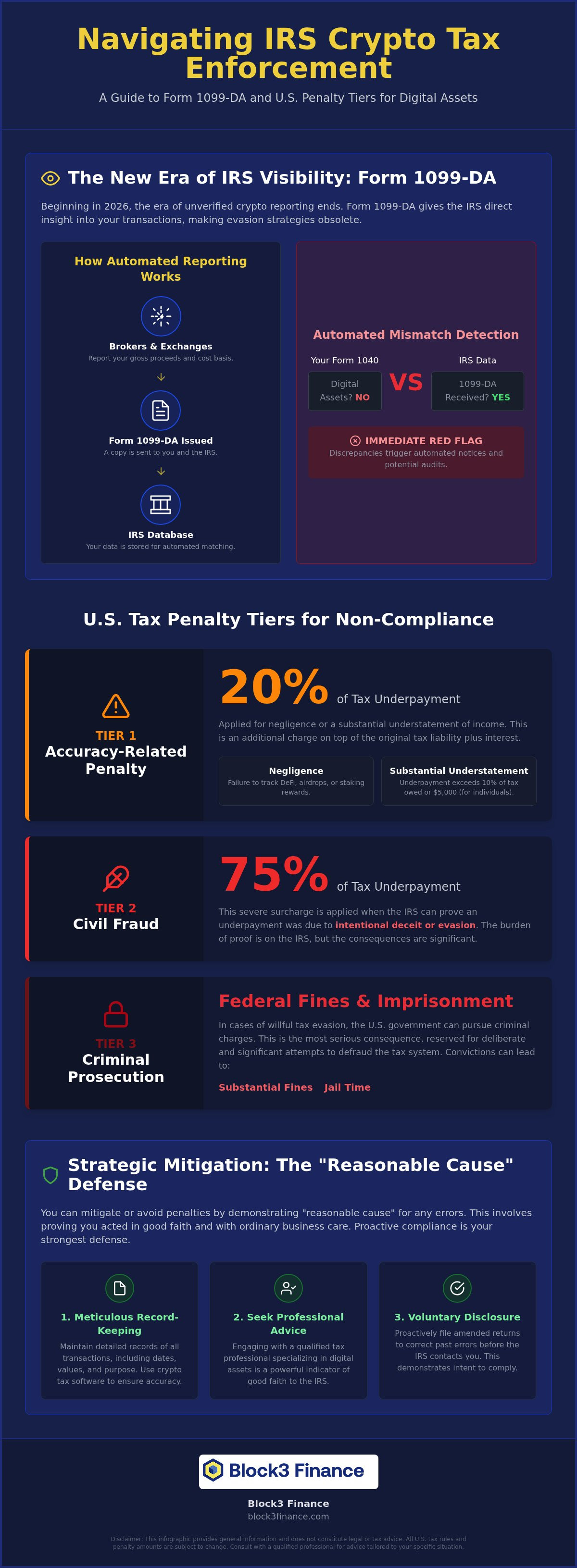
The 2026 landscape is defined by Form 1099-DA. Brokers are now required to furnish this form to report gross proceeds and, for assets acquired after January 1, 2026, the cost basis. This data goes directly to the IRS. It represents a fundamental shift from self-reporting to third-party verification for hosted wallets. You can't simply "forget" a transaction anymore. Sophisticated IRS algorithms now identify these omissions with surgical precision.
This level of oversight means that messy on-chain data is no longer an excuse. The IRS expects your tax return to match the digital breadcrumbs left at centralized exchanges. If you're concerned about discrepancies, seeking a professional IRS crypto audit defense is the strongest way to establish a "reasonable cause" argument before penalties escalate.
Automated Matching and the Digital Asset Question
Every Form 1040 now asks a direct, unavoidable question about digital asset transactions. Checking 'No' while the IRS has a 1099-DA on file from your exchange triggers an immediate red flag. This isn't a manual review process; it's an automated one. Automated matching is the IRS process of comparing tax returns against third-party data. Discrepancies are flagged instantly, often resulting in automated notices before a human auditor even looks at your file.
The IRS uses these matching systems to identify non-compliant taxpayers at scale. When the system detects a mismatch, it doesn't just ask for clarification. It often initiates a process that can lead to significant surcharges. Mastery of your financial records is the only way to navigate this environment without friction.
Tier 1 Penalties: Negligence and Accuracy-Related Fines
The first layer of financial exposure in a modern tax dispute often comes through the Accuracy-Related Penalty. This surcharge equals 20% of the total tax underpayment. It applies when the IRS determines your return contains negligence or a substantial understatement of income. Because the government treats digital assets as property, failing to adhere to IRS digital asset reporting requirements creates immediate vulnerability. This penalty isn't an alternative to paying your taxes; it's an additional cost layered on top of the original liability and accrued interest.
We view these penalties not as inevitable hurdles, but as risks that can be neutralized through strategic financial records. The IRS is no longer in an educational phase; they're in an enforcement phase. Maintaining a proactive stance is the only way to retain total command over your portfolio's growth.
Defining Negligence vs. Substantial Understatement
Negligence represents a failure to make a reasonable attempt to comply with the tax code. For crypto users, this often manifests as failing to track on-chain DeFi transactions, airdrops, or staking rewards. If you treat these as "non-events," the IRS views it as a disregard for established rules. A substantial understatement occurs when the tax shown on your return is significantly lower than the actual amount owed. For individuals, this threshold is generally the greater of 10% of the tax required to be shown or $5,000. Corporations face a different standard, typically triggered at 10% of the required tax or $10,000. In 2026, the underpayment penalty for estimated taxes has reached 8% annually, making the total cost of an IRS crypto audit finding quite high.
The Reasonable Cause Defense for Crypto Taxpayers
You don't have to accept these penalties as a foregone conclusion. The IRS allows for a "reasonable cause" defense if you can prove you acted in good faith. However, the standard for this defense has become much stricter. Claiming you didn't know crypto was taxable is no longer a valid excuse in 2026. The most robust way to demonstrate a good faith effort is by showing you relied on professional expertise. Engaging a specialized crypto tax accountant provides a defensible record of your attempt to comply with complex on-chain regulations. This proactive step can often mitigate or entirely remove accuracy-related fines. If you're currently facing scrutiny, you should consult with our team to build a defensible strategy before the audit progresses.
Tier 2 Penalties: Civil Fraud and the 75% Surcharge
While negligence carries a 20% sting, civil fraud represents a total breakdown of the relationship between the taxpayer and the government. The Civil Fraud Penalty is a 75% surcharge on the portion of the underpayment attributable to fraud. This isn't just a fine; it's a life-altering financial event. It targets those who intentionally manipulate their records to hide gains from the federal government.
Fraud requires "willfulness," which the IRS defines as a conscious and intentional violation of a known legal duty. Because the IRS has provided extensive guidance on how the IRS treats digital assets, claiming ignorance in 2026 is no longer a viable strategy. Crucially, while the standard statute of limitations for an IRS crypto audit is typically three years, there is no time limit for the IRS to assess tax and penalties in cases of civil fraud. The government can look back decades if they suspect a fraudulent return was filed.
Badges of Fraud in the Blockchain Ecosystem
The IRS looks for "badges of fraud" to build a case for intent. In the digital asset space, these indicators are increasingly technical and easy for authorities to track through on-chain forensics. These signs suggest you aren't just making a mistake; you're actively attempting to hide wealth from the U.S. Treasury. Common badges include:
- Using mixers or privacy-enhancing protocols specifically to obscure an audit trail from the IRS.
- Moving significant assets to non-KYC offshore exchanges to intentionally bypass domestic reporting requirements.
- Providing inconsistent or demonstrably false statements during an active investigation or audit.
- Maintaining two sets of books or omitting entire wallets that contain significant capital gains.
The Consequences of Willful Non-Compliance
To sustain a civil fraud penalty in court, the IRS must prove its case by "clear and convincing evidence." This is a higher burden of proof than for negligence, but the government's access to advanced blockchain analytics makes this easier than ever. A civil fraud investigation is a high-stakes environment where the outcome can escalate quickly. If an auditor detects a pattern of intentional deception, they won't just stop at a financial fine.
Many taxpayers don't realize that a civil fraud case can trigger a criminal referral to the IRS Criminal Investigation (CI) unit. This shifts the focus from your bank account to your personal liberty. Maintaining pristine blockchain financial records remains your most powerful defense. Clean, defensible books prove that your actions were transparent and professional. They effectively neutralize allegations of fraudulent intent by showing a consistent commitment to accuracy.
Criminal Tax Exposure: Federal Fines and Imprisonment
When an investigation moves beyond financial surcharges, it enters the territory of personal liberty. Criminal tax exposure represents the most severe escalation of an IRS crypto audit. While civil penalties focus on your bank account, criminal prosecution focuses on your freedom. These charges are typically reserved for large-scale, intentional efforts to defraud the government through systemic non-reporting.
Under U.S. federal law, tax evasion is a serious felony. According to 26 U.S.C. § 7201, willful evasion can result in up to five years in prison and fines of up to $100,000 for individuals. Filing a false return is a separate felony under 26 U.S.C. § 7206(1). This charge carries a penalty of up to three years in prison. We believe that understanding these stakes is the first step toward reclaiming command over your financial life.
How the IRS Criminal Investigation Division Tracks Assets
The IRS Criminal Investigation (CI) division is an elite unit that specializes in uncovering complex financial crimes. They don't just rely on the 1099-DA forms discussed earlier. They utilize advanced blockchain forensics and proprietary tools to de-anonymize transactions across the ledger. This makes the idea of "hidden" wallets a dangerous myth in 2026. The agency has successfully used "John Doe" summons to obtain massive datasets from major exchanges, identifying thousands of non-compliant users at once.
IRS CI maintains a high conviction rate for tax-related crimes. In many crypto cases, criminal charges aren't limited to tax statutes. Prosecutors often include additional counts for wire fraud or money laundering to increase the severity of the case. If your records are a mess, the government may interpret that chaos as a deliberate attempt to obscure the truth. You can protect your future by securing professional accounting services to ensure your books are clean and defensible.
The Importance of Immediate Representation
If you suspect that an audit has shifted toward a criminal investigation, you must stop all communication with the IRS immediately. Anything you say to an agent can be used as evidence in a criminal proceeding. Seeking specialized legal and accounting counsel is the only way to build a barrier between you and federal investigators. Willfulness in a criminal context is the voluntary, intentional violation of a known legal duty.
Our role is to serve as your "Visionary Navigator," helping you find the safest path through these high-stakes environments. We provide the technical rigor required to challenge the government's findings and establish a "reasonable cause" defense. Don't wait for a formal summons to protect your assets and your freedom. You should contact our team immediately if you are concerned about your criminal exposure during an audit.
Strategic Mitigation: Moving from Risk to Mastery
Proactive compliance is the only way to eliminate the risk of life-altering penalties. It's the ultimate offensive move for any serious digital asset investor. By identifying and correcting discrepancies through an amended return on Form 1040-X, you can significantly reduce your exposure to accuracy-related fines before the IRS flags your account. This process allows you to maintain total command over your financial narrative rather than reacting to a government inquiry.
Early action demonstrates a "good faith" effort to the federal government. This level of diligence is a core requirement for successful crypto audit preparation. When you choose to rectify past omissions voluntarily, you shift your status from a potential target to a disciplined professional. It's about turning a volatile landscape into a stable foundation for future growth.
The Power of the IRS Voluntary Disclosure Practice
The IRS Voluntary Disclosure Practice provides a formal path for non-compliant taxpayers to come forward. It's a strategic shield that can help you avoid criminal prosecution. This program is designed for taxpayers whose conduct was willful but who want to resolve their tax matters and stay out of prison. You must be prepared to pay the full tax amount plus accrued interest, which has reached an 8% annual rate for the 2026 tax year.
Coming forward voluntarily is only effective if your disclosure is complete and accurate. The IRS has no patience for partial truths in this program. Block3 Finance specializes in turning fragmented on-chain data into clean financial records that meet the highest federal standards. We help you present a defensible history that minimizes friction and protects your long-term interests.
Building a Defensible Audit Trail
A bulletproof 2026 filing requires more than just basic tax software. It demands technical accounting combined with expert strategic oversight. We act as your navigator in this complex environment, ensuring every transaction is documented and every cost basis is defensible. This level of preparation is your strongest defense against accuracy-related fines or fraud allegations under IRS rules. You don't have to wait for a notice to arrive to start protecting yourself.
We encourage you to contact our team for a confidential review of your current tax position. Our experts will help you identify potential red flags in your 2026 reporting and develop a plan to mitigate them. By building a robust audit trail now, you ensure that your digital asset portfolio remains an engine for wealth rather than a source of legal anxiety.
Reclaim Command Over Your Financial Evolution
The 2026 tax landscape has shifted from passive observation to active enforcement. With the IRS now possessing direct data from Form 1099-DA, the risks of non-compliance have never been higher. You've seen how penalties can escalate from a 20% accuracy charge to a 75% civil fraud surcharge, or even criminal prosecution under federal law. However, these outcomes are not inevitable for those who choose a path of transparency and technical rigor.
Clean, defensible records are your greatest asset during an IRS crypto audit. By utilizing voluntary disclosure and professional accounting, you transform vulnerability into a position of strength. As a top provider ranked by Bitcoin.com with over 13 years of blockchain financial expertise, we've helped more than 980 global clients navigate these complex waters with precision.
Don't let regulatory friction stall your portfolio's growth. You can secure your digital future with Block3 Finance crypto tax experts to ensure your filings are bulletproof. You have the power to master this landscape and move forward with total confidence in your financial legacy.
Frequently Asked Questions
Can the IRS really track my crypto transactions if I use a private wallet?
Yes, the IRS utilizes advanced blockchain analytics and "John Doe" summons to link private wallet addresses to real-world identities. While the wallet itself is pseudonymous, any interaction with a centralized exchange or regulated off-ramp creates a traceable link back to your tax ID. We help you map these interactions to ensure your on-chain activity remains transparent and defensible during a potential inquiry.
What is the penalty for accidentally forgetting to report a small crypto gain?
Forgetting even a small gain under IRS rules typically triggers the Accuracy-Related Penalty, which is 20% of the underpaid tax amount. Additionally, you'll owe an 8% annual interest rate for the 2026 tax year on that unpaid balance. While the dollar amount might be low, a pattern of omissions can lead to a broader IRS crypto audit of your entire digital asset portfolio.
How far back can the IRS audit my cryptocurrency transactions?
The IRS generally has three years from the date you file your return to initiate an audit. However, this window extends to six years if you omit more than 25% of your gross income from your filing. If the IRS suspects civil fraud or a willful attempt to evade taxes, there is no statute of limitations, allowing them to investigate your records indefinitely.
What should I do if I received an IRS notice about my crypto taxes?
You should immediately organize your transaction history and consult a specialized accountant if you receive an IRS notice. Do not ignore the correspondence, as failure to respond can lead to automated tax assessments and liens on your assets. We recommend a methodical review of your 1099-DA forms against your actual on-chain activity to identify and resolve discrepancies before the situation escalates further.
Is it possible to go to jail for crypto tax evasion?
It is possible to face imprisonment for willful tax evasion under 26 U.S.C. § 7201, which is a felony punishable by up to five years in prison. Criminal prosecution is usually reserved for cases involving intentional deception, such as hiding assets in offshore accounts or using mixers to obscure gains. Maintaining clean books is your most effective strategy for proving a lack of criminal intent.
How does the new Form 1099-DA change how the IRS finds unreported crypto?
Form 1099-DA requires brokers to report gross proceeds and cost basis directly to the IRS, creating a centralized database for automated matching. This means the IRS no longer relies solely on your self-reporting to identify taxable events. Any mismatch between your return and the 1099-DA data on file will likely trigger an immediate inquiry or a more intensive IRS crypto audit of your records.
Can I use crypto losses to offset my penalties?
No, you cannot use cryptocurrency capital losses to directly offset tax penalties or interest charges. While losses can reduce your total taxable income and capital gains liability, penalties are separate assessments based on the act of non-compliance. Realizing a loss after an audit has begun won't erase the fines associated with failing to report your previous gains accurately on your original return.
What is the difference between a tax mistake and tax evasion?
A tax mistake is generally viewed as negligence, resulting from a failure to make a reasonable attempt to comply with the law. Tax evasion, however, requires "willfulness," meaning a conscious and intentional violation of a known legal duty. The IRS distinguishes between these through "badges of fraud," such as maintaining double books or intentionally concealing wallet addresses from your professional tax preparer.

Article by
Mahad Mohamed
Mahad Mohamed is an accountant and the CEO of Block3 Finance, with over 26+ years of Canadian and international tax and accounting experience. A crypto accounting specialist since the early days of Bitcoin, he has consulted for over 38 crypto companies and collaborated with legal professionals on regulatory matters. His expertise spans corporate reorganization, cross-border tax structuring (Canada & US), tax disputes, and CRA audits.
Previously, Mahad worked for the Canada Revenue Agency (CRA), Big4 accounting firms, and served as a Rulings Officer for the Federal Tax Authority of the UAE before acquiring Tax Partners in 2014.
Block3 Finance and Tax Partners has 44 full-time accountants and over 9,800+ clients.
Disclaimer
This article provides general information only and is current as of its publication date. It has not been updated and may be out of date. It does not constitute legal advice and should not be relied upon as such. Every tax situation is unique and may differ from the examples discussed in this article. If you have specific questions, you should seek the advice of our accountants for your unique circumstances.
Frequently Asked Questions
Can the IRS really track my crypto transactions if I use a private wallet?
Yes, the IRS utilizes advanced blockchain analytics and "John Doe" summons to link private wallet addresses to real-world identities. While the wallet itself is pseudonymous, any interaction with a centralized exchange or regulated off-ramp creates a traceable link back to your tax ID. We help you map these interactions to ensure your on-chain activity remains transparent and defensible during a potential inquiry.
What is the penalty for accidentally forgetting to report a small crypto gain?
Forgetting even a small gain under IRS rules typically triggers the Accuracy-Related Penalty, which is 20% of the underpaid tax amount. Additionally, you'll owe an 8% annual interest rate for the 2026 tax year on that unpaid balance. While the dollar amount might be low, a pattern of omissions can lead to a broader IRS crypto audit of your entire digital asset portfolio.
How far back can the IRS audit my cryptocurrency transactions?
The IRS generally has three years from the date you file your return to initiate an audit. However, this window extends to six years if you omit more than 25% of your gross income from your filing. If the IRS suspects civil fraud or a willful attempt to evade taxes, there is no statute of limitations, allowing them to investigate your records indefinitely.
What should I do if I received an IRS notice about my crypto taxes?
You should immediately organize your transaction history and consult a specialized accountant if you receive an IRS notice. Do not ignore the correspondence, as failure to respond can lead to automated tax assessments and liens on your assets. We recommend a methodical review of your 1099-DA forms against your actual on-chain activity to identify and resolve discrepancies before the situation escalates further.
Is it possible to go to jail for crypto tax evasion?
It is possible to face imprisonment for willful tax evasion under 26 U.S.C. § 7201, which is a felony punishable by up to five years in prison. Criminal prosecution is usually reserved for cases involving intentional deception, such as hiding assets in offshore accounts or using mixers to obscure gains. Maintaining clean books is your most effective strategy for proving a lack of criminal intent.
How does the new Form 1099-DA change how the IRS finds unreported crypto?
Form 1099-DA requires brokers to report gross proceeds and cost basis directly to the IRS, creating a centralized database for automated matching. This means the IRS no longer relies solely on your self-reporting to identify taxable events. Any mismatch between your return and the 1099-DA data on file will likely trigger an immediate inquiry or a more intensive IRS crypto audit of your records.
Can I use crypto losses to offset my penalties?
No, you cannot use cryptocurrency capital losses to directly offset tax penalties or interest charges. While losses can reduce your total taxable income and capital gains liability, penalties are separate assessments based on the act of non-compliance. Realizing a loss after an audit has begun won't erase the fines associated with failing to report your previous gains accurately on your original return.
What is the difference between a tax mistake and tax evasion?
A tax mistake is generally viewed as negligence, resulting from a failure to make a reasonable attempt to comply with the law. Tax evasion, however, requires "willfulness," meaning a conscious and intentional violation of a known legal duty. The IRS distinguishes between these through "badges of fraud," such as maintaining double books or intentionally concealing wallet addresses from your professional tax preparer.