
The IRS isn't ignoring crypto anymore, and every founder who built their operation on informal records is about to find out the hard way. If you've been putting off the question of how to structure a crypto business, 2026 is the year that delay starts carrying a real price tag.
You already know the landscape has shifted. Regulatory scrutiny is tightening, banking relationships for crypto-native companies remain frustratingly difficult to secure, and legislation like the "One Big Beautiful Bill Act" has introduced new layers of complexity that most general accountants simply aren't equipped to untangle. The anxiety around an IRS audit isn't paranoia; it's a rational response to genuinely messy on-chain records and evolving compliance standards.
This guide cuts through that complexity. Under IRS rules applicable to US entities, you'll find a clear roadmap covering legal entity selection, tax-efficient strategies including QBI deductions and S-Corp elections, and the on-chain financial infrastructure required to keep your records audit-ready. By the end, you won't just understand your options; you'll have a defensible framework for building a Web3 enterprise that treats compliance as a competitive advantage, not a constraint.
Key Takeaways
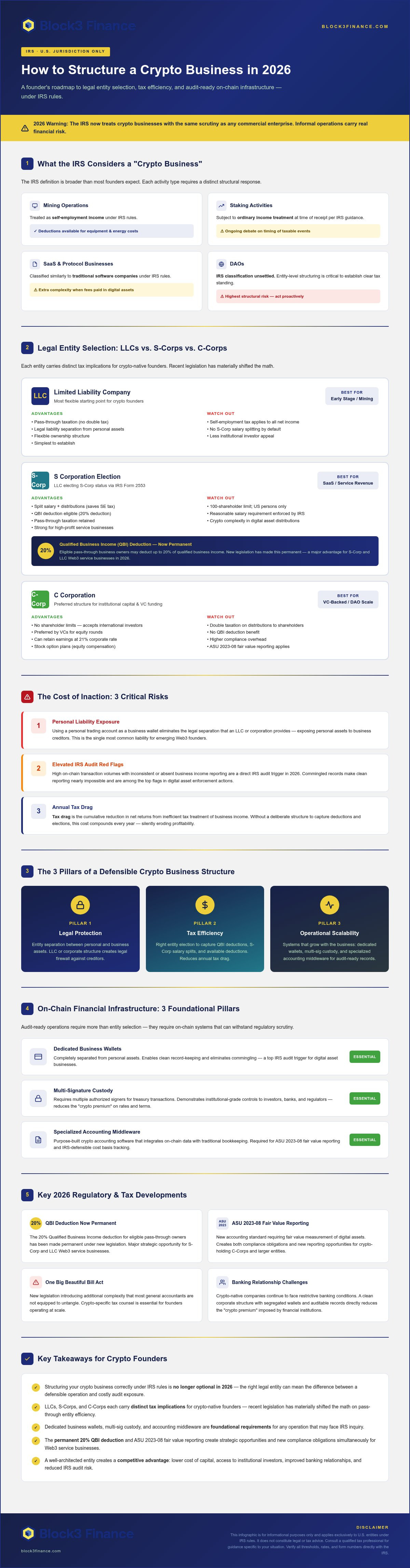
- Understanding how to structure a crypto business correctly under IRS rules is no longer optional in 2026 — the right legal entity can mean the difference between a defensible operation and a costly audit exposure.
- LLCs, S-Corps, and C-Corps each carry distinct tax implications for crypto-native founders, and recent legislation has materially shifted the math on which structure delivers the greatest efficiency for pass-through entities.
- Dedicated business wallets, multi-signature custody, and specialized accounting middleware are the foundational pillars of an on-chain financial infrastructure that can withstand regulatory scrutiny.
- The permanent 20% Qualified Business Income (QBI) deduction — a tax benefit for eligible pass-through business owners — and ASU 2023-08 fair value reporting standards create both strategic opportunities and new compliance obligations for Web3 service businesses in 2026.
- Moving from seed-stage startup to audit-ready enterprise requires a deliberate structuring strategy; the sections ahead map every critical decision point so you can build with confidence, not guesswork.
The Visionary Founder's Roadmap to Crypto Entity Structuring in 2026
The market has made its position clear: informal is finished. The founders gaining ground in 2026 aren't the ones moving fastest; they're the ones who built their operations on a defensible foundation from day one. Understanding how to structure a crypto business is no longer a back-office concern reserved for accountants. It's a front-line strategic decision that determines who gets funded, who gets banked, and who survives an IRS inquiry.
The shift from "crypto-native" to "compliant-first" isn't a retreat from innovation. It's the maturation of an industry that the IRS now treats with the same scrutiny it applies to any other commercial enterprise. Cryptocurrency, by its legal and financial characteristics under IRS guidance, generates taxable events across a wide range of activities, including mining, staking rewards, SaaS protocol fees, and DAO treasury distributions. Each of these requires a distinct structural response, not a one-size-fits-all workaround.
Before exploring entity types, it's essential to define what the IRS considers a "crypto business" in the current environment. The answer is broader than most founders expect:
- Mining operations: Treated as self-employment income under IRS rules, with specific deduction opportunities tied to equipment and energy costs.
- Staking activities: Subject to ordinary income treatment at the time of receipt, per IRS guidance, with ongoing debate around the timing of taxable events.
- SaaS and protocol businesses: Classified similarly to traditional software companies, but with additional complexity when fees are denominated in digital assets.
- DAOs (Decentralized Autonomous Organizations): An evolving area where IRS classification remains unsettled, making entity-level structuring especially critical to establish clear tax standing.
Why Structure is Your Greatest Competitive Advantage
A clean corporate structure isn't just a legal formality; it's a signal. Institutional investors and venture capital firms conduct rigorous due diligence, and a well-formed entity with clear ownership, segregated wallets, and auditable records removes the friction that kills deals at the term sheet stage. It also reduces what the industry informally calls the "crypto premium," the elevated rates and restrictive terms that banks and insurers impose on digital asset businesses they perceive as disorganized or opaque. Formalization, in practical terms, lowers your cost of capital and broadens your access to it.
Block3 Finance's corporate structuring services are built around this exact principle: that a well-architected entity creates a white-glove corporate identity that commands institutional confidence in a volatile ecosystem.
The Cost of Inaction: Personal Liability and Tax Drag
The single most common liability for emerging Web3 founders isn't a bad trade or a failed protocol. It's the personal trading account used as a business wallet. Commingling personal and business digital assets eliminates the legal separation that an LLC or corporation provides, exposing personal assets to business creditors and making clean record-keeping nearly impossible.
Informal setups also generate elevated IRS audit red flags in 2026, particularly when on-chain transaction volumes are high but corresponding business income reporting appears inconsistent or absent. Tax drag refers to the cumulative reduction in net returns caused by inefficient tax treatment of business income, a cost that compounds annually when no deliberate structure exists to capture available deductions and elections.
The three pillars of a successful structure address this directly: legal protection through entity separation, tax efficiency through the right entity election, and operational scalability through systems that grow with your business rather than against it.
Selecting the Optimal Legal Vehicle: LLCs, S-Corps, and C-Corps
Entity selection isn't a one-time administrative checkbox. It's a living strategic decision that should evolve as your revenue scales, your team grows, and your capital strategy shifts. For founders working through how to structure a crypto business under IRS rules, the choice between an LLC, S-Corp, and C-Corp carries materially different tax consequences, and the math has changed in 2026.
The "One Big Beautiful Bill Act" of 2025 made the 20% Qualified Business Income (QBI) deduction permanent for eligible pass-through entities. QBI is simply the net income flowing directly from a business to its owner's personal tax return, and this deduction allows eligible owners to exclude 20% of that income from federal taxation. That permanence removes a significant planning uncertainty that had made pass-through structures feel risky for longer-horizon businesses. It's now a durable advantage, not a temporary one.
The Crypto LLC: Flexibility for Solo Founders
A single-member LLC is taxed as a sole proprietorship by default; a multi-member LLC is taxed as a partnership. In both cases, profits pass through directly to the owner's personal return, avoiding the double taxation that applies to C-Corps. The permanent QBI deduction amplifies this advantage for qualifying service businesses, though income thresholds and business type restrictions apply, so confirming your eligibility against current IRS digital asset tax guidance is essential before relying on this deduction in your projections.
On the liability side, an LLC creates a legal boundary between your personal assets and business-level exposure. For Web3 founders running smart contract protocols or DeFi-adjacent operations, that separation isn't theoretical protection; it's a practical firewall against the unpredictable risk profile of on-chain operations.
S-Corp Elections: The Professional Trader's Choice
An LLC can elect S-Corp tax treatment without changing its legal structure. The strategic advantage is straightforward: S-Corp owners who actively work in the business must pay themselves a "reasonable salary," which is subject to payroll taxes (Social Security and Medicare). Profits distributed beyond that salary are not subject to self-employment tax.
For a Web3 developer or protocol founder generating substantial net income, this split between salary and distributions can produce meaningful payroll tax savings annually. The critical compliance requirement is that the salary must be defensible as reasonable compensation for the role. Paying yourself $1 while distributing $400,000 is an audit trigger; a well-documented salary benchmarked to market rates for your function is not.
Determining that benchmark correctly is where generalist accountants consistently fall short. Block3 Finance's corporate structuring services include customized S-Corp election support that accounts for your specific revenue profile and role, not a generic template.
When the C-Corp Becomes the Right Answer
The C-Corp structure is typically the right choice when any of the following conditions apply:
- Institutional fundraising: Venture capital firms and institutional investors almost universally require a Delaware C-Corp structure before committing capital.
- Token-based incentive programs: Issuing equity or token-based compensation to employees and advisors is significantly cleaner within a C-Corp framework.
- Exit planning: Founders anticipating an acquisition or public offering need the structural flexibility that only a C-Corp provides.
- Retained earnings strategy: C-Corps pay a flat corporate tax rate on profits retained within the entity, which can be advantageous when reinvesting heavily into infrastructure or development.
The double taxation concern with C-Corps is real but often overstated for early-stage companies that reinvest most of their earnings. The calculus shifts significantly once distributions to shareholders become a primary objective.
Knowing how to structure a crypto business means recognizing that the optimal entity today may not be optimal in 18 months. If your revenue model, funding strategy, or team structure is evolving, connect with a specialist before your current structure becomes a constraint rather than an asset.
Building a Defensible Financial Infrastructure for On-Chain Operations
Legal entity selection is only half the battle. The other half is building the operational infrastructure that makes your chosen structure defensible when the IRS comes looking. Knowing how to structure a crypto business means nothing if your on-chain records can't support the entity you've established on paper.
The four steps below form a sequential build-out. Each one addresses a specific gap that generalist accountants consistently miss.
Custody and Wallet Governance
The first step is deceptively simple: separate your business treasury from everything else. A dedicated business wallet isn't optional infrastructure; it's the foundational legal boundary that makes your LLC or S-Corp election meaningful in practice.
Hot wallets used for personal trading have no place in a corporate treasury. Enterprise-grade multi-signature custody solutions, such as Safe (formerly Gnosis Safe), distribute signing authority across multiple keyholders, eliminating the single point of failure that makes solo-key arrangements indefensible to auditors and investors alike. Internal controls should define precisely who holds signing authority, under what conditions transactions are approved, and how those approvals are documented.
This governance layer also directly supports your fiat liquidity needs. Structured on and off-ramp solutions connect your corporate treasury to banking rails cleanly, ensuring that crypto-to-fiat conversions are documented at the transaction level rather than reconstructed retroactively from exchange statements.
Creating the Audit-Ready Bookkeeping Trail
Here's the distinction that most founders miss: on-chain data is transparent, but it is not audit-ready. The IRS requires records that match specific accounting standards, including cost basis per asset lot, fair market value at the time of each transaction, and a clear reconciliation between your on-chain activity and your reported income. A block explorer shows what happened; it doesn't show what it meant for your tax position under IRS virtual currency tax guidance.
Bridging that gap requires specialized middleware. Platforms designed to ingest on-chain data and map it to traditional accounting software translate wallet activity into structured journal entries that your general ledger can actually use. Without this layer, every crypto-to-fiat transaction becomes a manual reconciliation exercise, and at volume, that's unsustainable.
Monthly reconciliation is non-negotiable. Waiting until year-end to reconstruct six months of DeFi interactions or NFT sales creates compounding errors that are expensive to unwind and damaging to audit credibility. For high-volume operations, a dedicated sub-ledger system that tracks each asset position separately is the only architecture that scales without breaking.
Block3 Finance's monthly accounting services are built specifically for this environment, providing the reconciliation cadence and on-chain data integration that US-based crypto businesses need to maintain audit-ready books under IRS rules. For founders who want to explore what a full financial infrastructure review looks like for their operation, the compliance checklist is a practical starting point.
Maximizing Tax Efficiency Under the Latest IRS Frameworks
Entity structure creates the legal container. Tax strategy determines how much you actually keep. For founders who've already worked through how to structure a crypto business, the next discipline is extracting every legitimate efficiency that current IRS frameworks permit, because leaving deductions unclaimed is just a slower form of overpaying.
The permanent 20% QBI deduction, solidified under the "One Big Beautiful Bill Act," is the most consequential planning tool available to pass-through crypto businesses in 2026. But eligibility isn't automatic. The IRS applies income thresholds and business classification tests that can disqualify certain service-based operations, particularly those categorized as Specified Service Trades or Businesses (SSTBs). Confirm your classification against current IRS guidance before building this deduction into your financial projections.
Beyond QBI, three income categories demand specific handling under IRS rules:
- Mining rewards: Treated as ordinary income at fair market value on the date of receipt. Equipment depreciation and energy costs are deductible business expenses, but the deduction strategy depends on whether mining is conducted as a trade or business versus a passive activity.
- Staking yields and airdrops: The IRS treats both as ordinary income at receipt. The timing of that taxable event remains an area of active legal debate, so documenting the date and fair market value of every receipt is essential to defend your position under audit.
- Gas fees and protocol costs: These are legitimate business expenses when incurred in the ordinary course of operations. Proper categorization in your general ledger, not a retroactive lump-sum estimate, is what makes them defensible.
Hardware, software subscriptions, and research costs related to blockchain development are also deductible when properly documented. The IRS expects contemporaneous records, meaning records created at the time of the expense, not reconstructed at year-end.
ASU 2023-08: The New Standard for Crypto Accounting
Before 2024, US companies holding digital assets were required to treat them as indefinite-lived intangible assets, recording impairment losses when values dropped but never marking them up when prices recovered. ASU 2023-08 replaced that approach with fair value measurement, requiring companies to report crypto holdings at current market value each reporting period.
The practical effect is significant. Corporate balance sheets now reflect real-time asset values rather than a perpetually impaired floor, which produces more accurate earnings reports and removes the asymmetric accounting treatment that made crypto holdings look worse on paper than they actually were. For businesses seeking institutional investment or credit facilities, this is a material improvement in financial presentation.
The compliance obligation is equally real. Fair value measurement requires a defensible valuation methodology, consistent application across reporting periods, and proper disclosure. Block3 Finance's detailed guide on ASU 2023-08 and crypto revenue recognition covers the full technical requirements for US entities navigating this standard in 2026.
Advanced Strategies: R&D Credits and International Exposure
Blockchain protocol development frequently qualifies for the federal Research and Development (R&D) tax credit under IRC Section 41, provided the work meets the four-part test: it must be technological in nature, intended to discover new information, involve experimentation, and relate to a qualified purpose. Founders building novel smart contract architecture or consensus mechanisms should evaluate this credit with a qualified specialist, as the documentation requirements are rigorous but the credit itself can be substantial.
International exposure adds another compliance layer. US persons with signature authority over foreign crypto accounts or custodial arrangements may face FBAR (FinCEN Form 114) and Form 8938 reporting obligations. Thresholds and definitions vary, so confirm your specific reporting requirements with a tax professional rather than relying on general summaries.
For founders who want professional support across filing, compliance, and strategic planning, Block3 Finance's tax filing and reporting services are built specifically for the complexity that crypto-native businesses face under IRS rules. Speak with a specialist to map your current tax position against the frameworks covered here.
Executing Your Vision: Strategic Corporate Structuring with Block3 Finance
Every framework covered in this guide, from entity selection to on-chain bookkeeping to QBI optimization, requires one thing to function: precise, specialized execution. Knowing how to structure a crypto business is the first step. Having a partner who's navigated that terrain for 980+ global clients across 13+ years of blockchain financial practice is what converts strategy into a defensible, scalable operation.
Block3 Finance occupies a specific position in the digital asset ecosystem. It's not a generalist accounting firm that added a crypto practice. It's a purpose-built financial infrastructure partner, recognized by Bitcoin.com as a top-ranked resource for crypto taxation, that treats compliance as the foundation of competitive advantage rather than an obstacle to it.
The founders who arrive at Block3 typically share a common profile: they've moved fast, built something real, and now face a structural gap between where their operation is and where institutional investors, banking partners, or IRS scrutiny requires it to be. Closing that gap isn't a single transaction. It's a sequenced build-out, and the Block3 executive team architects that build-out from the first conversation forward.
Fractional CFO Services for Scaling Firms
Scaling past the seed stage introduces financial complexity that most founding teams aren't equipped to manage internally. Treasury management, runway modeling, investor reporting, and Series A preparation each demand CFO-level oversight that a part-time bookkeeper simply can't provide.
Block3's CFO services deliver that oversight on a fractional basis, meaning you access senior financial leadership calibrated to your current stage without the overhead of a full-time hire. The practical output includes defensible financial records that satisfy institutional due diligence, treasury strategies that account for digital asset volatility, and reporting frameworks that make your next funding round a structured process rather than a scramble.
For Web3 companies preparing for Series A or B rounds, this is the difference between a term sheet and a passed deal.
Start Your Mastery Journey Today
Block3's onboarding process is structured around your current reality, not a generic template. It typically begins with a wallet and entity audit that surfaces the specific gaps between your existing setup and a fully defensible structure. From there, the path forward includes entity formation or restructuring, accounting system integration, and ongoing compliance support aligned to IRS rules for US entities.
The goal isn't just to get you compliant. It's to position your operation so that regulatory scrutiny becomes a non-event rather than an existential risk.
If you're ready to move from informal to institutional, the next step is straightforward. Schedule a consultation with Block3 Finance and let the executive team map a structuring strategy built specifically for your operation, your revenue model, and your growth horizon.
Your Next Move Defines the Next Chapter
The decisions covered in this guide don't exist in isolation. Entity selection, on-chain governance, QBI optimization, and ASU 2023-08 compliance are interconnected disciplines, and a gap in any one of them creates exposure across all the others.
Knowing how to structure a crypto business correctly in 2026 is no longer a differentiator reserved for the largest operations. It's the baseline that institutional investors, banking partners, and the IRS now expect from every serious Web3 enterprise, regardless of size or stage.
Block3 Finance has guided 980+ global clients through exactly this terrain, backed by 13+ years of blockchain financial expertise and a top ranking from Bitcoin.com. That depth of experience translates directly into structuring strategies that hold up under scrutiny, not just on paper.
The gap between where your operation is today and where it needs to be is closeable. The founders who act now build from a position of strength; the ones who wait inherit compounding complexity.
Connect with the Block3 Finance team and take the first step toward a structure that's built to last.
Frequently Asked Questions About How to Structure a Crypto Business
Do I need an LLC to trade cryptocurrency in the US?
You don't legally need an LLC to trade cryptocurrency in the US, but trading without one means all activity flows directly to your personal tax return with no liability separation. If your trading volume is high or you're conducting any business-related activity alongside personal trades, the absence of a formal entity creates both legal exposure and record-keeping complexity that becomes harder to unwind the longer it continues.
The more relevant question is whether your activity qualifies as a trade or business under IRS standards, since that classification determines which deductions are available to you. A tax professional familiar with IRS digital asset guidance can assess your specific activity pattern and recommend whether an LLC or another structure is appropriate for your situation.
What is the best business structure for a crypto startup in 2026?
There's no single best answer, because the optimal structure depends on your revenue model, funding strategy, and team composition. For solo founders building a service-based Web3 business, an LLC with an S-Corp election frequently delivers the most efficient tax treatment. Startups pursuing institutional venture capital or planning token-based compensation programs almost always require a Delaware C-Corp before serious conversations with investors can begin.
Knowing how to structure a crypto business correctly means treating entity selection as a strategic decision, not an administrative formality. The structure that fits your operation today may not serve you in 18 months, so building in flexibility and reviewing your setup annually with a specialist is a sound practice.
How does the S-Corp election save on crypto taxes?
An S-Corp election allows a business owner to split their income into two categories: a reasonable salary, which is subject to payroll taxes, and profit distributions, which are not. For a Web3 developer or protocol founder generating substantial net income, the distributions above the salary threshold avoid Social Security and Medicare taxes entirely, which can produce meaningful annual savings depending on your net income level.
The compliance requirement is strict: the salary must be defensible as reasonable compensation for your actual role in the business. Underpaying yourself to maximize distributions is a well-known IRS audit trigger. A properly benchmarked salary, documented against market rates for your function, is what makes the election durable rather than a liability.
What is the QBI deduction for crypto business owners?
The Qualified Business Income (QBI) deduction allows eligible owners of pass-through entities, such as LLCs and S-Corps, to deduct up to 20% of their qualified business income from their federal taxable income. The "One Big Beautiful Bill Act" made this deduction permanent, removing the planning uncertainty that previously made it difficult to rely on for longer-horizon businesses.
Eligibility isn't automatic. The IRS applies income thresholds and business classification tests, and certain service-based businesses categorized as Specified Service Trades or Businesses may be partially or fully excluded from the deduction above specific income levels. Confirm your eligibility against current IRS guidance before incorporating this deduction into your financial projections.
Can a crypto business deduct gas fees as a business expense?
Yes, gas fees incurred in the ordinary course of business operations are deductible as business expenses under IRS rules, provided they're properly categorized in your general ledger at the time they occur. The IRS expects contemporaneous records, meaning documentation created when the expense happens, not a retroactive estimate assembled at year-end.
The practical challenge is that gas fees accumulate across hundreds or thousands of transactions in active DeFi or protocol operations. Specialized accounting middleware that ingests on-chain data and maps each fee to a corresponding journal entry is the only architecture that makes this deduction defensible at volume without creating a manual reconciliation burden.
How do I pay employees in crypto legally in the US?
US employers can pay employees in cryptocurrency, but the IRS treats crypto wages identically to cash wages for payroll tax purposes. The fair market value of the digital asset on the date of payment must be used to calculate withholding for federal income tax, Social Security, and Medicare. Employers are still required to issue W-2s reflecting those dollar-equivalent amounts and remit payroll taxes on schedule.
The administrative complexity is meaningful: you need a reliable methodology for determining fair market value at each pay date, a process for withholding and remitting taxes in fiat, and payroll records that reconcile crypto amounts to their dollar equivalents. Working with an accountant experienced in digital asset payroll compliance is strongly advisable before implementing a crypto compensation program.
What are the IRS reporting requirements for a crypto DAO?
DAO classification under IRS rules remains an unsettled area, which makes entity-level structuring especially critical for founders operating in this space. Without a formal legal entity, a DAO may be treated as a general partnership by default, exposing all members to joint liability and pass-through tax obligations without the protections that a properly formed structure provides.
At minimum, DAOs with US-based members or treasury activity should document all distributions, establish a defensible cost basis for assets held in the treasury, and ensure that any income flowing to US persons is reported on their individual returns. Given the evolving nature of IRS guidance on DAOs, consulting a specialist rather than relying on general summaries is the appropriate standard of care here.
How does ASU 2023-08 affect my crypto business taxes?
ASU 2023-08 is an accounting standard, not a tax rule, so it doesn't directly change your IRS tax liability. What it does change is how digital assets appear on your financial statements: companies now report crypto holdings at fair market value each reporting period rather than at a perpetually impaired historical cost. This produces more accurate balance sheets and removes the asymmetric treatment that previously made crypto holdings look worse on paper than their actual market value.
The indirect tax implications are real, though. Fair value reporting requires a consistent, documented valuation methodology, and the resulting financial statements are what institutional investors, lenders, and auditors will scrutinize. Ensuring your accounting systems can support ASU 2023-08 compliance while maintaining the separate cost basis tracking the IRS requires is a dual obligation that demands specialized infrastructure, not a general-purpose accounting platform.

Article by
Mahad Mohamed
Mahad Mohamed is an accountant and the CEO of Block3 Finance, with over 26+ years of Canadian and international tax and accounting experience. A crypto accounting specialist since the early days of Bitcoin, he has consulted for over 38 crypto companies and collaborated with legal professionals on regulatory matters. His expertise spans corporate reorganization, cross-border tax structuring (Canada & US), tax disputes, and CRA audits.
Previously, Mahad worked for the Canada Revenue Agency (CRA), Big4 accounting firms, and served as a Rulings Officer for the Federal Tax Authority of the UAE before acquiring Tax Partners in 2014.
Block3 Finance and Tax Partners has 44 full-time accountants and over 9,800+ clients.
Disclaimer
This article provides general information only and is current as of its publication date. It has not been updated and may be out of date. It does not constitute legal advice and should not be relied upon as such. Every tax situation is unique and may differ from the examples discussed in this article. If you have specific questions, you should seek the advice of our accountants for your unique circumstances.
Frequently Asked Questions
Do I need an LLC to trade cryptocurrency in the US?
You don't legally need an LLC to trade cryptocurrency in the US, but trading without one means all activity flows directly to your personal tax return with no liability separation. If your trading volume is high or you're conducting any business-related activity alongside personal trades, the absence of a formal entity creates both legal exposure and record-keeping complexity that becomes harder to unwind the longer it continues. The more relevant question is whether your activity qualifies as a trade or business under IRS standards, since that classification determines which deductions are available to you. A tax professional familiar with IRS digital asset guidance can assess your specific activity pattern and recommend whether an LLC or another structure is appropriate for your situation.
What is the best business structure for a crypto startup in 2026?
There's no single best answer, because the optimal structure depends on your revenue model, funding strategy, and team composition. For solo founders building a service-based Web3 business, an LLC with an S-Corp election frequently delivers the most efficient tax treatment. Startups pursuing institutional venture capital or planning token-based compensation programs almost always require a Delaware C-Corp before serious conversations with investors can begin. Knowing how to structure a crypto business correctly means treating entity selection as a strategic decision, not an administrative formality. The structure that fits your operation today may not serve you in 18 months, so building in flexibility and reviewing your setup annually with a specialist is a sound practice.
How does the S-Corp election save on crypto taxes?
An S-Corp election allows a business owner to split their income into two categories: a reasonable salary, which is subject to payroll taxes, and profit distributions, which are not. For a Web3 developer or protocol founder generating substantial net income, the distributions above the salary threshold avoid Social Security and Medicare taxes entirely, which can produce meaningful annual savings depending on your net income level. The compliance requirement is strict: the salary must be defensible as reasonable compensation for your actual role in the business. Underpaying yourself to maximize distributions is a well-known IRS audit trigger. A properly benchmarked salary, documented against market rates for your function, is what makes the election durable rather than a liability.
What is the QBI deduction for crypto business owners?
The Qualified Business Income (QBI) deduction allows eligible owners of pass-through entities, such as LLCs and S-Corps, to deduct up to 20% of their qualified business income from their federal taxable income. The "One Big Beautiful Bill Act" made this deduction permanent, removing the planning uncertainty that previously made it difficult to rely on for longer-horizon businesses. Eligibility isn't automatic. The IRS applies income thresholds and business classification tests, and certain service-based businesses categorized as Specified Service Trades or Businesses may be partially or fully excluded from the deduction above specific income levels. Confirm your eligibility against current IRS guidance before incorporating this deduction into your financial projections.
Can a crypto business deduct gas fees as a business expense?
Yes, gas fees incurred in the ordinary course of business operations are deductible as business expenses under IRS rules, provided they're properly categorized in your general ledger at the time they occur. The IRS expects contemporaneous records, meaning documentation created when the expense happens, not a retroactive estimate assembled at year-end. The practical challenge is that gas fees accumulate across hundreds or thousands of transactions in active DeFi or protocol operations. Specialized accounting middleware that ingests on-chain data and maps each fee to a corresponding journal entry is the only architecture that makes this deduction defensible at volume without creating a manual reconciliation burden.
How do I pay employees in crypto legally in the US?
US employers can pay employees in cryptocurrency, but the IRS treats crypto wages identically to cash wages for payroll tax purposes. The fair market value of the digital asset on the date of payment must be used to calculate withholding for federal income tax, Social Security, and Medicare. Employers are still required to issue W-2s reflecting those dollar-equivalent amounts and remit payroll taxes on schedule. The administrative complexity is meaningful: you need a reliable methodology for determining fair market value at each pay date, a process for withholding and remitting taxes in fiat, and payroll records that reconcile crypto amounts to their dollar equivalents. Working with an accountant experienced in digital asset payroll compliance is strongly advisable before implementing a crypto compensation program.
What are the IRS reporting requirements for a crypto DAO?
DAO classification under IRS rules remains an unsettled area, which makes entity-level structuring especially critical for founders operating in this space. Without a formal legal entity, a DAO may be treated as a general partnership by default, exposing all members to joint liability and pass-through tax obligations without the protections that a properly formed structure provides. At minimum, DAOs with US-based members or treasury activity should document all distributions, establish a defensible cost basis for assets held in the treasury, and ensure that any income flowing to US persons is reported on their individual returns. Given the evolving nature of IRS guidance on DAOs, consulting a specialist rather than relying on general summaries is the appropriate standard of care here.
How does ASU 2023-08 affect my crypto business taxes?
ASU 2023-08 is an accounting standard, not a tax rule, so it doesn't directly change your IRS tax liability. What it does change is how digital assets appear on your financial statements: companies now report crypto holdings at fair market value each reporting period rather than at a perpetually impaired historical cost. This produces more accurate balance sheets and removes the asymmetric treatment that previously made crypto holdings look worse on paper than their actual market value. The indirect tax implications are real, though. Fair value reporting requires a consistent, documented valuation methodology, and the resulting financial statements are what institutional investors, lenders, and auditors will scrutinize. Ensuring your accounting systems can support ASU 2023-08 compliance while maintaining the separate cost basis tracking the IRS requires is a dual obligation that demands specialized infrastructure, not a general-purpose accounting platform.